


111,99 €
Mehr erfahren.
- Herausgeber: John Wiley & Sons
- Kategorie: Wissenschaft und neue Technologien
- Serie: Wiley - IEEE
- Sprache: Englisch
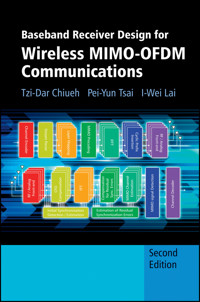
The Second Edition of OFDM Baseband Receiver Design for Wirless Communications, this book expands on the earlier edition with enhanced coverage of MIMO techniques, additional baseband algorithms, and more IC design examples. The authors cover the full range of OFDM technology, from theories and algorithms to architectures and circuits.
The book gives a concise yet comprehensive look at digital communication fundamentals before explaining signal processing algorithms in receivers. The authors give detailed treatment of hardware issues - from architecture to IC implementation.
- Links OFDM and MIMO theory with hardware implementation
- Enables the reader to transfer communication received concepts into hardware; design wireless receivers with acceptable implemntation loss; achieve low-power designs
- Covers the latest standards, such as DVB-T2, WiMax, LTE and LTE-A
- Includes more baseband algorithms, like soft-decoding algorithms such as BCJR and SOVA
- Expanded treatment of channel models, detection algorithms and MIMO techniques
- Features concrete design examples of WiMAX systems and cognitive radio apllications
- Companion website with lecture slides for instructors
Based on materials developed for a course in digital communication IC design, this book is ideal for graduate students and researchers in VLSI design, wireless communications, and communications signal processing. Practicing engineers working on algorithms or hardware for wireless communications devices will also find this to be a key reference.
Sie lesen das E-Book in den Legimi-Apps auf:
Seitenzahl: 517
Veröffentlichungsjahr: 2012
Ähnliche



















Contents
Cover
Title Page
Copyright
Dedication
Preface
About the Authors
Acknowledgements
List of Abbreviations and Acronyms
Part One: Fundamentals of Wireless Communication
Chapter 1: Introduction
1.1 Digital Broadcasting Systems
1.2 Mobile Cellular Systems
1.3 Wireless Network Systems
Summary
References
Chapter 2: Digital Modulation
2.1 Single-Carrier Modulation
2.2 Multi-Carrier Modulation
2.3 Adaptive OFDM
Summary
References
Chapter 3: Advanced Wireless Technology
3.1 Multiple-Input Multiple-Output (MIMO)
3.2 Multiple Access
3.3 Spread Spectrum and CDMA
Summary
References
Chapter 4: Error-Correcting Codes
4.1 Introduction
4.2 Block Codes
4.3 Reed–Solomon Codes
4.4 Convolutional Codes
4.5 Soft-Input Soft-Output Decoding Algorithms
4.6 Turbo Codes
4.7 Low-Density Parity-Check Codes
Summary
References
Chapter 5: Signal Propagation and Channel Model
5.1 Introduction
5.2 Wireless Channel Propagation
5.3 Front-End Electronics Effects
5.4 Channel Model
Summary
References
Part Two: MIMO-OFDM Receiver Processing
Chapter 6: Synchronization
6.1 Introduction
6.2 Synchronization Issues
6.3 Detection and Estimation of Synchronization Errors
6.4 Detection and Estimation of Synchronization Errors in MIMO-OFDM Systems
6.5 Recovery of Synchronization Errors
Summary
References
Chapter 7: Channel Estimation and Equalization
7.1 Introduction
7.2 Pilot Pattern
7.3 SISO-OFDM Channel Estimation
7.4 MIMO-OFDM Channel Estimation
7.5 Adaptive Channel Estimation
7.6 Equalization
7.7 Iterative Receiver
Summary
References
Chapter 8: MIMO Detection
8.1 Introduction
8.2 Linear Detection
8.3 MIMO Detection with Channel Preprocessing
8.4 Sphere Decoder
8.5 Soft-Output Sphere Decoder
8.6 Iterative MIMO Detection
8.7 Precoding
8.8 Space Block Code
Summary
References
Part Three: Hardware Design for MIMO-OFDM Receivers
Chapter 9: Circuit Techniques
9.1 Introduction
9.2 Fast Fourier Transform Modules
9.3 Delay Buffer
9.4 Circuits for Rectangular-to-Polar Conversion
9.5 Circuits for Polar-to-Rectangular Conversion
Summary
References
Chapter 10: MIMO IC Design Examples
10.1 Introduction
10.2 QR Decomposition IC
10.3 8 × 8 Soft-Output Sphere Decoder
Summary
References
Chapter 11: Mobile MIMO WiMAX System-on-Chip Design
11.1 Introduction of WiMAX Standard
11.2 Mobile WiMAX OFDMA and Frame Structure
11.3 WiMAX Baseband Receiver Design
11.4 WiMAX Media Access Control (MAC) Design
11.5 Implementation and Field Trial of the WiMAX SoC
Summary
References
Index
This edition first published 2012
© 2012 John Wiley & Sons Singapore Pte. Ltd.
Registered office
John Wiley & Sons Singapore Pte. Ltd., 1 Fusionopolis Walk, #07-01 Solaris South Tower, Singapore 138628
For details of our global editorial offices, for customer services and for information about how to apply for permission to reuse the copyright material in this book please see our website at www.wiley.com.
All Rights Reserved. No part of this publication may be reproduced, stored in a retrieval system or transmitted, in any form or by any means, electronic, mechanical, photocopying, recording, scanning, or otherwise, except as expressly permitted by law, without either the prior written permission of the Publisher, or authorization through payment of the appropriate photocopy fee to the Copyright Clearance Center. Requests for permission should be addressed to the Publisher, John Wiley & Sons Singapore Pte. Ltd., 1 Fusionopolis Walk, #07-01 Solaris South Tower, Singapore 138628, tel: 65-66438000, fax: 65-66438008, email: [email protected].
Wiley also publishes its books in a variety of electronic formats. Some content that appears in print may not be available in electronic books.
Designations used by companies to distinguish their products are often claimed as trademarks. All brand names and product names used in this book are trade names, service marks, trademarks or registered trademarks of their respective owners. The Publisher is not associated with any product or vendor mentioned in this book. This publication is designed to provide accurate and authoritative information in regard to the subject matter covered. It is sold on the understanding that the Publisher is not engaged in rendering professional services. If professional advice or other expert assistance is required, the services of a competent professional should be sought.
Library of Congress Cataloging-in-Publication Data
Chiueh, Tzi-Dar, 1960-
Baseband receiver design for wireless MIMO-OFDM communications / Tzi-Dar Chiueh, Pei-Yun Tsai, I-Wei Lai. –2nd ed.
p. cm.
Rev. ed. of: OFDM baseband receiver design for wireless communications / Tzi-Dar Chiueh, Pei-Yun Tsai. c2007.
Includes bibliographical references and index.
ISBN 978-1-118-18818-7 (cloth)
1. Radio–Transmitter-receivers. 2. Wireless communication systems–Equipment and supplies. 3. Orthogonal frequency division multiplexing. 4. MIMO systems. I. Chiueh, Tzi-Dar. II. Tsai, Pei-Yun. III. Lai, I-Wei, 1960-OFDM baseband receiver design for wireless communications. IV. Title.
TK5103.2.C4657 2012
621.384'18–dc23
2012000095
To my Dad Chin-Mu, my wife Jill, my daughter Joanne, and my son Kevin.
— Tzi-Dar Chiueh
To my families for their constant encouragement and support.
— Pei-Yun Tsai
To my dear parents, Yun-Tai and Hui-Chin, and my lovely sisters.
— I-Wei Lai
Preface
Orthogonal frequency-division multiplexing (OFDM) has become the favorite modulation technology for wireless communication systems. To address the needs of OFDM receiver design, we wrote the first edition of this book in 2007. Recently, wireless communication technology has progressed at a very fast pace, specifically the multiple-input multiple-output (MIMO) techniques that have brought wireless communications to a new era. MIMO enables higher throughput, larger cell coverage, and better quality of services (QoS). However, MIMO techniques entail high complexity in baseband transceiver design. In light of these changes, this second edition aims to present to readers important issues and techniques in MIMO-OFDM systems. Like the first edition, this book is ideal for advanced undergraduate and postgraduate students from either very-large-scale integration (VLSI) design or signal-processing backgrounds. For engineers working on algorithms or hardware for wireless communications systems, this book provides a comprehensive understanding of the state-of-the-art MIMO-OFDM design technology and will be a valuable reference.
The topics in this book include the theories, algorithms, architectures, and circuits of MIMO-OFDM wireless communication systems. Ideas behind formulas, rather than mathematical derivations, are emphasized and several examples are provided to allow easy comprehension of the concepts. One special feature lies in the last three chapters, from which our readers can learn how to develop signal-processing algorithms oriented toward hardware implementation and how to design integrated circuits (ICs) for wireless MIMO-OFDM systems. These techniques are illustrated through design examples dealing with two MIMO modules, QR decomposition and soft-output sphere decoding, which are both crucial MIMO modules that attract much attention. Last but not least, the book provides a complete system-on-chip (SoC) example that describes a MIMO-OFDM baseband modem for the IEEE 802.16e WiMAX standard.
This book is organized into three parts. The first part reviews background knowledge which includes the fundamentals of modulation schemes, MIMO and multiple-access technology, error-correcting codes, signal propagation, and channel modeling. In the second part, an in-depth treatment of two essential signal-processing tasks in MIMO-OFDM receivers, synchronization and channel estimation, is first introduced. Then, MIMO techniques, categorized as spatial multiplexing, precoding, and spatial diversity are also outlined. This part of the book will present readers with modern signal-processing algorithms in MIMO-OFDM baseband receivers. The third part of this book deals with hardware design-related issues. Essential blocks and important modules for OFDM and MIMO receivers are first presented. Finally, the book ends with a MIMO-OFDM SoC example that covers many topics in MIMO-OFDM baseband receiver development. The following gives a more detailed description of the content in each chapter.
Chapter 1 introduces several important wireless communication standards and their evolutions, including digital broadcasting systems, mobile cellular systems, and wireless data network systems. Without any exception, OFDM or MIMO-OFDM is adopted in those standards, exemplifying the importance of OFDM and MIMO technology in wireless communications.
Chapter 2 discusses digital modulation techniques, including both single-carrier modulation and multi-carrier modulation. The introduction to conventional single-carrier modulation techniques serves as the basis for explaining the multi-carrier OFDM modulation. Basic OFDM processing operations, such as discrete Fourier transform (DFT) and inverse discrete Fourier transform (IDFT), guard interval insertion, guard band reservation, and spectrum shaping, are addressed. The phenomenon of high peak-to-average power ratios in OFDM modulation signals is also illustrated. Finally, adaptive OFDM, which emerges as a promising solution to improve spectral efficiency and energy efficiency, is introduced.
Chapter 3 illustrates advanced wireless technology. First, the basic concepts of MIMO techniques and their advantages are provided. Multiple-access schemes, namely mechanisms to support a number of users in the same communication link, are then discussed. In addition, spread spectrum techniques, from which code-division multiple access (CDMA) is derived, are illustrated. In that section, several important codes popularly used in CDMA as well as spread spectrum systems are also presented.
In Chapter 4, error-correcting codes, indispensable in digital communication systems, are introduced. Several prevailing error-correcting codes and their decoding strategies are covered. They include block codes, convolutional codes, and Reed–Solomon codes. Another category of soft-input soft-output iterative decoding strategies is also discussed, where the soft information such as probability or log likelihood ratio (LLR) of bit values is exchanged and updated in every iteration. Two famous codes belonging to this category are turbo codes and low-density parity-check (LDPC) codes. Both play an important role in advanced wireless communication systems.
Wireless receiver design is impossible without a thorough understanding of the impairments to signals during propagation. Chapter 5 discusses propagation mechanisms, fading phenomena, and other non-ideal effects in the channel and transceiver front-ends. Passing through a wireless channel, communication signals suffer from path loss and shading effects, which prominently weaken the received signal strength. In addition, delay spread, Doppler spread, and angle spread in the signal are possible, and they produce signal replicas with different arrival times, distorted spectra, and incident angles. As a result, frequency selectivity, time selectivity, and spatial selectivity are generated. Front-end electronic non-ideality must also be taken into consideration when designing wireless receivers. Oscillator mismatch as well as relative motion between the transmitter and the receiver cause carrier frequency offset and sampling clock offset. Unmatched branches in the up-/down-conversion path may result in IQ imbalance and DC offset. Power amplifiers with limited linear range are another source of amplitude and phase distortion. In Chapter 5, details about all of the above will be presented.
Synchronization is one of the critical issues in all communication systems, wired and wireless alike. Algorithms for synchronizing the phase and frequency of the carrier signal as well as the sampling clock signal in single-input single-output (SISO) and MIMO-OFDM receivers are the main topic of Chapter 6. The chapter starts with descriptions of carrier frequency offset, carrier phase error, sampling clock offset, symbol timing offset, and IQ imbalance and their impacts on the received SISO-and MIMO-OFDM signals. For each synchronization error, several estimation algorithms are presented, along with a performance comparison. Then time-domain and frequency-domain compensation approaches are introduced. Their pros and cons are also given to help designers make knowledgeable and appropriate decisions for their designs.
Chapter 7 concentrates on the channel estimation tasks in SISO-and MIMO-OFDM receivers. To perform channel estimation, a receiver often relies on some reference signals, for example, the preamble and the pilot signals. As a result, channel estimation algorithms are categorized according to the available reference signal pattern. Channel statistics and characteristics of channel power-delay profiles can also be exploited to obtain better estimation results. Though one prominent advantage of OFDM lies in its simple yet effective one-tap equalization, more and more sophisticated equalization techniques that can further improve system performance are investigated and illustrated. We also discuss multi-tap equalizers in OFDM receivers, as they are needed due to inter-carrier interferences caused by mobile channels or imperfect synchronization.
MIMO configurations continue to show promising results in enhancing communication performance in regard to transmission efficiency and QoS. Hence, Chapter 8 focuses on the kernel of MIMO techniques, namely MIMO signal detection. We introduce quite a few MIMO detection techniques that have been developed for the spatial multiplexing scheme in the past. They include linear detection, successive interference cancellation, sphere decoding, and so on. With complete or partial channel state information fed back to the transmitter, the MIMO precoding techniques can help to decompose the convoluted spatial channel into parallel and independent subchannels, thus easing the detector design at the receiver. For space–time block codes, the maximum likelihood detection is practicable and feasible due to its orthogonality property.
Chapter 9 illustrates architectures and circuits that are widely used in OFDM systems, including fast Fourier transform (FFT) processors, delay buffers, and circuits for rectangular-to-polar conversion and polar-to-rectangular conversion. A couple of hardware-oriented FFT algorithms are first introduced, followed by several FFT architectures. Pipelined architectures can perform FFT at sample rate, though consuming more hardware resources. On the other hand, memory-based architectures are area-efficient, but may require higher clock rate and complicated control in memory addressing. A delay buffer can be efficiently implemented in shift registers or SRAMs depending on its length. The chapter also presents several circuits for rectangular-to-polar conversion, which are needed when the phase or magnitude of a complex value is desired. Furthermore, circuits for polar-to-rectangular conversion, needed to generate sinusoidal waveforms, are also introduced at the end of this chapter.
In Chapter 10, two essential hardware designs associated with high-throughput MIMO detection are provided. First, a QR decomposition module that offers the capability of either channel preprocessing or linear MIMO detection is illustrated. The algorithmic complexity to perform QR decomposition is first discussed. Then, the design concept of streaming coordinate rotation digital computer (CORDIC) architecture that combines a complex Givens rotation stage and a real Givens rotation stage is explained. The second example is a soft-output MIMO detector supporting antenna configuration from 2 × 2 to 8 × 8. We will show the endeavor of mapping from the newly proposed modified best-first with fast descent (MBF-FD) MIMO detection algorithm to the circuit design ideas including the pipelined quad-dual-heap (quad-DEAP) architecture and the tabular enumeration scheme. With these two examples, we believe that readers can comprehend first-hand the key design strategies for MIMO detectors.
A complete MIMO-OFDM baseband modem SoC compliant with the IEEE 802.16e WiMAX standard is presented in the final chapter of this book. This baseband modem, which integrates synchronization, channel estimation, MIMO detection, channel decoding blocks, as well as Media Access Control layer hardware/firmware serves as a concrete example showing how the algorithms and circuits introduced throughout the book can be applied in real-life designs.
T. D. Chiueh, P. Y. Tsai, and I. W. LaiTaipei, Taiwan
About the Authors
The authors and their groups at National Taiwan University, Taipei, Taiwan, and National Central University, Taoyuan, Taiwan, have been doing research in wireless communication baseband IC design for more than a decade, recently focusing especially on MIMO-OFDM systems. Their research results have been published in important international journals and conferences, and are recognized by several awards.
Tzi-Dar Chiueh received his Ph.D. in electrical engineering from the California Institute of Technology in 1989 and he is now a Professor of Electrical Engineering at National Taiwan University (NTU). Since November 2010, he was also appointed as the Director General of the National Chip Implementation Center in Hsinchu, Taiwan. He has held visiting positions at ETH Zurich, Switzerland, and at the State University of New York at Stony Brook, NY, USA. Prof. Chiueh has received the Acer Longterm Award 11 times and the MXIC Golden Silicon Award in 2002, 2005, 2007, and 2009. His teaching efforts have been recognized seven times by the Teaching Excellence Award from NTU. Prof. Chiueh was the recipient of the Distinguished Research Achievements Award from the National Science Council, Taiwan, in 2004, and he was awarded the Himax Chair Professorship at NTU in 2006. In 2009, he received the Outstanding Industry Contribution Award from the Ministry of Economic Affairs, Taiwan. He is the author of more than 190 technical papers, many of which are on algorithms, architectures, and integrated circuits for baseband communication systems.
Pei-Yun Tsai received her Ph.D. in electrical engineering from National Taiwan University in 2005, and she is now an Associate Professor of Electrical Engineering at National Central University, Taoyuan, Taiwan. Prof. Tsai has received the Acer Longterm Award, the First Asian Solid-State Circuit Conference Student Design Contest Outstanding Award, both in 2005, and the MXIC Golden Silicon Award in 2005 and 2010. Her research interests include signal-processing algorithms and architectures for baseband communication systems.
I-Wei Lai received his Ph.D. in electrical engineering from the National Taiwan University in 2011, and he is now a Postdoctoral Researcher at Academia Sinica, Taipei, Taiwan. From 2007 to 2010 (except 2008), he was a Research Assistant with the Institute of Integrated Signal Processing Systems (Prof. Ascheid and Prof. Meyr), RWTH Aachen University, Aachen, Germany. Dr. Lai's research interests include signal processing and communication theory on the physical layer.
Acknowledgements
First of all, the authors would like to thank Dr. Gene C. H. Chuang, Dr. Pan-An Ting, Ying-Chuan Hsiao, Jen-Yuan Hsu, Jiun-You Lai, Cheng-Ming Chen, and Chi-Tien Sun (from ITRI, Hsinchu, Taiwan) for contributing an important part of this book, Chapter 11. We would also like to thank Chun-Hao Liao, To-Ping Wang (formerly from Graduate Institute of Electronics Engineering, National Taiwan University), and Zheng-Yu Huang (formerly from Department of Electrical Engineering, National Central University) for their contribution to Chapter 10. We also appreciate the valuable comments of Bhoomek Pandya (Graduate Institute of Electronics Engineering, National Taiwan University) that helped to improve the content of this book.
Tzi-Dar Chiueh also wishes to thank all former and current students of his MicroSystem Research Laboratory (MSRL) in National Taiwan University for their tremendous research work.
List of Abbreviations and Acronyms
3GPPThird Generation Partnership ProjectADCanalog-to-digital converterAGCautomatic gain controllerAMamplitude modulationAOAangle of arrivalAODangle of departureAPaccess pointARQautomatic repeat requestASangle spreadASKamplitude shift keyingAVaudio/video [mode]BCJRBahl–Cocke–Jelinek–Raviv [algorithm]BERbit error rateBICM-IDbit-interleaved coded modulation with iterative decodingBSCbinary symmetric channelCCKcomplementary code keyingCDMAcode-division multiple accessCFOcarrier frequency offsetCIRchannel impulse responseCMOScomplementary metal–oxide–semiconductorCoMPcoordinated multipoint transmission and receptionCORDICcoordinate rotation digital computerCPcyclic prefixCPFSKcontinuous-phase frequency shift keyingCRCcyclic redundancy checkCSIchannel state informationCSMAcarrier sense multiple accessDABDigital Audio BroadcastingDACdigital-to-analog converterD-BLASTdiagonal Bell Labs layered space–timeDEAPdual-heapDETdouble-edge triggered [flip-flop]DFFD-type flip-flopDFTdiscrete Fourier transformDSLdigital subscriber loopDSSSdirect-sequence spread spectrumDVBDigital Video BroadcastingECCerror-correcting codesEDGEEnhanced Data rate for Global EvolutionEGCequal-gain combiningEGTequal-gain transmissionEMelectromagnetic [wave]EPAExtended Pedestrian A [channel]ETUExtended Typical Urban [channel]EVAExtended Vehicular A [channel]EXITextrinsic information transfer [chart]FDDfrequency-division duplexFDMAfrequency-division multiple accessFECforward error correctionFFTfast Fourier transformFHSSfrequency-hopping spread spectrumFIFOfirst-in first-out [buffer]FIRfinite impulse response [filter]FSKfrequency shift keyingGFSKGaussian-filtered frequency shift keyingGMSKGaussian minimum shift keyingGPRSGeneral Packet Radio ServiceHARQhybrid automatic repeat requestH-BLASThorizontal Bell Labs layered space–timeHDTVhigh-definition televisionHSDPAHigh Speed Downlink Packet AccessI/Oinput/outputICintegrated circuitICIinter-carrier interferenceIDFTinverse discrete Fourier transformIEEEInstitute of Electrical and Electronics EngineersIFintermediate frequencyIIP3third-order intercept pointIIRinfinite impulse response [filter]IMT-AdvancedInternational Mobile Telecommunications–AdvancedIPinternet protocolIRinfraredISIinter-symbol interferenceISMindustrial, scientific, and medical [band]ITU-RInternational Telecommunication Union RadioLANlocal area networkLDPClow-density parity-check [code]LLRlog-likelihood ratioLOlocal oscillatorLOSline of sightLSleast-squaresLSBleast significant bitLTELong Term EvolutionMACmedia access controlMANmetropolitan area networkMAPmaximum a posterioriMBWAmobile broadband wireless accessMCSmodulation and coding schemeMIMOmultiple-input multiple-outputMISOmultiple-input single-outputMLmaximum likelihoodMLSEmaximum likelihood sequence estimationMMSEminimum mean squared errorMRCmaximal ratio combiningMRTmaximal ratio transmissionMSBmost significant bitMSEmean squared errorMSKminimum shift keyingNCOnumerically controlled oscillatorNLMSnormalized least mean squareOBOoutput back-offOFDMorthogonal frequency-division multiplexingOFDMAorthogonal frequency-division multiple accessPApower amplifierPANpersonal area networkPAPRpeak-to-average power ratioPBPedestrian B [channel]PCBprinted circuit boardPCCCparallel-concatenated convolutional codePDPpower delay profilePDUprotocol data unitPEprocessing elementPHYphysical layerPLLphase-locked loopPLPphysical layer pipePMphase modulationPNpseudo-random [code]PSKphase shift keyingQAMquadrature amplitude modulationQoSquality of serviceQPSKquaternary PSKQRDQR decompositionRFradio frequencyRLSrecursive least-squaresRMSroot mean squareROMread-only memorySCOsampling clock offsetSDMAspace-division multiple accessSDCselection diversity combiningSDTselection diversity transmissionSFBCspace–frequency block codeSFNsingle-frequency networkSIMOsingle-input multiple-outputSINRsignal-to-interference-plus-noise ratioSISOsingle-input single-outputSMspatial multiplexingSNRsignal-to-noise ratioSoCsystem-on-chipSRAMstatic random-access memorySSPsemi set partitioning [mapping]STBCspace–time block codeSTCspace–time codeSTFBCspace–time–frequency block codeSTTCspace–time trellis codeSVDsingular value decompositionTDDtime-division duplexTDMAtime-division multiple accessUNIIUnlicensed National Information InfrastructureUSBuniversal serial busUWBultra widebandVAVehicular A [channel]V-BLASTvertical Bell Labs layered space–timeVLSIvery-large-scale integrationVoIPVoice over Internet ProtocolWANwide area networkWiMAXWorldwide Interoperability for Microwave AccessWSSwide-sense stationaryZFzero forcingZPzero paddingPart One: Fundamentals of Wireless Communication
Chapter 1
Introduction
The pursuance of better ways of living has been instrumental in advancing human civilization. Communication services available at any time and place free people from the limitation of being attached to fixed devices. Nowadays, thanks to remarkable progress in wireless technology, affordable wireless communication service has become a reality. Mobile phones hook people up whenever and wherever they want. Digital audio and video broadcasting offers consumers high-resolution, better-quality, and even interactive programs. The devices are now thin, light, small, and inexpensive. Recently, smart phones capable of running multimedia and broadband applications have gained popularity and now account for a large share of the worldwide mobile phone sales. As shown in Figure 1.1, the digital baseband transceiver is an essential piece of such smart phones.
Figure 1.1 System diagram of a smart phone-like device.
Several projects studying future wireless networks with different extents of coverage are under way. They will enable wireless access to the internet backbone everywhere, either indoors or outdoors, and in rural or metropolitan areas. In the following, their evolutions and future developments will be introduced. The essential role that the multiple-input multiple-output (MIMO) and orthogonal frequency-division multiplexing (OFDM) techniques play in wireless communication systems will become very clear.
1.1 Digital Broadcasting Systems
In the last century, most people satisfied their need for information and entertainment through audio and video broadcasting. The inauguration of AM radio can be traced back to the early twentieth century, while analog TV 5 programs were first broadcast before the Second World War. Around the middle of twentieth century, FM radio programs became available. These technologies, based on analog communication, brought news, music, drama, movies, and much more into our daily lives. To provide more and better programs, in the past several years, digital broadcasting techniques, such as digital audio broadcasting (DAB) and digital video broadcasting (DVB), have begun to replace the analog broadcasting technologies.
Lesen Sie weiter in der vollständigen Ausgabe!
Lesen Sie weiter in der vollständigen Ausgabe!
Lesen Sie weiter in der vollständigen Ausgabe!
Lesen Sie weiter in der vollständigen Ausgabe!
Lesen Sie weiter in der vollständigen Ausgabe!
Lesen Sie weiter in der vollständigen Ausgabe!
Lesen Sie weiter in der vollständigen Ausgabe!
Lesen Sie weiter in der vollständigen Ausgabe!
Lesen Sie weiter in der vollständigen Ausgabe!
Lesen Sie weiter in der vollständigen Ausgabe!
Lesen Sie weiter in der vollständigen Ausgabe!
Lesen Sie weiter in der vollständigen Ausgabe!
Lesen Sie weiter in der vollständigen Ausgabe!




