


62,99 €
Mehr erfahren.
- Herausgeber: John Wiley & Sons
- Kategorie: Wissenschaft und neue Technologien
- Sprache: Englisch
Basin Analysis is an advanced undergraduate and postgraduate text aimed at understanding sedimentary basins as geodynamic entities. The rationale of the book is that knowledge of the basic principles of the thermo-mechanical behaviour of the lithosphere, the dynamics of the mantle, and the functioning of sediment routing systems provides a sound background for studying sedimentary basins, and is a pre-requisite for the exploitation of resources contained in their sedimentary rocks. The third edition incorporates new developments in the burgeoning field of basin analysis while retaining the successful structure and overall philosophy of the first two editions.
The text is divided into 4 parts that establish the geodynamical environment for sedimentary basins and the physical state of the lithosphere, followed by a coverage of the mechanics of basin formation, an integrated analysis of the controls on the basin-fill and its burial and thermal history, and concludes with an application of basin analysis principles in petroleum play assessment, including a discussion of unconventional hydrocarbon plays. The text is richly supplemented by Appendices providing mathematical derivations of a wide range of processes affecting the formation of basins and their sedimentary fills. Many of these Appendices include practical exercises that give the reader hands-on experience of quantitative solutions to important basin analysis processes.
Now in full colour and a larger format, this third edition is a comprehensive update and expansion of the previous editions, and represents a rigorous yet accessible guide to problem solving in this most integrative of geoscientific disciplines.
Additional resources for this book can be found at: www.wiley.com/go/allen/basinanalysis.
Sie lesen das E-Book in den Legimi-Apps auf:
Seitenzahl: 1723
Veröffentlichungsjahr: 2013
Ähnliche




















Table of Contents
Title page
Copyright page
Companion website details
Preface to the third edition
Biographies
PART 1: The foundations of sedimentary basins
CHAPTER ONE: Basins in their geodynamic environment
1.1 Introduction and rationale
1.2 Compositional zonation of the Earth
1.3 Rheological zonation of the Earth
1.4 Geodynamic background
1.5 Classification schemes of sedimentary basins
CHAPTER TWO: The physical state of the lithosphere
2.1 Stress and strain
2.2 Heat flow
2.3 Rock rheology and lithospheric strength profiles
PART 2: The mechanics of sedimentary basin formation
CHAPTER THREE: Basins due to lithospheric stretching
3.1 Introduction
3.2 Geological and geophysical observations in regions of continental extension
3.3 Uniform stretching of the continental lithosphere
3.4 Modifications to the uniform stretching model
3.5 A dynamical approach to lithospheric extension
3.6 Estimation of the stretch factor and strain rate history
CHAPTER FOUR: Basins due to flexure
4.1 Basic observations in regions of lithospheric flexure
4.2 Flexure of the lithosphere: geometry of the deflection
4.3 Flexural rigidity of oceanic and continental lithosphere
4.4 Lithospheric buckling and in-plane stress
4.5 Orogenic wedges
4.6 Foreland basin systems
CHAPTER FIVE: Effects of mantle dynamics
5.1 Fundamentals and observations
5.2 Surface topography and bathymetry produced by mantle flow
5.3 Mantle dynamics and magmatic activity
5.4 Mantle dynamics and basin development
CHAPTER SIX: Basins associated with strike-slip deformation
6.1 Overview
6.2 The structural pattern of strike-slip fault systems
6.3 Basins in strike-slip zones
6.4 Modelling of pull-apart basins
6.5 Characteristic depositional systems
PART 3: The sedimentary basin-fill
CHAPTER SEVEN: The sediment routing system
7.1 The sediment routing system in basin analysis
7.2 The erosional engine
7.3 Measurements of erosion rates
7.4 Channel-hillslope processes
7.5 Long-range sediment transport and deposition
7.6 Joined-up thinking: teleconnections in source-to-sink systems
CHAPTER EIGHT: Basin stratigraphy
8.1 A primer on process stratigraphy
8.2 Stratigraphic cycles: definition and recognition
8.3 Dynamical approaches to stratigraphy
8.4 Landscapes into rock
CHAPTER NINE: Subsidence history
9.1 Introduction to subsidence analysis
9.2 Compressibility and compaction of porous sediments: fundamentals
9.3 Porosity and permeability of sediments and sedimentary rocks
9.4 Subsidence history and backstripping
9.5 Tectonic subsidence signatures
CHAPTER TEN: Thermal history
10.1 Introduction
10.2 Theory: the Arrhenius equation and maturation indices
10.3 Factors influencing temperatures and paleotemperatures in sedimentary basins
10.4 Measurements of thermal maturity in sedimentary basins
10.5 Application of thermal maturity measurements
10.6 Geothermal and paleogeothermal signatures of basin types
PART 4: Application to petroleum play assessment
CHAPTER ELEVEN: Building blocks of the petroleum play
11.1 From basin analysis to play concept
11.2 The petroleum system and play concept
11.3 The source rock
11.4 The petroleum charge
11.5 The reservoir
11.6 The regional topseal
11.7 The trap
11.8 Global distribution of petroleum resources
CHAPTER TWELVE: Classic and unconventional plays
12.1 Classic petroleum plays
12.2 Unconventional petroleum plays
12.3 Geosequestration: an emerging application
Appendices: derivations and practical exercises
1 Rock density as a function of depth
2 Airy isostatic balance
3 Deviatoric stress at the edge of a continental block
4 Lateral buoyancy forces in the lithosphere
5 Derivation of flexural rigidity and the general flexure equation
6 Flexural isostasy
7 The 1D heat conduction equation
8 Derivation of the continental geotherm
9 Radiogenic heat production
Slab models for radiogenic heat generation
Exponential distribution of radiogenic heat generation
10 Surface heat flow and the radiogenic contribution
11 Radiogenic heat production of various rock types
Heat generation derived from well logs
12 Effects of erosion and deposition on the geotherm
Instantaneous erosion
13 Effects of variable radiogenic heating and thermal conductivity on the geotherm in the basin-fill
Geotherm for crust blanketed by a radiogenic sedimentary basin
Geotherm for an eroded upper crustal radiogenic layer
Geotherm for a thickened upper crustal radiogenic layer (no sedimentary basin)
Geotherm in a basin with variable thermal conductivity and self-heating
14 The mantle adiabat and peridotite solidus
The mantle adiabat
The peridotite solidus
15 Lithospheric strength envelopes
16 Rift zones: strain rate, extension velocity and bulk strain
17 The ‘reference’ uniform extension model
18 Boundary conditions for lithospheric stretching
19 Subsidence as a function of the stretch factor
20 Inversion of the stretch factor from thermal subsidence data
Maximum thermal subsidence
21 Calculation of the instantaneous syn-rift subsidence
22 The transient temperature solution
23 Heat flow during uniform stretching using a Fourier series
24 The stretch factor for extension along crustal faults
25 Protracted rifting times during continental extension
26 Lithospheric extension and melting
27 Igneous underplating – an isostatic balance
28 Uniform stretching at passive margins
29 Flexure of continuous and broken plates
Deflection of a continuous plate under a point or line load
Deflection of a broken plate under a point or line load
30 The time scale of flexural isostatic rebound or subsidence
Postglacial rebound of Scandinavia
31 Flexural rigidity derived from uplifted lake paleoshorelines
Lake Algonquin
32 Deflection under a distributed load – Jordan (1981) solution
33 Deflection under a distributed load – numerical solution of Wangen (2010)
34 Deflection under a periodic distributed load
35 Flexural unloading from a distributed load – the cantilever effect
36 Bending from multiple loads: the Hellenides and Apennines in central Italy–Albania
37 Flexural profiles, subsidence history and the flexural forebulge unconformity
38 Bending stresses in an elastic plate
39 In-plane forces and surface topography during orogenesis
40 The onset of convection
41 A global predictor for sediment discharge: the BQART equations
42 Modelling hillslopes
43 The sediment continuity (Exner) equation
44 Use of the stream power rule
45 Effects of tectonic uplift on stream longitudinal profiles
46 Estimation of the uplift rate from an area-slope analysis
47 Uplift history from stream profiles characterised by knickpoint migration
48 Sediment deposition using the heat equation
49 Axial versus transverse drainage
50 Downstream fining of gravel
51 Sinusoidal eustatic change superimposed on background tectonic subsidence
52 Isostatic effects of absolute sea-level change
53 Sea-level change resulting from sedimentation
54 The consolidation line
55 Relation between porosity and permeability – the Kozeny-Carman relationship
56 Decompaction
Lagrangian method: porosity-free and real depths
Porosity-free and real depths
Layer thicknesses
57 Backstripping
Backstripping using the void ratio
58 From decompaction to thermal history
59 Advective heat transport by fluids
60 Heat flow in fractured rock
References
Index
This edition first published 2013 © 2013 by John Wiley & Sons, Ltd.
Second edition © 2005 by Blackwell Publishing, Ltd.
First edition © 1990 by Blackwell Publishing, Ltd.
Wiley-Blackwell is an imprint of John Wiley & Sons, formed by the merger of Wiley’s global Scientific, Technical and Medical business with Blackwell Publishing.
Registered office: John Wiley & Sons, Ltd, The Atrium, Southern Gate, Chichester, West Sussex, PO19 8SQ, UK
Editorial offices: 9600 Garsington Road, Oxford, OX4 2DQ, UK
The Atrium, Southern Gate, Chichester, West Sussex, PO19 8SQ, UK
111 River Street, Hoboken, NJ 07030-5774, USA
For details of our global editorial offices, for customer services and for information about how to apply for permission to reuse the copyright material in this book please see our website at www.wiley.com/wiley-blackwell.
The right of the authors to be identified as the authors of this work has been asserted in accordance with the UK Copyright, Designs and Patents Act 1988.
All rights reserved. No part of this publication may be reproduced, stored in a retrieval system, or transmitted, in any form or by any means, electronic, mechanical, photocopying, recording or otherwise, except as permitted by the UK Copyright, Designs and Patents Act 1988, without the prior permission of the publisher.
Designations used by companies to distinguish their products are often claimed as trademarks. All brand names and product names used in this book are trade names, service marks, trademarks or registered trademarks of their respective owners. The publisher is not associated with any product or vendor mentioned in this book. This publication is designed to provide accurate and authoritative information in regard to the subject matter covered. It is sold on the understanding that the publisher is not engaged in rendering professional services. If professional advice or other expert assistance is required, the services of a competent professional should be sought.
Limit of Liability/Disclaimer of Warranty: While the publisher and author have used their best efforts in preparing this book, they make no representations or warranties with the respect to the accuracy or completeness of the contents of this book and specifically disclaim any implied warranties of merchantability or fitness for a particular purpose. It is sold on the understanding that the publisher is not engaged in rendering professional services and neither the publisher nor the author shall be liable for damages arising herefrom. If professional advice or other expert assistance is required, the services of a competent professional should be sought.
Library of Congress Cataloging-in-Publication Data
Allen, P. A.
Basin analysis : principles and application to petroleum play assessment / Philip A. Allen, Department of Earth Science & Engineering, Imperial College London & John R. Allen. – Third edition.
pages cm
Includes bibliographical references and index.
ISBN 978-0-470-67376-8 (pbk.) – ISBN 978-0-470-67377-5 (hardback) – ISBN 978-1-118-45030-7 (epub) 1. Sedimentary basins. 2. Petroleum–Geology. 3. Petroleum–Prospecting. I. Allen, John R. (John Richard), 1953– II. Title.
QE571.A45 2013
552'.5–dc23
2013001792
A catalogue record for this book is available from the British Library.
Wiley also publishes its books in a variety of electronic formats. Some content that appears in print may not be available in electronic books.
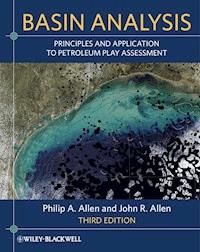
Cover image: The image on the front cover is an overlay of the faults and salt (black) structures in the Gulf of Mexico and surrounding coastal plain, with an image of the dispersal of sediment from the Mississippi plume. The tectonic map is from Rowan, M.G., Jackson, M.P.A. & Trudgill, B.D., Salt-related fault families and fault welds in the northern Gulf of Mexico, Bulletin of the American Association of Petroleum Geologists, 83, 1454–1484, Figure 1, page 1456. AAPG © 1999. Reprinted by permission of the AAPG whose permission is required for further use. The colour image shows mixing of the turbid Mississippi plume with the clear blue water of the Gulf of Mexico, and is from the NASA Earth Observatory, http://earthobservatory.nasa.gov.
Cover design by Nicki Averill Design & Illustration
Preface to the Third Edition
The first edition of Basin Analysis appeared in 1990, and the second edition in 2005. In a geometrical series, we should publish the third edition in 2020, but the widespread adoption of Basin Analysis courses in undergraduate and postgraduate curricula, and the speed of advancement and breadth of engagement of the subject make an earlier updating necessary. We continue to believe that knowledge of the basic principles of the thermomechanical behaviour of the lithosphere, the dynamics of the mantle, and the functioning of sediment routing systems provide a sound background for studying sedimentary basins, and are a prerequisite for the exploitation of resources contained in their sedimentary rocks. There are therefore no significant departures from the underlying philosophy followed in the first two editions.
Basin analysis increasingly represents a vehicle for the adoption of integrated approaches to geoscientific problems. Integration is very easy to talk about and very difficult to do. To focus on sedimentary basins dynamically is therefore a way in which diverse specialists can contribute to a wider mission. The big mistake in the study of sedimentary basins is to believe that it is the preserve of a particular discipline. Sedimentologists are tempted to believe that they hold the key to the understanding of sedimentary basins through their expertise in the depositional environments and stratigraphic architectures of sedimentary rocks. Likewise, geophysicists may assert that they hold the key through their understanding of the continuum mechanics of the way the lithosphere deforms and its thermal consequences. And structural geologists will no doubt defend their position that the key ingredient of basin analysis is the understanding of the nature of the brittle deformation of the crust and the evolution of its contractional and extensional fault arrays. To tackle basin analysis effectively in the future, there needs to be a ‘mind-set’ that has the courage to stray into adjacent disciplines, and an openness to share the significance of one’s own specialism. We aim to help develop this mind-set through reading this text.
The third edition is renamed Basin Analysis: Principles and Application to Petroleum Play Assessment to make clear that we choose to show the outworking of a basin analysis approach to the exploration for hydrocarbons. It is lengthened and published in larger format, allowing us to expand the content of some chapters in recognition of the growth of certain areas. In order to allow as fluent a text as possible, we have also removed some of the quantitative though often simplified work to Appendices. These Appendices contain details of quantitative derivations of concepts widely applied in basin analysis, and practical exercises that give hands-on experience of a wide variety of physical problems. The Appendices allow the student to gain additional skill in quantitative problem solving, but the selection of topics is necessarily incomplete and somewhat arbitrary. The key generic learning points from carrying out the calculations are emphasised. A rigorous treatment of principles used in basin analysis is the hallmark of this book, but despite the inclusion of 60 Appendices it is not a quantitative manual. We aim to illustrate important foundational principles in basin analysis rather than attempt an encyclopaedically descriptive coverage.
We set the scene for sedimentary basin analysis in Part 1 by outlining the compositional and rheological zonation of the Earth before providing a brief background to the geodynamics relevant to the formation and evolution of basins. Sedimentary basins are then classified in terms of this geodynamical background. The following chapter on the physical state of the lithosphere aims to give the essentials of the mechanics that underpin the way the lithosphere extends, shortens, bends and undergoes heating and cooling.
Part 2 of the book makes use of this information in considering the two main mechanisms for sedimentary basin formation, namely stretching of the continental lithosphere and flexure associated with mountain building, which are dealt with in Chapters 3 and 4. In each of these chapters the basic geological and geophysical observations of the rift–drift suite of basins and of foreland basin systems are presented before physical models are outlined and assessed. We have expanded the treatment of the effects of mantle dynamics to reflect the current emphasis on deep-to-surface connections and spend some time assessing whether mantle flow can be recognised in surface dynamic topography, and its implications for basin development. The last chapter of Part 2 is an updated treatment of basins associated with strike-slip tectonics.
Part 3 concerns the basin-fill in two chapters; firstly through an integrated view of the sediment routing system that links sediment erosion with transport and deposition from source-to-sink, and secondly through a process-orientated view of stratigraphy. These two interlinked chapters conform to the general philosophy of the textbook in highlighting the role of Earth surface dynamics in controlling the sedimentary systems feeding and occupying basins. The emphasis on the basin-fill continues with a rigorous treatment of the burial history and thermal history of sedimentary basins. Chapter 9 focuses on the loss of porosity during burial and the techniques necessary to correctly extract the time-depth trajectory of horizons or units within the basin-fill. The following chapter evaluates the various processes affecting thermal history from a modelling viewpoint, followed by an evaluation of a wide range of temperature proxies measured in basin sedimentary rocks.
We finish in Part 4, as before, with the application of basin analysis principles to the assessment of petroleum systems and plays. Firstly, we describe the building blocks of the petroleum play, which in essence covers the current state of understanding of the natural life cycle of petroleum from its biological precursors, generation and migration, through to the stages of entrapment, alteration and dissipation. Relative to the second edition of Basin Analysis, this is now presented in a condensed and updated form. We believe that many of the fundamentals of the scientific understanding of these key processes have not significantly changed over the past decade, but, nevertheless, in updating this section, we wanted to bring attention to the advances made in a number of important areas. Two areas that stand out for particular mention are the plays associated with gravity-driven foldbelts, which have become a major exploration focus over the past 10 to 15 years, and the plays associated with sand injectites, which have been conceived and have grown in importance over the past decade.
An addition in this third edition is a new chapter that begins by showing, through a small number of examples, how all of the elements come together to produce some classic conventional plays in truly world-class petroleum provinces that are of enormous economic importance. The examples chosen are the Niger Delta, the Campos Basin of Brazil, the pre-salt of the Brazilian Santos Basin, and the Northwest Shelf of Australia. In addition, in recognition of a major shift in focus that has occurred over the past decade, a number of unconventional petroleum plays are described. There is no doubt that the production contribution and economic importance of unconventional petroleum is growing as the rate of discovery of conventional petroleum resources has moved into long-term decline. Many unconventional gas resources indicate the operation of quite unconventional petroleum systems. While oil sands and heavy oils represent conventional oils that have been severely altered, unconventional gas plays such as basin-centred tight gas, shale gas and gas hydrates indicate processes at work that vary significantly from conventional models of petroleum formation and occurrence. Finally, the principles of basin analysis, and many of the geological understandings developed in the search for petroleum, can be applied in the new emerging area of carbon dioxide geosequestration. Although the sector is in its infancy, geological assessment has an important role to play in identifying and evaluating potential subsurface sites of CO2 storage, and it is fitting that this edition of Basin Analysis concludes with a brief description of this potentially important new area of application.
There is an increasingly impressive number of books that address important aspects of basin analysis. In the field of geodynamics and heat flow, we are pleased to acknowledge in particular the mighty Geodynamics (second edition 2002) by Donald Turcotte and Gerald Schubert, Dynamic Earth (1999) by Geoff Davies, with the all-important subtitle ‘Plates, Plumes and Mantle Convection’, The Solid Earth (second edition 2005) by Mary Fowler, Isostasy and Flexure of the Lithosphere (2001) by Tony Watts, the recently published (2011) Heat Generation and Transport in the Earth by Claude Jaupart and Jean-Claude Mareschal, and Crustal Heat Flow (2001) by G.R. Beardsmore and J.P. Cull. Valuable information is found in Quantitative Thermochronology (2006) by Jean Braun, Peter van der Beek and Geoffrey Batt. In the field of Earth surface dynamics, Geomorphology: The Mechanics and Chemistry of Landscapes (2010) by Bob Anderson and Suzanne Anderson is a tour de force, and further important contributions are made by Jon Pelletier’s Quantitative Modelling of Earth Surface Processes (2008), and Tectonic Geomorphology (2001) by Doug Burbank and Bob Anderson. Andrew Miall’s The Geology of Stratigraphic Sequences (second edition 2010) continues to provide a wealth of information on stratigraphic ground-truth, and Sedimentology and Sedimentary Basins by Mike Leeder (second edition 2011) places basin analysis in a firm context of sedimentary processes. Diagenesis: A Quantitative Perspective (1997) by Melvin Giles remains an important source of information on compaction and diagenesis. Tectonics of Sedimentary Basins (second edition 2012) edited by Cathy Busby and Antonio Azor contains a compilation of chapters of direct relevance to basin analysis. Petroleum Geoscience by Jon Gluyas and Richard Swarbrick (2004) is a valuable source of information and useful handbook for the practising petroleum geoscientist that focuses on the geoscience fundamentals important in the various stages of the Exploration & Production ‘value chain’, from frontier exploration through to field appraisal, development and production. In the petroleum area, it is timely to also recognise the American Association of Petroleum Geologists for the remarkable role they have played in the continuing education of the petroleum industry workforce, and in particular the excellent publications that have contributed so much to the understanding of petroleum genesis and occurrence that we have attempted to synthesise in this book. Finally, and importantly, we have benefitted greatly from Magnus Wangen’s quantitative treatment of an eclectic mix of topics of relevance to basin analysis in Physical Principles of Sedimentary Basin Analysis (2010).
We are grateful to a large number of past and present colleagues, friends and students who have provided input for the third edition, have commented on drafts of individual chapters, or have simply inspired us with their conversations and published work, including Rhodri Davies, Saskai Goes, Alex Whittaker, Sanjeev Gupta, Gary Hampson, Howard Johnson, Lidia Lonergan, Chris Jackson, Al Fraser, Amy Whitchurch and Nikolas Michael of Imperial College London, Hugh Sinclair (Edinburgh), Andy Carter (UCL), Alex Densmore (Durham University), Nicky White (Cambridge), John Armitage (Paris), Robert Duller (Liverpool), Niels Hovius (Potsdam), Sébastien Castelltort and Guy Simpson (Geneva University), Kerry Gallagher (Rennes), Peter Burgess (Royal Holloway), Chris Paola (Minnesota), Paul Heller (Wyoming), Andrew Miall (Toronto), Andrew Hurst (Aberdeen), Ian Lunt and Hans-Morten Bjornseth (Statoil) and Andy Morrison (Pura Vida Energy). PAA gratefully acknowledges the interaction with Australian geoscientists during the tenure of a Royal Society International Travel award, especially Mike Sandiford and Andrew Gleadow at Melbourne and Louis Moresi at Monash. PAA is especially pleased to acknowledge Lidia Lonergan who has co-taught a Basin Analysis course in Imperial College London for several years.
There will not be a fourth edition.
Biographies
Philip Allen graduated with a Bachelor’s degree in Geology from the University of Wales, Aberystwyth, and a PhD from Cambridge University. He held lectureships at Cardiff and Oxford, and professorships at Trinity College Dublin, ETH-Zürich and Imperial College London. He is a process-oriented Earth scientist with particular interests in the interactions and feedbacks between the solid Earth and its ‘exosphere’ through the critical interface of the Earth’s surface.
John Allen has over 30 years of experience in the international oil and gas industry as a petroleum geologist, exploration manager, senior exploration advisor, and business strategist with British Petroleum (BP) and BHP Billiton, as well as several years of experience as a non-executive director. He is currently based in Melbourne, Australia.
Philip A. AllenJohn R. Allen
PART 1
The Foundations of Sedimentary Basins
CHAPTER ONE
Basins in Their Geodynamic Environment
Summary
Sedimentary basins are regions of prolonged subsidence of the Earth’s surface. The driving mechanisms of subsidence are related to processes originating within the relatively rigid, cooled thermal boundary layer of the Earth known as the lithosphere and from the flow of the mantle beneath. The lithosphere is composed of a number of plates that are in motion with respect to each other. Sedimentary basins therefore exist in a background environment of plate motion and mantle flow.
The Earth’s interior is composed of a number of compositional and rheological zones. The main compositional zones are between crust, mantle and core, the crust containing relatively low-density rocks overlain by a discontinuous sedimentary cover. The mechanical and rheological divisions do not necessarily match the compositional zones. A fundamental rheological boundary is between the lithosphere and the underlying asthenosphere. The lithosphere is sufficiently rigid to comprise a number of relatively coherent plates. Its base is marked by a characteristic isotherm (c.1600 K) and is commonly termed the thermal lithosphere, which encloses a mechanical lithosphere. The upper portion of the thermal lithosphere is able to store elastic stresses over long time scales and is referred to as the elastic lithosphere. The continental lithosphere has a strength profile with depth that reflects its composition, temperature and water content. A weak, ductile zone exists in the lower crust below a brittle–ductile transition, but the strength of the underlying lithospheric mantle is uncertain. The oceanic lithosphere lacks this low-strength layer, its strength increasing with depth to the brittle–ductile transition in the upper mantle.
The relative motion of plates produces deformation, magmatism and seismicity concentrated along oceanic plate boundaries. Continental lithosphere is more complex, exhibiting seismicity and deformation far from plate boundaries, and with a heat flow and geotherm that is strongly influenced by radiogenic self-heating. Plate boundary forces and elevation contrasts strongly influence the state of stress of lithospheric plates.
Sedimentary basins have been classified principally in terms of the type of lithospheric substratum (i.e. continental, oceanic, transitional), their position with respect to the plate boundary (intracontinental, plate margin) and type of plate motion nearest to the basin (divergent, convergent, transform). The formative mechanisms of sedimentary basins fall into a small number of categories, although all mechanisms may operate during the evolution of a basin:
Isostatic consequences of changes in crustal/lithospheric thickness, such as caused mechanically by lithospheric stretching, or purely thermally, as in the cooling of previously upwelled asthenosphere in regions of lithospheric stretching.
Loading (and unloading) of the lithosphere causes a deflection or flexural deformation and therefore subsidence (and uplift), as in foreland basins.
Viscous flow of the mantle causes non-permanent subsidence/uplift known as dynamic topography, which can most easily be recognised in the domal uplifts of the ocean floor at volcanic hotspots.
From the point of view of lithospheric processes there are two major groups of basins: (i) basins due to lithospheric stretching and subsequent cooling, belonging to the rift–drift suite; and (ii) basins formed primarily by flexure of continental and oceanic lithosphere.
1.1 Introduction and Rationale
Maps of the global or plate-scale distribution of sediment thickness reveal strong variations (Fig. 1.1). It can be seen at both the global scale (Fig. 1.1) and the plate or continental scale (Fig. 1.2) that much of the area of the continental interiors is devoid of any sedimentary cover, with Precambrian crystalline rocks exposed at the surface. Elsewhere, the greatest sedimentary thicknesses are found in particular geological settings such as at extensional continental margins and fringing the world’s great collisional mountain belts. These regions of large sedimentary thickness have undergone extensive and prolonged subsidence (Bally & Snelson 1980). The complexities of geological history have resulted in a patchwork of currently subsiding active basins and their ancient counterparts. Sedimentary basins, ancient and modern, are the primary archive of information on the evolution of the Earth over billions of years.
Lesen Sie weiter in der vollständigen Ausgabe!
Lesen Sie weiter in der vollständigen Ausgabe!
Lesen Sie weiter in der vollständigen Ausgabe!
Lesen Sie weiter in der vollständigen Ausgabe!
Lesen Sie weiter in der vollständigen Ausgabe!
Lesen Sie weiter in der vollständigen Ausgabe!
Lesen Sie weiter in der vollständigen Ausgabe!
Lesen Sie weiter in der vollständigen Ausgabe!
Lesen Sie weiter in der vollständigen Ausgabe!
Lesen Sie weiter in der vollständigen Ausgabe!
Lesen Sie weiter in der vollständigen Ausgabe!
Lesen Sie weiter in der vollständigen Ausgabe!
Lesen Sie weiter in der vollständigen Ausgabe!
Lesen Sie weiter in der vollständigen Ausgabe!
Lesen Sie weiter in der vollständigen Ausgabe!
Lesen Sie weiter in der vollständigen Ausgabe!
Lesen Sie weiter in der vollständigen Ausgabe!
Lesen Sie weiter in der vollständigen Ausgabe!
Lesen Sie weiter in der vollständigen Ausgabe!
Lesen Sie weiter in der vollständigen Ausgabe!
Lesen Sie weiter in der vollständigen Ausgabe!
Lesen Sie weiter in der vollständigen Ausgabe!
Lesen Sie weiter in der vollständigen Ausgabe!
Lesen Sie weiter in der vollständigen Ausgabe!
Lesen Sie weiter in der vollständigen Ausgabe!
Lesen Sie weiter in der vollständigen Ausgabe!
Lesen Sie weiter in der vollständigen Ausgabe!
Lesen Sie weiter in der vollständigen Ausgabe!
Lesen Sie weiter in der vollständigen Ausgabe!
Lesen Sie weiter in der vollständigen Ausgabe!
Lesen Sie weiter in der vollständigen Ausgabe!
Lesen Sie weiter in der vollständigen Ausgabe!
Lesen Sie weiter in der vollständigen Ausgabe!
Lesen Sie weiter in der vollständigen Ausgabe!
Lesen Sie weiter in der vollständigen Ausgabe!
Lesen Sie weiter in der vollständigen Ausgabe!
Lesen Sie weiter in der vollständigen Ausgabe!
Lesen Sie weiter in der vollständigen Ausgabe!
Lesen Sie weiter in der vollständigen Ausgabe!
Lesen Sie weiter in der vollständigen Ausgabe!
Lesen Sie weiter in der vollständigen Ausgabe!
Lesen Sie weiter in der vollständigen Ausgabe!
Lesen Sie weiter in der vollständigen Ausgabe!
Lesen Sie weiter in der vollständigen Ausgabe!
Lesen Sie weiter in der vollständigen Ausgabe!
Lesen Sie weiter in der vollständigen Ausgabe!
Lesen Sie weiter in der vollständigen Ausgabe!
Lesen Sie weiter in der vollständigen Ausgabe!
Lesen Sie weiter in der vollständigen Ausgabe!
Lesen Sie weiter in der vollständigen Ausgabe!
Lesen Sie weiter in der vollständigen Ausgabe!
Lesen Sie weiter in der vollständigen Ausgabe!
Lesen Sie weiter in der vollständigen Ausgabe!
Lesen Sie weiter in der vollständigen Ausgabe!
Lesen Sie weiter in der vollständigen Ausgabe!
Lesen Sie weiter in der vollständigen Ausgabe!
Lesen Sie weiter in der vollständigen Ausgabe!
Lesen Sie weiter in der vollständigen Ausgabe!
Lesen Sie weiter in der vollständigen Ausgabe!
Lesen Sie weiter in der vollständigen Ausgabe!
Lesen Sie weiter in der vollständigen Ausgabe!
Lesen Sie weiter in der vollständigen Ausgabe!
Lesen Sie weiter in der vollständigen Ausgabe!
Lesen Sie weiter in der vollständigen Ausgabe!
Lesen Sie weiter in der vollständigen Ausgabe!
Lesen Sie weiter in der vollständigen Ausgabe!
Lesen Sie weiter in der vollständigen Ausgabe!
Lesen Sie weiter in der vollständigen Ausgabe!
Lesen Sie weiter in der vollständigen Ausgabe!
Lesen Sie weiter in der vollständigen Ausgabe!
Lesen Sie weiter in der vollständigen Ausgabe!
Lesen Sie weiter in der vollständigen Ausgabe!
Lesen Sie weiter in der vollständigen Ausgabe!
Lesen Sie weiter in der vollständigen Ausgabe!
Lesen Sie weiter in der vollständigen Ausgabe!
Lesen Sie weiter in der vollständigen Ausgabe!
Lesen Sie weiter in der vollständigen Ausgabe!




