


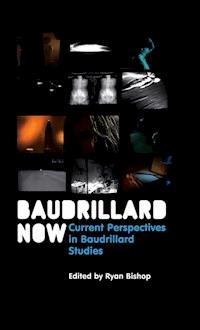
Baudrillard Now E-Book
19,99 €
Mehr erfahren.
- Herausgeber: John Wiley & Sons
- Kategorie: Geisteswissenschaft
- Serie: Polity Theory Now
- Sprache: Englisch
The writings of Jean Baudrillard have dramatically altered the face of critical theory and promise to pose challenges well into the 21st century. His work on simulation, media, the status of the image, the system of objects, hyperreality, and information technology continues to influence intellectual work in a diverse set of fields. This volume uniquely provides overviews of Baudrillards career while also simultaneously including examples of current works on and with Baudrillard that engage some of the many and varied ways Baudrillard's work is being addressed, deployed, and critiqued in the present. As such, it offers chapters useful to the novice and the well-versed in critical theory and Baudrillard Studies alike. Contributors to the volume include John Armitage, John Beck, Ryan Bishop, Doug Kellner, John Phillips and Mark Poster.
No less controversial today than he was in the past, Baudrillard continues to divide intellectuals and academicians, an issue this volume addresses by re-engaging the writing itself without falling into either simplistic dismissal or solipsistic cheerleading, but rather by taking the fecundity operative in the thought and meeting its consistent challenge. Baudrillard Now provokes sustained interaction with one of philosophy?s most important, provocative and stimulating thinkers.
Sie lesen das E-Book in den Legimi-Apps auf:
Seitenzahl: 317
Veröffentlichungsjahr: 2013
Ähnliche




















Baudrillard Now
Baudrillard Now
Current perspectives in Baudrillard studies
EDITED BYRYAN BISHOP
polity
This English-language edition copyright © Polity Press 2009
This edition published in 2009 by Polity Press. Originally published in the People’s Republic of China by Henan University Press. Published by arrangement with Henan University Press.
“Pursuit in Paris” was first published in Cultural Politics, Volume 4, Number 2, July 2008. The author gratefully acknowledges permission from Berg Publications to reprint the article in this collection.
A shorter version of “Baudrillard and the Evil Genius” appeared in Theory, Culture and Society (Sage).
A modified section of “Baudrillard, Death and Cold War Theory” appeared in Social Identities (Taylor and Francis).
The right of the authors to be identified as Author of this Work has been asserted in accordance with the UK Copyright, Designs and Patents Act 1988.
Polity Press65 Bridge Street Cambridge CB2 1UR, UK
Polity Press350 Main StreetMalden, MA 02148, USA
All rights reserved. Except for the quotation of short passages for the purpose of criticism and review, no part of this publication may be reproduced, stored in a retrieval system, or transmitted, in any form or by any means, electronic, mechanical, photocopying, recording or otherwise, without the prior permission of the publisher.
ISBN-13: 978-0-7456-5919-0
A catalogue record for this book is available from the British Library.
Typeset in 11 on 13 pt Bembo byServis Filmsetting Limited, Stockport, Cheshire.Printed and bound by MPG Books Group, UK
The publisher has used its best endeavours to ensure that the URLs for external websites referred to in this book are correct and active at the time of going to press. However, the publisher has no responsibility for the websites and can make no guarantee that a site will remain live or that the content is or will remain appropriate.
Every effort has been made to trace all copyright holders, but if any have been inadvertently overlooked the publishers will be pleased to include any necessary credits in any subsequent reprint or edition.
For further information on Polity, visit our website: www.politybooks.com
Contents
Notes on Contributors
Acknowledgments
Introduction: The End of Baudrillard and BeyondRyan Bishop
1
Jean Baudrillard (1929-2007): A Critical Overview Douglas Kellner
2
Baudrillard and the Evil Genius Ryan Bishop and John Phillips
3
Baudrillard, Death, and Cold War Theory Ryan Bishop
4
Swan’s Way: Care of Self in the Hyperreal Mark Poster
5
Et in Arizona Ego: Baudrillard on the Planet of the Apes John Beck
6
Pursuit in Paris John Armitage
7
What is a Tank?Ryan Bishop and John Phillips
8
Some Reflections on Baudrillard’s “On Disappearance”Douglas Kellner
9
Humanity’s End John Phillips
Index
Notes on Contributors
JOHN ARMITAGE teaches media and communication at Northumbria University, UK. He is co-editor, with Ryan Bishop and Douglas Kellner, of the Berg journal Cultural Politics.
JOHN BECK teaches English and American literature at Newcastle University. He is the author of Writing the Radical Center: William Carlos Williams, John Dewey, andAmerican Cultural Politics (SUNY, 2001) and Dirty Wars: Landscape, Power, andWaste in Western American Literature (Nebraska, 2009), and co-editor of AmericanVisual Cultures (Continuum, 2005)
RYAN BISHOP teaches at the National University of Singapore and has published on critical theory, military technology, avantgarde aesthetics, urbanism, architecture, literature, and international sex tourism. He edits or serves on the editorial boards of several journals. In addition to other works, he is co-author with John Phillips of Modernist Avant-Garde Aesthetics and Contemporary Military Technology: Technicities of Perception (Edinburgh University Press, 2010).
DOUGLAS KELLNER is George Kneller Chair in the Philosophy of Education at UCLA and is author of many books on social theory, politics, history, and culture, including Critical Theory, Marxism, and Modernity and Jean Baudrillard: FromMarxism to Postmodernism and Beyond; works in cultural studies such as Media Culture and Media Spectacle; a trilogy of books on postmodern theory with Steve Best; and a trilogy of books on the media and the Bush administration, encompassing Grand Theft 2000, From 9/11 to Terror War, and Media Spectacle and the Crisis ofDemocracy. Kellner’s Guys and Guns Amok: Domestic Terrorism and SchoolShootings from the Oklahoma City Bombings to the Virginia Tech Massacre won the 2008 AESA award as the best book on education. Forthcoming in 2009 with Blackwell is Kellner’s Cinema Wars: Hollywood Film and Politics in the Bush/Cheney Era. His website is at http://www.gseis.ucla.edu/faculty/kellner/kellner.html.
JOHN W. P. PHILLIPS teaches in the Department of English at the National University of Singapore. He has published on philosophy, literature, critical theory, psychoanalysis, aesthetics, military technology, urbanism, and Asian cities. Along with Ryan Bishop, Mike Featherstone, and Couze Venn, he is one of the editors of the New Encyclopaedia Project (volume I: Problematizing Global Knowledge; volume II (in preparation): Megacities: Problematizing the Urban). He is the co-author, with Ryan Bishop, of a forthcoming book on modernist aesthetics and military technology. He has just completed a manuscript on Jacques Derrida and is currently researching a project on autoimmunity in biotechnology and political philosophy.
MARK POSTER is Chair of the Department of Film and Media Studies and a member of the History Department at the University of California, Irvine. He has a courtesy appointment in the Department of Comparative Literature. He is a member of the Critical Theory Institute. His recent books are: Information Please: Culture and Politics in a Digital Age (Duke University Press, 2006); What’s the Matter with the Internet?: A Critical Theory of Cyberspace (University of Minnesota Press, 2001); The Information Subject in Critical Voices Series (New York: Gordon and Breach Arts International, 2001); Cultural History and Postmodernity (New York: Columbia University Press, 1997); The Second Media Age (London: Polity and New York: Blackwell, 1995); and The Mode of Infor mation (London: Blackwell and Chicago: University of Chicago Press, 1990).
Acknowledgments
Although books are written in isolation, they are never written alone. The case is rendered all the more literal with an edited collection such as this one, and it provides me great joy and humility to express my gratitude and pleasure to numerous individuals and institutions without whom this volume would not exist. First and foremost, I would like to thank my dear friends and colleagues whose work appears in the collection. Professor Jin Huimin of the Chinese Academy of Social Sciences, Prof. Yunpeng Zhang of Henan University Press, and Dai Abao, my sterling translator, deserve special thanks for suggesting a book on Baudrillard for the Chinese market that went through several transformations from English to Chinese and Chinese to English to become this book. The Dean’s office of the Faculty of Arts and Social Sciences at the National University of Singapore provided research grants that helped realize the volume; a special debt is owed to Robbie Goh, Tan Tai Yong and Lily Kong, scholars and administrators without peer. The faculty members and graduate students that participate in the Science, Technology and Society research cluster at NUS contributed invaluable intellectual input and stimulation. Thanks too to all the wonderful scholars working on Jean Baudrillard for such inspiring engagements. Numerous friends kindly gave of their time and ideas, and some deserve special thanks: Greg Clancey, Li Shiqiao, Mike Featherstone, Couze Venn, Ingrid Hoofd, Michael M. J. Fischer, Tania Roy, Chris Turner, Sean Cubitt, and my colleagues at Cultural Politics and Theory, Culture & Society. Many thanks to all the terrific people at Polity, especially Clare Ansell and Jonathan Skerrett, who made this a painless process, and most importantly Andrea Drugan, a dream of an editor if ever there was one. For their endless love, patience, and sarcastic asides, my deepest gratitude to and for my family near and far: my father Steve, my brothers Eric and Steve, my daughters Sarah and Sophia, and my loveliest collaborator Adeline; it is to them that this book is dedicated.
Introduction: The End of Baudrillard and Beyond
Ryan Bishop
The perfect symbol of the end of the century is (or was rather) the numerical clock at the Beaubourg (Centre Georges Pompidou) in Paris. There, the race against time was measured in millions of seconds. The Beaubourg clock illustrates the reversal of time characteristic of our contemporary modernity. Time is no longer counted from its point of origin, as a progressive succession. It is rather subtracted from the end (5, 4, 3, 2, 1, 0). It is like a bomb with delayed effect. The end of time is no longer the symbolic completion of history, but the mark of a possible fatigue, of a regressive countdown. We are no longer living according to a projected vision of progress or production. The final illusion of history has disappeared since history is now encapsulated in a numerical countdown (just as the final illusion of humankind disappears when man is encapsulated in genetic computations). Counting the seconds from now to the end means that the end is near, that one has already gone beyond the end.
Jean Baudrillard (1998)
The problem is, rather, that of a precession of thought over the event – and yet, simultaneously, of the precession of the event over thought. It’s this double helix that’s mysterious. In the case of the World Trade Center, for example, everything I’ve been writing for twenty years was, ultimately, something like a prefigured shock wave of the event, as though it had always been there, identified in a kind of retrospective anticipation. Thought’s neither a prophecy nor a prediction. It’s a prefiguration. It’s already there like the event in a sense, and it finds its fulfilment in something that wholly escapes it. The event impacts on thought even before it has occurred. And when it finally happens, it’s both the realization of thought and its end.
Jean Baudrillard and Enrique Valiente Noailles (2007: 4)
To call a book Baudrillard Now risks hubris or tautology – perhaps both. For Baudrillard has always been writing “the now” and is never more current than he is right now. But to say that Baudrillard has been, always was and always is, writing about the current moment is more than slightly glib and glosses over the many diverse and complex ways the present appears and disappears from view in his work in the guise of origins, history, time in general, and most specifically “the end”: our being consumed by as well as our consumption of the end, of endings, and the drive for completion. The called “the end” – its illusion, impossibility, necessity, desirability, and horror – winds its way through almost every single piece in this volume just as it finds many manifestations in Baudrillard’s work. So it is wise to begin with the end. Applying Baudrillard’s continued interest in reversibility, we can paraphrase Groucho Marx as Captain Spaulding and ventriloquize for Baudrillard: “I just left to say I must be staying.”
Lesen Sie weiter in der vollständigen Ausgabe!
Lesen Sie weiter in der vollständigen Ausgabe!
Lesen Sie weiter in der vollständigen Ausgabe!
Lesen Sie weiter in der vollständigen Ausgabe!
Lesen Sie weiter in der vollständigen Ausgabe!
Lesen Sie weiter in der vollständigen Ausgabe!
Lesen Sie weiter in der vollständigen Ausgabe!
Lesen Sie weiter in der vollständigen Ausgabe!
Lesen Sie weiter in der vollständigen Ausgabe!
Lesen Sie weiter in der vollständigen Ausgabe!




