


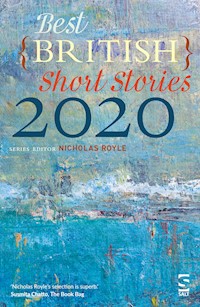
Best British Short Stories 2020 E-Book
Erhalten Sie Zugang zu diesem und mehr als 300000 Büchern ab EUR 5,99 monatlich.
- Herausgeber: Salt
- Kategorie: Gesellschafts- und Liebesromane
- Sprache: Englisch
The nation's favourite annual guide to the short story, now in its tenth year. Best British Short Stories invites you to judge a book by its cover – or, more accurately, by its title. This new series aims to reprint the best short stories published in the previous calendar year by British writers, whether based in the UK or elsewhere. The editor's brief is wide ranging, covering anthologies, collections, magazines, newspapers and web sites, looking for the best of the bunch to reprint all in one volume. Featuring: Richard Lawrence Bennett, Luke Brown, David Constantine, Tim Etchells, Nicola Freeman, Amanthi Harris, Andrew Hook, Sonia Hope, Hanif Kureishi, Helen Mort, Jeff Noon, Irenosen Okojie, KJ Orr, Bridget Penney, Diana Powell, David Rose, Sarah Schofield, Adrian Slatcher, NJ Stallard, Robert Stone, Stephen Thompson and Zakia Uddin.
Sie lesen das E-Book in den Legimi-Apps auf:
Seitenzahl: 351
Veröffentlichungsjahr: 2021
Das E-Book (TTS) können Sie hören im Abo „Legimi Premium” in Legimi-Apps auf:
Ähnliche




















v
vii
In memory of Clive Sinclair (1948–2018)
CONTENTS
xiNICHOLAS ROYLE
INTRODUCTION
Imagine if we had a high-profile weekly newsstand magazine, in this country, publishing a new short story every week. Americans have the New Yorker. Obviously we can read the New Yorker, we may even subscribe, but how often will we find a British author featured? Every now and then, sure, but the magazine doesn’t tend to look very far beyond the upper echelons (British writers featured in the magazine last year included Hari Kunzru, Salman Rushdie, Hanif Kureishi, Pat Barker and Tessa Hadley). The New Yorker doesn’t appear to feel any need to encourage emerging British writers – and why should it? That would be the job of a prestigious British magazine, like, say the New Statesman. I suppose we should be grateful that the New Statesman continues to publish stories at Christmas and, somewhat unpredictably, in either or both of their spring and summer specials.
The trouble with the Christmas double issue is that it carries both dates – the old year and the new. Was Kate Atkinson’s story, in the 2018/19 Christmas special, published in 2018 or 2019? You might think it doesn’t matter, that I should be less obsessed by dates, but you’ve got to have rules. Without rules you have anarchy. The 2019/20 Christmas special had a story by Lucy Ellmann. Three other stories appeared in the xiimagazine in 2019: Daisy Johnson’s Big Brother satire ‘How to Win’ in the spring special and Sarah Hall’s discomfiting ‘The Woman the Book Read’ in the summer special. In the autumn books special, William Boyd introduced a story by Olga Nekliudova. Knowing of William Boyd’s enthusiasm for metafictional trickery (remember Nat Tate?), I went online to find out a little bit more about Nekliudova and the very first link took me right back to the New Statesman and a section of the magazine’s website devoted to the fiction it publishes, which, when I scrolled down, appeared to solve the mystery of which year its Christmas stories are published in. The Lucy Ellmann was dated 11 December 2019 and the Kate Atkinson 5 December 2018. Mystery solved. Except that a little further down I find an Ian Rankin story dated 8 January 2016. My collection of back issues includes the 2015/16 Christmas special, dated 18 December 2015 – 7 January 2016; it contains the Ian Rankin story supposedly published on 8 January 2016, so, in fact, mystery not solved, after all.
Still, I think we’d all like it if the New Statesman would publish more stories. One a week would be nice, please. The 2020 summer special came out while I was writing this introduction and I flicked through it looking for the expected short story. There wasn’t one – or isn’t one. But perhaps this is a matter for next year’s introduction. Next year? Didn’t I announce last year that this year would be my last, as series editor? I did. Concerned, however, that the series might be discontinued, I changed my mind.
I had already made most of my selections, for the present volume, before the arrival in the UK of Covid-19, but, crucially, what I didn’t do was fetch a number of books and magazines from my office at Manchester Metropolitan University xiiibefore the lockdown put them beyond reach. These were books and magazines that I would need to do as thorough a job of writing this introduction as I normally aim to do.
I did, however, have some of those books and magazines at home, among them Wall: Nine Stories From Edge HillWriters (Edge Hill University) edited by Ailsa Cox & Billy Cowan. I loved this. The stories are good, it’s attractively designed and it’s short. Ultimately one story stood out. I liked how the absence of a conventional narrative in Sarah Schofield’s ‘Safely Gathered In’ made you want to create one, or more than one, only for one eventually to emerge that was different from any of the ones you’d dreamt up.
Two more volumes of Tales From the Shadow Booth appeared. The editor is Dan Coxon and there’s still no publisher named, but there’s a website. One has to assume it publishes itself. Stand-outs (in volume three) included Richard V Hirst’s ‘The School Project’ and Robert Shearman’s ‘I Say (I Say, I Say)’. Volume 4 boasts some great names, including Lucie McKnight Hardy, Gary Budden, Jane Roberts, Giselle Leeb … I could go on. In fact, I could just repeat the list of contents. The imprint page is dated 2018, which I assume is a mistake, unless in the world of the Shadow Booth time goes backwards. Citizens of Nowhere (Cinnamon Press) edited by Rowan B Fortune, an anthology of utopian stories, is distinguished by stories from Jez Noond and Diana Powell, who, in 2019, won the Chipping Norton Literary Festival short story competition with ‘Whale Watching’.
I enjoyed original stories by Alicia J Rouverol, Mark Lindsey and others in issue 15 of Route 57 Environs: ModernNatures edited by Dan Eltringham and Vera Fibisan, part of a collaboration between the University of Sheffield and xivThe Hepworth Wakefield; new stories by Angela Readman and Regi Claire stood out in Unthology 11 (Unthank Books) edited by Ashley Stokes and Tom Vowler. Threads and paths through life offered a way of connecting up the stories in Somewhere This Way edited by Rob Redman, the thirteenth volume in an ongoing series from the Fiction Desk. Shallow Creek didn’t appear to have an editor credited, but it was a new venture from Storgy Books, in which the stories, by Tom Heaton, Daniel Carpenter, Aliya Whiteley, David Hartley and others, had to be set in the fictitious eponymous town.
Port, edited by MW Bewick and Ella Johnston, is a fascinating and cherishable addition to the editors’ own Wivenhoe-based Dunlin Press catalogue. It features, poets, place writers and short story writers responding to the theme suggested by the title. My favourite piece was Sarah-Clare Conlon’s ‘The General Synopsis at Midday’, about sailing to the Isle of Man. There were more boats, buoys and pontoons in Conlon’s ‘Warning Signs’, in a flash fiction special issue of the ever-wonderful Lighthouse journal from Gatehouse Press. At the darker end of the spectrum, Black Static, from TTA Press, continues to disturb and unsettle. My thanks to editor Andy Cox and some of his contributors during 2019, including Stephen Volk, Tim Lees, Steven Sheil and David Martin, for continuing to shine their flickering torches into the darkness of the worlds both around and within us.
Cōnfingō Magazine is super-reliable. Last year’s two issues included stories by David Rose, Stephen Hargadon, Justine Bothwick, Elizabeth Baines, Tom Jenks and Vesna Main. I especially liked David Rose’s ‘Smoke’, but not quite as much as his ‘Greetings From the Fat Man in Postcards’ online at Litro. Highlight of Structo’s 2019, for me, was David Frankel’s story, xv‘Shooting Season’, in issue 19. The regular arrival of Ambit remains a cause for celebration and the fact I selected only one story from their four issues last year – Richard Lawrence Bennett’s ‘Energy Thieves: 5 Dialogues’ from issue 235 – is a reflection of how many good new stories are being published in magazines, anthologies and collections, and online.
I very much enjoyed four debut collections: Jane Fraser’s The South Westerlies (Salt), Jennifer Nansubuga Makumbi’s Manchester Happened (Oneworld), Nick Holdstock’s The False River (Unthanks Books) and The Map of Bihar and Other Stories (Circaidy Gregory Press) by Janet H Swinney, whose ‘Washing Machine Wars’ is a wryly observed tale of politely warring Turkish and Indian neighbours in suburban England and their years-long bouts of competitive cooking, gardening and household appliance acquisition. ‘“I don’t know why they’re called white people,” said Aslan, one of Mrs Çelik’s older boys, “because they’re grey.”’
From Valley Press came a science fiction anthology, the winner of last year’s longest title award: Science Fiction ForSurvival: An Archive For Mars, Terra Two Anthology: VolumeOne edited by Liesl King and Robert Edgar. Terra Two, it turns out, is an online magazine hosted by York St John University. Down the A19 and right a bit, Catherine Taylor edited The Book of Sheffield for Comma Press’s ongoing ‘A City in Short Fiction’ series. At least, I hope it’s ongoing. There wasn’t a bad story in this anthology. Leaving aside Philip Hensher’s ‘Visiting the Radicals’, a novel extract, stories by Margaret Drabble, Geoff Nicholson, Gregory Norminton, Naomi Frisby and Tim Etchells were all strong, but there was something somehow more mysterious about Helen Mort’s ‘Weaning’ that appealed to me. Etchells’ Endland (And Other xviStories) took me back to his 1999 collection Endland Stories from Pulp Books, an imprint of Elaine Palmer’s seminal small press Pulp Faction. The new volume combined reprints from the previous work with new stories.
Etchells’ stories fizz with the kind of disruptive energy that animates the contents of I Transgress, an anthology of mostly previously unpublished work edited by Chris Kelso for Salò Press, which has also been publishing original short stories in chapbook format, which it calls, rather wonderfully, ‘Flirtations’. Andrew Hook’s ‘The Girl With the Horizontal Walk’ was one of these. Another chapbook, NJ Stallard’s The White Cat, a beautifully crafted artefact, arrived from The Aleph, which ‘designs and publishes rare and limited editions’; these are definitely worth investigating.
One of the highlights of volume 12 of Bristol Short Story Prize Anthology (Tangent Books) was Cherise Saywell’s yearning tale of satellites, human beings and a dog, ‘Fellow Travellers’, while issue number 16 of The Mechanics Institute Review was, I think, the biggest and most handsome volume yet in that publication’s history. Billing itself ‘The Climate Issue’, it features stories (and poems and essays) by established and emerging writers alongside MA/MFA students from Birkbeck. The project director is Julia Bell and the managing editor is Sue Tyley, who has a sizeable editorial team working with her. In this volume the editors have saved, in my opinion and talking only about the short stories, the best till last, with two very strong pieces at the back of the book, ‘Gold’ by Lorraine Wilson and ‘This Place is No Vegas’ by KM Elkes. Wilson writes beautifully about birds, and Elkes about life, death and ponds. Wilson writes about life and death as well, and bird baths, if not ponds. xvii
Issue 11 of The Lonely Crowd was packed with good stories from Iain Robinson, Jo Mazelis, Jaki McKarrick, Susanna Crossman, Niall Griffiths, Gary Budden and many others. I had not previously come across Mal, ‘a journal of sexuality and erotics’. Edited by Maria Dimitrova, its fourth issue, ‘Real Girls’, focuses on ‘girlhood and agency’. Luke Brown’s story, ‘Beyond Criticism’, appears alongside pieces by Natasha Stagg and Chris Kraus as well as poetry and illustrations. Simply yet beautifully designed, it is a sharp, intelligent publication. I hadn’t come across The New Issue either, but that is because it is a brand-new publication, a subscription-only magazine from the Big Issue, edited by Kevin Gopal. Issue 1 featured a new story by Sarah Hall taken from her new collection Sudden Traveller. Another new magazine, which I discovered too late to think about picking either or both of the excellent stories by Martin MacInnes and Janice Galloway, is Extra Teeth, put together in Scotland by Heather Parry, Jules Danskin and Esther Clayton.
I enjoyed Michael Holloway’s story, ‘The Devil and My Dad’, in issue 23 of Open Pen, edited by Sean Preston. The same writer pops up in Still Worlds Turning: New Short Fiction, edited by Emma Warnock for Belfast-based No Alibis Press, with an entertaining account purporting to be ‘From Andy Warhol’s Assistant, 1964’. It was one of the highlights for me, along with stories by Joanna Walsh, Eley Williams, Lucy Caldwell and Sam Thompson (I think I’ve stayed in his ‘Seafront Gothic’ hotel).
I read one story last year by a highly regarded author in a very prestigious magazine. In many ways it was masterful, but one thing bothered me. Point of view is handed around like cups of Earl Grey. Not a flicker of emotion was there, either, xviiiin this story of mortality. It’s the sort of carefully written story that I have to force myself to finish reading. I find myself wondering what must such stories be like to write? What motivates the authors of such stories to keep going? They’re very fine, but rather dull. And what about point of view? Is it all right to let it float around so much – or at all? If you write in the first person, you restrict yourself to that point of view, so why not restrict yourself in third-person narratives as well? At least within paragraphs, or sections. And yet, in at least one of the stories included in the present volume, point of view is all over the place. Maybe it bothered me, fleetingly, but there was something exciting about the story that seduced me, that made me think maybe I get too worked up about point of view.
Here’s a point of view to end on. It’s about the Paris Review’s announcement of a ‘call for applications to our volunteer reader program’. The Paris Review went on: ‘This is in anticipation of an expansion to online submissions after sixty-six years of accepting unsolicited submissions only in hardcopy manuscripts. (We will continue to receive and consider manuscripts submitted by mail to our New York office.) In this new iteration of our submission process, we hope to grow a far-reaching network of readers who will be responsible for assessing unsolicited submissions of both prose and poetry.’
Hang on there un petit moment. The Paris Review is recruiting volunteer readers to assess submissions?
It goes on: ‘One of our goals is to equip readers with technical language and critical acumen (such as the composition of reader’s reports) necessary for assessment of contemporary literary work. We hope that they will be able to bring these skills with them after their time as readers with The ParisxixReview, particularly those who wish to pursue a career in publishing. Therefore, applicants at a stage where they feel they would benefit from such coaching, whether in a graduate program, recently post-grad, or interested in gaining a foothold in publishing, are strongly encouraged to apply. However, we will consider candidates at any point in their lives, in any location, so long as they are excited about the project of assessing new writing on The Review’s behalf.’
Alors, an exciting democratisation of the gatekeeper role at the Paris Review? Or they want you to go and work for them, virtually as editors, but without paying you un sou?
It goes on (it does go on): ‘This is a volunteer position requiring at least 5 hours of reading time a week, which can be done remotely, with a commitment of at least six months. Hours can be completed at any time during the day and week. Interested candidates should provide a resume, cover letter, and a half-to-one-page reader’s report on a piece of fiction or poetry published in a magazine or journal (not in The Paris Review) in the past year.’
I have probably allowed my point of view to be inferred, but I would be very interested to hear from anyone who applied, successfully or not. Lots of editors spend a lot of time ‘assessing new writing’ without getting paid for it, those of us who run small presses and certain little magazines. Is that the same or is it different? Is it, like the title of Stephen Thompson’s story in this volume, same same different?
Nicholas Royle
Manchester
May 2020 xx
xxi
xxii
1LUKE BROWN
BEYOND CRITICISM
1
The man across the aisle from Claire was no longer reading poetry. He had put down the book and picked up his phone, inserted one ear bud and turned to lean against the window, hiding his screen from passers-by on the way to the buffet car, but he had not thought of the way it would reflect on to the window behind him, the girl who was sitting on a low sofa and moving her hand between her legs in a room that gleamed with the green light of California.
Claire had seen this sort of pornography before. In her last days with David, when he avoided having sex with her, she had asked him to show her what he watched when he was alone, what it was that got him off.
But David said he didn’t watch porn. Well, only very rarely. Sometimes, obviously, but mostly out of anthropological interest. Honestly? Did she really want to see?
There would be no judgment, she insisted. This was the id. Desire was beyond criticism.
Real girls was what David liked, women about the age of the undergraduates she taught, when they were persuaded to take their clothes off and masturbate on a sofa as part of a 2screen audition which they hoped might win them work as a ‘calendar model’. He liked to see their suspicion supplanted by arousal but never fully allayed, to watch the way the women surrendered to their own corruption, the dawning truth of their ambition, like it was, in the end, a relief.
This, she presumed, was how he saw it, though they never talked about it again after that night so she might have been putting words into his mouth. The man behind the camera in these videos liked to begin the series of crises that broke the woman’s resistance by stroking her cheek before slipping a finger into her mouth to see whether or not she would suck it.
Before the man on the train had begun to watch pornography he had been reading a debut collection of poetry which Claire had been intending to buy for herself. Before he started to watch pornography on his phone she had imagined beginning a conversation with him; she had taught for six hours that day, the last of term, and the idea of reading for pleasure that afternoon, or ever again, was implausible; she wanted to talk and to drink with other bitter adults, to hear her own voice becoming improper, for hours and hours, until she was dead. Perhaps the man watching pornography had been teaching too, and what he was doing now was only a practical wind-down routine to get him back in the mood for reading poetry. To concentrate on anything these days required constant improvisation. After each orgasm he could probably read for another hour before he was tempted to look at more pornography. You could read a poetry collection in that hour. Perhaps she should be watching pornography too, her own female-friendly pornography, sensitive gangbangs, sympathetic ravagings at the hands of men dressed as soldiers, which she could monitor with her own single ear phone and 3ineffective discretion. Perhaps we could all court each other in this way now, revealing our trespasses in reflections which we were only pretending were accidental. This is my niche. Is it tolerable? We need never acknowledge the part of me that isn’t.
He looked up at her and away as though the sun was in his eyes. Then he looked back and smiled. She was wearing a new dress and no tights; it was a hot Friday in May, and he had not been the first man to look in the direction of her legs that day. His bag was on the seat next to him, artfully obscuring his crotch. The girl on the screen stood to turn away from the camera, and pull down her—
‘Is it good?’ she asked him, surprising them both.
It was good. The man flinched backwards.
‘The collection,’ she said. ‘I’ve been meaning to buy a copy.’
He had turned his screen off immediately and was blinking at her. ‘Yes, it is,’ he said.
‘You didn’t look like you lasted long before you put it down.’
The man gripped his bag and pulled it further over onto his lap. ‘Oh, you know. Social media. Twitter. I’m one of the great distracted morons of the present.’
His smile was actually rather nice. You couldn’t write off a man for looking at pornography: not unless pornography had completely turned you off from being heterosexual. You couldn’t write off a man just for enjoying the degradation of women.
‘You too?’ she said. ‘I seem to have forgotten how to read today.’
He put his bag on the floor and turned his knee to point to her. 4
She said, ‘I suppose I should just download some pornography and have done with it.’
‘Ha ha!’ And then he said ‘Ha ha!’ again. He had scruffy hair and a big beard, was only a few years younger than her.
‘Do you know any good sites?’ she asked.
He did his best to put his smile back on. ‘I mean, I don’t know what you’re into.’
She had kept her promise and tried not to judge David on what it was that turned him on, though it was difficult from then on not to think about the extent to which the other image he presented to the world was fraudulent, this man who was always judging other men, the sensitive NGO executive who had worn with complicated irony a ‘This Is What a Feminist Looks Like’ T-shirt on a stag do, who had read Irigaray and Butler, who had ‘done the work’, who cooked and cleaned, more than she did, and who liked to see women in their late teens as they were groomed by devious predators.
And then why shouldn’t a man unzip his principles then zip them straight back up again? Surely that was what the zip was invented for, to have one’s trousers on and off at the same time? Claire had tried to convince herself that the videos were probably staged in any case. That’s how she had watched the videos, with David that night and afterwards one time on her own: forensically, analytically. The women were too pretty. Too pliable. But the optimistic tattoos some of them possessed – the cursive profundities so difficult to read, along one side of the ribs or underneath a breast, the cute little animals’ faces, was that a squirrel? – they felt like the pointless blemish, the detail for the sake of detail, which conferred the presence of the real. She didn’t think the pornographers had 5read Barthes. And the actors were very good if they were only acting pensively.
To try to neutralise the mood that watching these videos with David had established, Claire had acted out a role herself that night. She played the corruptee, going to her bedroom to get changed and coming back in an old tartan mini skirt she had kept for emergencies from her dressing-up days as an undergraduate. She was a sexy student who had been missing his classes. David had tried to get into it, tried to spank her, but he was too embarrassed. The id made its prompts and so did his knowledge of workplace harassment. He was worried he was failing another test.
Claire looked back up at the man on the train. ‘I’m into, er, never mind,’ she said.
He smiled, put his phone in his pocket and picked up his collection again. ‘Thanks for reminding me I was enjoying reading this before I got stuck on Twitter.’
‘You’re welcome,’ she said, and she waited to see if he would become distracted by Twitter again.
2
Before David she was meeting Patrick in a club in Soho, one of the famous ones, which his work paid for, he said, when he suggested meeting there, as though he had forgotten that the last time they met there he had told her that he’d been given a free membership for being interesting. Could that be right? Patrick was only averagely interesting, after all. Perhaps he had been deemed more interesting once but had to pay now that whatever metrics they used had ascertained that he, like everyone else she knew, had become less interesting. Perhaps 6being averagely interesting was more than average these days, and the median was now soporific. Her mother would have had a saying refuting this sort of despair. Life’s as interesting as you make it. Only boring people get bored. But her mother’s second stroke had stopped her from witnessing the news coverage of the Brexit negotiations, or seeing the way that her mother’s feminist heroes were being vilified. Her mother had breathed oxygen in the days before the world had divided itself into so many incompatible good-and-evils.
Anyway, she had no issue with Patrick paying for a private members’ club with his own money, if he wanted to, though it was funny to remember that their friendship had been formed while fleeing the police during a protest about globalised capitalism. It was the G8 summit in Birmingham and they were reclaiming the streets. As the techno lashed and the police closed in, they had bought speed pills from a dreadlocked hippy, swallowing them in spite of their mutual distaste when the hippy produced them by reaching down inside the crotch of his cargo shorts. After the police charged, and they ran, they found themselves kissing each other in New Street station, and when they got back to Oxford they stayed up having sex until daylight, their first and only time together. It had been the first time either of them had sex on drugs; they’d been amazed at how good they were at it; they were like professionals, they could have gone on for days. That morning they had taken their first-year exam paper and she had got a first and he a 2.1, after which they didn’t speak for the rest of the summer, and after which Patrick lost all interest in political protest and illegal drugs for the rest of his degree.
She had thought about bringing drugs into her relationship with David when their sex life had become so moribund. 7But by that time she was trying to conceive, and what might drugs do to a foetus? Perhaps the risks would have been worth the opportunity cost, adding to the once-or-twice-a-month vaguely around ovulation, which David often contrived to leave the country for. They were not making the required effort, though she was trying to. She suspected she knew what David was doing when he retreated upstairs. She sometimes turned off the music she was listening to and listened hard for very small screams of sexual delight. She had wanted him to bring whatever he did up there into the light so they could look at it together. To stop wasting his orgasms and bring them to her. He could degrade her if he had to, if male desire could only be roleplayed now that its evil had been universally agreed upon, if it could only be defused by exaggeration, by consensual pantomine, fetish parade. He could wear a black cloak and fangs and whip her if he had to. Did he have to? She feared he had been draining himself in the study not from desire but from cunning, a desktop curator of a low potency that was neither no potency nor enough to make a baby. His libido kept cool by a fan whirring in the inside of a computer tower.
Patrick was sitting in a corner of the upstairs bar with a glass of beer in front of him. He was looking at it with great concentration, and though his face was still as unwrinkled and boyish as it had been when she met him, the expression he was pulling would begin to put some dints in it soon. When he stood to greet her he went to kiss her on both cheeks but she held on after the first kiss and felt his restraint relax as she hugged him.
‘Oh, Claire,’ he said. ‘Thanks for that. It’s nice to see a friend who’s not repulsed by me.’ 8
Which she was only a little repulsed by. He asked what she’d like to drink and she ordered a glass of wine – ‘No,’ he said, ‘let’s have a bottle.’
She cast her eyes around for celebrities as she sat down – it was that sort of place. She didn’t recognise anyone, though she was out of touch and a lot of the old ones were probably ankle-tagged and under house arrest by now.
‘How are you? Where are we with everything?’ she asked Patrick, but he didn’t want to talk about that yet.
‘It taints everything. I want to know how you are first. What are you doing in town? You’re not here just to see David, are you?’
Patrick and David had never liked each other. Patrick knew David judged him: the centrist who lacked faith in Corbynera Labour politics, who argued during dinner one night that the diversity initiatives installed at his workplace were superficial and weren’t making things any fairer. ‘Are you an actual racist or just being provocative?’ David had asked him, before Patrick put his coat on and walked out of the restaurant. Claire had stood up for the complexity of his argument when they got home and David had lectured her on how two privately educated people could never understand the ways that structural oppression worked. ‘What does that twat know about the working class?’ he asked, before stomping up to the study and banging the door shut behind him. Earlier that morning, when they had been lying in bed together, Claire’s app had pinged to tell her she was ovulating. ‘Tonight,’ he said, leaping up. ‘I’m going to be late for work if I don’t move now.’ And then dinner with Patrick and the argument. The convenient moral outrage. She waited ten minutes then crept down the corridor. Behind the closed door she could hear the 9sound of a woman crying out in pain, and she listened to that noise for a few seconds before she burst into the room. He had his headphones on and was watching—
‘What’s that?’ she said.
‘What are you doing?’ he said, startled.
‘What are you doing? Are you into women in head scarves?’
‘What?’ he said, looking back to the screen.
‘What are you watching?’
‘It’s a documentary about the occupation of the West Bank!’
He was thinking of such different things to her. What did it mean that at that moment she would have preferred him to be watching porn for men who were turned on by women in hijabs? Anything to show that living with her hadn’t put him off sex for ever. Anything to taint one of his good causes and bring him down to her level, the baby-hungry function she hated becoming, the bourgeois woman willing to let her mind and principles be rotted by her hormones.
‘I’m not just here to see David,’ she told Patrick. ‘I’m staying with my sister, taking my nieces to the theatre tomorrow, just going to wind down and walk around, see some exhibitions.’
‘Good. I was worried you might be considering getting back with him.’
‘Maybe I should. I haven’t found anyone else.’
‘You can’t have been looking hard enough. Any single man would be mad not to want you.’
He was not convincingly smooth. What she had liked most about him when they made friends was his abrasiveness, his willingness to argue against the consensus. But this was not a quality which would serve him well in his current 10predicament. Nor would any other qualities he possessed or didn’t.
‘Are you serious?’ she said. ‘I have my eye trained on every eligible model. It gets me into situations.’
She told him the story about the man on the train and how she had surprised him.
‘No!’ Patrick kept saying. ‘That’s brilliant. Well done, you.’
She waited to see if he would offer her the opinion that he didn’t really like porn. Casually, as an afterthought. As men had offered to her before. Sitting back in their chairs and looking her in the eye with an unnatural amount of care.
‘Do you watch porn on trains?’
‘No, I do not. I’d be worried about my data plan. Look, do you really have to meet David later? Blow him off and hang out with me.’
‘That sounds obscene.’
‘I suppose I should feel lucky you haven’t reported me to the sex police.’
‘“He said, bitterly.”’
‘I am bitter!’ he said.
‘I know you are,’ she said. ‘I know.’
3
It was nine when she met David; she was half an hour late; each time she refused to acquit Patrick without charge another argument sparked and needed to be stamped out. He was prepared to forego his complete innocence in the abstract but not on a single specific instance of wrongdoing. Despite the rhetoric she kept hearing from men that they ‘had to learn from women’, most still had the idea that they had to be innocent 11to be loveable. Impeccable. When it was the contortions they made to convince everyone that they were blemishless that made them most ugly.
David, always frugal, had suggested a Pizza Express on the South Bank. It’s fine, he texted, when she told him she was late but on the way. I’ve got a book, and she could picture it, something published by Verso that he would tell her about. Full of underlinings and annotations. What was happening to her to make her understand David’s intelligence so negatively? That he read philosophy purposefully enough to summarise and argue with it and apply it to public policy should have been a seductive thing about him, so why had she once dreamed of him ejaculating dusty pencil shavings over a white conference table?
As Pizza Expresses went, David had picked a nice one; it looked out on the Thames, on the bankside tinselled with fairy lights. Perhaps, she thought, he had chosen the place to be romantic. She worried that the reason he annoyed her so much was because she still wanted something from him, still believed he was reformable. They were both thirty-eight years old and knew they could live together in something like peace; they had done so for four years in her long breaks from teaching, in amiable semi-seclusion, on a sofa together with their books or in their separate working spaces. But what had seemed civilised then was no longer the type of peace she wanted; she was ready to sacrifice peace, even though she loved the peace she no longer wanted. How unfair that he had only ever had to acquiesce to her suggestion that they tried for a baby, that it was he who had forced her to bring it up, and that the first thing he had suggested when she admitted that their relationship was floundering was that perhaps this 12was because it was too soon for them to have a baby. She had been thirty-five then and it was not too soon for anything.
He was sitting upstairs at a little table by the window, tapping a pencil against the book he had open. And he looked just the same as she remembered him, his hair at the longer end of the length he let it get to, his beard a bit thicker than it had been, but still tidy, and his face had not cracked up, she saw no great scars left by her absence, just the slight crows’ feet and wrinkled brow that all sentient people their age had. He was a good-looking man, another unfairness. She watched him read something that disturbed him and he squeezed his brows together, scribbled something down. And then he smiled and let out a little laugh, and she remembered his sense of humour, the pithy accuracy with which he put down their shared enemies, and how she had loved him because of who he was, and not in spite of it. Even without a baby they might have been happy.
She was swilling that thought around her mouth, looking for the note of poison in it, when he looked up and saw her. His smile dropped for a second before he put it back on. That was understandable. She had probably not been smiling herself before he noticed her. But she smiled now, and he stood up and came out in front of the table and hugged her, and it felt natural to press their bodies against each other.
‘Hey, how are you? You look great,’ he said.
‘I’m good,’ she said. ‘You look great too.’
‘Stop being polite. You really do look great. Like a French actress. I don’t remember that dress.’
‘I only bought it yesterday.’
‘I should be honoured you’re wearing it first for me.’
‘I’m not wearing it for you.’ 13
His face fell. ‘Of course, of course, how silly of me to say that. I don’t mean to imply—’
‘Calm down, David. I’m teasing you. Sort of. Let’s sit down. I’m sorry I’m late.’
‘Yes. Patrick’s having an emergency?’
‘Yes, a little bit.’
‘What is it?’
‘Oh, let’s not waste our evening talking about that.’
‘He’s not?’
‘What?’
‘Well, all this Me Too stuff. I wouldn’t put it past him.’
‘Let’s not start on Patrick. You’ve always hated him.’
‘Hate’s a strong word. I just think he’s an arrogant, Etoneducated twat.’
‘But for you twat would always follow the words “Eton-educated”.’
‘With good reason. Have you been watching the news? I suppose I might give George Orwell a break.’
‘You must remember Patrick didn’t enrol himself there.’
‘Must I? Who says I must?’
‘Anyway,’ she lied, ‘it’s nothing like that.’
When the waiter came, David showed him a voucher he had downloaded to his phone, two for one pizzas, which the waiter said he would take later, and then David ordered the cheapest bottle of red without consulting her beyond the colour, as though there was nothing to consult, which was something else she liked about him, his common-sense stinginess.
She refilled her glass when he was half through his and topped up his as an afterthought. They had navigated past Patrick’s danger to women, and now David was talking to 14her earnestly about the work his NGO was doing, and about his new promotion to head of strategy, and why was it, she wondered, that she had lied to David about the circumstances of Patrick’s current crisis?
‘So,’ he said, eventually, ‘what about you? Any news? Are you seeing anyone?’
There had been a Victorian a year ago. A Romantic the year before. They gave her injured looks when they passed her on the corridor. And there was a lesbian colleague she wondered about sometimes.
‘Do you fancy her?’ he asked.
‘Look at your eyes light up. No, not really. I think she’s attractive. I like her company. I wonder how she feels about me sometimes. But, anyway, I haven’t given up on the conventions of a heterosexual life yet. On motherhood.’
He looked away and changed the subject. ‘You don’t mind Pizza Express, do you? I don’t eat out that much these days. I didn’t know where to suggest.’
‘It’s fine,’ she said. ‘You picked a nice one.’
They looked out at the Thames together. The tourists walking past made her think of the city breaks they had taken together to coastal cities, the waterside restaurants, the swimming, the reading, the galleries.
‘I seem to remember the Tate Modern’s open late on a Friday,’ she said.
‘We could be two tourists sightseeing.’
They watched the river, thinking what she thought were the same thoughts. The waiter showed a couple of young men to the table next to theirs.
‘So,’ she said. ‘It sounds like you’re not dating if you’re never in restaurants.’ 15
‘Well, yeah, my Tinder days are over, anyway.’
‘You were on Tinder?’
‘Aren’t you?’
‘No. Can you be on Tinder at our age?’
‘Of course. Though maybe it’s different for a man. Women probably enter an older age-range than men do with women.’
‘Women probably do. Men probably do. Which did you do, David?’
‘You know. A couple of years above. A few years below.’
‘A couple and a few.’
‘Well, anyway. I didn’t like the thing. It felt artificial. The conversations could be hard work.’
‘Hard to find women who cared about changing the world?’
‘Don’t be sarcastic. It was hard to find women who were curious about the world, who thought about it much at all. I certainly never met anyone like you.’
‘I’m sorry. I didn’t mean to sound sarcastic.’
‘Don’t become cynical.’
She smiled. ‘The world offers provocation.’
‘I can’t argue with that.’
‘These dates you went on. Did they never lead to sex?’
‘They sometimes led to sex.’
‘Despite the conversation.’
‘In spite of the conversation.’
She realised she wanted him to tell her about them. Perhaps somewhere private. ‘One-night stands?’
‘Er, yeah. Sometimes two-or three-night.’
‘Sounds fun. And being single doesn’t tempt you back there?’
He looked down. ‘Ah, well.’
‘Oh?’ 16
‘I’ve sort of been seeing someone.’
She had been curling her hair with her right hand and she gently returned it to rest on the table. ‘Oh. Good. For you.’
‘Yeah, thanks.’
‘Who is she?’
‘Someone I met during the council elections. We ended up door-knocking together.’
‘Right.’ She pictured the sort of shouty Corbynite she saw on Twitter. Down with capitalism. Good and evil. The right opinions, those which she shared, theoretically: David would get bored of her. ‘What’s she called?’
‘Isla.’
Which ruined the image. Now she was thinking of the Australian actor, those dark eyes and long red hair, a woman anyone would want to …




