


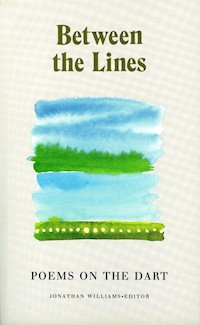
Between The Lines E-Book
4,80 €
Mehr erfahren.
- Herausgeber: The Lilliput Press
- Kategorie: Poesie und Drama
- Sprache: Englisch
One hundred and forty-four poems were selected by the editor from the two hundred or so displayed on DART carriages between 1987 and 1994: short enough for passengers to read without missing their stops, resonant enough to inspire reflection, disquietude or delight. Three were written especially for Dublin's train travellers, and about half of them are by Irish poets. Featuring poetry by Yeats, Dickinson, Larkin, Eliot, Synge, Auden, Heaney, Beckett, Blake, Frost, Muldoon, Shakespeare, Hardy, Montague, Wilde, Joyce, Milton, Coleridge, E.E. Cummings, Tennyson, Rossetti, Flann O'Brien, Longley, the Bronte sisters, and many more.
Das E-Book können Sie in Legimi-Apps oder einer beliebigen App lesen, die das folgende Format unterstützen:
Veröffentlichungsjahr: 1993
Ähnliche




















Between the Lines
Poems on the DART
JONATHAN WILLIAMS EDITOR
THE LILLIPUT PRESS MCMXCIV
To the man on the 7.22 a.m. from Kilbarrack
Contents
Title Page
Dedication
Introduction
Beautiful Lofty Things W.B. Yeats
Int en gaires asin tsail Anonymous
A bird is calling from the willow Thomas Kinsella
Untitled Emily Dickinson
Talking in Bed Philip Larkin
Gaineamh shúraic Nuala Ní Dhomhnaill
Quicksand Michael Hartnett
Sic Vita Henry King
Roundelay Samuel Beckett
Prelude John M. Synge
Dublin 4 Seamus Heaney
Mirror John Updike
Remember Christina Rossetti
Not Waving But Drowning Stevie Smith
Corner Seat Louis MacNeice
Uaigneas Brendan Behan
Loneliness Brendan Behan
Anecdote of the Jar Wallace Stevens
Fire and Ice Robert Frost
I May, I Might, I Must Marianne Moore
A Part of Speech Joseph Brodsky
Ar Aíocht Dom Máirtín Ó Direáin
A Melancholy Love Sheila Wingfield
Liffey Bridge Oliver St John Gogarty
Fin Liz Lochhead
Séasúir Cathal Ó Searcaigh
Seasons Thomas McCarthy
The Sick Rose William Blake
Farewell Anne Brontë
Night Train Craig Raine
Prelude T.S. Eliot
The Emigrant Irish Eavan Boland
Cock-Crow Edward Thomas
Rousseau na Gaeltachta Seán Ó Tuama
A Gaeltacht Rousseau Seán Ó Tuama
The Eagle Alfred, Lord Tennyson
The Boundary Commission Paul Muldoon
The Cocks Boris Pasternak/trans. J.M. Cohen
Last Hill in a Vista Louise Bogan
Pharao’s Daughter Michael Moran (‘Zozimus’)
Chinese Winter F.R. Higgins
Flowers by the Sea William Carlos Williams
To My Daughter Betty Thomas Kettle
Boy Bathing Denis Devlin
A Dying Art Derek Mahon
Holy Sonnet John Donne
A Farm Picture Walt Whitman
In the Middle of the Road Elizabeth Bishop
Sonnet 94 William Shakespeare
Double Negative Richard Murphy
To Norline Derek Walcott
Reo Seán Ó Ríordáin
Frozen Valentin Iremonger
Sonnet 15 Anthony Cronin
Moonrise Gerard Manley Hopkins
Scholar Seamus Deane
Sonnet from the Portuguese XXII Elizabeth Barrett Browning
Home Francis Ledwidge
To My Dear and Loving Husband Anne Bradstreet
Leannáin Michael Davitt
Lovers Philip Casey
Four Ducks on a Pond William Allingham
The Oil Lamp Rory Brennan
Untitled Osip Mandelstam/trans. Clarence Brown and W.S. Merwin
Secrecy Austin Clarke
Cré na Mná Tí Máire Mhac an tSaoi
The Housewife’s Credo Máire Mhac an tSaoi
A Lullaby Randall Jarrell
Heredity Thomas Hardy
Pygmalion’s Image Eiléan Ní Chuilleanáin
Merlin Geoffrey Hill
Les oiseaux continuent à chanter Anise Koltz
The birds will still sing John Montague
Nana Rafael Alberti
Lullaby Michael Smith
Fís Dheireanach Eoghain Rua Uí Shúilleabháin Michael Hartnett
The Last Vision of Eoghan Rua Ó Súilleabháin Michael Hartnett
Vuilniszakken Victor Vroomkoning
Rubbish Bags Dennis O’Driscoll and Peter van de Kamp
Di te non scriverò Elena Clementelli
I will not write of you Catherine O’Brien
Na h-Eilthirich Iain Crichton Smith
The Exiles Iain Crichton Smith
Fotografierne Benny Andersen
Photographs Alexander Taylor
Història Joan Brossa
History Susan Schreibman
Border Lake John Montague
First Fig Edna St Vincent Millay
She Tells Her Love While Half Asleep Robert Graves
How dear to me the hour Thomas Moore
Thought of Dedalus Hugh Maxton
Heraclitus William Johnson Cory
Cléithín Gabriel Rosenstock
Splint Gabriel Rosenstock
Pot Burial Tom Paulin
Political Greatness Percy Bysshe Shelley
Sonnet VIII Thomas Caulfield Irwin
Fear Charles Simic
To a Fat Lady Seen from the Train Frances Cornford
Throwing the Beads Seán Dunne
To My Inhaler Gerald Dawe
au pair girl Ian Hamilton Finlay
Les Silhouettes Oscar Wilde
The Distances John Hewitt
Song John Clare
Anthem for Doomed Youth Wilfred Owen
Above the Dock T.E. Hulme
Proof Brendan Kennelly
Tilly James Joyce
Two Winos Ciaran Carson
Once it was the colour of saying Dylan Thomas
Piazza di Spagna, Early Morning Richard Wilbur
Body Padraic Fallon
Work Without Hope Samuel Taylor Coleridge
The Demolition Anne Stevenson
October Patrick Kavanagh
Requiem, Robert Louis Stevenson
3 A.M. Dennis O’Driscoll
Taxman George Mackay Brown
The Bed Thom Gunn
My Mother Medbh McGuckian
The Five Senses Dermot Healy
The Death of Irish Aidan Mathews
Variations on a Theme of Chardin Ruth Valentine
Sonnet XX (On his Blindness) John Milton
Frozen Rain Michael Longley
Vengeance Padraic Fiacc
Old Age Edmund Waller
Dolor Theodore Roethke
Post-script: for Gweno Alun Lewis
Asleep in the City Michael Smith
Retreat Anthony Hecht
Sa Chaife Liam Ó Muirthile
In the Café Eoghan Ó hAnluain
Under the Stairs Frank Ormsby
Untitled e.e. cummings
Mrs Sweeney Paula Meehan
The Tired Scribe Brian O’Nolan
Gare du Midi W.H. Auden
Love and Friendship Emily Brontë
Their Laughter Peter Sirr
Untitled Thomas Kinsella
The Bright Field R.S. Thomas
Biographical notes
Acknowledgments
Index of titles
Index of poets and translators
Index of first lines
Copyright
Introduction
In May 1986, after nine years away from Ireland, I first stepped into a DART train, finding it a ‘clean, well-lighted place’ after the subways of New York and Chicago. Four months before, in London, Poems on the Underground had been launched, and the sight of those first poems on the District line made me long to do the same for Dublin on my return. Soon, with the enthusiastic collaboration of Raymond Kyne and Jim and Marianne Mays, Poetry in Motion was formed; the raison d’être of the scheme was to make poetry available to those who, otherwise, might have too little time, or even inclination, to read it.
The first two Poems on the DART went up in January 1987. Displaying the work of Irish poets would be a primary consideration. ‘Beautiful Lofty Things’, by W.B. Yeats, was chosen because of its reference to ‘Maud Gonne at Howth station waiting a train’. The second—a ninth-century nature poem in Irish, with a translation by Thomas Kinsella—is typical of many glosses found in the margins of monastic manuscripts, and signalled our commitment to presenting work in the Irish language.
Unlike our London counterparts, who from time to time put up extracts from long poems—Milton’s ‘Paradise Lost’ and Keats’s ‘Endymion’, for instance, we decided to display only complete poems, doubtless intimidated by the entire body of world poetry on which we could draw. (The single exception—discovered too late!—is Edmund Waller’s ‘Old Age’, which derives from the last two stanzas of ‘Of the Last Verses in the Book’, Poems [1686].) Our graphic designer, Raymond Kyne, established an upper limit of fourteen or (occasionally) fifteen lines, whilst retaining legibility, and this enabled us to include the sonnet. We had made our Procrustean bed and now would have to lie on it.
Immediately it became clear that the work of some fine poets would have to be jettisoned because they wrote so sparingly in the short form; but this, ironically, proved a blessing because it helped us to whittle down the vast range of literature open to us.
The poems in Between the Lines exhibit, we hope, a variety of moods, subject matter and tones. The eternal themes—love, death, war, the passage of time, memory, the seasons, the natural world—are represented; others were put up to mark particular events or occasions. These include the centenaries of the births of T.S. Eliot, Osip Mandelstam and Francis Ledwidge; the Dublin Millennium in 1988; separate visits to Dublin by Joseph Brodsky and Derek Walcott, who both read (Brodsky in Russian and English) their poems in trains in Dún Laoghaire station; Randall Jarrell’s scornful lullaby coincided with the deployment of American troops in the Kuwaiti desert; and during Dublin’s year as European City of Culture, in 1991, we presented the work of two living poets from each member state of the European Community, in Catalan, Danish, Dutch, French, German, Greek, Irish, Italian, Portuguese, Scots Gaelic, Spanish and Welsh, and in English translation.
From the start, we resolved that half our bi-monthly selection of eight poems would be by Irish poets, but otherwise we have no manifesto, no literary axes to grind. The essential criterion is that the poems will cause a smile, give comfort, disturb, provoke, or simply entertain. The impulse is to set these poems free from the books in which they are locked, often unread by the tens of thousands of DART travellers. Exceptions were Seamus Heaney, Craig Raine and Hugh Maxton, who wrote expressly for Poems on the DART.
Encouragement arrived in letters from the public, commenting on individual lines and praising favourite poems. A few items of correspondence stand out: a postcard, written on the journey south out of Dublin and mailed in Bray, from a woman moved by Christina Rossetti’s ‘Remember’; two separate requests for the words of Anne Brontë’s ‘Farewell’ (many months after it had been taken down), so that they could be incised on the gravestones of people who had died tragically young; a man who had remembered only the last line of Derek Walcott’s ‘To Norline’ (again months after its removal), who wanted to have the full poem; and many letters requesting copies of the original DART cards (the concrete poems by John Updike and Ian Hamilton Finlay were especially popular).
Whether or not we have chosen the best short poem by any of these poets is a matter for others to determine. With some, there was a lot of wavering. Which poems by Hardy, Frost and Joyce, which Shakespeare sonnet, should go up in the carriages? In these and in other cases, we canvassed widely, and we never resisted picking a poem that might be well known to many passengers; there are always new readers to win over.
So far, no poet has appeared more than once, unless he or she is represented by the translation of another poet, yet there are legions still to come: Ben Jonson, Swift, Wordsworth, Housman, de la Mare, Miroslav Holub, Tony Harrison, and a slew of new Irish poets. In future years, with the continued support of Cyril Ferris and Iarnród Eireann, we would like to give space to voices from the Caribbean, Africa and Canada, and perhaps to display over one two-month period poems for, and even by, children.
Between the Lines contains roughly three-quarters of the nearly 200 poems that have journeyed from Bray to Howth and back, presented in the order in which they appeared in the trains. Liberated for a couple of months from the confines of the printed page, they are now returned to where they traditionally belong.
JONATHAN WILLIAMSSandycove, County DublinNovember 1994
Between the Lines
Beautiful Lofty Things
Beautiful lofty things: O’Leary’s noble head;
My father upon the Abbey stage, before him a raging crowd:
‘This Land of Saints,’ and then as the applause died out,
‘Of plaster Saints’; his beautiful mischievous head thrown back.
Standish O’Grady supporting himself between the tables
Speaking to a drunken audience high nonsensical words;
Augusta Gregory seated at her great ormolu table,
Her eightieth winter approaching: ‘Yesterday he threatened my life.
I told him that nightly from six to seven I sat at this table,
The blinds drawn up’; Maud Gonne at Howth station waiting a train,
Pallas Athene in that straight back and arrogant head:
All the Olympians; a thing never known again.
W.B. Yeats
Int en gaires asin tsail
Int en gaires asin tsail
alainn guilbnen as glan gair:
rinn binn buide fir duib druin:
cas cor cuirther, guth ind luin.
Anonymous
A bird is calling from the willow
A bird is calling from the willow
with lovely beak, a clean call.
Sweet yellow tip; he is black and strong.
It is doing a dance, the blackbird’s song.
Translation by Thomas Kinsella
Untitled
The brain is wider than the sky,
For, put them side by side,
The one the other will include
With ease, and you beside.
The brain is deeper than the sea,
For, hold them, blue to blue,
The one the other will absorb,
As sponges, buckets do.
The brain is just the weight of God,
For, lift them, pound for pound,
And they will differ, if they do,
As syllable from sound.
Emily Dickinson
Talking in Bed
Talking in bed ought to be easiest,
Lying together there goes back so far,
An emblem of two people being honest.
Yet more and more time passes silently.
Outside, the wind’s incomplete unrest
Builds and disperses clouds about the sky,
And dark towns heap up on the horizon.
None of this cares for us. Nothing shows why
At this unique distance from isolation
It becomes still more difficult to find
Words at once true and kind,
Or not untrue and not unkind.
Philip Larkin
Gaineamh shúraic
A chroí, ná lig dom is mé ag dul a chodladh
titim isteach sa phluais dhorcha.
Tá eagla orm roimh an ngaineamh shúraic,
roimh na cuasa scamhaite amach ag uisce,
áiteanna ina luíonn móin faoin dtalamh.
Thíos ann tá giúis is bogdéil ársa;
tá cnámha na bhFiann ’na luí go sámh ann
a gclaimhte gan mheirg—is cailín báite,
rópa cnáibe ar a muinéal tairrice.
Tá sé anois ina lag trá rabharta,
tá gealach lán is trá mhór ann,
is anocht nuair a chaithfead mo shúile a dhúnadh
bíodh talamh slán, bíodh gaineamh chruaidh romham.
Nuala Ní Dhomhnaill
Quicksand
My love, don’t let me, going to sleep
fall into the dark cave.
I fear the sucking sand
I fear the eager hollows in the water,
places with bogholes underground.
Down there there’s ancient wood and bogdeal:
the Fianna’s bones are there at rest
with rustless swords—and a drowned girl,
a noose around her neck.
Now there is a weak ebb-tide:
the moon is full, the sea will leave the land
and tonight when I close my eyes
let there be terra firma, let there be hard sand.
Translation by Michael Hartnett
Sic Vita
Like to the falling of a star,
Or as the flights of eagles are,
Or like the fresh spring’s gaudy hue,
Or silver drops of morning dew,
Or like a wind that chafes the flood,
Or bubbles which on water stood:
Even such is man, whose borrowed light
Is straight called in, and paid to night.
The wind blows out, the bubble dies;
The spring entombed in autumn lies;
The dew dries up, the star is shot;
The flight is past: and man forgot.
Henry King




