


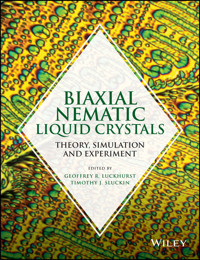
Biaxial Nematic Liquid Crystals E-Book
139,99 €
Mehr erfahren.
- Herausgeber: John Wiley & Sons
- Kategorie: Fachliteratur
- Sprache: Englisch
In the nematic liquid crystal phase, rod-shaped molecules move randomly but remain essentially parallel to one another. Biaxial nematics, which were first predicted in 1970 by Marvin Freiser, have their molecules differentially oriented along two axes. They have the potential to create displays with fast switching times and may have applications in thin-film displays and other liquid crystal technologies.
This book is the first to be concerned solely with biaxial nematic liquid crystals, both lyotropic and thermotropic, formed by low molar mass as well as polymeric systems. It opens with a general introduction to the biaxial nematic phase and covers:
• Order parameters and distribution functions
• Molecular field theory
• Theories for hard biaxial particles
• Computer simulation of biaxial nematics
• Alignment of the phase
• Display applications
• Characterisation and identification
• Lyotropic, thermotropic and colloidal systems together with material design
With a consistent, coherent and pedagogical approach, this book brings together theory, simulations and experimental studies; it includes contributions from some of the leading figures in the field. It is relevant to students and researchers as well as to industry professionals working in soft matter, liquid crystals, liquid crystal devices and their applications throughout materials science, chemistry, physics, mathematics and display engineering.
Sie lesen das E-Book in den Legimi-Apps auf:
Seitenzahl: 890
Veröffentlichungsjahr: 2015
Ähnliche




















Table of Contents
Cover
Title Page
Copyright
Dedication
About the Editors
List of Contributors
Preface
Chapter 1: Introduction
1.1 Historical Background
1.2 Freiser Theory
1.3 Nematic Order Parameters
1.4 Nematic Tensor Order Parameters
1.5 Theoretical Phase Diagrams
1.6 Landau–de Gennes Theory
1.7 Computer Simulation
1.8 Other Theoretical Issues
1.9 Applications
1.10 Characterisation
1.11 Lyotropic and Colloidal Systems
1.12 Molecular Design
References
Chapter 2: Biaxial Nematics: Order Parameters and Distribution Functions
2.1 Introduction
2.2 The Cartesian Language
2.3 The Spherical Tensor Language
2.4 Extension to Biaxial Nematics
2.5 Fourth-Rank Order Parameters
2.6 The Singlet Orientational Distribution Function
2.7 Appendices
Acknowledgements
References
Chapter 3: Molecular Field Theory
3.1 Introduction
3.2 General Mathematical Theory
3.3 Non-Polar Molecules
3.4 Polar Molecules
References
Chapter 4: Hard Particle Theories
4.1 Introduction
4.2 Theoretical Approaches
4.3 Board-Like Models
4.4 Bent-Core Models
4.5 Rod–Plate Mixtures
4.6 Conclusions and Speculations
Acknowledgements
References
Chapter 5: Landau Theory of Nematic Phases
5.1 Introduction
5.2 Symmetry of Biaxial Nematics and Primary Order Parameters
5.3 Landau Expansion
5.4 Conclusion
Acknowledgements
References
Chapter 6: Computer Simulations of Biaxial Nematics
6.1 Introduction
6.2 Order Parameters
6.3 Model Potentials and Applications
6.4 Conclusion
Acknowledgements
6.5 Appendices
References
Chapter 7: Continuum Theory of Biaxial Nematic Liquid Crystals
7.1 Introduction
7.2 Continuum Model and Energies
7.3 Dynamic Equations
7.4 Equilibrium Equations
7.5 Conclusion
References
Chapter 8: The Alignment of Biaxial Nematics
8.1 Introduction
8.2 Alignment by an External Electric or Magnetic Field
8.3 Surface Alignment
8.4 Flow Alignment
8.5 Lower Symmetry Biaxial Nematics and Hierarchical Domain Structures
Acknowledgements
References
Chapter 9: Applications
9.1 Introduction
9.2 Thin-Film Electro-Optic Devices
9.3 Non-Device Applications of Biaxial Nematic Liquid Crystals
9.4 Conclusion
References
Chapter 10: Characterisation
10.1 Textures of Nematic Liquid Crystals
References
10.2 Refractive Index Studies
References
10.3 Orientational Order Parameters of Nematic Liquid Crystals Determined by Infrared and Raman Spectroscopy
References
10.4 NMR Spectroscopy
References
10.5 Structural Studies of Biaxial Nematics: X-Ray and Neutron Scattering
Chapter 11: Lyotropic Systems
11.1 Introduction
11.2 Phase Diagrams
11.3 The Potassium Laurate–Decanol–Water Mixture: A Working Example
11.4 The Intrinsically Biaxial Micelles Model
11.5 Theoretical Reconstruction of the Lyotropic Nematic Phase Diagram: a Landau-Like Approach
11.6 Conclusions
Acknowledgements
References
Chapter 12: Colloidal Systems
12.1 Introduction
12.2 Onsager Theory and Extensions
12.3 Special Features of Colloids and Colloidal Liquid Crystals
12.4 Biaxiality in Mixtures of Rods and Plates
12.5 Particles with Inherent Biaxial Shape
12.6 Concluding remarks
References
Chapter 13: Thermotropic Systems: Biaxial Nematic Polymers
13.1 Introduction
13.2 Main-Chain Liquid Crystal Polymers
13.3 Side-Chain Liquid Crystal Polymers
13.4 Comparison of Attachment Geometries – Influence of Molecular Dynamics and Molecular Shape
13.5 Conclusion
References
Chapter 14: Low Molar Mass Thermotropic Systems
14.1 Preamble
14.2 Introduction and General Considerations
14.3 Single Component
14.4 Mixtures
14.5 Concluding Remarks
References
Chapter 15: Final Remarks
References
Index
End User License Agreement
Pages
xiii
xv
xvi
xvii
xviii
1
2
3
4
5
6
7
8
9
10
11
12
13
14
15
16
17
18
19
20
21
22
23
25
26
27
28
29
30
31
32
33
34
35
36
37
38
39
40
41
42
43
44
45
46
47
48
49
50
51
52
53
55
56
57
58
59
60
61
62
63
64
65
66
67
68
69
70
71
72
73
74
75
76
77
78
79
80
81
82
83
84
85
86
87
88
89
90
91
92
93
94
95
96
97
98
99
100
101
102
103
104
105
106
107
108
109
110
111
112
113
114
115
116
117
118
119
120
121
122
123
124
125
126
127
128
129
130
131
132
133
134
135
136
137
138
139
140
141
142
143
144
145
146
147
148
149
150
151
153
154
155
156
157
158
159
160
161
162
163
164
165
166
167
168
169
170
171
172
173
174
175
176
177
178
179
180
181
182
183
184
185
186
187
188
189
190
191
192
193
194
195
196
197
198
199
200
201
202
203
205
206
207
208
209
210
211
212
213
215
216
217
218
219
220
221
222
223
224
225
226
227
229
230
231
232
233
234
235
236
237
238
239
240
241
242
243
244
245
246
247
248
249
250
251
252
253
254
255
256
257
258
259
260
261
262
263
264
265
266
267
268
269
270
271
272
273
274
275
276
277
278
279
280
281
282
283
284
285
286
287
288
289
290
291
292
293
294
295
296
297
298
299
300
301
302
303
304
305
306
307
308
309
310
311
312
313
314
315
316
317
318
319
320
321
322
323
324
325
326
327
328
329
330
331
333
334
335
336
337
338
339
340
341
342
343
344
345
346
347
348
349
350
352
351
353
354
355
356
357
358
359
360
361
362
363
364
365
366
367
369
370
371
372
373
374
375
376
377
378
379
380
381
382
383
Guide
cover
Table of Contents
Preface
Begin Reading
List of Illustrations
Figure 1.1
Figure 1.2
Figure 1.3
Figure 1.4
Figure 3.1
Figure 3.2
Figure 3.3
Figure 3.4
Figure 3.5
Figure 3.6
Figure 3.7
Figure 3.11
Figure 3.8
Figure 3.9
Figure 3.10
Figure 3.12
Figure 3.13
Figure 3.14
Figure 3.15
Figure 3.16
Figure 3.17
Figure 3.18
Figure 3.19
Figure 4.1
Figure 4.2
Figure 4.3
Figure 4.4
Figure 4.5
Figure 4.6
Figure 4.7
Figure 5.1
Figure 5.2
Figure 5.3
Figure 5.4
Figure 5.5
Figure 5.6
Figure 5.7
Figure 5.8
Figure 5.9
Figure 5.10
Figure 5.11
Figure 6.1
Figure 6.2
Figure 6.3
Figure 6.4
Figure 6.5
Figure 6.6
Figure 6.7
Figure 6.8
Figure 6.9
Figure 6.10
Figure 6.11
Figure 7.1
Figure 7.2
Figure 7.3
Figure 7.4
Figure 7.5
Figure 8.1
Figure 8.2
Figure 8.3
Figure 9.1
Figure 9.2
Figure 9.3
Figure 9.4
Figure 9.5
Figure 9.6
Figure 9.7
Figure 10.1.1
Figure 10.1.2
Figure 10.1.3
Figure 10.1.4
Figure 10.1.5
Figure 10.1.6
Figure 10.1.7
Figure 10.1.8
Figure 10.1.9
Figure 10.1.10
Figure 10.1.11
Figure 10.1.12
Figure 10.1.13
Figure 10.1.14
Figure 10.2.1
Figure 10.2.2
Figure 10.2.3
Figure 10.3.1
Figure 10.3.2
Figure 10.3.3
Figure 10.3.4
Figure 10.3.5
Figure 10.3.6
Figure 10.3.7
Figure 10.3.8
Figure 10.4.1
Figure 10.4.2
Figure 10.4.3
Figure 10.4.4
Figure 10.5.1
Figure 10.5.2
Figure 10.5.3
Figure 10.5.4
Figure 11.1
Figure 11.2
Figure 11.3
Figure 11.4
Figure 11.5
Figure 11.6
Figure 11.7
Figure 11.8
Figure 11.9
Figure 11.10
Figure 11.11
Figure 11.12
Figure 12.1
Figure 12.2
Figure 12.3
Figure 12.4
Figure 12.5
Figure 12.6
Figure 13.1
Figure 13.2
Figure 13.3
Figure 13.10
Figure 13.4
Figure 13.5
Figure 13.6
Figure 13.7
Figure 13.8
Figure 13.9
Figure 13.11
Figure 14.1
Figure 14.2
Figure 14.3
Figure 14.4
Figure 14.5
Figure 14.6
Figure 14.7
Figure 14.8
Figure 14.9
Figure 14.10
Figure 14.11
Figure 14.12
Figure 14.13
Figure 14.14
Figure 14.15
Figure 14.16
Figure 14.17
Figure 14.18
Figure 14.19
Figure 14.20
Figure 14.21
List of Tables
Table 2.1
Table 2.2
Table 3.1
Table 3.2
Table 11.1
Table 12.1
Table 14.1
Table 14.2
Biaxial Nematic Liquid Crystals
Theory, Simulation, and Experiment
Edited by
GEOFFREY R. LUCKHURST AND TIMOTHY J. SLUCKIN
University of Southampton, United Kingdom
This edition first published 2015
© 2015 John Wiley & Sons, Ltd
Registered office
John Wiley & Sons Ltd, The Atrium, Southern Gate, Chichester, West Sussex, PO19 8SQ, United Kingdom
For details of our global editorial offices, for customer services and for information about how to apply for permission to reuse the copyright material in this book please see our website at www.wiley.com.
The right of the author to be identified as the author of this work has been asserted in accordance with the Copyright, Designs and Patents Act 1988.
All rights reserved. No part of this publication may be reproduced, stored in a retrieval system, or transmitted, in any form or by any means, electronic, mechanical, photocopying, recording or otherwise, except as permitted by the UK Copyright, Designs and Patents Act 1988, without the prior permission of the publisher.
Wiley also publishes its books in a variety of electronic formats. Some content that appears in print may not be available in electronic books.
Designations used by companies to distinguish their products are often claimed as trademarks. All brand names and product names used in this book are trade names, service marks, trademarks or registered trademarks of their respective owners. The publisher is not associated with any product or vendor mentioned in this book.
Limit of Liability/Disclaimer of Warranty: While the publisher and author have used their best efforts in preparing this book, they make no representations or warranties with respect to the accuracy or completeness of the contents of this book and specifically disclaim any implied warranties of merchantability or fitness for a particular purpose. It is sold on the understanding that the publisher is not engaged in rendering professional services and neither the publisher nor the author shall be liable for damages arising herefrom. If professional advice or other expert assistance is required, the services of a competent professional should be sought
The advice and strategies contained herein may not be suitable for every situation. In view of ongoing research, equipment modifications, changes in governmental regulations, and the constant flow of information relating to the use of experimental reagents, equipment, and devices, the reader is urged to review and evaluate the information provided in the package insert or instructions for each chemical, piece of equipment, reagent, or device for, among other things, any changes in the instructions or indication of usage and for added warnings and precautions. The fact that an organization or Website is referred to in this work as a citation and/or a potential source of further information does not mean that the author or the publisher endorses the information the organization or Website may provide or recommendations it may make. Further, readers should be aware that Internet Websites listed in this work may have changed or disappeared between when this work was written and when it is read. No warranty may be created or extended by any promotional statements for this work. Neither the publisher nor the author shall be liable for any damages arising herefrom.
Library of Congress Cataloging-in-Publication Data
Biaxial nematic liquid crystals : theory, simulation, and experiment / edited by Geoffrey R. Luckhurst and
Timothy J. Sluckin.
pages cm
Includes index.
ISBN 978-0-470-87195-9 (cloth)
1. Nematic liquid crystals. 2. Liquid crystals–Spectra. 3. Liquid crystals–Research. I. Luckhurst, G. R. II.
Sluckin, Timothy J.
QC174.26.W28B53 2014
530.4′29–dc23
2014017305
A catalogue record for this book is available from the British Library.
ISBN: 9780470871959
Professor Dr Klaus Praefcke 3rd January 1933 – 20th November 2013
This book is dedicated to our colleague Klaus Praefcke who made many innovative contributions to the molecular design and creation of liquid crystals including the elusive biaxial nematic phase.
About the Editors
Geoffrey Luckhurst was educated at the University of Hull where he graduated in 1962 with a first class honours degree in Chemistry. He then moved to the Department of Theoretical Chemistry at the University of Cambridge where he studied solution effects in ESR spectroscopy for his doctorate; this was awarded in 1965. His primary research supervisor was Alan Carrington, FRS, although he also worked with Leslie Orgel, FRS, and Christopher Longuet-Higgins, FRS. On leaving Cambridge he moved to Zürich where he was employed at the Varian Research Laboratories as their ESR spectroscopist. In 1967 he returned to England having been appointed as a Lecturer in Chemical Physics at the University of Southampton. Subsequently he has held posts there as Reader (1970), Personal Professor (1977) and Professor of Chemical Physics (1979). He currently holds the title of Emeritus Professor, which was awarded in 2004.
Geoffrey is an Honoured Member of the International Liquid Crystal Society of which he is a former President; he was elected an Honorary Member of the Royal Irish Academy in 2010. He has been awarded the Harrison Memorial Prize of the Chemical Society, the Meldola Medal of the Royal Institute of Chemistry, the Marlow Medal of the Faraday Society, the Corday-Morgan Medal and Prize of the Chemical Society, the Gray Medal of the British Liquid Crystal Society and the Fredericksz Medal and Diploma of the Russian Liquid Crystal Society. Together with Ed Samulski he founded the International Journal Liquid Crystals in 1986; Taylor & Francis, its publishers, have marked the success of the journal by the creation of the Luckhurst–Samulski Prize for the best paper published in each year. He remains research active and, following the discovery of the twist-bend nematic phase, has been much involved, with others, investigating this fascinating new liquid crystal phase.
Tim Sluckin was born in London in 1951. He studied natural sciences and mathematics at Jesus College, Cambridge, receiving the BA (1971) and MMath (1972) degrees. His PhD, on the theory of liquid helium, was from Nottingham University (1975). After postdoctoral posts in the USA and at the University of Bristol, he was appointed to a lectureship in mathematics at the University of Southampton in 1981. Since 1995 he has been Professor of Applied Mathematical Physics in Southampton. During this period he has lectured widely internationally, and has spent sabbatical periods in France, Italy, Israel and Slovenia. His main research interests in Southampton have been in the theory of liquid crystals and other soft matter. He is particularly well-known for his books (with David Dunmur and Horst Stegemeyer) on the history of liquid crystals – Crystals that Flow (Taylor & Francis, 2004), Fluidos Fora da Lei (IST Press, Lisbon, in Portuguese, 2006, translated by Paulo Teixeira), and Soap, Science and Flat Screen TVs (Oxford University Press, 2010). Outside liquid crystals, he also has other scientific research interests in the theoretical modelling of problems in the biological and social sciences.
List of Contributors
Roberto Berardi
, Dipartimento di Chimica Industriale “Toso Montanari”, Università di Bologna and INSTM, Bologna, Italy
Paul D. Brimicombe
, School of Physics and Astronomy, The University of Manchester, Manchester, United Kingdom
Felicitas Brömmel,
Institute for Macromolecular Chemistry, Albert-Ludwigs-Universität Freiburg, Freiburg, Germany
Patrick Davidson
, Laboratoire de Physique des Solides, Université Paris-Sud, Orsay, France
Ingo Dierking
, School of Physics and Astronomy, The University of Manchester, Manchester, United Kingdom
Heino Finkelmann
, Institute for Macromolecular Chemistry, Albert-Ludwigs-Universität Freiburg, Freiburg, Germany
Yves Galerne
, Institut de Physique et Chimie des Matériaux de Strasbourg UMR 7504 (CNRS-Université Strasbourg), Strasbourg, France
Anke Hoffmann
, Institut für Anorganische und Analytische Chemie, Albert-Ludwigs-Universität Freiburg, Freiburg, Germany; Institute for Macromolecular Chemistry, Albert-Ludwigs-Universität Freiburg, Freiburg, Germany
Antoni Kocot
, Institute of Physics, University of Silesia, Katowice, Poland
Matthias Lehmann
, Institut für Organische Chemie, Organische Materialien, Universität Würzburg, Würzburg, Germany
Lech Longa
, Marian Smoluchowski Institute of Physics, Jagiellonian University, Kraków, Poland
Geoffrey R. Luckhurst
, Chemistry, Faculty of Natural and Environmental Sciences, University of Southampton, Southampton, United Kingdom
Louis A. Madsen
, Department of Chemistry, Virginia Tech, Blacksburg, VA, United States of America
Andrew J. Masters
, School of Chemical Engineering and Analytical Science, The University of Manchester, Manchester, United Kingdom
Antonio M. Figueiredo Neto
, Instituto de Física, Universidade de São Paulo, São Paulo, Brazil
Antonio J. Palangana
, Departamento de Física, Universidade Estadual de Maringá, Maringá, Brazil.
Demetri J. Photinos
, Department of Materials Science, University of Patras, Patras, Greece
Timothy J. Sluckin
, Division of Mathematical Sciences, University of Southampton, Southampton, United Kingdom
Iain W. Stewart
, Department of Mathematics and Statistics, University of Strathclyde, Glasgow, United Kingdom
Jagdish K. Vij
, School of Engineering, Trinity College Dublin, The University of Dublin, Dublin, Ireland
Epifanio G. Virga
, Department of Mathematics, University of Pavia, Pavia, Italy
Gert J. Vroege
, Van't Hoff Laboratory for Physical and Colloid Chemistry, Debye Research Institute, Utrecht University, Utrecht, The Netherlands
Claudio Zannoni,
Dipartimento di Chimica Industriale “Toso Montanari”, Università di Bologna and INSTM, Bologna, Italy
Preface
To kill an error is as good a service as, and sometimes even better than, the establishing of a new truth or fact.
Charles Darwin
It is only relatively recently that the biaxial nematic liquid crystal phase has been the object of much intense study. But as with many good scientific tales, the story of this phase has its roots many years ago with a single imaginative pioneer. The pioneer was the theoretical physicist Marvin Freiser and the date was 1970. Freiser hailed from the IBM Thomas J. Watson Research Centre in Upstate New York, which at that time, despite (or perhaps because of this fact) being funded by an industrial organisation, was a centre for multiple, significant advances in pure science.
In noting that rather than possessing a rod-like shape – as usually assumed – most thermotropic, mesogenic molecules were in fact closer to being board-like, Freiser had opened a scientific Pandora's box. In consequence he realised that the mesogen should be expected to exhibit not one but two nematic phases, a uniaxial and a biaxial. The formation of a second nematic phase not only possessing novel properties, but also one which could have potential applications, stimulated considerable interest, as well as not a little controversy. To begin with it was theoreticians who took the lead, by exploring in some detail the broad molecular factors responsible for the new phase and its stability. Following in the tradition of Wilhelm Maier and Alfred Saupe, who first examined the statistical mechanical properties of uniaxial nematic liquid crystals as a function of temperature, these theoreticians focussed principally on thermotropic mesogens.
It was to be Alfred Saupe who yet again played an important role in the development of the field. But ironically the first liquid crystal to be found to form what proved to be a biaxial nematic was a lyotropic. In an elegant experimental investigation published as early as 1980, Yu and Saupe determined the concentrations as well as temperatures at which the biaxial nematic existed. They also showed how optical measurements and NMR spectroscopy could be used with confidence to identify the phase biaxiality. Subsequently Malthête and then Chandrasekhar tackled the problem of the thermotropic biaxial nematic by suggesting that molecules with both rod-like and disc-like features might form the biaxial phase but this did not meet with the same success.
The acceleration of work in the field, both theoretical and experimental, since the 1990s, as well as the increase in the number of workers in the field, suggested to the Editors that the time had come to summarise the field and take stock of progress. Not all areas in the field have yet reached their final form. Although some controversies in the field remain new ones are entering it. But sufficient progress has been made that a more mature view of the subject is now apparent. It is in this spirit that we offer this volume to its readers. The authors of chapters in this collection have all made significant contributions to our understanding of biaxial nematics, and all are sufficiently distinguished that their views on aspects of the field are certainly worthy of note. In assembling their chapters we have been guided by the book The Molecular Physics of Liquid Crystals, edited by Luckhurst and Gray. Here the contributions were arranged in a logical sequence reflecting the connections between them and described in an essentially common language enhancing the book's pedagogical quality. This was a recipe that seems to have worked well.
In the nature of subjects in the throes of rapid progress, notation in the area of biaxial nematic liquid crystals has not yet reached consistency or consensus. The Editors of this volume have nevertheless tried to maintain a degree of coherence in nomenclature between the contributions of different authors. We have not been entirely successful in this endeavour, but we ask forgiveness of our authors for intervening in their carefully prepared manuscripts, in the pursuit of a greater good. It is our hope that our attempts at consistency will stand the test of time.
We are grateful to colleagues in the field for long, stimulating and often provocative discussions, over the years, on the subject of biaxial liquid crystals; theory, simulation and experiment. As well as the colleagues who have made specific contributions to this book, we mention, in particular, David Dunmur, Duncan Bruce, Shohei Naemura and Martin Bates. For helping us to a successful conclusion and for the quality of our book, we are also grateful to the Editors at Wiley, Jenny Cossham, Sarah Keegan, Emma Strickland, Phil Weston, and, in particular, Gill Whitley. Finally, we wish to thank the contributors for their expertise which has made the intellectual quality so high. Such a book has, as might have been expected, taken longer than it should, and we hope that they will feel that the result is worth both their effort and, perhaps in particular, their patience.
Geoffrey R. Luckhurst and Timothy J. Sluckin University of Southampton, United Kingdom November 2014
Chapter 1Introduction
Geoffrey R. Luckhurst1 and Timothy J. Sluckin2
1Chemistry, Faculty of Natural and Environmental Sciences, University of Southampton, Southampton, United Kingdom
2Division of Mathematical Sciences, University of Southampton, Southampton, United Kingdom
1.1 Historical Background
Liquid crystals are so named because the original pioneers, particularly Friedrich Reinitzer and Otto Lehmann, observed fluids which exhibited what they interpreted as crystalline properties [1]. After some years it became clear that these materials were all optically anisotropic. Hitherto all optically anisotropic materials had indeed been crystalline, but nevertheless, in principle, the properties of anisotropy and of crystallinity could be regarded as distinct.
Until the discovery of liquid crystals, optical anisotropy had been regarded as a function of crystal structure, and was often regarded as part of the study of optical mineralogy. By anisotropy we mean that the velocities of light waves in a particular direction depend on the polarisation of the waves. An alternative way of considering this is to note that a light beam incident on an anisotropic material is usually split into two beams inside the material; the material is said to be doubly refracting or birefringent. From far away, the rather dramatic manifestation of this phenomenon is the appearance of two different images of the same object when viewed through a slab of such a material. When a beam is viewed through a smaller birefringent slab, the two beams may still overlap when they exit the sample. Then the two beams can interfere destructively after exiting the slab. In non-monochromatic beams (i.e. usually), the consequence will be bright interference fringes. Historically speaking, birefringent media were traditionally divided into two categories, known as uniaxial and biaxial, which we now briefly describe.
Of these the uniaxial media were rather simpler. The crystals exhibit trigonal, tetragonal or hexagonal symmetry [2]. All such materials possess a single optical axis, which is also an axis of symmetry for the crystal. The origin of the term uniaxial comes from this one axis. In general optical propagation in any given direction inside a uniaxial material divides itself into ordinary and extraordinary beams. The velocity of the ordinary waves is determined by components of the dielectric tensor in the plane perpendicular to the optical axis. Only the propagation of the extraordinary wave is affected by the dielectric component in the optical axis direction. The ordinary and extraordinary beams correspond to eigenmodes of Maxwell's equation for propagation in the direction in question. The key property of a uniaxial medium is that there is a single direction – the optical axis – along which the velocities of light with perpendicular polarisations are equal. In this case the two different optical eigenmodes become degenerate.
Lesen Sie weiter in der vollständigen Ausgabe!
Lesen Sie weiter in der vollständigen Ausgabe!
Lesen Sie weiter in der vollständigen Ausgabe!
Lesen Sie weiter in der vollständigen Ausgabe!
Lesen Sie weiter in der vollständigen Ausgabe!
Lesen Sie weiter in der vollständigen Ausgabe!
Lesen Sie weiter in der vollständigen Ausgabe!
Lesen Sie weiter in der vollständigen Ausgabe!
Lesen Sie weiter in der vollständigen Ausgabe!
Lesen Sie weiter in der vollständigen Ausgabe!
Lesen Sie weiter in der vollständigen Ausgabe!
Lesen Sie weiter in der vollständigen Ausgabe!
Lesen Sie weiter in der vollständigen Ausgabe!
Lesen Sie weiter in der vollständigen Ausgabe!
Lesen Sie weiter in der vollständigen Ausgabe!
Lesen Sie weiter in der vollständigen Ausgabe!
Lesen Sie weiter in der vollständigen Ausgabe!
Lesen Sie weiter in der vollständigen Ausgabe!
Lesen Sie weiter in der vollständigen Ausgabe!
Lesen Sie weiter in der vollständigen Ausgabe!




