


Erhalten Sie Zugang zu diesem und mehr als 300000 Büchern ab EUR 5,99 monatlich.
- Herausgeber: Influx Press
- Kategorie: Gesellschafts- und Liebesromane
- Sprache: Englisch
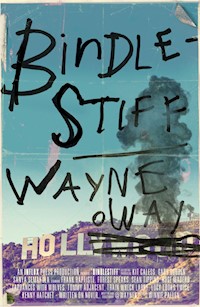
2036. In a ramshackle, backwater United States, Marine Corp vet Frank Dubois journeys from L.A. to Detroit, seeking redemption for a life lived off the rails, in a country derailed from its own manifest destiny. In present day Hollywood, a wannabe British film director hustles to get his movie 'Bindlestiff' off the ground starring 'Frank', a black Charlie Chaplin figure cast adrift in post-federal America. Weaving together prose and screenplay Bindlestiff explores the power and responsibility of storytelling, revealing what lies behind the voices we read and the characters we see on screen. We open with a simple image of a man mending a hole in his shoe using a cut off piece of rubber and a tube of glue. From there the story explodes into a broiling satire on race, identity, family, friendship, war, peace, sex, drugs but precious little rock and roll. Bindlestiff. "If it's broke, fix it."
Sie lesen das E-Book in den Legimi-Apps auf:
Seitenzahl: 392
Veröffentlichungsjahr: 2019
Das E-Book (TTS) können Sie hören im Abo „Legimi Premium” in Legimi-Apps auf:
Ähnliche


















BINDLESTIFF
Published by Influx Press49 Green Lanes, London, N16 9BUwww.influxpress.com / @InfluxPress
All rights reserved. © Wayne Holloway, 2019
Copyright of the text rests with the author.
The right of Wayne Holloway to be identified as the author ofthis work has been asserted in accordance with section 77 of the Copyright, Designs andPatents Act 1988.
This book is in copyright. Subject to statutory exception andto provisions of relevant collective licensing agreements,no reproduction of any part may take place without the written permission of Influx Press.
First edition 2019. Printed and bound in the UK by Clays Ltd., St Ives plc.Paperback ISBN: 978-1-910312-29-2Ebook ISBN: 978-1-910312-30-8
Editor: Kit Caless, Assistant Editor: Sanya SemakulaProofreader: Momus Editorial, Cover art and design: Jamie Keenan
This book is sold subject to the condition that it shall not, by way of trade or otherwise, be lent, re-sold, hired out, or otherwise circulated without the publisher’s prior consent in any form of binding or cover other than that in which it is published and without a similar condition including this condition being imposed on the subsequent purchaser.
This is a work of fiction. Names, characters, businesses, places, events, locales, and incidents are either the products of the author’s imagination or used in a fictitious manner. Any resemblance to actual persons, living or dead, or actual events is purely coincidental.
For my Nan, Winnie Pallen, 101, for the gift of her life and memories,as a grandson and a writer I couldn’t ask for more.
INCITING INSTANCES
EXT. SEGUNDO BEACH CALIFORNIA - DAY 2036
MUSIC MIXES BACK UP: WE PICK UP THE END OF ‘THE EARTH IS BROKEN’ BY TIM BUCKLEY.
Slow motion: Through a shimmer of heat haze we watch two mangy, skeletal dogs scuffle on the sidewalk. It’s hot, they pant, sweat and drool, but still they go at each other pointlessly.
Close-up of an old army boot fills the frame: The boot is crumpled, the heel worn down, and the sole has a hole in it. Sun pours through it as it is held up for inspection.
FRANK V/O
Shit.
A DIRTY FINGER POKES THROUGH, FEELING THE HOLE OUT.
CUT TO:
SHOTS OF A HAND RUMMAGING IN A BACKPACK. THE HAND FINDS WHAT IT’S LOOKING FOR: A KNIFE, A PIECE OF RUBBER AND A TUBE OF GLUE.
The hands mend the boot, expertly paring back the worn edges of the hole, cutting the piece of rubber to size and gluing it over the hole from the inside.
The hand holds the boot back up to the sun; it blocks it out, there are no gaps.
FRANK’S voice grunts in approval. He places it on the ground to dry in the sun. This is FRANK, mid-forties, a hard life written on his face and in the way it pains him to move.
The two dogs now lie side by side in the shade of a rusting truck, their chests heaving up and down with exhaustion, anger spent, flies buzzing around their muzzles.
FADE TO BLACK
LAVISH DIAMOND REYNOLDS, FACEBOOK LIVE FEED OF THE MURDER OF HER BOYFRIEND PHILANDRO CASTILE, 7 JULY 2016
‘Please don’t tell me my boyfriend’s gone! He don’t deserve this! Please, he’s a good man. He works for St. Paul Public Schools. He doesn’t have a record of anything. He’s never been in jail, anything. He’s not a gang member, anything.’
She prays aloud.
‘Allow him to be still here with us, with me… Please Lord, wrap your arms around him… Please make sure that he’s OK, he’s breathing… Just spare him, please. You know we are innocent people, Lord… We are innocent. My four-year-old can tell you about it.’
CUT TO:
‘I need a ride I’m on Larpenteur and Fry. . . My boyfriend, I don’t know what condition he’s in, I don’t know if he’s OK or if he’s not OK, I’m in the back seat of the police van car, in the back seat of the police car, handcuffed, I need a ride, I’m on Larpenteur and Fry, they got machine guns pointed.
(Aside to four-year-old daughter Dae’Anna) ‘Don’t be scared.’
‘My daughter just witnessed this, the police just shot him for no apparent reason, no reason at all. I can’t really do shit ‘cos they got me handcuffed…’
Dae’Anna: ‘It’s OK. Mummy.’
‘I can’t believe they just did this. I’m fucking, what the fuck is that?’
Crying, keening noises…
Dae’Anna: ‘It’s OK. I’m here with you.’
More sobs, feral pain…
‘Y’all pray for us, Jesus please I ask everybody on Facebook, everybody that’s watching, please pray for us.’
FADE TO BLACK
PROLOGUE
God’s Heaven,
New Orleans, Louisiana, 2024
Survivors zigzag across Crescent City Bridge, trying to get out of the city with whatever possessions they can carry. A man staggers, struggling to carry a 60-inch TV, the mains and HDMI cables trailing behind him, tripping him as he lurches forward, constantly changing grip, swapping out sweaty hands, wiping them dry on increasingly damp jeans, swapping hands again, an absurd dance/performance, his heroic attempts to gain purchase and move forward with the television set intact, screen unbroken and cables still attached.
Abandoned cars, some on fire, litter the bridge, mirages billowing thick oily black smoke across the road, obscuring the exit in an impenetrable flux of heat haze and particle suspension. Frank hugs a baby close to his chest, under his shirt, protecting it from the hard sunlight and all else. Sweat pours from him, baptising his child into the world. The baby’s hand tangles in a set of dog tags hanging from his neck. At the far end of the bridge, a line of cops hastily forms in front of their patrol cars. Gretna Parish cops armed with shotguns, glimpsed through the smoke, warped by the heat which kneads the light. These wobbly cops now conjure as infantrymen looming out of smoke cover from fired cannon, Confederates in this new civil war.
A song, a classic old-time tune, earworms its way into Frank’s conscious mind, as if it didn’t have enough to consider, something that had been playing on 98.5 WYLD right before the last hurricane made land. Now it plays as his personal soundtrack for what happens next.
‘I got shoes, you got shoes, all God’s children got shoes.’
The crowd approaches the line of cops. A loudhailer click, click, clicks into life. Inertia keeps them stumbling forward, desperate, almost lifeless automatons. A scene familiar from the zombie show craze, to those on both sides of this particular line. Nervous gallows humour prompts mimed head-shots from a few of the younger cops, straight out of the Walking Dead playbook.
‘Keep back, this is a final warning, no City residents to be allowed off the bridge, return to your homes and await further instructions. I repeat, return to your homes…’
Those that can hear shout back they have no homes, their homes are under water, but it’s no good, the scene is set and it’s only going one way, and that’s off the bridge.
‘When I get to Heaven gonna put on my shoes, I’m gonna walk all over God’s Heaven.’
The river roils below with detritus borne upon the surge, deep currents and oily foams pushing up as well as along, startling those on the bridge who care to look down. This water is not an escape option, as horizontally impassable as were the vertical walls of water held back by the God magic of Moses.
The white cops raise their shotguns for real and the mainly black crowd freezes, re-calibrates itself. The opening chords to a familiar, bone-deep dance. The guy lugging the huge TV now crouches behind it like a 16:9 ratio aspect Roman shield. Frank finds his anger, which brings him round like a dose of salts. He shouts, moves towards the line, shames them with his son held tight to his chest. A few step back, step back, but they all keep their weapons raised, they all keep their weapons raised.
‘Everybody talking about heaven, ain’t going there Heaven,
Heaven, Gonna walk all over God’s Heaven.’
Frank carefully prises the dog tags from his son’s hand, a gentle out of place gesture, a tender untangling of soft little fingers from a mesh of chain metal links. He rips them from his neck, holding them up, dangling them in the cops’ faces, as if some charmed amulet or ancient Kamea.
The singing voice is familiar, but the name escapes him.
‘I got wings, you got wings, all God’s children got wings.’
A red weal glistens with sweat across his muscle-corded neck, red on black.
‘When I get to heaven gonna put on my wings, I’m gonna fly fly all over God’s heaven.’
The boy let’s out a cry, and the cop nearest Frank wavers, his gun droops, his face questions. But by now other survivors have broken through, have managed to get behind the line of cops, a moment of hesitation passes before all hell breaks loose.
Batons swing, and the front line of cops charge forward into the crowd, others still staying back, preparing to fire rubber bullet, or tear gas rounds over the heads of their fellow officers.
The crowd breaks, some drop, the rest run back towards the drowned city. A shotgun offloads, a low resonant note, followed closely by the rest, deep thuds in battle order, provoking return pistol fire from the crowd, a defiant high-noted crack, summoning others like a string of Mardi Gras firecrackers; crack, crack, crack, in response to their boom, boom.
Frank turns his back to the cops, his son’s last defence, the muscles, ribs and spine of his father. Frank is dropped to his knees by a round of some kind, a rubber bullet or tear gas canister. Not mortally wounded, but bleeding freely from a head wound, blood stinging his eyes, running down his face and onto, flowing over his child, a second baptism, Frank’s arm miraculously still cradling him, the other raised, dog tags glinting in the harsh sun, talisman bright.
The earworm finally surrenders its name. Johnny Cash, Frank can’t help but think, Johnny Cash, blinded now by blood in his eyes and no spare hand to rub it away. Tears chase the blood from his face, yet his son is strangely silent, safe inside the crooked arm of his father as the deep thuds are replaced by live round explosions in the soundtrack of what happens next.
‘Everybody talkin’ ‘bout Heaven. Ain’t going there Heaven, Heaven, Going to fly all over, going to shout all over, Going play all over, gonna walk all over God’s Heaven.’
THE BLACK CHARLIE CHAPLIN
Hollywood Hills, Los Angeles, 2016
A black man, a handsome black man in his mid-thirties, an actor, a celebrity, sits at the breakfast bar of a large open-plan kitchen. Opposite him, a white man, a chubby faced Jewish man, hands the black man, his client, a movie script. The kitchen opens onto a terrace latticed by animated ropes of light bouncing out off the swimming pool. The filter system hisses and hums pleasantly. Cloistered in a humid microclimate, the borders of the garden are planted with banana trees, brightly coloured Hawaiian Hibiscus in tastefully made, hand-aged terracotta pots and beds of chubby Echeveria cacti. Trailing the back wall on trellises, the purples, reds and yellows of Fuchsia and Mimosa. This the work of a contract gardener with a taste for fancy cocktails.
Reflected inside, the black and orange of juice and coffee on the counter. The agent drinks coffee, his client OJ. The black man wears a white cotton gown, his agent a creased, expensive, light blue linen suit. A huge flat-screen TV plays 4k UHD sports mutely on the wall behind him.
The actor reads the cover page of the script: ‘If it’s broke fix it. Bindlestiff, the story of a black Charlie Chaplin.’
A pause as he thinks about what he’s just read, he doesn’t look impressed.
‘Who wrote this shit, man, “A black Charlie Chaplin”? What the fuck does that even mean?’
His agent shrugs.
‘Who cares? It’s the best film script you’ve been sent in five years. I never heard of this guy, a commercials director is what I was told, a Brit. His lawyer sent it, Lichter, she’s connected, so he must be kosher.’ The handsome black man smiles at the word kosher, chases it with a sneer.
‘A Brit. Shoulda known it, a Brit looking down his nose at us poor Americans.’
The agent raises his eyebrows. ‘Just read it Forest.’
‘Bindlestiff?’
‘I googled it. From the Depression, what they called tramps, hobos. The main character is an ex-marine, a hobo, it’s kinda set post-apocalyptically…’
‘I ain’t playing no broke-ass black space tramp. Stereotype bullshit. Who else they send it to?’
‘It’s not set in space. He says he wrote it for you.’
‘He a fag too?’
The agent, Morris, raises his eyebrows, finishing his coffee in silence.
Silence.
Forest paces a little, eyes the terrace.
‘OK, OK, I’ll read it. You wanna swim? I wanna swim.’
‘“Broke-ass black space tramp?” Did I miss something?’
‘Yeah, you did. How about Prometheus? They had one in that.’
‘I know, you were up for it.’
‘Touché, Morris, I’ll read it.’
They both smile. The handsome black actor Forest Speaks, famous for action movies and perfume commercials, takes off his towelling robe and goes outside. Morris Vogel finishes his coffee, fat fingers pumping his phone, desperately communicating how excited his client is to read the script…
Splash.
BEVERLY HILLS ADJACENT
Los Angeles, 2016
In the argot of Californian realty, (a standalone word and not a slurred take on ‘reality’, although it is also most definitely that), properties not in Beverly Hills but close by are designated Beverly Hills adjacent, spoken with as little pause between each word as possible. There is also Beverly Wood and Beverly Wood adjacent, but you get the picture. Like side pitching a B-level director off the back of an unavailable A-list one, in the argot of film and advertising. In both cases you get the frisson but with a smaller overhead. Just how far this adjacency extends depends on the bare-faced cheek of the sales rep concerned. In L.A. bare-faced cheek sells a lot of real estate.
Meet Tommy X, denizen of Beverly Hills Adjacent. Onetime TV actor in a big network show, cancelled after three series, turned producer, nicknamed Tommy Adjacent due to his Industry aspirations and personal proximity to people way more successful and famous than he is. Tommy is one of many fish in the sea, who, like the rest, swim adjacent to their dreams, which always lie tantalisingly just out of reach. He lives in South Cathay, Beverly Hills Adjacent to the max, with his wife Monica and their four, count them, children. Back east he had been a roommate of David Schwimmer and now his eldest son plays soccer with Tom Cruise’s kid. They had two kids, a boy and a girl, were happy with that, but then fell pregnant with the twins. He took on some commercials, (he has a great head of hair), they paid the bills and then he took more to pay some more bills and the movie world receded into the black blue of the distance, yet never fully out of sight. He went to Scout camp once with his youngest daughter and woke up in a tent next to a groaning seventy-odd-year-old Warren Beatty and his twelve-year-old boy.
‘What the hell did I do to deserve this?’ Warren laughed with Tommy over the 7 a.m. campfire coffee.
It pays to have children, right? Just get them into the right school, playing the right sports, and hey presto!
Everywhere this guy turns there’s proximity. He is (unconfirmed, but possibly) actual friends with Laura Linney. Anyway, define what ‘friend’ ‘actually’ means, right? If Tommy puts a call in to Schwimmer, it’s probably 70/30 he’ll call him back, although he no longer has his current ‘cell’ number. Old friends for sure. . .
Monica is a landscape gardener. Vibrant cocktails of colour are her signature and through Laura and her adjacency, their circle expands. To mix metaphors, they keep their heads above water. Tommy drives a leased Audi A8. Parked it once next to Forest Speaks and neither of them could recognise their own car. Same colour, (white), same lease, same inability to remember the license plate. They shared a joke, exchanged cards, well, Tommy gave Forest his. At a meeting later that week Tommy could say, if it comes up, and you can always make anything come up in these meetings, ‘Forest Speaks? Yeah, I know Forest, a great guy, you wanna get to him?’
Hollywood is a casino which operates like an enigmatic Blockchain in which adjacency is one of many currencies which you can spend in the game. Exchange rates are in constant flux, so it is advisable to play with several. The thing is, here’s the thing, most of the floor players are several paychecks away from sucking dicks to pay the bills. Sitting on top of the pile, remote players shall we call them, are the elite who have amassed so many future cheques, leveraged so much projected real estate income from flipping their way to the top, backed by so much offshore investment, with such a diverse portfolio of assets, that the possibility of sucking dick against one’s will, involuntarily, recedes beyond your death and hopefully that of your children, and God willing their children too. That’s the dream. To rise from the gambling floor. No need for comped drinks or rooms, they own it. For the working adjacent, the trick is to know when to put the money in the slot, when to play your hand, and when to cash in your (bit) coins.
For the rest of us the single figure ceiling still pertains. The true adjacency of this business is credit scored; translucent figures shimmering above each person’s head – like the glowing credit poles in Gary Shteyngart’s novel Super Sad True Love Story – our rating glowing a healthy green for high numbers, amber through the middle numbers and a flat red for single figures and a flashing, beeping blood red for the final countdown like Tommy’s leased Audi A8 parking assist 5,4,3,2, the last paycheck representing as a solid flat-lining red; a synaesthesiastically transposed dead phone line tone your ever-present companion through the last week, day by day, minute by minute.
So, you get the picture. A town with a lot of flashing red lights floating above heads. That’s show business. Dead phone lines and a lot of blow jobs.
Tommy has company for his troubles, some of it good. What I’m trying to say, maybe not hard enough because he’s an easy target in a town full of big fat easy targets, but what I want to say for the record is that he’s not a bad guy, not a bad apple, probably not a bad husband or father in a place where it is difficult to be either. But the erosion, the constant knock-backs, the wearing down of your sense of self-worth, the mirror that lurks, lies in wait in the bathroom every morning and the way in which Tommy finds himself constantly parlayed by others, all of this and then some, adds up to more than a cautionary tale, it’s fucking ‘Ivans XTC’ on methamphetamine.
Tommy’s mother was a Holocaust survivor, from Hungary. Now she deals antiques in Westwood Village (‘Neighborhood Charm, City Style’). As a rich kid in Budapest she rang a silver hand bell whenever she wanted something to eat or a drink. Her nursery was at the top of the house, servants brought it up four flights of stairs. She was six in 1944 and lost a tooth to the whip hand of Josef Mengele as she darted behind him to be with her mother on the railway sidings at Auschwitz. Now her gold front tooth glitters in the West Coast sunshine. Or so the story goes. If you lose a tooth at six, don’t you get a second chance toothwise? Wouldn’t that have been a milk tooth? Maybe the root got ripped out by the lash of the whip, making the gap permanent, so that a tooth could never grow there again. Or the lack of nutrition, the starvation she endured, deprived her of her dental maturity? I don’t know, I’m not a dentist. Anyway, who would make shit like that up?
Then again, there’s no business like Shoah business, right? How many times I gotta say that?
Now the thing is, Tommy’s problems began and ended with his mother. He hated her, she him.
‘Would have been better for the brownshirts to kill me than to live to have a son like you.’
I’m no shrink but this has got to fuck you up, especially in the self-worth department. Is that why Tommy became an actor? To crave affirmation outside of the family? Love beyond the limelight? Can you become somebody else in order to survive being born you?
Either way, Tommy’s mother’s experiences of World War Two twisted her into the piece of work she became, or was it that spoilt six-year-old, high up in her bedroom ringing the shit out of that silver bell, was that the problem? I don’t know. Never met the lady. In these stories there is rarely, if ever, any before-the-Holocaust story that isn’t coloured by it. ‘The Holocaust’, a rare historical moment that rewrites the past and rewires the future. Perhaps that’s why Primo Levi threw himself down the stairs forty years after surviving the death camps. Now that’s a desperate way to kill yourself, a stark unravelling of civilisation reclaimed, the horror of what must have driven him to do that, the seizure that must have taken over his body.
That’s what the Holocaust does, it reaches forward and takes you back. Whatever car you drive, however fast you drive it, the repo man will always be ahead of you, waiting with his engine running.
I know Tommy like a face in the mirror. Lies, self-hatred, paranoia, ambition, greed, self-delusion, laziness and a non-rational Arab-hating ultra-Zionism, all tucked away behind a veneer of normality and general good guy persona. And as I already mentioned, great head of hair, a really great head of hair.
It’s a heady mix. Not to say a volatile one. A personality that would veer, flip, turn itself inside out from one day to the next, over lunch, between toilet breaks, beats of the heart even. ‘Check please’, who picks up the tab? Somebody has to pay, and this is what you get. The mask slips at every bill time, every check is an axe that falls, and the rest of the time is only the run-up to the next bill. Each one an execution. This is his interior life, his emotional life, how he’s wired, the way this town has wired him.
This is a man, crucified.
You put this Rat King of a fuck-up into the movie business. Good luck. A guy in his early fifties, good looking in a very Semitic way, dark, tanned, looks great in a suit, has great hair, I can’t mention that enough, voluminous even, but whose haunted eyes, freighted with such black bags, tell of a hunt that has always been on, the sunken coal black pits reflect the real Twentieth Century Fox, snarling and feral snapping at his heels and stinking in heat, for it is a vixen and his nose twitches with her cunt stench as he scrambles from one unproductive meeting to the next, from one valet parking to another, ten bucks to ten bucks, that’s twenty bucks for two meetings, and lunches, minimum a hundred bucks sans booze, constantly weaving a way forward, pressing hard towards his goals, from one dodged tab to the ones you can’t dodge, it’s fucking life as pinball with the flippers snapping at your heels, as you, Tommy, are the last ball on the table, bouncing who knows where, triggering who knows what consequences, if any. And the smell of fear, of the hunted, the vixen close and getting closer, that smell, lodged in your sinuses for all time, always a disrupter, wrenching you back, back in time, tossing you forward, forward in time.
This is the guy who landed up with the Bindlestiff script in his lap. This guy.
His boy plays soccer with Tom Cruise’s son. They stand together on the touchline. They talk soccer. It’s a big thing with L.A. people, soccer. A beautiful world sport, everybody wants it except the American TV advertisers who can’t find a way to throttle it, two 45-minute halves with no commercial breaks what the fuck is that about? The boys are on the same team, the dads on the same touchline. So far, so far.
At the office (a generic pay-by-the-week rental space), a pile of books appeared on Tommy’s desk. Books about Scientology. His wife gave them to him. She popped into the office with them poking out of her wicker tote bag. He was getting shepherded towards Tom. A chunk of their weekly food budget on these books, tuna steaks from Santa Monica seafood skipped without comment that Thursday, a week’s worth of valet parking, two dry lunches even. This guy who loves being a Jew, thinks they’re the best, this ‘Go IDF go!’ type of Jew, boning up on L. Ron Hubbard in the office.
The apex of this story is a movie script stuffed into his back jeans pocket that Saturday morning at kids soccer. It is around this script that the story turns. The script he knows he shouldn’t get out, never having told Tom what he does for a living, as if Tom Cruise can’t smell a producer like shit on his shoe, but as long as it’s just kids and soccer, it’s OK, they can ‘shoot the breeze’. Don’t do it Tommy, don’t go there, don’t speak of what you do, don’t ask him to read anything. I think the script in question is some returning home from war dreck set in the bayou written by and/or starring his buddy from the Star Trek franchise.
Whatever it is, you don’t go there.
‘Hey Tommy,’ Cruise didn’t even open a door with a question like, ‘Had a good week?’ Just ‘Hey Tommy’ leaving him hanging with the only place to go the safety of the touchline and sports small talk.
Cruise wants to be a regular guy, a regular dad for a few hours each week. But that involves you playing ball too, in fact it involves you acting. Without being asked, that’s the unspoken plea of ‘Hey Tommy’. Shit, celebrities pay escorts to piss on them for similar reasons, to be brought down to earth, to feel reviled for a change, like judges in diapers, to be degraded, to feel the boot on the other foot, or however the saying goes. Tom just wants to be treated like a regular guy, or his version of what that means. Hell, he may even know vaguely who you are, but don’t go there. And you know what? Tommy didn’t. ‘Who we playing today?’ is the line he delivered, as scripted, and Tom played it from there.
After a week the Scientology books disappeared unread from his desk.
His son still plays football with Tom Cruise’s, they continue to be football dad buddies. The script in the back pocket stays invisible and tuna steak is back on the menu.
Because Tommy, despite and maybe because of all I have written about him, is a good guy. Or more precisely, has the capacity, to be better than some of the rest. That’s who he is. That’s a tight spot in which to turn. He has the balls to yank himself off the fucking cross, nail by nail, but still endure another crucifixion when Saturday comes.
Fucking soccer, every Saturday morning, an anticipation of more humiliation. For Christmas he thinks about buying his son a basketball, a hockey stick, an anything.
And, by the way, fuck Tom Cruise for creating that bad energy whirlpool, for sitting in the eye of his own storm whilst everyone else drowns. Fuck him, Tommy. For you.
Another story is infinitely sadder and has no negotiable ending. When Tommy finally got to produce a TV show, a pilot that gets picked up, you know what? He was rude and nasty and treated those below him like shit, aping those he imagines were above him, beyond his adjacent ceiling, in a psycho fantasy cliché of how a studio guy should behave, and nobody liked him, or trusted him. They laughed behind his back, at times in front of his face and I saw him turn, get nasty to the little people, runners, interns, caterers, crew, throw his weight about humiliating them and it never has to be like that, but somehow it always is, his beloved Israel surely the shining example of that shit truth, the smell of fear once again defining him, owning him in the American idiom, and send me to hell for writing it.
This guy.
This guy is looking to set up Bindlestiff in this town. Now who would ask him to do that, what writer would allow this to be so? A case of desperation, of cluelessness, above all a Writer/Director with no other option, would be my guess. A guy who was about to run out of dimes, every call he makes put on hold, or stonewalled with ‘Can I take a message?’, like a career flat-lining in a soon to be cancelled hospital soap opera. A guy just like @waynex.
This guy.
THE MONEY CHUCKLES
Rodeo Drive, Los Angeles, 2016
A bustling eatery off Rodeo Drive in Beverly Hills, in the style of a mid-twentieth-century French/European dining room; abuzz with the tinkling of glass, clinking of silverware and the snap of crisp white tablecloths dressing solid looking cherry wood tables. Bustling waiters and discrete sommeliers vie with the clientele for aisle space to and from the tables, the kitchen, the toilets and the hatcheck. As in all good restaurants the world over this dance works, looks pleasantly choreographed – the trained staff, performers elegantly dodging the untrained clientele.
One of the odd things that keeps you off kilter in this town is the mismatch between the soulless sanitised streets and boulevards and the seeming authenticity and elegance of the food and service and the architectural appointments of the interiors. As soon as you look closely, these interiors are as fake as the streets are real, all chipboard and varnish. But if you don’t look too closely and don’t literally knock on wood, then they project a studied realism. The trick is never to look too closely at anything.
‘So, great news, just spoke to his agent and Forest Speaks loves the script, wants a meeting.’
‘Huh. What about Jim Hawks?’
‘To play a black Charlie Chaplin?’
‘Black Charlie Chaplin? Gimme a break. Means nothing, some writer’s hocus pocus, who cares.’
Tommy Adjacent watches incredulously, as his lunch partner expertly mixes wasabi paste and low sodium soy sauce with the tips of his chopsticks, and the focus of a modern alchemist. In Hollywood the obsession amongst certain classes with sushi is acknowledged by the menus of even mid-century French/European restaurants; here too you will find sashimi, nigiri, assorted ‘hand rolls’ and the vintage sakes to go with them.
‘What do you think about the script changes? We lost the back story, opening scenes really fizz now.’ Tommy attempts a diversion, fails.
‘Hard to cast a black lead in such an indie project, in terms of finance. Forest is a mid-budget action hero, he ain’t gonna do shit playing a tramp. Look what happened to Wesley Snipes.’
Tommy flashes on the Snipes story. Wesley holed up in the presidential suite of the Hojo in downtown Bucharest, hookers, coke on call, a Benihana one floor below, staffed with exiled Japanese dope-smoking sushi chefs from the Paris franchise on punishment rotation.
The Howard Johnson hotel in Bucharest. Snipes banished to this eastern frontier, dodging bullets with fading stars and cheap home-grown gangsters. Health and safety deficient pyrotechnics, injured crew, lawsuits, tight budgets being pushed to the max in the wild East until inflation closed the gap on the noughties and they flushed clear out of there, further east, accountant navigators blazing a trail, Mason-Dixons of the next best margins, profit panzers aiming for the production friendly service cities of Almaty, Tbilisi, Ulan Bator.
‘Even if we make it for under ten, say for five, six mill?’
An apologetic, quietly desperate rearguard action to protect promises and integrity, not to say a friendship, albeit a Hollywood one.
The Money shrugs. Eats his sashimi with relish. Ebi, tuna, yellowtail with ponzu sauce sprinkled with juniper berries. So many great flavours, clean and intense.
‘Under ten? Then why we eating here? That’s salt beef and bagel money.’
Tommy nurses a Diet Coke, his plate empty of the sushi that sits between them.
‘Well, maybe with a little rewrite. Hawkes looks like a fucking tramp, right?
‘You been to that Sushi Nazi place by the 405? Fucking chef grows rice on the roof, there’s no menu, he looks at you and gives you what he thinks you will enjoy, place has got like five tables. 300 bucks a head. What a gag. Organic rice. Gimme a break, on that roof? Spitting distance from gridlock. You not eating?’
Tommy shakes his head, gulps his drink, thinking over other black options.
‘How about Don Cheadle? Or the slave guy, what’s his name, Chewy. . ?’
The Money shrugs again, incredulous, Chewy Who Cares.
‘Chewy, urgh, what’s his damn name, anyway, well, what about Ice Cube? Will Smith? Drake?’
The Money raises an eyebrow.
Too late. Chiwitel Ejiofor.
‘Black leads are tricky in this type of movie. Look at Danny Glover. You know he wants to make a movie about fucking Haiti and some fucking slave uprising?’
‘Toussaint L’Overture. Liberated Haiti during the French revolution.’
The eyebrow arches a little ‘you shittin’ me?’ higher. After a beat he recovers from any intuited slight…
‘Never gonna happen, never heard of the guy. Maybe if the shvoog put in some of his own money. . .’
Tommy has nowhere to go, doesn’t have the data to hand, figures to back up the viability of black leads in mid to low budget movies to overcome this prejudice, he’s just not that buttoned up. Now this is a good guy, but a desperate one, and without the stats at his fingertips? In this town? Being good ain’t good enough, in fact it’s bad, it’s a wasted opportunity. Besides, Tommy is two payments away from being on the street sucking dicks, so we must forgive him for being constantly distracted, juggling projects, bills due, solving day-to-day issues before they escalate into bigger problems, operating under pressure from the triumvirate of home, work and self. Beyond distracted, it’s almost like a cosmic persecution he’s suffering from, the torture of being him. He is an installation of all these things: The Crucifixion Of Tommy Adjacent now showing at LACMA; the invitation to the private view written all over his face, dark lights flickering behind his already inky eyes, the storm of who he is constantly threatening.
Integrity doesn’t come on an instalment plan.
‘French blacks? You gotta be kidding me, right?’ The Money straight up taunting him, bullying his lunch companion to agree with the racist absurdity of French black people.
Tommy flashes on the chopsticks sticking out of this fucker’s eyes, blood squirting out and ruining his $500 shirt. There was never any wriggle room, and what wriggle room there never was he’s now run out of. He says nothing.
The Money stabs the last piece of tuna, swallows it. The Money is always hungry, and Tommy has no appetite, his stomach full of acid. It’s a boxing mismatch, almost a con if you’re the audience, having paid good money. Tommy could never make weight with this guy.
He palms a Pepto Bismol in the toilet, tamping down his sour bile. He has run out of moves. He splashes water on his face, psychs himself back up in the mirror, shaking his head left to right.
‘So, let’s talk about Jim Hawks.’
Back at the table and he’s got a second wind. He segues, something he’s good at, a necessary skill in this town, especially if you can’t run the numbers, you move on, which is what you have to do above all else: keep in the game, keep the ball rolling, and never let the money leave the table.
Tommy buys time on the ropes.
‘I loved Hawkes in Martha May Mary Marlene, a very strong performance. You wanna make the movie, right? Or what are we doing?’
The Money stabs his chopstick towards Tommy’s eye. A gob of soy-drenched wasabi flicks God only knows where. Tommy flinches, eyeballs his shirt, it’s clean. If he had been eating this, his roll would have got stuck in his throat, stuck in his craw, sideswiped by this shark’s persistent and focused intelligence.
Tommy has to fight back, offer resistance. ‘It was Martha Marcy May Marlene.’
Custer’s last stand in this room, now.
The Money pours another glass of wine, a delicate Pinot from the Alsace, doesn’t miss a beat. The only response to this outré correction is to pretend he never heard it, that it never left Tommy’s mouth, so he covers the transgression, smothers Tommy’s resistance with a smile, a dazzling seal on the last stand that never was.
The shark smells blood, circles his prey.
‘Are you 100% attached to this project as the producer?’
‘Yeah, for sure, the writer is a good friend, let me talk to him.’
‘And he can’t direct it, you know that right? He’s a fucking nobody.’
Swims in close for the kill.
‘I’ll talk to him. He’s coming in Wednesday to work on the script.’
‘It’s a great story is what I’m trying to say Tommy, it’ll make your career, pay a few bills right?’
He finishes the last of the ebi, hesitant chopsticks and raised eyebrows do a so-so impression of asking permission, his first irony.
Blood swirls in the water.
‘Delicious.’ Patting his thin lips with a napkin.
‘Yes, it’s a fucking great story.’
‘Stupid title. Who gets it? Bindlestiff? I was thinking how about we call it Land of Hunger, suggests a bigger canvass right? A bigger movie. What d’you think?’
What bigger canvass?
‘I’ll suggest it,’ Tommy mumbles.
Unconditional surrender. He prays the victor will pick up the tab, his only consolation.
The Money surveys the table, the empty plate of sushi.
‘Tommy, you didn’t eat a thing!’
‘Nah, I hate sushi.’
The Money chuckles. They clink glasses. Warm Diet Coke, room temperature Pinot.
Check.
MAN’S BEST FRIEND
Hollywood Hills, Los Angeles, 2016
Forest Speaks studies the Bindlestiff script sitting by the pool. His dog, a Schnauzer called Bullseye, snoozes at his feet.
The pool hums, Forest reads aloud, in a flat voice.
‘Now girl, you know how much we both like that dim sum. Well, here’s where it’s at, every day. Don’t look at me like that damn dog.’
He runs the sentences together to get a feel for them, repeating them two or three times searching for the voice of the character speaking, getting a steer from reading the script direction.
FRANK buries his face in the dog’s ear, whispers, hides his tears.
Forest clears his throat, ruffles the fur of his sleeping dog, tries it again. This time he stands, adds moves to the words, and this time he inserts a pause before the line.
‘Don’t look at me like that damn dog.’
He likes that delivery, nods his head and continues reading. Forest hunkers low to his dog, the words now coming in a hushed voice, as he doesn’t want to be overheard.
‘You know I love you, and I be back, you and me come a long way together already, and this ain’t the end of the journey, this isn’t goodbye, no sir, it’s just a vacation, something I gotta do.’
FRANK stands up, hands the lead to Mr. KIM. Digs around in his bag and hands him a tattered camouflage dog coat.
Forest stands.
‘She gets cold nights.’
A tin bowl hangs from his backpack, he unties it, hands it to him.
‘And this here her bowl.’
‘Shit, this Brit thinks he can write Black, Asian, anything he damn likes. Not perfect, but not bad.’ Forest scribbles in the margins.
Forest continues the scene, reading Mr Kim’s lines in a flat neutral voice, but inhabiting Frank’s as his own.
‘She’ll be fine with me, but you come back Frank.’
‘She’ll eat anything, ain’t no trouble, just sit her in the sun out front. Hates the damp, loves the sun. That’s my dog. Now stay girl, stay.’
WE TRACK IN ON DOG’S FACE AS FRANK SHUFFLES OUT THE DOOR.
The Schnauzer looks up, breaking the actor’s concentration. ‘Not you Bullseye, I’m talking to. . . hell, I’m just talking.’
He puts the script down. It looks well-thumbed and has pencil revisions all over it. He has edited some dialogue, tweaking the idiom and the resulting cadence of the spoken words.
‘We never met, but he says he wrote the script for me.’ He shakes his head, rubs his hand across his mouth. In order to not just stand there, to move things on, Forest Speaks dives into the pool.
Splash.
THE CARD PLAYERS
Transatlantic, 2016
‘The hand that signed the paper felled a city;Five sovereign fingers taxed the breath,Doubled the globe of dead and halved a country;These five kings did a king to death.’
— Dylan Thomas
‘The hand that signed the paper.’
‘What’s next?’ is what @waynex felt as much as thought as he waited to board the plane. He was full of expectation, a not wholly unpleasant anxiety and an existential lightness of being he hadn’t felt since college, albeit leavened with the dread and foreboding that colours, drop shadows, the same.
‘The 11.30 flight to LAX is now boarding, will Upper Class and Gold members please proceed…’
Virgin Premium Economy, upgraded with points to first class. Prepare to experience an upper-class moral makeover. There will be blood.
‘Boarding all the winners at gate 24, will the losers please make way. . .’ An old joke but not far off describing the entitlement on show at the priority boarding gate and the weakness we others display when offered temporary membership of the international jet set.
The Virgin departure lounge is bright enough to wear sunglasses, so you wear them. A blank thousand-yard stare as you get up and walk past the rest. Slow-motion smugness, attitude lifted from their TV commercials.
At the end of the tunnel, you reach the aircraft door. Which way do you turn, left or right? Your life now reduced to these two options. Left or right. Us and them. The Masters of the Universe turn left and for today, for one day only, you can too. With a quick glance at your ticket the gatekeepers usher you forward. The trick is to pretend that this is how you always fly. You don’t turn left in awe, but rather as you would go upstairs on a bus. To trudge left is the trick. Where else would you go? And besides, it’s all a chore. Seated, you pass up the champagne as being a little too in your face for 11 on a Tuesday morning, this communicated by a casually dismissive minor shake of the head, left right, left right, accompanied by a momentary frown above disappointed eyes.
A soft crackle of nylon and one of the flight attendants lowers herself down to you, pen and clipboard in hand ready to tick you off.
‘Can I offer you one of our in-flight massage services, sir?’
‘No thanks, it’s fine,’ mumbles @waynex, friendly but with a frisson of ‘It’s not for me’.
Upper-class travel is an extended exercise in exquisite self-denial, because the ultimate pleasure is in being better than all the other fuckers. Better than either the turn left or God forbid turn right subsets of humanity. And never make eye contact with either. This best pleasure is transglobal, sustained authenticity is the prize. Better how? Morally? What moral code do you subscribe to? Socially, what class do you claim membership of? Intellectually, what justifies this sense of superiority? How can you travel authentically? Flying prompts these useless thoughts, perhaps as a diversion from worrying about the act of flying itself, the stark hubris of flying. The approximate 1 million people plus in the sky at any moment, sitting in 10,000 planes, 10,000 spinning plates in the air.
Focus on the mundane, home in on familiar details: menus, complimentary toiletries, the hot towel that cools rapidly on your face and is removed surreptitiously with tongs, your first drinks order, what films to watch and asking when does the in-flight service begin. Remember, it’s just you, the crew and your safety and comfort.
Makeover complete, last prods on the phone screen, then swipe up for flight mode as you taxi to the runway and accelerate down it. In this critical moment of screaming engines and liftoff, you cannot but wonder at the miraculousness of all that weight, all those people, all that luggage, kilos of overhead duty free, hauling itself off the ground at what untold engineering cost; critical stress points red-lining, popped and sheared rivets up and down the fuselage; it is in this split second between heaven and earth that your true identity floods back, your fragile flesh and blood and crushable bone returns as reflux in the back of your throat threatening to flood your mouth. As the anonymous and unheralded aircraft hauls itself once again into the breach of the sky, the details of who you are, your identity, your ‘soul on board’ – to use the technical term that designates us when we are airborne – a single line item, one of many, inconsequential in the face of all the others, hand-written on lists, printed on manifests alongside and given equal weight with (manifestly) present or missing cargo and carved into innumerable memorials, this infinitesimal facticity of ‘you’ overcompensates, punches above its weight, seduces you back, to the memories of others who bore your name, who came before, who thicken your bloodline, beating a path to your door with their genes. Showing you the tail of the comet that is you as projected by your ego, that will always rage against the dying of the light, or any hint of it. Therefore, in this moment of technological marvel @waynex flashes on his family and their stories, the source in so many ways of his.




