


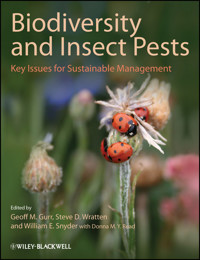
Biodiversity and Insect Pests E-Book
104,99 €
Mehr erfahren.
- Herausgeber: John Wiley & Sons
- Kategorie: Wissenschaft und neue Technologien
- Sprache: Englisch
Biodiversity offers great potential for managing insect pests. It provides resistance genes and anti-insect compounds; a huge range of predatory and parasitic natural enemies of pests; and community ecology-level effects operating at the local and landscape scales to check pest build-up. This book brings together world leaders in theoretical, methodological and applied aspects to provide a comprehensive treatment of this fast-moving field.
Chapter authors from Europe, Asia, Africa, Australasia and the Americas ensure a truly international scope. Topics range from scientific principles, innovative research methods, ecological economics and effective communication to farmers, as well as case studies of successful use of biodiversity-based pest management some of which extend over millions of hectares or are enshrined as government policy.
Written to be accessible to advanced undergraduates whilst also stimulating the seasoned researcher, this work will help unlock the power of biodiversity to deliver sustainable insect pest management.
Visit www.wiley.com/go/gurr/biodiversity to access the artwork from the book.
Sie lesen das E-Book in den Legimi-Apps auf:
Seitenzahl: 951
Veröffentlichungsjahr: 2012
Ähnliche




















Table of Contents
Cover
Title page
Copyright page
Preface
Foreword
Contributors
Introduction
Chapter 1 Biodiversity and insect pests
INTRODUCTION: INSECTS, PLANTS AND HUMANS
BIODIVERSITY
BIOTIC FORCES SHAPING PESTS: BETWEEN THE DEVIL AND THE DEEP BLUE SEA REPRISE
BIODIVERSITY AND ECOSYSTEM FUNCTION
NATURAL ENEMY EVENNESS
CONCLUSION: BIODIVERSITY FOR PEST MANAGEMENT
ACKNOWLEDGEMENTS
Fundamentals
Chapter 2 The ecology of biodiversity–biocontrol relationships
TROPHIC CASCADES
MECHANISMS UNDERLYING BIODIVERSITY–BIOCONTROL RELATIONSHIPS
NON-TROPHIC ENEMY BIODIVERSITY EFFECTS
THE UNDERAPPRECIATED ROLE OF THE SECOND COMPONENT OF BIODIVERSITY: EVENNESS
EFFECTS OF PREY DIVERSITY ON PREDATOR IMPACTS
BIODIVERSITY AND STABILITY
FOOD WEBS: PUTTING TROPHIC INTERACTIONS IN THEIR PLACE
CONCLUSIONS
Chapter 3 The role of generalist predators in terrestrial food webs: lessons for agricultural pest management
INTRODUCTION
WHAT IS A PREDATOR?
GENERALISTS VERSUS SPECIALISTS
IMPLICATIONS OF ECOLOGICAL THEORY FOR BIOLOGICAL CONTROL BY GENERALISTS
ALTERNATIVE PREY AND OMNIVORY
NON-PREY RESOURCES
INTERACTIONS AMONG NATURAL ENEMIES
COMPLEX INTERACTIONS IN DIVERSE SYSTEMS
CONCLUSIONS
ACKNOWLEDGEMENTS
Chapter 4 Ecological economics of biodiversity use for pest management
INTRODUCTION
WHAT IS ECOLOGICAL ECONOMICS?
WHAT ARE ECOSYSTEM SERVICES?
THE ECOLOGICAL ECONOMICS OF ECOSYSTEM SERVICES
THE ECOLOGICAL ECONOMICS OF SUSTAINABLE PEST MANAGEMENT
CONCLUSIONS AND FUTURE RESEARCH
Chapter 5 Soil fertility, biodiversity and pest management
INTRODUCTION
HEALTHY SOILS, HEALTHY PLANTS
INTERACTIONS BETWEEN ABOVE-GROUND AND BELOW-GROUND BIODIVERSITY
SOIL FERTILITY AND PLANT RESISTANCE TO INSECT PESTS
INDIRECT EFFECTS OF SOIL NITROGEN ON CROP DAMAGE BY ARTHROPODS
DYNAMICS OF INSECT HERBIVORES IN ORGANICALLY FERTILISED SYSTEMS
SYNERGIES BETWEEN PLANT DIVERSITY, NATURAL ENEMIES AND SOIL FERTILITY
CONCLUSIONS
Chapter 6 Plant biodiversity as a resource for natural products for insect pest management
INTRODUCTION
BIODIVERSITY OF PLANTS: A RESOURCE OF INSECT CONTROL COMPOUNDS
PHYTOCHEMICALS FOR INSECT CONTROL
LIMONOIDS AND QUASSINOIDS
FUTURE OUTLOOK
ACKNOWLEDGEMENTS
Chapter 7 The ecology and utility of local and landscape scale effects in pest management
INTRODUCTION
LANDSCAPE ECOLOGY AND PEST MANAGEMENT
LANDSCAPE COMPLEXITY AND BIOLOGICAL CONTROL
MECHANISMS BEHIND LANDSCAPE EFFECTS
SPATIAL SCALES OF LANDSCAPE EFFECTS
HABITAT MANIPULATIONS TO IMPROVE BIOLOGICAL CONTROL: ATTEMPTS TO PLACE THE RIGHT DIVERSITY AT THE RIGHT SPATIAL SCALE
CONCLUSION
ACKNOWLEDGEMENTS
Methods
Chapter 8 Scale effects in biodiversity and biological control: methods and statistical analysis
INTRODUCTION AND DEFINITIONS OF SCALE
FROM THE LABORATORY TO THE FIELD: UPSCALING PROBLEMS
FIELD METHODS FOR UNDERSTANDING LANDSCAPE-SCALE PATTERNS
DESIGN AND STATISTICAL ANALYSIS OF LARGE-SCALE BIOLOGICAL CONTROL
MODELLING SCALE EFFECTS IN BIOLOGICAL CONTROL
CONCLUSIONS
Chapter 9 Pick and mix: selecting flowering plants to meet the requirements of target biological control insects
INTRODUCTION
METHODS OF STUDYING FLOWER EXPLOITATION
FLORAL FOOD REQUIREMENTS FOR DIFFERENT GROUPS OF BIOLOGICAL CONTROL AGENTS
CONCLUSION
Chapter 10 The molecular revolution: using polymerase chain reaction Based methods to explore the role of predators in terrestrial food webs
INTRODUCTION
WHY USE MOLECULAR MARKERS?
THE BASICS: DETECTING PREDATION ON A TARGET PREY SPECIES
MULTIPLEXING
ANALYSIS OF PREY CHOICE
QUANTITATIVE (‘REAL TIME’) PCR
CLONING AND SEQUENCING
SOURCES OF ERROR
PYROSEQUENCING AND FUTURE DEVELOPMENTS
CONCLUSION
Chapter 11 Employing Chemical Ecology to Understand and Exploit Biodiversity for Pest Management
INTRODUCTION
HERBIVORE-INDUCED PLANT VOLATILES (HIPVS)
USING SYNTHETIC HIPVS TO TRIGGER HIPV EMISSIONS FROM CROP PLANTS
SILICON ENHANCES HIPV EMISSION AND NATURAL ENEMY ATTRACTION
PROSPECTS
Application
Chapter 12 Using Decision Theory and Sociological Tools to Facilitate Adoption of Biodiversity-Based Pest Management Strategies
INTRODUCTION
FARMER DECISION-MAKING: NEW TECHNOLOGIES
IMPLEMENTATION OF A BIODIVERSITY-BASED PEST MANAGEMENT STRATEGY
CONCLUSION
ACKNOWLEDGEMENTS
Chapter 13 Ecological Engineering Strategies to Manage Insect Pests in Rice
INTRODUCTION
ECOLOGICAL BACKGROUND
THREE PLANKS FOR ECOLOGICAL ENGINEERING IN RICE
CONCLUSION
ACKNOWLEDGEMENTS
Chapter 14 China’s ‘Green Plant Protection’ Initiative: Coordinated Promotion Of Biodiversity-Related Technologies
INTRODUCTION
BACKGROUND TO ‘GREEN PLANT PROTECTION’
CASE STUDIES
CONCLUSION
ACKNOWLEDGEMENTS
Chapter 15 Diversity and Defence: Plant–Herbivore Interactions at Multiple Scales and Trophic Levels
INTRODUCTION
RESISTANCE, COEVOLUTION, AND THE RED QUEEN’S RACE
THE COSTS OF VIRULENCE UNDER THE INFLUENCE OF NATURAL ENEMIES
NATURAL ENEMIES: THE GUARDIANS OF RESISTANCE
GENETIC DIVERSITY REDUCES CROP VULNERABILITY TO HERBIVORES
PLANT DEFENCE WITH A LITTLE HELP FROM FRIENDS
TOLERANCE: A SMALL PRICE FOR RELIABLE PROTECTION
EXTENSION: A KEY COMPONENT OF HOST-PLANT RESISTANCE
WHERE TO FROM HERE?
Chapter 16 ‘Push–Pull’ Revisited: The Process of Successful Deployment of a Chemical Ecology Based Pest Management Tool
INTRODUCTION
THE PUSH–PULL SYSTEM
THE PUSH–PULL CROPPING INNOVATION
CHEMICAL ECOLOGY OF THE PUSH–PULL SYSTEM
NEW DEVELOPMENTS
ECONOMICS OF THE PUSH–PULL TECHNOLOGY
FARMERS’ PERCEPTIONS OF THE PUSH–PULL TECHNOLOGY
UPSCALING OF THE PUSH–PULL TECHNOLOGY
CHALLENGES TO THE PUSH–PULL TECHNOLOGY
WIDER DEPLOYMENT OF THE PUSH–PULL TECHNOLOGY
FUTURE OUTLOOK
CONCLUSIONS
Chapter 17 Using native plant species to diversify agriculture
INTRODUCTION
MAJOR CONCEPTS
CASE STUDIES
CONCLUSION
Chapter 18 Using biodiversity for pest suppression in urban landscapes
INTRODUCTION
BIODIVERSITY IN URBAN LANDSCAPES
URBAN HABITAT BIODIVERSITY AND ARTHROPOD COMMUNITIES
CASE STUDIES OF URBAN HABITAT MANIPULATION AND PEST SUPPRESSION
USE OF HABITAT MANIPULATION FOR PEST MANAGEMENT IN URBAN LANDSCAPES
FUTURE RESEARCH DIRECTIONS: INCREASING THE USE OF URBAN BIODIVERSITY TO IMPROVE PEST SUPPRESSION
ACKNOWLEDGEMENTS
Chapter 19 Cover crops and related methods for enhancing agricultural biodiversity and conservation biocontrol: successful case studies
INTRODUCTION
COVER CROPS AND CONSERVATION TILLAGE IN COTTON IN GEORGIA, USA
CONSERVATION BIOLOGICAL CONTROL BY SYRPHID LARVAE OF NASONOVIA RIBISNIGRI AND OTHER APHIDS IN ORGANICALLY GROWN LETTUCE ON THE CENTRAL COAST OF CALIFORNIA
BEETLE BANKS
CONCLUSIONS
Synthesis
Chapter 20 Conclusion: biodiversity as an asset rather than a burden
INTRODUCTION
SHADES OF GREEN – DIFFERING CONCEPTIONS OF BIODIVERSITY
CONSERVING BIODIVERSITY AND FEEDING NINE BILLION PEOPLE: MUTUALLY EXCLUSIVE OR COMPLEMENTARY GOALS?
FUTURE DIRECTIONS
CONCLUSION
ACKNOWLEDGEMENTS
Index
Color plates
This edition first published 2012 © 2012 by John Wiley & Sons, Ltd.
Wiley-Blackwell is an imprint of John Wiley & Sons, formed by the merger of Wiley’s global Scientific, Technical and Medical business with Blackwell Publishing.
Registered office: John Wiley & Sons, Ltd, The Atrium, Southern Gate, Chichester, West Sussex, PO19 8SQ, UK
Editorial offices: 9600 Garsington Road, Oxford, OX4 2DQ, UK
The Atrium, Southern Gate, Chichester, West Sussex, PO19 8SQ, UK
111 River Street, Hoboken, NJ 07030-5774, USA
For details of our global editorial offices, for customer services and for information about how to apply for permission to reuse the copyright material in this book please see our website at www.wiley.com/wiley-blackwell.
The right of the author to be identified as the author of this work has been asserted in accordance with the UK Copyright, Designs and Patents Act 1988.
All rights reserved. No part of this publication may be reproduced, stored in a retrieval system, or transmitted, in any form or by any means, electronic, mechanical, photocopying, recording or otherwise, except as permitted by the UK Copyright, Designs and Patents Act 1988, without the prior permission of the publisher.
Designations used by companies to distinguish their products are often claimed as trademarks. All brand names and product names used in this book are trade names, service marks, trademarks or registered trademarks of their respective owners. The publisher is not associated with any product or vendor mentioned in this book. This publication is designed to provide accurate and authoritative information in regard to the subject matter covered. It is sold on the understanding that the publisher is not engaged in rendering professional services. If professional advice or other expert assistance is required, the services of a competent professional should be sought.
Library of Congress Cataloging-in-Publication Data
Biodiversity and pests : key issues for sustainable management / edited by Geoff M. Gurr, Steve D. Wratten, William E. Snyder ; with Donna M.Y. Read.
p. cm.
Includes bibliographical references and index.
ISBN 978-0-470-65686-0 (cloth)
ISBN 978-1-118-23182-1 (mobi)
ISBN 978-1-118-23184-5 (epdf)
ISBN 978-1-118-23185-2 (epub)
1. Agricultural pests–Control. 2. Insect pests–Control. 3. Agrobiodiversity. 4. Biodiversity. 5. Sustainable agriculture. 6. Sustainability. I. Gurr, Geoff. II. Wratten, Stephen D. III. Snyder, William E. IV. Read, Donna M. Y.
SB950.B47 2012
363.7'8–dc23
2011046054
A catalogue record for this book is available from the British Library.
Wiley also publishes its books in a variety of electronic formats. Some content that appears in print may not be available in electronic books.
Preface
Agriculture accounts for approximately 40% of the land area on planet Earth and has been a major factor in global biodiversity decline. It is ironic, then, that agriculture is now showing conspicuous signs of faltering because of a breakdown in the services provided by nature. Pest control, soil fertility and nutrient cycling are amongst the most important of these. Industrialised agriculture, in striving for greater levels of productivity, uses inputs such as millions of tons of pesticides and fertilisers to replace natural processes. Reliance on technologies based on non-renewable resources has widely acknowledged problems including pollution, human safety and – in the case of pesticides – reduced efficacy as a result of resistance developing in pest populations.
It is time to consider how agriculture worked in such a sustainable manner for thousands of years before the rise of industrialised agriculture. Much is to be learned from traditional practices of diverse crop systems in which biodiversity is maintained. But if agriculture is also to meet the future needs of an increasing human population, ecological science must rise to the challenge of providing more than theoretical understanding and ingenious new research methods. Practicable methods are also required that will permit highly productive farming systems which, by virtue of their ecological foundation, are more sustainable.
The chapters in this book address this challenge from the perspective of insect pest management. Insect pests continue to cause severe crop losses worldwide but novel pesticides and genetically modified plants are not the only technologies available for their control. This book explores ways in which biodiversity can be harnessed to achieve sustainable pest management. Vegetation diversification at scales ranging from the field up to the landscape can reduce pests either directly or by enhancing the activity of predators and parasites. Biodiversity is also a source of genes for better crop varieties and of compounds that can be used as botanical insecticides or that work by more subtle chemical ecology mechanisms.
The role of biodiversity in pest management is a burgeoning area of research and novel pest management strategies are now being implemented successfully in many countries. Forms of ecologically based pest suppression are important examples of the ecosystem services that can be provided by biodiversity. Moreover, pest suppression can be achieved concurrently with providing other benefits such as pollinator enhancement, wildlife conservation, dual crop production and even carbon sequestration.
Our aim as editors as we planned this book in 2010, the United Nations International Year of Biodiversity, was to achieve a comprehensive synthesis of this exciting and important field of applied science. To this end we recruited authors who include leading researchers and practitioners and combined their wide experience with that of carefully selected younger scientists with innovative thinking. With wide international coverage including Africa, America, Asia, Australasia and Europe, our treatment of the subject is significantly broader that that available from mainstream, English-language journals.
We have strived to make the material in this book accessible to advanced undergraduates and newcomers to the field, with plenty of illustrative features, while still offering the specialist reader a current synthesis and stimulating new ideas. Chapters are arranged under a series of headings (Introduction, Fundamentals, Methods, Application and Synthesis), but these should not be viewed too rigidly. Many of the chapters include a blend of material; especially when stressing the link between aspects of theory and the success of real-world use. Ultimately, we hope that the book will prove useful in placing pest management on a more sustainable footing.
We thank the chapter authors for their generous contribution of ideas, attention to detail and (nearly always) keeping to schedule. Many also served as reviewers for other chapters. We very much appreciate the assistance of the many colleagues who acted as reviewers for chapters: Helmut van Emden, Daniel Karp, Myron Zalucki, Sarah Wheeler, Debbie Finke, Gary Chang, Cory Straub, Deborah Letourneau, Stephen Duke, James Hagler, Wopke van der Werf, Nuria Agusti, Matt Greenstone, Mark Jervis, Jana Lee, Marcel Dicke, Liu Shu Sheng, A. Raman, Bob Bugg, Samantha Cook, Norman Arancon and Katja Poveda. This book would not have been possible without Donna Read, whose input went way beyond proofreading and formatting.
Geoff M. Gurr
Steve D. Wratten
William E. Snyder
August 2011
Foreword
Agriculture has been practised for several thousand years but it is only in the past few generations that the traditional practices that sustained agriculture have come to be replaced by modern and largely industrialised systems. Despite dramatic increases in food production, it is now recognised that agriculture can negatively affect the environment through overuse of natural resources as inputs or through their use as a sink for waste and pollution. Such effects are called negative externalities because they impose costs that are not reflected in market prices. What has also become clear in recent years is that the apparent success of some modern agricultural systems has masked significant negative externalities, with environmental and health problems widely documented. These environmental costs shift conclusions about which agricultural systems are the most efficient, and suggest that alternative practices and systems which reduce negative and increase positive externalities should be sought.
The growing human population and rapidly changing consumption patterns will bring increasing demands for food, fuel and fibre. It is estimated that world population will reach some nine billion by the middle of the twenty-first century. This will require agricultural production to increase by at least two-thirds; perhaps doubled if those in developing countries are to approach levels of animal protein intake that are taken for granted in industrialised countries. The scale of this challenge is daunting but studies of agricultural sustainability in developing countries suggest overall yield increases of 80–100% are possible in many countries and systems. One analysis of 286 projects in 57 countries showed improvements had been made by 12 million farmers on 37 million hectares of farmland (Pretty et al., 2006, Environmental Science and Technology, 4, 1114–1119); a recent study of African agriculture found that 10 million farmers and their families had more than doubled yields on another 13 million hectares (Pretty et al., 2011, International Journal of Agricultural Sustainability, 9, 5–24). Food outputs by such sustainable intensification have been multiplicative – by which yields per hectare increased by combinations of the use of new and improved varieties and new agronomic-agroecological management, and additive – by which diversification resulted in the emergence of a range of new crops, livestock or fish that added to the existing staples or vegetables already being cultivated.
Realising the promise of ecologically based agriculture will require a massive and coordinated effort. A key component is the role of science to both provide a better understanding of the natural resource base and develop new technologies. The significance of this book is that it amply demonstrates the power of biodiversity to combat one of the major causes of crop loss: insect pests. Methods such as growing secondary crops on the embankments around rice fields, incorporating agroforestry into farming systems, using locally appropriate crop varieties and adopting integrated pest management were widely used in these agricultural sustainability studies. Much of what is now happening on farms has drawn from the work of the authors and editors of this book. Each of these methods, and many other biodiversity-based approaches, are detailed in chapters that span the full spectrum from underlying theory, to methods for research and implementation and, ultimately, to cases of successful application and use. This book compellingly shows that biodiversity on farms and across landscapes can provide a range of benefits to humans at the same time as contributing to suppressing pests.
Understanding, protecting and harnessing biodiversity is a key to the agricultural and food challenge before us.
Professor Jules Pretty OBE, University of Essex
August, 2011
Contributors
ALTIERI, MIGUEL A.: Department of Environmental Science, Policy and Management, University of California, Berkeley, USA
BRUCE, TOBY J.A.: Rothamsted Research, Harpenden, Hertfordshire AL5 2JQ, UK
CATINDIG, J.: Crop and Environmental Sciences Division, International Rice Research Institute, DAPO Box 7777 Metro Manila, Philippines
CHENG, J.A.: Institute for Insect Sciences, Zhejiang University, 268 Kaixuan Road, Zhejiang Province, China, 310029
EKBOM, BARBARA: Department of Ecology, Swedish University of Agricultural Sciences, Box 7044, 75007 Uppsala, Sweden
ESCALADA, M.M.: Department of Development Communication, Visayas State University, Baybay, Leyte, Philippines
GÁMEZ-VIRUÉS, SAGRARIO: EH Graham Centre for Agricultural Innovation (Industry and Innovation NSW and Charles Sturt University), PO Box 883 Orange, NSW 2800, Australia
GARDINER, MARY M.: Department of Entomology, The Ohio State University, Ohio Agricultural Research and Development Center, Wooster, OH, USA
GILLESPIE, MARK: Bio-Protection Research Centre, PO Box 84, Lincoln University, Lincoln 7647, New Zealand and Institute of Integrative and Comparative Biology, University of Leeds, Leeds LS2 9JT, UK
GURR, GEOFF M.: EH Graham Centre for Agricultural Innovation (Charles Sturt University and NSW Department of Primary Industries), PO Box 883 Orange, NSW 2800, Australia
HARWOOD, J.D.: Department of Entomology, University of Kentucky, Lexington, Kentucky 40546, USA
HEONG, K.L.: Crop and Environmental Sciences Division, International Rice Research Institute, DAPO Box 7777 Metro Manila, Philippines
HOLLAND, J.M.: Game & Wildlife Conservation Trust, Burgate Manor, Fordingbridge, Hampshire SP6 1EF, UK
HORGAN, FINBARR G.: Crop and Environmental Sciences Division, International Rice Research Institute, DAPO Box 7777, Metro Manila, Philippines
JAMES, DAVID G.: Department of Entomology, Washington State University, Irrigated Agriculture Research and Extension Center, 24106 N. Bunn Road, Prosser, Washington 99350, USA
JONSSON, MATTIAS: Department of Ecology, Swedish University of Agricultural Sciences, Box 7044, 75007 Uppsala, Sweden
KHAN, ZEYAUR R.: International Centre of Insect Physiology and Ecology, PO Box 30772, Nairobi, Kenya
KOUL, OPENDER: Insect Biopesticide Research Centre, 30 Parkash Nagar, Jalandhar-144003, India
LANDIS, DOUGLAS A.: Department of Entomology and Great Lakes Bioenergy Research Center, Michigan State University, East Lansing, MI, USA
LAVANDERO, BLAS: Instituto de Biologia Vegetal y Biotecnolgia, University of Talca, 2 Norte 685, Talca, Chile, Fax : 56-71-200-276, Fono : 56-71-200-280, 200-Talca, Chile
LEATHER, SIMON R.: Division of Biology, Imperial College London, Silwood Park Campus, Ascot, SL5 7PY, UK
LU ZHONGXIAN: Institute of Plant Protection and Microbiology, Zhejiang Academy of Agricultural Sciences, Hangzhou 310021, China
MEYER, KATRIN M.: Department of Ecosystem Modelling, Büsgen-Institut, Georg-August-University of Göttingen, Büsgenweg 4, 37077 Göttingen, Germany
MIDEGA, CHARLES A.O.: International Centre of Insect Physiology and Ecology, PO Box 30772, Nairobi, Kenya
NICHOLLS, CLARA I.: Department of Environmental Science, Policy and Management, University of California, Berkeley, USA
ORRE-GORDON, SOFIA: Bio-Protection Research Centre, PO Box 84, Lincoln University 7647, Canterbury, New Zealand
PEROVIC, DAVID: EH Graham Centre for Agricultural Innovation (NSW Department of Primary Industries and Charles Sturt University), PO Box 883 Orange, NSW 2800, Australia.
PFANNENSTIEL, R.S.: Beneficial Insects Research Unit, USDA-ARS, Weslaco, TX 78599, USA
PICKETT, JOHN A.: Rothamsted Research, Harpenden, Hertfordshire AL5 2JQ, UK
PITTCHAR, JIMMY: International Centre of Insect Physiology and Ecology, PO Box 30772, Nairobi, Kenya
PONTI, LUIGI: Laboratorio Gestione Sostenibile degli Agro-Ecosistemi (UTAGRI-ECO), Agenzia nazionale per le nuove tecnologie, l’energia e lo sviluppo economico sostenibile (ENEA), Centro Ricerche Casaccia, Via Anguillarese 301, 00123 Roma, Italy and Center for the Analysis of Sustainable Agricultural Systems (CASAS), Kensington, CA 94707, USA
READ, DONNA M.Y.: Charles Sturt University, PO Box 883 Orange, New South Wales, Australia
REYNOLDS (NÉE KVEDARAS), OLIVIA L.: EH Graham Centre for Agricultural Innovation (Charles Sturt University and Industry & Investment NSW), Elizabeth Macarthur Agricultural Institute, Woodbridge Road, Menangle, New South Wales 2568, Australia
SCHERBER, CHRISTOPH: Georg-August-University Goettingen, Department of Crop Science, Agroecology, Grisebachstr. 6, D-37077 Goettingen, Germany
SHREWSBURY, PAULA M.: Department of Entomology, University of Maryland, College Park, Maryland 20742, USA
SIMPSON, MARJA: Charles Sturt University, PO Box 883, Leeds Parade, Orange, New South Wales 2800, Australia
SMITH, H.A.: University of Florida, Gulf Coast Research and Education Center, 14625 CR 672, Wimauma, Florida, 33598, USA.
SNYDER, WILLIAM E.: Department of Entomology, Washington State University, Pullman, Washington 99163, USA
SYMONDSON, WILLIAM O.C.: Cardiff School of Biosciences, Biomedical Sciences Building, Museum Avenue, Cardiff, CF10 3AX, UK
TILLMAN, P.G.: USDA, ARS, Crop Protection & Management Research Laboratory, PO Box 748, Tifton, Georgia, 31793, USA
TOMPKINS, JEAN: Bio-Protection Research Centre, Lincoln University, Canterbury, New Zealand.
TSCHARNTKE, TEJA: Department of Crop Sciences, Georg-August-University, Grisebachstr. 6, D-37077 Göttingen, Germany
TYLIANAKIS, JASON M.: Biological Sciences, University of Canterbury, Christchurch 8140, New Zealand
VAN RIJN, PAUL C.J.: Institute for Biodiversity and Ecosystem Dynamics (IBED), University of Amsterdam, The Netherlands
VISSER, UTE: Georg-August-University, Grisebachstr. 6, D-37077 Göttingen, Germany
WÄCKERS FELIX L.: Lancaster University, LEC, Centre for Sustainable Agriculture, Lancaster, UK and Biobest, Ilse Velden 18, Westerlo, Belgium
WELCH, K.D.: Department of Entomology, University of Kentucky, Lexington, Kentucky 40546, USA
WIEGAND, KERSTIN: University of Goettingen, Büsgenweg 4, 37077, Göttingen, Germany.
WRATTEN, STEVE D.: Bio-Protection Research Centre, PO Box 84, Lincoln University, Lincoln 7647, New Zealand
YANG PUYUN: National Agro-Technical Extension and Service Centre, Ministry of Agriculture, Beijing 100125, China
YANG YAJUN: Institute of Plant Protection and Microbiology, Zhejiang Academy of Agricultural Sciences, Hangzhou 310021, China
ZHAO ZHONGHUA: National Agro-Technical Extension and Service Centre, Ministry of Agriculture, Beijing 100125, China
Introduction
Chapter 1
Biodiversity and insect pests
Geoff M. Gurr, Steve D. Wratten and William E. Snyder
INTRODUCTION: INSECTS, PLANTS AND HUMANS
This book is essentially about interactions between the three most important life forms on planet Earth: insects, plants and humans, and the ways in which they are affected by biodiversity, the complex web of life. Over a million species of insect have been formally described (20 times the number of all vertebrates), with just one insect order, the beetles (Coleoptera), representing 25% of all described species of all forms of life (Hunt et al., 2007). It has been estimated that the biomass of insects in temperate terrestrial ecosystems is 10 times that of the usually more conspicuous vertebrates, and that for each human there are 1,000,000,000,000,000,000 living insects (Meyer, 2009).
Insect and plant biodiversity are tightly linked, and it is generally accepted that the rise of angiosperm plants during the Cretaceous period (145–65 million years ago) was accompanied by the development of many intricate coadaptations between plants and insects. These included pollination and seed dispersal (Ehrlich and Raven, 1964; Scriber, 2010), such that many insects benefit plants. However, many other insect species are herbivores harmful to plants, and there is compelling evidence for coevolution between plant defences and the ability of insect herbivores to overcome them. An example of great relevance to agricultural pest management is the phenomenon of ‘resistance breakdown’. This occurs when a pest population responds to the resistance genes bred into into a widely used crop variety by the development of increased virulence over successive generations of the adapting pest (e.g. McMenemy et al., 2009). This renders the host plant’s resistance mechanism(s) ineffective.
In contrast to the two ‘mega taxa’ sketched out above, Homo sapiens is an evolutionary newcomer, as anatomically modern humans have existed for much less than a million years. Of course it is only in the last few centuries that technological advances have allowed numbers of this single species to escalate, approaching seven billion as of June 2011 (US Census Bureau, 2011). The impacts of this rise are such that we are now said to be living in the Anthropocene era (Crutzen, 2006), characterised by very high rates of species extinctions, pollution (including elevated atmospheric carbon dioxide levels) affecting every corner of the globe, destruction of natural ecosystems and high levels of land use for urban and agricultural purposes. Amongst the most important technological advances that have allowed this dramatic success (‘success’ at least in terms of the population size of H. sapiens) is agriculture.
The concept of ‘pests’ has arisen out of human agricultural practice and the desire to preserve food security by protecting crops from ubiquitous insects. Some, such as the locust (most likely desert locust, Schistocerca gregaria Forsk. (Orthoptera, Acridiidae)), are mentioned in the Bible and in other early written works (Nevo, 1996). For many centuries, farmers combated pests with cultural techniques ranging from hand removal of pests to the use of crop rotations. Saving the best seeds from each year’s crop to sow in the following season led to the development of many landraces (locally adapted varieties) of major crop species, some of which persist to the present day (Thomson et al., 2009). These landraces often had useful levels of broadly based resistance to various pests to which they were exposed for hundreds of generations. More recently, other technologies were brought to bear against pests including chemistry to produce ever more sophisticated insecticides (Casida and Quistad, 1998), radiation technology to allow the development of the sterile insect technique (Dyck et al., 2005) and molecular biology to support plant breeding efforts (Sanchis and Bourguet, 2008). Many pest management technologies, however, are beset with problems of a technical nature (e.g. pollution, resistance breakdown, cost, etc. (van Emden and Peakall, 1996)) or a social nature (e.g. public acceptance of biotechnology in agriculture, deregistration of insecticides because of safety concerns (Cullen ., 2008; Lemaux, 2009)).
Lesen Sie weiter in der vollständigen Ausgabe!
Lesen Sie weiter in der vollständigen Ausgabe!
Lesen Sie weiter in der vollständigen Ausgabe!
Lesen Sie weiter in der vollständigen Ausgabe!
Lesen Sie weiter in der vollständigen Ausgabe!
Lesen Sie weiter in der vollständigen Ausgabe!
Lesen Sie weiter in der vollständigen Ausgabe!
Lesen Sie weiter in der vollständigen Ausgabe!
Lesen Sie weiter in der vollständigen Ausgabe!
Lesen Sie weiter in der vollständigen Ausgabe!
Lesen Sie weiter in der vollständigen Ausgabe!
Lesen Sie weiter in der vollständigen Ausgabe!
Lesen Sie weiter in der vollständigen Ausgabe!
Lesen Sie weiter in der vollständigen Ausgabe!
Lesen Sie weiter in der vollständigen Ausgabe!
Lesen Sie weiter in der vollständigen Ausgabe!
Lesen Sie weiter in der vollständigen Ausgabe!
Lesen Sie weiter in der vollständigen Ausgabe!
Lesen Sie weiter in der vollständigen Ausgabe!
Lesen Sie weiter in der vollständigen Ausgabe!
Lesen Sie weiter in der vollständigen Ausgabe!




