


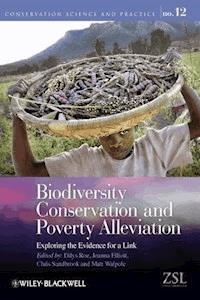
Biodiversity Conservation and Poverty Alleviation E-Book
64,99 €
Mehr erfahren.
- Herausgeber: John Wiley & Sons
- Kategorie: Wissenschaft und neue Technologien
- Serie: Conservation Science and Practice
- Sprache: Englisch
Biodiversity conservation and poverty alleviation are both important societal goals demanding increasing international attention. While they may seem to be unrelated, the international policy frameworks that guide action to address them make an explicit assumption that conserving biodiversity will help to tackle global poverty. Part of the Conservation Science and Practice Series published with the Zoological Society of London, this book explores the validity of that assumption. The book addresses a number of critical questions:
- Which aspects of biodiversity are of value to the poor?
- Does the relationship between biodiversity and poverty differ according to particular ecological conditions?
- How do different conservation interventions vary in their poverty impacts?
- How do distributional and institutional issues affect the poverty impacts of interventions?
- How do broader issues such as climate change and the global economic system affect the biodiversity – poverty relationship at different scales?
This volume will be of interest to policy-makers, practitioners and researchers concerned with understanding the potential - and limitations - of integrated approaches to biodiversity conservation and poverty alleviation.
Sie lesen das E-Book in den Legimi-Apps auf:
Seitenzahl: 608
Veröffentlichungsjahr: 2012
Ähnliche




















Table of Contents
Conservation Science and Practice Series
Title Page
Copyright
Contributors
Preface and Acknowledgements
Introduction
Chapter 1: Linking Biodiversity Conservation and Poverty Alleviation: What, Why and Where?
Biodiversity Conservation and Poverty Alleviation: Separate or Linked Challenges?
Where is The Evidence for Biodiversity–Poverty Linkages? The Objectives and Structure of This Book
A Note on Terminology
Biodiversity, Ecosystem Services and Poverty—The Potential for Synergies
Biodiversity and Poverty Relationships in Different Ecological Settings
Poverty Impacts of Different Conservation Interventions
Distributional and Institutional Issues
Biodiversity and Poverty Relationships in the Context of Global Challenges
References
Part I: Biodiversity, Ecosystem Services and Poverty—The Potential for Synergies
Chapter 2: The Potential, Realised and Essential Ecosystem Service Benefits of Biodiversity Conservation
Introduction
Approach and Methods
Potential Ecosystem Service Value: Economic Values Irrespective of Use
Realised Services: Valuing Ecosystem Services by Considering Their Use
Essential Services: Valuing the Ecosystem Services the Poor Rely Upon
Estimating All Benefits to the Poor: Essential Services and Payments for Environmental Services
Conclusions: Linking Ecosystem Service Flows, People and Biodiversity
Acknowledgements
References
Chapter 3: Poverty Reduction and Biodiversity Conservation: Using the Concept of Ecosystem Services to Understand the Linkages
Introduction
Ecosystem Services: Essential to Human Well-Being and a Lifeline for the Poor
Getting Aggregate Indicators Right—‘GDP of the Poor’
Assessing Ecosystem Services Reveals Poverty Implications
Identifying Property Rights to Nature
Working with Rights to Nature: Considering Property Rights and Regimes in Policy Design
How to Structure a Combined Assessment of Ecosystem Services and Related Property Rights
Conclusions
References
Chapter 4: Dependence of the Poor on Biodiversity: Which Poor, What Biodiversity?
Introduction
Definitional Issues
Approach and Methods
Dependence on Biodiversity: Direct Livelihood Linkages
Evidence on Dependence
Relative Dependence on Biodiversity Resources: Are the Poor Disproportionately Dependent?
Impacts on Inequality: Does The Inclusion of Biodiversity-Based Resources Improve Distributional Outcomes?
Dependence on Biodiversity: Insurance and Risk Coping
Agro-Biodiversity for Food Security Insurance
Wild Food Products, Biodiversity and Food Security
Biodiversity and Natural Hazards
Biodiversity and Health Risks
Biodiversity and Resilience
Conclusions
References
Part II: Biodiversity and Poverty Relationships in Different Ecological Settings
Chapter 5: Forests, Poverty and Conservation: An Overview of the Issues
Introduction
The Nature of ‘Forest Dependency’
Forests, Poverty and Remoteness
Influence of Forest Dwellers on Biodiversity
Influence of Conservation Activities on Poverty
Combining Biodiversity Conservation and Poverty Alleviation in Forest Communities
References
Chapter 6: Biodiversity and Poverty in Coastal Environments
Introduction: The Nature and Scale of Coastal Diversity
Linking Coastal Biodiversity and Poverty
Ecosystem Services Available to the Poor
Benefit Flows to the Poor
Threats to Poverty–Biodiversity Linkages
Conservation and Its Impact on the Poor
The Factors Influencing Livelihood Responses
Future Directions
References
Chapter 7: Linking Biodiversity and Poverty Alleviation in the Drylands—The Concept of ‘Useful’ Biodiversity
Introduction
Biodiversity in the Sahelian Context
Agro-Diversity and ‘Wild’ Biodiversity
Biodiversity and Rangeland Degradation
Trees, Shrubs and ‘Deforestation’
Faunal Diversity—Livestock
Biodiversity Conservation with Poverty Reduction?
Conclusion
References
Chapter 8: Biodiversity Isn't Just Wildlife—Conserving Agricultural Biodiversity as a Vital Contribution to Poverty Reduction
Introduction
Agro-Biodiversity and Poverty
Rural Poverty on the Increase
Focussing Attention on Sustainable Agriculture
Enhancing Genetic Diversity
Greater Species Diversity Increases Productivity and Reduces Farmers' Risks
Looking at The Ecosystem Level
Do Markets Work for Biodiversity and Poverty?
Towards an Integrated Approach: Next Steps in Enhancing the Contribution of Agricultural Biodiversity to Poverty Reduction
References
Part III: Poverty Impacts of Different Conservation Interventions
Chapter 9: Does Conserving Biodiversity Work to Reduce Poverty? A State of Knowledge Review
Introduction
Approach
Conservation Interventions
Challenges and Knowledge Gaps
Conclusions
References
Chapter 10: Protected Areas—What People Say about Well-Being
Introduction
Who Knows What about the Social Impacts of Protected Areas?
What are the Social Impacts of Protected Areas, and How Widespread Are They?
What Affects Who Experiences the Impacts of Protected Areas, and Why?
Conclusion
References
Chapter 11: Species Conservation and Poverty Alleviation—The Case of Great Apes in Africa
Introduction
The Relationship Between Species Conservation and Poverty
African Ape Conservation and Poverty Alleviation
Conclusions and Recommendations
Acknowledgements
References
Chapter 12: Community-Based Natural Resource Management (CBNRM) and Reducing Poverty in Namibia
Introduction
Community-Based Natural Resource Management in Namibia
Benefits from Conservancies
Limitations on Conservancy Benefits—Elite Capture
The Costs of Living with Wildlife
Conclusions
References
Chapter 13: Conservation Enterprise: What Works, Where and for Whom?
Why Conservation Enterprise?
The African Wildlife Foundation's Conservation Enterprise Programme
Measuring Conservation and Poverty Impacts
What are the Impacts of Conservation Enterprises?
Impact on Biodiversity
What Types of Conservation Enterprises Work Best?
Key Challenges for Successful Enterprise Development
Conclusions
Acknowledgements
References
Part IV: Distributional and Institutional Issues
Chapter 14: Payments for Environmental Services: Conservation with Pro-Poor Benefits
Introduction
Do Poor People Sell Environmental Services?
Do Poor People Gain from Selling Environmental Services?
Do Poor Environmental Service Users Benefit from PES?
How do Poor Non-Participants Fare?
Conclusions
References
Chapter 15: Pastoralism and Conservation—Who Benefits?
Introduction
Approach and Methods
Livestock, Farming, Off-Farm Work and Livelihoods in Maasailand
Income from Wildlife—What Role in Livelihoods?
Why does Wildlife Fail to Generate Local Benefits?
Moving Forward
Acknowledgements
References
Chapter 16: Local Organisations—An Entry Point for Conservation and Poverty Reduction
Introduction
What are Local Organisations?
The Importance of Local Organisations
Local Organisations: A Route to Participation and Good Governance
Scaling Up and Enabling Factors
Support to Local Organisations–Policy and Programmes
Issues and Challenges
Emerging Issues and Opportunities for Local Organisations
Conclusion
References
Chapter 17: Poverty Reduction Isn't Just about Money: Community Perceptions of Conservation Benefits
Introduction
Study Background and The Nature of Community Benefits
Exploring Benefits in 10 Equator Initiative Cases
Focussing on Local Objectives and Priorities
Discussion and Conclusions
Acknowledgements
References
Part V: Biodiversity and Poverty Relationships in the Context of Global Challenges
Chapter 18: Biodiversity, Poverty and Climate Change: New Challenges and Opportunities
Introduction
Maintaining Water Supplies
Food Security
Health
Reducing Vulnerability to Natural Disasters
Looking Forward—Opportunities for Enhancing the Synergies Between Biodiversity, Climate Change and Poverty Alleviation
Conclusion
References
Chapter 19: Conservation in the Anthropocene: Biodiversity, Poverty and Sustainability
Conservation, Community and Poverty
Away from the Last Frontier
Development, iPads and Ivory
Conservation's Development Paradox
The Challenge of Sustainability
Conservation's Challenge
References
Chapter 20: Tackling Global Poverty: What Contribution Can Biodiversity and Its Conservation Really Make?
Introduction
Do Biodiversity and Its Conservation Contribute to Poverty Alleviation?
So should Development Pay More Attention to Biodiversity?
The Need for Improved Evidence of Causal Linkages and The Results of Actions
Implications: Improving Policy and Practice
References
Index
Conservation Science and Practice Series
Published in association with the Zoological Society of London
Wiley-Blackwell and the Zoological Society of London are proud to present our Conservation Science and Practice series. Each book in the series reviews a key issue in conservation today from a multidisciplinary viewpoint.
Books in the series can be single or multi-authored and proposals should be sent to:
Each book proposal will be assessed by independent academic referees, as well as our Series Editorial Panel. Members of the Panel include:
Previously published
This edition first published 2013 © 2013 by John Wiley & Sons, Ltd
Wiley-Blackwell is an imprint of John Wiley & Sons, formed by the merger of Wiley's global Scientific, Technical and Medical business with Blackwell Publishing.
Registered office: John Wiley & Sons, Ltd, The Atrium, Southern Gate, Chichester, West Sussex, PO19 8SQ, UK
Editorial offices: 9600 Garsington Road, Oxford, OX4 2DQ, UK
The Atrium, Southern Gate, Chichester, West Sussex, PO19 8SQ, UK
111 River Street, Hoboken, NJ 07030-5774, USA
For details of our global editorial offices, for customer services and for information about how to apply for permission to reuse the copyright material in this book please see our website at www.wiley.com/wiley-blackwell.
The right of the author to be identified as the author of this work has been asserted in accordance with the UK Copyright, Designs and Patents Act 1988.
All rights reserved. No part of this publication may be reproduced, stored in a retrieval system, or transmitted, in any form or by any means, electronic, mechanical, photocopying, recording or otherwise, except as permitted by the UK Copyright, Designs and Patents Act 1988, without the prior permission of the publisher.
Designations used by companies to distinguish their products are often claimed as trademarks. All brand names and product names used in this book are trade names, service marks, trademarks or registered trademarks of their respective owners. The publisher is not associated with any product or vendor mentioned in this book. This publication is designed to provide accurate and authoritative information in regard to the subject matter covered. It is sold on the understanding that the publisher is not engaged in rendering professional services. If professional advice or other expert assistance is required, the services of a competent professional should be sought.
Library of Congress Cataloging-in-Publication Data
Biodiversity conservation and poverty alleviation : exploring the evidence for a link / edited by
Dilys Roe ... [et al.].
p. cm.
Includes bibliographical references and index.
ISBN 978-0-470-67479-6 (cloth)—ISBN 978-0-470-67478-9 (pbk.) 1. Biodiversity conservation—Economic aspects. 2. Poverty—Prevention—Environmental aspects. I. Roe, Dilys.
QH75.B53225 2013
333.95′16—dc23
2012017200
A catalogue record for this book is available from the British Library.
Wiley also publishes its books in a variety of electronic formats. Some content that appears in print may not be available in electronic books.
Front Cover Image: A Malawian girl carries beans back to her village of Murela in the Phalombe District which is east of Blantyre, Malawi, July 3, 2002. After the droughts and flooding in the last year, half of the students stopped going to school because of the ongoing food shortage in the region. The World Food Program estimates that 3.2 million people in Malawi alone will be affected before March 2003. © Ami Vitale. www.amivitale.com
Cover Design By: Edge Creative
www.edgecreativestudio.com
Contributors
Preface and Acknowledgements
The links between environment and development have long been discussed, but only recently has this discussion focussed specifically on the possible links between biodiversity conservation and poverty alleviation. In 2002, the Convention on Biological Diversity (CBD) adopted a target “to achieve by 2010 a significant reduction of the current rate of biodiversity loss at the global, regional and national level as a contribution to poverty alleviation and to the benefit of all life on earth”. The “2010 Target” was not met and it is clear that biodiversity loss is continuing apace–but even if conservation efforts were successful, would this really contribute to poverty alleviation? There is a diversity of opinion as to the nature and scale of biodiversity conservation, poverty alleviation links and the most appropriate mechanisms that can help to maximise them. Also, many generalisations and assumptions are made about these links. To explore the current state of knowledge and to challenge some of the prevailing myths and assumptions, a 2-day symposium titled ‘Linking biodiversity conservation and poverty alleviation: what, why and how?’ was organised at the Zoological Society of London (ZSL) in April 2010 by the editors of this book. This book is based on the presentations made during that symposium.
First and foremost, the editors would like to thank all the presenters at the meeting and the authors of the chapters contained in this book, for the care, rigour and patience with which they carried out their work. We are grateful to ZSL for hosting this meeting, and for the support offered throughout the organisation of the meeting and the development of this book. Joy Hayward and Linda Da Volls deserve a special mention for their dedication and the countless hours they worked to ensure the successful delivery of this event. We would like to thank Jon Hutton (UNEP-WCMC), Nigel Leader-Williams (University of Cambridge) and Matthew Hatchwell (Wildlife Conservation Society) for expertly chairing sessions during the symposium. A thank you also goes to Bill Adams (University of Cambridge), Willy Douma (Hivos), Katrina Brandon (Conservation International), Steve Bass (International Institute for Environment and Development [IIED]) and Jayant Sarnaik (Applied Environmental Research Foundation) who were engaging panellists in the closing session of the symposium. Finally, a mention goes to award winners from the Equator Initiative and everyone else who prepared and presented a poster during the symposium. Even though the posters have not been included in the present book, the poster sessions were a valuable and highly appreciated feature of the symposium.
Funding for the symposium and the outputs associated with it was provided through the generous support of a range of donors that support IIED including the Danish International Development Agency, the Department for International Development (United Kingdom), the Directorate-General for International Cooperation (the Netherlands), Irish Aid, the Norwegian Agency for Development Cooperation, the Swedish International Development Cooperation Agency and the Swiss Agency for Development and Cooperation; and through the African Wildlife Foundation and United Nations Environment Programme World Conservation Monitoring Centre (UNEP-WCMC). The symposium was organised under the umbrella of the Poverty and Conservation Learning Group (www.povertyandconservation.info) which is supported by the Arcus Foundation.
We are very grateful to Ward Cooper, Carys Williams and Kelvin Matthews at Wiley-Blackwell for their assistance during the production of this book and to our institutions–the International Institute for Environment and Development, African Wildlife Foundation and United Nations Environment Programme World Conservation Monitoring Centre—for providing the time and space for our editorial contributions. Before submitting this book to Wiley-Blackwell, a considerable effort was put into carefully reviewing each chapter to ensure accuracy and consistency of style. For this, we would like to thank Jessica Smith at UNEP-WCMC and also Abisha Mapendembe, who diligently checked every reference and numbered every box! Last, but not least, we would like to thank Alessandra Giuliani from IIED without whom production of this book would not have been possible. Alessandra coordinated the entire editorial process, acted as a focal point for communications with the authors and gently kept us all on track to completion.
Dilys Roe, Joanna Elliott, Chris Sandbrook and Matt Walpole February 2012
Introduction
Chapter 1
Linking Biodiversity Conservation and Poverty Alleviation: What, Why and Where?
Dilys Roe1, Joanna Elliott2, Chris Sandbrook3and Matt Walpole3
1International Institute for Environment and Development, London, UK
2African Wildlife Foundation, Oxford, UK
3United Nations Environment Programme World Conservation Monitoring Centre, Cambridge, UK
Biodiversity Conservation and Poverty Alleviation: Separate or Linked Challenges?
Biodiversity conservation and poverty alleviation are both important societal goals demanding increasing international attention. At first glance they may appear to be separate policy realms with little connection. The former is largely the concern of ministries of environment, conservation organisations and ecologists; the latter falls within the remit of ministries of finance and planning, development organisations and economists. The Convention on Biological Diversity (CBD), agreed in 1992, was drafted in response to escalating biodiversity loss and provides an international policy framework for biodiversity conservation activities worldwide. Similarly, the Organisation for Economic Co-operation and Development (OECD) International Development Targets of 1996—reiterated as the Millennium Development Goals (MDGs) in 2000—focus international development efforts on global poverty alleviation.
On closer inspection, although ostensibly aimed at very different communities of interest, both of these policy frameworks recognise links between their objectives:
The preamble of the CBD acknowledges that “economic and social development and poverty eradication are the first and overriding priorities of developing countries”. In 2002 the Conference of Parties (CoP) to the CBD agreed a Strategic Plan which included a target to “achieve by 2010 a significant reduction of the current rate of biodiversity loss … as a contribution to poverty alleviation and to the benefit of all life on Earth” (CBD, 2002). The new has a mission to halt the loss of biodiversity thereby contributing to human well-being and poverty eradication (CBD, 2010). The 2010 CoP also adopted a decision on the “integration of biodiversity into poverty eradication and development” (Decision X/VI).
Lesen Sie weiter in der vollständigen Ausgabe!
Lesen Sie weiter in der vollständigen Ausgabe!
Lesen Sie weiter in der vollständigen Ausgabe!
Lesen Sie weiter in der vollständigen Ausgabe!
Lesen Sie weiter in der vollständigen Ausgabe!
Lesen Sie weiter in der vollständigen Ausgabe!
Lesen Sie weiter in der vollständigen Ausgabe!
Lesen Sie weiter in der vollständigen Ausgabe!
Lesen Sie weiter in der vollständigen Ausgabe!
Lesen Sie weiter in der vollständigen Ausgabe!
Lesen Sie weiter in der vollständigen Ausgabe!
Lesen Sie weiter in der vollständigen Ausgabe!
Lesen Sie weiter in der vollständigen Ausgabe!
Lesen Sie weiter in der vollständigen Ausgabe!
Lesen Sie weiter in der vollständigen Ausgabe!
Lesen Sie weiter in der vollständigen Ausgabe!
Lesen Sie weiter in der vollständigen Ausgabe!
Lesen Sie weiter in der vollständigen Ausgabe!
Lesen Sie weiter in der vollständigen Ausgabe!
Lesen Sie weiter in der vollständigen Ausgabe!
Lesen Sie weiter in der vollständigen Ausgabe!
Lesen Sie weiter in der vollständigen Ausgabe!
Lesen Sie weiter in der vollständigen Ausgabe!
Lesen Sie weiter in der vollständigen Ausgabe!
Lesen Sie weiter in der vollständigen Ausgabe!




