


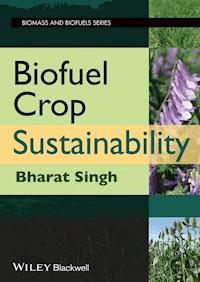
Biofuel Crop Sustainability E-Book
187,99 €
Mehr erfahren.
- Herausgeber: John Wiley & Sons
- Kategorie: Wissenschaft und neue Technologien
- Sprache: Englisch
Biofuel Crop Sustainability brings together the basic principles of agricultural sustainability and special stipulations for biofuels, from the economic and ecological opportunities and challenges of sustainable biofuel crop production to the unique characteristics of particular crops which make them ideal for biofuel applications. This book will be a valuable resource for researchers and professionals involved in biofuels development and production as well as agriculture industry personnel. Chapters focus the broad principles of resource management for ecological, environmental and societal welfare, the sustainability issues pertaining to several broad categories of biofuel crops , as well as the economics and profitability of biofuels on both a local and international scale. Coverage includes topics such as utilizing waste water for field crop irrigation and algae production, reliability of feedstock supply, marginal lands, and identifying crops with traits of significance for survival and growth on low fertility soils. The development of production practices with low external inputs of fertilizer, irrigation, and pesticides is also covered. Biofuel Crop Sustainability will be a valuable, up-to-date reference for all those involved in the rapidly expanding biofuels industry and sustainable agriculture research fields.
Sie lesen das E-Book in den Legimi-Apps auf:
Seitenzahl: 1099
Veröffentlichungsjahr: 2013
Ähnliche




















Contents
Cover
Title Page
Copyright
Contributors
Preface
Chapter 1: Biofuel Crop Sustainability Paradigm
Introduction
Biofuel and Biofuel Crops
Fossil Fuel versus Biofuel
Biofuel Sustainability Concept
Biofuel Sustainability—USA as Case Study
Biofuel Sustainability Outlook
Biofuel Sustainability Concerns
Summary and Conclusions
References
Chapter 2: Sustainable Production of Grain Crops for Biofuels
Introduction
Global Demand for Food and Energy
Grain Crops: Food or Biofuel
Ecosystem Services
Environmental Impact
Direct and Indirect Land-use Change
Genetic Improvement
Life-cycle Analysis
Conversion Technologies
Innovations to Enhance Sustainability
Research Needs and the Future of Grain-based Biofuels
Conclusions
References
Chapter 3: Sugarcane as an Energy Crop: Its Role in Biomass Economy
Introduction
Environmental Requirements
Conditions for Optimal Growth
Sugarcane Disease and Pest Control
Weed Control
Harvesting
Yield
Genetics and Breeding
Sugarcane Physiology
Life-cycle Assessment of Sugarcane Biofuel Production
Sustainability
Future Initiatives
References
Chapter 4: Sustainable Cellulosic Grass Crop Production
Introduction
A Sustainable Energy Crop Ideotype
Grass Feedstocks of Interest
Harvest, Storage, Logistics, and Process Considerations of Perennial Grasses
The Bigger Picture: Sustainability Issues for Herbaceous Energy Systems
Some Concluding Thoughts
References
Chapter 5: Sustainable Oil Crops Production
Introduction
Soybean (Glycine max)
Rapeseed (Brassica napus)
Ethiopian Mustard (Brassica carinata)
Camelina (Camelina sativa)
Oil Palm (Elaeis guineensis)
Life-cycle Analysis of Biofuel Production from Oil Crops
Conclusion
References
Chapter 6: Short-rotation Woody Crop Biomass Production for Bioenergy
Introduction
Shrub Willow (Salix spp.)
Poplar (Populus spp.)
Pine (Pinus spp.)
Environmental Sustainability Issues
Bioenergy Potential, Production, and Economics
Phytoremediation Potential
Conclusions
References
Chapter 7: Biomass Feedstock Production Impact on Water Resource Availability
Introduction
Climate and Weather Impact on Water Supply
Water Use for Major Bioenergy Crops for Ethanol
Potential Alternatives
Conclusions
References
Chapter 8: Biofuel Crops and Soil Quality and Erosion
Introduction
Soil Quality Definition and Assessment
Biofuel Crop Production and Soil Quality
Soil Quality and Sustainable Biofuel Crop Production
Biofuel Crops to Remedy Soil Contamination
Conclusions
Acknowledgments
References
Chapter 9: Nutrient Management in Biofuel Crop Production
Introduction
Fertility Requirement of Bioenergy Crops
Carbon Sequestration Potential of Bioenergy Crops
Conclusions
References
Chapter 10: Food, Farming, and Biofuels
Introduction
Risks to Food Security
Energy Security
Environmental Impact of Land-Use Change for Biofuel
Social Impact of Biofuel Production
References
Chapter 11: Biofuel Crops, Ecosystem Services, and Biodiversity
Introduction
The MA Framework as Applied to Biofuels
Impacts on Biodiversity
Response Options for Ecologically Sustainable Biofuel Production
Concluding Remarks
References
Chapter 12: Biofuel Crops and Greenhouse Gases
Introduction
Land Cover Change
Land as a Limiting Factor
Soil Emissions
Use of Fertilizers
Crop Management
Conversion Processes and Cost
LCA Methodology and Boundary Conditions
GHG Emissions from Indirect Land-use Change
References
Chapter 13: Economics of Biomass Feedstocks and Biofuels
Introduction
Background on Biofuels
Life-cycle Analysis as Component of Biofuel Economic Value
Economics of Biofeedstock and Biofuel Production
Cellulosic Biofeedstock Production: The Case of Crop Residues
Biomass Pricing and Standards
The Real Constraint to Financing Biofuel Development—Uncertain Policy
Conclusions
References
Chapter 14: Geospatial Modeling Applications for Biofuel Sustainability Assessment
Introduction
Spatial Suitability Analysis of Biofuel Crops
Precision Agriculture for Higher Biomass Crop Yield
Model or Procedure Development for Forest Quality Analysis
Environmental (Soil and Hydrologic) Impact Analysis with Geospatial Technology
References
Appendix I: Botanical Names
Index
This edition first published 2013 © 2013 by John Wiley & Sons, Inc.
Editorial offices:2121 State Avenue, Ames, Iowa 50014-8300, USA The Atrium, Southern Gate, Chichester, West Sussex, PO19 8SQ, UK 9600 Garsington Road, Oxford, OX4 2DQ, UK
For details of our global editorial offices, for customer services and for information about how to apply for permission to reuse the copyright material in this book please see our website at www.wiley.com/wiley-blackwell.
Authorization to photocopy items for internal or personal use, or the internal or personal use of specific clients, is granted by Blackwell Publishing, provided that the base fee is paid directly to the Copyright Clearance Center, 222 Rosewood Drive, Danvers, MA 01923. For those organizations that have been granted a photocopy license by CCC, a separate system of payments has been arranged. The fee codes for users of the Transactional Reporting Service are ISBN-13: 978-0-4709-6304-3/2013.
Designations used by companies to distinguish their products are often claimed as trademarks. All brand names and product names used in this book are trade names, service marks, trademarks or registered trademarks of their respective owners. The publisher is not associated with any product or vendor mentioned in this book.
The contents of this work are intended to further general scientific research, understanding, and discussion only and are not intended and should not be relied upon as recommending or promoting a specific method, diagnosis, or treatment by health science practitioners for any particular patient. The publisher and the author make no representations or warranties with respect to the accuracy or completeness of the contents of this work and specifically disclaim all warranties, including without limitation any implied warranties of fitness for a particular purpose. In view of ongoing research, equipment modifications, changes in governmental regulations, and the constant flow of information relating to the use of medicines, equipment, and devices, the reader is urged to review and evaluate the information provided in the package insert or instructions for each medicine, equipment, or device for, among other things, any changes in the instructions or indication of usage and for added warnings and precautions. Readers should consult with a specialist where appropriate. The fact that an organization or Website is referred to in this work as a citation and/or a potential source of further information does not mean that the author or the publisher endorses the information the organization or Website may provide or recommendations it may make. Further, readers should be aware that Internet Websites listed in this work may have changed or disappeared between when this work was written and when it is read. No warranty may be created or extended by any promotional statements for this work. Neither the publisher nor the author shall be liable for any damages arising herefrom.
Library of Congress Cataloging-in-Publication Data
Biofuel crop sustainability / editor, Bharat P. Singh. – 1st ed. p. cm. Includes bibliographical references and index. ISBN 978-0-470-96304-3 (hardback : alk. paper) – ISBN 978-1-118-63564-3 (epdf) – ISBN 978-1-118-63572-8 (epub) – ISBN 978-1-118-63578-0 (emobi) – ISBN 978-1-118-63579-7 1. Energy crops. 2. Sustainable agriculture. I. Singh, Bharat P. SB288.B565 2013 631.5–dc23 2013002832
A catalogue record for this book is available from the British Library.
Wiley also publishes its books in a variety of electronic formats. Some content that appears in print may not be available in electronic books.
Cover design by Nicole Teut
Contributors
Shaun D. Berry, Becker Underwood, Gillitts, South Africa
Nanthi Bolan, Centre for Environmental Risk Assessment and Remediation (CERAR), University of South Australia, Mawson Lakes, Australia
K.B. Cantrell, USDA-ARS Coastal Plains Soil, Water, and Plant Research Center, Florence, SC, USA
Dmitri Chatskikh, George Lemaître Centre for Earth and Climate Research, Earth and Life Institute, Catholic University of Louvain, Louvain-la-Neuve, Belgium
Christina Eynck, Linnaeus Plant Sciences Inc., Saskatoon Research Centre, Saskatoon, Canada
Kevin C. Falk, Agriculture and Agri-Food Canada, Saskatoon Research Centre, Saskatoon, Canada
Andrew Fieldsend, Research Institute of Agricultural Economics, Budapest, Hungary
John H. Fike, Crop and Soil Environmental Sciences, Virginia Polytechnic Institute and State University, Blacksburg, VA, USA
Wonae B. Fike, Crop and Soil Environmental Sciences, Virginia Polytechnic Institute and State University, Blacksburg, VA, USA
Thomas R. Fox, Department of Forest Resources and Environmental Conservation, Virginia Tech, Blacksburg, VA, USA
Wolfgang Friedt, Department of Plant Breeding, Justus Liebig University Giessen, Giessen, Germany
Cole Gustafson (Late Chair), Department of Agribusiness and Applied Economics, North Dakota State University, Fargo, ND, USA
A. Hastings, Institute of Biological and Environmental Sciences, School of Biological Sciences, University of Aberdeen, Aberdeen, UK
J. Hillier, Institute of Biological and Environmental Sciences, School of Biological Sciences, University of Aberdeen, Aberdeen, UK
Patrick G. Hunt, USDA-ARS Coastal Plains Soil, Water, and Plant Research Center, Florence, SC, USA
Abdullah A. Jaradat, USDA-ARS Research Lab and Department of Agronomy and Plant Genetics, University of Minnesota, Morris, MN, USA
Shailesh Joshi, South African Sugarcane Research Institute, Mount Edgecombe, South Africa
L. Chris Kiser, Department of Forest Resources, Abraham Baldwin Agricultural College, Tifton, GA, USA
Rocky Lemus, Department of Plant and Soil Sciences, Mississippi State University, MS, USA
Thein Maung, Department of Agribusiness and Applied Economics, North Dakota State University, Fargo, ND, USA
Bruce McCarl, Department of Agricultural Economics, Texas A&M University, College Station, TX, USA
Eric Obeng, Fort Valley State University, Fort Valley, GA, USA
Anna Ovchinnikova, Cargill Europe BVBA, Mechelen, Belgium
Sudhanshu S. Panda, GIS/Environmental Science Gainesville State College, Oakwood, GA, USA
David J. Parrish, Crop and Soil Environmental Sciences, Virginia Polytechnic Institute and State University, Blacksburg, VA, USA
József Popp, Faculty of Applied Economics and Rural Development, University of Debrecen, Debrecen, Hungary
David Ripplinger, Department of Agribusiness and Applied Economics, North Dakota State University, Fargo, ND, USA
K.S. Ro, USDA-ARS Coastal Plains Soil, Water, and Plant Research Center, Florence, SC, USA
David Saxowsky, Department of Agribusiness and Applied Economics, North Dakota State University, Fargo, ND, USA
Balaji Seshadri, Centre for Environmental Risk Assessment and Remediation (CERAR), University of South Australia, Mawson Lakes, Australia
Dev Shrestha, Biological and Agricultural Engineering Department, University of Idaho, Moscow, ID, USA
Bharat P. Singh, Fort Valley State University, Fort Valley, GA, USA
Hari P. Singh, Fort Valley State University, Fort Valley, GA, USA
P. Smith, Institute of Biological and Environmental Sciences, School of Biological Sciences, University of Aberdeen, Aberdeen, UK
Jeff Smithers, School of Engineering, University of KwaZulu-Natal, Pietermaritzburg, South Africa
Kenneth C. Stone, USDA-ARS Coastal Plains Soil, Water, and Plant Research Center, Florence, SC, USA
Rianto van Antwerpen, South African Sugarcane Research Institute, Mount Edgecombe, Department of Soil, Crops and Climate Sciences, University of Free State, Bloemfontein, South Africa
Tania van Antwerpen, South African Sugarcane Research Institute, Mount Edgecombe, South Africa
Michael van der Laan, Department of Plant Production and Soil Science, University of Pretoria, Hatfield, Pretoria, South Africa
Johann Vollmann, Division of Plant Breeding, Department of Crop Sciences, University of Natural Resources and Life Sciences, Vienna, Tulln, Austria
J. Yeluripati, Institute of Biological and Environmental Sciences, School of Biological Sciences, University of Aberdeen, Aberdeen, UK
Preface
Agriculture by nature is an unsustainable system. Crops take more out of soil than it has the ability to replenish under normal conditions. Being aware of this fact, throughout history man has tried to supplement the difference by various means with different degrees of success. It was no accident that the location of the first agriculture-based civilization was Mesopotamia, meaning “land between two rivers.” The flood water every year brought new rich alluvial soils down the river to enrich the farmland with nutrients. With increases in population, people migrated from the optimal to the best land and climate they could find, and in time were forced to settle for marginal soils and climates. However using ingenuity, mankind found ways to supplement what soil was not able to offer and used the climate to the fullest. Man's incessant desire for more, while at the same time having more mouths to feed started to take toll on the soil, the primary agricultural resource. Ancient scholars saw the development of this trend and warned against tendencies that made agricultural systems unsustainable. The evidence of such warnings is found in the literary archives of the Indus Valley, Chinese, and the Middle Eastern civilizations. In modern times, detriment to soil and climate became endemic with the large-scale use of chemicals and machineries in agriculture starting in the 1930s. Present scholars, like their ancient predecessors, raised the alarm and the “dust bowling” by mechanical agriculture created general awareness of the awaiting catastrophes from the overexploitation of agricultural resources.
The World Commission on Environment and Development of the United Nations General Assembly of 1987, also known as the Brundtland Commission provides the latest definition of sustainable agriculture. Under this definition, sustainability includes the long-term survival of agriculture as an economic enterprise benefitting not only the farmer, but the society as a whole, with due regard to the preservation of the quality of life in aesthetics, health, and culture by preserving the wholeness of the surrounding environment. It is similar to the concept followed during ancient agrarian times, components of which were lost during the Industrial Age. For example, Indian villages were a cluster of households; farming families were the nucleus and other families provided essential services to farmers, with the right of a portion of the harvest. Thus, essentially the part of the harvest a farmer could keep for his family in relation to other families in the village was fixed. Nonfarm families sold part of the harvest to exchange goods and services among themselves. This model of agrarian economy was sustainable because it created a system of exchange of goods and services that benefitted all members of the village. It also put the responsibility upon farmers to follow agricultural practices that guaranteed land to produce harvests year after year because the whole village depended on them. The farmer grew up sharing farm responsibilities from childhood and learning from his elders how to keep land productive and safe before assuming a decision-making role. People paid tribute to trees, rain, and animals and folklores were built around even the virtues of crows and vultures to ascribe their important contribution to human sustainability and to perpetuate this knowledge to future generations.
Biofuel is as old as man's discovery of how to light fire. Use of solid biofuel for cooking and the burning of plant oils for light was common until the start of the twentieth century. Using liquid biofuels for light and later as automotive fuel was not uncommon during the early 1900s. Cheap coal, kerosene, and later petroleum, however, slowly eroded plants' monopoly as energy providers and ultimately pushed them into subservient roles. Uncertainty regarding uninterrupted petroleum availability from disturbed regions of the world, which coincidentally have the greatest petroleum reserves, along with the intentions shown by petroleum-owning nations to use fuel as a political tool and fix prices outside the market domain have necessitated the shift to alternate fuel sources. Added to it was the clear evidence of detrimental impact of petro-fuels on the environment and, specifically, their connection to global warming. Thus, in the search for alternatives, there were two broad requirements: energy sources that are reliable and available year after year and secondly is environment friendly. Solar, wind, geothermal, hydro, and biofuel were perceived to meet the criteria. Biofuel is unique in the energy mix; it is the only fuel available both in solid and liquid forms and with the potential to match the multi-byproduct generation ability of petro-fuel. It is also the most suitable form of transportation fuel for the vehicles currently on the road. As the feedstock for biofuel comes from agriculture, the sustainability of feedstock production systems automatically becomes a matter of importance in consideration of this energy source. Keeping in mind that agriculture currently is mainly a food and fiber enterprise, noninfringement by biofuels of this primary function is also of paramount importance.
This book covers all aspects of sustainability as defined under the Brundtland Commission's definition, with the adage of food-over-fuel-priority underpinning all chapters. I have been fortunate to assemble the ablest authors from different countries. My sincere appreciation and thanks to all of them for graciously accepting my invitation to join in this exercise of providing a comprehensible scientific treatise on the different aspects of sustainability as it relates to biofuel crop production. The food-versus-fuel debate is highly emotional and some scientists have taken sides. I have tried my best to select authors who can provide objective deliberation and to examine each chapter carefully for science-based description. I hope this book proves useful to all concerned with agriculture, sustainability, and biofuel.
In closing, I would like to extend my sincere thanks and gratitude to my associate, Eric Obeng, for his assistance at every step of this editorial exercise. Without his help, this burden would have been lot heavier. I would like to dedicate this book to my 4-year-old grandson, Ayan—he never ceases to amaze me with his voracious appetite for reading anything with pictures and constantly attempts to discover things that are around him and which are intentionally hidden from him. What his parents call mischief, to me is just an innovative mind—the sign of a genius.
Bharat P. Singh Fort Valley State UniversityFort Valley, GA, USA
Chapter 1
Biofuel Crop Sustainability Paradigm
B.P. Singh
Fort Valley State University, Fort Valley, GA, USA
Introduction
Relevance of Sustainability
The topic of biological sustainability has been covered comprehensively by Morse (2010). In this review, the author contends that sustainability is more of a human centric term concerned with the survival of Homo sapiens. The origin of life by most accounts dates back some 3.5 billion years, to within just a billion years of Earth's own coming into existence. Living organisms evolved in many different forms and shapes (commonly referred to as species) to have multiple options of survival available for the various changes Earth may undergo over time. Sure enough, climate change is built into nature, yearly rotation with the change of season, occasional changes resulting from ocean current temperature variations, and drastic changes from gradual buildup or abrupt geological behavior such as ice age, volcanic eruptions, etc. At the same time, change through evolution is built into the constitution of living organisms, this continuous process is commonly known as mutation. Endowed with this gift of adaptability, living organisms have learned to flourish when the environmental conditions are optimal, sustain themselves when conditions become limiting, and survive when conditions turn harsh. Indeed, numerous species have disappeared in the course of time, but on the other hand, new resilient species have emerged. Sepkoski (2002) has developed a compendium of fossil marine genera, which is helpful in understanding the historical course of generation and extinction of marine species. There have been several periods of mass species extinction, one most noteworthy being Permian–Triassic event (about 250 million years ago) that killed up to 96% of marine species (Raup and Sepkoski, 1982; Rohde and Muller, 2005). As a matter of fact, though it has been stipulated that the extinction rate of living species has hovered around 99%, planet Earth remains the flourishing habitat of life. Reassuringly, there also appears to be an increase in the number of marine genera in the past 500 million years (Morse, 2010). Thus, it can be safely concluded that life has evolved a large window of survivability from catastrophic climatic events by continually transforming itself to adjust to widely different surroundings.
Human beings are only one among approximately 8.7 million eukaryotes inhabiting Earth. So, in nature's scheme of things, human extinction would be a mere footnote in its long history of evolution. However, for human beings, the subject of survival of H. sapiens is personal and of paramount importance. Creativity and innovation has been the hallmark of human existence. This human capability was first evidenced in the change from hunter/gatherer lifestyles with the constant search for food and water to being settled at a reliable water source and practicing agriculture for year-round reliable supply of food. The constant modernization since that period has brought us where mankind is today. Inventing preventions against diseases and developing shelters that provided safety from the vagaries of weather have drastically improved chances of human beings to live through the kinds of nature's episodes that resulted in the extinction of other species. These efforts have also cut the rate of mortality resulting in an exponential human population growth giving the species a better chance of being left with enough residual stock to repopulate in the event of a catastrophe. Human beings were cognizant of the fact that they were able to achieve all these feats due to their unique ability to exploit the earth to their benefit. All these successes, however, made mankind overconfident and led to the development of the notion that it was immune to nature's consequences and has the inalienable right to use Earth's resources at pleasure. However, the apparent gap between resource demand and resource availability became obvious to the wise centuries ago, and voices of concern have been raised intermittently for generations. More recently, it has become very clear that what many people and nations consider development, if not carried out more thoughtfully and better planned, will ultimately wipe out the very essential resources that man had taken for granted and the consequences could be calamitous. The book Population Bomb (Ehrlich, 1968), the United Nations Conference on the Human Environment (UNCHE) (UNEP, 1972), World Commission on Environment and Development (WCED) (United Nations General Assembly, 1987) (also known as the Brundtland Commission after its chairman), from which the definition for sustainable development was derived, and several subsequent worldwide forums are manifestations of concerns regarding resource availability and resource consumption. Sustainable development was defined by the WCED as “the kind of development that meets the needs of the present without compromising the ability of future generations to meet their own needs.” Thus, parity in the right of the present and future generations in sharing the earth's resources was brought to clear focus. The details of the report also emphasized the importance of sharing the resources so that the poor of the world are not left behind. Thus was born the current version of the term “sustainability,” which imbibes the theme of the survival and the perpetuation of high quality of life for all mankind of the present and future generations inhabiting different regions of planet Earth. The domain of sustainability born out of the environmental concern, thus, was expanded to incorporate the ingredients of sharing and social justice. Part of the reason for this change was the realization that the environment had no boundaries and all mankind must partake in its preservation, but this was only feasible if material benefits provided by resource exploitation were shared.
Lesen Sie weiter in der vollständigen Ausgabe!
Lesen Sie weiter in der vollständigen Ausgabe!
Lesen Sie weiter in der vollständigen Ausgabe!
Lesen Sie weiter in der vollständigen Ausgabe!
Lesen Sie weiter in der vollständigen Ausgabe!
Lesen Sie weiter in der vollständigen Ausgabe!
Lesen Sie weiter in der vollständigen Ausgabe!
Lesen Sie weiter in der vollständigen Ausgabe!
Lesen Sie weiter in der vollständigen Ausgabe!
Lesen Sie weiter in der vollständigen Ausgabe!
Lesen Sie weiter in der vollständigen Ausgabe!
Lesen Sie weiter in der vollständigen Ausgabe!
Lesen Sie weiter in der vollständigen Ausgabe!
Lesen Sie weiter in der vollständigen Ausgabe!
Lesen Sie weiter in der vollständigen Ausgabe!




