


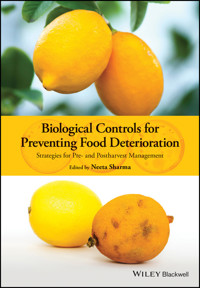
Biological Controls for Preventing Food Deterioration E-Book
151,99 €
Mehr erfahren.
- Herausgeber: John Wiley & Sons
- Kategorie: Fachliteratur
- Sprache: Englisch
Various biotic factors cause diseases in crops, which result in food losses. Historically pesticide development has been instructive to us in terms of the benefits derived as well as the hazards that accompany their indiscriminate use. The application of fertilizers and pesticides to crops has become a norm in agricultural production, but this has led to resurgence in pests as they have developed resistance to such chemicals. Biological control of plant pests and pathogens is part of the solution to this problem. This is an area that continues to inspire research and development. It is also the foundation on which sustainable, non-polluting pest control for tomorrow’s farms must be built.
Biological Controls for Preventing FoodDeterioration provides readers with options of non-chemical, eco-friendly, environmentally safe natural alternatives to prevent food from spoilage at pre- and postharvest stages. It covers the principles behind these techniques and their implementation. By integrating theory and practice, this book discusses the potential and associated problems in the development of non-chemical alternatives to protect food and addresses the common hurdles that need to be overcome to enable commercialization and registration of natural products for combating diseases.
Focussing on plant foods, this timely book is unique in scope as it offers an international perspective on food deterioration caused by bacterial, fungal, viral, and mycotoxin contamination. It brings together highly respected scientists from differingyet complementary disciplines in one unified work that is important reading for food safety professionals, researchers and students.
Sie lesen das E-Book in den Legimi-Apps auf:
Seitenzahl: 894
Veröffentlichungsjahr: 2014
Ähnliche




















Table of Contents
Title Page
Copyright
Dedication
Preface
List of Contributors
Acknowledgments
Chapter 1: Biologicals: Green Alternatives for Plant Disease Management
1.1 Introduction
1.2 Food supply on a collision course
1.3 The enormity of the problem
1.4 Preventing food losses
1.5 Hazards from synthetic pesticides
1.6 A way out of this crisis
1.7 Types of biopesticides
1.8 Strategies of biological control
1.9 Biopesticides: advantages and limitations
1.10 Major constraints
1.11 Conclusion and future prospects
References
Chapter 2: Postharvest Damages of Mandarin (Citrus reticulata Blanco) and Its Management
2.1 Introduction
2.2 Diseases and disorders in mandarins
2.3 Strategies for postharvest management
2.4 Naturally occurring antifungal compounds for biocontrol
2.5 Induced resistance
2.6 Conclusion and future prospects
References
Chapter 3: Yeasts: Bio-Bullets for Postharvest Diseases of Horticultural Perishables
3.1 Introduction
3.2 Presence of an antagonist
3.3 Introduction of the yeast antagonist in the postharvest system of horticultural perishables
3.4 Commercial production
3.5 Problems in product development and registration
3.6 Enhancement of the bioactivity of the yeast antagonist
3.7 Conclusion and future prospects
References
Chapter 4: Dissecting the Mechanisms of Action of Biocontrol Agents to Control Postharvest Diseases of Fruit
4.1 Introduction
4.2 Studying the mechanism of action
4.3 Competition
4.4 The role of biofilm formation
4.5 Production of diffusible and volatile antimicrobial compounds
4.6 Parasitism and release of hydrolases
4.7 Induction of resistance
4.8 The role of oxidative stress
4.9 Conclusion and future prospects
Acknowledgements
References
Chapter 5: Potential of PGPR Bacteria in Plant Disease Management
5.1 Introduction
5.2 Beneficial bacteria in soil
5.3 Rhizobacteria
5.4 Bacterial parasites of nematodes
5.5 Mechanisms involved in biocontrol
5.6 Conclusion and future prospects
References
Chapter 6: Entophytic Microbes and Biocontrol of Plant Diseases
6.1 Introduction
6.2 How entophytes affect plants
6.3 Entophytes in plant protection
6.4 Entophytes' interactions with fungi
6.5 Interactions with viruses and bacteria
6.6 Entophytes' interactions with nematodes
6.7 Entomopathogenic entophytes
6.8 Entophytes in postharvest management of diseases
6.9 Endophytic microorganisms with the potential to improve phytoremediation
6.10 Mechanisms of entophytic protection
6.11 Bioprospecting entophytes
6.12 Conclusion and future prospects
References
Chapter 7: AM Fungi: A Natural Bio-Protectant against Soil Pathogens
7.1 Introduction
7.2 The rhizosphere
7.3 Mycorrhiza
7.4 Soil microbes and AMF dynamics
7.5 The bio-communications of microbes and mycorrhizae
7.6 The role of AMF in plant protection
7.7 AMF as a potential natural bio-protectant
7.8 AMF biocontrol efficacy and mechanisms
7.9 The genetic interpretation of induction
7.10 Conclusion and future prospects
References
Chapter 8: Potential of Entomopathogenic Fungi in Bio-Management of Insect Pests
8.1 Introduction
8.2 Storage pests
8.3 Insecticide resistance in storage pests
8.4 The urgent need
8.5 Entomopathogenic fungi
8.6 Efficacy of entomopathogenic fungi
8.7 Mode of infection
8.8 Mode of action
8.9 Virulence and viability
8.10 Effect of temperature and relative humidity
8.11 Compatibility of entomopathogens with botanicals
8.12 Compatibility of entomopathogens with chemicals
8.13 Production of entomopathogens
8.14 Constraints on the production and commercialization of entomopathogens
8.15 Conclusion and future prospects
References
Chapter 9: The Multifaceted Role of the Trichoderma System in Biocontrol
9.1 Introduction
9.2 Why
Trichoderma
?
9.3 Mechanisms used by
Trichoderma
spp
9.4 Compatibility of the
Trichoderma
system with other microorganisms
9.5 Other applications
9.6 Pesticide susceptibility
9.7 Mass multiplication of
Trichoderma
9.8 Methods of mass multiplication
9.9 Commercial use of
Trichoderma
9.10 Basic components of biocontrol systems
9.11 Conclusion and future prospects
References
Chapter 10: Ladybirds: Potential Bioagents against Plant Pests and Vectors
10.1 Insects and humans
10.2 The rise of crop pests and their management
10.3 Biocontrol rediscovered
10.4 Ladybirds: potential bioagents
10.5 Pre-release studies
10.6 Mass production and release techniques
10.7 Success stories
10.8 The urgent need
References
Chapter 11: Biomanagement of Phytonematodes
11.1 Introduction
11.2 Ecologically safe methods/products
11.3 Antagonists of plant-parasitic nematodes
11.4 Endophytic bacteria
11.5 Nematophagous fungi
11.6 Predacious nematodes
11.7 Invertebrates
11.8 Proposed mechanisms behind the antagonism
11.9 Conclusion and future prospects
References
Chapter 12: The Effect of Essential Oils on the Development of Phytopathogenic Fungi
12.1 Introduction
12.2 Essential oils and their effects
12.3 Bioactivities of essential oils
12.4 Antifungal effects
12.5 Results
12.6 Application of essential oils
12.7 Conclusion and future prospects
References
Chapter 13: Chitosan: A Potential Antifungal Compound to Control Anthracnose Disease in Papaya
13.1 Introduction
13.2 Papaya (
Carica papaya
L.)
13.3 Major postharvest diseases of papaya
References
Chapter 14: Induction of Defence Responses for Biological Control of Plant Diseases
14.1 Introduction
14.2 Plant protein-induced systemic resistance
14.3 Ribosome-inactivating proteins
14.4 Plant growth-promoting rhizobacteria
14.5 Systemic acquired resistance
14.6 Induction of SAR and role of PR-proteins and salicylic acid
14.7 Conclusion and future prospects
References
Chapter 15: Molecular Markers and Phytopathology
15.1 Introduction
15.2 Types of molecular markers
15.3 Hybridization-based markers
15.4 PCR-based markers
15.5 Sequencing-based markers
15.6 Applications of molecular markers in plant pathogen genomic analysis
References
Chapter 16: Deciphering the Pathogenic Behaviour of Phyto-Pathogens Using Molecular Tools
16.1 Introduction
16.2 Bacteria
16.3 Fungi
16.4 Nematodes
16.5 Viruses
16.6 Conclusion and future prospects
References
Chapter 17: Is PCR-DGGE an Innovative Molecular Tool for the Detection of Microbial Plant Pathogens?
17.1 Detection methods of plant pathogens from the past to the present
17.2 Molecular detection techniques of plant pathogens
17.3 Microbial plant pathogens: what we know and how can we benefit?
17.4 PCR-DGGE: novel microbial pathogens detection tool…but how?
17.5 Conclusion and future prospects
References
Index
End User License Agreement
Pages
v
xvii
xviii
xix
xx
xxi
xxiii
1
2
3
4
5
6
7
8
9
10
11
12
13
14
15
16
17
18
19
20
21
22
23
24
25
27
28
29
30
31
32
33
34
35
36
37
38
39
40
41
42
43
44
45
46
47
48
49
50
51
52
53
54
55
56
57
58
59
60
61
62
63
64
65
66
67
69
70
71
72
73
74
75
76
77
78
79
80
81
82
83
84
85
87
88
89
90
91
92
93
94
95
96
97
98
99
100
101
102
103
104
105
106
107
108
109
110
111
112
113
114
115
116
117
118
119
120
121
122
123
124
125
126
127
128
129
130
131
132
133
134
135
136
137
139
140
141
142
143
144
145
146
147
148
149
150
151
152
153
154
155
156
157
158
159
160
161
163
164
165
166
167
168
169
170
171
172
173
174
175
176
177
178
179
180
181
182
183
184
185
186
187
188
189
190
191
192
193
194
195
196
197
198
199
200
201
202
203
204
205
206
207
208
209
210
211
212
213
214
215
216
217
218
219
220
221
222
223
224
225
226
227
228
229
230
231
232
233
234
235
236
237
238
239
240
241
242
243
244
245
246
247
248
249
250
251
252
253
254
255
256
257
258
259
260
261
262
263
264
265
266
267
268
269
270
271
273
274
275
276
277
278
279
280
281
282
283
284
285
286
287
288
289
290
291
293
294
295
296
297
298
299
300
301
302
303
304
305
306
307
308
309
310
311
312
313
314
315
316
317
318
319
321
322
323
324
325
326
327
328
329
330
331
332
333
334
335
336
337
338
339
341
342
343
345
344
346
347
348
349
350
351
352
353
354
355
356
357
358
359
360
361
362
363
364
365
366
367
368
369
370
371
372
373
374
375
376
377
378
379
380
381
382
383
384
385
386
387
388
389
390
391
392
393
394
395
396
397
398
399
400
401
402
403
404
405
406
407
408
409
410
411
412
413
414
415
416
417
418
419
420
421
422
423
424
425
426
427
428
429
430
431
432
433
435
436
437
438
439
440
Guide
Table of Contents
Preface
Begin Reading
List of Illustrations
Figure 1.1
Figure 1.2
Figure 3.1
Figure 6.1
Figure 7.1
Figure 7.2
Figure 8.1
Figure 9.1
Figure 9.2
Figure 9.3
Figure 9.4
Figure 10.1
Figure 10.2
Figure 10.3
Figure 10.4
Figure 11.1
Figure 11.2
Figure 11.3
Figure 12.1
Figure 12.2
Figure 13.1
Figure 13.2
Figure 13.3
Figure 15.1
Figure 15.2
Figure 15.3
Figure 15.4
Figure 15.5
Figure 15.6
Figure 15.7
Figure 15.8
Figure 15.9
Figure 15.10
Figure 15.11
Figure 15.12
Figure 16.1
Figure 16.2
Figure 17.1
Figure 17.2
Figure 17.3
Figure 17.4
List of Tables
Table 1.1
Table 1.2
Table 1.3
Table 2.1
Table 3.1
Table 3.2
Table 5.1
Table 9.1
Table 9.2
Table 9.3
Table 9.4
Table 9.5
Table 9.6
Table 11.1
Table 12.1
Table 13.1
Table 16.1
Table 16.2
Table 17.1
Table 17.2
Table 17.3
Biological Controls for Preventing Food Deterioration
Strategies for Pre- and Postharvest Management
Edited by
Neeta Sharma
University of Lucknow, Lucknow, India
This edition first published 2014 © 2014 by John Wiley & Sons, Ltd
Registered office: John Wiley & Sons, Ltd, The Atrium, Southern Gate, Chichester, West Sussex, PO19 8SQ, UK
Editorial offices: 9600 Garsington Road, Oxford, OX4 2DQ, UK
The Atrium, Southern Gate, Chichester, West Sussex, PO19 8SQ, UK
111 River Street, Hoboken, NJ 07030-5774, USA
For details of our global editorial offices, for customer services and for information about how to apply for permission to reuse the copyright material in this book please see our website at www.wiley.com/wiley-blackwell.
The right of the author to be identified as the author of this work has been asserted in accordance with the UK Copyright, Designs and Patents Act 1988.
All rights reserved. No part of this publication may be reproduced, stored in a retrieval system, or transmitted, in any form or by any means, electronic, mechanical, photocopying, recording or otherwise, except as permitted by the UK Copyright, Designs and Patents Act 1988, without the prior permission of the publisher.
Designations used by companies to distinguish their products are often claimed as trademarks. All brand names and product names used in this book are trade names, service marks, trademarks or registered trademarks of their respective owners. The publisher is not associated with any product or vendor mentioned in this book.
Limit of Liability/Disclaimer of Warranty: While the publisher and author(s) have used their best efforts in preparing this book, they make no representations or warranties with respect to the accuracy or completeness of the contents of this book and specifically disclaim any implied warranties of merchantability or fitness for a particular purpose. It is sold on the understanding that the publisher is not engaged in rendering professional services and neither the publisher nor the author shall be liable for damages arising herefrom. If professional advice or other expert assistance is required, the services of a competent professional should be sought.
Library of Congress Cataloging-in-Publication Data has been applied for
ISBN 978-1-118-53306-2 (hardback)
A catalogue record for this book is available from the British Library.
Wiley also publishes its books in a variety of electronic formats. Some content that appears in print may not be available in electronic books.
To Dr. C.L.Wilson, who inspired and motivated me
Preface
Think Green and Be Green are the new buzzwords doing the rounds globally. The global population has, over the years, callously used up the world's resources; substituting a blatant use of chemicals to sustain the system and to provide for and feed the growing population. This has resulted in the dark clouds of climate change, plant pests, food losses, food scarcity and chemical-laden soils, all looming large, threatening future generations. We are approaching the upper limits of the Earth's human-carrying capacity. It is questionable whether advances in crop production can address these problems in a timely manner and keep up with food demand. Food shortages threatening the future of civilization are a real possibility. Clearly, a comprehensive plan is needed to tackle this impending disaster and it is needed now.
In developing countries, agriculture is the driving force for broad-based economic growth. There is an ever-increasing demand for more food but one of the stumbling blocks to achieving that goal seems to be yield losses due to pests and pathogens. Plant diseases need to be controlled to maintain the quality and abundance of food, feed, and fiber produced by growers around the world. The problem of plant disease, particularly in developing countries, is exacerbated by the paucity of resources devoted to their study. Pest and disease management has played its role in doubling food production in the last 40 years, but pathogens still claim 10–16% of the global harvest. The reason for this is that pest resurgence has developed due to pesticide resistance.
Beyond good agronomic and horticultural practices, growers often rely heavily on chemical fertilizers and pesticides. Conventional insecticides possess inherent toxicities that endanger the health of the farm operators and the consumers, and spoil the environment. The current trend in modern intensive agriculture is characterized by three major interventions: pest control, environmentally safe measures, and consumer demand for healthy and pesticide-free products.
Biologicals have advantages over broad-spectrum conventional pesticides. They affect only the target pest and closely related organisms; they are effective in very small quantities and provide residue-free food and a safe environment. When incorporated into integrated pest management programs, botanical pesticides can greatly reduce the use of conventional pesticides or can be used in rotation or in combination with other insecticides, potentially lessening the overall quantities applied and possibly mitigating or delaying the development of resistance in pest populations.
A variety of biological controls are available for use, but further development and effective adoption will require a greater understanding of the complex interactions among plants, people, and the environment. Today much more is known about biological control agents or BCAs. Biological control is considered a mature science. Research has generated a wealth of information on how BCAs impact plant disease.
This book deals with the current state and future prospects of biologicals in the economic and environmentally safe management of plants and pathogens. It aims to increase awareness of their potential as well as sensitizing the readers to the various aspects of biological control and pest management strategies. The book consists of 17 chapters contributed by eminent scientists, and addresses different topics related to biological control agents and various molecular techniques used in the management of various pathogenic diseases of plants. It is an attempt to disseminate notable and diversified scientific work carried out by leading scientists in their own field.
The book aims to provide the reader with a 360-degree perspective of the quality pre- and post-harvest research being conducted at present and details future ideas being proposed to ensure a food-secure, pesticide-free world.
Neeta Sharma
List of Contributors
K. Acharya
Molecular and Applied Mycology and Plant Pathology Laboratory, Department of Botany, University of Calcutta, Kolkata, India
S. K. Basu
Department of Biological Sciences, University of Lethbridge, Lethbridge, Canada
Avantina S. Bhandari
NGO Forum for Health, Geneva, Switzerland
N. Chakraborty
Molecular and Applied Mycology and Plant Pathology Laboratory, Department of Botany, University of Calcutta, Kolkata, India
Jasenka Ćosić
Faculty of Agriculture in Osijek, Croatia
Aly Farag El Sheikha
Department of Food Science and Technology, Minufiya University, Minufiya Government, Egypt; Department of Biology, Al-Baha University, Al-Baha, Saudi Arabia
Ayman M.H. Esh
Sugar Crops Research Institute, Agricultural Research Center, Giza, Egypt
N. S. Gupta
Molecular and Applied Mycology and Plant Pathology Laboratory, Department of Botany, University of Calcutta, Kolkata, India
Akhtar Haseeb
Institute of Agricultural Sciences, Aligarh Muslim University, Aligarh, India
Musarrat Haseeb
Department of Plant Protection, Faculty of Agricultural Sciences, Aligarh Muslim University, Aligarh, India
Ilmi Hewajulge
Food Technology Section, Industrial Technology Institute, Colombo, Sri Lanka
Akansha Jain
Department of Botany, Centre of Advanced Study, Faculty of Science, Banaras Hindu University, Varanasi, India
Drazenka Jurkovic
Faculty of Agriculture in Osijek, Croatia
Chetan Keswani
Department of Biochemistry, Faculty of Science, Banaras Hindu University, Varanasi, India
Geetanjali Mishra
Centre for Excellence in Biocontrol of Insect Pests, Department of Zoology, University of Lucknow, Lucknow, India
Sandhya Mishra
Department of Mycology and Plant Pathology, Institute of Agricultural Sciences, Banaras Hindu University, Varanasi, India
Omkar
Centre for Excellence in Biocontrol of Insect Pests, Department of Zoology, University of Lucknow, Lucknow, India
Rakesh Pandey
Central Institute of Medicinal and Aromatic Plants, Lucknow, India
Vivek Prasad
Department of Botany, University of Lucknow, Lucknow, India
Ramesh Chandra Ray
Regional Centre, Central Tuber Crops Research Institute, Orissa, India
Birinchi Kumar Sarma
Department of Mycology and Plant Pathology, Institute of Agricultural Sciences, Banaras Hindu University, Varanasi, India
Amrita Saxena
Department of Botany, Centre of Advanced Study, Faculty of Science, Banaras Hindu University, Varanasi, India
Neeta Sharma
Department of Botany, University of Lucknow, Lucknow, India
Swati Sharma
Department of Biosciences, Integral University, Lucknow, India
Takeo Shiina
Distribution Engineering Laboratory, Food Engineering Division, National Food Research Institute, National Agriculture and Food Research Organization, Ibaraki, Japan
Akanksha Singh
Department of Botany, Centre of Advanced Study, Faculty of Science, Banaras Hindu University, Varanasi, India
H.B. Singh
Department of Mycology and Plant Pathology, Institute of Agricultural Sciences, Banaras Hindu University, Varanasi, India
Davide Spadaro
Department of Agricultural, Forestry and Food Sciences (Di.S.A.F.A.) and AGROINNOVA Centre of Competence for the Innovation in the Agro-environmental Sector, University of Torino, Grugliasco, Italy
Madhu Prakash Srivastava
Department of Botany, Lucknow University, Lucknow, India
Nupur Srivastava
Department of Botany, Lucknow University, Lucknow, India
Ritu Srivastava
Biotech Park, Lucknow, India
Shalini Srivastava
Department of Botany, University of Lucknow, Lucknow, India
Shradha Srivastava
Department of Botany, Lucknow University, Lucknow, India
Richa Tiwari
Department of Botany, University of Lucknow, Lucknow, India
Abhishek Tripathi
Banasthali Vidyapeeth, Rajasthan, India
Arpita Tripathi
Central Institute of Medicinal and Aromatic Plants, Lucknow, India
Karolina Vrandečić
Faculty of Agriculture in Osijek, Croatia
Shanthi Wilson Wijeratnam
Food Technology Section, Industrial Technology Institute, Colombo, Sri Lanka
Acknowledgments
I am indebted to all the contributors who so willingly offered their cooperation in making this project a reality in spite of their busy academic schedules. Without their encouragement, enthusiasm, and the timely submission of the chapters, this work would not have been possible.
I express my deep sense of gratitude to my husband, Dinesh K. Sharma, who has been an excellent intellectual companion and a constant source of inspiration. I also want to thank my parents for their loving support. I would also like to mention the excellent help provided by my son Areenjay and daughter Avantina for the hours they spent in helping me organize my work throughout this project and make the whole process worthwhile.
Special thanks to John Wiley & Sons Limited for publishing the book with the utmost interest. My special thanks to Andrew Harrison, the Commissioning Editor, who initially motivated me to bring out this book. I am thankful to Fiona Seymour, Becky Ayre, Susan Dunsmore, the copy editor, Gayle Mak, the production editor, Mary Malin and Sangeetha Parthasarathy for sparing no pains to ensure a high standard of publication.
Chapter 1BiologicalsGreen Alternatives for Plant Disease Management
Neeta Sharma
Department of Botany, Lucknow University, Lucknow, India
1.1 Introduction
Worms have destroyed half the wheat, hippopotami have eaten the rest; there are swarms of locusts alight; the rats roam in the field, the cattle devour, the little birds pilfer and if the farmer loses sight for an instant of what remains on the ground, it is carried off by the robbers.
(Anonymous)
Man's dependence on plants for sustenance and survival has always been of paramount importance. The origins of civilization can be traced back to man's discovery and assurance of an available, accessible and affordable food supply. The maintenance of an adequate supply of food is essential for the existence and prosperity of a nation.
Today, we produce about four billion metric tons of food per annum. However, there are claims that food production has increased at the same time that there are counter-claims that report on the depletion of our natural resources. To ensure sufficient food for every inhabitant of the Earth, both in quantity and in quality, native ecosystems are rapidly being converted for human use, destroying forests, soil and native plants and animals. However, pressure is growing on finite resources of land, energy and water. Such a projection presents mankind with wide-ranging social, economic, environmental and political issues that need to be addressed today in order to ensure a sustainable future tomorrow. One key issue is the production of sufficient food for everyone in a world of finite resources. At the close of the twentieth century, astonishing advances in agricultural productivity and human ingenuity have not yet been translated into a world free of hunger and malnutrition. To produce sufficient food, commercial and subsistence farming systems must be highly productive, but sustainable and nonpolluting (Sharma, Sharma and Prabha, 2012).
1.2 Food supply on a collision course
While advances in science and technology have greatly increased food availability, we are definitely facing a potential food production crisis. The International Food Policy Research Institute (IFPRI) projects that global demand for cereals between 1993 and 2020 will increase by 41% to 2490 million metric tons and for roots and tubers to increase by 40% to 855 million tons. Loss of food arguably poses greatest vulnerability to food security worldwide. Approximately half of the population in the Third World does not have access to adequate food supplies. Diseases caused by various biotic factors, a general phenomenon, is a matter of grave concern at the field level as well as after harvest resulting in food losses. Due to poor practices in harvesting, storage and transportation, coupled with market and consumer wastage, it is estimated that 30–50% (nearly 1.2–2 billion tonnes) of all food produced never reaches a human stomach. In developed countries, losses and wastage of food have been estimated to be between 10–60%. In developing countries these losses can run to over 50%. It has been estimated that a minimum of 47 000 000 metric tons of durable crops and 60 000 000 metric tons of perishable crops become victims of various pathogens.
Lesen Sie weiter in der vollständigen Ausgabe!
Lesen Sie weiter in der vollständigen Ausgabe!
Lesen Sie weiter in der vollständigen Ausgabe!
Lesen Sie weiter in der vollständigen Ausgabe!
Lesen Sie weiter in der vollständigen Ausgabe!
Lesen Sie weiter in der vollständigen Ausgabe!
Lesen Sie weiter in der vollständigen Ausgabe!
Lesen Sie weiter in der vollständigen Ausgabe!
Lesen Sie weiter in der vollständigen Ausgabe!
Lesen Sie weiter in der vollständigen Ausgabe!
Lesen Sie weiter in der vollständigen Ausgabe!
Lesen Sie weiter in der vollständigen Ausgabe!
Lesen Sie weiter in der vollständigen Ausgabe!
Lesen Sie weiter in der vollständigen Ausgabe!
Lesen Sie weiter in der vollständigen Ausgabe!
Lesen Sie weiter in der vollständigen Ausgabe!
Lesen Sie weiter in der vollständigen Ausgabe!
Lesen Sie weiter in der vollständigen Ausgabe!




