


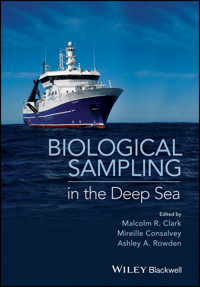
Biological Sampling in the Deep Sea E-Book
139,99 €
Mehr erfahren.
- Herausgeber: John Wiley & Sons
- Kategorie: Wissenschaft und neue Technologien
- Sprache: Englisch
The deep sea covers over 60% of the surface of the earth, yet less than 1% has been scientifically investigated. There is growing pressure on deep-sea resources and on researchers to deliver information on biodiversity and the effects of human impacts on deep-sea ecosystems. Although scientific knowledge has increased rapidly in recent decades, there exist large gaps in global sampling coverage of the deep sea, and major efforts continue to be directed into offshore research.
Biological Sampling in the Deep Sea represents the first comprehensive compilation of deep-sea sampling methodologies for a range of habitats. It reviews the real life applications of current, and in some instances developing, deep-sea sampling tools and techniques. In creating this book the authors have been able to draw upon the experiences of those at the �coal face� of deep-sea sampling, expanding on the existing methodological texts whilst encompassing a level of technical detail often omitted from journal publications. Ultimately the book will promote international consistency in sampling approaches and data collection, advance the integration of information into global databases, and facilitate improved data analyses and consequently uptake of science results for the management and conservation of the deep-sea environment.
The book will appeal to a range of readers, including students, early-career through to seasoned researchers, as well as environmental managers and policy makers wishing to understand how the deep-sea is sampled, the challenges associated with deep survey work, and the type of information that can be obtained.
Sie lesen das E-Book in den Legimi-Apps auf:
Seitenzahl: 1212
Veröffentlichungsjahr: 2016
Ähnliche




















Table of Contents
Cover
Title Page
Contributors
Foreword
Preface
Origin and scope of the book
Structure of
Biological Sampling in the Deep Sea
Acknowledgements
References
Chapter 1: Deep-Sea Benthic Habitats
1.1 Introduction
1.2 Ecosystem and habitat diversity in the deep sea
1.3 Conclusions
Acknowledgements
References
Chapter 2: Deep-Sea Fauna
2.1 Introduction
2.2 Life forms
2.3 Life habits
2.4 Adaptations
2.5 Spatial distribution patterns
2.6 Temporal patterns
2.7 Concluding remarks
Acknowledgements
References
Chapter 3: Survey and Sampling Design
3.1 Introduction
3.2 General survey design
3.3 Case studies
3.4 Concluding remarks
References
Chapter 4: Environmental Sampling
4.1 Introduction
4.2 Conductivity, temperature and depth
4.3 Acoustic Doppler current profilers
4.4 Particulate organic matter
4.5 Sampling strategies
4.6 Future outlook and summary
Acknowledgements
References
Chapter 5: Benthic Habitat Mapping
5.1 Introduction
5.2 Habitat – what do we mean?
5.3 Acquisition of remote-sensed data
5.4 Key elements of survey design for habitat mapping
5.5 Data processing, categorization and map generation
5.6 Acquisition of ground-truth data
5.7 Synthesis
Acknowledgements
References
Chapter 6: Deep-Sea Zooplankton Sampling
6.1 Introduction
6.2 General considerations in deep-sea zooplankton sampling
6.3 Examples of zooplankton samplers used in deep-sea studies
6.4 Sampling operations
6.5 Environmental impact of sampling operations
Acknowledgements
References
Chapter 7: Trawls
7.1 Introduction
7.2 General description of gear types
7.3 Sampling operations
7.4 Dealing with rough seafloor
7.5 Evaluation of trawl gear performance
7.6 Sample sorting and processing
7.7 Interpretation of data
7.8 Environmental impact considerations
Acknowledgements
Appendix 7.1 Net, ground gear and rigging plans for a typical rough-bottom trawl used both commercially and for research on seamounts in the southern hemisphere (Reproduced with permission of NIWA)
Appendix 7.2 Details of a beam trawl design used by CEFAS in European waters (CEFAS. Reproduced with permission)
Appendix 7.3 Flow diagram of Scanmar sensor use from the
International Bottom Trawl Survey Manual
(Reproduced with permission. ICES, 2010)
References
Chapter 8: Longlines
8.1 General introduction
8.2 Gear description, specifications and modifications
8.3 Sampling operations
8.4 Measurements, metrics and data considerations
8.5 Comparisons with other methods that sample fishes
Acknowledgements
Appendix 8.1 Characteristics of some longline component materials
References
Chapter 9: Epibenthic Sledges
9.1 Introduction
9.2 Description of dredge and sledge types, specifications and modifications
9.3 Sampling operations: how to choose and use a sledge
9.4 Sample sorting and processing
9.5 Interpretation of data
9.6 Concluding remarks
Acknowledgements
References
Chapter 10: Corers and Grabs
10.1 Introduction
10.2 Description of gear types
10.3 Sampling operations
10.4 Sample processing
10.5 Data interpretation
References
Chapter 11: Landers
11.1 Introduction
11.2 Experimental design
11.3 Interpretation of data
11.4 Future developments
Acknowledgements
References
Chapter 12: Towed Cameras
12.1 Introduction
12.2 Towed camera systems
12.3 Fundamentals of towed camera imaging systems
12.4 Deployment and survey design
12.5 Management of images and metadata
12.6 Data extraction and analysis
12.7 Methods reporting
12.8 Summary
Acknowledgements
References
Chapter 13: Submersibles and Remotely Operated Vehicles
13.1 Introduction
13.2 General descriptions of submersibles and ROVs
13.3 Submersible and ROV sample collection gear
13.4 Submersible and ROV sample storage gear
13.5 Other gear used during submersible and ROV sampling
13.6 Submersible and ROV sampling operations
13.7 Submersible and ROV sample processing
Acknowledgements
References
Chapter 14: Seafloor Observatories
14.1 Introduction
14.2 Planning an observatory system
14.3 Cabled observatories
14.4 Autonomous observatories
14.5 Data processing, management and archiving
14.6 Outreach for seafloor observatories
14.7 The future
Acknowledgments
References
Chapter 15: Sorting, Recording, Preservation and Storage of Biological Samples
15.1 Introduction
15.2 Pre-voyage preparation
15.3 Sorting
15.4 Preservation
15.5 Sample labelling and recording
15.6 Photographing specimens
15.7 Sample storage and transport
Acknowledgements
Appendix 15.1 Example of forms that help sorting staff with consistent taxonomic identification, recording, and preservation standards
Appendix 15.2 Shipping of samples in ethanol or formalin
Appendix 15.3 Recommendations for the completion of a shipping letter (adapted from the Australian Quarantine and Inspection Service, AQIS) for shipping ethanol by air
References
Chapter 16: Information Management Strategies for Deep-Sea Biology
16.1 Introduction
16.2 General information management considerations
16.3 Considerations for specific data types
16.4 Conclusions
Acknowledgements
References
Chapter 17: Data Analysis Considerations
17.1 Introduction
17.2 Hypotheses – what is your question?
17.3 Faunal data – what type of data do you have?
17.4 Environmental data – what should you use?
17.5 Sampling biases – how can you account for them?
17.6 Stratification and covariance – how can you partition out main effects?
17.7 Interpretation – how can you make the best sense of your results?
References
Chapter 18: Application of Biological Studies to Governance and Management of the Deep Sea
18.1 Introduction
18.2 What is managed and who are the managers?
18.3 The role of science
18.4 Management approaches and needs
18.5 Case studies
18.6 Biological studies at the science–policy interface
Acknowledgements
References
Chapter 19: The Future of Biological Sampling in the Deep Sea
19.1 Introduction
19.2 Data collection
19.3 Data management
19.4 Data analysis
19.5 Future motivations for sampling
Acknowledgements
Glossary
Index
Supplemental Images
End User License Agreement
List of Tables
Chapter 01
Table 1.1 A summary of the main deep-sea habitats, their definitions, and the types of sampling methods, as well as the main considerations for each method
Chapter 02
Table 2.1 Benthic sampling gear types and their associated target fauna, and the habitats and substrates on which they are typically deployed. [note that gears can also be used to obtain samples or information that can be used to characterise the seafloor substrates.]
Chapter 03
Table 3.1 Guide to deployment and retrieval times (hours) of various gear types commonly used in multipurpose surveys
Chapter 04
Table 4.1 Basic, derived and supplementary water column properties that are typically measured by CTDs and additional attached sensors in whatever deployment fashion employed (real-time vessel, towed, moored etc.)
Table 4.2 Table summarizing the typical acoustic properties of ADCPs used for oceanographic research, together with general environmental processes that can be quantified
Table 4.3 Summary of methodologies to sample suspended particulate material in the water column with principal advantages/disadvantages of each
Chapter 05
Table 5.1 Advantages and disadvantages of the three echosounder systems most commonly used for mapping seafloor habitat
Table 5.2 Typical MBES operation capabilities (maximum depth in parentheses)
Chapter 06
Table 6.1 Comparison of tow duration and sample volume in vertical and oblique hauls (0.25 m
2
MultiNet
®
, five depth strata of 500 m each, maximum depth 2500 m, assumed 1.75:1 wire length to depth ratio in oblique hauls)
Chapter 07
Table 7.1 Summary of trawl gear suitable for general types of seafloor and faunal type. Yes has three levels of suitability (low–med–high)
Table 7.2 Calculations of the distance and time (minutes) of the gear behind the vessel, given combinations of depth and amount of wire out (assuming a warp length to depth ratio of 1.8:1)
Chapter 08
Table 8.1 Examples of deep-sea longline surveys and fisheries, with details of gear configuration
Table 8.2 Major sampling strategies for deep-sea longline surveys with some general considerations about design and analysis.
Table 8.3 Examples of demersal longline surveys in the Atlantic Ocean including location, depth range covered and number of species caught
Table 8.4 Examples of families of deep demersal ichthyofauna caught on longline surveys
Chapter 09
Table 9.1 Pre-sampling considerations: comparison of important technical features (weight, opening–closing device, mesh size), selectivity (target fauna, bottom type) and sampling efficiency (quantitative vs. qualitative) in different sledge and dredge types
Lesen Sie weiter in der vollständigen Ausgabe!
Lesen Sie weiter in der vollständigen Ausgabe!
Lesen Sie weiter in der vollständigen Ausgabe!
Lesen Sie weiter in der vollständigen Ausgabe!
Lesen Sie weiter in der vollständigen Ausgabe!
Lesen Sie weiter in der vollständigen Ausgabe!
Lesen Sie weiter in der vollständigen Ausgabe!
Lesen Sie weiter in der vollständigen Ausgabe!
Lesen Sie weiter in der vollständigen Ausgabe!
Lesen Sie weiter in der vollständigen Ausgabe!
Lesen Sie weiter in der vollständigen Ausgabe!
Lesen Sie weiter in der vollständigen Ausgabe!
Lesen Sie weiter in der vollständigen Ausgabe!
Lesen Sie weiter in der vollständigen Ausgabe!
Lesen Sie weiter in der vollständigen Ausgabe!
Lesen Sie weiter in der vollständigen Ausgabe!
Lesen Sie weiter in der vollständigen Ausgabe!
Lesen Sie weiter in der vollständigen Ausgabe!
Lesen Sie weiter in der vollständigen Ausgabe!
Lesen Sie weiter in der vollständigen Ausgabe!
Lesen Sie weiter in der vollständigen Ausgabe!
Lesen Sie weiter in der vollständigen Ausgabe!
Lesen Sie weiter in der vollständigen Ausgabe!
Lesen Sie weiter in der vollständigen Ausgabe!
Lesen Sie weiter in der vollständigen Ausgabe!
Lesen Sie weiter in der vollständigen Ausgabe!
Lesen Sie weiter in der vollständigen Ausgabe!
Lesen Sie weiter in der vollständigen Ausgabe!




