


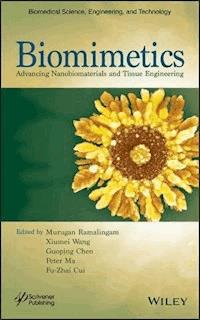
Biomimetics E-Book
181,99 €
Mehr erfahren.
- Herausgeber: John Wiley & Sons
- Kategorie: Fachliteratur
- Serie: Biomaterials Science, Engineering and Technology
- Sprache: Englisch
Provides cutting-edge advances in biologically inspired, biomimetically-designed materials and systems for developing the next generation of nanobiomaterials and tissue engineering Humans have been trying to learn biomimetics for centuries by mimicking nature and its behaviors and processes in order to develop novel materials, structures, devices, and technologies. The most substantial benefits of biomimetics will likely be in human medical applications, such as developing bioprosthetics that mimic real limbs and sensor-based biochips that interface with the human brain to assist in hearing and sight. Biomimetics: Advancing Nanobiomaterials and Tissue Engineering seeks to compile all aspects of biomimetics, from fundamental principles to current technological advances, along with future trends in the development of nanoscale biomaterials and tissue engineering. The book details research, useful in inspiring new ideas, that seeks the principles and rules implemented by nature, such as self-assembly, a bottom-up approach in which molecular structures are assembled with little or no external intervention to generate nano, micro, and macro structures. Other subjects covered in the book include: * Cartilage tissue engineering as an emerging technology * The fabrication methods of nanofibrous scaffolds and their potential utility in bone tissue engineering applications * Dental and craniofacial tissue engineering with bioactive polymers and bionanomaterials * Strategies to prevent bacterial adhesion on biomaterials * The latest achievements in biomimetic ECM scaffolds prepared from cultured cells * Graphene oxide and graphene as promising scaffold materials * Stem cells as a source for building tissues or organs in the laboratory
Sie lesen das E-Book in den Legimi-Apps auf:
Seitenzahl: 609
Veröffentlichungsjahr: 2013
Ähnliche




















Contents
Cover
Half Title page
Title page
Copyright page
List of Contributors
Preface
Acknowledgements
Chapter 1: Biomimetic Polysaccharides and Derivatives for Cartilage Tissue Regeneration
1.1 Introduction
1.2 Strategies for Cartilage Tissue Engineering
1.3 Designing Scaffold for Cartilage Tissue Engineering
1.4 Natural Polysaccharides for Cartilage Tissue Engineering
1.5 Conclusions and Remarks on Prospects
References
Chapter 2: Biomimetic Synthesis of Self-Assembled Mineralized Collagen-Based Composites for Bone Tissue Engineering
2.1 Introduction
2.2 Hierarchical Assembly of Mineralized Collagen Fibrils in Natural Bone
2.3 Biomimetic Synthesis of Self-Assembled Mineralized Fibrils
2.4 Applications of Mineralized Collagen-based Composites for Bone Regeneration
2.5 Concluding Remarks
References
Chapter 3: Biomimetic Mineralization of Hydrogel Biomaterials for Bone Tissue Engineering
3.1 Introduction
3.2 Incorporation of Inorganic Calcium Phosphate Nanoparticles into Hydrogels
3.3 Biomimetic Mineralization in Calcium and/or Phosphate-Containing Solutions
3.4 Enzymatically-Induced Mineralization Using Alkaline Phosphatase (ALP)
3.5 Enhancement of Hydrogel Mineralization Using Biomacromolecules
3.6 Conclusions
References
Chapter 4: Biomimetic Nanofibrous Scaffolds for Bone Tissue Engineering Applications
4.1 Bone Tissue Engineering and Scaffold Design
4.2 Self-Assembled Nanofiber Scaffolds
4.3 Electrospun Scaffolds
4.4 Thermally Induced Phase Separation (TIPS) Scaffolds
4.5 Overall Trends in Biomimetic Scaffold Design
References
Chapter 5: Bioactive Polymers and Nanobiomaterials Composites for Bone Tissue Engineering
5.1 Introduction
5.2 Design and Fabrication of Biomimetic 3D Polymer-Nanocomposites Scaffolds
5.3 Nonbiodegradable Polymer and Nanocomposites
5.4 Biodegradable Polymer and Nanocomposites
5.5 Conclusions and Future Remarks
References
Chapter 6: Strategy for a Biomimetic Paradigm in Dental and Craniofacial Tissue Engineering
6.1 Introduction
6.2 Biomimetics: Definition and Historical Background
6.3 Developmental Biology in Dental and Craniofacial Tissue Engineering: Biomimetics in Development and Growth (e.g. model of wound healing)
6.4 The Paradigm Shift in Tissue Engineering: Biomimetic Approaches to Stimulate Endogenous Repair and Regeneration
6.5 Extracellular Matrix Nano-Biomimetics for Craniofacial Tissue Engineering
6.6 Biomimetic Surfaces, Implications for Dental and Craniofacial Regeneration; Biomaterial as Instructive Microenvironments
6.7 Angiogenesis, Vasculogenesis, and Inosculation for Life-Sustained Regenerative Therapy; The Platform for Biomimicry in Dental and Craniofacial Tissue Engineering
6.8 Conclusion
Acknowledgements
References
Chapter 7: Strategies to Prevent Bacterial Adhesion on Biomaterials
7.1 Introduction
7.2 Characteristics of Prokaryotic Cells
7.3 Summary
Acknowledgement
References
Chapter 8: Nanostructured Selenium – A Novel Biologically-Inspired Material for Antibacterial Medical Device Applications
8.1 Bacterial Biofilm Infections on Implant Materials
8.2 Nanomaterials for Antibacterial Implant Applications
8.3 Selenium and Nanostructured Selenium
8.4 Selenium Nanoparticles for Antibacterial Applications
8.5 Summary and Outlook
References
Chapter 9: Hydroxyapatite-Biodegradable Polymer Nanocomposite Microspheres Toward Injectable Cell Scaffold
9.1 Introduction
9.2 Pickering Emulsion
9.3 Fabrication of HAp-Polymer Nanocomposite Microspheres by Pickering Emulsion Method
9.4 Evaluation of Cell Adhesion Properties of HAp-Biodegradable Polymer Nanocomposite Microspheres
9.5 Application of HAp-Biodegradable Polymer Nanocomposite Microspheres as an Injectable Scaffold
9.6 Degradation Behavior of HAp-Biodegradable Polymer Nanocomposite Microspheres
9.7 Conclusions
Acknowledgments
References
Chapter 10: Biomimetic ECM Scaffolds Prepared from Cultured Cells
10.1 Introduction
10.2 Cultured Cell-Derived ECM Porous Scaffolds
10.3 Autologous ECM Scaffolds
10.4 Application of Cultured Cell-Derived ECM Scaffolds
10.5 Summary
References
Chapter 11: Design and Synthesis of Photoreactive Polymers for Biomedical Applications
11.1 Introduction
11.2 UV-Reactive Biological Polymers
11.3 UV-Reactive Synthetic Polymers
11.4 Visible Light-Reactive Biopolymer Systems
11.5 Conclusions
References
Chapter 12: The Emerging Applications of Graphene Oxide and Graphene in Tissue Engineering
12.1 Introduction
12.2 Design and Fabrication of Biomimetic GO/Graphene Materials
12.3 Graphene Oxide and its Cell and TE Applications
12.4 Graphene and Its Cell and TE Applications
12.5 Conclusions and Future Directions
Acknowledgement
References
Chapter 13: Biomimetic Preparation and Morphology Control of Mesoporous Silica
13.1 Introduction
13.2 Biomineralization and Biomimic Synthesis
13.3 Mesoporous Silica
13.4 Biomimic Preparation and Morphology Control of Mesoporous Silica
13.5 Conclusion and Prospective
References
Chapter 14: Biomimetic Materials for Engineering Stem Cells and Tissues
14.1 Introduction
14.2 Fabrication of Biomimetic Materials
14.3 Surface Modification
14.4 Engineering Stem Cells and Tissues
14.5 Concluding Remarks
Acknowledgements
References
Index
Also of Interest
Biomimetics
Scrivener Publishing 100 Cummings Center, Suite 541J Beverly, MA 01915-6106
Biomedical Science, Engineering, and Technology The book series seeks to compile all the aspects of biomedical science, engineering and technology from fundamental principles to current advances in translational medicine. It covers a wide range of the most important topics including, but not limited to, biomedical materials, biodevices and biosystems, bioengineering, micro and nanotechnology, biotechnology, biomolecules, bioimaging, cell technology, stem cell engineering and biology, gene therapy, drug delivery, tissue engineering and regeneration, and clinical medicine.
Series Editor: Murugan Ramalingam, Centre for Stem Cell Research Christian Medical College Bagayam Campus Vellore-632002, Tamilnadu, India E-mail: [email protected]
Publishers at Scrivener Martin Scrivener ([email protected]) Phillip Carmical ([email protected])
Copyright © 2013 by Scrivener Publishing LLC. All rights reserved.
Co-published by John Wiley & Sons, Inc. Hoboken, New Jersey, and Scrivener Publishing LLC, Salem, Massachusetts. Published simultaneously in Canada.
No part of this publication may be reproduced, stored in a retrieval system, or transmitted in any form or by any means, electronic, mechanical, photocopying, recording, scanning, or otherwise, except as permitted under Section 107 or 108 of the 1976 United States Copyright Act, without either the prior written permission of the Publisher, or authorization through payment of the appropriate per-copy fee to the Copyright Clearance Center, Inc., 222 Rosewood Drive, Danvers, MA 01923, (978) 750-8400, fax (978) 750-4470, or on the web at www.copyright.com. Requests to the Publisher for permission should be addressed to the Permissions Department, John Wiley & Sons, Inc., 111 River Street, Hoboken, NJ 07030, (201) 748-6011, fax (201) 748-6008, or online at http://www.wiley.com/go/permission.
Limit of Liability/Disclaimer of Warranty: While the publisher and author have used their best efforts in preparing this book, they make no representations or warranties with respect to the accuracy or completeness of the contents of this book and specifically disclaim any implied warranties of merchantability or fitness for a particular purpose. No warranty may be created or extended by sales representatives or written sales materials. The advice and strategies contained herein may not be suitable for your situation. You should consult with a professional where appropriate. Neither the publisher nor author shall be liable for any loss of profit or any other commercial damages, including but not limited to special, incidental, consequential, or other damages.
For general information on our other products and services or for technical support, please contact our Customer Care Department within the United States at (800) 762-2974, outside the United States at (317) 572-3993 or fax (317) 572-4002.
Wiley also publishes its books in a variety of electronic formats. Some content that appears in print may not be available in electronic formats. For more information about Wiley products, visit our web site at www.wiley.com.
For more information about Scrivener products please visit www.scrivenerpublishing.com.
Cover design by Russell Richardson
Library of Congress Cataloging-in-Publication Data:
ISBN 978-1-118-46962-0
List of Contributors
Samad Ahadian received his PhD in materials science from Tohoku University, Japan in 2011. Since 2011, he has been working with Professor Ali Khademhosseini as a research associate at WPI-Advanced Institute for Materials Research, Japan. His research interests are tissue engineering, biomedical microdevices, and biomaterials. He is the author of more than 20 refereed journal papers that have been published in leading journals in the field, such as Tissue Engineering, Lab on a Chip, Nano Letters, and Advanced Materials.
Sheikh Rafi Ahmad was the founder and lead of the Centre of Applied Laser Spectroscopy at Cranfield University (Shrivenham) and has recently retired. He received his DPhil degree from the University of Oxford in 1972 on the topic of laser interaction with solid materials. The scope of his research field extended to include, among many diverse topics, laser ignition of energetic materials and laser-induced processing of natural and synthetic polymers for biomedical applications.
Mohamed A. Alkhodary is a lecturer of dentistry at Alexandria University in Egypt. In 2006 he earned his Masters on bone engineering and PhD on dental implant biomimetic laser grooving and protein coating in 2010.
Indu Bajpai is a PhD student in the Department of Materials Science and Engineering at the Indian Institute of Technology Kanpur, India. She has two recent publications in international journals and specialization is implants associated infection and treatment of bacterial infection by using external fields.
Bikramjit Basu is an associate professor at the Materials Research Center and Bio-Engineering Program, Indian Institute of Science, Bangalore, India. He earned his PhD in ceramics at Katholieke Universiteit, Leuven, Belgium in 2001. He has authored/coauthored more than 200 peer-reviewed research papers. H-index of his publications is 28 and a total citation is more than 2000.
Qiang Cai is leading a research group in the Key Laboratory for Advanced Materials, Tsinghua University, China. His research interests are biomaterials and biomimetic synthesis of materials. He had received his PhD in 1998 from Jilin University.
Guoping Chen received his PhD from Kyoto University in 1997 and now is principal investigator and unit director of Tissue Regeneration Materials Unit, MANA, NIMS, Japan. His research interests include tissue engineering, polymeric porous scaffolds, biomimetic biomaterials, micro-patterning and surface modification. He has authored more than 200 publications with more than 2500 citations. He is an associate editor of Journal of Materials Chemistry B.
Fuzhai Cui is currently a full professor in the School of Materials Science and Engineering at Tsinghua University, China. He received his PhD degree in materials science from Tsinghua University in 1984. His research interests include biomineralization, bone tissue engineering, and surface modification of biomaterials. He has authored more than 300 SCI journal papers. He was honored with the “Somiya Award” from the International Union of Materials Research Societies in 2003, “State Natural Science Award 2011” and “State Technological Invention Award 2008” from the State Council of the P.R. China as the first achiever.
Timothy E.L. Douglas is a postdoctoral research fellow of the Research Foundation Flanders (FWO) at the Polymer Chemistry and Biomaterials (PBM) group at Ghent University, Belgium. He has published 32 peer-reviewed publications and 1 patent, mainly in the areas concerning enzymatic functionalization of hydrogel biomaterials, materials for bone regeneration and artificial extracellular matrices.
Rania M. Elbackly is a lecturer of endodontics and researcher at the tissue engineering labs, Faculty of Dentistry, Alexandria University, Egypt. She received her PhD in regenerative medicine and tissue engineering from the University of Genoa, Italy. Her main research focus is bone and dentin/pulp tissue regeneration. She is a member of TERMIS and has numerous publications and presentations at international congresses.
Ahmad M. Eweida is an assistant lecturer of Head and Neck Surgery, Faculty of Medicine; University of Alexandria. In 2012 he received his doctorate degree from the University of Erlangen-Nürnberg in Germany. His focus of research is bone regeneration and vascularization.Ahmad has a total of 17 publications and international presentations.
Syuji Fujii received his PhD from Kobe University in 2003, and is now an associate professor of Osaka Institute of Technology. He is the author of more than 140 publications and his research interests involve polymer particles, soft dispersed systems (emulsion, foam, liquid marble and dry liquid) and conducting polymers.
Tsutomu Furuzono received his PhD from Kagoshima University, Japan in 1996. He is now Professor and Department Chair of Dept. of Biomedical Engineering, School of Biology-Oriented Science and Technology at Kinki University. His research interests involve inorganic-organic biomaterials for artificial organs, medical devices and regenerative medicine.
Yoshihiro Ito is Chief Scientist and Director of Nano Medical Engineering Laboratory at RIKEN since 2004. He received his Dr. Eng. from Kyoto University in 1987. His research focus is on biomaterials science, combinatorial bioengineering for the creation of functional polymers, and soft nanotechnology.
Robert Kane received his PhD in bioengineering from the University of Notre Dame, USA, and is currently a postdoctoral researcher in the lab of Peter X Ma at the University of Michigan Dental School. His primary research focus is determining how to control cellular behavior through the physical properties of materials.
Naoki Kawazoe is a senior researcher at the National Institute for Materials Science in Japan. His research interest is in polymeric biomaterials for stem cell manipulation by using micropatterning. Since he received his PhD from Kyoto University in 1999, he has published more than 100 papers in the field of biomaterials.
Ali Khademhosseini is an internationally recognized bioengineer regarded for his contributions and research in the area of biomaterials and tissue engineering. Currently he is an associate professor at Harvard University and holds appointments at the Harvard-MIT Division of Health Sciences Technology, Brigham & Women’s Hospital and Tohoku University. He is also an associate faculty of the Wyss Institute and Harvard Stem Cell Institute. His research is based on developing micro and nanoscale technologies to control cellular behavior, developing microscale biomaterials and engineering systems for tissue engineering, drug discovery and cell-based biosensing.
Ferdous Khan graduated from Dhaka University, Bangladesh and then earned his PhD degree in polymer science in 1999 at Cranfield University. He was a research fellow at the University of Edinburgh, where he developed 100s of polymer-based biomaterials for tissue engineering applications such as polymer hydrogels for cartilage tissue regeneration, stem cells functioning and scaffolds for bone tissue engineering. He has authored more than 60 peer-reviewed journal articles. Currently, he is working as a Senior Polymer Chemist in Ocutec Limited, UK.
T. S. Sampath Kumar is a professor of metallurgical and materials engineering at the Indian Institute of Technology Madras, India. He is an internationally renowned materials scientist and has published numerous papers in the field. His research interests include bioceramics, functionally graded biomaterials, ceramic coatings and ceramic based drug delivery systems.
Sander Leeuwenburgh obtained his MSc degree in materials science at Delft University of Technology (2001) and his PhD degree at the Department of Biomaterials of Radboud University Medical Center in Nijmegen, The Netherlands (2006) where he was appointed as assistant professor in 2008.
Zhixu Liu received her master degree from Guangxi Normal University in 2013. She is currently a research assistance in the School of Materials Science and Engineering at Tsinghua University, China. Her research focuses on the calcium phosphate biomineralization on functional group surfaces.
Hongxu Lu obtained his PhD from the University of Tsukuba, Japan in 2009. He is currently a research associate at the University of New South Wales, Australia. His research involves developing ECM scaffolds for tissue engineering, drug delivery system and construction of 3D tumor models. He has published 29 papers and received a Young Investigator Award from Japanese Society for Regenerative Medicine in 2012.
Peter X. Ma received his PhD in polymer science and engineering from Rutgers University. He then did his postdoctoral research at MIT and Harvard Medical School on biomaterials and tissue engineering. He is currently the Richard H. Kingery Endowed Collegiate Professor at the University of Michigan, Ann Arbor, MI, USA.
Mona K. Marei is a professor of prosthetic dentistry. She is the founder and the head of tissue engineering science and technology/laboratories, Alexandria University, Egypt. She is President of the African Materials Research Society. She is the principal investigator and team leader for a number of national and international projects and agreements in the field of biomaterials, biomedical engineering, regenerative medicine and tissue engineering. Dr. Marei has published numerous articles in the international scientific journals and received patent #23731 in July 2007 from the Ministry of scientific research, several awards, medals and certificates of recognition.
Naglaa Bahgat Nagy is an oral biology professor at the Faculty of Dentistry, Tanta University, Egypt. She got her PhD in anatomy and cell biology from the University of Illinois, Chicago, USA. Her research focuses on development, physiology and function of teeth and craniofacial structures. She has authored more than 20 publications. As a member of the Tissue Engineering Labs, Alexandria University, she is involved in all bone tissue engineering applications.
Masahiro Okada received his PhD from Kobe University in 2004, and is now an assistant professor of Osaka Dental University, Japan. He has been active in nano-biomedical research since 2004, focusing mainly on the synthesis and medical applications of nanostructured bioceramics such as hydroxyapatite nanocrystals.
Elzbieta Pamula works as a professor at the Department of Biomaterials at AGH University of Science and Technology in Krakow, Poland. She is the author of more than 200 publications (including 45 papers in SCI journals), mainly on the development of polymeric scaffolds for bone tissue engineering.
Ce Peng received his BSc (2011) in material sciences & engineering from Tsinghua University, China. He presently works as a master candidate under the supervision of Prof. Qiang Cai at School of Materials Science & Engineering. His research focuses on the controlled synthesis and biomedical applications of mesoporous silica.
Seeram Ramakrishna is the Director of HEM Labs at the National University of Singapore. He has authored five books and more than 400 four hundred international journal papers, which have attracted more than 14,000 citations.
Murugan Ramalingam is an associate professor and scientist at the Centre for Stem Cell Research, Christian Medical College and Hospital Campus, India. Concurrently he is an adjunct associate professor at the Tohoku University, Japan. He received his PhD in biomaterials from the University of Madras and has undergone training in ethical and policy issues on stem cells from Harvard University, USA. He is the author of more than 160 publications, including peer-reviewed journal papers, conference proceedings, book chapters, authored books, edited books, and patents relevant to biomaterials, stem cells, and tissue engineering. He is the Editor-in-Chief of the Journal of Biomaterials and Tissue Engineering, and the Journal of Bionanoscience. He is a recipient of several prestigious fellowships and awards, including CSIR Fellowship (India), SMF Fellowship (Singapore), NRC National Academies Fellowship (USA), Nationale Professeur des Universités (France) and Fellow of Royal Society of Chemistry (UK).
Mona S. Saad is an assistant lecturer of prosthodontics, Faculty of Dentistry, Alexandria University, Egypt. In 2011 her Masters centered on polymer nanocomposites preparation and characterization. She is now preparing for her PhD in bone engineering under supervision of Prof. Mona K. Marei.
Kaarunya Sampathkumar is a junior research fellow at the Centre for Stem Cell Research, Christian Medical College Campus, India. She received her MTech degree in medical nanotechnology from Sastra University. Her research interests include the development and characterization of nanobiomaterials for stem cell engineering, tissue regeneration, and smart drug delivery.
Azadeh Seidi is a biochemist at the Okinawa Institute of Science and Technology, Japan. Since earning her PhD from Tokyo Institute of Technology, she has focused her activities on biomedical researches, both on biochemical and engineering levels.
P. M. Sivakumar, has been a foreign postdoctoral researcher at of the Nano Medical Engineering Laboratory at Riken, Japan since 2012. He received his PhD biotechnology from IIT Madras, India. He has published more than 30 papers in peer-reviewed journals. His research interests include biofilm, bionanotechnology and biomaterials.
Tae Il Son is a professor in the Department of Biotechnology at Chung-Ang University in South Korea since 1990. He received his PhD in electronic chemistry from Tokyo Institute of Technology in 1989. His current research interests are in the areas of application of natural polymer (chitin/chitosan, gelatin, hyaluronic acid, starch, alginate etc.) derivatives for biomedical materials.
Alok Srivastava is a professor of medicine at the Christian Medical College, Vellore, India. He is the head of the Department of Haematology and the Center for Stem Cell Research which is unit of inStem, Bengaluru. He is involved with research in hemostasis, both clinical and genetic aspects and is currently coordinating the development of gene therapy for hemophilia in India.
Qi Wang is a bioengineering PhD student and research assistant working in Dr. Thomas J. Webster’s Nanomedicine Lab at Northeastern University. He received his BS in chemical physics from the University of Science & Technology of China in 2010 and his MS in chemistry from Brown University in 2013. His research is focused on using nanostructured selenium as a novel coating material for preventing bacterial biofilm growth on various materials. He has published 4 literature articles and conference proceedings and gave 10 conference presentations concerning the use of nanoselenium as an antibacterial coating.
Xiumei Wang received her PhD degree in materials science and engineering from Tsinghua University, China in 2005. She is currently an associate professor on biomaterials, with major research interests on central nerve tissue engineering, angiogenesis, self-assembling peptide, and biomineralization. She has authored more than 70 publications, including peer-reviewed journal papers, book chapters, authored books, and patents relevant to biomaterials. She was honored the “State Natural Science Award 2011” from the State Council of the P.R. China.
Thomas J. Webster is the chair and professor of the Department of Chemical Engineering at Northeastern University. He is also the founding chief editor for the International Journal of Nanomedicine. He received his PhD in chemical engineering from the Rensselaer Polytechnic Institute in 2000. Dr. Webster currently directs the Nanomedicine Laboratory which designs, synthesis, and evaluates nanomaterials for various implant applications. His lab group has produced at least 10 books, 35 book chapters, 335 literature articles and conference proceedings, and 15 provisional or full patents on the study of nanophase materials and implantable devices.
Samer H. Zaky is a research associate professor at Department of Oral Biology, University of Pittsburgh, USA. Samer was introduced to the tissue engineering field by Prof. Mona Marei. Awarded a Marie Curie Fellowship (FP6), he earned his PhD in regenerative medicine in 2009 from the University of Genoa, Italy. His research focuses on regenerating critical-size bone and bone/soft tissue interface defects together with the re-establishment of the stem cell niche.
Di Zhou is a foreign postdoctoral researcher of Nano Medical Engineering Laboratory at Riken, Japan since 2012. He received his PhD in polymer chemistry and physics from Soochow University, China in 2008. His current research interests are in the areas of polymer chemistry and biomaterials for tissue engineering.
Preface
Nature is the world’s foremost amazing designer and manufacturer, creating unique materials with hierarchical structures and functions from the nanoscale to the macroscale. For centuries, humans have been trying to learn from nature and mimic its behaviors and processes in order to develop novel materials, structures, devices, and technologies, which are called biomimetics. One of the classic examples of a biomimetic process dates back more than five hundred years ago, when there was an effort made to create a “flying machine” that imitated the flight of birds. In addition to mimicking animals, people have already successfully replicated a wide range of colorful minerals, such as pearl, jade, and other gemstones. Nevertheless, the most substantial benefits of biomimetics will likely be for human medical applications, such as the development of bioprosthetics that mimic real limbs, and sensor-based biochips that interface with the human brain to assist in hearing and sight. It is evident that biomimetics is a field with endless possibilities.
Biomimetics today is a multidisciplinary subject, and it is the science of imitating or mimicking natural phenomena of a biological system in terms of its composition, structure and function as a model for design and engineering of new materials and systems suitable for all kinds of applications. Researchers have been seeking the principles and rules implemented by nature to inspire new ideas. From a materials point of view, it is called self-assembly, a bottom-up approach in which molecular structures are assembled with little or no external intervention to generate nano, micro and macro structures. Recent progress in biomimetic process and technology has led to a growing interest in the development of new materials and systems at different length scales, in particular at the nanoscale. Therefore, updating the recent progress on biomimetics is essential for advancing biomedical fields.
This book, entitled Biomimetics: Advancing Nanobiomaterials and Tissue Engineering, is an effort to compile all aspects of biomimetics from fundamental principles to current technological advances, along with future trends in the development of nanoscale biomaterials and tissue engineering. Keeping these points in mind, the editors have undertaken the compilation of recent endeavors of biomimetically-designed materials and systems as a single reference for those who work in these areas. The scope of this book is principally confined to biologically inspired design of materials and systems for the development of next generation nanobiomaterials and tissue engineering. It is aimed at addressing state-of-the-art research progress in the applications of the principles, processes, and techniques of biomimetics for advancing key areas of biomedicine, such as nanobiomaterials and tissue engineering. The prospective outcomes of current advancements and challenges in biomimetic approaches are also presented.
This book is unique because it covers all important aspects dealing with the basic science of current technological innovations in key areas of biomaterials and tissue engineering. It is intended for a wide audience including students, researchers, professors, and industrial experts working in the fields of, but not limited to, material science and engineering, biomaterials, bioengineering, cell biology, biomedical sciences, tissue engineering, nanoscience, nanotechnology and nanomedicine. Overall, the book delivers new insights in the field of biomimetics to the readers.
Murugan Ramalingam Xiumei Wang Guoping Chen Peter Ma Fu-Zhai Cui
Acknowledgements
The editors gratefully acknowledge all the authors who contributed to the success of the book. This book would not have succeeded without their insights and perspectives. We also appreciate the support and encouragement from colleagues and students in the following departments: Centre for Stem Cell Research at the Christian Medical College Campus in India, Faculty of Dental Surgery at the University of Strasbourg in France, World Premier International Advanced Institute for Materials Research at the Tohoku University in Japan, Institute for Regenerative Medicine and Biomimetic Materials at the Tsinghua University in China, Tissue Regeneration Materials Unit at the National Institute of Materials Science in Japan, and Department of Biologic and Materials Sciences at the University of Michigan in United States of America. Other valuable suggestions were made by anonymous sources, to whom the editors would like to convey our special thanks. Our publisher, Wiley-Scrivener Publishing, has been extraordinarily supportive and patient with our process. Our special thanks go to Martin Scrivener for his overall coordination in bringing the book in on time, and other supportive staff who greatly amended the text format, technical corrections, and presentation style. We also wish to thank and formally acknowledge all the publishers and authors, cited in the text and figures, who granted us permission to use their material in this book. This list is incomplete and we apologize to anyone we omitted.
Chapter 1
Biomimetic Polysaccharides and Derivatives for Cartilage Tissue Regeneration
Ferdous Khan* and Sheikh Rafi Ahmad
School of Chemistry, The University of Edinburgh, UK
Abstract
Cartilage tissue engineering is an emerging technology for the regeneration of such tissues damaged by disease or trauma. Unlike other types of tissue, cartilage does not have a blood supply and, therefore, lacks regenerative capabilities. Hence, there is an urgent need to develop cartilage tissues in clinically translatable conditions for regeneration. This field of research involves the choice of the appropriate cells and biomaterials, devising signaling factors to the defect site for regeneration. The objective of this chapter is to provide a comprehensive synopsis of different approaches and recent advancements that have been taking place in this area, with an emphasis on various biomimetic polysaccharide-based biomaterials with integrated cell sources (e.g., chondrocytes, fibroblasts, and stem cells). Stem cells undergo chondrogenesis and deposit neocartilage in a variety of biomaterial-based scaffolds. However, there is still a limitation in recapitulating the properties of native tissues. Thus, the design of biomaterials that support the distribution of formed tissue is crucial for the optimization of cartilage formation. The state-of-the art of advances in biomaterials and knowledge of their interaction with cells are also evaluated in this chapter. Additionally, the importance of signaling factors on cellular behavior that promote the production of cartilage tissue, that, in turn, mimics native tissue properties, accelerates restoration of tissue function and is clinically translatable, has been addressed here. Finally, the challenges, limitation and future prospect of cartilage regeneration are discussed.
Keywords: Chitosan, hyaluronic acid, alginate, cellulose, biomimetic 3D scaffold, cartilage tissue engineering
1.1 Introduction
Tissue engineering is a rapidly growing field of research which has the potential to provide permanent solutions to tissue damage and tissue loss to millions of people each year [1]. Many strategies have been developed for various tissues regeneration [2], most of which involve the use of cells, scaffolds, and growth factors independently or sometimes in combination of any of these.
Lesen Sie weiter in der vollständigen Ausgabe!
Lesen Sie weiter in der vollständigen Ausgabe!
Lesen Sie weiter in der vollständigen Ausgabe!
Lesen Sie weiter in der vollständigen Ausgabe!
Lesen Sie weiter in der vollständigen Ausgabe!
Lesen Sie weiter in der vollständigen Ausgabe!
Lesen Sie weiter in der vollständigen Ausgabe!
Lesen Sie weiter in der vollständigen Ausgabe!
Lesen Sie weiter in der vollständigen Ausgabe!
Lesen Sie weiter in der vollständigen Ausgabe!
Lesen Sie weiter in der vollständigen Ausgabe!
Lesen Sie weiter in der vollständigen Ausgabe!
Lesen Sie weiter in der vollständigen Ausgabe!
Lesen Sie weiter in der vollständigen Ausgabe!
Lesen Sie weiter in der vollständigen Ausgabe!




