


15,99 €
Mehr erfahren.
- Herausgeber: John Wiley & Sons
- Kategorie: Wissenschaft und neue Technologien
- Sprache: Englisch
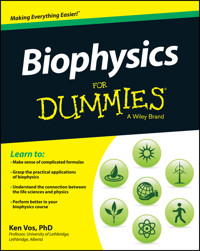
The fun, easy way to get up to speed on biophysics concepts, principles, and practices One of the most diverse of modern scientific disciplines, biophysics applies methods and technologies from physics to the study of biological systems and phenomena, from the human nervous system to soil erosion to global warming. What are the best options for satisfying the world's growing energy demands? How can we feed the world's growing population? How can we contain, or reverse, global warming? How can we vouchsafe a plentiful supply of potable water for future generations? These are among the critical questions to which biophysicists work to provide answers. * Biophysics courses are increasingly taken by students of biology, physics, chemistry, biochemistry, physiology, statistics, bioengineering, neuroscience, computer science, pharmacology, agriculture,and many more * Provides a friendly, unintimidating overview of the material covered in a typical college-level biophysics course * A one-stop reference, course supplement and exam preparation tool for university students currently enrolled in an introductory biophysics courses * An indispensable resource for those studying the natural sciences, biological sciences, and physics, as well as math, statistics,computer science, pharmacology and many other disciplines * The current job market for people well versed in biophysics is very strong, and biophysics is currently listed as one of the fast-growing occupations in the North America
Sie lesen das E-Book in den Legimi-Apps auf:
Seitenzahl: 651
Veröffentlichungsjahr: 2013
Ähnliche



















Biophysics For Dummies®
Published by: John Wiley & Sons, Inc., 111 River Street, Hoboken, NJ 07030-5774, www.wiley.com
Copyright © 2013 by John Wiley & Sons, Inc., Hoboken, New Jersey
Published simultaneously in Canada
No part of this publication may be reproduced, stored in a retrieval system or transmitted in any form or by any means, electronic, mechanical, photocopying, recording, scanning or otherwise, except as permitted under Sections 107 or 108 of the 1976 United States Copyright Act, without the prior written permission of the Publisher. Requests to the Publisher for permission should be addressed to the Permissions Department, John Wiley & Sons, Inc., 111 River Street, Hoboken, NJ 07030, (201) 748-6011, fax (201) 748-6008, or online at http://www.wiley.com/go/permissions.
Trademarks: Wiley, For Dummies, the Dummies Man logo, Dummies.com, Making Everything Easier, and related trade dress are trademarks or registered trademarks of John Wiley & Sons, Inc., and may not be used without written permission. All other trademarks are the property of their respective owners. John Wiley & Sons, Inc., is not associated with any product or vendor mentioned in this book.
Limit of Liability/Disclaimer of Warranty: while the publisher and author have used their best efforts in preparing this book, they make no representations or warranties with respect to the accuracy or completeness of the contents of this book and specifically disclaim any implied warranties of merchantability or fitness for a particular purpose. no warranty may be created or extended by sales representatives or written sales materials. The advise and strategies contained herein may not be suitable for your situation. you should consult with a professional where appropriate. neither the publisher nor the author shall be liable for damages arising herefrom.
For general information on our other products and services, please contact our Customer Care Department within the U.S. at 877-762-2974, outside the U.S. at 317-572-3993, or fax 317-572-4002. For technical support, please visit www.wiley.com/techsupport.
Wiley publishes in a variety of print and electronic formats and by print-on-demand. Some material included with standard print versions of this book may not be included in e-books or in print-on-demand. If this book refers to media such as a CD or DVD that is not included in the version you purchased, you may download this material at http://booksupport.wiley.com. For more information about Wiley products, visit www.wiley.com.
ISBN: 978-1-118-51350-7 (pbk); ISBN: 978-1-118-51352-1 (ebk); ISBN: 978-1-118-51353-8 (ebk); ISBN: 978-1-118-51354-5 (ebk)
Manufactured in the United States of America
10 9 8 7 6 5 4 3 2 1
Biophysics For Dummies®
Visit www.dummies.com/cheatsheet/biophysics to view this book's cheat sheet.
Table of Contents
Introduction
About This Book
Foolish Assumptions
Icons Used in This Book
Beyond This Book
Where to Go from Here
Part I: Getting Started with Biophysics
Chapter 1: Welcoming You to the World of Biophysics
Getting the Lowdown on What Biophysics Really Is
Grasping the Mechanics of Biomechanics
Surveying the rules
Focusing on statics
Going the dynamic route
Moving around with kinematics
Eyeing the Physics of Fluids
Understanding fluid’s mechanics and cohesive forces
Tackling fluid dynamics
Moving through membranes and porous materials
Comprehending Waves and Sound
Disturbing the material
Knowing how animals and instruments make sound waves
Hearing sound waves
Applying sound waves
Forcing Biophysics onto the World
Binding with the electromagnetic force
Getting a hold on radiation and how it battles cancer
Working with radiation
Using biophysics in medicine
Chapter 2: Interrogating Biophysics: The Five Ws and One H
Figuring Out What Biophysics Is
Locating Biophysics: The Where
Understanding Why Biophysics Is Important
Determining When Biophysics Is Relevant
Finding Out Who Are Biophysicists
Answering the Hows of Biophysics
Chapter 3: Speaking Physics: The Basics for All Areas of Biophysics
Stretching Out in All Physical Dimensions with Units
Grasping Scalars, Vectors, and Their Properties
Defining Physical Quantities
Plotting the position
Rotating to an angular position
Timing the change: Velocity
Scoping out speed
Focusing on angular velocity
Examining the direction of angular variables
Measuring acceleration
Describing momentum
Interacting with others: Force
Spreading force over an area: Pressure
Going ’round and ’round: Axis of rotation
Distributing mass: Moment of inertia
Quantifying motion: Angular momentum
Tackling torque
Working with work
Perusing power
Eyeing energy
Part II: Calling the Mechanics to Fix Your Bio — Biomechanics
Chapter 4: Bullying Biomechanics with the Laws of Physics
Recognizing That the Force Is Always with You: Newton’s Laws
Moving with inertia — Newton’s first law of motion
Stopping requires force — Newton’s second law of motion
Interacting takes two — forces and Newton’s third law of motion
Meeting Conservative Forces — No Tea Party Folks Here
Hooking into Hooke’s Law
Getting heavy with the effect of gravity
Recognizing the Nonconservative Forces: No Bleeding Hearts Here
Walking in the park — static friction
Hurting in the joints when moving — kinetic friction
Identifying other nonconservative forces
Thinking Green — Conservation Is Good; So Is Energy, Work, and Power
Conserving momentum
Moving energy and work
Working with energy and power
Colliding objects
Chapter 5: Sitting with Couch Potatoes –– Static Equilibrium
Understanding Static Translational Equilibrium
Solving static translational equilibrium problems
Drawing free-body diagrams
Finding forces with static translational equilibrium
Turning to Static Rotational Equilibrium
Solving rotational equilibriums
Doing static rotational free-body diagrams
Bending to the will of static rotational equilibrium
Breaking Rigid Bodies with Static Equilibrium
Applying static translational equilibrium multiple times — break a leg
Applying static rotational and static translational equilibrium — the iron cross
Chapter 6: Building the Mechanics of the Human Body and Animals
Getting Down with Gravity
Shifting to the center of mass
Staying stable and balanced
Feeling the Effects of Acceleration
Noticing the physiological effects of acceleration
Gaining a hold of effective weight — blackouts and redouts
Perceiving angular momentum and balance
Floating in space and the effects of weightlessness
Rising of the Machines — The Bio-Terminator
Marching to the mechanical advantage
Perusing the machines within biomechanics
Working with your body
Responding to Biological System’s Forces
Grasping elasticity, stress, and strain
Bending, buckling, and compressing
Shearing and twisting
Defining Scaling: No Scales Required
Growing cows and trees
Scaling in the body
Chapter 7: Making The World Go Round with Physics –– Dynamics
Reducing Motion to a Straight Line
Riding my bike
Racing the horses
Simplifying the dynamics of multiple objects in contact
Discovering Forces and Torques Involved with Circular Motion
Racing on a circular track — forces and acceleration
Accelerating around the corner — torques and forces
Chapter 8: Looking at Where Moving Objects Go –– Kinematics
Grasping One-Dimensional Motion
Analyzing sprinters’ run — the 100-meter dash
Dunking the basketball — people and animals’ jumping abilities
Skydiving and non-uniform acceleration
Spinning In Circles
Moving With Noncircular Two-Dimensional Motion
Serving in tennis — projectile motion
Pouncing on prey — combining jumping and projectile motion
Part III: Making Your Blood Boil — The Physics of Fluids
Chapter 9: Understanding the Mechanics of Fluids and Cohesive Forces
Pushing On Fluids — Pressure and Density
Squeezing atoms together — density and pressure
Weighing air and fluids — Pascal’s principle
Gauging blood pressure
Examining Why Things Float
Floating in fluid — Archimedes’ principle and the buoyant force
Measuring the density of the human body
Solving Conservation Laws
Grasping the continuity equation
Understanding Bernoulli’s equation
Applying Bernoulli’s equation to static fluids
Sticking Together — Cohesive Forces
Fighting surface tension
Making contact with capillarity and contact angles
Blocking fluids with Laplace’s law
Sneaking oxygen into the body
Looking into negative pressure in water columns
Chapter 10: Going with the Fluid Flow — Fluid Dynamics
Ignoring Friction Nonviscous Fluids
Conserving energy with Bernoulli’s equation
Flowing air — wind, birds, planes, and baseball
Regulating temperature in warm-blooded animals — conservation of heat energy
Applying the heat formulas to biophysics
Fighting the Drag — Viscous Flow
Stressing out with viscous fluids
Classifying viscous fluids — Newtonian and non-Newtonian fluids
Flowing slowly at the edge — laminar flow and Poiseuille’s law
Flowing of the blood and flow resistance
Pumping of the heart — making the blood move
Chapter 11: Breaking through to the Other Side — Transport, Membranes, and Porous Material
Examining the Ins and Outs of Diffusion
Defining the diffusion coefficient
Flowing through materials — Fick’s law
Restricting what passes through the barrier — osmosis and osmosis pressure
Understanding Human Metabolism
Eating — balancing your energy
Searching for efficiency of food energy
Eliminating Product from the Body
Keeping doses low — classical kinetics
Indulging too much — Michaelis-Menten kinetics
Part IV: Playing the Music Too Loud — Sound and Waves
Chapter 12: Examining the Physics of Waves and Sound
Comprehending Harmonic Motion
Explaining harmonic motion in action
Weighing a virus: Applying Hooke’s law and harmonic motion
Swinging in a swing: Applying gravity and harmonic motion
Comprehending Waves and Their Properties
Dealing with all types of waves
Grasping physical properties of waves
Going the math route with waves
Adding linear superposition and interference
Seeing the Effect of Boundaries on the Wave
Traveling from a medium into a denser medium
Traveling from a medium into a less dense medium
Going to extremes: Open and closed boundaries
Resonating with resonance
Chapter 13: Grasping How Animals and Instruments Produce Sound Waves
Knowing the Nature of Sound and the Speed of Sound
Vibrating the air and pressure waves
Speeding ticket for sound
Exploring the physical properties of sound
Resonating with Vibrations and Resonance
Resonating with a clarinet
Vibrating air in a flute
Combining Cords: The Human Voice and Musical Instruments
Tying down the strings and cords
Checking body resonance in an acoustic guitar
Collapsing cavities
Chapter 14: Detecting Sound Waves with the Ear
Understanding Hearing and the Ear
Outer ear
Middle ear
Inner ear
Realizing How Sensitive the Human Ear Is — the Power of Sound Waves
Taking a closer look at ear power
Tuning into a sound wave
Grasping the eardrum and limit range
Grasping How Amazing Hearing Is
Interacting complex waves
Beating beats and tuning a guitar
Chapter 15: Listening to Sound — Doppler Effect, Echolocation, and Imaging
Forecasting with the Doppler Effect
Moving on the receiver’s end
Moving on the source’s end
Moving sources and receiver
Considering the special case — light
Finding Your Way in the Dark — Echolocation
Echolocating with constant frequency sound waves and the Doppler Effect
Triangulating with frequency modulated sound — echolocation
Understanding the Limited Range of Echolocation
Seeing the Unseen: Ultrasound Imaging
Part V: Interacting Subatomic Particles’ Influence on Biological Organisms
Chapter 16: Charging Matter: The Laws of Physics for Electricity, Magnetism, and Electromagnetism
Forcing Matter in Biological Systems to Interact
Describing matter by their properties: The Lorentz force
Sticking balloons on the wall: Coulomb’s law and static charge
Producing electric fields
Producing magnetic fields and the Biot-Savart law
Changing electric fields create magnet fields: Maxwell-Ampere law
Creating electric fields: Faraday’s law
Resisting AC/DC — the resistance of the human body and other resistors
Storing energy with charge: Capacitors
Connecting Electric Circuits
Conserving energy: Ohm’s law and the power dissipation of devices
Drawing road maps for electrons: Circuits and circuit diagrams
Conserving energy and charge within a circuit: Kirchhoff’s laws
Chapter 17: Tapping into the Physics of Radiation
Understanding What Nuclear Physics and Radioactivity Are
Explaining radioactivity
Decaying of elements – the physical half-life
Identifying the three types of isotopes
Debunking Misconceptions about Electromagnetic Radiation
Understanding non-ionizing radiation
Comprehending ionizing radiation
Seeing How Radioactivity Interacts with Biological Systems
Finding a date in archaeology — call Carbon-14
Eliminating radioactive material within the body — biological half-life
Determining how radioactive humans are
Chapter 18: Fighting the Big C –– But Not All Radiation Is Bad
Investigating Radiation within Biological Systems
Interacting radiation with matter
Hurting cells with radiation — mechanisms of cell damage
Exposing the Body to Radiation
Estimating the effects from radiation
Measuring the unhealthy effects of radiation
Glowing walls — all matter is radioactively decaying
Looking closer at lung cancer
Chapter 19: Seeing Good Biophysics in the Medical Field
Identifying Radiation at Work in Medicine
Arming dentists and doctors with X-ray machines
Producing radionuclides and radiopharmaceuticals — nuclear medicine
Focusing Your X-Ray Vision — Computer Tomography (CT) Scans
Zapping the body — how CT works
Looking inside the body — what CT is used for
Staying away — who should avoid CT scans
Posing For Pictures — Positron Emission Tomography (PET)
Setting up the PET — how does it work
Picturing the body — what is PET used for
Part VI: The Part of Tens
Chapter 20: Ten (or So) Tips to Help You Master Your Biophysics Course
Drawing Diagrams and Figures
Obeying the Rules
Creating Your Own Dictionary
Understanding the Concepts
Not Fearing the Mathematics
Applying the Knowledge in Your Field
Networking with Your Classmates
Surfing the Internet
Chatting with Biophysicists
Chapter 21: Ten Careers for People Studying Biophysics
Experimental Biophysicist in Academia
Theoretical Biophysicist in Academia
Biophysicists outside Academia
Nuclear Power Reactor Health Physicist
Governmental Health Physicist
Environmental Health Physicist
Medical Health Physicist
Radiation Therapy Medical Physicist
Diagnostic Imaging Medical Physicist
Nuclear Medicine Medical Physicist
About the Author
Cheat Sheet
Connect with Dummies
Introduction
Welcome to Biophysics For Dummies. Biophysics is a fascinating field of science that combines the study of the laws of physics with the study of systems involving living organisms (biology). The combination of these two fields makes biophysics interdisciplinary, which means biophysicists work side by side with people from many different backgrounds. Biophysics is a very diverse and interesting field; even if you spend your entire life studying biophysics, you can still discover new and interesting pieces of information.
About This Book
Biophysics For Dummies lays down the foundations for the fields of biophysics, including neurophysics, medical physics, health physics, and related fields that overlap with biophysics, presented in an easy-to-access manner. This reference book presents biophysics in plain English, so you can easily find what you’re looking for. When you’re reading, you don’t have to begin at the beginning. You can go directly to the chapter or section that interests you and start reading. Of course, I prefer that you read it from cover to cover, but then again, I am a bit biased. If you’re strapped for time and only want to read what you need to know, even when you’re reading the chapter or section of interest to you, you can skip the sidebars and the paragraphs marked with the Technical Stuff icon without losing any of the essential info.
This book is unique in that the majority of the material is at the introductory level, but the material presented is at an advanced enough level that you can use the book as a stepping stone in your biophysics studies. This book also lays out in a clear step-by-step procedure how to apply concepts in physics to problems in biophysics and the life sciences. The book introduces topics in the five fundamental areas of physics: mechanics, fluids, thermodynamics, electromagnetism, and nuclear physics.
You may notice while reading the book that I have done a few things that I hope make your reading and search of information easier:
I avoid using URLs. These URLs can change over time, so I have placed only the more important ones that probably won't change on the online Cheat Sheet. You can find all the important links in a single place for easy access with a single click at www.dummies.com/cheatsheet/biophysics.
I italicize all the variables used in mathematical formulas, so you can easily identify them. I also italicize words when I define them. Many words in biophysics have special meanings, and understanding the terminology is an important step toward comprehending the subject.
I use certain symbols differently than do some other biophysics books. The symbols are as follows:
• N for the torque instead of τ (tau), which is used in many introductory books. (Many engineering books use M.) Some more advanced physics books use N for torque and in addition, τ looks very similar to t (time), T (period), and T (half-life). I would have too many physical quantities using similar symbols.
• P(a) for absolute pressure, P(g) for gauge pressure, and P for power. I have too many sections where I use power and pressure at the same time, so I distinguish them this way.
• E represents energy and F represents force. I distinguish between the different energies and forces by using subscripts. Some books use T or K for the kinetic energy and some use U or V for the potential energy. I use EK and EP instead for kinetic energy and potential energy.
Foolish Assumptions
As I write this book, I assume you, my dear reader, fall into at least one of the following groups:
You’re in college and taking an introductory biophysics course.
You’re interested in studying biophysics or some related field where knowledge of biophysics is useful.
You’re involved with the sciences and want to expand your knowledge base in biophysics.
You have already taken algebra, geometry, and a science course in either biology, chemistry, or physics.
Icons Used in This Book
I use a few icons as markers in the margins. These markers are useful for helping you locate material or skip over material, depending on what you’re searching for. I use them to indicate what I think is important for you to notice. These icons can help you navigate through the material.
When I present helpful information that can make your life a bit easier when studying biophysics, I use this icon.
This icon highlights important pieces of information that I suggest you store away because you’ll probably use them on a regular basis.
This icon highlights common mistakes or errors that I see time after time from people who are taking a biophysics course.
This icon indicates in-depth examples. Try solving the problem and continue reading to see how to solve the problem.
This icon requires nonessential information, usually at least at a calculus background level. If you have a math phobia, then you may want to avoid reading these paragraphs. If you enjoy biophysics and mathematics, then I encourage you to read these paragraphs.
Beyond This Book
In addition to the material in Biophysics For Dummies, I also provide a free Cheat Sheet online at www.dummies.com/cheatsheet/biophysics. The Cheat Sheet adds a few extra tidbits that you will find interesting, such as solving biomechanical problems. You can also find other interesting bits of additional information online at www.dummies.com/extras/biophysics.
After reading the Cheat Sheet and online information, you may decide to pursue biophysics more in-depth, so I include URLs to the biophysical society, the association of medical physicists, and the health physics society. These links are a great starting point in search of answers to your biophysical questions.
Where to Go from Here
Science is about being curious and exploring, which is what attracted me to biophysics. As you read this book, feel free to jump around and start with the chapters and sections that interest you the most. If you need a particular section for your science course, such as kinematics or biomechanics, you can go straight there. You can also look in the index or the table of contents to find a topic that interests you. No matter what you decide to read, enjoy your adventure into the world of biophysics.
Part I
Getting Started with Biophysics
Go to www.dummies.com/cheatsheet/biophysics to discover some more informative Dummies content online about biophysics.
In this part . . .
Get a thorough overview of what biophysics is, including its diverse fields, such as biomechanics, fluids, waves and sound, the electromagnetic force, and medical physics, so you can fully appreciate how it affects your daily life.
Discover where you can find biophysics. You may be surprised to know who biophysicists are and where biophysics is used.
Tackle mathematics, most of which should be a review for you if you’ve already taken a chemistry, physics, or calculus class. Biophysics does use mathematics, so having a decent grasp of the basic formulas and equations is important when you study biophysics.
Comprehend some of the basics of biophysics, such as notation and terminology, that aren’t used in everyday life and clear up a few common myths.
Make the distinction between experimental and theoretical biophysics. Biophysics isn’t mathematics, but mathematics is a tool used by both experimental and theoretical biophysicists.
Chapter 1
Welcoming You to the World of Biophysics
In This Chapter
Mentioning mechanics
Flowing with fluids
Riding the waves
Identifying biophysics in the every day
Biophysics is the study of biology and all sciences connected to the biological sciences using the principles and laws of physics. It’s the ultimate interdisciplinary science combining biology, chemistry, and physics. If you love science, then biophysics is for you. The field touches on all aspects of all the natural sciences.
This chapter gives you the bird’s-eye view of biophysics and what you’ll find in this book. In this chapter, I explain the general features of biomechanics, the motion of fluids, waves and sounds, and electromagnetic force as well as radiation and radioactivity.
Getting the Lowdown on What Biophysics Really Is
No matter if you’re stuck taking a biophysics course to meet your science course requirements or you’re taking your first of many biophysics courses, you need to make sure you understand what you’re studying. Just break down the word biophysics.Bio means life and physics means nature, so biophysics is the study of living matter, its motion, and its interaction with the natural universe. Chapter 2 expands on the explanation of what biophysics is, and Chapter 3 covers some of the basic terminology used in biophysics.
The following clarifies what biophysics really means:
Biophysics uses techniques and methods from physics, mathematics, biology, and chemistry to study living organisms.
Biophysicists design experiments or do computational calculations in order to understand biological processes. A few examples of these biological processes are
• Photosynthesis
• The on-off switching of genes
• Memory and brain processes
• Muscle control
Biophysicists study how the senses work.
Biophysicists try to understand why things behave the way they do in sports and improve the performance of athletes.
Biophysicists study how molecules enter cells and how they interact.
Biophysicists study how cells move, divide, and respond to the environment.
As you can see, biophysics is all of this and everything that deals with living organisms. Biophysics plays an essential role in medicine, sports, engineering, physics, biology, biochemistry, and environmental science to mention a few areas. Whenever you’re considering something that involves a living organism and its interaction with its surroundings, you’re using biophysics.
Grasping the Mechanics of Biomechanics
Biomechanics is an important part of biophysics. Bio means life, and mechanics is the study of the interaction of a physical object with its surroundings. Therefore, biomechanics is the study of a living object’s interaction with its surroundings, which also includes the study of how living organisms move and the causes of this motion.
These sections explain a bit more about what biomechanics is. I discuss rules because biophysicists love rules, explain what happens when forces try to change an object’s motion, and look at the motion of an object.
Surveying the rules
Biomechanics has many rules because things don’t happen randomly or bychance. Things happen because of actions, and these rules tell you what the consequences of an action are. These rules are usually called whichcan’t be broken.
Lesen Sie weiter in der vollständigen Ausgabe!
Lesen Sie weiter in der vollständigen Ausgabe!
Lesen Sie weiter in der vollständigen Ausgabe!
Lesen Sie weiter in der vollständigen Ausgabe!
Lesen Sie weiter in der vollständigen Ausgabe!
Lesen Sie weiter in der vollständigen Ausgabe!
Lesen Sie weiter in der vollständigen Ausgabe!
Lesen Sie weiter in der vollständigen Ausgabe!
Lesen Sie weiter in der vollständigen Ausgabe!
Lesen Sie weiter in der vollständigen Ausgabe!
Lesen Sie weiter in der vollständigen Ausgabe!
Lesen Sie weiter in der vollständigen Ausgabe!
Lesen Sie weiter in der vollständigen Ausgabe!
Lesen Sie weiter in der vollständigen Ausgabe!
Lesen Sie weiter in der vollständigen Ausgabe!
Lesen Sie weiter in der vollständigen Ausgabe!
Lesen Sie weiter in der vollständigen Ausgabe!
Lesen Sie weiter in der vollständigen Ausgabe!
Lesen Sie weiter in der vollständigen Ausgabe!
Lesen Sie weiter in der vollständigen Ausgabe!
Lesen Sie weiter in der vollständigen Ausgabe!
Lesen Sie weiter in der vollständigen Ausgabe!
Lesen Sie weiter in der vollständigen Ausgabe!
Lesen Sie weiter in der vollständigen Ausgabe!
Lesen Sie weiter in der vollständigen Ausgabe!
Lesen Sie weiter in der vollständigen Ausgabe!
Lesen Sie weiter in der vollständigen Ausgabe!
Lesen Sie weiter in der vollständigen Ausgabe!




