


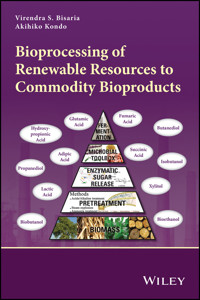
Bioprocessing of Renewable Resources to Commodity Bioproducts E-Book
127,99 €
Mehr erfahren.
- Herausgeber: John Wiley & Sons
- Kategorie: Fachliteratur
- Sprache: Englisch
This book provides the vision of a successful biorefinery—the lignocelluloic biomass needs to be efficiently converted to its constituent monomers, comprising mainly of sugars such as glucose, xylose, mannose and arabinose. Accordingly, the first part of the book deals with aspects crucial for the pretreatment and hydrolysis of biomass to give sugars in high yield, as well as the general aspects of bioprocessing technologies which will enable the development of biorefineries through inputs of metabolic engineering, fermentation, downstream processing and formulation. The second part of the book gives the current status and future directions of the biological processes for production of ethanol (a biofuel as well as an important commodity raw material), solvents (butanol, isobutanol, butanediols, propanediols), organic acids (lactic acid, 3-hydroxy propionic acid, fumaric acid, succinic acid and adipic acid), and amino acid (glutamic acid). The commercial production of some of these commodity bioproducts in the near future will have a far reaching effect in realizing our goal of sustainable conversion of these renewable resources and realizing the concept of biorefinery.
Suitable for researchers, practitioners, graduate students and consultants in biochemical/ bioprocess engineering, industrial microbiology, bioprocess technology, metabolic engineering, environmental science and energy, the book offers:
- Exemplifies the application of metabolic engineering approaches for development of microbial cell factories
- Provides a unique perspective to the industry about the scientific problems and their possible solutions in making a bioprocess work for commercial production of commodity bioproducts
- Discusses the processing of renewable resources, such as plant biomass, for mass production of commodity chemicals and liquid fuels to meet our ever- increasing demands
- Encourages sustainable green technologies for the utilization of renewable resources
- Offers timely solutions to help address the energy problem as non-renewable fossil oil will soon be unavailable
Sie lesen das E-Book in den Legimi-Apps auf:
Seitenzahl: 1125
Veröffentlichungsjahr: 2014
Ähnliche




















BIOPROCESSING OF RENEWABLE RESOURCES TO COMMODITY BIOPRODUCTS
Edited by
Virendra S. Bisaria
Akihiko Kondo
About the Cover: The pyramid represents successive and increasingly selective processing stages in bioconversion of plant biomass to industrial chemicals. The chemicals in white bubbles are the industrial commodity bioproducts pertaining to the realm of “white biotechnology”.
Cover illustration/design by Ruchi Uppal.
Rights of Cover Design are owned by Prof. Virendra S. Bisaria.
Copyright © 2014 by John Wiley & Sons, Inc. All rights reserved.
Published by John Wiley & Sons, Inc., Hoboken, New Jersey. Published simultaneously in Canada.
No part of this publication may be reproduced, stored in a retrieval system, or transmitted in any form or by any means, electronic, mechanical, photocopying, recording, scanning, or otherwise, except as permitted under Section 107 or 108 of the 1976 United States Copyright Act, without either the prior written permission of the Publisher, or authorization through payment of the appropriate per-copy fee to the Copyright Clearance Center, Inc., 222 Rosewood Drive, Danvers, MA 01923, (978) 750-8400, fax (978) 750-4470, or on the web at www.copyright.com. Requests to the Publisher for permission should be addressed to the Permissions Department, John Wiley & Sons, Inc., 111 River Street, Hoboken, NJ 07030, (201) 748-6011, fax (201) 748-6008, or online at http://www.wiley.com/go/permission.
Limit of Liability/Disclaimer of Warranty: While the publisher and author have used their best efforts in preparing this book, they make no representations or warranties with respect to the accuracy or completeness of the contents of this book and specifically disclaim any implied warranties of merchantability or fitness for a particular purpose. No warranty may be created or extended by sales representatives or written sales materials. The advice and strategies contained herein may not be suitable for your situation. You should consult with a professional where appropriate. Neither the publisher nor author shall be liable for any loss of profit or any other commercial damages, including but not limited to special, incidental, consequential, or other damages.
For general information on our other products and services or for technical support, please contact our Customer Care Department within the United States at (800) 762-2974, outside the United States at (317) 572-3993 or fax (317) 572-4002.
Wiley also publishes its books in a variety of electronic formats. Some content that appears in print may not be available in electronic formats. For more information about Wiley products, visit our web site at www.wiley.com.
Library of Congress Cataloging-in-Publication Data:
Bioprocessing of renewable resources to commodity bioproducts / edited by Virendra S. Bisaria, Akihiko Kondo. pages cm Includes bibliographical references and index. ISBN 978-1-118-17583-5 (hardback) 1. Microbial biotechnology. 2. Biomass energy. I. Bisaria, Virendra S., editor of compilation. II. Kondo, Akihiko, 1959- editor of compilation. TP248.27.M53B5626 2014 662′.88–dc23 2013046035
CONTENTS
Preface
Contributors
Part I: Enabling Processing Technologies
Chapter 1: Biorefineries—Concepts for Sustainability
1.1 Introduction
1.2 Three Levels for Biomass Use
1.3 The Sustainable Removal of Biomass from the Field is Crucial for a Successful Biorefinery
1.4 Making Order: Classification of Biorefineries
1.5 Quantities of Sustainably Available Biomass
1.6 Quantification of Sustainability
1.7 Starch- and Sugar-Based Biorefinery
1.8 Oilseed Crops
1.9 Lignocellulosic Feedstock
1.10 Green Biorefinery
1.11 Microalgae
1.12 Future Prospects—Aiming for Higher Value from Biomass
References
Chapter 2: Biomass Logistics
2.1 Introduction
2.2 Method of Assessing Uncertainty, Sensitivity, and Influence of Feedstock Logistic System Parameters
2.3 Understanding Uncertainty in the Context of Feedstock Logistics
2.4 Future Prospects
2.5 Financial Disclosure/Acknowledgments
References
Chapter 3: Pretreatment of Lignocellulosic Materials
3.1 Introduction
3.2 Complexity of Lignocelluloses
3.3 Challenges in Pretreatment of Lignocelluloses
3.4 Pretreatment Methods and Mechanisms
3.5 Economic Outlook
3.6 Future Prospects
References
Chapter 4: Enzymatic Hydrolysis of Lignocellulosic Biomass
4.1 Introduction
4.2 Cellulase, Hemicellulase, and Accessory Enzyme Systems and Their Synergistic Action on Lignocellulosic Biomass
4.3 Enzymatic Hydrolysis at High Concentrations of Biomass Solids
4.4 Mechanistic Process Modeling and Simulation
4.5 Considerations for Process Integration and Economic Viability
4.6 Economic Outlook
4.7 Future Prospects
Acknowledgments
References
Chapter 5: Production of Cellulolytic Enzymes
5.1 Introduction
5.2 Hydrolytic Enzymes for Digestion of Lignocelluloses
5.3 Desirable Attributes of Cellulase for Hydrolysis of Cellulose
5.4 Strategies Used for Enhanced Enzyme Production
5.5 Economic Outlook
5.6 Future Prospects
References
Chapter 6: Bioprocessing Technologies
6.1 Introduction
6.2 Cell Factory Platform
6.3 Fermentation Process
6.4 Recovery Process
6.5 Formulation Process
6.6 Final Product Blends
6.7 Economic Outlook and Future Prospects
Acknowledgment
Nomenclature
References
Part II: Specific Commodity Bioproducts
Chapter 7: Ethanol from Bacteria
7.1 Introduction
7.2 Heteroethanologenic Bacteria
7.3 Homoethanologenic Bacteria
7.4 Economic Outlook
7.5 Future Prospects
References
Chapter 8: Ethanol Production from Yeasts
8.1 Introduction
8.2 Ethanol Production from Starchy Biomass
8.3 Ethanol Production from Lignocellulosic Biomass
8.4 Economic Outlook
8.5 Future Prospects
References
Chapter 9: Fermentative Biobutanol Production: An Old Topic with Remarkable Recent Advances
9.1 Introduction
9.2 Butanol as a Fuel and Chemical Feedstock
9.3 History of ABE Fermentation
9.4 Physiology of Clostridial ABE Fermentation
9.5 ABE Fermentation Processes, Butanol Toxicity, and Product Recovery
9.6 Metabolic Engineering and “Omics”—Analyses of Solventogenic Clostridia
9.7 Economic Outlook
9.8 Current Status and Future Prospects
References
Chapter 10: Bio-based Butanediols Production: The Contributions of Catalysis, Metabolic Engineering, and Synthetic Biology
10.1 Introduction
10.2 Bio-Based 2,3-Butanediol
10.3 Bio-Based 1,4-Butanediol
10.4 Economic Outlook
10.5 Future Prospects
Acknowledgments
References
Chapter 11: 1,3-Propanediol
11.1 Introduction
11.2 Bioconversion of Glucose into 1,3-Propanediol
11.3 Bioconversion of Glycerol into 1,3-Propanediol
11.4 Metabolic Engineering
11.5 Down-Processing of 1,3-Propanediol
11.6 Integrated Processes
11.7 Economic Outlook
11.8 Future Prospects
Acknowledgments
A list of abbreviations
References
Chapter 12: Isobutanol
12.1 Introduction
12.2 The Access Code for the Microbial Production of Branched-Chain Alcohols: 2-Ketoacid Decarboxylase and an Alcohol Dehydrogenase
12.3 Metabolic Engineering Strategies for Directed Production of Isobutanol
12.4 Overcoming Isobutanol Cytotoxicity
12.5 Process Development for the Production of Isobutanol
12.6 Economic Outlook
12.7 Future Prospects
Nomenclature
Abbreviations
References
Chapter 13: Lactic Acid
13.1 History of Lactic Acid
13.2 Applications of Lactic Acid
13.3 Poly Lactic Acid
13.4 Conventional Lactic Acid Production
13.5 Lactic Acid Production From Renewable Resources
13.6 Economic Outlook
13.7 Future Prospects
Nomenclature
References
Chapter 14: Microbial Production of 3-Hydroxypropionic Acid From Renewable Sources: A Green Approach as an Alternative to Conventional Chemistry
14.1 Introduction
14.2 Natural Microbial Production of 3-HP
14.3 Production of 3-HP from Glucose by Recombinant Microorganisms
14.4 Production of 3-HP from Glycerol by Recombinant Microorganisms
14.5 Major Challenges for Microbial Production of 3-HP
14.6 Economic Outlook
14.7 Future Prospects
Acknowledgment
List of Abbreviations
References
Chapter 15: Fumaric Acid Biosynthesis and Accumulation
15.1 Introduction
15.2 Microbial Synthesis of Fumaric Acid
15.3 A Plausible Biochemical Mechanism for Fumaric Acid Biosynthesis and Accumulation in
RHIZOPUS
15.4 Toward Engineering
RHIZOPUS
for Fumaric Acid Production
15.5 Economic Outlook
15.6 Future Perspectives
Acknowledgment
References
Notes
Chapter 16: Succinic Acid
16.1 Succinate as an Important Platform Chemical for a Sustainable Bio-Based Chemistry
16.2 Microorganisms for Bio-Succinate Production— Physiology, Metabolic Routes, and Strain Development
16.3 Neutral Versus Acidic Conditions for Product Formation
16.4 Downstream Processing
16.5 Companies Involved in Bio-Succinic Acid Manufacturing
16.6 Future Prospects and Economic Outlook
References
Chapter 17: Glutamic Acid
17.1 Introduction
17.2 Glutamic Acid Production by
CORYNEBACTERIUM GLUTAMICUM
17.3 Glutamic Acid as a Building Block
17.4 Economic Outlook
17.5 Future Prospects
List of Abbreviations
References
Chapter 18: Recent Advances for Microbial Production of Xylitol
18.1 Introduction
18.2 General Principles for Biological Production of Xylitol
18.3 Microbial Production of Xylitol
18.4 Xylitol Production by Genetically Engineered Microorganisms
18.5 Economic Outlook
18.6 Future Prospects
Acknowledgments
Nomenclature
References
Chapter 19: First and Second Generation Production of Bio-Adipic Acid
19.1 Introduction
19.2 Production of Bio-Adipic Acid
19.3 Ecological Footprint of Bio-Adipic Acid
19.4 Economic Outlook
19.5 Future Prospects
References
Index
End User License Agreement
List of Tables
Chapter 1
Table 1.1
Table 1.2
Table 1.3
Table 1.4
Table 1.5
Chapter 3
Table 3.1
Table 3.2
Table 3.3
Table 3.4
Chapter 4
Table 4.1
Chapter 5
Table 5.1
Table 5.2
Table 5.3
Table 5.4
Chapter 6
Table 6.1
Table 6.2
Table 6.3
Chapter 7
Table 7.1
Table 7.2
Table 7.3
Chapter 9
Table 9.1
Table 9.2
Table 9.3
Table 9.4
Chapter 10
Table 10.1
Table 10.2
Table 10.3
Chapter 11
Table 11.1
Table 11.2
Chapter 12
Table 12.1
Table 12.2
Table 12.3
Table 12.4
Chapter 13
Table 13.1
Table 13.2
Table 13.3
Table 13.4
Table 13.5
Chapter 14
Table 14.1
Table 14.2
Table 14.3
Chapter 15
Table 15.1
Table 15.2
Chapter 16
Table 16.1
Table 16.2
Chapter 18
Table 18.1
Table 18.2
Table 18.3
Chapter 19
Table 19.1
Table 19.2
List of Illustrations
Chapter 1
Figure 1.1 Food security, energy security, and climate change are centered around the limited availability of arable land. This constitutes a trilemma, which has to be addressed by our societies.
Figure 1.2 Schematic overview about the processing strategy of different feedstock used in biorefineries and the various products obtained. Processes leading to an energy product are shown as dashed lines. Fermentation sludge is the microbial biomass produced during the bioconversion processes.
Figure 1.3 Total US oil consumption compared to potential and currently harvested nonfood biomass divided into its main uses. The area of each circle is proportional to the consumed amount. From Vennestrøm et al. (2011).
Figure 1.4 Worldwide production of the main sugar- and starch-containing crops. Data taken from the Food and Agriculture Organization of the United Nations (www.fao.org).
Lesen Sie weiter in der vollständigen Ausgabe!
Lesen Sie weiter in der vollständigen Ausgabe!
Lesen Sie weiter in der vollständigen Ausgabe!
Lesen Sie weiter in der vollständigen Ausgabe!
Lesen Sie weiter in der vollständigen Ausgabe!
Lesen Sie weiter in der vollständigen Ausgabe!
Lesen Sie weiter in der vollständigen Ausgabe!
Lesen Sie weiter in der vollständigen Ausgabe!
Lesen Sie weiter in der vollständigen Ausgabe!
Lesen Sie weiter in der vollständigen Ausgabe!
Lesen Sie weiter in der vollständigen Ausgabe!
Lesen Sie weiter in der vollständigen Ausgabe!
Lesen Sie weiter in der vollständigen Ausgabe!
Lesen Sie weiter in der vollständigen Ausgabe!
Lesen Sie weiter in der vollständigen Ausgabe!
Lesen Sie weiter in der vollständigen Ausgabe!
Lesen Sie weiter in der vollständigen Ausgabe!
Lesen Sie weiter in der vollständigen Ausgabe!
Lesen Sie weiter in der vollständigen Ausgabe!
Lesen Sie weiter in der vollständigen Ausgabe!
Lesen Sie weiter in der vollständigen Ausgabe!
Lesen Sie weiter in der vollständigen Ausgabe!
Lesen Sie weiter in der vollständigen Ausgabe!
Lesen Sie weiter in der vollständigen Ausgabe!
Lesen Sie weiter in der vollständigen Ausgabe!




