


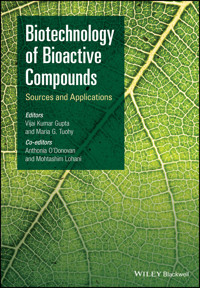
Biotechnology of Bioactive Compounds E-Book
210,99 €
Mehr erfahren.
- Herausgeber: John Wiley & Sons
- Kategorie: Fachliteratur
- Sprache: Englisch
Bioactive compounds play a central role in high-value product development in the chemical industry. Bioactive compounds have been identified from diverse sources and their therapeutic benefits, nutritional value and protective effects in human and animal healthcare have underpinned their application as pharmaceuticals and functional food ingredients. The orderly study of biologically active products and the exploration of potential biological activities of these secondary metabolites, including their clinical applications, standardization, quality control, mode of action and potential biomolecular interactions, has emerged as one of the most exciting developments in modern natural medicine.
Biotechnology of Bioactive Compounds describes the current stage of knowledge on the production of bioactive compounds from microbial, algal and vegetable sources. In addition, the molecular approach for screening bioactive compounds is also discussed, as well as examples of applications of these compounds on human health. The first half of the book comprises information on diverse sources of bioactive compounds, ranging from microorganisms and algae to plants and dietary foods. The second half of the book reviews synthetic approaches, as well as selected bioactivities and biotechnological and biomedical potential. The bioactive compounds profiled include compounds such as C-phycocyanins, glycosides, phytosterols and natural steroids. An overview of the usage of bioactive compounds as antioxidants and anti-inflammatory agents, anti-allergic compounds and in stem cell research is also presented, along with an overview of the medicinal applications of plant-derived compounds.
Biotechnology of Bioactive Compounds will be an informative text for undergraduate and graduate students of bio-medicinal chemistry who are keen to explore the potential of bioactive natural products. It also provides useful information for scientists working in various research fields where natural products have a primary role.
Sie lesen das E-Book in den Legimi-Apps auf:
Seitenzahl: 1446
Veröffentlichungsjahr: 2015
Ähnliche




















CONTENTS
Cover
Title page
Copyright page
List of contributors
Foreword
Preface
Section I: Bioactive compounds from diverse plant, microbial, and marine sources
Chapter 1: Bioactive compounds from vegetable and fruit by-products
1.1 Introduction
1.2 Beneficial health effects obtained by consuming vegetable and fruit products rich in phytochemicals
1.3 By-products from vegetable and fruit processing to obtain phytochemicals
1.4 Vegetable by-products
1.5 Fruit by-products
1.6 Pretreatment and extraction systems
References
Chapter 2: Bioactive compounds in fresh-cut fruits
2.1 Introduction
2.2 Factors affecting quality and phytochemical content of fresh-cut fruits
2.3 Raw material
2.4 Effect of minimal processing: Major operations
2.5 Effect of atmosphere composition and temperature during storage
2.6 Conclusions
Acknowledgments
References
Chapter 3: Pressurized hot water extraction of polyphenols from plant material
3.1 Introduction
3.2 Polyphenols: Key bioactive compounds
3.3 Pressurized hot water extraction process
3.4 Pressurized hot water extraction to isolate plant polyphenols
3.5 Conclusions
3.6 Future research
References
Chapter 4: Bioactive compounds in cereals
4.1 Introduction
4.2 Cereal bioactive compounds
4.3 Conclusions
References
Chapter 5: Antimicrobials from medicinal plants
5.1 Introduction
5.2 Medicinal plants: An untapped source of antimicrobials
5.3 Antimicrobial phytochemicals
5.4 Mode of action
5.5 Challenges
5.6 Future prospects
Acknowledgment
References
Chapter 6:
Coccoloba uvifera
as a source of components with antioxidant activity
6.1 Introduction
6.2 Materials and methods
6.3
In vitro
antioxidant properties
6.4 Statistical analysis
6.5 Results and discussion
6.6 Conclusion
References
Chapter 7: Bioactive compounds and medical significance of some endangered medicinal plants from the Western Ghats region of India
7.1 Introduction
7.2 Western Ghats (Sahyadri ranges)
7.3
Aegle marmelos
(L.) Correa (Rutaceae)
7.4
Aristolochia indica
L. (Aristolochiaceae)
7.5
Baliospermum montanum
(willd.) Muell-arg (Euphorbiaceae)
7.6
Coscinium fenestratum
(gaertn.) Coleb. (Menispermaceae)
7.7
Decalepis hamiltonii
Wight & Arn. (Periplocaceae)
7.8
Eugenia singampattiana
bedd. (Myrtaceae)
7.9
Oroxylum indicum
(l.) Benth.Ex kurz (bignoniaceae)
7.10
Pterocarpus santalinus
L. (Fabaceae)
7.11
Rauvolfia serpentina
(L.) Benth. ex kurz (Apocyanaceae)
7.12
Trichopus zeylanicus
gaertn. (Dioscoreaceae)
7.13 Conclusions
Acknowledgments
References
Chapter 8: Fungal bioactive compounds
8.1 Introduction
8.2 Bioactive compounds or biological activity
8.3 Conclusion
Acknowledgments
References
Chapter 9: Arbuscular mycorrhizal fungi
9.1 Introduction
9.2 Plant fungal endophytes
9.3 Arbuscular mycorrhizal fungi and biocompounds
9.4 Ectomycorrhizas and biocompounds
9.5 Plants, arbuscular mycorrhizal fungi, and DSE
9.6 Arbuscular mycorrhizal fungi and medicinal plants
9.7 Conclusion
Acknowledgments
References
Chapter 10: Extremophiles as source of novel bioactive compounds with industrial potential
10.1 Introduction
10.2 Thermophiles
10.3 Psychrophiles
10.4 Alkaliphiles
10.5 Acidophiles
10.6 Halophiles
10.7 Piezophiles
10.8 Radiophiles
10.9 Metallophiles
10.10 Polyextremophiles
10.11 Conclusion
References
Chapter 11: New trends in microbial production of natural complex bioactive isoprenoids
11.1 Introduction
11.2 Isoprenoids
11.3 Metabolic engineering of the mevalonate (MEV) pathway
11.4 Metabolic engineering of the mep pathway for isoprenoids production
11.5 Modeling and simulation approaches
11.6 Conclusions
References
Chapter 12: Production of c-phycocyanin and its potential applications
12.1 Introduction
12.2 Production of c-phycocyanin
12.3 Photoautotrophic production
12.4 Mixotrophic production
12.5 Heterotrophic production
12.6 Recombinant production
12.7 C-phycocyanin as a natural dye
12.8 Application of c-phycocyanin as an additive in food and cosmetics
12.9 Diagnostic applications of c-phycocyanin
12.10 Nutraceutical and pharmaceutical applications
12.11 Anticancerous activity
12.12 Future prospects
References
Section II: Chemistry, biotechnology, and industrial relevance
Chapter 13: Glycosides
13.1 Introduction
13.2 Glycosides
13.3 Classification
13.4 Hydrolysis
13.5 Chemical properties and identification
13.6 Biologic activity and therapeutic applications
13.7 Case studies: From production to therapeutic application
13.8 Conclusion
References
Chapter 14: Trehalose mimics as bioactive compounds
14.1 Introduction
14.2 Trehalose processing enzymes and trehalose mimetics as bioactive compounds
14.3 Trehalose-processing mycolyltransesterase enzymes
14.4 Trehalose-processing sulfotransferase
14.5 Acyl
2
SGL mimetics: Novel potential antitubercular vaccines
14.6 Conclusions
References
Chapter 15: Virtual screening and prediction of the molecular mechanism of bioactive compounds
in silico
15.1 Introduction
15.2 Ligand-based virtual screening (LBVS)
15.3 Structure-based virtual screening (SBVS)
15.4 Reverse docking approach for predicting biological activity of compounds
15.5 Predicting molecular targets responsible for antiaging properties of artemisinic acid
15.6 Advanced options
15.7 Predicting molecular targets of D-pinitol responsible for antioxidant activity in a
C.
elegans
model using computational approaches
15.8 Future directions
References
Chapter 16: Steroids in natural matrices
16.1 Introduction
16.2 Structure and classification
16.3 Bioavailability of steroids
16.4 Biosynthesis
16.5 Analytical methods
16.6 Biological activity
16.7 Conclusions
Acknowledgments
References
Chapter 17: Bioactive compounds obtained through biotechnology
17.1 Introduction
17.2 Antioxidant compounds
17.3 Anticancer compounds
17.4 Antimicrobial compounds
17.5 Conclusion
References
Chapter 18: Metabolic engineering of bioactive compounds in berries
18.1 Introduction
18.2 Engineering of berry secondary metabolites
18.3 Enhanced secondary metabolite production by elicitation
18.4 Conclusion
References
Chapter 19: Food-derived multifunctional bioactive proteins and peptides
19.1 Bioactive peptides: Overview
19.2 Multifunctional food peptides
19.3 Milk-derived multifunctional proteins and peptides
19.4 Egg-derived multifunctional proteins and peptides
19.5 Plant protein-derived multifunctional peptides
19.6 Perspectives in production
19.7 Bioprocess-based research challenges
19.8 Conclusion
References
Chapter 20: Food-derived multifunctional bioactive proteins and peptides
20.1 Applications of multifunctional peptides
20.2 Pharmaceutical products
20.3 Dermopharmaceutical products
20.4 Recent advances and emerging technologies
20.5 Quantitative structure activity relationship (qsar) models
20.6 Research concerns and bottlenecks
20.7 Conclusions and future projections
References
Section III: Biochemistry and nutraceutical or health-related applications
Chapter 21: An overview of the molecular and cellular interactions of some bioactive compounds
21.1 Introduction
21.2 Prokaryotic versus eukaryotic
21.3
lac
operon
21.4 The structure of
β
-globin in sickle cell anemia
21.5 Direct reversal pathway for Dna repair
21.6 Oxidants, free radicals, and antioxidants: The balance
21.7 The “nutritional genomics”
21.8 Food affects our genes
21.9 Active antitumor compounds from medicinal plant
21.10 Structure of plant bioactive compounds
21.11 Bioactive compounds not always friends
21.12 Use of drug combinations
21.13 Screening for the presence of alkaloids and/or nitrogenous bases and flavonoids in plant extracts
21.14 Protocol for
in vitro
detection of antioxidants
21.15 Determination of ahh activity
21.16 Determination of microsomal hydrogen peroxide
21.17 Conclusion
References
Chapter 22: Bioactive compounds as growth factors and 3D matrix materials in stem cell research
22.1 Introduction
22.2 Prominent growth factors
22.3 Biotic scaffolds for tissue regeneration
22.4 Conclusion
References
Chapter 23: Phytosterols
23.1 Introduction
23.2 Phytosterols
23.3 Other biological effects
23.4 Conclusion
Acknowledgments
References
Chapter 24: Overview of the role of food bioactive compounds as complementary therapy for celiac disease
24.1 Introduction
24.2 Gliadins-mediated alterations in intestinal epithelium
24.3 Gluten-free diet (GFD) and nutrition
24.4 Role of pre- and probiotics in celiac disease
24.5 Micronutrients (iron, zinc, and selenium)
24.6 Vitamins (A, C, and E), antioxidants (phytochemicals), and fatty acids
24.7 Conclusions
Lesen Sie weiter in der vollständigen Ausgabe!
Lesen Sie weiter in der vollständigen Ausgabe!
Lesen Sie weiter in der vollständigen Ausgabe!
Lesen Sie weiter in der vollständigen Ausgabe!
Lesen Sie weiter in der vollständigen Ausgabe!
Lesen Sie weiter in der vollständigen Ausgabe!
Lesen Sie weiter in der vollständigen Ausgabe!
Lesen Sie weiter in der vollständigen Ausgabe!
Lesen Sie weiter in der vollständigen Ausgabe!
Lesen Sie weiter in der vollständigen Ausgabe!
Lesen Sie weiter in der vollständigen Ausgabe!
Lesen Sie weiter in der vollständigen Ausgabe!
Lesen Sie weiter in der vollständigen Ausgabe!
Lesen Sie weiter in der vollständigen Ausgabe!
Lesen Sie weiter in der vollständigen Ausgabe!
Lesen Sie weiter in der vollständigen Ausgabe!
Lesen Sie weiter in der vollständigen Ausgabe!
Lesen Sie weiter in der vollständigen Ausgabe!
Lesen Sie weiter in der vollständigen Ausgabe!
Lesen Sie weiter in der vollständigen Ausgabe!
Lesen Sie weiter in der vollständigen Ausgabe!
Lesen Sie weiter in der vollständigen Ausgabe!
Lesen Sie weiter in der vollständigen Ausgabe!
Lesen Sie weiter in der vollständigen Ausgabe!
Lesen Sie weiter in der vollständigen Ausgabe!
Lesen Sie weiter in der vollständigen Ausgabe!
Lesen Sie weiter in der vollständigen Ausgabe!
Lesen Sie weiter in der vollständigen Ausgabe!
Lesen Sie weiter in der vollständigen Ausgabe!
Lesen Sie weiter in der vollständigen Ausgabe!
Lesen Sie weiter in der vollständigen Ausgabe!
Lesen Sie weiter in der vollständigen Ausgabe!
Lesen Sie weiter in der vollständigen Ausgabe!
Lesen Sie weiter in der vollständigen Ausgabe!
Lesen Sie weiter in der vollständigen Ausgabe!
Lesen Sie weiter in der vollständigen Ausgabe!
Lesen Sie weiter in der vollständigen Ausgabe!




