


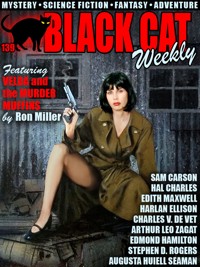
2,79 €
Mehr erfahren.
- Herausgeber: Black Cat Weekly
- Kategorie: Gesellschafts- und Liebesromane
- Sprache: Englisch
This issue, we have a pair of original stories: Stephen D. Rogers’ “Sonnenblumenkried” (which translates as Sunflower War, for those not fluent in German), courtesy of Acquiring Editor Michael Bracken) and a new Velda story by Ron Miller. Acquiring Editor Barb Goffman snagged a great Edith Maxwell tale, plus we have The Disappearance of Anne Shaw, by Augusta Huiell Seaman as our mystery novel. And don’t forget there’s another Hal Charles solve-it-yourself puzzler, too.
On the science fiction & fantasy side, we have a pair of novelettes from pulp greats: Edmond Hamilton and Arthur Leo Zagat. Plus an early Harlan Ellison story, and tales by Charles V. De Vet and Sam Carson. Fun stuff.
Das E-Book können Sie in Legimi-Apps oder einer beliebigen App lesen, die das folgende Format unterstützen:
Seitenzahl: 512
Veröffentlichungsjahr: 2024
Ähnliche

















Table of Contents
COPYRIGHT INFORMATION
THE CAT’S MEOW
TEAM BLACK CAT
SONNENBLUMENKRIEG, by Stephen D. Rogers
DEATH BY COMIC BOOK, by Hal Charles
BYE-BYE, JOJO, by Edith Maxwell
VELDA AND THE MURDER MUFFINS, by Ron Miller
THE DISAPPEARANCE OF ANNE SHAW, by Augusta Huiell Seaman
CHAPTER I
CHAPTER 2
CHAPTER 3
CHAPTER 4
CHAPTER 5
CHAPTER 6
CHAPTER 7
CHAPTER 8
CHAPTER 9
CHAPTER 10
CHAPTER 11
CHAPTER 12
CHAPTER 13
CHAPTER 14
CHAPTER 15
CHAPTER 16
CHAPTER 17
CHAPTER 18
CHAPTER 19
CHAPTER 20
CHAPTER 21
A WORLD TO DIE FOR, by Sam Carson
DEATH OF A MUTANT, by Charles V. De Vet
THE UNTOUCHABLE ADOLESCENTS, by Harlan Ellison
THE SEA HORROR, by Edmond Hamilton
COPYRIGHT INFORMATION
CHAPTER 1
CHAPTER 2
CHAPTER 3
CHAPTER 4
CHAPTER 5
CHAPTER 6
VENUS STATION, by Arthur Leo Zagat
COPYRIGHT INFORMATION
CHAPTER 1
CHAPTER 2
CHAPTER 3
CHAPTER 4
CHAPTER 5
CHAPTER 6
CHAPTER 7
COPYRIGHT INFORMATION
Copyright © 2024 by Wildside Press LLC.
Published by Black Cat Weekly
blackcatweekly.com
*
“Sonnenblumenkrieg” is copyright © 2024 by Stephen D. Rogers and appears here for the first time.
“Death by Comic Book” is copyright © 2022 by Hal Blythe and Charlie Sweet. Reprinted by permission of the authors.
“Bye-Bye, Jojo” is copyright © 2022 by Edith Maxwell. Originally published in Ellery Queen’s Mystery Magazine, March/April 2022. Reprinted by permission of the author.
“Velda and the Murder Muffins” is copyright © 2024 by Ron Miller and appears here for the first time.
The Disappearance of Anne Shaw, by Augusta Huiell Seaman, was originally published in 1928.
“A World to Die For,” by Sam Carson, was originally published in Fantastic Universe, July 1954.
“Death of a Mutant,” by Charles V. De Vet, was originally published in Super-Science Fiction, February 1957.
“The Untouchable Adolescents,” by Harlan Ellison, was originally published in Super-Science Fiction, February 1957, under the pseudonym “Ellis Hart.”
“The Sea Horror,” by Edmond Hamilton, was originally published in Weird Tales, March 1929.
“Venus Station,” by Arthur Leo Zagat, was originally published in Science Fiction Stories, April 1943. Although in the public domain in the United States, this classic work remains in copyright in Spain and other countries. Reprinted by permission of the author’s estate.
THE CAT’S MEOW
Welcome to Black Cat Weekly.
This issue, we have a pair of original stories: Stephen D. Rogers’ “Sonnenblumenkried” (which translates as Sunflower War, for those not fluent in German), courtesy of Acquiring Editor Michael Bracken) and a new Velda story by Ron Miller. Acquiring Editor Barb Goffman snagged a great Edith Maxwell tale, plus we have The Disappearance of Anne Shaw, by Augusta Huiell Seaman as our mystery novel. And don’t forget there’s another Hal Charles solve-it-yourself puzzler, too.
On the science fiction & fantasy side, we have a pair of novelettes from pulp greats: Edmond Hamilton and Arthur Leo Zagat. Plus an early Harlan Ellison story, and tales by Charles V. De Vet and Sam Carson. Fun stuff.
Here’s the complete lineup—
Cover: Ron Miller
Mysteries / Suspense / Adventure:
“Sonnenblumenkrieg” by Stephen D. Rogers [Michael Bracken Presents short story]
“Death by Comic Book” by Hal Charles [Solve-It-Yourself Mystery]
“Bye-Bye, Jojo” Edith Maxwell [Barb Goffman Presents short story]
“Velda and the Murder Muffins” by Ron Miller [short story]
The Disappearance of Anne Shaw, by Augusta Huiell Seaman [novel]
Science Fiction & Fantasy:
“A World to Die For,” by Sam Carson [short story]
“Death of a Mutant,” by Charles V. De Vet [short story]
“The Untouchable Adolescents,” by Harlan Ellison [short story]
“The Sea Horror,” by Edmond Hamilton [novelette]
“Venus Station,” by Arthur Leo Zagat [novelette]
Until next time, happy reading!
—John Betancourt
Editor, Black Cat Weeklyl
TEAM BLACK CAT
EDITOR
John Betancourt
ASSOCIATE EDITORS
Barb Goffman
Michael Bracken
Paul Di Filippo
Darrell Schweitzer
Cynthia M. Ward
PRODUCTION
Sam Hogan
Enid North
Karl Wurf
SONNENBLUMENKRIEG,by Stephen D. Rogers
We’d been marching through the field of sunflowers for an hour, and still, I could smell the village burning. The dark smoke rose through the sweltering summer heat to become the clouds that darkened the sky.
The Hauptmann only asked once. If he didn’t get the cooperation he expected, he discovered undesirables among the local population and ordered them shot. He then waited for someone to come forward with the requested information.
Nobody in the village we’d just left wanted to tell us which Russian units were operating in this area. The Hauptmann gave the barbarians more than enough incentive to be helpful, systematically shooting newly discovered undesirables every two hours, but the peasants resisted to the end. The end consists of the witch who spat and cursed from the moment she was dragged from her hole until bullets silenced her unintelligible ranting.
What had been men, women, and children were now just so many lumps of blooded rags. That was how the Hauptmann operated, how he created opportunity and made plain his displeasure.
We were then ordered to set fire to the buildings and fields to spite the bandits who officially didn’t exist. We torched everything despite the fact that we’ll probably need it next winter when we advance to the rear. Only to straighten our lines, of course, the non-retreat having nothing to do with Russian offenses.
Not that I would ever dare say such things. My crime of thinking them was serious enough.
In the Hauptmann’s left blouse pocket, he carried a notebook listing the names of those in his command who failed to show the necessary zeal. These were the Landsers he sent out to spearhead assaults, to probe for mines, to locate Russian snipers. When the Hauptmann had shown me my name, he also pointed out the names through which lines had already been drawn.
Despite his best efforts, the Hauptmann hadn’t managed to kill me yet.
Maybe today. Maybe today I would be allowed to redeem myself.
I shrugged my shoulders to shift the straps out of the ruts they’d worn in my flesh if not my bones. We’d lost the wagon that might have carried our belongings and so they hung on our backs.
There wasn’t enough time to wait for a replacement wagon. We must advance, advance, advance to defeat this godforsaken country. There was only enough time to halt if the delay meant slaughtering peasants and burning their stores.
The smoke stung my nose.
The invectives of the cursing witch rang in my ears.
The Kompanie marched dispersed to minimize the risk of losing too many to mines, and to maximize the chance of flushing any enemy who might be hidden in this field. Some Landsers sang, others spoke to whomever was marching close enough, but most trudged along in silence.
I didn’t need to look left and right to know I was point.
The Hauptmann never failed to offer me a chance to die for the Führer.
If storm clouds covered the sky, sunflowers covered the earth. We marched through an endless field of meter-high stalks topped by bursts of yellow that threatened to blind.
Screams. Schmidt was ablaze and screaming. Twisting and flapping and screaming.
Something in Schmidt’s pack exploded, and he flopped to the ground, disappearing among the sunflowers.
All this I saw because I could not turn away from the sight. I simply stared while my Gruppe formed a defensive position without me.
Slowly I came to, as blooms open to seek the sun. I fell into place and sought evidence of ambush.
The machine guns probed, firing in short bursts, placing their shots randomly at random intervals. No enemy stood with arms raised or broke and ran. We could have been alone out here.
In time, the Hauptmann commanded us to stop firing.
I never even started, too disrupted by the shock of what had happened.
Although Schmidt had marched in the middle of the formation, he might have tripped some incendiary device that others had missed. Alternately, he might have gone crazy and decided to light himself a Tannenbaum.
Such things happened on the eastern front. Such things happened even amidst flowers.
We halted long enough to bury Schmidt in the black soil.
We halted long enough for the Hauptmann to call me a coward.
We halted long enough for me to feel disjointed, as if I’d lost the thread, the strings that allowed my legs to carry me across the kilometers without any intervention on my part.
Schmidt had died and I... I gripped my rifle as though I’d never touched a gun before, wore my uniform as if for the first time, staggered and stumbled.
Schmidt had died—his blackened corpse left no doubt of that—but what had killed him? Since being thrust into the Wehrmacht, I had seen men die in more ways than I’d ever imagined possible, but there was always a logical explanation.
Schmidt’s death struck me as so unreasonable that my understanding of the world failed to ground me, failed to even include me. I was here but not here, marching through this field of sunflowers, but not.
Schmidt might have been dead but at least he was real.
When had I ceased to be? When I stepped on foreign soil? When I joined the Wehrmacht? When Hitler gained power?
I was out of step. A bad thing when marching. Especially in this land of vast melancholy.
But the Hauptmann called me a coward for taking too long to respond. To be reprimanded, I must exist.
Just as this field of sunflowers must exist for me to stomp its soil and part its stalks. Must exist despite the nightmarish nature of its size. After all, this place was not so different than the other monstrosities I’d marched through, Russian fields and forests and swamps that dwarfed anything found in Germany.
We could kill every peasant in every village and still I doubted we could ever defeat Russia the country. More reason for the Hauptmann to question my resolve.
Maeder howled, ablaze, a human torch. Others rushed to smother the inferno, but he pushed through them and bolted, ran past me and through my field of vision, ran as if he could escape the flames following him, chasing him.
I took my defensive position but could discover no threat, no Russians popping up to attack or staying low as they moved through the flowers.
Maeder weaved as he ran, perhaps hoping to throw off the flickering tail, the weave slowing to a wobble, but his voice remaining strong.
I’d seen men disfigured, dismembered, disemboweled. And when you see things like that, you hear the men yell and scream and wail and moan and cry. The experience affects you. But nothing affected me as much as the sights and sounds of someone burning alive. A village burning alive.
Maeder howled as he ran, outdistancing the men trying to help him, and then he slowed and dropped.
The Hauptmann oversaw the burial and then formed us up single file. Single file we made the smallest possible target, tread the thinnest path. The Hauptmann took the lead position and then waved me ahead.
Maybe today he’d manage to kill me.
I broke a trail for the Kompanie to follow.
Maeder had been a member of my Gruppe. A fellow rifleman. He had a girlfriend back in Düsseldorf, a future in his father’s butcher shop. He liked to read.
A wind came up, pushing me back as it grew stronger. The sunflowers leaned towards me as if baring their teeth.
We’d lost two to the field and time. I increased my pace before the Hauptmann ordered me to do so. While I didn’t care about whatever schedule the Kompanie was expected to keep, I wanted out of this cursed field, and I did not use the word “cursed” lightly.
I was no coward, but this never-ending field of sunflowers, the dark clouds and the stiffening wind, the unusualness of the two deaths, they all combined to keep me on edge. More than anything else, I wanted to put this field behind me and be somewhere else.
What had that witch been raving before we put her down?
My mouth tasted of copper.
I could still smell the village but didn’t know whether the smoke reached me despite the wind blowing in the opposite direction or whether the smoke was in me, caked within my nose and my lungs and my mind.
I could well imagine that the smell would accompany me to the grave, a grave that waited at my feet.
My mother had wanted me to follow in her father’s footsteps and become a music teacher, or perhaps I’d achieve his dream of opening a music store and giving private lessons. Adolph Hitler, however, had other ideas.
I looked straight ahead as I fought the wind. Left, right, and then at the place I was about to step.
Nothing moved ahead of us except for the sunflowers, the wind at their back urging them forward.
Ahead of me, they stared and watched me coming.
Left, right, and then at the place I was about to step.
Again, I thought about the villagers we’d murdered. As soon as we started down that path, we lost the war, no matter how it turned out.
I snuck a glance over my shoulder to see if the Hauptmann could read my mind.
He grimaced, opened his mouth, and burst into flame.
Did nobody else see what happened? The beams of light that flashed from the sunflowers? “Die Sonnenblumen!”
I broke into a run.
Slowing, I looked back. Light burst from the sunflowers and converged to create balls of fire that engulfed the men. Two or three plants at a time, targeting only a single man, but always winning the encounter.
We were surrounded.
I hit the ground as a fireball passed over me.
Over the din I heard orders and rifle fire. At long last I heard a machine gun join the fight, but the weapon was soon silenced. Much easier to mow down waves of screaming Russians than it was to cut down a field of sunflowers.
Cut down. I fixed my bayonet to my rifle, and none too soon. I looked up to see a sunflower peering at me through the leaves. I grabbed the butt of my rifle and swung, slicing through the stalk.
The bloom dropped to the earth merely yellow.
There were fewer screams now. Concentrated rifle fire. The occasional grenade.
Someone would start screaming, and then there would be one less firing.
I quickly poked my head up over the flowers. The Kompanie was quarter strength, if that. I hit the ground and felt the heat pass overhead.
I extended my rifle ahead of me. Gripped the butt with both hands and swung the bayonet in small arcs, slicing. Used my legs to squirm myself forward.
The sunflowers tried to get at me. I saw and felt bursts of light but perhaps there needed to be more than one plant involved for the attack to be deadly, and I was crawling down a narrow corridor.
Behind me, I heard scattered shots. Then none.
No longer could I hear commands being shouted or men calling to coordinate counter-attacks. I no longer heard screams but then perhaps there was nobody left to kill.
I wriggled away from the site of the massacre, slowed by the need to clear a path ahead, squirming over and crushing flowers I’d sent tumbling.
Could the whole Kompanie really have been wiped out? Or were Landers simply staying low and crawling for safety? Was there even such a thing?
My bayonet dulled. Instead of slicing I had to hack through the stalks, which was taking too much time. I pulled the weapon back and wiped the thick white fluid off the blade.
Turned over onto my back and laid my arms down along my side to rest the muscles. The sky was just as dark. The wind was just as brisk. Russia was just as immense.
I could be alone here in this sunflower field. Alone in the world. After taking a deep breath, I shouted my existence. “Hallo!”
Nobody answered.
I went down the list of those who had fallen. Recalled hometowns, people left behind, favorite meals. Hobbies and what they intended to do after the war. I remembered friendships and slights.
The Hauptmann. Had he crossed off names of the two who fell before him? Did my name remain in the pile of charred ash?
I took several deep breaths. Smelled above the smoke from the village the stench of roasted flesh.
“Hallo?”
I’d called out twice now. Anybody left must know it was safe to respond. Since no one had, nobody was left.
What about the sunflowers? Perhaps they’d exhausted whatever had allowed them to attack us. Perhaps they’d satisfied the demands of the curse. Perhaps they’d been sated.
If the sunflower field had represented an endless march, I did not want to imagine how long it would take to crawl free.
I twisted to work off my pack. I stuck my sleeping bag onto my bayonet and then raised my rifle until the sleeping bag was visible above the field.
A flash of bright light engulfed the sleeping bag in flames.
Realizing the setback could be turned into an opportunity, I waved the flaming ball back and forth until with a final thrust I sent the fireball flying.
If I set the field burning, the smoke might blind the sunflowers, and the fire might clear away the threat entirely.
I hacked at the plants nearest me, clearing an area to act as a firebreak. Then I froze.
Burning men had already fallen into the field, and a fire hadn’t sparked and spread. Why would my sleeping bag be any more successful?
I waited to see if I could be wrong.
Waited and waited to hear flames and smell smoke.
Watched the black clouds move across the sky.
The sunflowers had done what they’d done even while the sun was hidden, which meant darkness was probably not the safe haven I’d been afraid to hope.
Maybe the opposite was true. Maybe their dark power was related to the ominous cloud cover that blocked out the sun. Maybe night would make them stronger. If that were the case, I couldn’t expect to escape under the cover of darkness. In fact, I couldn’t risk being here past nightfall.
Opening the various sections of my pack, I cataloged the tools at my disposal. The bayonet was good but slow. Firing at the plants seemed pointless. Gas mask but no gas that might provide cover. Canteen. Breadbag. The entrenching tool had potential, swung like a pick or held up as a shield, however small. Finally, I had the seven stick grenades.
While the grenades would clear away the plants faster, the blast area might work against me by increasing the width of the corridor in which I hid.
And I had but the seven.
No matter. I had bayonet, entrenching tool, and seven stick grenades with which to cross an unknown distance.
Attack!
Rolling onto my stomach, I thrust my rifle in front of me and continued cutting.
Left, right, squirm. Left, right, squirm. Left, right, squirm. I advanced at a snail’s pace but at least I advanced.
The interminable task made the hours drag. My arms hurt and then ached and then went numb even though I could see them moving.
I didn’t dare stop or even slow, not knowing how much farther I must travel, how little time I had remaining.
Left, right, squirm. Left, right, squirm.
The occasional sight of a sunflower glaring at me, dousing me with light, was all that broke the monotony.
Come darkness, would a single sunflower be enough to be too much?
Left, right, squirm.
I thought of nothing, and I thought of the men who had died. I thought about the men who died before we reached the sunflower field, the men who died in normal ways: gunfire, artillery, mines. I thought about the villagers and the witch who cursed us.
Left, right, squirm.
The day was growing darker. I didn’t know for a fact that the sunflowers would be more dangerous at night, but I could not risk the unknown.
Cutting the stalks while crawling was simply too slow.
The stick grenades had an effective blast radius of thirteen meters. Using seven of them and allowing for overlap would not buy me the length of a soccer field.
How could I determine I was that close to the end of the sunflowers without being able to stand? Wait until the last second and then take it on faith. “Gottmituns.”
Or if not with us, let God be with me.
The light changed suddenly, and then it was dark.
Left, right, squirm. Left, right, squirm. Left, right, squirm. A sunflower glowed ahead. I rolled to the side and watched a ball of fire land where I’d been, burn for a second and then die.
I withdrew a grenade, unscrewed the end of the handle, and pulled the porcelain ball. Threw the grenade as far as I could. Four seconds later, the grenade exploded, and I was running at a crouch across the cleared area, glad for the falling soil that provided some measure of cover.
Nearing the end of the blast area, I dropped to the ground and threw the second grenade.
I waited for the explosion and then ran at a crouch until I neared the end of that blast area.
Hit the ground. Threw a grenade. Ran.
I repeated the cycle again and again until I threw my last grenade, ran at a crouch with my entrenching tool held in front of my face.
The ground under my feet shifted and dropped. I was stumbling down an incline and then I was splashing. I strode deeper into the water until the current carried me free of the sunflowers. Knowing I’d need to explain what happened to the rest of the Kompanie, I fashioned a story of bandits.
ABOUT THE AUTHOR
Stephen D. Rogers is the author of Shot to Death and more than 800 shorter works. His website, www.StephenDRogers.com, includes a list of new and upcoming titles as well as other timely information.
DEATH BY COMIC BOOK,by Hal Charles
While solving the original Peterson case, State Police Detective Kelly Stone had never been nervous, but here in the studio to discuss that case, when the ON AIR light came on, she found herself literally shaking.
“I’m here with my sister,” announced the podcast’s host, Krissy Stone, “to discuss her successful closing of the Peterson case. Perhaps Kelly you could start by reminding our audience who Mr. Peterson was.”
“Thanks for having me,” said Kelly, going slowly so as to regulate her breathing. “Jefferson J. Peterson was probably the richest man in the county, and he lived in the biggest house out at Fire Lake.”
“He had been divorced what . . . three times?” said the host.
“Correct, but we’re getting ahead of ourselves.” “Well,” continued Krissy, “he was convinced that one of his exes would try to do him in.”
“Yes, and to prevent that unfortunate event,” Kelly said, “Mr. Peterson surrounded himself with an army of guards.”
“So tell us then, how was the murder effected?”
“Like most of us, Jefferson Peterson had a weakness. He was in fact highly allergic to peanut butter.”
“Something all three ex-wives knew about firsthand,” interjected Krissy.
“Yes.”
“So how was the dastardly deed accomplished? I imagine Mr. Peterson had people to scrutinize anything resembling peanuts as it entered the house.”
“He did, but he also had another weakness.”
“Another allergy?”
“No, but it was an itch he scratched quite frequently. Mr. Peterson was an avid collector of Golden Age superhero comic books. That’s comics published between 1938 and 1956. Day and night Mr. Peterson haunted eFanboy, which is a website for buying and trading such comics.”
“I think if I had a husband of his age who sat around all day buying and reading comic books, I’d have killed him, too,” commented Krissy.
Kelly shook her head, but her sister’s attempt at levity was making her feel more at ease.
“Was this hobby of acquiring old comic books something he had himself acquired before his first marriage?” continued the host.
“If you’re asking did all three wives know about his real love, yes, they did.”
“Believe me, sis, I love the set-up, but the suspense is killing me. Again, how did one of the three witches slay the dragon? Or were they in collusion?”
“No, Mallory, wife #3 who had divorced him the previous month, acted alone. Marlowe, wife #1, and Meredith, wife #2, had no knowledge of what their successor was doing.”
“Yet all three ex-wives had the same motive?”
“Absolutely. To marry Peterson they were all forced to sign unbreakable pre-nups, which left each one angry.”
“So basically, since she would receive nothing, the killer was simply satisfying her anger.”
“Yes.”
“So how was the murder accomplished?” posed Krissy.
“The killer knew from seeing his list during their time of marriage what comics he had. The killer simply purchased the comics of Mr. Peterson’s desire on another website and offered them for sale on eFanboy. Also knowing his eFanboy trading name, she could enter into negotiation with him and drop the price low enough to entice him to buy.”
“You have the necessary evidence?”
Kelly crinkled a cellophane bag used to wrap and ship the murderous comic book in. “I found this bag beside Mr. Peterson’s body. Take a whiff.”
Krissy inhaled deeply. “I’ll have the answer in a jiff. That’s the unmistakable odor of peanut butter. Clever.”
“And lethal.”
“How did you catch her?”
“The envelope the comic came in bore the return address of where one of the ex-wives had relocated.”
“That sounds a bit easy. I’m sure she used an alias.”
“She did, but not an out-of-town post office, but it really didn’t matter to me.”
“Why not?”
“Long before the address and the subsequent confession, I knew who did it.”
SOUTION
Deduction. For the killer to be certain to offer to sell a comic book on eFanboy that would attract Mr. Peterson, Kelly reasoned, she had to know what her ex-husband wanted, but more specifically what comics he didn’t have. To be sure of that information the ex-wife had to be very up-to-date on Jefferson Peterson’s list of comic books in his possession. The person most current was ex-wife #3, Mallory, whose divorce was only a month old.
The Barb Goffman Presents series showcasesthe best in modern mystery and crime stories,
personally selected by one of the most acclaimed
short stories authors and editors in the mystery
field, Barb Goffman, forBlack Cat Weekly.
BYE-BYE, JOJO,by Edith Maxwell
If that dog doesn’t stop barking, I’m going to kill someone. It’s not like I don’t know how.
My mind takes me back two years to when I inherited this house after my mean SOB father died. Of course, there are questions about how he died and what I know. I fake grief and ignorance, and that is that.
It takes a while to settle his estate, but when I move in a year later in the summer, all is quiet. The house behind mine is on the market and unoccupied. Well-behaved retired couples live on either side of me.
I work at home, and with the ultra-acute hearing I’ve had all my life, I need quiet. The neighbors do not disappoint, and they tell me they head south to climes warmer than Massachusetts for the entire winter.
I know the neighbors are happy in the fall when I start methodically removing the vines that range over all the walls of the house. I clean up the herb garden near the side door and keep the lawn tidy. Pop had let the place go to hell in a handcart, but I’m not that kind of homeowner. I have one more wall of vines to go, and then I’ll repaint. I buy a nice teak patio set for the deck, where I enjoy a drink and a good book at the end of the day.
* * * *
My life goes to all to hell in the spring. A woman—Kay Hobart—moves in behind me. She and her asshole dog. Let me amend that. She’s the asshole. Not her dog. Still, it’s a big black thing with a deep voice, and it’s outside barking nearly constantly. In the morning. All afternoon. Every evening.
Did I say my hearing is better than 99 percent of humans? That might have to do with my Dumbo ears. I can’t help it if my ears stick straight out from my head, but I was endlessly bullied about them in school. The plastic surgeon I saw this winter said it’s because I have underdeveloped antihelical folds as well as too much cartilage in both conchas. I’m afraid of surgery, so I just have to live with these ears. Unfortunately, they make any set of headphones hurt, including the best noise-canceling ones. I go through pair after pair of silicone earplugs. I can still hear the damn dog.
One Saturday in May, I watch from my kitchen window as Kay sets bricks in a small circle in her yard. I head out to the four-foot-high chain-link fence that divides our properties. I don’t open the connecting gate but call to her from my side.
“Kay, can I have a word with you, please?”
She glances up, waves, and comes back to the fence. The dog comes with her.
“Hey, Pat. Nice day, isn’t it?”
“Yes.” I clear my throat. “I’m not sure you’re aware that your dog barks all the time when you’re at work. And it barks all evening too. I’d appreciate it if you’d restrain it from barking when you’re home and keep it inside when you’re not.”
She laughs. “Oh, that’s just the kind of dog he is. You know I live alone. Jojo protects me. Do you know how dark and isolated this road is with the woods on the other side?”
“Well, can you put him in while you’re at work?”
“He wouldn’t like that. Would you, Jojo boy?” She rubs his head with both hands. “Who’s a good boy?”
I manage not to roll my eyes until after she turns away.
I file a complaint about the barking with the animal control officer. Nothing happens. Kay’s job as secretary to the mayor could have something to do with it.
Shouldn’t home be a respite? A place of escape and comfort? The barking is a jackhammer drilling into my brain. My productivity suffers.
Kay takes to starting fires in that circle of bricks. She sits out there drinking. Sometimes she has a man over. She never puts out the fire when she goes indoors. It smolders until late into the night. Our breezes usually come from the west, blowing smoke away from me, as her house is to my east. One night the wind changes. My house fills with smoke before I can close the windows. I cough all night. Between the smoke and the dog, I need a plan.
* * * *
It’s a dry June. Instead of disposing the vine branches in black trash bags as I had been doing, I leave some out to dry, then cut them into foot-long sticks. One moonless night I glove up. It’s midnight, and the damn dog is finally inside. Kay’s lights are out too. After I apply WD-40 to the hinges on the gate, I deposit a load of branches on top of the pile of sticks Kay has been using to start her fires.
The dog starts barking. It must be standing at one of the open windows, because the bark is almost as loud as when it’s outside.
“Nighty night, Jojo,” I whisper.
I spend the next two nights in a hotel at the coast. Kay’s car is gone when I get home Monday morning. The dog is outside. Barking. After a day at my laptop not producing what I should, I head to the kitchen at five to make a mint julep. From the window I see Kay.
“Damn.” I watch as she dismantles the brick ring.
A few minutes later, I take my drink to the back fence. “All done with fires?” I call to her.
She makes her way to the fence. Her voice is raspy. “I was in the hospital for a day. They said I had urushiol smoke in my lungs.”
“I’m sorry to hear that. What kind of smoke?”
“Poison ivy oil. I guess I must have had some growing in with the brush I’ve been burning.”
“That stuff’s nasty.”
“I know. I had it a couple of times when I was younger. Got it at camp, but then it was just a rash. Anyway, I can’t risk breathing that smoke again. They said every reaction will be worse.”
“You be careful now.” I raise my glass.
“Thanks!” She scritches the head of the ever-present and temporarily quiet Jojo. “We will, won’t we, Jojo boy?”
That evening, I finish taking the last of the vines off the front of the house.
“Looking good, Pat,” the silver-haired man who lives to my left said as he passes walking his reddish dog on a leash at his side. This dog is large and rangy with a beautiful tail. It never barks.
“Thanks.”
My neighbors feel safe here. Neither house has a security camera front or back. I’ve checked.
After darkness falls, I glove up again and strip the leaves off the vines into a plastic grocery bag. I empty the bag into a big mason jar in the kitchen and fill it with vodka. I cap it, shake it a little, and put it under the sink.
On Thursday a week later, I strain the liquid into a different jar and fill a spray bottle with it. A couple of hours after all goes dark and quiet at Kay’s, I don a fresh pair of gloves and go for a walk, carrying the bottle in a dark bag.
Her street is as dark and isolated as she claimed. I’m confident no one sees me spraying the handle on her car door. I also spritz the knob on her front door and the knob on her side door, the one she uses to get to her car.
I do the same on my after-hours walk the next night.
The following morning, I watch from the window as she lets the dog out. She’s scratching her hands something fierce. I smile to myself.
I repeat my walk for the purpose of spraying a week later. This time I try the car door. She thinks she needs a guard dog, but she doesn’t lock her vehicle? Fine with me. I lift the mask hanging from the mirror and spray the inside, then replace it. I spray the inside door handle and the steering wheel too.
I stay in Friday night. Saturday morning when she comes out, she’s rubbing her face and neck as if plagued.
I go walking and spraying again the following Wednesday night. And Thursday, for good measure.
Kay doesn’t emerge Friday morning. I can hear the dog barking inside the house. I don’t see her Saturday or Sunday either. By Sunday, the dog’s barking is much diminished in volume. Someone with average hearing might not even notice.
On Sunday evening, I drain my spray bottle and run it through the dishwasher, adding a little bleach. Later that night, gloved of course, I deposit a black trash bag full of vines in her trash barrel. For the first time in a month, it’s raining. Gardens and lawns really need the rain. It’s good for my purposes too, as it will dilute or even wash away any traces of urushiol that might be left on the handles I coated.
On Monday, I phone the police, but not the emergency number. I identify myself and give my address.
“My neighbor directly to the rear—Kay Hobart—hasn’t been out since Thursday afternoon. Her car is there, and I can hear her dog barking inside the house. She lives by herself, and I wonder if an officer should do a wellness check or something.”
“Kay who works at town hall?” the dispatcher asked.
“I’m not sure where she works. I would have called her, but I don’t have her number.”
“Did you knock on her door?”
“Oh, no,” I say. “I’m afraid of dogs.”
She assures me they’ll check on her and thanks me.
I keep vigil at the kitchen window. Ten minutes later a cruiser pulls into Kay’s drive. The officer tries the side door. Kay apparently doesn’t lock her house as well as her car.
Within half an hour, an ambulance has arrived sans lights or siren, along with several other vehicles.
* * * *
Bye-bye, Jojo. He and his bark are gone. Of course, there are questions, since I’m the one who called in Kay’s disappearance. I simply express the kind of regret any stranger would at a death.
My life is quiet once more. Kay’s house, after a flurry of movers and workers coming and going, is on the market again. I can work in peace. I can sit on my deck and sip a cocktail without my brain exploding from the unceasing noise. It’s a quirk of my personality that I don’t feel remorse. I never have. I don’t even understand what that would be like.
The leaves on the big maple in the yard behind are a scarlet red when a family with two school-age children moves in. The parents erect a play structure. The mother works endlessly in the yard, turning over soil and fencing in a vegetable patch. The father kicks a soccer ball with both daughters. I hear squeals of delight and shouts of sibling rivalry sometimes, but it’s not bad. It’s not Jojo.
One late afternoon, as I sip my martini—dry, three olives—the mother is on hands and knees in her garden, but the children and dad aren’t outside. I wander out to the fence.
“What are you planting?”
She looks up and smiles. “It’s garlic. We eat lots of garlic, and it’s easy to grow.”
“You plant it in the fall?”
The family car pulls in.
“Yes,” she says to me. “Oh good, they’re back.”
“Open the gate, girls,” the father says, going around to the back of the car. A minute later, a dog bounds into the yard. The dad closes the gate behind it.
I stare. The dog—big, black, and looking way too familiar—races to the fence and starts barking. At me.
The mother dusts off her knees and stands. “Isn’t it great? Our girls have been after us to get a dog, and they’re finally old enough for the responsibility of taking care of a pup. This one was at the rescue place.” She strokes its head.
“It looks a lot like the dog that used to live here,” I murmur.
“He is! This is Jojo himself. We couldn’t believe it when we gave them our address, and they said he’d be going home.” She beams, first at the devil hound and then at me. “You must be so happy to see him.”
I turn without speaking. Back on the deck, I drain my drink right down. My brain winces at the relentless noise.
If that dog doesn’t stop barking, I’m going to kill someone. It’s not like I don’t know how.
ABOUT THE AUTHOR
Edith Maxwellis the author of the Agatha Award-winning historical Quaker Midwife Mysteries and short crime fiction. As Maddie Day, she pens the Dot and Amelia Mysteries, the Country Store Mysteries, the Cozy Capers Book Group Mysteries, and the Cece Barton Mysteries. Edith lives with her beau and cat Martin north of Boston, where she writes, gardens, cooks, and wastes time on Facebook. Find her at EdithMaxwell.com, wickedauthors.com, mysteryloverskitchen.com, and on Facebook and Instagram.
VELDA AND THE MURDER MUFFINS,by Ron Miller
“You don’t have to sit like that,” Chip said, “I’ll take you somewhere and feed you.”
“I was hoping you’d take me someplace nice for a change,” I scowled, uncrossing my legs and pulling the hem of my skirt back below my knees.
“Yeah, well,” he said, leaning back from his typewriter and digging his wallet from his back pocket. “Here’s a couple bucks. Why don’t you run across the street to the Automat and pick us up some sandwiches? Coffee, too. I gotta get this story to rewrite by seven or, well, I’ll be back working for Slotnik. You wouldn’t want that to happen, would you?”
Was he kidding? What did I care? I hopped off the corner of his desk and took his damned money.
“Nobody can ever say you don’t know how to show a girl a good time.”
“Aw, don’t be like that, Velda, you know what I make here... ”
“Piffle. You were making a lot better money at Slotnik’s and you still only took me to the Automat.”
“Say, you were making pretty good money, too—before you quit to become a private eye. How much’ve you made since?”
“Yeah? Well the same to you, too,” I said and stormed down to the street, as angry at Chip as I was at myself for having made such a lame rejoinder, let alone one that hadn’t made a lick of sense. The Automat was actually a block away and I was still so sore at Chip that I was nearly there before I realized there was a crowd pushing its way around the entrance.
“Hey, Clancy,” I asked a cop I recognized, “someone jump off the roof?”
“Oh—howya doin’, Velda? Naw, someone croaked inside. Two of ‘em, in fact. All I know. I’m just here to keep the rubberneckers movin’.”
I knew the food was no great shakes, but this news certainly gave me pause for thought. I’d never heard of the stuff actually killing anyone before.
“You wanna know what’s goin’ on, you go on in there and talk to the lieutenant.”
“Dillinger? Why’s homicide interested?”
“Ya gotta ask him that.”
I went inside and did. The lieutenant was as happy to see me as he always is.
“How the hell did you get in here, Velda?” he said, warmly.
“I just pushed on the revolving door and here I am. What’s up, anyway? Someone finally order the salmon mousse?”
“Naw. It’s a plain case of poisoning, see?” the lieutenant said, holding out a plate on which lay a couple of half-gnawed muffins. “Loaded with enough cyanide to kill a horse.”
They looked ordinary-enough to me at which thought a chill went down my back. What had I expected? Little skull-and-crossbones on them? I told Dillinger that Clancy’d said a couple of people had died.
“Yeah. One’s right over here,” he said, pointing to a sheet-covered form on the linoleum floor. “Show ‘er the stiff, Ralph.”
The cop pulled the sheet aside, revealing a body that’d probably looked no better alive than it did dead. It was a raggedy old lady, about a thousand years old, like you see a hundred times a day picking through ash cans and bumming cigarettes. Dillinger must’ve seen the expression on my face.
“Anyone you recognize?”
“Yeah. She used to come round Slotnik’s all the time, looking for handouts and cadging cigarettes and dimes. Lived in a dump at the end of the alley that ran behind the theater. Shame, I guess, her being bumped off this way and all. She was okay—a nice enough old bird, I guess. I gave her some change now and then, but I don’t think I ever said more than two words to her. Never did learn her name. Uh, you said there are two of them?”
“Uh huh. The other one’s over here,” he said, leading me toward the door to the men’s restroom. He turned to me and damned if he wasn’t blushing!
“He’s, ah, he’s in the, ah, men’s room.”
“Why, that’s great, Lieutenant. I can not only see the body, I can finally find out what the inside of a men’s room looks like.”
“Tsk, tsk. Your dad must never’ve known what sort of daughter he was raising.”
I knew the lieutenant was just kidding around. My dad was the best cop the force ever had—and would still be if he hadn’t gotten killed in the line of duty. There was a big scandal around his death—I won’t go into that now—and Dillinger was one of the cops that put his career on the line standing up for my dad’s name. I owed him a lot for that. On the other hand, there was something to what he said. I know dad wouldn’t have approved of my job at Slotnik’s, but what was I to do?
I followed him inside, where the police photographer was still taking shots. The body was uncovered and I saw a chubby little man in a nice pinstripe suit. Nice, but not expensive and not new, either. Looked like an insurance salesman, maybe, or an accountant.
“This fellow,” Dillinger said, handing me a business card, “we know. According to this, he was Conklin P. Aglet. Got a little import-export business around the corner. Dealt mostly in plastic spatulas.”
“Anything to tie the two together?”
“Not a thing, so far’s I can tell.”
“So what do you figure, lieutenant? Some psycho, maybe?”
“I dunno. Beats me. Who else’d poison the food in a restaurant?”
It beat me, too.
There was obviously little point in trying to get anything to eat at the Automat. Which was okay by me since I hated eating there anyway. I went around to the next block where I knew there was a little coffee shop. I got myself a cheeseburger and black coffee and started thinking. Not about Chip. Let him wonder where his dinner was, I figured. Do him good. No, what I was thinking about was that old lady. I’d kind of liked the old bat and wondered if there was anyone at her place who ought to know she was dead. Maybe a cat or something.
* * * *
Slotnik’s was only about three blocks over, so I hoofed it to the alley behind the theater. At the dead end of it were the rears of half a dozen tenements. The old lady, I knew, had a hole she called home in the basement of one of them. I banged on the door, but didn’t get an answer, which is pretty much what I expected. It took me about three seconds to spring the lock. (I’ve been getting really good at that lately, I’m pleased to say.)
Inside it was an even worse dump than I’d imagined. There was just the one room, an old storeroom or something like that. No heat, no electricity, no water. There was a ratty-looking cot pushed up against one wall behind a bunch of fiberboard barrels. Sitting on an old vegetable crate next to it was a sterno hot plate. There were empty tin cans—mostly beans and hash—piled on the floor around it. The rest of the room was filled with stuff—nothing but junk and more junk. She must’ve been like a packrat or whatever they’re called, picking up everything she saw and dragging it back here. There were bundles of old newspapers and magazines, broken baby carriages, empty bottles, old mattresses, busted chairs, discarded clothes, bird cages, stuffed animals missing legs and heads, all sorts of lumber, car parts, bicycle frames, old radios, you name it and every bit of it was useless trash.
I poked through it all, not having any idea why—maybe just a kind of morbid fascination—when I spotted a Folger’s coffee can sitting on top of a doorless Frigidaire. I don’t know why I thought there was anything unusual in that, given how the rest of the place was decorated, but I took the can down and shook it. There was something inside. I pried the lid off and pulled out a zippered leather bag, like the kind people keep toiletries in when they travel.
Oh ho!
It contained a fistful of bank books. Five of them, to be exact. There was also a bunch of other papers, but they were just typed pages, all yellow with age. Old letters or some such, I figured. I was more interested in the books. I spread them out like a poker hand. They were from banks all over the city. I opened one of them at glanced at the first page. Well, at least now the old lady had a name: Lola Momrath. That was something anyway. I flipped through to the last page in each book and did a mental calculation. Oh ho, indeed. The old bat had more than forty-five grand stashed away.
This certainly gave me pause for thought. Could it be possible that she had been the intended victim, not the spatula man? But then, why did Aglet die? And if someone’d croaked the old lady for her money, what were the bank books still doing here? The whole thing was making me damned curious.
I walked over to Splittner St., where Aglet had his office according to the business card I’d seen. It was after eight o’clock, but there was a light on in the third floor front, where I figured Aglet’s place probably was. I went upstairs. At the end of the hall there was a door with a pebbled glass panel on which was painted: CONKLIN P. AGLET—IMPORT AND EXPORT. There was a light on behind it, so I went on in.
Inside was just a small room with a bunch of filing cabinets, a couple of ratty leather chairs and a desk with a blonde behind it. She had been crouched down digging in a bottom drawer and jumped about six inches straight up when I came in.
She pushed her harlequin glasses back onto her button nose, glared at me over the top of them and said, “Oh. I thought it was the police again. I’m sorry, but the office is closed.”
I fished one of my cards out of my purse and dropped it onto her desk. She didn’t pick it up. She didn’t even look at it.
“My name’s Velda Bellinghausen. I’m a private investigator. I was wondering if I might ask you a few questions about Mr. Aglet?”
“Why?”
“Why what?”
“Why are you interested in Mr. Aglet? I really don’t see what concern he would be to you.”
“I’m not at liberty to reveal my, ah, client. I only have a couple of questions, though. You don’t have to answer any of them if you don’t want to.”
“I probably won’t, but go ahead if it’ll make you happy.”
I glanced around the room and asked the obvious one: “Was Mr. Aglet in any sort of financial difficulty?” That got her. She snorted derisively. It was a very unladylike sound.
“Was he ever! He was dead broke, the lousy phony! I ain’t been paid in two months! And it sure don’t look like I’m gonna get paid now, does it?”
“I’m surprised you’re still working... ”
“Yeah, you’d think so, wouldn’t you? Well, I ain’t working. I just figure maybe I can find something worth pawning before the creditors start showing up.”
“Bad businessman?”
“Naw—he was a great one. A lousy gambler is what he was. Made a ton a cash in the business but lost every penny he had on the ponies—and every penny he could borrow, too, near’s I can figure. Buncha tough mugs been comin’ round lately lookin’ for their dough, which I can tell you I didn’t like so much.”
“You think he welshed on a gambling debt?”
“What do you think? You’re the detective. The lousy fink! Now what am I supposed to do?”
I couldn’t have cared less. It looked like my next stop was going to be Virgil the Bookie. I found him where he could always be found, twenty-four hours a day, but then it’s easy to find a good case of tetanus, too, and who does that on purpose?
I spotted him as soon as I entered the bar. He was a skinny man who’d gone completely bald while still in high school, which gave him a jaundiced outlook the rest of his life. He watched me walk up to his booth with all the expression of a doorknob, which he resembled to no small degree.
“Well, you’re sure a sight for sore eyes, I can tell you.” He meant that, too, being a longtime sufferer from granulated eyelids. “Siddown, siddown, already, have a beer or somethin’.”
I slid onto the bench opposite him and took the drink he offered. It was an ice cold Pabst, so how could I have refused?
“So how’s the private eye racket?”
“It’s just swell, too.”
“You ain’t on a case now, are you? ‘Cause I gotta tell you I don’t know nuthin bout nuthin.”
“No, I’m not on a case, not exactly. I’m just curious about something, that’s all.”
“Well, sometimes curiosity, you know, is a pretty good thing. I mean, you discover gravity and penicillium and things like that, but sometimes curiosity also ain’t such a good thing, if you get my drift, you know what I mean?”
“Yeah, I know what you mean, but this isn’t anything like that. Like I said, this is just for me.”
“I can tell you got a question you’re just dying to ask me, so go ahead and shoot.”
“You know a guy named Aglet? Conklin P. Aglet?”
“Don’t I just!”
“How much was into you for?”
“That piker? Hell, I sold his marker. Wasn’t worth keeping. It was only a lousy forty-five centuries. Peanuts.”
“Well, someone must’ve liked peanuts well enough to have croaked him.”
“Only one person that hungry—”
Yeah, I knew just whose name he was going to say, too. Spider-eyes Griswold. No way he was going to get stuck with anyone’s bad debt, peanuts or no peanuts. I thanked Virgil for the beer and left.
Spider-eyes ran his operation from a cubbyhole in the back of what passed itself off as an auto repair shop, but I sure would’ve been surprised if the owners of any of the cars I sidled past knew they were there since the men working on them were busy filing the serial numbers off the engine blocks. The door to Griswold’s office was closed and was kept that way by a thick-necked bruiser the size of a Nash Metropolitan and probably not half as smart. Fortunately, he’d spent a lot of what his boss paid him at Slotnik’s box office, so he knew perfectly well who I was. I recognized him, too, since he’d always sat in the front row.
“The boss in, Percy?”
“Hey! Velda!” he said, with a grin that threatened to split his head in half, like a grapefruit. “Watcha doin’ here, not that it ain’t swell to see ya?”
“Just want to have a little chat with Spider-eyes, is all. Okay?”
“Hey! Yeah! Sure thing, Velda!”
He turned to let me pass and just for a treat for being so nice, I kinda bumped him a little as I went by.
I opened the door, but didn’t go more than half a step into the room. Not that I didn’t want to, but because Griswold had already filled it to capacity. He was not only the fattest human being I’d ever seen (he made Fifi, the fat lady with Professor Peerpont’s Grand Universal Wonder Show, look like a Vogue model), he was the ugliest, with a kind of monumental ugliness that was almost supernatural.
“Say! If it ain’t my favorite stripper! Little overdressed tonight, ain’t we?”
“Not you, Spider-eyes. I see you forgot the paper bag you oughta wear over your head.”
“Ha. Ha. Ha—” he laughed just like that; three distinct, mirthless syllables “—You think you’re a riot, don’t you.”
“Yeah, I got ‘em slapping their knees at the rest home. So—how’s business?”
“It’s a livin’. Why the sudden interest?”
“I heard that Harry Aglet was into you for forty-five hundred bucks. Buy you a lot of chicken-fried steak.”
“Chicken feed you mean. I dint have nuthin’ t’ do with him gettin’ hisself croaked. I heard he just ate somethin what disagreed with him.”
“Yeah—like maybe a muffin full of cyanide.”
“Look here, kid—yer barkin’ up the wrong neck of the woods. You think I’d risk a murder rap for a lousy forty-five hundred bucks? I mighta had the boys mess ‘im up a little, but poison? That’s for sissies. Jesus, Velda, I’d hoped you thought better of me than that.”
I walked back to Pith Street, made myself a stiff martini and went to bed.
The papers the next morning were making the most of the story, which I’m sure Mr. Horn and Mr. Hardart just hated. I went down to Joe’s for my usual coffee and donuts and he tossed the morning edition of the Graphic onto the counter for me to look at while he got my order. He knows I usually prefer the Graphic out of loyalty to Chip, but today I opened the paper with only halfhearted interest. I forgot my gripe with him, though, when the headline jumped out at me: BUSINESSMAN KILLS SELF AT AUTOMAT. Joe set my coffee and donuts by my elbow, but I ignored them as I flipped to the page with the story. There wasn’t much to it. The cops’d found a suicide note in Aglet’s office. It was pretty straightforward. He’d been up to his neck in debt and didn’t see any way out but suicide. Goodbye cruel world, sincerely, Conklin P. Aglet.
I didn’t believe a word of it.
Well, I mean I didn’t believe a word about Aglet’s checking himself out, though if true it explained, I guess, what happened to Lola. When Aglet felt sick and went to the restroom, she’d glommed onto his left-over muffin like the good little panhandler she was and, well, there you go.
But...
“You’re going to get wrinkles, screwing your face up like that.”
“I know, Joe, but I’m trying to figure something out.”
“About that bozo what croaked hisself over at the Automat?”
“Yeah.”
“See? All the more reason you shouldn’t oughta eat at places like that. How many times I tell you that? Who knows what’s goin’ on behind that wall, huh? Here, the food ain’t nothin’ special, but you see what you’re gettin’, you know what I mean.”
“Only thing might put me off my feed, Joe, is you, not the food.”
“That’s okey dokey by me. You got a strong enough stummick to take my looks, my grub won’t be nothin’.”
I told him how I just couldn’t figure Conklin P. Aglet for suicide, but couldn’t put my finger on why.
“Hell, eating a poisoned muffin in the Automat? You gotta be kiddin’ me. That ain’t no way to kill yourself. A guy, he’s gonna eat a bullet or jump out a winda—but a poisoned muffin? No way. Hell, how many guys even know how to make a muffin?”
I had to admit he had a point there. I couldn’t make a muffin... well, I couldn’t make much of anything for that matter, but that’s beside the point. Could a spatula importer make a muffin? I had my doubts. On the other hand, it sure seemed even sillier to think of someone going to the Automat, getting a muffin from the window, sitting down and then sprinkling it with cyanide.
I went back to my place and called Sally at my answering service, though I was pretty sure what I’d hear.
“You got about a dozen messages from Chip,” she said. “You wanna hear any of them?”
“Hell, no.”
“That’s what I figgered so I already dumped ‘em. Why don’t you do the same thing to the bum, Velda?”
“I might just do that very thing, Sally.”
“Yeah, sure—you could have your choice of any man in the city, for pete’s sake. Sure could do a lot better than that cheapskate, at any rate.”
“No kidding. I’m sure getting tired of take-out Chinese and going to the fights. That’s all we ever do.”
“Sure thing! Say, Velda... you ever give the bum the rush, lemme know, will ya? I ain’t had a date in so long I can’t afford to be too fussy. Maybe he goes for the petite blonde type, you know?”
“He might at that,” I said, hanging up. I was, after all, three and a half inches taller than him.
A thought had been percolating through my head ever since breakfast, so I called Lieutenant Dillinger.
“Say, Lieutenant,” I said after the usual chit chat, “anyone find the container, the one that had the cyanide in it?”
“What container?”
“The one I just said, the one that Aglet had the cyanide in?”
“What the hell’re you talking about, Velda?”
“Nothing, Lieutenant. I was just thinking is all.”
“Well, it was bound to happen sometime, but don’t get overexcited about it—it might be just a fluke.”
“Yeah? Well, the only flukes I




