



2,76 €
Mehr erfahren.
- Herausgeber: Black Cat Weekly
- Kategorie: Gesellschafts- und Liebesromane
- Sprache: Englisch
Three favorite series highlight this issue: First, Sherlock Holmes—or rather, several Sherlock Holmeses—feature in A.L. Sirois’s “The Matter of Time” (thanks to Acquiring Editor Michael Bracken). Then burlesque queen turned private eye Velda returns in Ron Miller’s original tale, “Big Top Velda.” (You will recall several other Velda stories in recent months—and we have more upcoming!). And on the science fiction front, space opera misfit Lancelot Biggs stars in “The Downfall of Lancelot Biggs,” by Nelson Bond. Fun stuff!
More highlights: Acquiring Editor Barb Goffman has found a real winner in Debra H. Goldstein’s “Harvey and the Redhead.” (I’m a sucker for bar stories.) And our mystery novel is by Harold MacGrath.
On the science fiction front, we have dark fantasies from British master John S. Glasby (who’s in his 90s and still writing) and Frank Belknap Long, plus space opera from Edmond Hamilton and classic SF from Lester del Rey.
Here’s the complete lineup—
Mysteries / Suspense / Adventure:
“The Matter of Time” by A.L. Sirois [Michael Bracken Presents short story, Sherlock Holmes series]
“The Case of the Lost Library” by Hal Charles [Solve-It-Yourself Mystery]
“Harvey and the Redhead” by Debra H. Goldstein [Barb Goffman Presents short story]
“Big Top Velda” by Ron Miller [short story, Velda series]
The Blue Rajah Murder, by Harold MacGrath [novel]
Science Fiction & Fantasy:
“The Matter of Time” by A.L. Sirois [Michael Bracken Presents short story, Sherlock Holmes series]
“A Place of Shadows” John S. Glasby [short story]
“Evans of the Earth-guard,” by Edmond Hamilton [short story]
“The Downfall of Lancelot Biggs,” by Nelson S. Bond [short story, Lancelot Biggs series]
“The Cottage” by Frank Belknap Long [short story]
“The Life Watch” by Lester del Rey [novella]
Das E-Book können Sie in Legimi-Apps oder einer beliebigen App lesen, die das folgende Format unterstützen:
Seitenzahl: 676
Veröffentlichungsjahr: 2024
Ähnliche



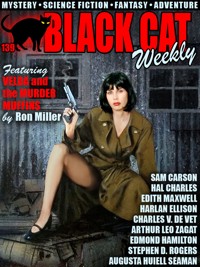

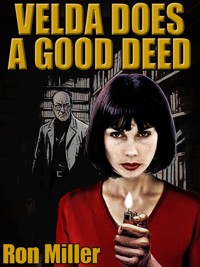














Table of Contents
COPYRIGHT INFORMATION
TEAM BLACK CAT
THE CAT’S MEOW
THE MATTER OF TIME, by A.L. Sirois
THE CASE OF THE LOST LIBRARY, by Hal Charles
HARVEY AND THE REDHEAD, by Debra H. Goldstein
BIG TOP VELDA, by Ron Miller
THE BLUE RAJAH MURDER, by Harold MacGrath
PART 1
CHAPTER 1
CHAPTER 2
CHAPTER 3
CHAPTER 4
CHAPTER 5
CHAPTER 6
CHAPTER 7
CHAPTER 8
CHAPTER 8
CHAPTER 10
CHAPTER 11
CHAPTER 11
CHAPTER 13
CHAPTER 14
CHAPTER 14
CHAPTER 14
CHAPTER 15
PART 2
CHAPTER 1
CHAPTER 2
CHAPTER 3
CHAPTER 4
CHAPTER 5
CHAPTER 6
CHAPTER 7
CHAPTER 8
CHAPTER 9
CHAPTER 10
CHAPTER 11
CHAPTER 12
CHAPTER 13
CHAPTER 14
CHAPTER 15
CHAPTER 16
CHAPTER 17
CHAPTER 18
CHAPTER 19
CHAPTER 20
CHAPTER 21
A PLACE OF SHADOWS, by John S. Glasby
EVANS OF THE EARTH-GUARD by Edmond Hamilton
THE DOWNFALL OF LANCELOT BIGGS by Nelson S. Bond
THE COTTAGE, by Frank Belknap Long
THE LIFE WATCH, by Lester del Rey
COPYRIGHT INFORMATION
Copyright © 2024 by Wildside Press LLC.
Published by Black Cat Weekly
blackcatweekly.com
*
“The Matter of Time” is copyright © 2024 by A.L. Sirois and appears here for the first time.
“The Case of the Lost Library” is copyright © 2022 by Hal Blythe and Charlie Sweet. Reprinted by permission of the authors.
“Harvey and the Redhead” is copyright © 2019 by Debra H. Goldstein. Originally published in The Eyes of Texas: Private Eyes from the Panhandle to the Piney Woods. Reprinted by permission of the author.
“Big Top Velda” is copyright © 2024 by Ron Miller and appears here for the first time.
The Blue Rajah Murder, by Harold MacGrath, was originally published in 1929.
“A Place of Shadows” is copyright © 1963 by John S. Glasby. Originally published in Supernatural Stories No. 79 under the pseudonym “Peter Laynahm.” Reprinted by kind permission of the author and the author’s agent, Philip Harbottle of the Cosmos Literary Agency (UK).
“Evans of the Earth-guard,” by Edmond Hamilton, was originally published in AirWonderStories, April 1930.
“The Downfall of Lancelot Biggs,” by Nelson S. Bond, was originally published in Weird Tales, March 1941.
“The Cottage” is copyright © 1954 by Frank Belknap Long. Originally published in FantasticUniverse, September 1954. Reprinted by permission of the author’s estate.
“The Life Watch” is copyright © 1954 by Lester del Rey. Originally published in FantasticUniverse, September 1954. Reprinted by permission of the author’s estate.
TEAM BLACK CAT
EDITOR & PUBLISHER
John Betancourt
ART DIRECTOR
Ron Miller
ASSOCIATE EDITORS
Barb Goffman
Michael Bracken
Paul Di Filippo
Darrell Schweitzer
Cynthia M. Ward
EDITORIAL BOARD
Thomas A. Easton
Ryan Hines
Vicki Erwin
Paula Messina
Richard Prosch
PRODUCTION
Sam Hogan
Karl Wurf
THE CAT’S MEOW
Welcome to Black Cat Weekly.
Three favorite series highlight this issue: First, Sherlock Holmes—or rather, several Sherlock Holmeses—feature in A.L. Sirois’s “The Matter of Time” (thanks to Acquiring Editor Michael Bracken). Then burlesque queen turned private eye Velda returns in Ron Miller’s original tale, “Big Top Velda.” (You will recall several other Velda stories in recent months—and we have more upcoming!). And on the science fiction front, space opera misfit Lancelot Biggs stars in “The Downfall of Lancelot Biggs,” by Nelson Bond. Fun stuff!
More highlights: Acquiring Editor Barb Goffman has found a real winner in Debra H. Goldstein’s “Harvey and the Redhead.” (I’m a sucker for bar stories.) And our mystery novel is by Harold MacGrath.
On the science fiction front, we have dark fantasies from British master John S. Glasby (who’s in his 90s and still writing) and Frank Belknap Long, plus space opera from Edmond Hamilton and classic SF from Lester del Rey.
Here’s the complete lineup—
Cover Art: Ron Miller
Mysteries / Suspense / Adventure:
“The Matter of Time” by A.L. Sirois [Michael Bracken Presents short story, Sherlock Holmes series]
“The Case of the Lost Library” by Hal Charles [Solve-It-Yourself Mystery]
“Harvey and the Redhead” by Debra H. Goldstein [Barb Goffman Presents short story]
“Big Top Velda” by Ron Miller [short story, Velda series]
The Blue Rajah Murder, by Harold MacGrath [novel]
Science Fiction & Fantasy:
“The Matter of Time” by A.L. Sirois [Michael Bracken Presents short story, Sherlock Holmes series]
“A Place of Shadows” John S. Glasby [short story]
“Evans of the Earth-guard,” by Edmond Hamilton [short story]
“The Downfall of Lancelot Biggs,” by Nelson S. Bond [short story, Lancelot Biggs series]
“The Cottage” by Frank Belknap Long [short story]
“The Life Watch” by Lester del Rey [novella]
Until next time, happy reading!
—John Betancourt
Editor, Black Cat Weekly
THE MATTER OF TIME,by A.L. Sirois
Jane Holmes was at the kitchen sink peeling parsnips when movement out in the barnyard caught her eye. She stood staring through the window, vegetables forgotten in the colander, water dripping from her hands. The song she’d been softly singing died on her lips. Daughter of a mathematics professor and a librarian, Jane was tall and dark-haired and retained in her speech the Irish lilt of her forefathers.
Her eyes narrowed as she examined the strangers. Who in the world were these people?
She leaned forward, over the sink. The taller of the two was obviously a man, wearing a coat and trousers that looked somehow strange, as though out of fashion, or were perhaps of foreign cut. Jane frowned slightly, trying to place his apparel.
The shorter one was a small, pale, child-like figure with long, flaxen hair. Jane’s frown grew deeper. Was he—she?—wearing dark, blue-tinted goggles over his—her?—eyes?
From whence had these odd persons come? She hadn’t heard a carriage pull up.
Jane licked her upper lip. Her husband was somewhere on the estate, repairing fences, and she had no way to contact him. Mycroft, her elder son, was in London, working his government job. That left her younger son, upstairs, packing prior to his departure for his first year at university.
Right, she said to herself. Taking a step away from the sink, she called, “Sherlock! Can you come here, please?”
From the house’s upper reaches came his reply—“Sure, Mum.”—followed a moment later by the clatter of his footsteps on the stairs.
“What do you want?” he asked as he entered the kitchen.
She gestured out the window over the sink. “Who is that, d’you think?”
Sherlock peered at the strangers. He frowned, which made him look very much like her. “I’ve no idea,” he said. “Shall I go see?”
“If you would, please.”
Sherlock crossed the kitchen to the outside door, taking up his walking stick from where it leaned against the wall. In his hands it could be a formidable weapon, while appearing perfectly harmless. As the door opened, the strangers turned in his direction. He approached them calmly. As far as Sherlock could see, the man bore no weapons, and was displaying a relaxed posture.
Thirties, not a laborer, educated, probably upper-class, though not royalty or a peer. Somewhat oddly dressed.
“Hullo,” Sherlock said, keeping his voice friendly and non-confrontational. “May I help you?”
The man, who had curly light-brown hair and an open face, smiled. “Ah,” he said. “You are Sherlock Holmes.”
“Why, yes, I am. And you are…?”
“Beynon. Simon Beynon.” The man stepped forward, offering his hand. Sherlock took it and they shook. “And this,” he added, indicating the child, “is my assistant, Ganch.”
Sherlock nodded pleasantly. “A pleasure. What is your business, Mr. Beynon?”
“I must speak with you concerning a matter of great importance.”
“I’m sorry, sir, but I’m getting ready to leave for university later today, and I have no time right now. Perhaps at a later date.”
“Simon, please. And I can promise you that you will have as much time as you or anyone else would ever need.”
Sherlock allowed himself a frown. “Mr. Beynon—Simon—I don’t particularly enjoy riddles or puzzles at the best of times, and this is not the best of times.”
“I understand, but a man’s life is at stake here, Master Holmes.”
“Oh, yes? Whose?”
“Yours.”
Sherlock could not hide his surprise. “Your jest, sir, is in extremely poor taste.”
“Forgive me,” Beynon said. “If you will, kindly allow me but fifteen minutes to explain, and to show you something that will convince you.”
Sherlock glanced back at the house, where his mother was watching through the kitchen window. “Very well,” he said, “but do let us make haste. My carriage arrives in three hours.”
Beynon smiled more broadly, showing small, even teeth. They were very white. “As I said,” he replied, “you will have all the time you need. If you would come around to the side of the barn with me?” Beynon motioned with his hand.
Sherlock was instantly on alert. “Why?”
“It will be simpler to show you what I mean rather than explain it.”
“Very well.” After a glance back at the kitchen window, through which his mother was still watching, Sherlock followed Beynon. Once out of sight of the main house, Beynon turned to Sherlock. “I went to a deal of trouble to find you at an age when you would not be shadowed by…” Beynon pauses. “No, I’d best not say his name.”
Puzzled by the man’s language, Sherlock was immediately curious. “Of whom do you speak?” He glanced at Ganch, with her odd goggles. So far she had not uttered a word.
“Pray, forget I said anything. In days to come you will acquire an amanuensis, let us say, a splendid fellow and doughty companion but not as quick-witted as you. Now, then. What is your favorite period of history if I may ask?”
“I’m afraid I don’t understand,” Sherlock said, beginning to feel annoyed. “Why should you want to know?”
Beynon reached into the pocket of his coat and took out a small complicated-looking instrument only a little bigger than a deck of cards. “Indulge me,” he said.
Sherlock sighed in exasperation. “Oh, very well. I suppose… I suppose it would be ancient Egypt when the pyramids were being built.”
“Splendid!” Beynon fiddled with a few small knobs on the device. “Location, time… Egypt, Africa, say, mmm…that was in the fourth dynasty, early twenty-sixth century BC. And now, Mr. Holmes? Take my hand if you would.” After a moment Sherlock complied, keeping his walking stick firmly in his other hand. What was Beynon up to?
“And here we go.” Using one hand, Beynon tapped on the device.
Instantly a sparkling peach-colored fog enveloped them, springing seeming from nowhere and startling Sherlock. Before he could speak, a wave of dizziness and nausea engulfed him, and he staggered. He struggled to regain his balance while fierce heat and light swamped his senses.
When his vision cleared, he saw, in the distance, a dazzling sight: an immense three-sided structure of white stone, towering into the clear blue sky. There seemed to be ants crawling at its base. Then his sense of scale snapped into place, and he realized the “ants” were human beings.
The structure—the pyramid—was enormous.
Sherlock, rarely at a loss for words, could not think what to say. Was this a dream? A hallucination?
He croaked out a syllable or two and began to topple to one side. Am I fainting? How extraordinary!
But before he collapsed, Beynon grasped his arms as he flailed for balance.
A moment later, the glittering fog sprang up around them once more. When it cleared a moment later, they were back standing beside the barn.
“What…what…” was all Sherlock could say.
“Convincing, innit?” Beynon asked, grinning. “Sorry, I forgot to warn you about the disorientation. Ganch and I are quite used to it. Let me show you one more thing.” He fiddled with his little device once more. “New York City, 2017.”
“Wait, I—” But Holmes protested in vain, for the fog enveloped them once more. When it cleared, he was standing with Beynon at an intersection. Cacophony assailed his ears, and although there were people everywhere, bustling around them, tapping on little devices similar to Beynon’s, the streets were full of self-propelled wheeled machines, and immense buildings rose up into the sky like explosions of stone and glass, some of the displaying signs with moving pictures like animated photographs, but in full color. There was a sharp odor of smoke and petrol, and, from a nearby cart, cooked meat. Sherlock, astounded, knew he was standing in the center of a city, but such a city! Nothing like this existed anywhere on the Earth of Sherlock’s day.
His eyes followed the height of the buildings up to the sky—and he saw something, a silvery glint up there, drawing a line of white on the blue, like a cloud string. What could that be?
But—what was it Beynon had said? Twenty-seventeen? Twenty-seventeen? As in, two thousand and seventeen AD?
An instant later they were back beside the barn.
Beynon regarded Sherlock with a slight grin on his face. “Well?”
“How…” Sherlock swallowed hard. “How did you do that? Those were the most convincing illusions I have ever seen.”
Ganch chuckled. “Not…not illusion,” she said in a guttural voice.
“This,” Beynon said, displaying the little machine, “is…well, to put it bluntly, it’s a time machine.”
“A, a what?”
“Time-traveling device,” Beynon said. “With it, I can move forward or backward in time. As I have demonstrated—convincingly, I hope.”
Sherlock opened his mouth to expostulate on the impossibility of Beynon’s claim, but instead he said, “How is it done?”
“I mean no offense, but, lacking a sufficient understanding of mathematics and engineering as you do, it would be useless for me to attempt to explain it to you.”
“It’s true, I know little of such things,” Sherlock said. “Though I have had some experience with the latter,” he added, thinking back to his association with Captain Nemo and Victor I. Barbicane, both superior engineers.
Beynon inclined his head. “Suffice it to say that the first working model of the machine would have taken up most of the space in the parlor of your home. Now, I must confess here that the device is not my own invention. My uncle Moses created it after twenty-three years of research and experimentation. I do not fully understand the principles behind it, but I know that it works. After I almost lost my original model three-quarters of a million years in the future, I decided I needed a smaller version I could carry around with me. Utilizing technology I learned from around the time period we visited in New York City, I succeeded. So I am no longer tied to the room-sized model and can take other people along with me.”
Sherlock held up a hand. “This…well, it’s rather a lot of information to take in,” he said. “I wish I were sufficiently well-versed in science to understand what you are saying. Your demonstration of the device’s capabilities, however, is jolly convincing. May I take it from what you have said that we are to visit the future—my future?”
“That is correct,” Beynon said. “Not far, though; only to 1914.”
“Forty-two years seems amply far to me.” Holmes drew a deep breath. “However, I am ready.” I think, he added to himself.
“Good. And let me assure you, again, that once we are done with our errand, I will be able to return you here, to almost this same moment. Not earlier, however, for we would not wish to encounter our past selves.”
“Um—no, I daresay not.”
Before Sherlock could say anything else, Beynon activated his time-twisting machine, and they were flung into futurity.
When his blurred vision cleared, Sherlock found himself in a field. To his left was a stand of birch trees with gorse flourishing around them. To his right was a scattering of small dwellings. Beynon gestured in that direction, and said, “Our man lives down there.”
1914 was not terribly different from 1872, from what Sherlock could see. “Where are we, exactly?” he enquired.
“The Sussex countryside,” Beynon replied. “More precisely, we are in the South Downs, not far from the village of Midhurst.”
“I see.” Sherlock had never heard of the place, but he had a good idea of their location. “And you say my older self is sixty years of age?”
“Yes.”
“Why could you not simply show up at the moment of the killing, and prevent it?”
“That’s a very good question,” Beynon said. “Let me try to explain. In the future—well, your personal future, twenty or thirty years from 1872—you have achieved some renown, and your adventures have become quite popular. Many people read them.” Seeing Sherlock frowning, Beynon said, “This is entirely due to the efforts of your, um, friend, with whom you will share lodgings. Money was tight for you both, as I understand it, so he began chronicling your cases in order to earn few extra pounds.”
Sherlock sniffed in disapproval but said nothing.
“Public interest remained high until you finally retired,” Beynon said. “And for a long time thereafter. I myself was—am—a fan. Is it little wonder that, once I found myself in possession of a working time machine, that I would seek you out? However, I decided not to do that until you were no longer actively engaged in your career.” Beynon waved a hand at the cottages. “You retired here, to enjoy a quiet life. You keep bees and live a solitary existence.”
“Hmmm,” was Holmes’s only response. He was still grappling with the implications of time-travel.
“And so I arrived one day, a day which is, mind you, still a fortnight in the future, only to find you dead on the floor of your cottage. There was no blood, no evidence of violence, no wounds on the body.”
“Hmmm,” Sherlock repeated, interested now despite himself. “Most curious. If what you tell me is true, and I have no reason to doubt that it is, why could you not shift your, ah, arrival, to a time closer to the actual event?”
“I was wondering if you would ask me that,” Beynon said. “Due to a fluctuation in the time stream, which I believe was caused by an occurrence I will explain in a few moments, I could not narrow my focus. Indeed, I tried, but my efforts to do so were frustrated.”
“I see. Or I think I do. What is this occurrence of which you speak?”
“In June of 1908, there was—will be—an immense explosion in Eastern Siberia, apparently caused by a comet or a large meteor striking the Earth in that place. This explosion has caused ripples in the fabric of the continuum, making precise navigation of time impossible for a period of six years in either direction, past or future. If I were now to try getting closer in time to the event, we might well find ourselves displaced months or even years to either side. The distortions could fling us about in space, as well. We could end up in Spain or America, or…in the middle of the ocean.”
“So our arrival here is a matter of some chance?”
Beynon nodded. “You have grasped the essence of the problem. There is also the fact that, as I said earlier, there is some risk of encountering alternate versions of us, earlier or later ones, already in play, as it were.”
“Dear me. Time travel would seem to be a most complex business.”
“It is. At this moment-point in time, here and now, we are less than a day from my original arrival. I do not dare stay long enough for that, because I fear that the appearance of two versions of myself, and Ganch, of course, could cause temporal distortions; or at least, a situation I would be hard pressed to explain.”
Sherlock shook his head. “Mr. Beynon, I have had a number of strange experiences as I seek to perfect my methods of investigation, but this is far and away the oddest. Looking at the facts, however, I conclude that you have given us, or me, very little time to solve the problem of my own death.”
“Indeed.”
“It’s a pity, though, I cannot examine the scene of the crime after it occurred.”
“But you can,” Beynon said, with a grin. “Look here.” From his pocket he took another small device, this one with a glass front. He tapped on it a few times and handed it to Sherlock. “If you swipe to the left, like this…you can see other pictures.”
“Egad! I have never known the like,” Sherlock said, utterly amazed. He took the small object gingerly in his hands and did as Beynon suggested—moved his finger across its glass screen from left to right, and right to left, to see the pictures change. “What is this device?” he murmured, more to himself than to his companions, but Beynon answered anyway.
“It’s called a telephone,” he said. “In the future, everyone has one of the things. Think of it as being like a portable telegraph set. They’re rather obnoxious,” he added thoughtfully. “But they can come in very handy. They play music, and they take photos…and movies.”
“Movies, you say? What are movies?”
“Oh, right. You wouldn’t know. I’ll show you. Here’s a funny one with a cat.” He demonstrated to Sherlock.
“Amazing, simply amazing. A full color, moving picture—with sound. But let us go back to the crime scene. Did you take any, what, movies of it?”
“Along with the photographs, yes.” He showed Sherlock how to access the files, and the youth spent several minutes studying them.
“Ah. I wonder—Simon, is there a way to increase the size of these?”
“Yes.” Simon demonstrated how to enlarge the photos and the movies.
“Magnificent, thank you.” Sherlock spent more time examining the photos and the videos. Beynon started to say something, but Sherlock held up his hand for silence, and Beynon subsided.
At last, Sherlock said, “I believe I know how the killing was accomplished.”
“That’s incredible! How could you—”
“But,” Sherlock said, forestalling him, “it still remains to learn who did the deed.”
“Let’s go down to the cottages so that you can get a look at your, ah, the victim.”
“Very well.” As they walked, Beynon continued with his story. “I am a nephew of Dr. Moses Nebogipfel,” he said. “Doubtless you’ve never heard of him, but one day his name will be a shining beacon. In his youth he had the glimmering of an idea for a machine that would transport him through time. His first designs were large and ungainly, as I have said, and he never really got it to work properly. He died disappointed but before he passed on, he managed to convince me that the thing could be done. And I did it, thanks largely to my invention of an advanced type of battery used to store the energy that powers the thing.” Beynon described how he first visited 802,701 AD and discovered the decadent Eloi and the throwback Morlocks, and how he returned later with books and weapons to stop the Morlocks from preying on the Eloi.
“In the Palace of Green Porcelain, I discovered the talking rings and the Vox system, forms of library technology far superior to books. From these I learned the truth about the Morlocks: they were the result of genetic experiments, following which they became the dominant intelligent human species, though the experiments left them highly light-averse. Most of the rest of humanity died off, leaving only immunes, who in time became the Eloi, mentally degraded surface dwellers.
“I was so absorbed by this discovery that I failed to notice that a section of the deteriorating building was on the verge of collapsing. I was rescued by Ganch, a female Morlock.” He motioned to his companion, who inclined her head. “She had heard of my exploits and, unlike the male Morlocks, sought only to befriend me in order to learn of the past.”
Sherlock glanced at the goggled Morlock, wondering if she could truly be trusted. He didn’t know, but for the time being was forced to accept Beynon’s claim that her allegiance lay with him.
“In common with all of her breed, she is a talented engineer,” Beynon went on. “We bonded over the intricacies of my mechanism and became friends. With Ganch accompanying me, I began to explore time. Having always been a fan of your adventures, Sherlock, I decided to visit you in your retirement in Sussex, leading me—us—to the present situation.”
Sherlock could not prevent a smile crossing his face. “Fascinating.” Moments later they arrived at the door of a small thatch-roofed dwelling. A small plaque beside the door was inscribed with the word Bymeadows. Gardens full of flowers surrounded it. Many bees were busy among the blooms. Beynon lifted his hand and rapped smartly on the green painted wood.
A moment later it opened. An aging man stood there, glaring at them. Sherlock stared up at the old man’s frowning face, unable to think of anything to say. Can this be me? he asked himself. It didn’t seem possible. Here was a man with hairy ears, grey stubble on his chin, and crow’s-feet radiating from the corners of his eyes. Those eyes were his most prominent feature: cold, analytical, fiercely intelligent. Despite their clarity, however, he did not look well.
“Who are you?” he demanded. “What do you want? If it’s assistance you crave, I am no longer available for consultation.”
“I, um…” Sherlock said. He cleared his throat. How to explain their errand?
Ignoring Beynon and Ganch, the man spoke. “I do not know you, young fellow, yet you are…oddly familiar. Have we met?”
Sherlock could only blink at him. What was he to say to this person?
Simon Beynon broke the awkward silence. “Do you not recall this face from your mirror?”
The older man’s gaze flicked toward Beynon, then back to the youth. His long, saturnine face grew pale, and he seemed to stagger for a moment. Then he drew a breath and visibly composed himself. He took a closer look at the younger version of himself.
“Have you already begun using cocaine?” he asked softly. “Ah, I see it in your eyes. Yes, I remember now. That affair with the beautiful and monstrous Lady Corwynne was the first time. I…have continued with it, I fear, occasionally, and perhaps it has affected my memory.” He passed a hand across his eyes. “Yes, now I recall being here, standing where you stand. I rejected the memory as a drug-induced dream.”
“Then you know why we have come,” Sherlock said.
The older man squeezed his eyes shut and slowly shook his head. “Please excuse me,” he said. “I have been feeling rather ill of late.” He straightened up. “So this is not a dream.”
Sherlock drew in a breath. “Ill, you say? How long have you felt this way if I may ask?”
The older man stared at him through rheumy eyes. “For some days now,” he said. “Perhaps a week.”
Sherlock turned to Beynon. “I fear we may be too late.” Beynon went pale. Before he could say anything, Sherlock went on. “Sir, may we be allowed inside your home?”
“Oh. I, I suppose so,” he said, and stood aside to let them in. It was evident to the younger Holmes that his older self was an indifferent housekeeper at best. The place, little more than a two-room shanty, was untidy. Sherlock went straight to the table, where the remains of a meal lay. He pointed to a jar of honey. “Is this a product of your own hives?”
The older Holmes shook his head. “No. A neighbor, a fellow member of the British Bee Keepers Association named Hauptmann, gave it me.”
“I suspected as much,” he said. “Notice the dead flies laying on the table near it?”
The older man scowled. “I admit I am not much of one to keep things neat, young fellow. Watson and I, we had disputes about this. But—”
“I don’t know who this Watson was, or is, or will be; nor do I care. I submit to you, sir, that the honey has been poisoned. The flies that were attracted to it have died from ingesting it.”
The older man went white. “I am accustomed to putting one or two teaspoons of it in my tea,” he said faintly.
Young Holmes sighed. “It is as I feared. Over time, you have taken enough to provide a fatal dose. I am very sorry.”
“Is there nothing to be done?” Beynon asked, clutching his hands together.
“Regrettably, there is not.” Turning to his older self, who had slumped down into a chair beside the table, he said, “Sir. How did you come to know Mr. Hauptmann?”
“Herr Hauptmann, as he prefers to be called. He is a German national who relocated here to care for an ailing relative. Now that war is threatening in Europe, he has become most strident in defending the actions of the Kaiser. We have had numerous disputes about it…all good-natured, though, I assure you.”
“Perhaps not as good-natured as you would care to believe,” young Holmes said, not bothering to keep sarcasm out of his tone.
The older man sighed heavily. “Yes, you may well be right. I tried to show him with logic that the Central Powers could not possibly win a war, but he would not hear of it.”
“I have found that logic often fails to shift the opinions of those who have an emotional investment in their position on certain matters,” Sherlock said dryly. “I’m sure you will agree.”
“Indeed. Apparently I forgot that in my discussions with Herr Hauptmann. And I fear that my lapse has been the death of me.” The old man’s shoulders drooped, and his complexion seemed to become grey.
Young Sherlock wondered if the shock of learning the truth was accelerating the effect of the toxin in the older man’s body. Without warning, the grotesque absurdity of the scene hit him. Here I am, watching myself slowly die. Resolutely, he shoved his confusion aside. There was a mystery here, and it had to be solved.
“I wonder…how long do you think I have?” the older man asked.
“A day or so,” Beynon said, laying a hand on his shoulder. “I’m sorry.”
A sense of outrage swelled within the younger Sherlock. Unlike his momentary disorientation, he let the emotion have its way with him.
Turning to Beynon, he said “We’re going to do something about this.” To his older self, he said, “I swear I will do everything I can for you. At the very least, you will have justice.”
“Ah,” said the older man, a little sadly. “Thank you.” They clasped hands. “So, then, you will be staying a bit longer?”
“Yes,” said young Sherlock. “I daresay there is an inn in Midhurst. Yes? Splendid. We’ll seek refreshment there.” They took their leave from the aging detective.
“There is one more thing I must tell you,” Beynon said to young Sherlock as they walked toward the village. “The first time Ganch and I approached this cottage, it was well past sunset. We—well, I’ll let her tell it. Ganch?”
The Morlock woman took up the story, speaking slowly and with obvious difficulty. Sherlock had the impression that English was not easy for her. “In the dark,” she said in her rasping voice, “I hears something and takes off in pursuit. My hearing is…” She looked to Beynon for help and said something in her own tongue.
“Acute,” he said. “Your hearing is acute.” To Sherlock, he said, “In their lightless tunnels, you see, Morlocks navigate in the dark by chirping to one another or snapping their fingers. She sees well in semi-darkness, but they avoid the sun. Even moonlit nights are difficult for their eyes to endure.”
Ganch nodded, and said, “In caverns are…things in the dark. Unknown. Things brought back from other worlds long, long ago or created by genetic tinkering escaped from labs. We learn to be wary. So I chase thing outside cottage. Is person, man, not thing. Man attack me from behind tree. Hit me in head, knock me down. I do not see, but I hear. Will recognize voice if hear again.”
Sherlock nodded. If what she—and Beynon—said was true, Ganch had grown up in an almost unimaginable world: a vast, almost lightless underground civilization, in which hordes of small subhuman creatures lived and worked amid gigantic and imponderable mechanisms, laboring ceaselessly to provide for themselves and the feckless Eloi, upon whom, in a sad bit of irony, the Morlocks relied for sustenance.
“I confess,” he said to Beynon, “that I cannot wrap my mind around it. Did humanity last for over three-quarters of a million years only to come to that?”
“My very thoughts,” Beynon said with a sigh. “That’s why I returned to my own time, briefly, to outfit myself with some weaponry and some books. I picked up some very efficient electric torches from the twenty-first century—this telephone thing is one; it has a built-in light, among other helpful utilities—so that I wouldn’t have to confront the Morlocks with mere matches, like I did when first I visited their era. Plus, of course, I had Ganch to help me.” He grinned at the little Morlock woman, who smiled briefly back at him. “She understands that the ‘natural’ order of things in her time needs to change, that Morlocks and Eloi have both stagnated, and must work together to bring about peace and resume human development and expansion. We had the stars once, Sherlock. I mean to see that we have them again.”
“Again, you speak of things I do not understand,” Sherlock said. “But one thing I do understand is that we’ve only got a day to find a killer, as well as his reason for killing.” He paused as a thought struck him. “Given what you showed me, Simon, the pyramids being built…which leads me to ask, how long did they last?”
“They are still extant in Ganch’s time,” Beynon said. “A method of preserving them within a sphere of force, a sort of electronic screen, was perfected early in the twenty-third century. That part of the planet is now underwater, but the pyramids, and the Sphinx, sit unmolested within their shield. Perhaps one day they can be brought out into the air once more.”
“Most interesting! But now let us put together a plan. I believe we can assume that the murderer—my murderer—lives in the vicinity. Therefore, I propose the following.”
* * * *
A short time later, Sherlock, in the guise of his older self’s fictional grieving nephew, Sherrinford, began canvasing the nearby cottages and homes in the company of Beynon and Ganch, who took the roles of other relatives looking to discover any information about the elder Sherlock’s abrupt decline.
By late afternoon, they had visited five dwellings, all in vain. The neighbors, rustics for the most part, were saddened to hear of the elder Holmes’s imminent passing, but could offer no information.
“Well,” Sherlock said when they finished talking to the owner of the fifth little house, “it’s starting to cloud up. We may have rain soon.”
“I concur,” Beynon said. Rather disconsolately, the three hastened toward the village of Midhurst. On the way, they saw two additional small houses on Midhurst’s outskirts.
“We might as well see if anyone there can help us,” Sherlock said. Pointing at the closest of the two, he said, “I’ll take this one, Simon. You and Ganch take the other.”
“Very well.”
As the time-traveler and his peculiar assistant continued walking, Holmes approached the closest cottage. Beside the door was a small nameplate. It read, Dr. Emmanuel Fiegel. Surgery hours 10 AM to 4 PM, daily.
“Interesting,” Holmes murmured. He pulled the bell cord and heard the answering jangle from within. Moments later, a short, dapper man in spectacles opened the door. He smiled at Homes.
“Yes? May I help you?”
“Perhaps,” Sherlock said. “My name is Sherrinford Holmes. I am the nephew of Sherlock, who lives at Bymeadows cottage.”
“Oh, yes, I am quite familiar with the great detective,” said the physician. “He is a friend. Are you here to look after him? It’s good of you, but I fear there is little anyone can do for him now.”
“Ah. So you have seen him, then.”
Fiegel licked his lips. Holmes’s suspicions were immediately aroused. He’s going to lie to me, he thought, not letting his surprise show on his face.
“Yes, several times over the course of his, ah, illness. I have done all I can for him.”
He’s not telling the truth…but at the same time, he is. There’s more going on here than meets the eye.
Holmes opened his mouth to speak but was interrupted by a shout from further down the lane in the direction of Midhurst. A burly red-faced man was running toward them, while behind him, Beynon was being assisted to his feet by Ganch. The Morlock shouted again: “Stop him! I know voice!”
Without thinking, Sherlock stepped forward to block the running man, who lowered his head as if to slam into the youth. But despite his thin frame, Sherlock did not shrink from confrontation. He sidestepped the man’s onrush and grabbed his arm as he sped by, causing him to stumble and sprawl headlong.
“Herr Hauptmann!” Doctor Fiegel said. “What the devil?”
Hauptmann struggled in Holmes’s grasp, clearly surprised that a mere slip of a boy could waylay him so easily. He came up swinging, but Sherlock, a trained pugilist, easily ducked the blow and responded with a roundhouse right that dropped the man to his knees.
Before Hauptmann could attack Holmes again, Beynon and Ganch arrived on the scene and helped subdue the struggling German.
Helpless now, Hauptmann glared at his captors. “What is the meaning of this outrage?”
Sherlock knelt, bringing his face on a level with Hauptmann’s. “Was it you who gave my, uh, uncle the jar of honey?”
Hauptmann anger turned to suspicion. “Yes, I gave him one,” he said. “What of it?”
“We hear there is no love lost between you two,” Beynon said with a scowl. “Why give him anything?”
Hauptmann snorted. He got to his feet, brushing himself off. “I have lived here for many years, but the foolishness of you English never ceases to amaze me. Yes, it’s true that we had disagreements. Primarily we did not see eye to eye on the necessity of the government to be involved in disease control.”
Sherlock, puzzled, said, “I do not follow you.”
“This does not surprise me. We are members of the British Bee Keeping Association, the BBKA. Of late there has been an outbreak of foulbrood disease among the bees in this region. The sickness cuts down the production of honey, which, as even you must realize, is an important foodstuff. Your uncle insists that the BBKA should lobby the government for more oversight. I, and others, say that we’ve had quite enough of that. Anyway, we often shared the products of our hives. We may not have been close friends, but out here in the downs, well, we look after each other. It is part of being good neighbors.”
Sherlock glanced at the doctor. “How does this sound to you, sir?”
Fiegel said, “Well enough.” He shrugged. “The beekeepers, they are a contentious lot. But yes, people here do come together in hard times.”
Hauptmann regarded them with disdain and folded his arms. “I would not expect you to understand how we live.”
“I understand one thing well enough,” Beynon said. “You are the fellow who assaulted my friend Ganch, here, a few nights ago.”
Hauptmann became defensive. “I didn’t.”
“Did,” Ganch insisted. “We were here at cottage, you were here at cottage. I chase you, you surprise me, knock me down. I recognize voice.”
“What nonsense,” Hauptmann said. “You need to release me at once.”
“You lying.” Ganch reached up and removed her goggles. Everyone except Beynon gasped at the sight of her eyes. They were enormous, reddish grey, with cat-like slit pupils.
Hauptmann recoiled in horror. “Gott! What are you?”
The thickening clouds cut down the fading light even more, but despite the increasing dimness Ganch apparently could not tolerate it for long. She replaced the goggles. “Not your concern,” she said. “I sees well in dark, but my hearing ver’ good, ver’ good. You did assault me.”
“All right, I admit it,” Hauptmann said, drawing himself up. “I, I didn’t know who you were. Many folks hereabouts do not like me because of my nationality. I have been subjected to prejudice.” He looked at Holmes. “Not from your uncle, though! We disagreed about many things, but he was always cordial to me and I to him. I have no reason to wish him ill.”
“Then what were you doing outside his cottage?” Sherlock demanded.
“I, well, I wanted to see how he was faring. I know he has been ill. I also know that he doesn’t like people poking into his affairs. He keeps to himself. I respect that. The world would be a great deal better off if everyone acted thus. I brought him honey, and I knew he was ailing. He didn’t like to talk about himself, so I have gotten into the habit of peeking into his window every so often, to see how he is doing.” Looking at Ganch, he said, “I am sorry I knocked you down. If that’s not enough of an apology for you, then I don’t know what.”
“Steady on,” Sherlock said. “We have discovered that the honey you gave my uncle is poisoned.”
Hauptmann’s jaw dropped. “What? Horrible!” He blinked. “And you think I did that.” His face contorted in anger. “I would never!”
Sherlock raised his hands. “I believe you,” he said. “I further believe that you have been used as an innocent pawn in someone else’s scheme.”
Hauptmann bridled. “This is true? How dare they! Of whom do you speak?”
Holmes turned to Dr. Fiegel. “Will you tell them, sir, or shall I?”
Dr. Fiegel, who had been looking more and more uncomfortable, now spoke. “I regret to say I am the one responsible.”
The others turned toward him, aghast.
“But you are not the sole perpetrator,” Holmes said, putting an edge in his voice.
“No, I am not,” Fiegel said, so quietly that he could hardly be heard. “Come inside, and I shall explain.”
Moments later, the party was assembled in the doctor’s sitting room. “Where to begin?” he mused. “Well, I suppose I can say that Mr. Holmes and I—Sherlock, not this clever young man—have been friends since he moved here some years ago. I have enjoyed his intelligent conversation, and I have long been a fan of his exploits.
“After a time, he began feeling poorly, and naturally enough consulted me about it. I found out soon enough that he is suffering from cancer.”
“Ah,” said Sherlock with sorrow. “It is as I feared.”
The doctor stared at him. “How could you possibly know? He told no-one and begged me not to reveal his secret.”
“Simple enough,” Sherlock replied. “He told us that his eyesight was failing, and that he could not see the dead flies clustered around the jar of honey on his table. Yet I saw every indication that he is an omnivorous reader because there are newspapers and periodicals piled up everywhere in his rooms. However, he does not wear glasses. Once I started to think about this, it occurred to me that he was lying about his eyesight.” He shrugged. “Which led me to wonder what else he might be lying about. I did not suspect cancer, but it does not surprise me. A susceptibility to the disease runs in our family. I conclude, Dr. Fiegel, that you yourself supplied the toxin, and he has been adding it to his tea regularly, using honey.”
“Alas, yes,” the physician said. “It fair goes against my grain to provide a person the means of his own demise, but…well, I admire him so, and he is beginning to suffer greatly. I could not bear it, so when he asked me for help, I acquiesced to his wishes. The end is quite near now.”
“Less than twenty-four hours,” Beynon murmured.
Fiegel looked at him in surprise. “That is my own conclusion. Again I ask, how could you know?”
Sherlock and Simon shared a glance. Sherlock said, “That’s not important. The fact is, we do know. We will do nothing to interfere.”
“Thank you,” Fiegel murmured, clasping their hands in turn. “He will pass before the pain becomes too great to bear. It is the least I can do for him, who has done so much for so many.”
Soon they took their leave of the unhappy doctor. As they were walking back toward Bymeadows, Sherlock said, “There seems little point in staying, now that we know the truth.”
“I agree,” said Beynon. “The old man has dealt with enough. Let us leave him to his solitude, as he wishes.” He took the little time-traveling device out of his pocket. “Ganch and I will now return to her home, to continue our work among her people and the Eloi.”
“But wait,” Sherlock said in alarm, thinking of his upcoming journey to the university. “What of me? I have no desire to accompany you.”
“No, of course not,” said Beynon. “First we will return you to your own time.”
He activated the machine, and once more they were engulfed in peach-colored light. When it faded, Sherlock saw he was back in the farmyard of his home. It was still afternoon.
“A mere five minutes have passed since we left here,” Beynon said. “You can go about your prior business.”
“Thank you,” said Sherlock, gripping Beynon’s hand. “This has been a most enlightening experience.” He bowed to the be-goggled Ganch, who smiled at him and nodded.
“Farewell,” said Beynon, and activated his machine. Moments later, he and Ganch had vanished.
Shaking his head, Sherlock went into the house.
“You’d best be about your packing,” said Jane Holmes, still cleaning parsnips at the sink. “You mustn’t be late for the carriage.”
“I’ve plenty of time,” said Sherlock Holmes. Alone in his room, he continued sorting through his belongings, albeit mechanically. Without warning he was struck by a staggering realization: Alone among men, he knew the precise time and place of his demise.
After a moment he resumed packing, determined to do everything he could to forget it.
ABOUT THE AUTHOR
A.L. Sirois is a writer, ghostwriter, developmental editor, illustrator & graphic artist living in North Carolina with his wife, novelist Grace Marcus. His daughter lives in Brooklyn, NY. Murder in Mennefer, the first book of his YA trilogy set in ancient Egypt, was published in June 2024.
THE CASE OF THE LOST LIBRARY,by Hal Charles
When Krissy opened her front door for their weekly luncheon, State Police Detective Kelly Stone could tell immediately by the look on her sister’s face that something was wrong.
“Is today Wednesday already?” Krissy exclaimed. “Of course it is. I forgot—”
“No problem.” Kelly pulled out her cell as she stepped inside. “I’ll just order us some garden salads.”
An obviously flustered Krissy said, “I’ve been overwhelmed. Scott was just called out-of-town on business. He was helping Bobby on his scouting project in the basement that will now go unfinished. I had to take Percy the cat to the vet this morning, and, to top it off, did you see what was missing when you drove into the neighborhood?”
“Sorry, I missed that,” said Kelly, putting her phone back in her gray sports coat, “but lunch will be here in a mere twenty minutes.”
“Well, that empty pole at the entrance used to carry the neighborhood library box that Scott built to look like a little red barn. And, of course, I’m the new president of the neighborhood association, so finding it also falls on me.”
“Do you think somebody just took the box?”
“Yes, which I suppose is better than some teenagers playing baseball bat bingo with it. If we can find it, Scott won’t have to build a new one.”
“Okay,” said Kelly, putting on her detective hat, “who would take it?”
“Well, Mr. Bester hates the box because it’s on the border between his property and the entrance. He claims mowing around is it such a pain that someday he’s going to rip that pole right out of the ground.”
Kelly noted the name and grievance on her phone. “Anyone else?”
Krissy began spooning food in Percy the cat’s bowl. “Yvette Larson despises the little library for artistic reasons. She considers the library’s barn design not consistent with the ‘suburban vibe’ of the neighborhood.”
“That’s two suspects,” said Kelly, also noting the new suspect on her phone. “That it?”
“Mark Morrison dislikes the library box because it clogs traffic. People from adjoining neighborhoods discovered it, pulled their cars up, and began using it.”
“Gee,” said Kelly, “and I always thought the purpose of a library was to stimulate people into reading.”
“Mom,” yelled Bobby from the basement, “when is my PB&J coming?”
“Just a minute,” Krissy called back, pulling a jar of peanut butter from the shelves. “My son’s down there trying to build without his father,” she explained to Kelly. Suddenly Krissy’s phone pinged with a text, and on reading it she cursed mildly.
“Problems?” posed Kelly.
“That was Yvette. She just this second got back from a two-week vacation and noticed the naked post at the entrance. She wondered if we had taken down the library and were going to paint the post like a barber pole.”
“I can feel the sarcasm from here,” said Kelly, “but if she just returned, that eliminates one suspect.”
“You know, if Mr. Bester were truly worried about mowing obstacles,” said Krissy, “he would have removed the post with the library.”
Krissy added some chips to the paper plate and excused herself to take lunch downstairs to her son, who met her at the top of the stairs. Percy the cat wrapped his body and tail around Kelly’s right leg, so she headed to the fridge to find more cat food.
On returning and seeing the meowing cat, Krissy said, “Percy is a conman. I just fed him.”
The doorbell rang, and Kelly retrieved their bagged lunches from a driver.
“That leaves only our retired traffic cop, Mark Morrison, as a suspect,” said Krissy. “Should we give him the third degree before or after lunch?”
Kelly smiled as she set the food down on the kitchen table and changed the subject. “How’s Bobby’s build going, and what’s his project?”
“A bird house, Krissy said.”
“Let’s stop the chaos by sitting down and eating. I think I know what happened to the little library.”
SOLUTION
Kelly realized that with Scott’s absence Bobby was unable to finish his scouting project. Since birds would love the barn structure of the library, Bobby had ‘borrowed’ what she later found in the basement workshop, the neighborhood library box. Kelly helped Bobby finish his bird house and returned the library to its post with a new coat of paint.
The Barb Goffman Presents series showcasesthe best in modern mystery and crime stories,
personally selected by one of the most acclaimed
short stories authors and editors in the mystery
field, Barb Goffman, forBlack Cat Weekly.
HARVEY AND THE REDHEAD,by Debra H. Goldstein
“Harvey. Not exactly the most popular name in Houston right now.” The redhead pointed to the Noir Night name tag pasted on my brown blazer’s lapel.
I gave her a second look. She was pretty. Not a cute pretty, but the genuine siren type beauty that would knock most guys’ socks off. Not mine, though. I’ve sworn off blondes and redheads. “Maybe not.” Hurricane Harvey had dropped over thirty inches of water here last week, and a lot of folks had lost their homes. “But, the name suits me.”
She took the barstool next to me and crossed her legs in my direction. I didn’t even try to avert my eyes from her perfectly formed gams. Why bother? My gaze didn’t faze her one iota. Either she was used to men staring and drooling or she was deliberately provoking me. When she inched her skirt up, exposing more thigh, I decided it was both.
I bit.
“Most folks here tonight are probably like me, escaping Houston flood stuff by taking part in Open Mic. But I get the feeling I’m your target tonight. Why don’t I buy you a drink and you tell me why?”
The laugh that erupted from her cherry-red lips as I signaled for the waiter was deep and throaty. What you’d expect from a Dashiell Hammett or Raymond Chandler character or a dame like this one. I pulled a pack from my pocket and offered her one. She took it. It dangled from her lips until I lit it. Then she let it lightly rest on two fingers as she removed it from her mouth and blew smoke rings over her shoulder.
This was the era of non-smokers, but I doubted that ever deterred her. I guessed she was trying to conjure up my memories of Bogie playing off Bacall or Bergman, but her style might simply have been influenced by what we’d heard over the microphone during the last hour. Or maybe she and I belonged back in the golden era of hard-boiled detective stories and noir. I like to think the stories I grew up reading made me become a private eye. Then again, maybe not.
No matter. Considering this was the first night in four I wasn’t lying awake in a shelter fretting about how much I lost when my Meyerland place flooded, I had no intention of being in working mode.
“Scotch neat for me,” I told the waiter. “And the lady will have…”
“A vodka martini with two olives.”
I looked at her more closely. Unlike me, her face was unlined and, rather than needing a tint or Grecian Formula, the red was natural. No question, she wanted something from me or she’d be doing something better with her time. I doubted she even knew the names of the writers or any of the characters whose names were being tossed around during Open Mic.
The waiter brought our drinks. Without a toast to each other, I drank about half of mine and tapped my glass for a refill. Might as well be fortified for the evening. In good time, I’d find out how she knew to find me here.
I waited. There’s a lot of waiting in my business. Sometimes, it’s a stakeout to get pictures of a philandering husband or a kid as he finishes servicing an older guy’s young wife or mistress. Most of the time, it’s a matter of going through dusty records, doing internet searches, or using old-fashioned legwork to find someone or something. Occasionally, I’ll pretend to be a meter man or delivery guy to get close enough to talk to a neighbor or take a closer peek through a window or door. This gal didn’t give me the feeling any of these things would be what she wanted.
“You know my name, so why don’t you tell me who you are. Or, should I call you Double Olive?”
She laughed again while the waiter replaced my empty glass.
“Olive actually is right. Olive Twist.” When I raised an eyebrow, she added, “Really.”
“Sure.” I don’t like to be played. Next thing she’d tell me she was a cousin to those Hogg sisters or part of that Tree family who named its kids Christmas, Pine, and on down the line.
She sipped her drink. “You’ve heard of Twist Realty and Development?”
I sat up straighter and mentally clocked in. There might be a good fee in whatever this was. “Yeah.”
“Last year, you discreetly helped my uncle Jack resolve a problem. He thought you might be able to do the same for me.”
“It depends. I don’t take just any case.” I twirled my glass around thinking I should have ordered it on the rocks so I could have made the ice clink a bit. Although I wasn’t looking for work tonight, Harvey’d made it necessary for me to find a gig soon.
Things were slow before Harvey, and who knew what the storm’s aftermath was going to be for dicks like me. The three shirts, blazer, and two pairs of slacks I’d salvaged from my old place didn’t take up much space in my newly provided FEMA closet. They were going to need some company, especially if anything went to the cleaners. Hopefully, whatever Olive wanted wouldn’t take me to the cleaners.
“I understand. But Uncle Jack, he’s my dad’s business partner but not really a relative, thought this might interest you—especially since you live in Meyerland.”
“That’s a bit debatable this week, but I’m listening.”
“I need a painting retrieved.”
I held up my hands framing a small picture. She shook her head and spread hers wide. Without seeing it, I had the feeling her painting would dwarf any wall in my old house, if it still had walls.
“That seems a pretty big painting to misplace. Was it stolen during the storm?”
“No, years ago, but it turned up the day before Harvey.”
“If you know where it is, what do you need me for?”
“To get my painting back without involving me or any of my family.”
I sipped my drink and bent closer to her, my eyes never leaving her face. This time, it was she who waited me out. I was impressed. Silence usually works in my favor, but I’m the one who ended up speaking first. “It sounds like this is something better suited for the police than a private detective.”
She asked for another cigarette. I gave it to her and flicked my Bic to light it. Olive inhaled before slowly blowing the smoke back at me. “That would be complicated. I never reported it missing.”
“It’s hot? Something bought on the black market?”
“Nothing like that. Uncle Jack painted the picture. When my grandfather and he were young, they got into art as a cultural thing. They studied and began buying what’s now the Twist-Griswald collection. Uncle Jack also tried his hand at painting. The missing painting hung in his study, but because I liked it, he gave it to me when I was fourteen. It has sentimental value but no economic worth.”
Consciously, I relaxed the furrow of my brow, but couldn’t fully erase my frown. “I think I’m missing something here. Your uncle Jack isn’t a famous artist whose paintings carry great price tags. Nor is he someone infamous enough for his works to command top dollar, like those of Eisenhower, Churchill, or that ex-president who paints in Dallas. So, why avoid the police?”
“Two reasons. First, because my name is Twist.” She shoved a copy of the previous day’s Houston Chronicle at me.
I glanced at its front page while listening to her. The two-line headline read: “Artist Daniel Jones Rescues Ten/Dies Trying to Save His Own Paintings.” The picture showed standing water licking the bottom of a couch. From a dark slash on the wall behind the couch, I could tell the water had significantly receded from its high point. A painting of one of our local parks was centered over the couch, just above the flood line.
I skimmed the story. Apparently, Jones, a local artist whose name I even recognized, used a rubber dinghy and electrical cords to bring people from his house, as well as two sets of neighbors, to safety from the hurricane’s swirling waters. When there was a lull in the storm, he returned home to retrieve his favorite pieces of artwork, but something went wrong. Responders checking for stranded people spotted him lying face down in the muck in front of his house. It was unknown if a tree limb or piece of falling debris hit him. He was pronounced dead at the scene of the accident.
“And two?”




