


2,68 €
Mehr erfahren.
- Herausgeber: Black Cat Weekly
- Kategorie: Gesellschafts- und Liebesromane
- Sprache: Englisch
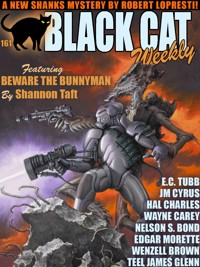
We have another great lineup this time, with original tales by Robert Lopresti (thanks to Acquiring Editor Michael Bracken), Shannon Taft (thanks to Acquiring Editor Barb Goffman), Wayne Carey, Teel James Glenn, and JM Cyrus (who gets the honor of having the story with the longest title that we’ve [yet] published!)
As always, it’s an eclectic mix, from traditional mysteries to supernatural crimes, from space opera to a fantastic world of moving islands…and everything in between! I hope you enjoy them all.
And special thanks to our art director, Ron Miller, who has found a terrific Steve Hickman cover for this issue (and continues to design amazing covers).
Here’s the complete lineup—
Mysteries / Suspense / Adventure:
“Shanks’s Last Words,” by Robert Lopresti [Michael Bracken Presents short story]
A shrewd mystery writer teams up with a rookie detective to try to solve a small-town accountant’s murder, unraveling cryptic clues.
“The Case of the Sabotaged Sloops,” by Hal Charles [Solve-It-Yourself Mystery]
A small-town boat race faces sabotage threats. Can you solve the case before Detective Kelly Stone?
“Beware the Bunnyman,” by Shannon Taft [Barb Goffman Presents short story]
A detective tries to unravel the truth behind a bizarre murder involving a giant rabbit costume and marital deception.
“The Jade Dragon of Dunhuang,” by Wayne Carey [short story]
An expert in Chinese antiquities visits 1930s San Francisco, entangling himself in intrigue over a rare jade artifact.
The Sturgis Wager, by Edgar Morette [novel]
A detective tackles a case of bank fraud and murder in 1890s New York, using keen observation and deductive reasoning.
Science Fiction & Fantasy:
“Dr. Darque and the Phantom Fear,” by Teel James Glenn [short story]
A detective investigates mysterious deaths at Coney Island, uncovering a supernatural threat feeding on fear.
“How To Cross the Cavorting Sea’s Wandering Islands During the Fourth Dance of the Widdershins Elliptical Cycle,” by JM Cyrus [short story]
A man’s journey across magical islands becomes a voyage of self-discovery and unexpected love in a whimsical world.
“The Return of Lancelot Biggs,” by Nelson S. Bond [short story]
Quirky spaceship crew faces danger as efficiency expert’s mistakes pit them against the Sun’s deadly pull.
“Murderer’s Chain,” by Wenzell Brown [short story]
A greedy son-in-law plots murder with an alien weapon, but his scheme unravels in an unexpected twist.
“Home Is the Hero,” by E.C. Tubb [short story]
A space pioneer returns to Earth, grappling with physical challenges and the complexities of his heroic status.
Das E-Book können Sie in Legimi-Apps oder einer beliebigen App lesen, die das folgende Format unterstützen:
Seitenzahl: 477
Veröffentlichungsjahr: 2024
Ähnliche

















Table of Contents
COPYRIGHT INFORMATION
TEAM BLACK CAT
THE CAT’S MEOW
SHANKS’S LAST WORDS, by Robert Lopresti
THE CASE OF THE SABOTAGED SLOOPS, by Hal Charles
BEWARE THE BUNNYMAN, by Shannon Taft
THE JADE DRAGON OF DUNHUANG, by Wayne Carey
THE STURGIS WAGER, by Edgar Morette
CHAPTER I.
CHAPTER II.
CHAPTER III.
CHAPTER IV.
CHAPTER V.
CHAPTER VI.
CHAPTER VII.
CHAPTER VIII.
CHAPTER IX.
CHAPTER X.
CHAPTER XI.
CHAPTER XII.
CHAPTER XIII.
CHAPTER XIV.
CHAPTER XV.
CHAPTER XVI.
CHAPTER XVII.
CHAPTER XVIII.
CHAPTER XIX.
CHAPTER XX.
CHAPTER XXI.
CHAPTER XXII.
CHAPTER XXIII.
CHAPTER XXIV.
CHAPTER XXV.
DR. DARQUE AND THE PHANTOM FEAR, by Teel James Glenn
HOW TO CROSS THE CAVORTING SEA’S WANDERING ISLANDS DURING THE FOURTH DANCE OF THE WIDDERSHINS ELLIPTICAL CYCLE, by JM Cyrus
THE RETURN OF LANCELOT BIGGS, by Nelson S. Bond
MURDERER’S CHAIN, by Wenzell Brown
HOME IS THE HERO, by E.C. Tubb
COPYRIGHT INFORMATION
Copyright © 2024 by Wildside Press LLC.
Published by Black Cat Weekly
blackcatweekly.com
*
Cover art by Stephen Hickman, courtesy of Vicki Hickman. Copyright © 2024 by Vicki Hickman.
“Shanks’s Last Words” is copyright © 2024 by Robert Lopresti and appears here for the first time.
“The Case of the Sabotaged Sloops” is copyright © 2022 by Hal Blythe and Charlie Sweet. Reprinted by permission of the authors.
“Beware the Bunnyman” is copyright © 2024 by Shannon Taft and appears here for the first time.
“The Jade Dragon of Dunhuang” is copyright © 2024 by Wayne Carey and appears here for the first time.
The Sturgis Wager, by Edgar Morette, was originally published in 1899.
“Dr. Darque and the Phantom Fear” is copyright © 2024 by Teel James Glenn and appears here for the first time.
“How To Cross the Cavorting Sea’s Wandering Islands During the Fourth Dance of the Widdershins Elliptical Cycle” is copyright © 2024 by JM Cyrus and appears here for the first time.
“The Return of Lancelot Biggs,” by Nelson S. Bond, was originally published in Amazing Stories, May 1942.
“Murderer’s Chain,” by Wenzell Brown, was originally published in Fantastic Universe, March 1960.
“Home Is the Hero,” by E.C. Tubb, was originally published in New Worlds, May 1952. Reprinted by permission of the Estate of E.C. Tubb and Phil Harbottle of the Cosmos Literary Agency (UK).
TEAM BLACK CAT
EDITOR & PUBLISHER
John Betancourt
ART DIRECTOR
Ron Miller
ASSOCIATE EDITORS
Barb Goffman
Michael Bracken
Paul Di Filippo
Darrell Schweitzer
Cynthia M. Ward
EDITORIAL BOARD
Thomas A. Easton
Ryan Hines
Vicki Erwin
Paula Messina
Richard Prosch
PRODUCTION
Sam Hogan
Karl Wurf
THE CAT’S MEOW
Welcome to Black Cat Weekly.
We have another great lineup this time, with original tales by Robert Lopresti (thanks to Acquiring Editor Michael Bracken), Shannon Taft (thanks to Acquiring Editor Barb Goffman), Wayne Carey, Teel James Glenn, and JM Cyrus (who gets the honor of having the story with the longest title that we’ve [yet] published!)
As always, it’s an eclectic mix, from traditional mysteries to supernatural crimes, from space opera to a fantastic world of moving islands…and everything in between! I hope you enjoy them all.
And special thanks to our art director, Ron Miller, who has found a terrific Steve Hickman cover for this issue (and continues to design amazing covers).
Here’s the complete lineup—
Cover Art: Stephen Hickman
Mysteries / Suspense / Adventure:
“Shanks’s Last Words,” by Robert Lopresti [Michael Bracken Presents short story]
A shrewd mystery writer teams up with a rookie detective to try to solve a small-town accountant’s murder, unraveling cryptic clues.
“The Case of the Sabotaged Sloops,” by Hal Charles [Solve-It-Yourself Mystery]
A small-town boat race faces sabotage threats. Can you solve the case before Detective Kelly Stone?
“Beware the Bunnyman,” by Shannon Taft [Barb Goffman Presents short story]
A detective tries to unravel the truth behind a bizarre murder involving a giant rabbit costume and marital deception.
“The Jade Dragon of Dunhuang,” by Wayne Carey [short story]
An expert in Chinese antiquities visits 1930s San Francisco, entangling himself in intrigue over a rare jade artifact.
The Sturgis Wager, by Edgar Morette [novel]
A detective tackles a case of bank fraud and murder in 1890s New York, using keen observation and deductive reasoning.
Science Fiction & Fantasy:
“Dr. Darque and the Phantom Fear,” by Teel James Glenn [short story]
A detective investigates mysterious deaths at Coney Island, uncovering a supernatural threat feeding on fear.
“How To Cross the Cavorting Sea’s Wandering Islands During the Fourth Dance of the Widdershins Elliptical Cycle,” by JM Cyrus [short story]
A man’s journey across magical islands becomes a voyage of self-discovery and unexpected love in a whimsical world.
“The Return of Lancelot Biggs,” by Nelson S. Bond [short story]
Quirky spaceship crew faces danger as efficiency expert’s mistakes pit them against the Sun’s deadly pull.
“Murderer’s Chain,” by Wenzell Brown [short story]
A greedy son-in-law plots murder with an alien weapon, but his scheme unravels in an unexpected twist.
“Home Is the Hero,” by E.C. Tubb [short story]
A space pioneer returns to Earth, grappling with physical challenges and the complexities of his heroic status.
—John Betancourt
Editor, Black Cat Weekly
SHANKS’S LAST WORDS,by Robert Lopresti
“I never was a cheerleader,” said Cora Neal.
“Too bad,” said Leopold Longshanks. “You would have looked great in one of those short skirts.”
His wife gave him her famous long-suffering look. “You know what I mean. I hate this part of the business.”
Shanks knew. Cora’s latest novel had just been published to excellent reviews—except for something nasty from one of the gutless anonymous critics at an outlet famous for hating everything. Not that Shanks paid attention to such rubbish.
Now Cora was on the publicity circuit. A reporter would be phoning later that morning to interview her. Hence her complaint about having to play cheerleader.
Early in Cora’s writing career she had wanted Shanks around for support at such times. Now she preferred that he not be underfoot, as she put it, which was fine with him.
“I’m heading downtown,” he told her as they finished their late morning coffee. “I’ll pick up that new prescription.”
These days it seemed that one of them was always starting a new prescription. Yet another of the joys of late-ish middle age. If one of them ever actually got sick the pharmacy would have to open another wing.
“Good.” Her attention was buried in notes for the phone call.
“Anything else you want while I’m out?”
“Hmm? No. We’re fine.”
Shanks decided the time was right. “By the way, do you remember Officer Dereske?”
Cora blinked. “One of your police heroes?”
Shanks wrote mysteries. His wife wrote women’s fiction. Series characters were an oddity to her.
“No, she’s the policewoman who came to our house a couple of years ago when—”
“I remember now. We invited the neighbors after the police found that teenager with a basement full of guns.” Cora shivered. “That still gives me the willies. But she was very nice.”
Dereske had been great. She walked the line neatly at that meeting, giving people helpful hints about dealing with scary situations without turning them into vigilantes.
“Why do you bring her up?”
“Oh,” Shanks said. “She asked me to have lunch with her today. If you would like to come along, I can put her off—”
“No. Have fun.” Cora frowned. “What do you think she wants? I suppose she’s decided to write a book, like everybody else.”
“That seems the most likely explanation.” Which wasn’t quite a lie.
* * * *
Shanks knew better than to go dining with another woman without warning Cora.
She wasn’t the jealous type—she knew his real vices all too well to worry about one he did not have—but she would be rightfully ticked off if a so-called friend blindsided her with the news that her husband had been seen wining and dining an attractive younger woman.
Now he was home-free on that score.
There wouldn’t be any wine involved. The Wrap Shop had no liquor license.
He arrived on time to find Dereske already sitting at a table on the sunny sidewalk in front of the restaurant. She stood when she saw him. It was the first time he had seen her in civilian clothes. Not surprisingly, she wore a conservative business suit.
She smiled and held out a hand to shake. “Thanks for coming, sir—uh, Mr. Long…”
Dereske faded off. He had given up on trying to convince her to call him Shanks. Far too informal for her taste. But she had never settled on a different moniker.
“It’s a pleasure, Officer,” he said as they sat down.
“Actually, it’s Detective now.”
“Really.” Shanks felt a proprietary thrill. The first time they met he had helped her with a case, which no doubt had given her career a boost.
That had left her feeling in his debt and it turned out Dereske hated that feeling, so she had been very pleased a few months ago to return the favor when a young man he knew did something stupid. With her help Shanks had kept the youngster, if not undisgraced, at least unimprisoned.
“I’m sure the promotion is well-deserved. Congratulations.”
The waiter arrived and the newly-minted detective ordered something complicated and Asian. It smelled depressingly healthy. Shanks chose a cheesesteak.
“One of the best things about living around here,” he explained, “is that you’re close enough to Philadelphia to get a good cheesesteak and to New York to get a good cheesecake.”
Dereske looked startled. “Wow. I don’t think that combination would do much for my health.”
Shanks’s bushy eyebrows dropped in a scowl. “Well, it’s not my everyday meal plan.”
“Of course.” She shook her head. “Look, Mr…. Maybe we should get down to business. I’m hoping you can give me some ideas about a case I’m working on.”
“I’ll be glad to if I can. What is it?”
“It’s the first murder investigation I’ve run. Did you hear about Dominic Lorenza?”
Shanks eyes went wide. “Oh, yes. I read about it a few days ago. An accountant, wasn’t he? Shot in his office.”
Dereske nodded. “On Second Street, half a mile from here.”
“The press implied he was, well, a bit of a sleaze ball.”
“They weren’t wrong. Some of his clients are looking at charges of—” She closed her eyes. “Tax fraud. Medicare fraud. Theft from an escrow account.”
“Wow. He ran a full-service business.”
“Apparently. You can see why I’m struggling. Plenty of suspects, not a lot of clues.”
“Any alibis?”
“Some have them, but that doesn’t mean they didn’t hire somebody.” Dereske stuck her chopsticks into her food. She was surprisingly dainty about it.
“What makes it worse is that there is one clue. I just can’t make anything out of it.”
“Ah,” Shanks said. “This is where I sing for my supper.”
Dereske frowned. “Excuse me?”
“I mean this sounds like the part where you think I can help.”
“Oh. Right.” She pushed the plate away. “I had better give you the background. At ten seventeen on Tuesday night the nine-one-one operators recorded a phone call. No one spoke at the other end.”
“Huh. Do they get those often?”
“More than you’d think. It could be an accident—butt-dialing, they call it. Or a cat stepped on speed dial. But sometimes the caller really is in danger and can’t speak because—”
“Because the source of the danger might hear them.”
“Right. Plus, you never know when someone might be unable to speak because they’re having a heart attack. The operators always trace the call and dispatch someone.”
“Of course.”
“This time the call came from the landline in Lorenza’s office. The door was unlocked, and the patrolman found him lying on the floor near his desk. The phone was lying on the other side.”
Shanks nodded. “He had no chance to say anything. Was he alive when the officer arrived?”
“Just. He was lying on the floor, barely breathing.”
“So, what was the clue?”
“The officer called an ambulance and then he knelt down next to him. Lorenza looked up and said, ‘My last words.’”
Shanks’s eyebrows dropped. “What were they?”
Dereske’s expression made it clear that she had ridden this merry-go-round before. She raised two curved fingers on each hand, either making air quotes or preparing to sing “Little Bunny Foo Foo.”
“He said, ‘My last words.’ Then he died.”
“Oh, for Pete’s sake,” said Shanks.
The cop nodded. “Not helpful.”
“It’s worse than that. I don’t suppose you read much mystery fiction, Detective.”
She looked alert. “No sir, I don’t really have time for that. I did read one of yours. The book about the mugging victim. It was pretty good.”
Shanks waved that off. “What I’m saying is that the dying words clue is a cliché in mystery fiction. The victim identifies his killer with some ridiculous gibberish that the detective has to figure out.”
“Well,” said Dereske, “now we’ve got a real-life example, and this detective is getting nowhere.”
“I suppose you’ve tried the obvious.”
“Definitely.” She scratched her nose. “What do you consider obvious?”
Shanks paused to take a bite of cheesesteak. “Notes on his desk. The last file on his computer. Last phone call. His final text message on social media. A voice memo app.”
Dereske nodded impatiently. “Been there. Done that. Nothing seemed to relate to any of the suspects.”
“Oh, them. Who are they?”
The cop started holding up fingers. “The main ones? His estranged wife, Heather Marshall. His secretary, Barbara Small. A couple of disgruntled clients, Fritz Shafer and Mitch Brubaker. Three of them have had nasty public fights with him. His secretary claims she got along fine with him, but apparently, he was a real piece of crap, so he can’t have been fun to work with.”
She cleared her throat. “Pardon my language.”
Shanks almost told her that a little cussing was one of the most human things he had ever seen her do. But making her more self-conscious would not be a kindness.
“Anyone else?”
“Amy Robbins. She’s a violist.”
That caught him by surprise. “What had he done to a viola player?”
“Apparently Lorenza was a violinist. That was his hobby.”
She paused. “What’s the difference between a violin and a fiddle?”
“The price of lessons, I think.”
“Anyway, Lorenza played in a string quartet and so did Robbins, until he convinced the others to kick her out. Witnesses said the argument got pretty nasty.”
“Do you know why he canned her?”
Dereske shrugged. “He says she didn’t practice enough. She says it was because she turned down his request for non-musical activities.”
“Oh.” Shanks scratched his bald spot. “Classical musicians have a reputation for bad tempers, but I have no idea if that’s true.”
“I’ve broken up fights between kindergarten teachers. Also, social workers. So, I’m not sure any profession has a claim to pacifism.”
“I take it she has no alibi.”
“Nope.”
“We’re beating around the bush, aren’t we?” he asked. “The real question is this: if Lorenza had the breath to say something, why didn’t he just name his killer?”
Dereske slammed her chopsticks down. “Exactly! That’s what’s been bugging me. Can you explain it?”
Shanks scratched the spot on the top of his head where hair didn’t grow any more. He was running through some of the many dying-word clue stories he had read.
“Jack Ritchie, who was a great mystery writer, did a piece in which the victim wrote out a nonsense clue to show that he knew the killer would be the one who found his body.”
Dereske frowned. “I don’t get it.”
“Because if he mentioned the name the killer would have simply erased it.”
She shook her head. “Things like that are the reason I don’t read mystery fiction. No offense.”
“None taken. Although that story was pretty good.”
“Wait a minute. If you’re thinking that the man who found Lorenza was the killer, you’re—well. You’re wrong. I know the officer.” She frowned. “Besides, if he was the killer he would have just claimed Lorenza had described someone else.”
“Good point.” He reached for his plate and discovered the cheesesteak had vanished. Thinking was hungry work. “You said his cell phone fell on the floor.”
“No. That was his office phone, a landline. The cell was in a desk drawer. He couldn’t reach it.”
“I don’t suppose you brought it with you?”
Dereske looked astonished. “Of course not. It’s sealed in an evidence locker, where it should be. What are you getting at?”
“It would be nice to see a photo of the screen.” Shanks shrugged. “Here’s my point. You said you checked his voice memo recorder?”
“Sure. The phone had one, but he didn’t use it.”
“Any chance he did, but the killer erased the memos?”
“I don’t think so. What are you getting at?”
Shanks leaned forward. “I’m thinking about him being a violist.”
Dereske’s eyes went wide. “What does that have to do with anything?”
“A dedicated musician would have a way to record his practicing, wouldn’t he? If he wasn’t using the memo recorder he must have downloaded a more sophisticated program. They have apps that let you edit, change keys…”
“Huh.” She frowned. “Give me a moment.” Dereske pulled her own phone out and started digging through it.
Shanks took the empty time to do some people-watching but found himself wondering what the late great Jack Ritchie could have done with a cell phone as a plot device. Come to think of it, maybe Shanks could—
“No mention of a music recording app,” said Dereske. “But let’s check.”
She hit speed dial. “Brendan? I just had an idea.” She looked away as she said that.
“Get Lorenza’s phone. Well, unseal it. Check for any app you don’t recognize. We’re looking for one that might be used for recording music. Call me back.”
While she was busy Shanks paid the bill.
Dereske frowned. “You shouldn’t have done that. I wanted to pay—”
“You can get dessert.”
They walked two blocks to the Polar Parlor. Shanks ordered a cone of rocky road. Dereske abstained.
“You sure? It’s excellent.”
“Goes right to my hips.” Her cell started to chirp the Dragnet theme.
“Brendan? That’s great. Wait a second. Let me write this down.” She stepped outside.
Shanks decided the rocky road looked lonely and asked the server for a scoop of pistachio to keep it company. Once he acquired the cone, he gathered several napkins and followed his favorite cop outside.
Dereske was scribbling furiously. “Look him up. I’ll be in soon.”
She closed the connection and glanced up, so wired that she hardly seemed to recognize him.
“Oh. Did I pay for your ice cream?”
“Doesn’t matter. What’s the news?”
“Turns out there was an app on his phone called Vokalitee. I’ve never heard of it. Have you?”
“Nope. I assume it’s a music recorder.”
“It sure is. Brendan says he definitely recorded himself on the violin, but the last recording was made about two hours before he died.”
“His last words,” murmured Shanks.
“Maybe so. Anyway, it was a memo to his secretary, saying he had just received an angry phone call from someone who claimed to have been ripped off by one of Lorenza’s shady clients. And get this, the name of the guy who called was, as near as my officer could make out, Bartholomew Kazinovsky.”
“Wow.”
She grinned, a rare sight. “No wonder he didn’t try to gasp that out while he was dying, huh?”
Shanks nodded. “Especially since his secretary’s name is Barbara. If he got out just the first part…”
“Yeah. That could have gotten her in real trouble.”
Dereske slipped her notebook and phone into various pockets. “I have to get back to the station and help track down Kazin—the suspect.”
“Excellent,” said Shanks. Rocky road was escaping down his fingers. Napkins never did the trick perfectly; licking was required.
Dereske was jumping to be gone. “Mr.—Uh, Shanks. You really helped me again. I don’t know how long it would have taken to figure this out without you.”
“My pleasure.”
She grimaced. “I guess I owe you another favor.”
Shanks smiled. No words necessary.
ABOUT THE AUTHOR
Robert Lopresti is the author of Shanks On Crime and the editor of Crimes Against Nature: New Stories of Environmental Villainy, which Down & Out Books is publishing in October.
THE CASE OF THESABOTAGED SLOOPS,by Hal Charles
When State Police Detective Kelly Stone pulled up to the Fire Lake Boat Lodge, her little sister, who had taken a part-time summer job with Great Falls’ Parks & Rec, came running up the path to meet her.
“You’ve got to help,” Krissy said. “We’ve got a spy in the OSS.”
Kelly was stunned at the accusation. “Krissy, the OSS was disbanded by President Truman at the end of World War II.”
“That’s not what I mean,” said her younger sister, leading the way to a boat dock. “The OSS is the Organization of Small Ships…you know, like models.”
“Aha! Now you tell me.”
“Anyway, one of my first ideas to improve the visibility of Fire Lake rec programs was to create a race between small boats. Remember how Dad used to litter the cellar with those things?”
“Sailboats, power boats, reproductions of WW II craft—he had them all.”
“Dad taught me how to build a sailboat. Anyway, I challenged Slocum County Marina on the other side of the Fire Lake to a Fourth of July small sailboat race, and they accepted. So I taught a class in the Lodge. Six people, though I admit two of them were my own kids.”
“That’s quite ingenious on your part, Sis, so what’s the problem?”
Krissy put on a pair of gloves, pulled a note out of her pocket, and handed it to her sister. “I found this paper tacked to the Lodge’s door when I arrived this morning. The big race is tomorrow, and I don’t know if I should tell the OSS about the threat before this morning’s race to determine our entry.”
Kelly read the note, which consisted of letters cut from magazines: IF YOU PERSIST IN RACING, YOUR SHIPS WILL BE BLOWN OUT OF THE WATER.
“How nice to see you, Aunt Kelly,” said Katrina Taylor, Krissy’s daughter. “What are you reading?”
Kelly folded up the note and slipped it into her pocket. No sense in upsetting the OSS. “Just an ad your mother showed me for our next shopping trip,” she lied.
“What do you think of my sloop?” said Katrina.
“See that OSS logo?” said Krissy. I had six of them made and told the club members to proudly place them on the ship’s starboard side.”
“Very nice, Sis. I see your sloop even has a name on the stern, Katie.”
“Not very original,” said her brother, Bobby, holding up his sloop. “Behold the Avenger.”
“Guess whose so-called life is watching and re-watching superhero movies?” said Katie.
“The other four members are down at the dock,” interrupted Krissy.
When they arrived, Kelly asked each to come see her alone.
“I’m Don Watts, retired,” said a gray-haired man. “This is the Gus,” he said, holding up his model sloop. “I named it after Krissy’s dad, who got me into boat-building when I was a kid.”
The next to arrive was Clio Laine, Krissy’s yoga instructor. “I love these boats because as with yoga it’s the attention to detail that matters.”
Kelly noticed she had named her sloop after herself as Clio was etched into the stern.
“And you remember my neighbor, Minerva Watts?” said Krissy. “Don’s ex-wife.”
“Everybody calls me Minnie, like the mouse because I’m so short.” The woman laughed. “I joined the OSS because I’m competitive about everything. The Minerva will wipe out the field.”
“The final member of the team is Suzie Quagmire, who moved here from Slocum County last month.”
As she proudly held up the Suzie Q., the sun glanced off the OSS nameplate on the left side of her boat, nearly blinding Kelly.
“I’m a good boat builder but a great sailor,” announced Suzie.
As the last interviewee walked away, Krissy announced, “It’s time for the race to see who goes against Slocum tomorrow.”
“If they survive the threat you received this morning,” cautioned the detective. “I think the person who lied to me and the note sender are the same person.”
SOLUTION
Kelly heard Suzie refer to herself as ‘a great sailor,’ yet the woman who had been told by Krissy to put the OSS logo on the sloop’s starboard side had placed it on the left or port side. Confronted, Suzie confessed to not being ‘a great sailor,’ so she was trying to scare off her teammates so she could win.
The Barb Goffman Presents series showcasesthe best in modern mystery and crime stories,
personally selected by one of the most acclaimed
short stories authors and editors in the mystery
field, Barb Goffman, forBlack Cat Weekly.
BEWARE THE BUNNYMAN,by Shannon Taft
“Did you say the intruder was a giant rabbit?” I asked the dispatcher in disbelief. I was a recent addition to Fairfax County’s Major Crimes Bureau, a transplant from a county an hour west who’d been lured in by Fairfax’s higher pay rate, and there had been a lot of jokes about me coming from a rural area. But I hadn’t expected this kind of a prank. Especially after eleven on a late September night.
“Affirmative, sir.” The female voice on the other end was brisk and formal, as if this call was perfectly routine. “A white rabbit of approximately six feet, now deceased. And the responding officers said that there is no axe, Detective Sutcliffe. Not this time.”
* * * *
I made it to the scene in under twenty minutes. Every window of the three-story McMansion seemed to be lit, and there were three patrol cars parked outside, their emergency lights flashing for the whole neighborhood to see.
I was greeted at the door by Officer Winters, a stocky man in his twenties, with skin the color of aged mahogany. He stepped out to join me on the portico, gently shutting the door behind him. “We’ve got the homeowner in the living room, sir,” he explained in a somber voice. “Anna Demarest, age thirty-seven. We thought she’d do better with a woman, so we have Officer Janet Rivera with her. Officer Harrison is upstairs with the body while we wait for the forensics team and the medical examiner.”
Before I could ask any questions, I heard a vehicle approaching up the drive. I turned in time to see the mobile crime scene truck come to a halt. The police chief’s pride and joy, it could do nearly everything the main lab could do. The head of the forensics division, Major Kinkaid, climbed out from the driver’s seat, his prematurely silver hair reflecting a dance of red and blue illumination from the flashing light bar of one of the patrol vehicles.
I waited silently for him to join us on the porch.
The first words out of his mouth were addressed to Winters. “Intruder was dressed like a rabbit?”
Winters replied calmly, “Yes, sir. Homeowner says she went to bed early with a headache, woke up, saw the rabbit in the bedroom doorway—the shape backlit by light from the hallway. She knew the Bunnyman legend, so she grabbed her gun from the nightstand and shot him.”
“Any axe?”
At that moment, my curiosity was stronger than my professionalism, so I cut in. “Why does everyone keep mentioning an axe?”
Kinkaid turned to me, his arctic-blue eyes piercing in the artificial light. “You don’t know about the Bunnyman?”
“The what?”
“The Bunnyman of Fairfax County,” Kinkaid said with forced patience. “He usually attacked people in vehicles, though, not houses. Used a hatchet. We still have one in evidence, but that crime was back in 1970. When I tried to get DNA off it a few years ago… We hadn’t stored the hatchet properly. Anything that might’ve been there was too degraded.”
I blinked at the major a few times in disbelief, then turned to look at Winters, expecting him to share my reaction.
Winters was all business as he told Kinkaid, “I believe there were some home invasions over the years attributed to the Bunnyman too, sir.”
“No way,” I muttered.
Kinkaid shook his head chidingly, his eyes on mine. “When you get the chance, Detective, google it. The Washington Post ran some stories. Violent criminal, dressed like a rabbit. Known to carry a hatchet. But most people referred to him as the axe-wielding bunny, or just the Bunnyman.”
I had no idea of the correct response and settled upon, “Oh.”
Kinkaid gestured to the front door. “Let’s see what we’re dealing with now.”
We entered the large foyer, and as we headed for the stairs, I could see into a spacious but tidy room to the left. A woman with long brown hair was sitting on an ivory sofa, her teal nightgown visible at the bottom of her white terry-cloth robe. I gave a nod to Officer Rivera, who sat with her, then followed Winters and Kinkaid up the stairs.
At the top, we turned to the right, where Harrison waited at the end of the hall outside a wide-open door. He stepped aside so that Kinkaid and I could crowd the opening and peer into the bedroom.
It looked as if the Easter Bunny had starred in a horror film—albeit a comparatively tasteful one. The only color on the snowy fur of the costume came from the pink ovals inside the perky bunny ears and the deep-red blood from where the approximately six-foot-tall bunny had been shot in the face of the structured costume head.
The bunny outfit was comprehensive, even down to the Thumper-style feet and paw-like hands. One paw—glove—was lying a few feet away from the body, and the only part of the corpse that was visible was a single pale hand with a mat of dark hair at the wrist. The carpet where he lay was a pale slate blue, nearly white, which made the pool of blood that had soaked in around the bunny’s head a garish contrast. A baseball bat was on the floor nearby with a bit of blood spatter on it. A formerly pristine wall had likewise suffered from a small mist of blood. But otherwise—excepting the bedsheets that had been tossed aside—the bedroom seemed to be in perfect order.
I pointed to the isolated glove with an implied question. Winters was behind us, but he could apparently see where I was pointing because he said a little defensively, “We had to take it off to check for a pulse.”
I nodded to let him know he’d done the right thing. Corpses were under the jurisdiction of the Office of the Chief Medical Examiner—OCME—and not to be touched without their consent. But policy stated that preservation of human life took precedence. No matter how much blood was surrounding the rabbit, the responding officers had needed to interfere with the corpse enough to definitively confirm the death.
I heard footsteps coming up the stairs and stepped back, nearly crashing into Winters as I tried to see who was coming. “My people,” Kinkaid told me as two men came into view, both carrying what seemed to be heavy cases. “I’m waiting for a callback from the OCME to find out their ETA. We’ll work around the body until then.”
I nodded my understanding and headed back down the hall, squeezing sideways to make room as I passed the forensic guys. The crime scene was theirs, but the witness was mine, and she was waiting below.
At the bottom of the steps, I paused for a moment, trying to get into the right frame of mind to set the tone I wanted. The woman in the living room was both a victim and a suspect. A homeowner awoken by what had to be a woman’s worst nightmare—an intruder who might rape or kill her. But she’d also taken a life, and for that the system required answers.
“Ma’am?” I said gently as I entered the room. “I’m Detective Sutcliffe.”
She started to rise, but I motioned her back down.
“Anna,” she said hoarsely. Then stronger, “I’m Anna Demarest. Please call me Anna.”
“If that makes you more comfortable,” I told her.
As I came closer, Officer Rivera stood so that I could have her spot on the sofa. A petite woman with pixie-cut hair, and barely old enough to drink, no one looking at her would guess she had a brown belt in aikido. I tried not to watch her as she moved to the entryway. I didn’t want Anna to realize that Rivera was remaining in the room to record the interview on her body camera. Luckily, Anna kept her eyes on mine. They were a robin’s-egg blue, made more vivid by the pink tint of the rest of her eyes, doubtless the result of copious tears.
“I’m sorry to trouble you just now,” I told Anna. “But we need to know what happened while your memory is still fresh.”
“I don’t know what happened,” Anna wailed. “I woke up and saw…” She shook her head, then started over in a more controlled tone. “It was probably the light from the hallway that woke me up. I’d left that light on for Craig—my husband—but I’d closed the bedroom door so I could have a dark room for sleeping. When I woke, I saw…that thing framed in the doorway. It was like those stories kids tell at sleepover camp. Tall. Menacing. I saw the outline of bunny ears, and he was holding something, like an axe, maybe. But…when the police came, there was no axe. Just a baseball bat. I think… Maybe I mistook that bat for an axe?”
She sounded nervous now, perhaps afraid that without the axe she might be in trouble for killing the man.
“A bat is considered a deadly weapon when used against a person,” I assured her. “And in the dark, coming out of sleep, a stranger in your bedroom wearing a bizarre costume, holding something in his hands, it’s perfectly natural to be afraid. Terrified, even.”
Anna rapidly nodded her agreement. “I keep a gun on the nightstand when Craig isn’t here. It’s in the drawer the rest of the time. I reached out, grabbed the gun…” She ended in a whisper, staring down at her lap. “I shot the rabbit.”
The room was silent as I waited for her to continue.
Her chin lifted and she drew in an audible breath before continuing. “I scrambled off the bed. The rabbit was down, but he was between me and the door, and I didn’t know for sure if… Well, in the horror movies he’d reach out and grab the girl as she runs by, right?”
“Yes,” I agreed. “And we all make fun of the person who was so foolish as to approach a dangerous intruder without knowing for sure if he’s out of commission.”
“Exactly,” Anna said with satisfaction. “So, I ran to the bathroom instead. Locked it. My watch has a phone function.” She lifted her wrist so that I could see the Apple watch. “I used it to call nine one one. I had the gun with me and kept my eyes peeled on the bathroom door. If that handle had as much as shaken, I’d have fired right through the door.”
“Perfectly understandable. Now, Anna, I have a few questions for you. Did you recognize the intruder?”
“Recogn—?” She broke off with a nervous titter. “It was a rabbit! How could anyone recognize someone covered by a costume from head to toe?”
She rather had a point.
“I keep saying ‘he’ because of the size of it,” Anna explained. “I got a bit of a look when the police came and escorted me down here. But for all I know it was a super-tall woman. I don’t personally know any women that tall, though, if that’s what you were asking.” She frowned. “Was it a woman?”
Based on the shape of the hand and amount of dark hair I’d seen at the wrist, I was pretty sure we were dealing with a male, but I left her question unanswered. “Have you received any threatening messages? Upsetting social media, phone calls, texts, letters in the mail?”
Anna shook her head.
“Any trouble at work?”
She shook her head again. “I work for a literacy nonprofit. Mostly I do fundraising. And I primarily work from home, going into DC maybe once or twice a month.”
I pondered the probable salaries at a nonprofit as I looked around the neat, spacious room, surreptitiously sliding my thumb against the buttery leather of the sofa at my side. Most of the furniture looked like antiques, or at least something handcrafted out of solid wood. Expensive. My thoughts apparently showed on my face because Anna said, “My husband, Craig, is a personal injury lawyer.”
“I see. Where is Craig?”
“He said he was going to work late but…this is really late, even for him. The nine one one operator had me stay on the line with her until the first officers arrived, and then they asked me not to call anyone yet… Please, may I call Craig now?” Her eyes welled, and a tear slowly made its way down her pale cheek.
“I can’t stop you from calling him,” I said as smoothly as I could while bitterly wishing she had not told me her husband was a lawyer. It made any efforts to prevent that call deeply problematic. As far as the Sixth Amendment was concerned, a lawyer was a lawyer, regardless of what kind of cases he usually took. And being a lawyer, he’d probably tell her to stop talking to us. “It would be helpful if you answered just a few more questions first, Anna.”
“What kind of questions?” Her tone was plaintive, and I could not blame her. She’d been through hell, yet we were keeping her from getting comfort from her husband.
I held up my index finger in a request for patience, then rose and went over to Rivera’s side. I leaned in close to whisper to the officer, “Any signs of a forced entry?”
“No,” she whispered back.
I nodded my thanks before returning to the sofa. “Anna, can you tell me who has keys to your house?”
Her brow furrowed. “The house? Only me and Craig. The side door has a keypad, though. We installed that in case we ever lock ourselves out.”
“No cleaning staff?” I looked down at the pale carpet, the same shade as the one in the bedroom. “Your house is spotless.”
“We have one of the robot vacuum things on each floor. They’re programmed to run once a day. And a service comes twice a week for everything else, but I let them in. If we ever need them to come when I’m not here, we set the keypad with a special code they can use, and I change it back later. But I haven’t had to do that for a few months now. I’m pretty much around.”
“Does your husband work late a lot?”
She stiffened and swiped at her eyes with the sleeve of her robe before saying angrily, “I don’t see what that has to do with anything.”
Her reaction told me I might be on the right track. “Anna, do you have a prenuptial agreement?”
“No.” Her expression crumpled for a heartbeat, then she resumed control, giving it a forced placidity. “I met Craig in undergrad, and we married the summer after we graduated. I worked sixty-hour weeks as a cocktail waitress to put him through law school.”
The unspoken message weighed heavily in the room. If the Demarests ever divorced, Anna would get a large chunk of the marital assets.
I broke the silence by repeating the question that had put us on this path. “Does your husband work late a lot?”
She sniffed dismissively, but it seemed forced. “As a matter of fact, yes. He often stays quite late at the office. There’s nothing odd about… Well, he should be home by now, of course, but…”
“Would he be working alone?”
Anna’s lips twisted bitterly, and her tone was curt as she dropped the pretense that his absence was justified. “The woman he’s likely with is named Margot. His paralegal. Last month he went to a conference in the US Virgin Islands to get his continuing education credits. The credits are a bar requirement for lawyers licensed in Virginia, and the sessions are often someplace pretty to get them to pick that conference over a different one. When I called the office that week about, um, something, Tansy—the receptionist—said that Margot was on vacation.”
I couldn’t imagine what would cause Anna to call her husband’s office when she knew Craig was out of town, other than to deliberately check up on precisely what she’d found. Margot’s vacation when the boss would be out of town was not proof of adultery, of course. Perhaps the boss being away, and thus not needing her, had made it the most convenient time for the paralegal to use her leave.
“Does Craig know about the Bunnyman stories?”
Anna trembled for a moment before saying in an unsteady voice. “Last year, for Halloween, we stayed with some friends at a cabin in the woods and told ghost stories by the fire after dinner. You know, like the one about the hitchhiker with the hook or the Mothman. Someone told us about the Bunnyman with the axe attacking people right here in Fairfax County. I think he said that the Bunnyman was an escaped convict, but I’m not sure. I don’t think anyone really believed in the Bunnyman. I certainly didn’t—not at the time. But when I woke up and saw…” She broke off with a shudder.
I was sure Anna was right about what everyone had believed that night at the cabin, but a killer wouldn’t need to believe in the Bunnyman stories to find them useful. If Anna had been repeatedly struck with the bat, then the blood spatter pattern would have displayed the outline of a tall rabbit, complete with bunny ears. And our investigation of her death would have necessarily included a Bunnyman theory—a ready-made defense for any other suspect.
I patted Anna’s hand before rising to speak with Rivera once more. But this time I gestured the officer out of the room. We found Winters in the hall, and I realized he’d likely been listening in the whole time but staying out of the way so that Anna wouldn’t feel crowded and outnumbered.
I kept my voice low as I asked the patrol officers, “You checked all the other rooms, right?”
“Yeah,” Winters replied softly. “I took half, and Rivera took half. We turned on the light in each room as we went and kept it that way. Covered the whole house. No one else was home.”
“Any signs of a man’s shoes?”
Rivera frowned. “What?”
“The costume’s feet are perfectly clean—snowy white. He put that thing on after he got in the house. A man might put his shoes away when he comes home, especially in a house this clean, but an intruder doesn’t do that. Which means, unless somebody is wearing dirty shoes inside that costume, we have no extra shoes and a missing husband who should have made it home by now.”
“Oh, hell,” Winters muttered. “Her husband didn’t hire a killer while he maintained a perfect alibi at the office, did he? He went for the do-it-yourself approach.”
Rivera whispered, “Wouldn’t Mr. Demarest still need an alibi? We always take a look at the husband whenever a wife gets killed.”
“True,” I admitted. “But if all these late nights are Craig spending time with his paralegal mistress, maybe she’s agreed to be his alibi. To claim they were working together on some case.”
“So, we call the office?” Rivera asked. “See if anyone’s there?”
I shook my head. “First things first. You guys checked the garage, right?”
“Yeah,” Winters said. “No intruder. Two-car garage, both cars were…” He stopped to roll his eyes, then bury his face in one hand.
“Both cars present and accounted for?” I asked dryly.
“Damn it,” Winters muttered. “Once she mentioned her husband to you, I should have realized what the two cars meant.”
I waved that off. “Hey, for all we know, he takes a taxi to work. Or maybe they’ve got a third car. But it does mean I’ve got an appointment upstairs with the Bunnyman.”
“To take off the mask,” Rivera said with satisfaction.
“No,” I replied. “Not quite yet.”
* * * *
After getting Craig’s cell phone number from Anna, I went upstairs with Winters. I explained the situation to Kinkaid, then everyone went silent as I dialed Craig’s number. A second passed in which I could not even hear breathing from my colleagues before the rabbit’s rump emitted a brief musical riff—the default ringtone of an iPhone.
“Either her husband is in that costume,” I told Kinkaid, my voice firm, “or someone stole his keys and phone, in which case, we have a missing person in need and every minute counts.”
“You don’t believe her husband is in need of anything anymore.” Kinkaid pulled out his own phone. “But I commend you on making the best case you could for exigent circumstances to remove the costume’s head. Let me call OCME.”
After a brief telephone negotiation, Kinkade hung up. “We have their permission to take off the bunny head, provided we film the removal from multiple angles.”
It took a bit of preparation, as the forensic guys did not want to lose any evidence in the process, but ten minutes later I was staring down at a perfect match for the driver’s license photo of Craig Demarest—with an extra hole in his face.
Getting permission to remove the phone from the body took another call, and I estimated nearly half an hour had passed in total before I returned to Anna in the living room.
She was standing at the window, looking out. I cleared my throat to get her attention.
When she turned, her first words were, “I called Craig’s office number. There was no answer.”
I could see in her face that we both knew what it meant that she had not tried to call his cell phone. She’d been afraid she might cause precisely what I had done on purpose—getting the corpse to ring.
Her gaze went to the clear evidence bag I held at my side.
I shifted my hand to hold it in front by the seam at the top so she could see the contents. “Does this phone belong to your husband?”
She wrapped her arms across her chest and began to slide her hands up and down her upper arms in self-comfort. “His is silver, like that one. And it has no case, like that one too.”
“Do you know the passcode?”
She closed her eyes for several heartbeats, as if to deny the proof in front of her. “His birthday,” she said, her eyes meeting mine once more as she recited the digits.
I keyed them in through the plastic evidence bag, then turned the bag around to let her see the open screen.
Anna gave a faint moan before stumbling over to the sofa, dropping down, and gripping the leather tightly by her sides, her nails digging in.
She began to rock in place, forward and back, her eyes trained on her husband’s phone.
* * * *
By mid-afternoon the next day, the OCME had done the formal identification of the body, and they said they would contact Anna to officially tell her what she already knew—her husband had died of a gunshot wound to the head inflicted while he was in their home wearing a giant rabbit costume.
According to Kinkaid, the position of the baseball bat and the direction of the blood spatter on it indicated that at the time of the shooting, he’d probably been carrying it high, near his head, as if preparing to smash it down on something—or someone.
As for the cell phone, thanks to the password Anna had given me and Craig’s use of Apple’s password manager, I had no trouble using it to access his Amazon account. A simple word search for “costume” in the orders section gave me the expected answer—the purchase of a rabbit costume a few weeks earlier.
But several crucial questions remained unanswered. Had Margot been an accessory to Craig’s plan to get rid of his wife by implicating the Bunnyman? Had it perhaps even been her idea? And if so, was she still a threat to Anna?
The cell phone’s history showed no text messages between Craig and his paralegal, which seemed odd for two people who worked so closely together. I looked at the other apps, and sure enough, Craig’s phone had an app for sending texts that self-destruct, suitable for terrorists, murderers, and run-of-the-mill adulterers.
I thought of Anna, frightened into defending herself at gunpoint and now having to live with the knowledge that the man she’d been married to for more than a decade had wanted her dead—and that she’d had to take his life to save her own. She deserved whatever answers I could find.
I fished Margot’s cell phone number out of Craig’s contact list and nearly dialed it to see how Margot would sound after her dead lover’s name showed up on the caller ID. But that kind of cruelty wasn’t likely to get me much cooperation once the shock wore off.
I dialed from my work phone instead.
A hoarse female voice, whose owner sounded like she’d been crying, said, “Hello?”
“Margot Jennings?” I asked.
“Yes. This is she.”
“This is Detective Sutcliffe, Fairfax County Police. I’ve been assigned to the death of Craig Demarest.”
There was a weary sigh before Margot said, “And you want to talk to me.”
I felt the fact that I was on the phone with her made that rather self-evident. “Can we meet?”
“If you insist,” she said dully.
I had not insisted, merely requested, but saw no reason to point that out to her. When I asked if I could come to see her, she said she was at the office. That struck me as odd, given that her presumed lover had just died, but I told her I’d be there within the hour.
* * * *
Craig Demarest had a solo practice, according to the receptionist who greeted me at his office. Tansy was in her early twenties with long blond hair held back in a ponytail and clear hazel eyes that showed neither grief nor celebration. “I suppose Anna will sell this place,” she said pragmatically. “Only a lawyer can own a law practice, which means she has to either sell it or shut it down. And I can’t imagine Anna will make any effort to get the buyer to keep Margot employed. Which means I’m probably about to be fired too.”
“You knew about Margot and Craig?” I asked.
“Oh, yeah. They weren’t subtle about it. You’d think they’d at least avoid tossing the used condoms in the office wastebasket. I mean, really?” She screwed up her face in disgust. “Gross. And did anyone tell you about the Virgin Islands?”
“I understand that while Craig was down there, Margot was…” I arched an eyebrow as I paused meaningfully to let Tansy finish my sentence.
“Yeah, she was with him. I felt awful when Anna called last month to ask if Margot was around. But Craig was my boss, and the official story was that Margot was away on vacation, so that’s what I told Anna.”
“And you’re sure Margot wasn’t vacationing elsewhere?”
The receptionist snorted. “He booked both tickets together.” Tansy pulled open her desk drawer and took out a manila folder. She opened it wide on the desktop facing me. “The trip was a business expense—tax deductible—for a lawyer, but not for Margot, who’s only a paralegal and had no business being at that conference.” Tansy tapped a French-manicured finger on Margo’s name on the e-ticket. “The firm’s records belong to Anna now, so if she wants to give these to you…well, just have her call and tell me.”
“Or I can get a subpoena,” I noted absently, my focus on the details of the trip laid out before me—particularly the single hotel room.
“That works too,” Tansy said.
A cold female voice came from the hallway to the receptionist’s right side. “Thank you, Tansy. That will be quite enough.” A woman stepped forward. She was about thirty, with a willowy build, red hair, and green eyes. Dressed in a black suit with a pencil skirt and black leather pumps, she appeared unnaturally pale.
Tansy turned her head and flushed, but she didn’t back down. She stared right at the other woman. “I don’t mind making an effort to help the police, Margo. In fact, I’ll call Anna now to get her permission to give the records to the detective.”
“I’m sure you will,” Margot said smoothly. “Detective, I believe you came here to speak with me?” She did not wait for a response before turning around and heading back down the hallway.
I gave Tansy a little nod of thanks, then followed Margot as she led me to a conference room.
“Tansy is pissed because she blames me for the fact that we’re both about to be unemployed,” Margot explained as she took a seat at the oak table, which had eight black leather chairs around it.
I sat opposite her. “Is she wrong?”
Margot looked away for a moment before admitting, “I suppose not. If Craig was still alive…well, we’d all have jobs for the indefinite future and likely a large bonus coming next year. Instead, Anna will sell the firm, and she’ll find it easier without any conditions about someone keeping us on board. That’s why I’m here packing up my stuff—I don’t want to go through the humiliation of her kicking me out. But I still can’t believe that… The news said that Craig was shot by his wife in what looks like self-defense.” Her tone turned pleading. “But they didn’t explain why anyone would think Craig could… It makes no sense.”
“Tell me, Margot, have you ever heard of the Bunnyman?”
Her brow furrowed. “The what?”
“A six-foot-tall man in a bunny suit who carries an axe.”
She shook her head, seemingly mystified. “What on earth are you talking about?”
“Your boss—your lover—decided to dress like the Bunnyman and try to kill his wife. Or so we assume. Can you think of any rational reason for him to sneak into his wife’s bedroom carrying a baseball bat and dressed like the Easter Bunny?”
“He was…? That’s…that’s…” she spluttered before slapping her open palm loudly on the table and bursting out, “That’s insane!”
“So, no furry fetishes on his part, right?”
She drew her head back. “What? No. Of course not.”
I noted she hadn’t specifically denied the lover accusation, only the fetish possibility. “There’s no reason why he’d think his wife would be receptive to him showing up in that costume?”
Margot shook her head so violently I thought she might do herself an injury. It was the first bit of evidence I’d seen in her favor. If she’d planned the attack with Craig, it would’ve been in her interest to now make it sound as if no attack had been planned at all. As if dressing like a rabbit was part of Craig’s normal foreplay.
“Does he own a baseball bat?”
She frowned. “Probably. He’s on a baseball team. It’s made of local lawyers. But that doesn’t mean he—”
“Did you and Craig ever discuss him getting a divorce?”
Margot slumped in her chair but said nothing.
I was prepared to wait as long as it took.
Finally, she nodded. “I asked Craig to divorce Anna, but he said he’d lose too much money. She put him through law school, and they’ve been married fifteen years. The courts would want her compensated.”
“I see.”
“But we have a really great product liability case coming up,” Margot explained hurriedly. “Craig said our share will be as much as two million dollars. I told him that if he divorces Anna now, he can probably get her to settle for half of what they currently own and no future alimony. But once the payday comes in, well, she’ll want her share of that too.”
I noted that Margot was using the present and future tense to describe what she wanted Craig to do, as if the Bunnyman’s appearance and everything that had followed was not yet real to her.
“Did Craig hint that if some misfortune was to befall Anna, perhaps you and Craig could wed?”
“No,” Margot said forcefully. “Look, Detective, I may have had an affair with a married man, which makes me less than a saint, but I’m not crazy! Who would want to be wife number two for a guy who’d killed wife number one? If I had the slightest idea that he was thinking of hurting her, I’d have ended things with him—if only for my own sake.”
Seconds passed in silence before she added in a wheedling tone, “Craig was a nice, normal guy. Traditional. He liked to go sailing or watch classic movies, like It’s a Wonderful Life. God, I got sick of Jimmy Stewart—he was Craig’s favorite.” She shook her head. “In a million years I would never have expected Craig to hurt his wife. Cheat on her, yes. Divorce her, I hoped so. But this bunny thing… What the holy hell was he thinking?”
“That he could blame a random act of violence on an urban legend,” I said wearily. Margot was successfully convincing me that she had been clueless. That was an enormous problem, because it meant she wouldn’t be able to give me answers for the things that still didn’t make sense.
I could see how a guy who liked Jimmy Stewart movies could end up married to a woman whose chosen career was charity fundraising. And I could see why he might not want to divorce Anna, especially if Margot had been merely a passing affair. But how did that nice, boring guy suddenly decide to dress as the Bunnyman?




