


2,73 €
Mehr erfahren.
- Herausgeber: Black Cat Weekly
- Kategorie: Fantasy und Science-Fiction
- Sprache: Englisch
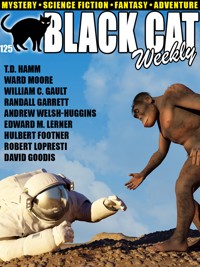
This time, we have a rare mystery from Hulbert Footner (whose Madame Storey mysteries I greatly enjoy). His novel Queen of Clubs in this issue is a jazz-age mystery that—well, I don’t want to spoil the surprises. Read it and see for yourself!
Also on the mystery front, we have original tales by Andrew Welsh-Huggins and Robert Lopresti (thanks to our Acquiring Editors, Michael Bracken and Barb Goffman), a classic crime story by David Goodis, and, of course, a solve-it-yourself puzzler from Hal Charles.
On the science fiction & fantasy side, we have a recent tale by Edward M. Lerner, classic shorts from William C. Gault, Randall Garrett, and T.D. Hamm, and a rare short novel from Ward Moore—most famous for his classics Greener Than You Think and Bring the Jubilee. Moore’s Transient originally appeared in Amazing Stories magazine in 1960 and languished undiscovered for decades before a small press reprinted it in an anthology a decade ago. I’m sure you’ll enjoy it. (Keep an eye out for unicorns.)
Here’s the complete lineup—
Mysteries / Suspense / Adventure:
“The Cumberland Gap,” by Andrew Welsh-Huggins [Michael Bracken Presents short story]
“The Porch Pirate and the Pillow,” by Hal Charles [Solve-It-Yourself Mystery]
“Late Bus,” by Robert Lopresti [Barb Goffman Presents short story]
“The Blue Sweetheart,” by David Goodis [short story]
Queen of Clubs, by Hulbert Footner [novel]
Science Fiction & Fantasy:
“I’ve Got the World on a String” by Edward M. Lerner [short story]
“Burden the Hand,” by Randall Garrett [short story]
“Title Fight,” by William C. Gault [short story]
“Floor of Heaven,” by T.D. Hamm [short story]
Transient, by Ward Moore [short novel]
Das E-Book können Sie in Legimi-Apps oder einer beliebigen App lesen, die das folgende Format unterstützen:
Seitenzahl: 716
Veröffentlichungsjahr: 2024
Ähnliche



















Table of Contents
COPYRIGHT INFORMATION
THE CAT’S MEOW
TEAM BLACK CAT
THE CUMBERLAND GAP, by Andrew Welsh-Huggins
THE PORCH PIRATE AND THE PILLOW, by Hal Charles
LATE BUS, by Robert Lopresti
THE BLUE SWEETHEART, by David Goodis
THE QUEEN OF CLUBS, by Hulbert Footner
CHAPTER 1
CHAPTER 2
CHAPTER 3
CHAPTER 4
CHAPTER 5
CHAPTER 6
CHAPTER 7
CHAPTER 8
CHAPTER 9
CHAPTER 10
CHAPTER 11
CHAPTER 12
CHAPTER 13
CHAPTER 14
CHAPTER 15
CHAPTER 16
CHAPTER 17
CHAPTER 18
CHAPTER 19
CHAPTER 20
CHAPTER 21
CHAPTER 22
CHAPTER 23
CHAPTER 24
CHAPTER 25
CHAPTER 26
CHAPTER 27
CHAPTER 28
I’VE GOT THE WORLD ON A STRING, by Edward M. Lerner
BURDEN THE HAND, by Randall Garrett
TITLE FIGHT, by William C. Gault
FLOOR OF HEAVEN, by T. D. Hamm
TRANSIENT, by WARD MOORE
CHAPTER 1
CHAPTER 2
CHAPTER 3
CHAPTER 4
CHAPTER 5
CHAPTER 6
CHAPTER 7
CHAPTER 8
COPYRIGHT INFORMATION
Copyright © 2023 by Wildside Press LLC.
Published by Wildside Press, LLC.
wildsidepress.com | bcmystery.com
*
“The Cumberland Gap” is copyright © 2023 by Andrew Welsh-Huggins and appears here for the first time.
“The Porch Pirate and the Pillow” is copyright © 2023 by Hal Blythe and Charlie Sweet. Reprinted by permission of the authors.
“Late Bus” is copyright © 2024 by Robert Lopresti and appears here for the first time.
“The Blue Sweetheart,” by David Goodis, originally appeared in Manhunt, April, 1953.
Queen of Clubs, by Hulbert Footner, was originally published in 1928.
“I’ve Got the World on a String” is copyright © 2019 by Edward M. Lerner. Originally published in Galaxy’s Edge, January 2019. Reprinted by permission of the author.
“Burden the Hand,” by Randall Garrett, was originally published in Infinity, November 1958.
“Title Fight,” by William C. Gault, was originally published in Fantastic Universe, December 1956.
“Floor of Heaven,” by T. D. Hamm, was originally published in Amazing Stories, January 1961.
Transient, by Ward Moore, was originally published in Amazing Stories, February 1960.
THE CAT’S MEOW
Welcome to Black Cat Weekly.
We are still exploring all the new books and stories available for reprint with the coming of the new year (and an expanded public domain in the United States). Last issue, we had the third Charlie Chan novel from Earl Derr Biggers. This time, we have a rare mystery from Hulbert Footner (whose Madame Storey mysteries I greatly enjoy). His novel Queen of Clubs in this issue is a jazz-age mystery that—well, I don’t want to spoil the surprises. Read it and see for yourself!
Also on the mystery front, we have original tales by Andrew Welsh-Huggins and Robert Lopresti (thanks to our Acquiring Editors, Michael Bracken and Barb Goffman), a classic crime story by David Goodis, and, of course, a solve-it-yourself puzzler from Hal Charles.
On the science fiction & fantasy side, we have a recent tale by Edward M. Lerner, classic shorts from William C. Gault, Randall Garrett, and T.D. Hamm, and a rare short novel from Ward Moore—most famous for his classics Greener Than You Think and Bring the Jubilee. Moore’s Transient originally appeared in Amazing Stories magazine in 1960 and languished undiscovered for decades before a small press reprinted it in an anthology a decade ago. I’m sure you’ll enjoy it. (Keep an eye out for unicorns.)
Here’s the complete lineup—
Mysteries / Suspense / Adventure:
“The Cumberland Gap,” by Andrew Welsh-Huggins [Michael Bracken Presents short story]
“The Porch Pirate and the Pillow,” by Hal Charles [Solve-It-Yourself Mystery]
“Late Bus,” by Robert Lopresti [Barb Goffman Presents short story]
“The Blue Sweetheart,” by David Goodis [short story]
Queen of Clubs, by Hulbert Footner [novel]
Science Fiction & Fantasy:
“I’ve Got the World on a String” by Edward M. Lerner [short story]
“Burden the Hand,” by Randall Garrett [short story]
“Title Fight,” by William C. Gault [short story]
“Floor of Heaven,” by T.D. Hamm [short story]
Transient, by Ward Moore [short novel]
Until next time, happy reading!
—John Betancourt
Editor, Black Cat Weekly
TEAM BLACK CAT
EDITOR
John Betancourt
ASSOCIATE EDITORS
Barb Goffman
Michael Bracken
Paul Di Filippo
Darrell Schweitzer
Cynthia M. Ward
PRODUCTION
Sam Hogan
Enid North
Karl Wurf
THE CUMBERLAND GAP,by Andrew Welsh-Huggins
He called me on a Tuesday, looking for help with a missing girlfriend, and two days later he was waiting for me in the breakfast room at a Super 8 on East Main just past the Outer belt. Not the most elegant of locations, but few of my clients are what you’d call high-rollers.
“I really appreciate this, Mr. Hayes,” he said, gesturing for me to sit after I walked in and introduced myself. “It’s all so upsetting. I just wasn’t sure what to do. Who to call.”
“Call me Andy.” I handed him my card. “Your trip was okay?”
“It’s an easy drive. Under five hours.”
“Good to hear. Now how can I help?”
He nodded, composed himself, and explained. His name was Dale Eckman. He was an accountant from Cumberland, Maryland, where he handled finances for the local convention bureau. It was a beautiful area, very historic, he told me. I should really consider a trip sometime. Bring the whole family if I wanted. He could help with the arrangements, no problem.
“Thanks,” I said, not bothering to remind him he’d made the same offer on our call two days before.
He was single, he went on, never married. A girlfriend once, years ago after college, but it didn’t pan out because she wanted to move to Baltimore and he wasn’t interested in big-city living. Now his parents were older and needed his help and it seemed like he never had time to meet people.
“That’s what was so great about Mandy,” he said.
“Great?”
“We met online.”
“A dating site?”
He shook his head. “She reached out to me on Facebook Messenger. Said she was from Cumberland originally and was trying to reconnect with people. She thought we might have known each other in high school.”
“Did you?”
“Turns out she went to school in the country, just over the city line. But that was okay. We had a lot in common. We started talking on the phone. It was nice.”
Not five minutes into our meeting and already I had a bad feeling about this.
“The thing is, about six weeks ago she lost her job. She wouldn’t tell me flat-out for a few days, but between her emails and a couple calls I could sense she was upset. I kept asking if anything was wrong and she finally admitted what happened.”
“Which was?”
He grew noticeably angry. “She quit her job after her boss, this jerk named Joey, put the moves on her. She didn’t want to say anything because she was so embarrassed. But she had a lot of bills and things were tight and she wasn’t sure what she was going to do.”
“What kind of job?”
“She worked for a water purification plant here, in Columbus. She did testing and stuff.”
“Go on.”
“I told her I was happy to help. She wouldn’t think of it at first. But then one night she started crying and said she didn’t even have money to buy cat food and Kiki kept crying and crying—”
“Kiki?”
“Sorry, her cat. I asked her how much she needed. She said maybe a hundred dollars. I told her no problem and PayPal-ed it right away.”
Something clicked in my head. Mandy. Joey. Kiki. Water purification. A realization that made an already bad situation worse.
“And?”
“And she was really grateful. She sent me these cute pictures of her with Kiki and it seemed like everything was going to be fine. But then Mandy got sick, and there were all these medical bills—”
“How much?”
“How much what?”
“How much did you give her? In total?”
“I’m not really sure that’s any of your business.”
“Pretend it is. It might be connected to her being missing.”
After a moment’s hesitation, he said. “Maybe two thousand, give or take.”
I tried not to let my dismay show. “All right. You gave Mandy two-thousand dollars. Then what happened?”
“That’s just it. Nothing. She disappeared. No emails or texts. Won’t answer her phone. Her Facebook page is gone.”
“And you think—”
“Something’s happened to her. Which is why I called you.”
I sat back and considered the best approach to take. Some days, half a private investigator’s job—no, make that two-thirds—is figuring out the gentlest way to dole out disappointment. Problem was, Dale Eckman looked like a man not unfamiliar with being let down. I pegged him early forties, past one spare tire and in danger of inflating a second, thinning, sandy hair and a fleshy face with a neat goatee hiding a weak chin. Big brown eyes filled with concern.
“Mr. Eckman—”
“Dale, please.”
“Dale, then. Are you familiar with a television program called Waterworks?”
“I’ve heard of it. Never watched it.”
“What about catfishing?”
“As a kid, I guess, once or twice,” he said, frowning. “I wasn’t really the outdoors type. What does that have to do with anything?”
“Not that kind of catfishing. It’s a”—I paused, struggling for the right word—“a technique used by individuals to masquerade online.”
“Masquerade?”
“To disguise themselves as someone else for the purpose of misleading people.”
“I’m not sure I follow.”
“It’s a scam, Dale. A deception used as a trick, sometimes for the thrill of it, but sometimes for monetary gain. Catfishers gain people’s trust, establish a relationship, then prey on their sympathies with tales of woe. Say of losing their job and not having enough money for cat food.” I held his gaze as respectfully as possible. To add insult to injury, I explained after a moment that whomever he was talking to, they’d simply appropriated names—Mandy, Joey, Kiki—from a popular television comedy set in a Midwestern municipal water facility.
“That can’t be. She showed me pictures. She’s real. We were…”
“You were what?”
“Close, Mr. Hayes. We were close.” But I could see in his eyes that the truth of his situation was sinking in.
“I’m sorry, Dale. You’re not the first person this has happened to. These people are sophisticated. They know what they’re doing. I’m sorry to have to break it to you, and I’m sorry you drove all this way. I know that she, or whoever it is, told you she’s from Columbus. But they could be anywhere in the country. The world, for that matter.”
“But the pictures. There’re landmarks. Recognizable places. I’m not an idiot, you know.”
“I would never accuse you of—”
“See for yourself.”
He thrust his phone at me. I stared at a photo of a woman, red-haired and smiling, wearing a scarf and sunglasses, standing on a bridge. A selfie. Age indeterminate because of the glasses and headwear. In the background, across the Scioto River, loomed COSI, the city’s science museum.
“Yes, but—”
“Or this one.”
The same woman, same sunglasses but now with a Columbus Clippers ballcap, standing in front of the entrance to the zoo. He swiped his phone and showed me more. Mugging in front of the Field of Corn in Dublin, a public art display of giant concrete ears of corn; beneath the statue of Gambrinus, King of Beer, in the Brewery District; grinning in the topiary garden next to the downtown library. Always wearing sunglasses, always with a hat on. He moved on to a series of Mandy’s cat, a sleepy-looking Siamese.
“And then there’s this.” He swiped to a picture of Mandy outside the entrance to Ohio Stadium. “You must recognize this place? You played there, on the football team, right? At least according to the Internet.”
“A couple reincarnations ago, sure.”
“So, she was definitely here.” He sat back, daring me to contradict him.
“I agree those pictures were taken in Columbus. But Dale.”
“But what?”
“Take a closer look. Do you see how she’s always wearing sunglasses and some kind of hat? And I’m pretty sure that’s a wig. It’s hard to get a read on what she looks like or how old she really is.”
“It’s not true,” he said, but his voice softened, and his posture shifted as he seemed to physically deflate. His eyes were now dull and flat as a cast-off Amazon box.
“So she’s not missing. Not in danger?”
“No.”
“And the two of us weren’…”
“Unfortunately not.”
“And she probably isn’t even Mandy?”
I didn’t say anything, letting silence fill the space between us.
“What can I do?” he said at last, on the verge of tears.
Watch more television, I thought. But what I said was, “It’s a little tricky. You could contact the police, but—”
“The police? Could they help me?”
“I’m not sure. Catfishing itself isn’t illegal. There are always fraud charges but that’s a bit of a gray area in cases like this. Plus, there’s the difficulty in finding the person to begin with.”
“What about you?”
“Me?”
“Could you find her? Find Mandy or whoever she is? Find her and get my money back?”
I hedged. “These are experts. With highly evolved computer skills. Probably used to covering their tracks.”
“I can pay. I have money,” he said bitterly. “As you probably figured out by now.”
“I’m just not sure.”
“What?”
“Nothing.”
“No—the look on your face just now. Like you do think you can help.”
There’s a reason I don’t play poker, as Dale Eckman had just discovered. And he was right, sort of. Though I can Google with the best of them, chasing down fabricated emails and tracing fictitious IP addresses was beyond my rudimentary skills. However, I knew someone who could. I didn’t like the idea of Dale losing any more money because of “Mandy” by paying my standard fee. But I also have a living to make, plus there was something that bugged me about a scam like this being pulled front and center in my town.
“There is someone we can talk to. It’s probably best if we did it in person. As long as you’re okay with babies. And dogs.”
“I’m okay with anything at this point,” he said, misery painting his face. “As long as I can get my money back.”
* * * *
Half an hour later we were sitting in Bonnie Deckard’s Linden living room. She was changing her son’s diaper while her boyfriend, Troy, dressed their daughter. Observing the operation from the couch was a mastiff the approximate size and tonnage of a Carnival Cruise liner. Her name was Mimi. I’d been told repeatedly she wouldn’t hurt a fly but I wasn’t so sure about private eyes, so I kept my distance. When Bonnie wasn’t raising twins with Troy, she ran a freelance web design business. When she wasn’t doing that, she skated as a blocker for the Arch City Roller Girls. When she wasn’t doing any of those things—which didn’t leave a lot of time—she took on an occasional job for me.
Babies changed and dressed, she kissed them and Troy goodbye as they headed to the twins’ daycare. Then she led us down into her basement home office, had Dale recite his various passwords, swung her French-braided auburn hair over her shoulder, and went to work.
Mimi joined us downstairs a minute later, occupying the basement couch. I was working up my courage to suggest she might find the carpeted floor more comfortable when Bonnie said, “Got it.”
“That was fast.”
She leaned back in her chair, stretching her muscled, tattoo-lined arms. “Normally, I’d accept the compliment. But this one was easy. They’re using public Wi-Fi to keep the IP address hidden, except they didn’t bother using a VPN, which is basically like putting valuables in a safe and then taping the combination to the door.”
“Can you tell who it is?”
“Not who. That would take a bit more work. But where is easy. They’re at a Starbucks at Easton.”
“Are they there now?”
She shook her head. “From what I can see, most of the activity runs from three-thirty in the afternoon to five or so. If I had to guess, given that time frame, I’d say they’re high school kids.”
My heart sank as I glanced at Dale. He looked like a man who’d approached a merry cluster of people at a party only to discover it was him they were laughing about.
“How much do I owe you?” Dale said as we headed back upstairs.
“That’s between Bonnie and me,” I said. “You and I can work it out later.”
“That one’s on the house,” Bonnie said, bringing up the rear with Mimi.
“Thank you,” Dale said. “But why?”
“Waterworks is one of my favorite shows. I don’t like people messing with it.”
* * * *
Dale wanted to accompany me to the afternoon detail, but I told him that wasn’t a good idea since we weren’t entirely sure who we were dealing with. What I didn’t say was that nothing wrecks surveillance faster than an amateur seated beside you, rubber-necking every person who walks in. It’s like trying to enjoy a baseball game with a guy more interested in tracking the beer vendor. He reluctantly agreed to wait for news back at the motel.
Bonnie narrowed the Easton Starbucks in question to a street in the middle of the sprawling mall’s faux town center, positioned between Build-A-Bear and Victoria’s Secret. By three-fifteen I was seated at a table in the back with a view of the entire store, hot chocolate beside me, that month’s issue of 614 Magazine to keep me occupied, and a book hidden on my lap. I glanced again at the photos of “Mandy” that Dale had texted me and settled in to wait. And wait.
It soon became clear that Bonnie’s quick work wasn’t going to be replicated here. Business waxed and waned over the next hour as customers streamed in for a daily dose of overpriced caffeine. Moms with pre-school age kids. Women closer to my age with the freedom for mid-afternoon shopping trips, boutique paper bags in hand. Generation Z-ers of all stripes drifting in on their work breaks. To a person, everyone on his or her phone. This is the way the world ends, not with a bang but a touchscreen. I was despairing my task, and feeling worse and worse for my client, when just past four-thirty the door opened and in walked Mandy.
At least I was pretty sure it was her. It took a minute of observing my subject without sunglasses, the red wig, and the assortment of headwear, but in the end, there was no question. The smile she flashed in all those photos she sent Dale—a grin as genuine as a three-dollar bill—was the same as the one she gave the guy at the counter taking her order. Otherwise, in person she was an ordinary teenager: petite, with short blond hair, a touch of acne, a pink blouse and designer jeans filled with designer holes. With her was a skinny high school boy in braces with a wing of dark hair he kept brushing out of his eyes. I waited until they retrieved their purchases, drinks which involved a lot of foam, espresso shots, and flavored drizzle, and seated themselves two tables over. Soon the girl’s laptop was up and running and both were leaning over the screen, stifling laughs as her fingers flew across the keyboard.
“Hi there,” I said, pulling up a chair. “Watched any good TV shows lately?”
“What?” she said, shooting me a puzzled stare.
“You heard me. Mandy, right?”
That got her attention. Her eyes moved quickly to her companion and back. “Do I know you?”
“Not yet. I like to take my time when I meet people. Which I prefer to do in-person, as opposed to online. Guess I’m just old-fashioned that way.”
“Look, I don’t know what you think—”
“I think you’re going to listen carefully.” I placed both elbows on the table the way my mother always told me not to, dropped a business card on her keyboard, and said, “I represent a gentleman named Dale Eckman. He believes, and I agree, that he’s been sorely used by you. The humiliation is bad enough, but there’s also the little matter of the two-thousand dollars you stole. We need to straighten out both these problems, but we’re going to start with the money.”
Her already pale face drained to the color of the whipping cream atop her drink. Her companion, by contrast, was blushing so deeply I was momentarily concerned he might pass out.
“…”
“What’s your name?”
“We didn’t mean any—”
“Name.”
She glanced around the coffee shop as if hoping for divine intervention. With none forthcoming, her shoulders sagged, and she spilled forth her confession. Abigail, but she went by Abby. Her friend was Nick. Both high school juniors.
“Are we, like, in trouble?” Nick said.
“Galaxy-sized. And you’re going to be in a universe of hurt if we don’t fix this pronto.”
“It was just a joke,” Abby protested. “I figured he’d know those names from the show. I mean, how dumb can you be? Then it just kind o…got out of hand.”
“Out of hand? You told him you were fired. That you couldn’t feed your cat. That you were sick. Lie after lie.”
“I know, I know.”
“Is that cat even real?”
“He’s real,” she said, suddenly defiant. “Like we’d fake a cat.”
“So now you have standards.”
“We had to sedate him,” Nick said, as if in mitigation. “He’s really wild.”
“You sedated your cat to fool Dale?” I said to Abby.
“It wasn’t that big a deal. You just take a little Benadryl and—”
“How’d you pick Dale anyway?” I interrupted. “Just dip your hook in the water, or what?”
Abby stared at her lap, then at her keyboard, then at a woman in a colorful wrap and hijab sitting with her son two tables over.
“How?”
“We trolled Facebook and checked out the people who looked like the biggest doofuses. He won that contest easily, so I messaged him. He didn’t have to answer it,” she added quickly.
“So now it’s Dale’s fault?”
“That’s not what I meant.”
“Sure, it wasn’t. You realize what you did is against the law, right?” I figured the time had come for a fabrication of my own. “That the two of you are facing prison time?”
“That’s not true,” Abby protested as Nick flushed a shade of red so deep it brought to mind heirloom tomatoes.
“Catfishing’s just, like, a prank thing?”
“Serious prison time,” I said, producing the book I brought along—a thick Ohio Revised Code volume—and dropping it on the table heavily enough that dark liquid sloshed from their cups. Several customers within earshot turned and stared. I tapped the book knowingly, hoping they’d miss the 2001 publication date. “Try looking at something besides a screen now and then.”
“So, what are we going to do?” Abby said.
“We’re not going to do anything. You’re going to tell me how many other people you pulled this on.”
The slightest hesitation. “No one, I swear.”
“You better hope that’s true. Because you left bread loaf-sized crumbs along the trail. I found you with one hand tied behind my back. And if I did, that means other people can too.”
“I told you—”
“Secondly, we’re going to get my client’s money back. Assuming you haven’t spent it all?”
Now it was Abby’s turn to blush, which made for a nice change of pace, as Nick choked on a clump of foam.
“We should tell him,” he said.
“Shut up, Nick,” Abby said. “We didn’t spend the money. Not all of it, anyway. I’m sure we can, you know, work something out? Like I said, it was just a joke.”
“Without a punchline. Tell me your address.”
“Why?”
“Because I’m asking nicely. For now.”
“I don’t have to give you that.”
I tapped the ORC volume and raised my eyebrows.
She named a street in nearby New Albany with the enthusiasm of a student forced to read her text messages aloud in class.
“You live in New Albany and you’re fleecing lonely hearts? What, your trust fund bottomed out?”
“We were just kidding around,” she mumbled.
“Said the spider to the fly. Let’s go.”
“Go?”
“To your house. I need to talk to your parents, see what we can work out.”
“Do we have to?”
“I guess not. I don’t have to go to the police either. But I will if you don’t follow me to my van right now.”
“I’ve got my own car parked here?”
“Good for you. I’m sure a bright girl like you can figure out a way to retrieve it later. Unless it’s stolen by then.”
Casa de Abby turned out to be a red brick Georgian pile on a leafy street lined with other red brick Georgian piles. They weren’t the biggest houses I’d seen in the tony village, but they weren’t the smallest either.
“That your parents’ car?” I said, pulling in behind a black Chevy Blazer.
“No,” Abby said, glancing at Nick.
“Another lie?”
“I’m not lying. I don’t know anybody with a car like that. Can we please just get this over with?”
“It would be my pleasure.” I grabbed my blue sports coat from the passenger seat as we headed for the house. Always good to make it look official.
“Mom?” Abby called as we walked inside. I followed her through a spacious great hall, a well-appointed kitchen, a spotless dining room, and into a long TV room at the rear of the house occupied by Abby’s parents, the cat from the pictures, and two unhappy-looking men.
“The hell are you?” the one closest to me said, turning and leveling a gun at my chest.
* * * *
“Abby,” her mother said in a small voice. “These men say you owe them money?”
One look at Abby’s face told me all I needed to know. Of course, she’d catfished others. It’s like pistachios: how can you stop at just one? And these two apparently found Abby as easily as Bonnie Deckard had. Except that they—the gunman, a white guy with a scar on his face that hadn’t come from shaving, and a Black guy holding a baseball bat and with a nose that had been broken and more than once—weren’t wearing the same embarrassed expression as Dale Eckman. They looked like men ready to slam car doors on fingers, and not in a nice way.
The white man spoke again. “I said, the hell are you?”
This day had started out so promisingly. Invigorating run around Schiller Park. Breakfast on my patio over muffins and the Dispatch. A quick trip to the east side to collect a small fee for shattering a grown man’s dream…
“I said—”
I needed a plan, and yesterday.
“Last time.”
“Listen carefully.” I stood up straight and threw my shoulders back. “My name is Archibald Goodwin. Special Agent Archibald Goodwin.” I opened the left flap of my sport coat just long enough to flash the badge I keep pinned there, which I may or may not have won at an Ohio State Fair arcade game for one of my sons one summer. “Having said that, the question is not who I am, but who you are, and why you’re pointing a gun at a federal agent, a crime which is punishable by up to ten years in prison and a fine of $250,000, not including court costs and a one-time $100 special assessment fee.”
Gunman looked at Bat-man, then at Abby’s parents, then back at me.
“Bullshit.”
“Bullshit yourself,” I said, raising myself up to my full six foot two inches and forcing myself to take an aggressive step toward him as sweat poured down the back of my shirt. “I’m here investigating an egregious case of Internet fraud and conspiracy.” I nodded at Abby and Nick. “They’re in serious trouble, as I’ve already explained to them. If you have a beef to pick with them too, I’m all ears. But first you need to put down the gun.”
Gunman licked his lips, considering. Bat-man stood frozen, unsure what to do. From the couch, Abby’s father squeaked, “I—”
“What about the money?” Gunman said.
“What money?”
“Three thousand dollars they stole. From an innocent woman.”
“Who?”
“Our boss’s sister. Nice lady, just a little naive. And he ain’t too happy about it, I can tell you right now.”
“Gun,” I said.
He lowered it slightly but didn’t release it.
I turned to Abby. “Three thousand dollars?”
She nodded dumbly.
“Who’s your boss?” I said to the gunman.
“None of your business.”
“None of my business?” I raised my voice and took another step closer while simultaneously wondering if sweat was visible through a dark sport coat.
“Just a guy we work for, okay?” Bat-man interrupted. “He found out these clowns took his sister for a ride. Made themselves out to be this lonely chump looking for love. Then started taking her money, making up stories about losing his job, medical expenses, plane tickets to see his sick mom.”
“Three K in total, not to mention they broke her heart,” Gunman said.
Gun down by his side now but still held with a firm grip. I glanced again at Abby. She flashed a look that was two parts hand caught in the cookie jar, one part abject terror.
From the couch, Abby’s father muttered, “I kno…”
Swallowing, I said, “It appears we all want the same thing. These youngsters brought to justice and the money they stole returned to its rightful owners.”
“Damn right,” Bat-man said.
“And the sooner you set your weapons aside the faster we can make that happen.”
“You’ll really do right by us?” Gunman asked.
“I swear on the grave of J. Edgar Hoover.”
“I sure I kno…” Abby’s dad babbled. I was starting to worry he was going into shock.
Most people don’t understand how long ten seconds is. Plenty of time for a tornado to strike, a building to implode, a chain reaction car crash to unfold. For lives to flash before eyes and not the abridged versions. For sweat to soak all the way through a shirt under a sport coat. And even, on somebody’s lucky day, for a crisis to resolve itself. Slowly, ever so slowl…on…tw…thre…Gunman moved to his right and placed the gun on a side table while just as slowly Bat-man stood his bat against the end of the couch.
“That’s better,” I said, breathing a sigh of relief. “Now let’s see what it takes to get us across the goal line—”
“That’s it,” Abby’s father said.
Everyone stared at him.
“What’s it?” Gunman said.
“I know you,” he said, rubbing his forehead as he looked up at me. “Goal line. You’re that washed-up football player. Used to play for Ohio State and then the Browns. I thought I recognized you from somewhere. Not Archibald, though. Something else. And not FBI either. You’re, like, private, right? I saw that on the news. Like an investigator—”
“Dad,” Abby said, but it was too late.
Several things happened at once. Gunman dove toward the side table and the gun. Abby’s mother screamed. Bat-man cursed and grabbed the bat. The sudden movement and sounds startled the cat, which simultaneously leaped from the couch onto the floor. Acting on pure reflex I stuck out my right foot, scooped up the cat, and lofted it softly through the air and onto Gunman’s face where it landed with a decidedly un-sedated yowl. The perfect onside kick; not bad for a washed-up football player.
Gunman cried out as claws met flesh while I turned to face Bat-man, who was raising his own weapon high over his head. I rushed him head-on, forcing him backward and off-balance. Robbed of its arc, the bat bounced lightly off my shoulders. I wrestled it free, introduced its thick end to Bat-man’s nose—what’s another break between friends?—pivoted and just in time brought the bat down on Gunman’s hand as, cat disengaged, he reached for the gun. The sound of ash meeting knuckles echoed through the room like a firecracker going off in the street. He crumpled to the carpet with a howl. I took a breath and looked around. Nick, Abby, her parents, and the cat were all staring at me.
“For God’s sake,” I said. “Do something useful with your phones for a change and call nine-one-one.”
* * * *
All ended about as well as can be expected. The police showed up, and then the real FBI. Gunman and Bat-man went up on intimidation and kidnapping charges. Prosecutors filed several counts of fraud against Abby and Nick, but they were ultimately dropped in favor of six months of community service and a compensation agreement with Dale Eckman and the sister of the dynamic duo’s boss. Harshest of all, Abby was grounded for a year. I never did hear whether she got her car back from the mall.
As for Dale, the last I knew he was planning a trip to the Philippines to find himself a bride. I tried to talk him out of it, but he promised to be more careful this time. Said he learned his lesson. I offered a final warning and then wished him the best. What else could I do? Over the years, one other thing I’ve learned in my business is that there’s no telling the steps people will take to close the gap between loneliness and love.
ABOUT THE AUTHOR
Andrew Welsh-Huggins is the Shamus, Derringer, and ITW-award-nominated author of the Andy Hayes Private Eye series and editor of Columbus Noir. Kirkus calls his new crime novel, The End of The Road, “A crackerjack crime yarn chockablock with miscreants and a supersonic pace.” Other recent stories have appeared in Alfred Hitchcock Mystery Magazine, Ellery Queen Mystery Magazine, andMickey Finn 21st Century NoirVols. 1, 3, and 4.
THE PORCH PIRATE AND THE PILLOW,by Hal Charles
Exiting the car she had parked in front of her Granny Moon’s house, Detective Lettie Longet felt a tap on her left shoulder. Turning, she found herself confronting a tiny girl in a ponytail, who handed her a wanted flyer.
“It’s for my mother’s pet Pomeranian, officer,” said the kid. “Been missing a long time. If you find Pom-Pom, we’d be awfully obliged to you. Mom’s in mourning.”
“I’ll be sure to keep my eyes open,” said Lettie with an assuring smile as she folded the poster and pocketed it.
Her sister, Felicia, opened the door. “Thanks for coming. I know this case isn’t important except to members of the family.”
Entering the house of a million memories, Lettie said, “I got your phone message, Gran. What was taken?”
“Only my prize possession,” said Granny Moon. “Remember the pillow with the image of my dog, Mark, on it that your mother crocheted for me? I keep it on the front porch. It was there last night, but gone when I went to fetch the morning paper.”
“Porch pirates?” posed Lettie. “Did you ever install that camera system out there that I’ve been pestering you about?”
“Not really,” said Granny Moon sheepishly. “You know how I feel about letting strangers in my house.”
To help her embarrassed grandmother, Lettie changed the subject. “You live on an out-of-the-way cul-de-sac, so no through traffic. Anybody in these five houses have a reason to take your treasured pillow?”
Granny sat in her favorite rocker and began the familiar soothing motion. “Well, Mr. Leweylan next door always hated my dog. Maybe the pillow was a bad reminder. And old Mrs. Pynchon across the street has what my generation called ‘light fingers.’ If she sees something she likes, she thinks she has a right to take it. And don’t get me started about the Colliers’ grandson. Do they still use the term juvenile delinquent, dear?”
Lettie had clocked out an hour earlier, so she felt investigating the theft of the pillow on her own town wouldn’t ruffle Police Chief Palmore’s feathers.
The paper boy, who was collecting payment, informed her Mr. Leweylan still had a week remaining on his vacation. Having been caught shoplifting one too many times, Mrs. Pynchon was wearing one of the town’s newest ankle bracelets, and a quick call downtown confirmed the woman hadn’t been 100 feet from her house in ten days. Lettie paced it off, and the shoplifter lived over one hundred and fifty feet from Granny Moon’s porch.
She found the Colliers in their backyard grilling hamburgers. They remembered Lettie from the summers when she had lived with her grandmother.
“Our grandson hasn’t been to stay with us since his mother moved down south after the divorce,” said Cal Collier.
“But,” said his wife, Caryn, “we have one of those high tech doorbell cameras, and since we’re the last house in the cul-de-sac, the highly sensitive motion sensor picks up most activity in the area.”
Running the time stamp back to sunset last night, Lettie watched the images. A few cars, some animals, including a red fox, and finally at dawn, a jogger. Lettie slowed the video down. The grainy image suggested the jogger was female and running haltingly. She passed Granny Moon’s, looking over at the house, but on the return headed over to the porch and stuffed something under her warm-up jacket. Granny’s favorite pillow.
Going back to Granny Moon’s, Lettie found her favorite grandmother rocking more furiously in her chair. “One question—what breed of a dog was Mark?”
“A German Spitz. Why dear?”
“Mark the Spitz. How could I forget it?” she said with a laugh. “It’s a long shot, and I don’t have a lot of proof, but I think I know who took your pillow.”
SOLUTION
Lettie knew that the Spitz and the Pomeranian were distant relatives, looking alike. On the flyer the little girl had given her, Lettie found the address of the girl’s family. The mother confessed immediately that because the crocheted image of Mark looked so much like her lost Pomeranian, Pom-Pom, she had compulsively snatched the pillow. Sympathetic to her plight, Granny Moon gave the woman the pillow.
The Barb Goffman Presents series showcasesthe best in modern mystery and crime stories,
personally selected by one of the most acclaimed
short stories authors and editors in the mystery
field, Barb Goffman, forBlack Cat Weekly.
LATE BUS,by Robert Lopresti
The drunk made a speech as he climbed on board the All Nighter bus, explaining at the top of his lungs that he was Patrick X. Sorley, multimillionaire hedge fund manager, and the first thing he was going to do bright and early the next day when he returned to his corner office high above Montgomery Street would be arrange for the firing of the bartender who had taken his car keys and then kicked him out after pouring only one more measly bourbon.
He would have called a taxi, Sorley also announced—or a goddamn limousine, which was his preferred form of transportation—except that he had misplaced his phone somehow during a night of prodigious imbibing. He had a lot of trouble getting out the word “prodigious,” but “imbibing” was even worse.
“You wanna ride,” said the bored bus driver, “it’s two-fifty cash. We don’t take no credit cards, stock certificates, or crown jewels.”
One of the preppy types smoking a few feet away, just outside the BART station, snickered.
Ronson sighed. He was standing behind Sorley, waiting for his chance to climb on the bus. He wished he could stand further away, dissociating himself from the loathsome hedge fund manager, but they were the only passengers getting on.
It was just after midnight, but the weather was still pleasant. Or so it seemed to Ronson, who was a product of the Midwest. Based on the layers of clothes wrapped around the people he had passed, Californians, even those who lived in San Francisco, were used to warmer nights than this.
Sorley, the drunken hedge fund manager, finally pulled three bills out of his wallet and fed them, with difficulty, into the fare machine. He stumbled down the aisle and plopped onto a seat.
Ronson paid his money and walked all the way to the back of the bus. He sat on the bench and closed his eyes. In order to stay focused he tried to picture all of his fellow passengers.
A Black teenager near the front had his head buried in a game on his phone.
Two Asian women, possibly mother and daughter, were talking softly in a language he didn’t recognize.
An elderly man was listing badly to one side.
An attractive young blond woman, buds in her ears, was deep in a thick paperback. Sitting across from her was the over-served fund manager, Sorley.
Ronson frowned as he realized he couldn’t remember in which direction the elderly man was tilting. He opened his eyes and discovered that the old gentleman was slumped against the left window.
And now he saw that the insufferable drunk, Sorley, was acting out again. Although the blond woman’s body language screamed leave me alone, he was attempting to start a conversation.
“Good book?”
Either she couldn’t hear him over her headphones or she chose to pretend that was the case.
Ronson knew hints wouldn’t work. You didn’t get to be a hedge fund manager by being shy.
Sure enough, Sorley leaned across the aisle, practically sticking his leering face between her and the pages. “I said: good book?”
She straightened up, shoulders rigid. “Yes.”
“Thought so. What is it? Romance?”
The drunk thought he was being suave.
“A mystery.” The blond woman’s voice was cold enough to freeze the road. “By Walter Mosley.”
Sorley snorted. “Don’t have time to read fiction.”
Hell of a seduction technique the guy had.
“When you run a hedge fund,” the drunk continued, “You’re busy all the time. ’Cept when I get away for vacation. Like last year, I spent a month in Africa.”
So that was the plan. Brag about his wealth and the blond woman would no doubt throw herself at his feet. Or at least his wallet.
Apparently unimpressed, she turned a page.
“My name’s Patrick. What’s yours?”
Ronson could hear the sigh. “Charlotte.”
Sorley sat up straight, wobbling a bit. “I like that name! Anybody call you Charlie?”
“No.”
“That’s too bad. You mind if I do?”
“I’d rather you didn’t.”
The drunk was scowling now. “Didn’t your mama teach you manners? You oughta look at someone when they’re talking to you.”
The strain was obvious in her voice now. “I’m trying to read.”
“Some stupid novel.” He reached out a hand as if he were about to grab it. Charlotte leaned away, toward the window.
Ronson shook his head. There was only so much rudeness he could tolerate.
He stood and walked up the aisle, almost needing to push Sorley out of the way to pass. His muttered apology earned only a glare from the hedge fund manager.
When he reached the front—the driver was oblivious to everything behind him—Ronson picked up a route schedule and started back.
When he approached the blond woman he did a double take. “Charlotte? Is that you?”
She looked at him blankly, as well she might.
Ronson waved a hand. “It’s Jack. Remember? We met at Frank’s party two weeks ago.”
Her eyes lit up as she got the idea. “Oh! Of course, Jack! How are you?”
Ronson sat down in the seat in front of her, close to the window, giving her plenty of excuse to look away from Sorley. She seemed happy to do so.
“I’m doing great,” said Ronson. “I was just at a bachelor bash for Desmond. You remember Desmond from the party?”
“How could I forget him?” She was grinning now, getting into it. “Was that his fiancée he was with? The one with all the tattoos?”
“Well,” said Ronson, rolling his eyes. “Not exactly. That was just an old girlfriend. A last fling, I suppose, while his bride-to-be was out of town.”
Sorley leaned forward. “Your friend sounds like a jackass.”
Ronson wasn’t sure which of them he was talking to, or about whom. Didn’t matter. He decided to step it up a little.
“Hey, you told me you were planning to buy a new gun, right? Did you ever make your mind up between the thirty-eight and the forty-five?”
Charlotte’s face went so blank that for a moment he was afraid she was going to ruin the gag. Then she smiled. “Oh. I took your advice and went with the smaller one.”
“The thirty-eight.” Ronson nodded sagely. “Better choice for a person your size. And from what Frank told me, you’re a hell of a shot anyway.”
“Well…” She gave a modest shrug. “Years of practice.” And she patted her purse, just as if there were a pistol in its depths.
Sorley had backed as far away as he could without jumping through the window. He seemed less interested in pestering a markswoman.
But by this point they were committed to their parts, so Ronson and Charlotte kept gossiping away about the rowdy adventures of people who didn’t actually exist. Fifteen minutes flew by before she jerked forward. “Oh. This is my stop coming up.”
Ronson saw Sorley shifting in his seat. Damned if Mr. Hedge Fund wasn’t considering getting off the bus, despite the possibility of Charlotte having a pistol in her purse. Amazing how incapable some men were of getting a clue.
“You know what?” Ronson said, rising. “My stop is the next one. I think I could use the walk.”
Sorley slumped back into his seat, muttering to himself.
At the corner, Charlotte got off with Ronson right behind her. As soon as the bus pulled away she turned to him, laughing till tears poured.
“You are a wonderful man. Thank you for getting me away from that jackass!”
Ronson shrugged. “It was a pleasure to play knight-errant. Especially since I didn’t have to actually fight a duel. May I walk you home?”
“Sure. It’s just a block this way.” She started off, then turned to look at him. “How far are you from your actual stop?”
“Not so far. And I really could use the exercise.”
“Well, you were amazing. Have you ever done something like that before?”
“Nope. I’m astonished I thought of it. And you were very quick on the uptake.”
She laughed. “The hard part was remembering all those names we made up. Was it Frank who was cheating on his girlfriend?”
“No, I believe that was Desmond. What a cad! Frank was our host at the party.”
“You have quite an imagination.”
“Thanks. If you don’t mind me asking, all the time we were making stuff up, I was wondering what you were really doing out so late.”
“Oh.” Charlotte shrugged. “I was helping a friend who’s a chef. She’s opening a pop-up restaurant on Friday and has a thousand things to finish.”
“I’m surprised she didn’t spring for taxi fare home. Or an Uber, anyway.”
“I never thought to ask. The bus works fine. Usually.” She smiled. “And what were you doing before you entered my life?”
“I had a dinner with two potential clients.” Ronson sighed. “Unfortunately, there’s not going to be any sales there. It turned out I was really just a beard.”
“A beard? What does that mean?”
“It means I was only there to give them an excuse to flirt with each other and then tell their spouses it was a business dinner.”
“Which you paid for, I’ll bet.”
“My bosses did. Thanks for making it feel even worse.” He shook his head. “I really should thank you, because dealing with your boozy admirer was the highlight of an otherwise miserable day.”
“It sure cheered me up, so thanks to you as well.” She turned to face him. They were standing in front of a three-story house. “Well. My apartment’s in there. I really do need to get some sleep.”
“Of course,” said Ronson.
“But,” she said, reaching into her purse, “if you’d like to call me sometime—”
He shook his head. “I’ll be leaving San Francisco tomorrow. Having failed in my sales mission I have to get home to my wife.”
Ronson watched her rapidly revising the calculus in her head. “Oh. Well, she’s a very lucky woman.”
He laughed again. “I’m afraid she says that more when I leave than when I come back.”
“I doubt that.” Keys in her hand, she stretched up and kissed him on the cheek. “Thanks, Jack. I really appreciate it.”
“My pleasure.”
* * * *
Once Charlotte was safely inside her house, Ronson walked three blocks before calling for a ride, sending it to a location a bit farther ahead. It would take him to his motel room, which was a mile away in the Marina District.
Then he pulled out his other phone, the burner with only one number programmed into it.
“Is it done?” asked a harsh voice.
“There was a complication. He called too much attention to himself.”
A muttered curse. “Booze. But that could have worked to your advantage. When he got in his car—”
“He got on a bus, yelling a lot. In front of witnesses.”
The other man snorted. “And that frightened you off.”
Ronson put some annoyance into his voice. “I was cautious. If you wanted a hothead you could have hired one and dealt with the mess he left behind.”
“All right, all right. I suppose you know best. But remember the deadline.”
Ronson knew it. Sorley was scheduled to speak to a grand jury the day after tomorrow. No wonder he had been drinking.
“I remember.” He ended the call.
Ronson picked up his pace. He would find another opportunity to kill the hedge fund manager, but Sorley would wake to see one more morning.
Considering the hangover the man was likely to have, that might not be a kindness.
ABOUT THE AUTHOR
Robert Lopresti is a retired librarian and the author of more than one hundred stories. He has won the Derringer Award three times, as well as the Black Orchid Novella Award, and been nominated for the Anthony. He blogs at SleuthSayers and Little Big Crime. roblopresti.com
THE BLUE SWEETHEART,by David Goodis
Thick sticky heat came gushing from the Indian Ocean, closed in on Ceylon, and it seemed to Clayton that he was the sole target. He sat at the bar of a joint called Kroner’s on the Colombo waterfront, and tried vainly to cool himself with gin and ice. It was Saturday night and the place was mobbed, and most of them needed baths. Clayton told himself if he didn’t get out soon, he’d suffocate. But he knew he couldn’t walk out. If he walked out, he’d be killed.
It was a weird paradox. A man who feared violent death would never come near Kroner’s, let alone sit at the bar with his back to the tables. The place was a hangout for agents who dealt in violence, a magnet for thugs and muggers and professional murderers. They’d tackle any job for money or its equivalent in opium, and because they had nothing to lose they were afraid of nothing. Except one element. The element was Kroner.
And Kroner was Clayton’s friend, the only friend he had. That was why he felt safe here. Two days ago he’d managed to sneak in from the interior of Ceylon, had told Kroner about the blue treasure, the huge sapphire he’d found in the earth. Kroner had smiled and said he ah ready knew about it. This kind of news traveled fast in Colombo.
Kroner hadn’t asked to see the sapphire. He wasn’t interested in sapphires. He placed a premium on friendship, he always said, and his prime concern was the welfare of his friends. Built short and wide and completely bald, the fifty-year-old Dutchman was a quiet-spoken man whose sentimental nature was a soft veneer. Under it, there were rock-hard muscles and the ferocity of a water-buffalo.
He’d given Clayton a room upstairs, and promised to make arrangements for passage on the next available boat out of Colombo. Until that was accomplished, he emphasized, Clayton must stay here and not worry and not do anything foolish.
Clayton wondered if he could handle the latter item. In the course of his life he’d made countless impulsive moves, some of them absurdly foolish. Now, at twenty-nine, his appetite for danger was tempered with a grim hunger to stay alive.
He was a medium-sized man, built like a fast welterweight, the build nicely balanced for power and agility. A long time back he’d boxed professionally, and his face showed it. But despite the marks, it was a face that women liked to look at. They didn’t seem to mind the broken nose and the scar tissue above the eyes. And Alma used to put her lips against the scars, and when she did it, she purred. He was remembering the sound of it, the way she purred. His mouth hardened with bitter memory.
He leaned across the bar and told Kroner to sell him another drink. As Kroner poured the gin, a hand came down on Clayton’s shoulder. It came down like a feather, settling gently. Clayton turned slowly on the bar stool and saw the shiny smiling face of the Englishman.
The Englishman’s name was Dodsley and he was a greasy whiskered derelict of some forty-odd years. He was a crumpled slob who took opium but managed to control it enough so that he was coherent at intervals. Now his face showed his thoughts were in order and Clayton knew what was coming. Dodsley’s profession was displayed in his glowing eyes. He was an agent for anyone who wished to obtain gems, whether it meant purchase, swindle or downright theft.
The Englishman went on smiling. It seemed he was carefully choosing his first words. He waited another moment, then said, “They say it’s a very big stone. They tell me it’s almost two hundred carats.”
Clayton didn’t say anything.
“May I see it?”
“No,” Clayton said.
“I can’t make an offer unless I see it.”
“It isn’t for sale,” Clayton said. He turned to face the bar and focus on the gin.
He heard the Englishman breathing behind him, and then the voice saying, “You found the stone near Anuradhapura, at the Colonial mines. My client is part-owner of the mines. I think you know who my client is, and I’m sure you understand his business methods—”
“That’s enough,” Clayton cut in. Again he was facing the Englishman. “The stone is my property. I didn’t find it in the mine area. I picked it up in the hills at least three miles away from their land holdings.”
Dodsley shrugged. “There were witnesses.”
“Of course there were witnesses. They flocked around like hungry hyenas. But they went away when I showed them the gun. It’s a neat little gun. I always have it with me and I always keep it loaded.”
“The gun is not important,” Dodsley said. “This is a legal matter. They said you were working at the mines—”
Clayton was grinning and shaking his head. “I quit the mines two weeks before I found the stone. Got checking-out papers to prove it.” The grin faded as he went on, “Just tell your client about the gun. Tell him I’m always ready to use it.”
The Englishman looked up at. the ceiling and sighed. It was a mixture of sad prophecy and ruthless pronouncement. It caused Clayton to stiffen, and he was thinking of Dodsley’s client.
He was thinking of a man named Rudy Hagen. It was Hagen who’d booted him out of Colombo more than a year ago. And it was Hagen who’d taken Alma from him. The memory of it seared his brain.
Now it came back, cutting hard and deep. He was in Hagen’s private office again in the warehouse on the waterfront. He was broken and bleeding at Hagen’s feet. And Alma was in Hagen’s arms, looking down at him as though he were mud. As they dragged him to the door to throw him out, he heard the laughter. He didn’t feel the rough hands of Hagen’s men. He felt only the ripping pain of hearing the laughter. It was like acid, and it came burning into him from Alma’s lips.
He could hear it again in his brain. He quivered with rage. He was telling himself to leap off the stool and run out of here and race along the docks to Hagen’s place, and let it happen any way it was going to happen. Just then he heard the soft whistle.
He moved his head and saw the warning gesture. It was Kroner’s finger going from side to side. And Kroner’s eyes were saying, “Don’t do it, be sensible.”
Clayton took a deep breath. He turned to Dodsley. His voice was calm and level. “Tell Hagen to leave me alone and I’ll leave him alone. I’m willing to forget what he did to me. All he did was take some little stones and a woman. As far as I’m concerned, everything he took was junk.”
He shoved Dodsley and the Englishman bumped into a table where a bearded Hindu gave him another shove. It became a succession of shoves that sent Dodsley all the way to the door. Kroner was there at the door, waiting for him, smacking the back of his head to make the exit emphatic. Clayton tossed off the remainder of the gin and went up to his room.
The knocking was a parade of glimmering blue spheres bouncing in blackness. He opened his eyes and the spheres were gone but the blackness stayed there. Then he heard the knuckles rapping against the door.
The gun was under the mattress and he reached for it, found it, released the safety catch and quickly hauled himself out of bed.
Outside the room a voice said, “It’s me, Kroner.”
He switched on the light and opened the door. Kroner saw the gun in his hand and nodded approvingly.
Clayton yawned. “What time is it?”
“Past three. She’s downstairs.”
He stared at the Dutchman. He said, “Send her up.” He said it automatically, without thinking.
Kroner sighed. He didn’t say anything. He waited there in the doorway. His eyes told Clayton it would be a serious mistake to let her enter this room.
Clayton’s mouth hardened. He could feel the challenge of her presence on the floor below. He spoke louder. “You heard what I said. Send her up.”
“Now?”
“Right now.”
“Don’t you want time to shave? Look at you. You aren’t even dressed.”
“The hell with that. She’ll see me the way I am.”
Kroner sighed again, backed out of the room, and closed the door. Clayton lit a cigarette and stood staring at himself in the wall mirror. His hair was a black storm on his head and he had a two-day growth on his face and all he wore was a pair of shorts. But then, still focusing on the mirror, he wasn’t seeing his unkempt appearance. He was seeing something beyond the mirror. Again his brain made the tortuous journey along the paths of bitter memory.
It was three years ago and he was meeting her for the first time. They had a few drinks and then she told him to let it ride and forget about her. She said it was just a matter of cold cash and he didn’t have it and that put him out of the picture.
But he knew she wasn’t a professional, and he begged her to explain. So then she told him about it, the husband who’d been killed in the Okinawa campaign, a series of hard knocks, one or two crackups and finally the decision to put money ahead of anything else.




