


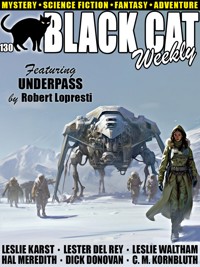
2,73 €
Mehr erfahren.
- Herausgeber: Black Cat Weekly
- Kategorie: Fantasy und Science-Fiction
- Sprache: Englisch
This issue has a pretty much everything you could possibly want from a mystery and science fiction magazine (and some things you probably never thought you wanted!)—detectives, neanderthals, a professional taster, starships, a body in an underpass, dinosaurs, World War II soldiers, aliens with tentacles, musicians, time travel—and so much more!
Here’s the complete lineup—
Mysteries / Suspense / Adventure:
“Underpass,” by Robert Lopresti [Michael Bracken Presents short story]
“Who Took the Tsarina’s Pearls?” by Hal Charles [Solve-It-Yourself Mystery]
“Curse of the Supertaster,” by Leslie Karst [Barb Goffman Presents short story]
“The House on the Cliff,” by Hal Meredith [short story, Sexton Blake series]
Suspicion Aroused, by Dick Donovan [short story collection]
“The 13th Juror,” by Leslie Waltham [short story]
Science Fiction & Fantasy:
“The Luck of Ignatz,” by Lester del Rey [short story]
“The 13th Juror,” by Leslie Waltham [short story]
“Iteration,” by C.M. Kornbluth [short story]
“Rhythm Rides the Rocket,” by Bob Olsen [novelet]
“Blitzkrieg in the Past,” by John York Cabot [novella]
Das E-Book können Sie in Legimi-Apps oder einer beliebigen App lesen, die das folgende Format unterstützen:
Seitenzahl: 794
Veröffentlichungsjahr: 2024
Ähnliche














Table of Contents
COPYRIGHT INFORMATION
THE CAT’S MEOW
TEAM BLACK CAT
UNDERPASS, by Robert Lopresti
WHO TOOK THE TSARINA’S PEARLS?, by Hal Charles
CURSE OF THE SUPERTASTER, by Leslie Karst
THE HOUSE ON THE CLIFF, by Hal Meredith
SUSPICION AROUSED, by Dick Donovan
1. SPOILING THEIR GAME
2. AT THE DAWN OF DAY
3. THE GREAT DIAMOND FRAUDS
4. A WIDOW’S MITE
5. THE FATAL FORTY
6. THE MARFIELD MYSTERY
7. FOILED: A DARK CHAPTER FROM A STRANGE HISTORY
8. THE STORY OF BILLY THE BAGMAN
9. A DESPERATE VENTURE
10. THE TRUE STORY OF PERCY MAPLETON LEFROY
11. THE MELVILLE POISONING CASE
12. THE STRANGE STORY OF AN OLD MAN’S LOVE
13. A POLISHED IMPOSTOR
THE LUCK OF IGNATZ, by Lester del Rey
THE 13TH JUROR, by Leslie Waltham
ITERATION, by C. M. Kornbluth
RHYTHM RIDES THE ROCKET, by Bob Olsen
CHAPTER I
CHAPTER II
CHAPTER III
CHAPTER IV
CHAPTER V
CHAPTER VI
BLITZKRIEG IN THE PAST, by John York Cabot
CHAPTER 1
CHAPTER 2
CHAPTER 3
CHAPTER 4
CHAPTER 5
CHAPTER 6
CHAPTER 7
CHAPTER 8
CHAPTER 9
COPYRIGHT INFORMATION
Copyright © 2023 by Wildside Press LLC.
Published by Wildside Press, LLC.
wildsidepress.com | bcmystery.com
*
“Underpass” is copyright © 2024 by Robert Lopresti and appears here for the first time.
“Who Took the Tsarina’s Pearls?” is copyright © 2022 by Hal Blythe and Charlie Sweet. Reprinted by permission of the authors.
“Curse of the Supertaster” is copyright © 2024 by Leslie Karst and appears here for the first time.
“The House on the Cliff,” by Hal Meredith, was originally published in Answers, Feb. 6, 1909.
Suspicion Aroused, by Dick Donovan, was originally published in 1898.
“The Luck of Ignatz,” by Lester delRey, is copyright © 1939 by Street & Smith, renewed 1967. Originally published in Astounding Science-Fiction, August 1939. Reprinted by permission of the author’s estate.
“The 13th Juror,” by Leslie Waltham, was originally published in Startling Stories, Summer 1955.
“Iteration,” by C. M. Kornbluth, was originally published in Future, Sept-Oct 1950.
“Rhythm Rides the Rocket,” by Bob Olsen, was originally published in Science Fiction, October 1940.
“Blitzkrieg in the Past,” by John York Cabot, was originally published in Amazing Stories, July 1942.
THE CAT’S MEOW
Welcome to Black Cat Weekly.
This issue has a pretty much everything you could possibly want from a mystery and science fiction magazine (and some things you probably never thought you wanted!)—detectives, neanderthals, a professional taster, starships, a body in an underpass, dinosaurs, World War II soldiers, aliens with tentacles, musicians, time travel—and so much more!
As always, thanks to our Acquiring Editors, Barb Goffman and Michael Bracken, for help in finding great stories.
Here’s the complete lineup—
Mysteries / Suspense / Adventure:
“Underpass,” by Robert Lopresti [Michael Bracken Presents short story]
“Who Took the Tsarina’s Pearls?” by Hal Charles [Solve-It-Yourself Mystery]
“Curse of the Supertaster,” by Leslie Karst [Barb Goffman Presents short story]
“The House on the Cliff,” by Hal Meredith [short story, Sexton Blake series]
Suspicion Aroused, by Dick Donovan [short story collection]
“The 13th Juror,” by Leslie Waltham [short story]
Science Fiction & Fantasy:
“The Luck of Ignatz,” by Lester delRey [short story]
“The 13th Juror,” by Leslie Waltham [short story]
“Iteration,” by C.M. Kornbluth [short story]
“Rhythm Rides the Rocket,” by Bob Olsen [novelet]
“Blitzkrieg in the Past,” by John York Cabot [novella]
Until next time, happy reading!
—John Betancourt
Editor, Black Cat Weekly
TEAM BLACK CAT
EDITOR
John Betancourt
ASSOCIATE EDITORS
Barb Goffman
Michael Bracken
Paul Di Filippo
Darrell Schweitzer
Cynthia M. Ward
PRODUCTION
Sam Hogan
Enid North
Karl Wurf
UNDERPASS,by Robert Lopresti
Sean was running late even before he ran into the corpse.
It hadn’t been the alarm’s fault. His phone had rung smack on time, and he popped out of bed like a fireman. But it was just one of those mornings when everything moved in slow motion. He sat down with coffee and half a microwaved burrito, then saw it was already quarter past six. To reach work by seven he would have to take off now.
The burrito returned to the fridge. He grabbed his bike and went out the door, then rushed back for his mask. Can’t go to work with a naked face in this wonderful summer of 2020.
Where the hell had he put it last night? He would have to use the spare he kept in his locker, which made his ears bleed by the end of the shift.
It was Covid’s fault that he was late. Not that Mr. Crocasta would buy that. “No excuses,” he would say. “You do or you don’t do.” Sounding just like Yoda.
Sean was pedaling as fast as he could when he turned onto the Whatcom Creek Trail, the fastest way to get from downtown to Electric Avenue where the Lunchbox was located.
It was a sunny day, bright even through his sunglasses. There were two underpasses, first under the southbound highway, and then under the north. Both were short but pitch black compared to outside, and when he entered the second, he never saw the body until he ran into it.
Sean flew, landed on a mucky spot that kept him from breaking anything, and rolled another two yards. He rose, swearing. Shedding his helmet, he fumbled around for his bicycle, pulled it up by the handlebars and almost tripped over something.
He reached down. God! It was a person.
“Mister, you okay?”
Sean touched the man’s cheek. No mask, was his first thought, quickly followed by: He’s cold. He’s dead.
In a weird way that was a relief. The man surely couldn’t have gone cold in the ten seconds since Sean hit him. He must have been dead for, what? Hours?
Didn’t matter. The smart thing was to haul ass before someone saw him. The fact that he had nothing to do with the man’s death wouldn’t stop the police from making his life hell.
Sean pushed his bike. The front wheel wouldn’t roll. Damn it.
He closed his eyes. They were beginning to adjust to the dark, but he could not be certain that parts of his bike hadn’t fallen off. He might leave traces.
That changed things.
He pulled out his phone. There was no signal in the underpass, so he stepped out into the bright sunlight with one eye shut. That would keep one eye adapted for the darkness, a trick he had learned from a guy in stir for house robbery.
“Nine-one-one. What’s your emergency?”
“Yeah. I just found a dead body.”
“Where are you, sir?”
“Under the overpass. Or in the underpass. I-5 on the Whatcom Creek Trail.”
“That’s off Meador?”
“Right.”
“What’s your name, sir?”
Sean hesitated. But they already had his phone number, didn’t they? “Sean Palient. Like Patient, but with an L.”
“Please wait there. Officers will arrive within ten minutes.”
“Right.”
He killed the phone and started toward the body.
No. Try to think ahead for once.
Back to the sunny world of phone signals. He called the Lunchbox.
“You’re late,” Mr. Crocasta said.
“Yeah. I found a dead body. The cops told me to wait here.”
“You…” For once the little man seemed lost for words. “You don’t have the imagination to make that up, do you?”
How could you answer that? “Also, my bike’s busted. I don’t know when I’ll be there.”
The boss sighed. “Get here when you can. And I want the phone number of the cop you talk to.”
“Yes, sir.”
The man was tougher than his parole officer.
Back in the underpass Sean opened his left eye. Son of a gun, the trick really worked. He could see in the dark.
The body was there, still dead. It was an old dude, maybe fifty. One of his eyes was staring at the ceiling, the other half closed, as if he had been trying the same dark-adopted maneuver. On the north side of the tunnel the creek went by, beyond a fence. He saw ducks in the water, minding their own business. But on the south side there were boulders, piled five feet high, and the dead man was lying against one in an impossible pose, a dried puddle of blood under his head.
He wore a black sports coat with a black shirt under it. Jeans and polished dressed shoes. The corpse must have been one of the best-dressed men in this casual city.
The flap of the coat was open, and Sean could see something sticking out of the pocket. A wallet.
Damn.
Sean’s hands were suddenly sweaty. How many hours of pay was he going to miss for this?
No sign of the cops. No siren, no footsteps coming up the trail.
Sean pulled out the wallet and flipped it open.
The driver’s license said the man was Hector Whiteshaw. He carried fifty-four dollars.
Sean took the two twenties and the ten, leaving the four singles. He dropped the wallet next to the man.
He rolled the bills up tight and wedged them into a bottom corner of his bike panier. Then he went to the other end of the underpass, sat against the wall, and waited.
The cops arrived about five minutes later, two patrolmen. They had their hands on their holsters.
“You Mr. Patient?” asked the gray-haired cop.
“Palient, yeah.” He kept his hands far from his body. “Okay if I stand up?”
“Okay. You don’t have a mask?”
“Sorry. Left home without it.”
“Here.” He gave Sean a cheap paper one.
“Thanks.”
The younger cop, with a big moustache, knelt by Hector Whiteshaw. “He’s dead. Call it in. How’d you find the body, sir?”
“I rode over him in the dark. Screwed up my bicycle.”
The older cop had finished his phone call. “Step out here, sir.”
Sean stepped into the light. The patrolman looked him up and down. “You had a fall. Are you all right? Did you bang your head?”
“No. I had my helmet on.”
“You should replace it,” the younger cop said. He was taking pictures with his phone. “Always replace a helmet after a crash.”
“Thanks. I didn’t know that.”
“The fire department has helmets to give away.”
“Really? That’s cool.”
“Let me see your hands,” said the older cop.
“They’re okay.” Sean flexed them.
“Yeah. No bruises.” He was examining the knuckles.
Sean realized he was checking to see if Sean had been in a fight. Well, screw him. He had lost some skin on a palm in the fall, but nobody could mistake that for the results of a punch, could they?
“What have we got, Lopez?”
Two men in coats and ties, obviously plainclothes cops, were coming down the trail.
The older patrolman explained things quickly. He referred to Sean as a witness, not a suspect, which was a relief.
The new men said they were Detectives Kanon and Lawton. Kanon was short, stocky, and wore a black suit. His mask as also black. “What were you doing on your bike this morning? You a health nut?”
“On my way to work. The Lunchbox over on Electric.”
That caught their attention.
Lawton was tall and had sandy hair. He wore a gray bandanna as a mask. “Crocasta still hiring ex-cons?”
“Yes, sir. I served a year for car theft. I’m on parole.”
“Now you’re stealing bicycles,” Kanon said. “That’s coming down in the world.”
In prison you learned when to shut up.
Lawton was squatting beside the body. “Did you touch anything, Mr. Palient?”
“Yeah. I touched him to see if he was alive.”
“And was his wallet like this?”
“No. It was hanging out of his jacket, so I pulled it out.”
“Yeah?” Kanon said. “What did you take from it?”
Sean met his eyes. “Nothing, sir. My cousin has diabetes. He carries a medical card in case of emergencies. I thought this guy might have something like that.”
The cop raised an eyebrow. “What kind of emergency would matter now? The guy’s skull was bashed in.”
He shrugged. “I’m not a doctor.”
“Touch anything else?”
“No, sir.”
“Could this be natural causes?” Lawton asked, apparently of himself. “Out for a stroll in the dark and tripped?”
“He hit his head damned hard for a stumble,” Kanon said.
“No mask, either.”
“If I was walking in the dark alone, I wouldn’t use one.” He looked back at Sean. “Did you see—”
Then the ambulance people rushed in.
“Get gone,” Kanon said. “We’ve got your home and work addresses and your phone number, right? Just don’t disappear.”
“Wait,” Lawton said. “Here are our business cards. In case you think of something else.”
Sean walked his bike out of the underpass and down the trail. In the bright light he could see that it wasn’t badly damaged. Just a bent fender he could pull away from the tire.
He startled peddling. He would be about an hour and ten minutes late. Mr. Crocasta would dock him the full two hours. That means he was out twenty-seven bucks for his good deed.
Subtract that from the fifty he had taken from the wallet, and he was twenty-three ahead. Not bad.
* * * *
“Where’s your mask?” That was Mr. Crocasta ’s greeting.
Sean had taken off the itchy blue paper one after locking up his bike. “It got messed up at the crime scene. I’ve got a spare in my locker.”
“Crime scene?” The short man’s eyes widened. “What have you done now, Palient?”
Mr. Crocasta hired ex-cons because they were cheap and put up with his crap. But he also liked to associate with bad guys, from a distance.
Sean told him what had happened, playing up the blood and the cops. The old man loved it.
After hearing every detail, he snorted. “Enough. Get your mask and your apron. You’re in the weeds.”
“Okay, boss.”
In the kitchen Mickey and Jaybee looked up. “What did you get up to this time?” said the cook. “The croaker says the cops think you killed somebody?”
“Ran my bike over a corpse.”
“Oh my God!” Jaybee said. Her hands rushed up to her mask. “That’s awful.”
“You’re not supposed to touch your face.”
“Right.”
Was she smiling under the mask? He couldn’t tell. Her eyes were wide and focused on him. That was good.
“Let’s get to work,” Mickey said.
* * * *
Sean was having trouble concentrating, which slowed things down, but fortunately it was a light day. Unfortunately, there had been a lot of those. Mr. Crocasta was complaining about not making the nut. If somebody got laid off or lost hours, it would be Sean.
He was thinking about that when, just after the last lunch customers straggled out, the detectives showed up. Mr. Crocasta led them back to the kitchen with a look in his eyes that said: What have you done now?
The short one, Kanon, didn’t mess around. “What did you do with the money?”
Sean sucked in his breath. They couldn’t prove the fifty came from Whiteshaw’s wallet, could they? Do bills hold fingerprints?
“What money?”
“The five thousand bucks.”
Jaybee dropped a plate, which shattered.
Lawton said, “Let’s go outside.”
Mr. Crocasta tried to follow them. Kanon killed that with a glance.
There were picnic tables outside and Lawton waved at the one farthest from the door.
Sean sat on one side and the cops sat on the other.
“So,” Lawton said, in an easy tone, “tell us about the money, Sean. I don’t blame you for taking it.”
“I don’t know anything about five grand.”
“Then you won’t mind emptying your pockets.” Sean knew that was coming. He also knew that being on parole meant you obeyed orders. He stood up and emptied them, pulling them out as he did so.
He saw two customers, a middle-aged man and woman with matching Seahawks masks, coming up to the front of the Lunchbox, staring at him.
Kanon picked up his wallet, flipped it open. “Six bucks. Living the good life.”
Silence is golden.
“You had a bag on your bike,” Lawton said.
“A panier.”
“Where is it now?”
“In my locker. You’ll want to see it too.”
“It’s like you read minds,” Kanon said.
“May I put the stuff back in my pockets?”
“Knock yourself out.”
Back in the hall next to Mr. Crocasta’s office, Kanon took the panier out and went back to the table while Lawton inspected the locker.
Sean watched as Kanon opened every nook and cranny of the pack. He spotted the rolled-up bills and looked pleased until he saw they were just two twenties and a ten. Then he lost interest and stuffed them back.
“May I ask a question?”
“It’s a free country.”
“What makes you think that guy had so much money on him?”
“He took five thou out of the bank yesterday. All fifties. His wife didn’t know that and doesn’t know why. Neither do his employees. He owned the sporting goods store on Iowa.”
Lawton appeared, shaking his head. “I checked the john and the kitchen. Nothing. You stop anywhere on the way to work, Sean?”
“No, sir. May I ask a question?”
“Another one,” Kanon said, cramming things into the pack. “He’s a regular TV news reporter.”
“Go ahead.”
“Wouldn’t it make more sense if the killer took the money?”
Kanon’s eyes, above the mask, went wide. “Who says he was killed?”
“You said he fell too hard for an accident.”
“Did I?” He looked at his partner. “Kid’s got an impressive memory. He’ll go far in the hospitality industry.”
Lawton sighed. “You may be right, son. But we know you were there, and we don’t know who the killer was, if there was one, so it makes sense to eliminate you as a suspect in the theft of the money. Got it?”
“Yes, sir.”
“You can go back to work now.”
“Thanks.” Sean stood up. “Would you mind telling my boss I cooperated?”
“We ain’t your mama,” Kanon said, pushing the panier across the table.
“I’ll do it,” Lawton said.
Kanon sighed, puffing out his mask. “You’re lucky my partner’s a soft touch.”
* * * *
“What do you think?” Jaybee asked. She was refilling the bins of ketchup packets and other condiments that they packed with take-out orders.
Sean was scrubbing the kitchen floor and trying not to get caught looking at her legs. “Think about what?”
“The guy you saw.”
“Hector Whiteshaw.”
“Wow.” She shivered. “Knowing his name makes it worse, you know? Makes it real.”
“Oh, it was real.” He tried to sound tough.
“I can’t imagine! But what I mean is, do you think he was, you know, murdered?”
“Well, I’ve thought about that a lot.” He looked around as if Mr. Crocasta might be eavesdropping. “Maybe we could talk about it later. Wanna have dinner somewhere?”
He held his breath.
“That could work, if it’s early. I’ve got a study session at nine. Zoom meeting.”
She was taking summer courses, trying to keep up with cancelled college classes.
“How about the Chinese place near Elizabeth Park? We can do take-out.”
“Sounds good. You can pick me up at—” She laughed. “I’m forgetting. You can’t.”
The damned bicycle. He felt himself reddening.
“I mean, we can’t socially distance in a car, can we?”
“Oh, right.”
* * * *
He paid for dinner, thanks to the involuntary donation from Hector Whiteshaw.
There was a gazebo in the park, a funny little open-air house where bands would be playing if King Covid hadn’t overruled everything. They sat in it, leaning against opposite walls and eating Szechuan out of white foam boxes. Sean used a plastic fork, so as not to show off his incompetence with chopsticks.
“I think the guy was murdered. You don’t get your head bashed like that just by tripping.”
Jaybee made a face. It was nice to be able to see her nose and mouth for a change. “I’m glad I wasn’t there. I’d have nightmares.”
“You want to stop talking about it? I don’t want to spoil your appetite.”
“I’m okay. Are the cops going to make trouble for you? You were in jail.”
“Car theft. Not violent crime.” He shrugged. “Lucky for me he died hours before I got there. Why would I hang around with a corpse and then phone it in?”
“Yeah, that would be dumb. It was good of you to call nine-one-one, though.”
He nodded. No reason to mention the damaged bike.
“And what about the money? Do they think you have, what, five grand?”
“They were just checking. I wish I did, though.”
“Yeah, that would be great.” She raised her head from her Buddha’s Delight. “Hey, is there a reward?”
“Wow. I never thought of that.” He considered. “What would we have to do? Find the murderer?”
“Or the money.”
“The reward would be less than the money, right?”
“I think it’s usually ten percent.”
“Why not keep it all?”
She laughed, a sweet sound. “That’s smart. But how would we find it?”
“Find the killer.”
Jaybee put down her container. “How?”
“I don’t know. Let’s think about it.”
She looked at her phone. “Uh oh. I’m gonna be late. You can tell me tomorrow. Thanks for dinner!”
“It was fun. Maybe we can—”
“Gotta run.”
Sean sighed. Well, what was he expecting? This was the year of social distancing.
* * * *
His apartment was above a pizza parlor. The rent was good because most of the potential tenants were students who split when the university went on lockdown.
The pizza joint wasn’t doing so well either. He saw one customer at the counter and a man waiting six feet behind her. Everybody wore masks.
The door leading up to his apartment was on the left. Sean unlocked it and pushed it wide to get his bike through.
Something rammed him from behind and he fell forward on the steps, landing on the bike. The handlebar hit him in the breastbone, which hurt like hell. When he tried to stand somebody crashed on top of him.
A hand grabbed him by the hair and yanked his head backwards. “Stand up! Up, asshole, or I’ll tear out your scalp.”
Sean stuck an elbow into the guy behind him and earned a kidney punch in return. He vomited pork chow mein.
The thug yanked the bike away from him and dropped it down the steps. “Up, jerk. And don’t step in that stuff.”
They stumbled up together. On the landing, Sean pulled out his key and fumbled the door open. He thought about trying to push the guy down the stairs and slamming the door. An arm around his throat changed his mind.
Inside, the thug released him and shoved him forward. Sean fell on the futon, which was the main piece of furniture in the room. “What the hell do you want?”
The thug flipped a light switch and Sean saw him for the first time. He was six-foot-three or four, which gave him half a foot on Sean, and probably thirty pounds as well. He wore a black bandanna, like the villain in a Western movie. A black watch cap covered his hair, and he had sunglasses on. Not much face to see.
“I want my money.”
“What money? I don’t owe you anything.”
The thug snorted. “Oh yes you do, punk. Five big ones.”
“Five—” Sean blinked. “The dead guy’s money?”
“That’s right. You killed him and swiped the cash. It was supposed to be mine.”
“What for?”
“I’m running for mayor.”
There was a bicycle pump on the floor. The thug picked it up and swung it casually, looking for something to hit.
“I didn’t kill the guy and I didn’t see any money. Whoever offed Whiteshaw must have taken it.”
“Yeah?” Apparently frustrated that he saw nothing in the place worth breaking the thug pressed the handle of the pump against Sean’s chin. There was a smell now: something weird, sweet, and fruity. “Why should I believe you?”
“If I killed him the cops would have arrested me, right?”
“They aren’t so smart.” He tossed the pump to the floor. Reaching into his pocket, he pulled out a cigarette lighter.
Was this lunatic going to burn the place down?
No, he lit a cigarette. Then he threw the lighter overhand, smashing the frame of a photo of Bellingham Bay. That would come out of the security deposit. “I’ll be watching you, bike boy. If you start spending money, I’ll be down your throat like a cold beer. You get me?”
“Trust me, that’s not gonna happen.”
Sean listened to the thug descending the stairs. He kicked the lighter against the wall. Then he turned out the lights and peeked out the window. The thug took off his sunglasses and stared up. There was something wrong with his left eye. The lid didn’t open all the way, and there was a scar that sliced his eyebrow in two.
Not the kind of face you would want to meet in a dark stairwell. Or under a highway.
* * * *
Sean left early for work the next morning, knowing he was not going to take the short cut through the underpass.
Jaybee’s day started an hour later, and when she arrived, he was dying to tell her about the nighttime visitor but the place did a crazy breakfast business for a change.
In the calm before lunch, Mr. Crocasta finally told them to take their break and they went to one of the tables outside.
Her eyes widened as he told her about the incident. Maybe he made it sound like he had been a little braver and more resourceful than he had.
“Wow! What do you think Whiteside—”
“Whiteshaw.”
“Whatever. What was he giving him money for?”
“I dunno. Nothing good.” Sean started to scratch his chin, remembered the mask, and took his hand away. “Drugs, maybe?”
Jaybee’s forehead wrinkled. “I can’t imagine him buying so much for personal use. Could he have been a dealer?”
“I doubt it. He owned a sporting goods store. That doesn’t sound like he was pushing heroin.”
“What about steroids? Body builder crap.”
Sean wished he had thought of that. “Could be.”
She jumped in her seat. “Hey! There’s a bigger question. How did the guy last night know you were involved?”
Damn. He really should have thought of that. “He must have heard it from the cops. Who else?”
“That’s scary. So, what are you gonna do?”
“I dunno. I don’t think he’ll be back unless he hears I’m spending Whiteshaw’s money, and that won’t happen.”
“But you have to call the police!”
Sean frowned. “What? Why?”
“To tell them about the mugger, or whatever he was.”
“But we already figured out he musta heard about me from the cops.”
“All the more reason. They need to know he has a spy on the force.”
“A spy. You’re talking crazy.”
“Well, how else could he know?”
Sean’s nose itched like crazy. “Okay. I’ll call next break.”
“I wanna hear it.”
“Sure.”
Mr. Crocasta wouldn’t let them take their lunch together, so it had to wait until Sean’s day was done and Jaybee snagged a coffee break. Again, they met at the tables outside.
Sean pulled out his wallet. “Here’s the thing. Each of the detectives gave me their card. One was a complete clown, one was okay.”
“Good cop, bad cop.”
He snorted. “In this case I think it was jerk, not jerk.”
“Call the non-jerk.”
“That’s the problem.” He tapped the cards. “I don’t remember which was which.”
“So, take your best guess. I have to go in soon.”
“Okay.” He picked one card and called the number.
“Kanon.”
Damn. It was the jerk.
“Uh, hi, Detective. This is Sean Palient. From the underpass?”
“Yeah, kid. What can I do for you?”
“Listen, when I got home last night there was a hood waiting for me. A big creep with a scar on his left eye. Dragged me upstairs and threatened to beat me up if I didn’t give him the money.”
“What? Your lunch money?”
“The five thousand bucks.”
“So, you took it.”
“No! I never saw any money. But this guy thought I did.”
“And why would he think that?”
“That’s what I’m telling you. The news must have leaked from somewhere.”
“Leaked? What do you think this is? The White House?”
Jaybee had been watching the conversation. Her blue eyes rolled with frustration.
“I thought you’d want to know about this guy, that’s all. Like, maybe he’s the killer.”
“If he was the killer he’d have the money, wouldn’t he?”
“I guess so. But what was Whiteshaw buying with the money?”
“Good question, kid. When we find out you’ll read it on Twitter. Meanwhile, stay out of this and watch who you play with.”
“But how am I—” Sean stared at Jaybee. “I don’t believe it. He hung up.”
“You’re right about one thing. He really is a jerk.”
* * * *
They met again at Elizabeth Park that evening. Jaybee brought roast beef sandwiches. “When the lockdown started, I was baking sourdough every week, but it got to be too much trouble. This bread is from the co-op.”
“It’s good.”
“So, what now?”
His instinct was to stay the hell away from the situation. The cops didn’t want them there and One-Eye was nothing but trouble.
On the other side: this was the most time he had spent with Jaybee.
“What are we trying to do?” he asked. “Find a killer? Find the money? I don’t know how to do those things.”
Jaybee took a sip of beer. “Let’s start with the guy in your apartment.”
“What good it will do? He didn’t know who the killer was or where the money went.”
“Yeah. But he must know why Whiteshaw was going to pay him all that money. And that must have something to do with the killing, don’t you think? I mean, it’s too big of a coincidence.”
“I guess.” He frowned. “How do we go looking for him?”
“It sounds like people would know him from the description, but who do we ask? Is there anything else you remember about him? How was he dressed?”
“Dark jacket. Jeans. Boots, I think. Nothing that stands out.”
“And you didn’t see his car. Did you hear anything else, or smell anything?”
“Wait a minute. Wait a minute.” Sean put down the sandwich. “Yes! There was a funny smell. A kind of fruity thing…”
Jaybee nodded. “Like bananas maybe?”
“That’s it! But not real ones. The phony flavor they use in candy. How did you know?”
“That’s the soap they use in some of the homeless shelters in town.”
“Wow. How do you know that?”
“There used to be a homeless guy who came around the Lunchbox at closing time to see if there was leftover food. Mr. Crocasta chased him away when Covid started. He always smelled like that.”
“So, One-eye is homeless and sleeps in a shelter.” Sean nodded. “That makes sense. How do we find him? Go to the shelters?”
“They won’t tell us anything. But I know where to find Tintin.”
“Your homeless pal? Named after a cartoon?”
“He says it was a famous series of graphic novels before Spielberg made the movie. French. Or Belgian, maybe.”
“So, he’s a comic book fan.”
“He says he used to be an artist.” She shrugged. “Before whatever left him on the street.”
“Where will we find him?”
“Maritime Heritage Park.”
“That makes sense. Can we go there now?”
“Sure. Oh.” She frowned. “You don’t have a car.”
He felt himself coloring. “I can bike there pretty fast. It’s downhill.”
The park was downtown, between the old City Hall, now a museum—closed for Covid, of course—and the waterfront. Beside grass and trails there were cement pools where fish were raised, but they were empty now too.
Sean found Jaybee waiting in her car. He locked his bike, and they started up the hill, toward City Hall.
“I don’t wanna sound like a wuss,” he said, “but is this safe? Some of these homeless guys aren’t stable at the best of times, much less taking precautions for the virus.”
“You’re right. We’ll be careful and definitely get out of here before sunset.” Which gave them about an hour. This far north in Washington state it stayed light past nine p.m. in the summer.
They saw a couple of men lying on their backs in the grass. Jaybee didn’t have to get close before she shook her head. Not who she was looking for.
There were cement benches next to the creek that poured down the hill toward the bay. It startled Sean to realize that this was the same creek that flowed through the underpass, miles away.
“That’s him!”
Jaybee nodded at a skinny man with wild brown hair under a porkpie hat. He wore a Seahawks T-shirt and a torn red coat. Unlike most of the homeless types Sean had seen around, he had a mask on, a cheap blue paper one that had seen better days. He was staring down at the creek but jerked around when he heard them approach.
“Tintin? How you doing?”
He was on his feet now, backing toward the fence. “Stay away! I got a knife.”
“It’s Jaybee. From the luncheonette?” She pulled her mask down for a moment so he could see her smile.
Tintin’s shoulders dropped. “Jaybee? What’re you doing here? Who’s he?”
“This is my friend Sean. Look, we were having dinner and there’s a leftover sandwich. You hungry?”
His eyes went wide. “Maybe. Maybe. Whatcha got?”
“Roast beef.”
“Give it here.”
She put it down on the bench and backed off.
He unwrapped it and pulled down his mask.
“We’ve got a question, Tintin. Somebody broke into Sean’s place and threatened him. We’re trying to find the guy.”
“Why you wanna do that? Stay away from trouble. Don’t go lookin’ for more.”
“I think,” Sean said, “this guy’s gonna be trouble until we find out who he is and what he wants. Understand?”
Tintin nodded, his mouth full.
“So, we’re looking for this guy, he’s maybe six foot three. Has a scar around his left eye. He’s—”
“That’s Odin!” Tintin was on his feet. “He sacrificed an eye for wisdom.”
“We’re not talking about mythology,” Jaybee said. “This is a real guy.”
Tintin was walking down the hill, almost running. “Don’t mess with Odin. Don’t!”
He bit into the sandwich again and his next words were lost in a mass of roast beef.
Sean looked at Jaybee. “Any point in going after him?”
“I guess not. What now?”
“His name’s not Odin.”
The speaker was a woman standing near the education center. She had long gray hair and was dressed too warmly for the summer evening, in multiple layers. She was pushing a shopping cart, which seemed to be full of everything she owned. Her mask was a pale blue scarf.
“You know the man we’re talking about?” asked Jaybee.
“Sure do. I can tell you his name and where to find him.”
“That’s great. Who is he?”
The woman shook her head. “What’s in it for me, kiddo?”
Sean took out his wallet. “I can give you twenty bucks.”
“Make it forty.”
He grimaced. This was costing more than he took out of Whiteshaw’s wallet.
“I’ve got twenty,” Jaybee said. “So, tell.”
“It’s not Odin. His name is O.T. Or Odie.” She shrugged. “Never saw it written down. And Tintin’s right. He’s a dangerous M.F. If you’re smart, you’ll stay away from him.”
“Where should we stay away from?” asked Sean. “Where does O.T. hang around?”
“He’s got an RV, blue and white. Usually parks near Squalicum Beach.”
* * * *
The next day was Monday, and the Lunchbox was closed. They met at ten a.m. at the northern end of the bay, where the beach was hidden from the main roads.
“Look,” Jaybee said, “the only way to do this is lock up your bike and get in the car with me.”
“The virus—”
“We’re wearing masks. We’ll keep the windows rolled down. Hell, we work next to each other every day anyway.”
“Okay.”
He found a patch of woods and locked the bike to a tree.
Then he got into her Kia. It was cleaner than any car he ever owned, and it smelled better.
They cruised through the neighborhood and on Illinois Avenue found a bevy of RVs.
“There’re a few places like this around,” Sean said. “In Old Town, and at the end of Cornwall.”
“And here’s another. The woman said blue and white, right?”
They saw a blue Fleetwood and a gray and white Safari. “How many different kinds of RVs do they make?” Jaybee asked.
“Too many. There! Off the side of the road.”
It was a battered Winnebago, mostly dirt-colored now, but definitely blue with white trim.
“If he has an RV, why is he bathing in the homeless shelter?”
“It’s not hooked up to plumbing, is it?”
She made a face. “Gross.”
Jaybee pulled over to the side. “Now what? Ring his doorbell and run?”
Sean reached up to scratch his chin, bumped into his mask and yanked his hand away “We can’t sit here all day. People will notice. Tell you what. I’ll go into the woods and watch to see who comes out. I’ll call you later.”
“You’ll be okay?”
“Sure. I can walk to my bike from here.”
“Okay. Good luck.”
She drove a block and he got out. He passed two more RVs, seeing no signs of life. Not an early-rising crowd.
Sean settled into a spot in the woods, wishing he had worn a darker jacket. Finally, he took off his yellow coat. It was beginning to warm up, anyway.
He thought about Jaybee, wondering if she liked him, and where that could lead in this damned plague year. Then he started thinking about what they were trying to do. Hanging around outside the house of a guy who already attacked him once. Did that make any sense?
He had been known to make bad decisions, God knows. Going for a joyride with a cousin in a sports car he knew damn well Bob couldn’t have come by honestly. That had cost him a year of his life and given him a felony record.
Was he just digging a deeper hole now? And maybe dragging Jaybee in with him?
There were signs of activity up and down the row of vehicles now. Maybe it was time for a change of plan before someone spotted him.
There were some baseball-sized stones near his feet. He picked one up, hefted it, and threw it at the side of the Winnebago. It made a satisfactory bang as it bounced off the wall.
Sean backed up, getting as far away as he could and still see the RV. He had just picked up a second stone when the door was flung open.
Odin—or Odie or O.T—was standing there in a pair of jeans, and nothing else. He glared around but didn’t see anyone. He muttered something and went back in, slamming the door.
Okay. They knew where the guy lived. Now what?
* * * *
“This is creepy,” Jaybee said. They were in the underpass.
“Nah, it’s a nice trail,” Sean said. “You just think it’s weird because you know what happened here.”
“Maybe.” She stopped and listened to the roar of cars on the concrete road overhead. “But that’s Interstate 5 which runs all the way from Canada to Mexico, and here we are walking right under it. You don’t think that’s weird?”
“Well, there has to be a way around it, right? Under or over. Whoa.”
He stopped. They had come to the second underpass, the one beneath the northbound lanes. Someone had propped up a framed picture of Hector Whiteshaw on one of the boulders near where he died.
“Is that him?” asked Jaybee.
“Yeah.” It was a professional photo, showing the man standing in front of his sporting goods store, a big smile on his face. He wore a red barn coat over a tie.
A few people had left notes under the picture. We miss you, Hec. Rest in peace.
“It’s so sad,” Jaybee said. “The only people I know who died were my grandmothers. And they were old.”
“My parents died when I was a teenager,” Sean said. “Car accident. And two guys I know from high school died this year.”
“Covid?”
He nodded.
Someone was approaching from the southern underpass. A young woman. She hesitated when she saw them, then came forward.
She was blond, short, and pretty. She wore a loose T-shirt and jeans, and a black mask. She was carrying a bouquet of roses.
“Hi,” Jaybee said. “Don’t let us stop you.”
After a moment she stepped forward and bent down to place the flowers next to the picture.
“We’re sorry for your loss,” Jaybee said. “Did you know him well?”
She nodded. “He was my boss. I can’t believe he’s gone.”
“It’s a shame,” Sean said.
“Did you know him?”
He wondered if he should explain about finding the body. Probably not. “No, we just heard about it.”
“I can’t believe anyone would want to hurt him. And why was he wandering around in the dark without a mask? He never went anywhere without a mask. Even had them made for all the employees.”
“Sounds like a great guy,” Jaybee said.
“He was.” Now she was crying.
Jaybee held out her arms to the side. “I wish I could hug you, but…”
“I know.” The blonde wiped tears away. She gave a little laugh. “Social distancing.”
“I’m Sean. This is Jaybee.”
“Alicia.” She pointed to a small pile of wilted flowers that looked like they had been gathered from the trailside. “This is the second night somebody did this. Was it you?”
“No,” Sean said. “Maybe his wife?”
The blonde snorted. “Like she cares. Do you know what she did the day after the funeral? Came down to the store to check the books. See how much money she’ll get.”
She shuddered. “God. What do I do now?”
“If you don’t mind my asking,” Jaybee said. “How far along are you?”
Alicia’s hands went to her stomach and for the first time Sean noticed the bulge.
“Three months. Almost four.”
Jaybee’s eyes met Sean’s.
“Yes,” Alicia said, her voice hard. “It’s Hector’s child. You happy now?”
“It’s none of our business,” Jaybee said.
“That doesn’t stop anybody. You should hear what they say at the shop.” She rolled her eyes. “A married man, like that’s some kind of big deal. And he promised me he was going to take care of it. Take care of me.”
“Like getting a divorce?” Sean asked.
Alicia looked at him, wide-eyed. “Of course! What do you think I meant?”
“He didn’t mean anything. Listen, do you have someplace to go—”
“What? Do I look like I’m homeless? I have a home and I’m heading there now. You two can go to hell.”
She stormed off.
Sean and Jaybee looked at each other.
“Wow,” she said.
“That was weird.”
“It sure was.” Jaybee pinched her nose.
“Don’t touch your face.”
“Damn it. What were you thinking when you asked if she was talking about divorce?”
“I don’t know. Not much. Why?”
“Because she got so defensive. You know, there’s another way Whiteshaw could solve her problem. And it might explain the money.”
“Like what?”
“What if he was paying to have his wife killed?”
“Wow.” Sean took another look at the smiling man in the photograph. “That sounds like something in Odin’s skill set. Do we report it to the police?”
“Report what?” Jaybee waved a hand in frustration. “We don’t know anything.”
“Actually, we learned one new thing.”
“What’s that?”
Sean pointed to the little memorial. “She said somebody put those crummy flowers there two nights in a row. If it wasn’t the wife or the girlfriend, who the hell was it?”
* * * *
“Remind me again why this is a good idea,” Jaybee said. They were on the other side of the fence that separated the Whatcom Creek Trail from the creek itself. They sat on a blanket on the bank. This way they could hear people walking by, without being seen in the moonlight. That was the theory anyway. Fortunately, the July night was pleasant.
Sean figured if Odin, or someone equally scary, spotted them they could wade across the creek and get away while the bad guy was climbing over the fence.
Unless he had a gun, of course.
“Maybe it’s a mistake. You wanna leave?”
Jaybee thought. Then she shook her head. “It’s this or nothing. I’ve got no other ideas.”
“So, we wait.”
He liked being there in the darkness with her, even six feet apart.
It was almost midnight when they heard someone approaching from the underpass. Sean lifted his flashlight.
“Wait,” Jaybee whispered.
They heard voices now. A man talking. A woman giggled. The couple strolled by, never looking their way.
“I don’t think they’re delivering flowers,” Jaybee said.
“Not maintaining social distance either.”
Half an hour passed, and Sean was wondering how long he could stay awake.
“Listen.”
Someone was on the trail, walking east toward the underpasses.
Sean stood, hoping his joints didn’t crackle. Jaybee slid smoothly around the end of the fence and he followed.
They slipped quietly up to where someone was putting flowers in front of the memorial. It was a man, Sean, was sure. Tall and thin, and a hat. A pork pie hat.
He turned on his flashlight. “Hey, Tintin. Whatcha doing here?”
The homeless man’s eyes went wide. He turned and started to run.
“It’s okay, Tintin! It’s me, Jaybee!”
He stopped and turned. “Stay away! I got a knife.”
“We know. Sean and I are just wondering why you’re bringing flowers for Mr. Whiteshaw. Did you know him?”
Tintin was breathing so hard his paper mask was sucked in and out.
“Know him?” He laughed, a harsh sound. “No. He thought he knew me.”
“What does that mean?”
“I was here one night. Walking. I like to follow the creek.”
“Sure.”
“And this guy—” He pointed at the framed photo. “Came up to me. Tried to hand me a paper sack.”
“A sack?” Sean said.
“Said I promised to kill his girlfriend, and this was half the payment. He’s crazy. I couldn’t kill anybody!”
“His girlfriend,” Jaybee whispered.
“How did he say you two agreed?”
“By email,” he said. “I don’t have email. That’s how the government controls you.”
“So, you had to kill him.”
“I didn’t want to! He tore off his mask and tried to push that sack at me. I pushed back, that’s all!”
“And he fell against the rocks,” Jaybee said.
“What did you do with the sack?”
“Blood money.” Tintin pointed over his shoulder. “I threw it in the bushes.”
“You poor thing,” Jaybee said.
“I ain’t going to prison!”
“Of course not. But you better get out of here.”
When he was gone, they looked at each other.
“Now what?”
Sean walked toward the bushes. “Point your flashlight in there.”
She did. He pushed his way in, with a flashlight in his left hand.
“You see anything?”
“What are the odds of spotting a brown sack in—Wait.”
There was something down near the ground, not brown but red. He reached forward, scraping his hand on a bunch of thorns, and picked it up.
“It’s a mask. Iowa Street Sports.”
“Wow,” Jaybee said.
“And here’s the sack. Man, it’s decomposing.”
“We’re lucky it didn’t rain.”
Sean stuffed his flashlight into one pocket and the mask into another. He used both hands to pick up the sack. Then he had to fight his way out of the bush.
Jaybee pointed her light at the sack. “Show me.”
They looked at the money. “Does that look like five grand to you?”
“I don’t know. I’ve never seen that much, except in the movies.” She looked up at him. “We need to talk. Let’s go back to my place.”
* * * *
Jaybee shared a house with three other students on Jersey Street, not far from the university. “I can’t bring you in,” she said. “Because of the bug.”
“Sure,” Sean said, trying not to sound disappointed.
The big front porch had old folding chairs, so they were able to sit six feet apart. But that made it hard to keep their voices down.
“We are not turning Tintin in.”
Sean nodded. “He wouldn’t last an hour.”
“And anyway, it wasn’t his fault. He was just scared and pushed the man—”
“You don’t have to convince me. Whiteshaw thought he was meeting Odin and Odin had agreed to kill his girlfriend.”
“Alicia,” Jaybee said. “That poor thing.”
“Don’t feel too sorry for her. She thought he was going to have his wife bumped off.”
“What do we do now?” Jaybee scratched her head. “Do we tell the cops about Odin?”
“We can’t do that without talking about Tintin.”
“Now what? I can’t believe there’s no way forward, not when we’ve found the money. What is it? I can tell you’re smiling, even with the mask on.”
“Ten percent reward.”
* * * *
“I’ll be damned,” Kanon said. “Somebody sent us a goddamned clue.”
Lawton looked across his desk. “A bloody footprint? Deathbed confession?”
“None of the above. Check your email.”
Lawton did. The message, from a fake-sounding account, had been sent to both of them.
To the detectives investigating Hector Whiteshaw’s death.
There’s a guy says he killed him. Whiteshaw promised him five thousand bucks to kill his girlfriend but tried to give him only five hundred.
The guy’s name is Odie or Otie and he lives in a motor home on Illinois Avenue. Please get him off the street before he hurts one of us.
“One of us,” Lawton said. “This was probably sent from one of the homeless types who hang around there.”
“Yeah, and this guy Odie has them scared. Wasn’t that the kid on the Andy Griffith Show?”
“That’s Opie. Nice of whoever it is to send the license plate number. Let’s run it.”
The answer was waiting when they returned from lunch.
“What do you know?” Kanon said. “Otis Wayne Caffrey. And the man’s got a record. Assault. Armed robbery. A real peach. Can we get a warrant to search his RV?”
“Not based on an anonymous note.” Lawton banged a fist on the desk. “Guess what? Turns out we don’t need one.”
* * * *
The next day Otis Caffrey woke bright and early at ten a.m. when someone banged on his door. “Keep your freaking shirt on!” he said, putting on his own.
Damned hangover.
He opened the door and squinted through brilliant sunlight at a familiar face. “Mr. Ricardo? What the hell are you doing here?” He wasn’t due to see his parole officer for a week.
“Surprise inspection, Otis. These officers need to take a look around your place.”
“They got a warrant?”
“Remember the terms of your release? If you refuse, I can cancel your parole.”
“For God’s sake.” He did a quick mental inventory. “Weed is legal, right?”
Ricardo rolled his eyes. “If that’s all we find, I won’t say a thing. You willing to let these officers do their job?”
Otis waved a hand. “Be my guest.”
He watched the tall one going through his shelves. The shorty stopped. “That’s some scar on your eye. You got a parrot to go with it?”
“You’re a riot.”
“Somebody was telling me about an eye like that.” He nodded. “Oh, yeah. Any chance you have a friend in our department, Mr. Caffrey?”
Damn it. Now his ex-girlfriend’s sister was going to get in trouble. “No. I don’t think we run in the same circles.”
“We’ll check that,” said the tall one. “How about you check outside, Kanon?”
“Ten-four.” And he went out.
“What are you guys looking for, anyway?”
“Evidence.”
Otis snorted. “Of what?”
The cop was pulling stuff out of his food cabinet, mostly beer. “Well. Let’s put it this way. When was the last time you talked to Hector Whiteshaw?”
Otis straightened up, trying to keep his face still. What the hell could the cops know about that? All communication with that guy had been through a dummy email account and a burner phone and, thank God, he’d thrown it in the bay as soon as the corpse was identified.
“Don’t know the man. What does he say about me?”
“Nothing, because you killed him.”
Otis grinned under his mask. “You gotta be kidding. I never met him.” Which was true enough. The jerk had gotten himself killed on the night he was supposed—
“Got it!” yelled the cop outside.
The tall one pointed. “Let’s go see what Detective Kanon found.”
“Hell, yeah.”
The short cop was standing behind the RV. He had disconnected the spare tire. “Lookie here.” He waved a brown bag.
“I’ve never seen that before in my life.”
“No?” Kanon held it open between his gloved hands. “You claim somebody just left you all this money as a gift?”
Otis blinked. “Money?”
“I’m guessing five hundred. Is that what it looks like to you, Detective Lawton?”
“More or less.”
“Bull!” Otis jerked forward. “You planted it!”
Lawton had a gun in his hand faster than Otie could imagine. “Hands against the wall, Caffrey. You are under arrest.”
Otis shook his head. “I swear I never even saw that guy who got killed.”
“That’s funny,” Kanon said. “Look what else is in the sack.”
Now handcuffed, Otis turned to look.
Kanon was holding up a red mask. “Iowa Street Sports. Whiteshaw’s store. Hell of a coincidence, don’t you think?”
“This is bull!”
“Anything else in there?” asked Lawton.
“A cigarette lighter. Hey, I’ll bet that holds fingerprints.”
* * * *
“I’m still not sure we did the right thing,” Sean said. “I mean about mentioning in the letter that Whiteshaw was gonna use the money to kill his girlfriend.”
They were on their break at the Lunchbox. The newspaper website had reported Otis Caffrey’s arrest.
“I mean,” he said, “wasn’t it nasty to tell the wife that he had a lover and the lover that he was going to kill her?”
“I’m sure,” Jaybee said. “They both had a right to know what the bastard was really like. It’ll help them get over their grief.”
“Hmm. Maybe. So, what are going to do with—” He looked around to make sure no one could hear them. “You know.”
She nodded. “There’s forty-five hundred bucks left. I say we split it three ways.”
“Three? How do you figure?”
“One third to Alicia. For the baby.”
“Okay. That’s fair.” His hand started for his head, then jerked away. “We’ll put it in an envelope with her name and leave it at the sporting goods store.”
“That’s probably the best way.”
Sean nodded. “Do you have any envelopes?”
“I think so. You need more than one?”
“There’s another debt I have to pay.”
* * * *
Dear Mrs. Whiteshaw.
I’m sorry for your loss.
This $23 belongs to you.
ABOUT THE AUTHOR
Robert Lopresti is a retired librarian who lives in Washington state and rides a bicycle every day. His 100+ stories have won the Derringer and Black Orchid Novella Award and been reprinted in The Best American Mystery Stories. He blogs at SleuthSayers and Little Big Crimes.
WHO TOOK THETSARINA’S PEARLS?,by Hal Charles
As soon as Detective Kelly Stone rang the bell of the house on 21 Hydrangea Lane, the door was opened by her college roommate. Jessica Hartov immediately hugged her old friend and thanked her for coming over on her day off.
“How long has it been since I last saw you at graduation?” asked Kelly, entering the foyer.
“Too long, but let’s not use numbers.” Bidding her friend to sit down on a living room couch, Jessica said, “This is actually my mother’s house. I moved in with her after my daughter left to attend our alma mater and Momma came down with a case of the ‘sugar.’”
“How’s your mom doing?” pressed Kelly.
“Terrifically. I have her on a strict diet, I oversee her daily shots, and we walk every night after I get home from the law office.”
“Then what’s the problem?”
“The priceless Tsarina’s Pearls are missing. Family legend has it that Queen Victoria gave her granddaughter’s pearls to an ancestor of ours, who passed them down to the eldest daughter in our family and so on.”
“My,” said Kelly, “does that mean they would someday become yours?”
“At Mother’s death, which we hope is years away. Mother wore them for her birthday supper last night, and when she awoke this morning, they were gone. We searched the house and couldn’t find them. All the family stayed the night, and according to the video cameras no one has gone out or come in until you a few minutes ago…with the exception of Mother, who went outside to her garden gnomes.”
“So,” concluded Kelly, “the thief must be a member of the family.”
“Yes. And there were only four of us here—me, my husband, Gerald; my sister, Janice; and her husband, Frederic. They are still at the breakfast table.”
“Why don’t you bring them in here to the den, one at a time?”
Jessica returned with a staggering male she introduced as her husband.
“I may have had too much to drink last night and again when all the drama started up this morning,” he admitted, plopping into a plush chair.”
“Gerald was in a car accident last year and has, I’m afraid, chosen to recover with the aid of Jack and Jim, Daniels and Beam,” Jessica explained.
Kelly realized first that Gerald was too drunk to have stolen into Jessica’s mother’s room, grabbed the necklace, and hidden it, and, second, that her roommate had a hard life.
Leaving Gerald to sleep it off, Kelly had Jessica bring her sister’s husband into where her old friend suggested, the study.
“Actually, I was up last night around midnight,” admitted Frederic. “Momma and I shared a half-gallon of Rocky Road.”
“Is it my turn yet, Princess?” said a cigarette-smoking Janice, wandering into the study. “Oh, Detective, I call my sister ‘princess’ since she stands to literally inherit the family’s crown jewels and why? Because she had the good fortune to be born a year before me.”
Kelly avoided the family friction that dominated the house like an unwanted guest. “Can you tell me your whereabouts last night after your mother went to bed?”
“I would love to tell you my husband and I did something exciting last night,” said Janice, blowing a smoke ring, “but as usual I went to sleep, probably before Mother, and didn’t awake until I heard my sister calling you. Have you solved the case yet?”
“I think so. Jessica,” said Kelly. “Bring your mother back in from her gnomes, so I can tell her what happened.”
SOLUTION
As Jessica had explained how she had her mother faithfully following a diabetic regimen, Kelly knew that Frederic had to be lying about sharing blood sugar-peeking Rocky Road ice cream with his wife’s mother. So why had he lied? After Jessica’s mother denied she had been part of the fridge raid and Frederic was further interrogated by Kelly, he confessed that he had snuck into Jessica’s mother’s room, stole the jewels, and hid them. Aware that the best lies always contain a grain of truth, Kelly located the pearls in the trash, hidden inside a discarded half-gallon of Rocky Road ice cream, something Frederic was going to help take out.




