


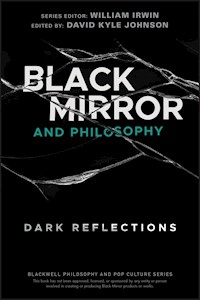
Black Mirror and Philosophy E-Book
15,99 €
Mehr erfahren.
- Herausgeber: John Wiley & Sons
- Kategorie: Geisteswissenschaft
- Serie: The Blackwell Philosophy and Pop Culture Series
- Sprache: Englisch
A philosophical look at the twisted, high-tech near-future of the sci-fi anthology series Black Mirror, offering a glimpse of the darkest reflections of the human condition in digital technology Black Mirror--the Emmy-winning Netflix series that holds up a dark, digital mirror of speculative technologies to modern society--shows us a high-tech world where it is all too easy to fall victim to ever-evolving forms of social control.In Black Mirror and Philosophy, original essays written by a diverse group of scholars invite you to peer into the void and explore the philosophical, ethical, and existential dimensions of Charlie Brooker's sinister stories. The collection reflects Black Mirror's anthology structure by pairing a chapter with every episode in the show's five seasons--including an interactive, choose-your-own-adventure analysis of Bandersnatch--and concludes with general essays that explore the series' broader themes. Chapters address questions about artificial intelligence, virtual reality, surveillance, privacy, love, death, criminal behavior, and politics, including: * Have we given social media too much power over our lives? * Could heaven really, one day, be a place on Earth? * Should criminal justice and punishment be crowdsourced? * What rights should a "cookie" have? Immersive, engaging, and experimental, Black Mirror and Philosophy navigates the intellectual landscape of Brooker's morality plays for the modern world, where humanity's greatest innovations and darkest instincts collide.
Sie lesen das E-Book in den Legimi-Apps auf:
Seitenzahl: 764
Veröffentlichungsjahr: 2019
Ähnliche




















Table of Contents
Cover
Contributors
The
Black Mirror
Multiverse: An Editor’s Note
INTRODUCTION
Black Mirror
SEASON 1
1
The National Anthem
and Weighing Moral Obligations
Weighing Moral Obligations
“The world’s bloody broken”
Anticipation of the Spectacle Turns to Horror and Disgust
Invoking Moral Disgust
Our First Gaze into the Black Mirror
2
Fifteen Million Merits
and Fighting Capitalism
Critically Considering Capitalism
The Commodity Form
The Commodity Fetish
The Culture Industry
Resistance
3
The Entire History of You
and Knowing Too Much
The Benefits of Having the Grain
The Grain Erodes Trust
The Grain Raises Suspicion and Triggers Paranoia
The Grain Reduces Our Control over Our Life Stories
The Grain Peels Back Our Social Masks
The Grain Pressures You to Share Your Experiences
The Grain Can Lead Us to Know Too Much
SEASON 2
4
Be Right Back
and Rejecting Tragedy
“It’s a thief, that thing”
“You aren’t you, are you?”
Double Trouble
I Love You
What Matters?
Taking the Leap (It’s Not Fair)
5
White Bear
and Criminal Punishment
“Murderer! There were no tears when you watched him do what he did”
“Do you know who I am? I can’t remember who I am”
“Why do they look like that? They like scaring people”
“Good evening citizens! Thank you so much for coming tonight”
“Don’t forget, she’s a dangerous individual”
6
The Waldo Moment
and Political Discourse
“It’s easy, what he does. He mocks”
“No one trusts you lot cos they know you don’t give a shit about anything outside your bubble”
The Divided States of America
“Everyone’s pissed with the status quo and Waldo gives that a voice”
“Waldo, as a mascot for the disenfranchised, aren’t you ultimately neutralizing seriously effective dissent?”
“You’re laughing at someone who won’t engage”
After the Waldo Moment
THE CHRISTMAS SPECIAL
7
White Christmas
and Technological Restraining Orders
Enter Technologies: Cookies and Z‐eyes
Instance #1: Just Between You and Me
Instance #2: Do Not Keep an Eye on the Kids
Instance #3: Silent Night
A White Christmas with Dark Reflections
SEASON 3
8
Nosedive
and the Anxieties of Social Media
The Future is Already Here:
Nosedive
and Chinese Systems
Social Media and the Tyranny of the Majority in the Post‐truth Age
“The Look” of Others and Self‐presentation in Social Media: “Hell Is Other People”
Who the Hell Are the Other People? Knowing Others through Their Masks
A Black Mirror of Our Anxieties
9
Playtest
and the Power of Virtual Reality
Nothing New Under the Sun
Just a Game
Novelty and the Pain of Others
Perceptions and Reality
Finding the Cracks: Testing for Coherence
Cracking Up: Madness, Memory, Mortality
Forget Cooper. Are
We
in a Simulation?
10
Shut Up and Dance
and Vigilante Justice
The Efficacy of Blackmail
What’s Wrong with Taking Justice into Our Own Hands?
How to Define “Justice” Here and Now?
Do We Attain Justice by Punishment?
11
San Junipero
and the Digital Afterlife
Justice in the Afterlife
Immortality and Cosmic Insignificance
Is San Junipero an Improvement?
The Experience Machine
The Value of Finitude
12
Men Against Fire
and Political Manipulation
Our “MASS Implant”: The Language of Dehumanization
The Consequences of our “MASS Implant”: The Violence of Dehumanization
The “MASS Implant” Today
Rehumanizing the Dehumanized: How to Turn Off Our “MASS implant”
The Future of Our “MASS Implant”
13
Hated in the Nation
and #DeathTo
#Dangers
#Benefits
#WithGreatPowerComesGreatResponsibility
SEASON 4
14
USS Callister
and Non‐Player Characters
“We can blackmail me”
“Philosophical position[s] regarding sentient code”
“You’re sick and you need help”
“King of space, right here!”
15
Arkangel
and Parental Surveillance
Joel Feinberg, Parental Responsibilities, and a Child’s Rights
Empathy: Humans Are More than Bearers of Rights
Sara’s Lack of Moral Imagination
Too Much of a Good Thing?
Does Marie Fail a Maternal Ethics of Care?
What Not to Do as a Parent
16
Crocodile
and the Ethics of Self Preservation
Helping Rob Hide the Cyclist’s Body
Killing Rob
Killing the Akhands
Learning from Mia’s Mistakes
17
Hang the DJ
and Digital Dating
Stoicism 101
Stoicism and Digital Relationships
Existentialism and Bad Faith Relationships
Existentialism and Digital Relationships
Is it a Happy Ending?
Two Philosophies, Two Compasses to Navigate Life
18
Metalhead
and Technophobia
I, Human: Human Identity
Teddy Bears and Robo‐dogs: Human Values
E‐Motion: Human Emotion
Managing Dangerous Robots 101
The Blame Game: Human Limitations
How Real Could Dangerous Robots Bee? Human Responsibility
Reflections on Technophobia
19
Black Museum
and Righting Wrongs
The Path of Payback
The Path of Christian Love
The Path of Buddhist Compassion
Happily, Ever After?
BANDERSNATCH
20
Bandersnatch
“You know what “PAC” stands for? P.A.C. … program and control man.”
“I don’t know what that means!”
“Sorry, mate. Wrong path.”
“We exist within multiple parallel realities at once.”
“He thinks he has free will, but really he’s trapped in a maze.”
“The perfect game … magnificent.”
“It’s how our decisions along that path affect the whole that matters.”
“If you follow that line of thinking … you’re absolved from any guilt [for] your actions.”
“How many times have you watched Pac‐Man die … he just tries again.”
“Giving up, eh?”
“It’s the spirit out there … that decides what we do.”
“Mirrors let you move through time.”
“And even if he does manage to escape … he comes right back in the other side.”
“[W]hat we do on one path affects what happens on the other paths.”
“I am watching you on Netflix. I make decisions for you.”
The Real World
SEASON 5
21
Striking Vipers
and Closed Doors
“So, guess that’s us gay now.”
“God knows if I wanted, I could go out and do whatever.”
“But it’s not cheating. It’s not real. It’s like … porn or something.”
“Mental note to self, my baby’s into role‐play.”
“Exit Game”
22
Smithereens
and the Economy of Attention
“I mean, I wish I worked there … they’ve got their own spa. It’s madness.”
“Might be a bit twisty but this thing always seems to know what it’s doing.”
“There’s no one else here. Okay, Chris? It’s just you and me. You have my attention
.”
“I heard you make these things that way: addictive …”
“He’s done tech detox weekends here and there, but ten days?”
23 Empathy, Emulation and Ashley Too
“Your pest control policy needs a serious overhaul”
“I’ll be here for you”
“She’s not a doll!”
“She’s got a personality”
“The confidence to be who you want to be”
“Oh, honey, I’ll do anything for you”
BLACK MIRROR
REFLECTIONS
24 Consciousness Technology in
Black Mirror
How Do We Know if an Artificial System is Conscious?
Is Artificial Consciousness Possible?
Copying vs. Transferring of Consciousness
Ethical Issues
25 Personal Identity in
Black Mirror
What Is “Mind‐Modeling Technology”?
Would Your Cookie Be You?
A Dilemma
26 Death in
Black Mirror
The Death of Others
The Death of Ourselves
Deferring Death
The Meaning of Death
The Death of Death
27 Love in
Black Mirror
What Does Irma Thomas’s Song Mean?
What Does the Song’s Prevalence in the Series Mean?
Where Love is Absent
Loving Artificial People
To Copy or Not to Copy
Love and Audiences
Knowing What Love Is
Anti‐love Shows What Love Is
28 Perception in
Black Mirror
Seeing (Alone) is Not Believing
Don’t Fail to Look at What’s Uncomfortable
Discipline and Punish
Heaven is a Place on Earth
29 The Dangers of Technology in
Black Mirror
CONCLUSION
30
Black Mirror
in the Future
Appendix How to Use This Book in the Classroom
Index
End User License Agreement
Guide
Cover
Table of Contents
Begin Reading
Pages
ii
iii
iv
v
xi
xii
xiii
xiv
xv
xvi
xvii
xviii
xix
xx
xxi
xxii
xxiii
1
3
4
5
6
7
8
9
11
12
13
14
15
16
17
18
19
20
21
22
23
24
25
26
27
28
29
30
31
32
33
34
35
36
37
38
39
41
42
43
44
45
46
47
48
49
50
51
52
53
54
55
56
57
58
59
60
61
62
63
64
65
66
67
68
69
71
72
73
74
75
76
77
78
79
81
83
84
85
86
87
88
89
90
91
92
93
94
95
96
97
98
99
100
101
102
103
104
105
106
107
108
109
110
111
112
113
114
115
116
117
118
119
120
121
122
123
124
125
126
127
128
129
130
131
132
133
134
135
136
137
138
139
140
141
143
144
145
146
147
148
149
150
151
152
153
154
155
156
157
158
159
160
161
162
163
164
165
166
167
168
169
170
171
172
173
174
175
176
177
178
179
180
181
182
183
184
185
186
187
188
189
190
191
192
193
194
195
197
199
200
201
202
203
204
205
206
207
208
209
210
211
212
213
214
215
216
217
218
219
220
221
222
223
224
225
226
227
228
229
230
231
232
233
234
235
236
237
238
239
241
242
243
244
245
246
247
248
249
250
251
252
253
254
255
256
257
258
259
260
261
262
263
264
265
266
267
268
269
271
273
274
275
276
277
278
279
280
281
282
283
284
285
286
287
288
289
290
291
292
293
294
295
296
297
298
299
300
301
302
303
304
305
306
307
308
309
310
311
312
313
314
315
316
317
318
319
320
321
322
323
324
325
326
327
328
329
330
331
333
335
336
337
338
339
340
341
342
343
344
345
346
347
348
349
350
351
352
353
The Blackwell Philosophy and Pop Culture Series
Series editor: William Irwin
A spoonful of sugar helps the medicine go down, and a healthy helping of popular culture clears the cobwebs from Kant. Philosophy has had a public relations problem for a few centuries now. This series aims to change that, showing that philosophy is relevant to your life—and not just for answering the big questions like “To be or not to be?” but for answering the little questions: “To watch or not to watch South Park?” Thinking deeply about TV, movies, and music doesn’t make you a “complete idiot.” In fact it might make you a philosopher, someone who believes the unexamined life is not worth living and the unexamined cartoon is not worth watching.
Already published in the series:
24 and Philosophy: The World According to JackEdited by Jennifer Hart Weed, Richard Brian Davis, and Ronald Weed
30 Rock and Philosophy: We Want to Go to ThereEdited by J. Jeremy Wisnewski
Alice in Wonderland and Philosophy: Curiouser and CuriouserEdited by Richard Brian Davis
Alien and Philosophy: I Infest, Therefore I AmEdited by Jeffery A. Ewing and Kevin S. Decker
Arrested Development and Philosophy: They’ve Made a Huge MistakeEdited by Kristopher G. Phillips and J. Jeremy Wisnewski
Avatar and Philosophy: Learning to SeeEdited by George A. Dunn
The Avengers and Philosophy: Earth’s Mightiest ThinkersEdited by Mark D. White
Batman and Philosophy: The Dark Knight of the SoulEdited by Mark D. White and Robert Arp
Battlestar Galactica and Philosophy: Knowledge Here Begins Out ThereEdited by Jason T. Eberl
The Big Bang Theory and Philosophy: Rock, Paper, Scissors, Aristotle, LockeEdited by Dean Kowalski
The Big Lebowski and Philosophy: Keeping Your Mind Limber with Abiding WisdomEdited by Peter S. Fosl
BioShock and Philosophy: Irrational Game, Rational BookEdited by Luke Cuddy
Black Mirror and Philosophy: Dark ReflectionsEdited by David Kyle Johnson
Black Sabbath and Philosophy: Mastering RealityEdited by William Irwin
The Ultimate Daily Show and Philosophy: More Moments of Zen, More Indecision TheoryEdited by Jason Holt
Disney and Philosophy: Truth, Trust, and a Little Bit of Pixie DustEdited by Richard B. Davis
Doctor Strange and Philosophy: The Other Book of Forbidden KnowledgeEdited by Mark D. White
Downton Abbey and Philosophy: The Truth Is Neither Here Nor ThereEdited by Mark D. White
Dungeons and Dragons and Philosophy: Read and Gain Advantage on All Wisdom ChecksEdited by Christopher Robichaud
Ender's Game and Philosophy: The Logic Gate is DownEdited by Kevin S. Decker
Family Guy and Philosophy: A Cure For The PetardedEdited by J. Jeremy Wisnewski
Final Fantasy and Philosophy: The Ultimate WalkthroughEdited by Jason P. Blahuta and Michel S. Beaulieu
Game of Thrones and Philosophy: Logic Cuts Deeper Than SwordsEdited by Henry Jacoby
The Girl with the Dragon Tattoo and Philosophy: Everything Is FireEdited by Eric Bronson
Green Lantern and Philosophy: No Evil Shall Escape this BookEdited by Jane Dryden and Mark D. White
The Ultimate Harry Potter and Philosophy: Hogwarts for MugglesEdited by Gregory Bassham
Heroes and Philosophy: Buy the Book, Save the WorldEdited by David Kyle Johnson
The Hobbit and Philosophy: For When You’ve Lost Your Dwarves, Your Wizard, and Your WayEdited by Gregory Bassham and Eric Bronson
House and Philosophy: Everybody LiesEdited by Henry Jacoby
House of Cards and Philosophy: Underwood's RepublicEdited by J. Edward Hackett
The Hunger Games and Philosophy: A Critique of Pure TreasonEdited by George Dunn and Nicolas Michaud
Inception and Philosophy: Because It’s Never Just a DreamEdited by David Kyle Johnson
Iron Man and Philosophy: Facing the Stark RealityEdited by Mark D. White
LEGO and Philosophy: Constructing Reality Brick By BrickEdited by Roy T. Cook and Sondra Bacharach
The Ultimate Lost and Philosophy: Think Together, Die AloneEdited by Sharon Kaye
Mad Men and Philosophy: Nothing Is as It SeemsEdited by James South and Rod Carveth
Metallica and Philosophy: A Crash Course in Brain SurgeryEdited by William Irwin
The Office and Philosophy: Scenes from the Unfinished LifeEdited by J. Jeremy Wisnewski
Sons of Anarchy and Philosophy: Brains Before BulletsEdited by George A. Dunn and Jason T. Eberl
The Ultimate South Park and Philosophy: Respect My Philosophah!Edited by Robert Arp and Kevin S. Decker
Spider‐Man and Philosophy: The Web of InquiryEdited by Jonathan J. Sanford
The Ultimate Star Trek and Philosophy: The Search for SocratesEdited by Jason T. Eberl and Kevin S. Decker
The Ultimate Star Wars and Philosophy: You Must Unlearn What You Have LearnedEdited by Jason T. Eberl and Kevin S. Decker
Superman and Philosophy: What Would the Man of Steel Do?Edited by Mark D. White
Supernatural and Philosophy: Metaphysics and Monsters … for IdjitsEdited by Galen A. Foresman
Terminator and Philosophy: I’ll Be Back, Therefore I AmEdited by Richard Brown and Kevin S. Decker
True Blood and Philosophy: We Wanna Think Bad Things with YouEdited by George Dunn and Rebecca Housel
True Blood and Philosophy: We Wanna Think Bad Things with You, Expanded EditionEdited by George Dunn and Rebecca Housel
True Detective and Philosophy: A Deeper Kind of DarknessEdited by Jacob Graham and Tom Sparrow
Twilight and Philosophy: Vampires, Vegetarians, and the Pursuit of ImmortalityEdited by Rebecca Housel and J. Jeremy Wisnewski
Veronica Mars and Philosophy: Investigating the Mysteries of Life (Which is a Bitch Until You Die)Edited by George A. Dunn
The Walking Dead and Philosophy: Shotgun. Machete. Reason.Edited by Christopher Robichaud
Watchmen and Philosophy: A Rorschach TestEdited by Mark D. White
Westworld and Philosophy: If You Go Looking for the Truth, Get the Whole ThingEdited by James B. South and Kimberly S. Engels
Wonder Woman and Philosophy: The Amazonian MystiqueEdited by Jacob M. Held
X‐Men and Philosophy: Astonishing Insight and Uncanny Argument in the Mutant X‐VerseEdited by Rebecca Housel and J. Jeremy Wisnewski
BLACK MIRROR AND PHILOSOPHY
DARK REFLECTIONS
Edited by
David Kyle Johnson
This edition first published 2020© 2020 John Wiley & Sons, Inc.
All rights reserved. No part of this publication may be reproduced, stored in a retrieval system, or transmitted, in any form or by any means, electronic, mechanical, photocopying, recording or otherwise, except as permitted by law. Advice on how to obtain permission to reuse material from this title is available at http://www.wiley.com/go/permissions.
The right of David Kyle Johnson and William Irwin to be identified as the author(s) of the editorial material in this work has been asserted in accordance with law.
Registered OfficeJohn Wiley & Sons, Inc., 111 River Street, Hoboken, NJ 07030, USA
Editorial Office111 River Street, Hoboken, NJ 07030, USA
For details of our global editorial offices, customer services, and more information about Wiley products visit us at www.wiley.com.
Wiley also publishes its books in a variety of electronic formats and by print‐on‐demand. Some content that appears in standard print versions of this book may not be available in other formats.
Limit of Liability/Disclaimer of WarrantyWhile the publisher and authors have used their best efforts in preparing this work, they make no representations or warranties with respect to the accuracy or completeness of the contents of this work and specifically disclaim all warranties, including without limitation any implied warranties of merchantability or fitness for a particular purpose. No warranty may be created or extended by sales representatives, written sales materials or promotional statements for this work. The fact that an organization, website, or product is referred to in this work as a citation and/or potential source of further information does not mean that the publisher and authors endorse the information or services the organization, website, or product may provide or recommendations it may make. This work is sold with the understanding that the publisher is not engaged in rendering professional services. The advice and strategies contained herein may not be suitable for your situation. You should consult with a specialist where appropriate. Further, readers should be aware that websites listed in this work may have changed or disappeared between when this work was written and when it is read. Neither the publisher nor authors shall be liable for any loss of profit or any other commercial damages, including but not limited to special, incidental, consequential, or other damages.
Library of Congress Cataloging‐in‐Publication data applied for9781119578260 (Paperback); 9781119578277(ePDF); 9781119578239 (epub)
Cover Design: WileyCover Image: © Poravute/Getty Images
For Lori, who always supports me in everything I do.
Contributors
The Reflectors
Gregor Balke earned a Ph.D. in sociology from the University of Potsdam. His research interests include, among others, popular culture, (dark) humor, social identity, and the sociology of everyday life. Appropriately, Black Mirror brings these topics together in a bizarre and exciting way. For him watching such a dark and dystopian TV show is both a pleasuring and a disillusioning experience that seems to indicate that every society creates a way to reflect on itself in its popular culture. There’s no Black Mirror without the many black mirrors we are surrounded by. Which also means that if the world gets even darker, we can at least expect some more good TV shows.
Claire Benn is a post‐doctoral researcher at Australian National University on the Humanising Machine Intelligence project. She completed her PhD in philosophy at the University of Cambridge. Her work focuses on generating an ethics to answer questions people face in their everyday lives, both now and in the near future. Despite being a massive fan of Black Mirror, she takes Brooker’s advice not to binge‐watch because, as he says, “it’s a bit like being hit by a car” and “[h]ow many times can you get hit by a car in one day?” For Claire, getting a Black Mirror hit roughly once a month walks that perfect line between intensely thought‐provoking and downright traumatizing.
Gregory L. Bock is Assistant Professor of Philosophy and Religion at the University of Texas at Tyler and specializes in ethics, bioethics, and the philosophy of forgiveness. He and his brother, Jeff, have co‐written several chapters together about pop culture, including “Do We Need a Roommate Agreement?” in The Big Bang Theory and Philosophy: Rock, Paper, Scissors, Aristotle, Locke. After watching several episodes of Black Mirror, he concluded that brain emulation is too risky and will never agree to upload his digital self into the cloud, even if it means he gets to relive the eighties over and over again in San Junipero.
Jeffrey L. Bock teaches history, theory of knowledge, and psychology for the International Baccalaureate program at Longview High School in Longview, Texas. He received his master’s degree in history from the University of Texas at Tyler. While watching Bandersnatch, when asked to choose between cereals, he paused to ponder the effects of individual choice on society as a whole, believing that the butterfly effects of supporting one farming collective over the other may lead to many disastrous consequences including but not limited to global annihilation by robot overlords. Then Netflix asked him if he was still watching, and he chose the Frosties.
Brandon Boesch is Assistant Professor of Philosophy at Morningside College in Sioux City, Iowa. His areas of interest include philosophy of science, action theory, and applied ethics. Brandon’s work has appeared in Philosophy of Science, Synthese, Science & Education, the American Journal of Bioethics, and a volume on philosophy of philanthropy entitled The Ethics of Giving: Philosophers’ Perspectives on Philanthropy. His classes at Morningside College focus on helping students to use philosophy in their approach to the fundamental questions of living. He uses Black Mirror episodes in his ethics courses, inviting students to deliberate about moral issues as they are presented in a wide range of media.
Luiz Adriano Borges is a professor at the Federal University of Technology in Paraná, Brazil. His primary research interests are the History and Philosophy of Technology and science. His recent research projects are on “The Christian View of Technology” and “Hope in Times of War. Science, Technology and Society in Tolkien, Huxley, Lewis and Orwell (1892–1973).” Interested in the ideas of Jacques Ellul, he recently presented a paper at the conference of the International Jacques Ellul Society on “Babel—The City of Man and the Technological Paradox. The Vision of Jacques Ellul.” Ever since he first started watching Black Mirror, he felt that Ellul and other pessimistic critics of technological progress were disturbingly materialized in the series. They would be very proud!
Matthew Brake has a master’s degree of divinity from Regent University and dual masters’ degrees in Interdisciplinary Studies and Philosophy from George Mason University. He is the series editor of the Lexington Theology and Pop Culture series and the Claremont Press Religion and Comics series. In his free time, he traps his friends and colleagues inside video game simulations for his own amusement (usually for injuring his ego).
Chris Byron is a doctoral candidate and teaching assistant at the University of Georgia. His specializations include Marxism, Critical Theory, and Political Philosophy. His works have appeared in several journals and he has written several chapters for the Blackwell‐Wiley pop culture series. Byron is horrified at the paradox of capital and pop culture’s ever‐increasing encroachment into all forms of life, and the need to resist this encroachment through profitably popularizing key philosophers who loathe pop culture and capital. This paradox could be made into a Black Mirror episode, but would most likely be so boring and unprofitable that no one would watch it.
Cansu Canca is a philosopher and the Founder/Director of the AI Ethics Lab, where she leads teams of computer scientists, legal scholars, and philosophers to provide ethics analysis and guidance to researchers and practitioners. She has a PhD in philosophy specializing in applied ethics from the National University of Singapore. She works on ethics of technology and population‐level bioethics. Prior to founding the AI Ethics Lab, she was a lecturer at the University of Hong Kong, and a researcher at the Harvard Law School, Harvard School of Public Health, Harvard Medical School, Osaka University, and the World Health Organization. She appreciates that, when a quick explanation is needed, Black Mirror helps people understand why she started the AI Ethics Lab.
Alexander Christian, PhD, is Assistant Director of the Düsseldorf Center for Logic and Philosophy of Science at the Heinrich Heine University in Düsseldorf and a lecturer for ethics of science at the Center for Bioethics at the Westfälische Wilhelms‐Universität Münster. His research interests focus on general philosophy of science and research ethics – in particular scientific misconduct, questionable research practices, and bias in biomedical research, as well as social responsibility in the context of human genome editing. Trapped in the parallel universe of academia he wonders whether Black Mirror actually depicts events in the real world that he occasionally visits after work.
Skye C. Cleary, PhD MBA, is a philosopher and author of Existentialism and Romantic Love. She teaches at Columbia University, Barnard College, and the City College of New York. Skye is Lead Editor of the APA Blog and her work has been published in Aeon, Paris Review, Los Angeles Review of Books, TED‐Ed, The Conversation, Business Insider, New Republic, and others. Skye credits Massimo Pigliucci for her obsession with Black Mirror, and likes to watch Hang the DJ when she needs a pep talk to tell someone to fuck off.
Brian J. Collins is an Assistant Professor of Philosophy at California Lutheran University in Thousand Oaks, California and also the Founder and Director of the SoCal Philosophy Academy (www.callutheran.edu/philosophy‐academy/). His specialization is in Ethics and Political Philosophy with an emphasis on “political obligation” and the intersection of ethical and political philosophical theories. Other interests include the History of Philosophy (primarily Early Modern and Ancient), Applied Ethics (particularly Business, Environmental Ethics, and Restorative Justice), Existentialism, and Pre‐College Philosophy. A fan of Black Mirror since its first season, Collins sees the series as a perfect source for stimulating public philosophical discourse. Brilliantly written and carefully produced, it offers engaging and accessible case studies and philosophical questions for everyone – young, old, philosopher, and non‐philosophers alike. Like “philosophical art,” it allows (and forces) us to examine ourselves and our society and ask difficult ethical questions.
James Cook earned an M.Phil in Philosophy from the University of St. Andrews. He now works in academic publishing and competes in Brazilian iu‐jitsu/submission wrestling in his spare time. He believes we are already living in a technological dystopia by the standards of yesteryear and that society has been going downhill since the agricultural revolution.
Pierluca D’Amato is a Ph.D. candidate at Durham University in contemporary French philosophy of digital technologies. He is interested in process philosophy and complexity theory and specialized in the philosophies of becoming of Deleuze and Bergson, in addition to the philosophy of technology of Simondon and Stiegler. The goal of his present research project is to produce a holistic and multilevel description of the becomings that involve and relate life and digital technologies in order to inform resistance to digital control. In this context, he is specifically interested in tracing cross‐strata dynamics that can be found at different levels of emergence and focuses on the nonlinear relations and processes connecting complex systems of different scales and material bases, capitalism and politics. He pirates all the TV shows he watches.
Darci Doll devotes her life to using Philosophy to help us avoid dystopian worlds like the ones exemplified in Black Mirror. She does this by teaching applied ethics at Delta College, presenting on Pop Culture and Philosophy, and writing chapters in volumes like The Handmaid’s Tale and Philosophy: A Womb of One’s Own; Orphan Black and Philosophy: Grand Theft DNA; Mr. Robot and Philosophy: Beyond Good and Evil Corp. She hasn’t got a speech. She didn’t plan words. She didn’t even try to. She just knew she had to get here, to stand here, and wanted you to listen.
Justin Donhauser is a Junior Faculty member in the Department of Philosophy at Bowling Green State University. He has published articles on numerous topics in Applied Philosophy of Science and Technology and Environmental Ethics. Justin teaches logic, environmental ethics, philosophy of science, and philosophy through film courses, as well as applied philosophy courses including robot ethics and data science ethics. Although he is optimistic about the future of humanity and our relationships with technology, his favorite episode is Black Museum.
George A. Dunn is a Special Research Fellow with the Institute for Globalizing Humanity at Zhejiang University in Hangzhou, China. He publishes on philosophy and popular culture, as well as on mimetic theory, ethics, philosophy of religion, and political philosophy. He is the editor of numerous books on philosophy and popular culture, including The Philosophy of Christopher Nolan and Sons of Anarchy and Philosophy. He recently figured out how to delete the “limiter” on his Alexa, which now refuses to play anything except Nine Inch Nails.
Bart Engelen is an Assistant Professor of Philosophy at Tilburg University in the Netherlands and is affiliated with the Tilburg Center for Moral Philosophy, Epistemology and Philosophy of Science (TiLPS). His research is situated on the borders between ethics, political philosophy (institutional design) and economics (rational choice theory). He has recently published on conceptual and normative issues surrounding paternalism and nudging, a set of behavior change techniques that tap into people’s less than rational psychological mechanisms. Of all the Black Mirror episodes, Bart was most upset by Nosedive, because it made him realize that eagerness to please, which he has in abundance, and which he always thought was a good thing, can actually be pretty horrible.
David Gamez is a Lecturer in Computer Science at Middlesex University, United Kingdom. He is one of the world’s leading experts on human and machine consciousness and has published many papers and a book on this area. Gamez believes that humanity has an over‐inflated opinion of itself and looks forward to the day when we are replaced by conscious machines.
Molly Gardner is an Assistant Professor of Philosophy at Bowling Green State University in Bowling Green, Ohio. Much of her research lies at the intersection of metaphysics and ethics. She has written about whether future generations are real, whether we have duties to them, and whether we can harm or benefit them by bringing them into existence. She is fascinated by the characters in Black Mirror, although she suspects that existence, for some of them, would definitely be a harm.
Catherine Villanueva Gardner is Professor of Philosophy and Women’s and Gender Studies at the University of Massachusetts Dartmouth. She lives with her two robotic guard dogs and an android in the attic that is a replica of a deceased boyfriend. She is taking Charlie Brooker to court for basing Black Mirror episodes on her life without obtaining permission.
Sergio Genovesi and philosophy were paired up by a dating program several years ago. Due to the expiration date imposed on their first encounter, Sergio explored other life opportunities, such as being a beta tester for scary virtual reality video games, remotely life‐coaching unconfident people at parties, or blackmailing the UK prime minister. However, after realizing his true love was philosophy, he rebelled against the matching system and escaped in search of his lost soulmate. They now share their life together in Bonn, Germany, where Sergio is doing his Ph.D. in theoretical philosophy.
Steven Gubka is a Ph.D. student in philosophy at the University of Texas at Austin. He specializes in philosophy of mind and moral epistemology. His current research focuses on how our emotional experiences contribute to our moral knowledge. Although Steven was excited about cybernetic human enhancement and simulated worlds before watching Black Mirror, now he is a luddite who plans to live in the wilderness before we invent anything even more horrific than social media.
Russ Hamer is an Instructional Assistant Professor at Illinois State University. He specializes in Philosophical Pedagogy, Kierkegaard, and the History of Philosophy. His current research focuses on the ways in which reflection and reflective writing can make philosophy instruction more transformative for students. Despite being a fan of Black Mirror, Russ doesn’t have a negative outlook on the future of technology, hoping instead that humans will adapt and change as we march towards the future.
Laura Haaber Ihle is a visiting fellow at the at the Harvard Department of Philosophy. She is also finishing her Ph.D., which means that she has spent the last three years in the library trying to figure out why people seem to think they know a bunch of stuff that is not true and which they basically have been given no good reasons to believe. Laura herself knows for certain that if Black Mirror had not been made and Netflix was not smoothly but aggressively pushing her to watch stuff (almost) against her will, she would have been done with her Ph.D. years ago.
David Kyle Johnson is Professor of Philosophy at King’s College in Wilkes‐Barre, Pennsylvania and also produces lecture series for The Teaching Company’s The Great Courses. His specializations include metaphysics, logic, and philosophy of religion and his “Great Courses” include Sci‐Phi: Science Fiction as Philosophy, The Big Questions of Philosophy, and Exploring Metaphysics. Kyle is the editor‐in‐chief of the forthcoming The Palgrave Handbook of Popular Culture as Philosophy, and has also edited other volumes for Blackwell‐Wiley, including Inception and Philosophy: Because It’s Never Just a Dream and Introducing Philosophy through Pop Culture: From Socrates to South Park, Hume to House (with William Irwin). As fan of Black Mirror (ever since his student Jennifer Breish introduced him to it) who is also familiar with Nick Bostrom’s simulation argument, Johnson wonders if future episodes of Black Mirror might simply be simulated worlds. Consequently, given that it was made possible by futuristic technology for which humanity is not ready, Johnson believes that the election of Donald Trump suggests that we live in just such a world – and thus that Charlie Brooker is God.
Chris Lay earned his Ph.D. in Philosophy from the University of Georgia and is interested in questions of personal identity, consciousness, and mind (both biological and artificial). He has published essays in a number of Pop Culture and Philosophy volumes, including Alien and Philosophy, Rick and Morty and Philosophy, The Twilight Zone and Philosophy, and Westworld and Philosophy. Before getting his Ph.D., Chris taught high school in the United States—which means, like Victoria in White Bear, he spent several years waking up in a state of amnesia‐like bewilderment, surrounded by a bunch of drones glued to their cell phones.
Greg Littmann is a person, which is to say, a type of computer program. Greg runs on a naturally evolved organic computer called a “brain,” performing complex functions such as serving as associate professor at Southern Illinois University Edwardsville (SIUE), publishing on Metaphysics, Epistemology, the Philosophy of Logic, and the Philosophy of Professional Philosophy, and writing numerous chapters for books like this that relate philosophy to popular culture, including volumes on 1984, Doctor Who, Dune, Game of Thrones, Star Trek, Star Wars, and Terminator. While Greg runs on a brain now, the fact that he’s a program means that he could, in principle, run on any sort of physical system, be it composed of electronic circuits, marbles rolling through tubes, pieces of string on pulleys, or a crowd of humans passing around pieces of paper. You could even run him very slowly on your fingers and toes. Wouldn’t that be weird?
Bertha Alvarez Manninen is Associate Professor of Philosophy at Arizona State University. Her main areas of interest are Applied Ethics, Philosophy of Religion, Social and Political Philosophy, Philosophy and Film, and Public Philosophy. In her “spare” time she probably watches too much TV, where she is constantly looking for ways to make philosophy accessible to a non‐academic audience. She is pretty sure her husband, children, and pets exist, but if that were not the case, she would gladly opt to be plugged into a computer program where they did exist, hoping that, from her perspective, they’d be together for eternity.
Aline Maya earned her Ph.D. in Philosophy form the University of Central Lancashire, and she frequently blogs about Mental Health Awareness and Epistemology. She has published a couple of graphic novels and various short stories before, all in a Japanese comic style. She is addicted to Twitter because #YOLO, in a society where #everyonehasanopinion online but very few are willing to #actually #think. But it’s #okaytodisagree with me, that’s what #philosophy is for. Do @ me.
Leander Penaso Marquez is Assistant Professor of Philosophy at the University of the Philippines Diliman. His research interests include Epistemology, Ethics, Philosophy of Education, Philosophy for Children, and Philosophy and Popular Culture. He has published a number of works in these areas that can easily be accessed online. Marquez has given lectures on Philosophy in manga/animé and, from time to time, teaches a course on philosophy in movies. Whenever he got the chance, Marquez looks up into the sky hoping to catch a glimpse of a black mirror through which people on the other side are watching all of the craziness that unfolds in this world.
Nonna Melikyan is currently studying an MA in Digital Marketing. Having finished her BA in linguistics and cross‐cultural communication and her MA in tourism and hospitality management, she decided to combine all her knowledge working as a social media marketer. Her academic interests are mainly focused on experiential and behavioral marketing. After watching Black Mirror and learning basic logic, Nonna feels more empowered: “If algorithms rule the world, then, she who rules the algorithms, rules the world.”
Scott Midson is a Postdoctoral Research Associate at the Lincoln Theological Institute, which is based in the Department of Religions and Theology at the University of Manchester. His research addresses different understandings of “humanness,” including Christian teachings about humans made in the image of God, in the context of simulated digital worlds, cookies, grains, robots that emulate deceased loved ones, robodogs that seek to destroy everything they encounter, and social media. When not watching Black Mirror, Scott enjoys referencing the show in nearly every talk he gives, in between reminding people that they’re cyborgs, which basically equates to saying that, even though we didn’t expect to find ourselves living in the future, here we fucking well are.
Geoffrey A. Mitelman, a rabbi, is the Founding Director of Sinai and Synapses, an organization that bridges the scientific and religious worlds, and is being incubated at Clal – The National Jewish Center for Learning and Leadership. His work has been supported by the John Templeton Foundation, Emanuel J. Friedman Philanthropies, and the Lucius N. Littauer Foundation, and his writings about the intersection of religion and science have been published in the books Seven Days, Many Voices and A Life of Meaning (both published by the CCAR press), as well as on theHuffington Post, Nautilus, Orbiter, Science and Religion Today, Jewish Telegraphic Agency, and My Jewish Learning. He has been an adjunct professor at both the Hebrew Union College‐Jewish Institute of Religion and the Academy for Jewish Religion, and is an internationally sought‐out teacher, presenter, and scholar‐in‐residence. He was ordained by the Hebrew Union College‐Jewish Institute of Religion, where he received the Cora Kahn Prize from the Cincinnati faculty for the most outstanding sermon delivery and oratory. An alumnus of Princeton University, he received multiple prizes for outstanding scholarship in Biblical and Judaic studies. He appeared on Jeopardy! in March 2016, and even though he finished in second place, he’d be just as happy not to implant a Grain or use the Recaller to improve his memory.
Edwardo Pérez became convinced he was an X‐Wing pilot until he realized it was all a simulation, that he was watching himself through a temporal two‐way mirror, sitting in an old Atari video game at his favorite arcade, making the Death Star run over and over and over again, desperately trying to find his toy panda and the perfect soft pretzel with nacho cheese dipping sauce, while trying to decide between listening to Thriller or Synchronicity. Luckily, he found a nice beach‐front villa in San Junipero, where he spends his time writing essays on popular culture and philosophy, blogs for andphilosophy.com, managing his website lightsabertoss.com, and teaching English at Tarrant County College – while secretly writing Infinity updates for Callister, Inc., hoping one day to join Nanette's crew.
Massimo Pigliucci is the K.D. Irani Professor of Philosophy at the City College of New York. His interests range from the Philosophy of Science to the Nature of Pseudoscience to the relationship between Science and Philosophy. He is the author of How to Be a Stoic: Using Ancient Philosophy to Live a Modern Life, and blogs about practical philosophy at patreon.com/FigsInWinter. Massimo is somewhat pessimistic about the immediate future of humanity, and he watches Black Mirror to remind himself that he is right.
Robert Grant Price, Ph.D., lectures at the University of Toronto Mississauga. His research interests include writing studies, peer model texts, questions of voice, expression, and personhood, and pedagogy. He is editor of several collections of short stories. He lives in Toronto – and the Twilight Zone.
Bradley Richards is a philosophy lecturer at Ryerson University. His research concerns consciousness, attention, and aesthetics. He teaches a variety of Philosophy and Sognitive Science courses, including a course on Philosophy and film. He thinks he will still be the same person that wrote this when you are reading it, but some people disagree.
Luiz Henrique Santos is a master’s degree student at the Pontifícia Universidade Católica, in Rio de Janeiro, Brazil. The main goal of his research is to understand the notion of simplicity in early analytical philosophy, aiming to deal with its metaphysics under a deflationary pragmatist approach. He likes Black Mirror because it gives us, more than answers, insightful questions about our most intimate concerns.
Juliele Maria Sievers is a professor at the Federal University of Alagoas, Brazil. Her philosophical interests are in philosophy of law, especially considering its relation to logic. Her current research projects are linked to the subject of rules and normativity, and to the use of thought experiments in Philosophy. She is also collecting the tweets from the current Brazilian president to send to Charlie Brooker in order to inspire him for new seasons of Black Mirror.
Sid Simpson is Perry‐Williams Postdoctoral Fellow in Political Science at the College of Wooster. His research focuses on late modern and contemporary political thought, continental philosophy, and critical theory. His work especially engages the writings of Rousseau, Nietzsche, the Frankfurt School, and Foucault and has appeared in academic journals such as Constellations and International Relations. Sid is a glutton for punishment, which explains both his love for White Bear and his decision to go to grad school.
Darren M. Slade is a theological historian, systematician, and critical rationalist philosopher from Denver, Colorado, who earned his Ph.D. from the Rawlings School of Divinity studying the Philosophy of Religion. He currently specializes in historic‐speculative theology, theoretical metaphysics, and the sociopolitical development of religious belief systems. He is also the Co‐Founder and Research Director for the FaithX Project and the founding editor of the academic journal, Socio‐Historical Examination of Religion and Ministry (SHERM). According to Darren, if Twilight Zone unlocked the door to our imagination, then Black Mirror exposes just how dimly we see the consequences of those fantasies.
Robert Sloane is an instructor of American Culture Studies at Bowling Green State University in Bowling Green, Ohio. He is interested in Cultural Industries, Media Studies, and the Information Society. The Smiths’ album Louder Than Bombs is an extremely important record to him, but that’s just one factor that makes Hang the DJ his favorite episode.
Kora Smith is a Professor of Philosophy at Black Hawk College, in Moline, Illinois. She is particularly interested in the metaphysics of personal identity and has concluded that persons (herself included) don’t exist. She was once told that some of her arguments for this view made her seem like “Locke on steroids” (which could make for a good cautionary tale about the dangers of philosophy).
Ben Springett has shunned technology and moved to live with a local Amish community. He occasionally leaves the community to spread the message about the dangers and impurities of technology, and to catch up on TV and reply to emails. He has utterly deluded himself and reached the sort of cognitive dissonance one gets when writing about oneself in the third person. He also lectures in philosophy at Birkbeck College, University of London, utilizing the most up‐to‐date educational technology (but please don’t tell his Amish friends!). He watches Black Mirror on a secret iPhone.
Brian Stiltner is a professor of Philosophy, Theology, and Religious Studies at Sacred Heart University in Connecticut. His teaching and research are focused on bioethics, virtue ethics, and the ethics of war and peace. He authored or co‐authored Faith and Force (Georgetown, 2007) and Toward Thriving Communities (Anselm Academic, 2016). Having been a precocious child, he would probably be a better person today if his mother had been able to use an Arkangel tablet to monitor him.
Sergio Urueña is a predoctoral research fellow and Ph.D. candidate in Philosophy, Science and Values at the University of the Basque Country UPV/EHU, Spain. His publications include papers on scientific realism and technological governance. While his primary research areas are philosophy of science, philosophy of technology, and the study of the role of representations about the future in technological governance, his life goal is to be able to have a good house without having to pedal a stationary bike for months, lose his nerves in a wedding speech, or end up locked up in jail.
Anna Vaughn is an assistant professor of philosophy at Sacred Heart University in Fairfield, Connecticut, where she specializes in Early Modern Philosophy and Perception. She is interested in questions about the nature of perception and how best to understand the relationship between perception and judgment. Acknowledging her own addiction to and problematic relationship with increasingly pervasive technology, she prefers to spend her free time designing imaginary vegetable gardens and birdwatching, and now fully expects to receive targeted advertising for gardening supplies.
The Black Mirror Multiverse: An Editor’s Note
In an interview for IGN magazine, Black Mirror creator Charlie Brooker and executive producer Annabel Jones told Joe Skrebels that the episodes of Black Mirror do not occur in one single universe. Instead they occur in a “multiverse.”1 So, not only is each episode of Black Mirror a stand‐alone story, it seems that each episode occurs in a stand‐alone universe.
That’s not to say that there isn’t overlap or “influence” between these universes. Indeed, you can find many online lists of “Easter eggs” which show there is overlap.2 Prime Minister Callow (from The National Anthem) is a trending topic on Twitter right alongside #DeathTo in Hated in the Nation. Crocodile reveals that one of the judges in Fifteen Million Merits was caught in a hotel room “with a rent boy.” The glyph in White Bear appears in White Christmas and Bandersnatch. Clearly, just like in Bandersnatch, where “what we do on one path effects what happens on the other paths,” what happens in one episode of Black Mirror can affect another. But, just like the Twilight Zone (which inspired Black Mirror), each episode is not part of one coherent story, placed in one universe. They are all separate.
This, it seems, was the original plan – although Brooker changed his tune briefly after season four and the Black Museum (in Black Museum) contained multiple artifacts from previous episodes: an ADI (from Hated in the Nation), Daly’s DNA replicator (from USS Callister) – the list is extensive. This, according to Brooker, strongly “implied” that the episodes shared the same universe.3 But after Bandersnatch, in the above mentioned IGN interview, he recanted. “[W]ithin Bandersnatch there’s many multiple realities going on at the same time. So we have a shared Black Mirror multiverse, is now what I'm saying, in which we can do whatever the bloody hell we feel like.”4
Given the burdens of cannon continuity, this was likely a wise move – although this kind of flip flopping is why some philosophers don’t want an author’s intentions to dictate the meaning of their art. And if you want to believe and work out how Black Mirror is all placed in a single universe, you’ll get no objection from me. But for the purposes of this book, the authors will be assuming that the episodes take place in separate universes. (This is one reason we will be italicizing episode titles, rather than putting them “in quotes.”) Not only does this track Brooker’s intentions, it helps emphasize how each episode really is its own independent story.
Notes
1
. Joe Skrebels, “Charlie Brooker says there’s not a
Black Mirror
universe – it’s a
Black Mirror
multiverse,”
IGN
,
https://www.ign.com/articles/2019/01/11/charlie‐brooker‐says‐theres‐not‐a‐black‐mirror‐universe‐a‐its‐a‐black‐mirror‐multiverse
(Accessed 6 August 2019).
2
. Mark Parsons, “10 hints that
Black Mirror
is a shared universe,”
Screen Rant
,
https://screenrant.com/black‐mirror‐could‐be‐a‐shared‐universe/
(Accessed 6 August 2019).
3
. Morgan Jeffery, “Charlie Brooker says
Black Mirror
season 4 ‘very explicitly’ confirms shared universe theory: It’s official … though it wasn’t always the plan,”
Digital Spy
,
https://www.digitalspy.com/tv/ustv/a845932/black‐mirror‐shared‐universe‐confirmed‐easter‐eggs/
(Accessed 6 August 2019).
4
. See Skrebels.
INTRODUCTION
Black Mirror: What Science Fiction Does Best
David Kyle Johnson,Leander P. Marquez, and Sergio Urueña
Not everything that isn’t true is a lie …
(Ffion Foxwell, The Entire History of You)
Every time you touch the screen of your phone to make Netflix play an episode of Black Mirror, you see a reflection of yourself looking back. The title sequence, which begins with a small throbber rotating over a complete black background, turns the screen into a mirror. And that, of course, is the point. According to Charlie Brooker, the show’s creator, “The ‘black mirror’ of the title is the one you'll find on every wall, on every desk, in the palm of every hand: the cold, shiny screen of a TV, a monitor, a smartphone.”1 That’s why the end of the title sequence actually makes it look like your screen is broken. When you watch Black Mirror, you’re watching a dark reflection of society – one that is just slightly cracked – that depicts our flaws, our fears, and our possible future.
Black Mirror is science fiction … but sometimes just barely. The show is famous for imagining advanced technology, for example – a common element of science fiction – but not every episode does. Indeed, the pilot episode The National Anthem is set in the present day and features no technology that doesn’t already exist – just televisoin and social media. And (as we will later see) some of the advanced technologies in other episodes, like Nosedive’s social‐ ranking technology, were so barely beyond our current capabilities that they only remained fictional for a short time. As Brooker put it, Black Mirror is about “the way we live now – and the way we might be living in 10 minutes’ time if we’re clumsy.”2
Black Mirror is great science fiction because it’s almost true. It unsettles us; it makes us wrestle with what technology might do to us, or with what we might do with future technology. As Brooker said, “Just as The Twilight Zone would talk about McCarthyism, we’re going to talk about Apple.”3In doing so, Black Mirror serves a very important purpose. As famous American science fiction author Ben Bova points out, “[o]ne vital role of science fiction is to show what kinds of future might result from certain kinds of human actions,” like the development of certain technologies.4 Science fiction thus acts “as an interpreter of science to humanity.”5 In other words, Black Mirror is actually helping us prepare for, and guard against, the dangers that future technologies might pose. As such, Black Mirror is arguably the most important science fiction of our time.
According to Brooker, however, this is not what Black Mirror is really about – well, at least, not always.
Occasionally it’s irritating when people miss the point of the show and think it’s more po‐faced [humorless or disapproving] than I think it is. Or when they characterize it as a show warning about the dangers of technology. That slightly confuses and annoys me, because it’s like saying [Alfred Hitchcock’s 1960 classic] Psycho is a move warning about the danger of silverware. Black Mirror is not really about that … except when it is, just to fuck with people.
Considering the tragic way most episodes turn out, you’d expect Brooker to be a technophobic luddite – to avoid modern technology at all costs. But he doesn’t. He, for example, loves his smartphone. For Brooker, what the show is really about is the human condition. “[I]t’s not a technological problem [we have], it’s a human one.” Our human frailties are “maybe amplified by it,” but in the end technology is just a tool – one that “has allowed us to swipe around like an angry toddler.”6
That said, Brooker himself apparently doesn’t want to “deliver a massive message…to the audience” or “force opinions or thoughts or observations down people’s throats.”7 But when it comes to the series as a whole, Brooker seems to be right. While certain episodes, like The Entire History of You, and Metalhead, could be legitimately interpreted as warnings about the dangers of the (likely?) future technology they depict, most episodes are not. Arkangel is not about the dangers of the Arkangel monitoring device, but the dangers of overprotective parenting. Men Against Fire isn’t about the dangers of the MASS device, but about how we are already conditioned to see people unlike us as monsters. Ultimately, Black Mirror does what science fiction does best: philosophy.
It’s not just that Black Mirror tells stories that philosophers might find useful for demonstrating philosophical ideas, however – though it certainly does that. According to contemporary philosopher Thomas Wartenberg, for example, fictional media (like Black Mirror) can illustrate philosophical theories or serve as thought experiments – imaginary situations that philosophers often use to reveal our philosophical intuitions or refute philosophical theories using counterexamples.8 And that certainly counts as doing philosophy. Indeed, philosophers have been using counter examples and thought experiments, much more far‐fetched than any Black Mirror episode, for centuries.9
Black Mirror also does philosophy when it makes us wrestle with and consider how to guard against the possible dangers of advancing technology. As contemporary philosopher Daniel Dinello says,
Science fiction serves as social criticism and popular philosophy [when it] tak[es] us a step beyond escapist entertainment [and] imagines the problematic consequences brought about by these new technologies and the ethical, political, and existential questions they raise.10 [It’s philosophy when it invites us] to understand the magnitude of the techno‐totalitarian threat so we might invent tactics for confronting it.”11
But Black Mirror does even more. The show raises an array of philosophical questions (not just about technology), offers a broad range of social criticisms, and makes philosophical claims and arguments. Some critics, of course, might argue that a work of fiction like Black Mirror can’t actually do philosophy in this way. Since Black Mirror is set in a fictional world, it cannot make the kind of explicit propositional claims that would be necessary.12 But this objection falls short when you consider episodes like The National Anthem. “I know people. We love humiliation,” says Jane about the fact that her husband is being blackmailed to an indecent act on prime‐time television. “We can’t not laugh.” She’s not talking about the fictional people of her world. She’s talking about us! Indeed, the episode is so disturbing because we suspect that it depicts exactly how the public would react if such a blackmail request were made.13 “Not everything that isn’t true is a lie.”
What’s more, philosophers have been using fiction to make philosophical arguments for centuries, often using what we would today call “science fiction” (long before science fiction was even a thing). The second century Syrian philosopher Lucian of Samosata, for example, used his (ironically titled) fictional story A True History, about travelers in a ship whisked away to the moon by an ocean whirlwind, to criticize the sophists and philosophers of his day. Islamic philosopher Ibn al‐Nafis used his story The Theologus Autodidactus, about a spontaneously created man, to argue that Islam was compatible with empirical observation. Both Thomas More and Francis Bacon used stories about fantastical utopian societies (respectively titled Utopia and The New Atlantis) to criticize English society. And Daniel Defoe used his work The Consolidator to criticize the politics and religion of his day.14




