


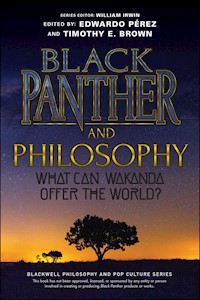
Black Panther and Philosophy E-Book
15,99 €
Mehr erfahren.
- Herausgeber: John Wiley & Sons
- Kategorie: Geisteswissenschaft
- Serie: The Blackwell Philosophy and Pop Culture Series
- Sprache: Englisch
Explore the fascinating historical and contemporary philosophical issues that arise in Black Panther In Black Panther and Philosophy: What Can Wakanda Offer The World, a diverse panel of experts delivers incisive critical reflections on the Oscar-winning 2018 film, Black Panther, and the comic book mythology that preceded it. The collection explores historical and contemporary issues--including colonialism, slavery, the Black Lives Matter movement, intersectionality, and identity--raised by the superhero tale. Beyond discussions of the influences of race and ethnicity on the most critically and culturally significant movie in the Marvel Cinematic Universe, this book presents the moral, feminist, metaphysical, epistemological, existential, and Afrofuturistic issues framing Black Panther's narrative. The explorations of these issues shed light on our increasingly interconnected world and allow the reader to consider engaging questions like: * Should Wakanda rule the world? * Was Killmonger actually a victim? * Do Wakanda's Black Lives Matter? * Does hiding in the shadows make Wakanda guilty? * What does Wakanda have to offer the world? Perfect for fans of the most culturally significant film in the Marvel Cinematic Universe, Black Panther and Philosophy will also earn a place in the libraries of students of philosophy and anyone with a personal or professional interest in the defining issues of our time.
Sie lesen das E-Book in den Legimi-Apps auf:
Seitenzahl: 586
Veröffentlichungsjahr: 2022
Ähnliche




















The Blackwell Philosophy and Pop Culture Series
Series editor: William Irwin
A spoonful of sugar helps the medicine go down, and a healthy helping of popular culture clears the cobwebs from Kant. Philosophy has had a public relations problem for a few centuries now. This series aims to change that, showing that philosophy is relevant to your life – and not just for answering the big questions like “To be or not to be?” but for answering the little questions: “To watch or not to watch South Park?” Thinking deeply about TV, movies, and music doesn’t make you a “complete idiot.” In fact it might make you a philosopher, someone who believes the unexamined life is not worth living and the unexamined cartoon is not worth watching.
Already published in the series:
The Avengers and Philosophy: Earth’s Mightiest Thinkers
Edited by Mark D. White
Batman and Philosophy: The Dark Knight of the Soul
Edited by Mark D. White and Robert Arp
The Big Bang Theory and Philosophy: Rock, Paper, Scissors, Aristotle, Locke
Edited by Dean Kowalski
BioShock and Philosophy: Irrational Game, Rational Book
Edited by Luke Cuddy
Doctor Strange and Philosophy: The Other Book of Forbidden Knowledge
Edited by Mark D. White
Dungeons and Dragons and Philosophy: Read and Gain Advantage on All Wisdom Checks
Edited by Christopher Robichaud
Game of Thrones and Philosophy: Logic Cuts Deeper Than Swords
Edited by Henry Jacoby
The Good Place and Philosophy: Everything is Fine!
Edited by Kimberly S. Engels
Green Lantern and Philosophy: No Evil Shall Escape this Book
Edited by Jane Dryden and Mark D. White
The Ultimate Harry Potter and Philosophy: Hogwarts for Muggles
Edited by Gregory Bassham
The Hobbit and Philosophy: For When You’ve Lost Your Dwarves, Your Wizard, and Your Way
Edited by Gregory Bassham and Eric Bronson
Iron Man and Philosophy: Facing the Stark Reality
Edited by Mark D. White
LEGO and Philosophy: Constructing Reality Brick By Brick
Edited by Roy T. Cook and Sondra Bacharach
Metallica and Philosophy: A Crash Course in Brain Surgery
Edited by William Irwin
The Ultimate South Park and Philosophy: Respect My Philosophah!
Edited by Robert Arp and Kevin S. Decker
Spider-Man and Philosophy: The Web of Inquiry
Edited by Jonathan J. Sanford
The Ultimate Star Wars and Philosophy: You Must Unlearn What You Have Learned
Edited by Jason T. Eberl and Kevin S. Decker
Superman and Philosophy: What Would the Man of Steel Do?
Edited by Mark D. White
Watchmen and Philosophy: A Rorschach Test
Edited by Mark D. White
Wonder Woman and Philosophy: The Amazonian Mystique
Edited by Jacob M. Held
X-Men and Philosophy: Astonishing Insight and Uncanny Argument in the Mutant X-Verse
Edited by Rebecca Housel and J. Jeremy Wisnewski
Forthcoming
Avatar: The Last Airbender and Philosophy
Edited by Helen De Cruz and Johan De Smedt
Dune and Philosophy
Edited by Kevin S. Decker
Indiana Jones and Philosophy
Edited by Dean A. Kowalski
Star Wars and Philosophy Strikes Back
Edited by Jason T. Eberl and Kevin S. Decker
For the full list of titles in the series see www.andphilosophy.com
BLACK PANTHER AND PHILOSOPHY
WHAT CAN WAKANDA OFFER THE WORLD?
Edited by
Edwardo PérezTimothy E. Brown
This edition first published 2022
© 2022 John Wiley & Sons, Inc.
All rights reserved. No part of this publication may be reproduced, stored in a retrieval system, or transmitted, in any form or by any means, electronic, mechanical, photocopying, recording or otherwise, except as permitted by law. Advice on how to obtain permission to reuse material from this title is available at http://www.wiley.com/go/permissions.
The rights of Edwardo Pérez and Timothy E. Brown to be identified as the authors of editorial material in this work have been asserted in accordance with law.
Registered Office
John Wiley & Sons, Inc., 111 River Street, Hoboken, NJ 07030, USA
Editorial Office
111 River Street, Hoboken, NJ 07030, USA
For details of our global editorial offices, customer services, and more information about Wiley products visit us at www.wiley.com.
Wiley also publishes its books in a variety of electronic formats and by print-on-demand. Some content that appears in standard print versions of this book may not be available in other formats.
Limit of Liability/Disclaimer of Warranty
The contents of this work are intended to further general scientific research, understanding, and discussion only and are not intended and should not be relied upon as recommending or promoting scientific method, diagnosis, or treatment by physicians for any particular patient. In view of ongoing research, equipment modifications, changes in governmental regulations, and the constant flow of information relating to the use of medicines, equipment, and devices, the reader is urged to review and evaluate the information provided in the package insert or instructions for each medicine, equipment, or device for, among other things, any changes in the instructions or indication of usage and for added warnings and precautions. While the publisher and authors have used their best efforts in preparing this work, they make no representations or warranties with respect to the accuracy or completeness of the contents of this work and specifically disclaim all warranties, including without limitation any implied warranties of merchantability or fitness for a particular purpose. No warranty may be created or extended by sales representatives, written sales materials or promotional statements for this work. The fact that an organization, website, or product is referred to in this work as a citation and/or potential source of further information does not mean that the publisher and authors endorse the information or services the organization, website, or product may provide or recommendations it may make. This work is sold with the understanding that the publisher is not engaged in rendering professional services. The advice and strategies contained herein may not be suitable for your situation. You should consult with a specialist where appropriate. Further, readers should be aware that websites listed in this work may have changed or disappeared between when this work was written and when it is read. Neither the publisher nor authors shall be liable for any loss of profit or any other commercial damages, including but not limited to special, incidental, consequential, or other damages.
Library of Congress Cataloging-in-Publication Data
Names: Pérez, Edwardo, editor. | Brown, Timothy E., editor. Title: Black Panther and philosophy : what can Wakanda offer the world? / edited by Edwardo Pérez and Timothy E. Brown. Description: Hoboken, NJ : John Wiley & Sons, 2022. | Series: The Blackwell philosophy and pop culture series | Includes bibliographical references and index. Identifiers: LCCN 2021033084 (print) | LCCN 2021033085 (ebook) | ISBN 9781119635840 (paperback) | ISBN 9781119635826 (pdf) | ISBN 9781119635864 (epub) | ISBN 9781119635871 (ebook) Subjects: LCSH: Black Panther (Fictitious character) | Black Panther (Motion picture : 2018) | Superheroes, Black. | Comic books, strips, etc.--United States--History. | Afrofuturism. | Philosophy in literature. | Philosophy in motion pictures. Classification: LCC PN6728.B519338 B55 2022 (print) | LCC PN6728.B519338 (ebook) | DDC 741.5/973--dc23 LC record available at https://lccn.loc.gov/2021033084 LC ebook record available at https://lccn.loc.gov/2021033085
Cover image: © hannesthirion/Adobe Stock
Cover design by Wiley
Set in 10/12 Sabon LT Std Text by Integra Software Services, Pondicherry, India
Dedication
When we started writing this book, Chadwick Boseman was still with us. None of us knew what he was going through, making his death all the more tragic. Like the loss of many whose lives are cut short, Boseman’s loss leaves a hole that can never be filled, as the following posts attest:
“When I was around Chadwick, I wanted to be better, less petty, more purposeful … He was fueled by love, not fear. He moved quietly, deliberately and without imposing himself or his ideals on others. And yet he also made damn sure that his life meant something. He was unwavering about that. He cared so deeply about humanity, about Black people, about his people. He activated our pride. By pushing through and working with such high purpose in the films he chose to commit to, Chadwick has made the infinite his home.”
– Lupita Nyong’o, Tweet, September 8, 2020
“My entire job as Okoye was to respect and protect a king. Honor his leadership. Chadwick made that job profoundly easy. He was the epitome of kindness, elegance, diligence and grace. On many an occasion I would think how thankful I was that he was the leading man I was working closely with. A true class act. And so perfectly equipped to take on the responsibility of leading the franchise that changed everything for Black representation.”
– Danai Guriria, Instagram, August 30, 2020
“In African cultures we often refer to loved ones that have passed on as ancestors. Sometimes you are genetically related. Sometimes you are not. I had the privilege of directing scenes of Chad’s character, T’Challa, communicating with the ancestors of Wakanda. We were in Atlanta, in an abandoned warehouse, with bluescreens, and massive movie lights, but Chad’s performance made it feel real. I think it was because from the time that I met him, the ancestors spoke through him. It’s no secret to me now how he was able to skillfully portray some of our most notable ones. I had no doubt that he would live on and continue to bless us with more. But it is with a heavy heart and a sense of deep gratitude to have ever been in his presence, that I have to reckon with the fact that Chad is an ancestor now. And I know that he will watch over us, until we meet again.”
– Ryan Coogler, from a statement issued on August 30, 2020
“I wish we had more time. One of the last times we spoke, you said we were forever linked, and now the truth of that means more to me than ever. […] Everything you’ve given the world … the legends and heroes that you’ve shown us we are … will live on forever. But the thing that hurts the most is that I now understand how much of a legend and hero YOU are. […] I’m more aware now than ever that the time is short with people we love and admire. I’m gonna miss your honesty, your generosity, your sense of humor, and incredible gifts. I’ll miss the gift of sharing space with you in scenes. I’m dedicating the rest of my days to live the way you did. With grace, courage, and no regrets. ‘Is this your king!?’ Yes. He. Is! Rest In Power Brother.”
– Michael B. Jordan, Instagram, August 31, 2020
“When he listened, he gave you his full attention. He had such grace, a regal quality – it’s no coincidence he was chosen to play the king of a nation, Wakanda, in Black Panther. He taught me the power of stillness: knowing who you are and letting that speak for you. No matter how many early morning calls or events he had to get to, I never saw him rush. Every second was important, not to be wasted. He always made you feel at ease. And I loved his laugh. It was so beautiful, you always knew when he was in the room.”
– Letitia Wright, excerpt from “A King Among Men,” British Vogue, March 15, 2021
Of course, we didn’t know Chadwick personally, so our sentiments are those of fans who admired his work, his character, his smile, his energy, and the regal nature that permeated his life and the characters he embodied. He was undoubtedly a true hero, and losing Chadwick midway through the production of this book was a gut punch to all of us. We know that this is only a book. Yet, in putting it together, it felt like we’d lost a member of our team and our family. Thus, to honor Chadwick and especially his role as T’Challa and Black Panther, we dedicate this volume to his memory.
Rest in peace Chadwick … and thank you for setting the example for what a real hero looks like – on screen and off.
Contents
Cover
Series page
Title page
Copyright
Dedication
Contributors: One Single Tribe
Introduction: A Few Words from the Wakandan International Outreach Centre
Part I Yibambe!
1 Challenge Day: Tradition and Revolution in Wakanda
2 Transforming Wakanda: Justice (or Not?) in
Black Panther
3 Sins of the Fathers: Historical Injustice and Its Repair in
lack Panther
4 “What Would You Have Wakanda Do about It?” Black Panther, Global Justice, and African Philosophy
5 T’Challa’s Liberalism and Killmonger’s Pan-Africanism
Part II Wakanda Forever!
6 Panther Virtue: The Many Roles of T’Challa
7 Should Wakanda Take Over the World? The Ethics of International Power
8 T’Challa, the Revolutionary King: Legitimation Crises in Wakanda
9 T’Challa’s Machiavellian Methods
10 Understanding the Reigns of T’Challa and Killmonger through Hannah Arendt
Part III The Heart-Shaped Herb
11 Beastly Boys: The Racial-Sexual Politics of Meat
12 Panther Mystique: Wakandan Feminism Demystified
13 The Ancestral Plane: Metaphysical Mystery or Meaningful Metaphor?
14 The Afterlife of Erik Killmonger in African Philosophy
15 Wakandan Resources: The Epistemological Reality of Black Panther’s Fiction
Part IV Vibranium
16 When Tech Meets Tradition: How Wakandan Technology Transcends Anti-Blackness
17 Vibranium Dreams and Afrofuturist Visions: Technology, Nature, and Culture
18
Black Panther
’s Afrofuturism: Reconnecting Neural and Cultural Pathways
19 Wakanda and the Dilemma of Racial Utopianism
20 The Value of Vibranium
Part V Black Lives Matter
21 Dismantling the Master’s House with the Master’s Tools
22 An Impossible Return? (Anti)Colonialism in/of
Black Panther
23 T’Challa’s Dream and Killmonger’s Means: Echoes of MLK and Malcolm X
24 “It’s Time They Knew the Truth about Us! We’re Warriors!”:
Black Panther
and the Black Panther Party
25 Fear of a Black Museum: Black Existentialism
Index
End User License Agreement
Guide
Cover
Series page
Title page
Copyright
Dedication
Table of Contents
Contributors
Begin Reading
Index
End User License Agreement
Pages
i
ii
iii
iv
v
vi
vii
viii
ix
x
xi
xii
xiii
xiv
xv
xvi
xvii
xviii
1
2
3
4
5
6
7
8
9
10
11
12
13
14
15
16
17
18
19
20
21
22
23
24
25
26
27
28
29
30
31
32
33
34
35
36
37
38
39
40
41
42
43
44
45
46
47
48
49
51
52
53
54
55
56
57
58
59
60
61
62
63
64
65
66
67
68
69
70
71
72
73
74
75
76
77
78
79
80
81
82
83
84
85
86
87
88
89
90
91
92
93
94
95
96
97
98
99
100
101
102
103
104
105
106
107
108
109
110
111
112
113
114
115
116
117
118
119
120
121
122
123
124
125
126
127
128
129
130
131
132
133
134
135
136
137
138
139
140
141
142
143
144
145
146
147
148
149
150
151
152
153
154
155
156
157
158
159
160
161
163
164
165
166
167
168
169
170
171
172
173
174
175
176
177
178
179
180
181
182
183
184
185
186
187
188
189
190
191
192
193
194
195
196
197
198
199
200
201
202
203
204
205
206
207
208
209
210
211
212
213
214
215
216
217
219
220
221
222
223
224
225
226
227
228
229
230
231
232
233
235
236
237
238
239
240
241
242
243
244
245
246
247
248
249
250
251
252
253
254
255
256
257
258
259
260
261
262
263
264
265
266
267
268
269
Contributors: One Single Tribe
Ben Almassi teaches philosophy at Governors State University and lives in Chicago, where just once he would love to flip an 18-wheeler lengthwise or pull out into a line of school buses to complete the perfect bank heist. Alas, these things only happen in Chicago in The Dark Knight. If they could move to Wakanda, he and his family would probably fit best with the Jabari – his naturalist spouse could explore the mountains and he could feed interrupting CIA operatives to his daughter. (Just kidding! We are vegetarians.)
Steve Bein is Associate Professor of Philosophy at the University of Dayton. He is a regular contributor to volumes on popular culture and philosophy, with chapters on Batman, Wonder Woman, LEGO, Star Trek, Blade Runner, and Mr. Rogers. He’s also a novelist, and his sci-fi short stories make the occasional appearance in science fiction courses across the United States. His books include Purifying Zen (2011), Compassion and Moral Guidance (2012), and the Fated Blades trilogy. Steve has traveled extensively through southern Africa but never made it as far north as Wakanda.
Armond Boudreaux is an Associate Professor of English at East Georgia State College. His publications include The Way Out and The Two Riders (the first two books in his sci-fi thriller series Forbidden Minds); contributions to Disney and Philosophy and Doctor Strange and Philosophy; as well as Titans: How Superheroes Can Help Us Make Sense of a Polarized World. It is not unusual for him to spend his spare time in the faculty lounge trying to convince his colleagues that the best way to choose a department chair is through ritual combat.
Timothy E. Brown is an Assistant Professor of Bioethics and Humanities at the University of Washington School of Medicine. His academic interests bring together the ethics of biotechnology, Black/Latinx feminist philosophy, and aesthetics. His research explores on how different disabled people experience the world through technologies that stimulate their brains and spinal cords. Tim is also a geek of many trades – from creating yo-yo tricks to making sci-fi sounds with esoteric synthesizers.
Gerald Browning is a husband, father, writer, and martial artist who teaches English and Literature for Muskegon Community College and Grand Valley State University. He enjoys reading philosophy and history. He cross-trains in multiple martial arts – serving as a sparring partner for T’Challa and Okoye – and has published in other popular culture and philosophy books. An avid writer of horror fiction, his first horror novel is titled, Demon in My Head.
Julio C. Covarrubias-Cabeza is Visiting Assistant Professor of Philosophy at Hobart and Williams Smith Colleges. After learning to ride a rhinoceros during an internship with W’Kabi and the Border Tribe, Julio received his PhD in philosophy at the University of Washington, and was Arnold L. Mitchem Fellow at Marquette University, where he finished writing his dissertation reconceptualizing the concept of genocide for settler/slaver empires like the United States. His work focuses on questions that emerge from thinking at the nexus of critical race theory, critical Indigenous studies, and Latin American and Latina/o/x philosophy. He sees these traditions as different manifestations of anti-colonial thought, his goal being to put them into conversation in new ways.
Paul A. Dottin, PhD, is a China Affiliated Scholar at The Johns Hopkins University – Nanjing University Center for Chinese and American Studies in China. After apprenticing with Nakia at the Wakandan International Outreach Centre, Paul now conducts research on China–Africa social and cultural relations, American social movements, and African-Chinese comparative philosophy. Paul was also an Alain L. Locke Visiting Scholar in Philosophy at Purdue University.
Ian J. Drake is Associate Professor of Jurisprudence at Montclair State University in New Jersey. He obtained his PhD in American history from the University of Maryland at College Park. Prior to earning his PhD, Drake practiced insurance defense law – and was very busy after the Avengers trashed New York and Sokovia (and don’t even mention the snap). His research and teaching interests include American legal and constitutional history and the history of animal rights law. Drake is also a host of the New Books in Law podcast on the New Books Network. When Drake is not engrossed in a book, he’s likely discussing the finer points of Marvel characters with his son, Owen.
Juan M. Floyd-Thomas is Associate Professor of African American Religious History at Vanderbilt University where he teaches on theories and methods of religious studies as well as religion and popular culture. While Juan earned a few academic degrees from fancy educational institutions (Rutgers, Temple, and University of Pennsylvania), his true preparation for the task at hand began as a geeky latch-key kid in NJ whose hard-working single mother introduced him to the wonderful world of comic books at 11 years old. Although he started out pretty agnostic about comic book fandom, he quickly decided to give his allegiance to Marvel! Much like T’Challa, he maintains a pretty busy schedule as a teacher, author, spouse, and parent thanks to a steady diet of the purple Heart-Shaped Herb (a.k.a. coffee). Meanwhile, he happily lives in a household with his lovely wife and adorable daughter who are the bravest, most beautiful, and brilliant women warriors this side of the Dora Milaje.
Alessio Gerola, not able to enjoy an education like the children of royalty, made the poor life decision to study philosophy at the University of Trento in Italy. As the world was not yet aware of Wakanda at the time, he specialized in philosophy of technology at the University of Twente in the Netherlands. An avid wanderer of fictional worlds, he is always trying to imagine what the world would look like from a different perspective. He opted to spend lockdown in Wakanda as flights were cheap at the time, and has not regretted it ever since. He’s now trying to apply for a PhD at Golden City University under the supervision of Wakandan philosopher Changamire, but visa issues are slowing down the process. In the meantime, he’s been working as a school teacher.
Michael J. Gormley is an ecocritic by way of wilderness survival training and a pop culture literary critic by way of never shutting up about Star Wars. His literary criticism focuses on the biotic relationship between an organism and environment as expressed in its tracks, on this planet, the Moon, and on Mars. Generally, he prefers his realities fictional and sees little difference between the literary and real images of tracks and most other things. At conferences and in the classroom, he has entwined these ecocritical notions with Thanos in Avengers: Infinity War to reflect on reactions to climate change in the environmental humanities. Gormley published his article “The Living Force: An Ecological Reading of How the Force Regards His Adherents” in 2019, and his first book, working title The End of the Anthropocene, is currently being made better by his editor(s) at Rowman & Littlefield for inclusion in their Ecocritical Theory and Practice line. If you notice an insistence on natural spaces in the chapter he co-authored here, he is to blame and is not sorry. Further unapologetic, Gormley is the loud one in the office he shares with co-author Benjamin Wendorf.
Stephen C.W. Graves serves the University of Missouri in the Department of Black Studies. He specializes in political theory, Black politics, and American government, and is an expert on Wakandan politics. Dr. Graves is the author of A Crisis of Leadership and the Role of Citizens in Black America: Leaders of the New School, a theoretical examination of the concepts of the citizen, citizenship, and leadership. Prior to receiving his PhD from Howard University, Stephen received his master’s degree in political science from the University of Nevada, Reno. Dr. Graves is also a highly sought-after speaker and mentor who has led professional development workshops and lectured at numerous college campuses, high schools, and institutions.
Christine Hobden wrote her contribution to this volume while lecturing philosophy at the University of Fort Hare in the Eastern Cape Province of South Africa. She has since moved inland to Wits School of Governance in Johannesburg where she lectures in ethics and public governance. Unsure if this Earth is really Earth-616 or Earth-1610, she hasn’t written on the Marvel Universe too often, but hopes to do so more often in the future after the excellent experience of engaging with Black Panther and its relationship to African philosophy (and because the editors of this volume were really cool).
Sofia Huerter is an instructor at Colorado Technical University, as well as a doctoral candidate in philosophy at the University of Washington, where they work on issues at the intersection of animal ethics and epistemology, generally from a feminist perspective. In addition to their research, Sofia has worked extensively to bring philosophy to underserved populations, through their work with the Freedom Education Project of the Puget Sound, which creates pathways to education for women, as well as trans-identified and gender non-comforming individuals, in prison, and also through the Simpson Center for the Humanities as a Mellon Fellow. During The Blip, Sofia interned at the Wakandan International Outreach Centre in Oakland.
Thanayi M. Jackson is an American historian and lifelong student of punx, drunx, freaks, and geeks, revolutionary jocks and hippies, hip hop intellectuals, and heavy metal queens. Born and raised in San José, California, she spent most of her days trying to escape capitalism as a disciple of Rock before a Griot banished her to the discipline of History where a great odyssey through the University of Maryland transformed her into a semi-mild-mannered professor. Jackson has held positions at San José State University, Berea College, and is currently Assistant Professor of History at California Polytechnic State University, San Luis Obispo. A fangirl of the Reconstruction period, her work examines transitions from slavery to freedom and all things Black Power. Jackson abides by a punk rock pedagogy whereby anything can be learned, everything can be deconstructed, and nothing can be lost.
Karen Joan Kohoutek is an independent scholar and poet, who has published about weird fiction and cult films in various journals and literary websites. Recent subjects include the female protagonists of Robert E. Howard’s Conan stories, the writers August Strindberg and Charles Brockden Brown, and Doris Wishman’s cult film oddity Nude on the Moon. She has also published a novella, The Jack-o-Lantern Box, and the reference book Ici Repose: A Guide to St. Louis Cemetery No. 2, Square 3, about the historic New Orleans cemetery. She lives in Fargo, North Dakota.
Ruby Komic is a pop-culture-overthinker from Melbourne, Australia. In 2021, she completed her master of arts in philosophy, at the University of Melbourne. Her thesis and writing centers around social epistemology, justice issues, and the imagination. Her future work will aim to break down the barriers of accessibility between academic philosophy and mainstream culture. When she’s not thinking and writing, Ruby goes on walkabouts to get in some practice time with her Dora Milaje spear.
Dean A. Kowalski is a Professor of Philosophy and Chair of the Arts & Humanities department in the College of General Studies at the University of Wisconsin-Milwaukee. He regularly teaches philosophy of religion, Asian philosophy, and ethics. He is the author of Joss Whedon as Philosopher (2017), Classic Questions and Contemporary Film, 2nd edition (2016), and Moral Theory at the Movies (2012). He is the editor of The Big Bang Theoryand Philosophy (2012), The Philosophy of The X-Files, revised edition (2009), and Steven Spielberg and Philosophy (2008); he is the co-editor of The Philosophy of Joss Whedon (2011). Dean’s younger sister once called him “genius,” but he’s pretty sure she was being sarcastic, like Shuri.
Deana G. Lewis is a scholar and organizer whose work focuses on Black women and girls who have experienced state violence and how their experiences have often been left out of discourses on incarceration. Deana is a member of Love & Protect, a collective supporting women and gender nonbinary people who are criminalized by interpersonal violence. She is also a founding member of the Just Practice Collaborative, whose purpose is to build communities’ capacities to compassionately respond to intimate partner violence and sexual assault without relying primarily on state-based systems. As a plant lover, Deana is on the eternal pursuit for a Heart-Shaped Herb or two.
If Greg Littmann had a Black Panther suit, he wouldn’t do any more administrative work and nobody would be able to make him. He’d still be an Associate Professor of Philosophy at Southern Illinois University Edwardsville, whether they wanted him to be or not, but anytime someone tried to get him to do some administration, he’d just jump right over them and keep walking. He’d still teach subjects including metaphysics, epistemology, and philosophy through popular literature and film, but he’d return the graded exams any time he damn well liked. He’d still publish in a wide variety of areas, including philosophy of logic, evolutionary epistemology, and the philosophy of professional philosophy. He’d also still write chapters for books like this that relate philosophy to popular culture, like the ones he’s written for volumes on The Big Bang Theory, Black Mirror, Doctor Who, Game of Thrones, The Good Place, It’s Always Sunny in Philadelphia, and numerous others. But there would be no word limits. Not when Greg has panther claws.
Matthew B. Lloyd was created in 1970 in comics published in Charlotte, NC. He would later appear with an art history MA in University of Louisville Comics. He currently appears on a podcast on the Comics in Motion Network, Classic Comics with Matthew B. Lloyd. He can also regularly be found writing reviews and editorials at www.dccomicsnews.com when he’s not appearing in Restaurant Manager Comics. He has previously co-authored an essay with Ian J. Drake in Politics inGotham: The Batman Universe and Political Thought.
Edwardo Pérez was raised by the Puma deity on an alternate Earth (where the Mayans ruled the entire planet) to be Jaguar Paw, the Mayan equivalent of Wakanda’s Black Panther. But after The Blip, Edwardo appeared on Earth-616 disguised as an unassuming (though smartly dressed) Professor of English and prolific writer, contributing essays and blogs to the Blackwell Philosophy and Pop Culture Series. Stripped of his Jaguar power, but endowed with rhetorical prowess, Edwardo instructs students in the ancient art of persuasion and the modern ways of critical theory at Tarrant County College Northeast. But, on the off chance that Doctor Strange is able to transport Edwardo back to his home world (where he could regain his Jaguar Paw powers), Edwardo keeps his claws sharpened, ready to aid anyone in the multiverse who needs help.
Charles F. Peterson is a Blerd from the hidden Black land of 1970s/80s Gary, IN. His Blerd consciousness was awakened by pages of The Uncanny X-Men, #127, vol. 1. He went on to receive degrees in philosophy from Morehouse College (BA), and philosophy, interpretation and culture from Binghamton University (MA, PhD). He writes in the areas of Africana political theory, cultural theory, and aesthetics. He is the author of DuBois, Fanon, Cabral: The Margins of Elite Anti-Colonial Leadership (2007) and the forthcoming Beyond Civil Disobedience: Social Nullification and Black Citizenship (2021). He is currently an Associate Professor of Africana studies at Oberlin College.
Kevin J. Porter has been an avid fan of superhero comics, graphic novels, television programs, movies, and collectibles for over 40 years. After all this time, he still keeps by his bedside a fresh stack of single issues or trade paperback collections that he reads nearly every evening, sometimes staying up much later than he should even though he really ought to know better by now. After coming to the painful realization that he just wasn’t going to be the next Stan Lee or Frank Miller, Kevin pursued his true calling as an academic and is currently Associate Professor and Department Chair of English at the University of Texas at Arlington. This chapter marks his first contribution to a volume in the Blackwell Philosophy and Pop Culture Series.
Jolynna Sinanan has spent the past two decades watching movies when she should have been reading philosophy, reading philosophy when she could have been watching movies, and writing about neither. She is a researcher in media and anthropology and her fieldwork in Trinidad (which earned her a War Dog tattoo) is the subject of the books Webcam and Visualising Facebook (with Daniel Miller) and Social Media in Trinidad, where there are short sections on Breaking Bad and Paranormal Activity and an image of Iron Man in social media in Trinidad.
Ryan Solinsky is a spinal cord injury medicine physician and scientist at Spaulding Rehabilitation Hospital and an Assistant Professor at Harvard Medical School. He lives so engrossed in the small field of spinal cord injury medicine that he can watch a Marvel movie and immediately start to think about neural connections and their correlations to societal undertones. He and co-author Dr. Wendorf grew up in the same small northern Wisconsin town and played on the same hockey line together.
Benjamin D. Wendorf, PhD, is a former Zamboni driver, now Associate Professor of History at Quinsigamond Community College and a lecturer at Clark University, specializing in Africa and the African Diaspora. He has published on neo-African religions in the Americas and is working on a manuscript on African Diaspora railway labor for Ohio University Press. In a previous life, he was an author and editor of NHL statistical analyses, and co-founder of the NHL research website Hockey Graphs. If you are concerned about the double life he has been living, understand that both things can be done wearing the same outfit. Ben is the quiet one in the office he shares with Michael J. Gormley.
Mark D. White is Chair of the Department of Philosophy at the College of Staten Island/CUNY, where he teaches courses in philosophy, economics, and law. He has edited or co-edited seven volumes in the Blackwell Philosophy and Pop Culture Series, including ones on Iron Man, Doctor Strange, and the Avengers; contributed chapters to many more; and authored books on Captain America, Batman, and Civil War. As of this writing, he is still waiting to hear back about his application to the Agents of Wakanda.
J. Lenore Wright is the Director of the Academy for Teaching and Learning (ATL) and Associate Professor of Interdisciplinary Studies & Philosophy at Baylor University. Wright’s scholarly interests include theories and modes of self-representation and feminist philosophy. She is the author of two books: Athena to Barbie: Bodies, Archetypes, and Women’s Search for Self (2021) and The Philosopher’s ‘I’: Autobiography and the Search for the Self (2006). She serves as an expert reviewer for the International Journal of Feminist Approaches to Bioethics and a regular reviewer for Feminist Philosophy Quarterly. Wright is the co-editor of Called to Teach: Excellence, Commitment, and Community in Christian Higher Education (2020), and she is an academic consultant for the International Organization for Student Success, publisher of the College Portfolio for Success. Wright received Baylor’s Outstanding Professor Award in 2008/9 for distinctive teaching.
Introduction A Few Words from the Wakandan International Outreach Centre
Edwardo Pérez and Timothy E. Brown
When the character of Black Panther first appeared in Fantastic Four no. 52 in July 1966, legendary creators Stan Lee and Jack Kirby didn’t just write a story about another hero with extraordinary powers, they birthed the first Black superhero. For Lee, “it was a very normal thing,” because “A good many of our people here in America are not white. You’ve got to recognize that and you’ve got to include them in whatever you do.”1
While it might’ve seemed normal to Lee, Black Panther’s (and Wakanda’s) significance cannot be overstated. After all, the first Black superhero isn’t just a Black superhero, he’s the King of an African nation endowed with otherworldly powers, and Wakanda isn’t just an African nation, it’s the most advanced civilization the Earth has ever seen. Indeed, it shouldn’t be lost on us that when Black Panther was introduced (during the Civil Rights era of the 1960s) the thought of a Black President – or an advanced, futuristic African society – would have been, well, unthinkable for too many people.
Perhaps Stan was being modest. Or, perhaps Stan was just being Stan, using his platform, his voice, and his characters to tackle the issues of society in a way only superheroes in comics can. Indeed, one of the most noteworthy columns Stan published, tackling social issues, was a “Stan’s Soapbox” in 1968 that began with the following statement:
Let’s lay it right on the line. Bigotry and racism are among the deadliest social ills plaguing the world today. But, unlike a team of costumed super-villains, they can’t be halted with a punch in the snoot, or a zap from a ray gun. The only way to destroy them is to expose them – to reveal them for the insidious evils they really are.2
And ended with the following words:
[…] Sooner or later, we must learn to judge each other on our own merits. Sooner or later, if man is ever to be worthy of his destiny, we must fill our hearts with tolerance. For then, and only then, will we be truly worthy of the concept that man was created in the image of God – a God who calls us ALL – His children.3
It’s a powerful column, one that not only resonates with the issues of today’s world, but that also reflects the message of Ryan Coogler’s 2018 film: that we are all “one single tribe.”
Of course, to be fair, Black Panther isn’t a perfect hero and Wakanda isn’t a perfect nation. T’Challa recognizes this in the film and so do the contributors of this volume, who analyze the character of Black Panther and the nation of Wakanda (seen in the film and comics) with a critical, philosophical eye, tackling issues of racism, colonialism, slavery, sexuality, feminism, politics, morality, spirituality, Afrofuturism, technology, and the wonders of vibranium with a mixture of insight and humor that not only reflects the nature of this philosophical series, but that also honors the tradition Stan (and Jack) started all those years ago.
Yibambe!
Ed and Tim
Notes
1.
Joshua Ostroff, “Marvel comics icon Stan Lee talks superhero diversity and creating Black Panther,”
Huffington Post
, September 1, 2016, at
https://www.huffingtonpost.ca/2016/09/01/stan-lee-marvel-superhero-diversity_n_11198460.html
.
2.
Stan Lee on Instagram: “Stan’s Soapbox, 1968,” at
https://www.instagram.com/p/CBBlrsOp3Ox/?hl=en-gb
.
3.
Lee.
PART I Yibambe!
1 Challenge Day Tradition and Revolution in Wakanda
Armond Boudreaux
At its heart, Wakanda has a paradoxical nature: in its integration of technology into daily life, the reclusive nation is more like the industrialized countries of the Western world than its continental neighbors, but in its political structure, it has more in common with the ancient African past. Wakanda uses highly advanced science to improve the lives of its people, and yet it is ruled by kings who are selected through inheritance and ritual combat. In other words, it is a nation of contradictions, ruled by a complex synthesis of reason and tradition.
Moreover, Wakanda controls the Vibranium Mound, which is perhaps the most important resource on earth, a resource that has defined Wakandan society for millennia. Situated inside a mountain, the Vibranium Mound is what remains of a meteor that fell to Earth in the deep past. Though small amounts of vibranium have left Wakanda over the years (showing up in Captain America’s shield, US Agent’s shield, and in Ulysses Klaue’s sonic cannon, for example), the unearthly metal remains the property of Wakanda – and therefore the responsibility of its king.
The paradoxes at the heart of Wakandan society as well as its highly desirable resources mean that it is often the subject of attacks, invasions by outsiders, and attempted political revolutions. Many people have challenged its ancient traditions and political order, claiming to offer a better use of its resources or a more just society than the culture that has evolved organically over the course of millennia (as if it isn’t absolutely crazy to try to take over the Black Panther’s home turf!).
It seems as if every supervillain and misguided revolutionary thinks that he or she knows better than T’Challa how to run Wakanda. We see this, for example, when Eric Killmonger and Baron Macabre try to stage a coup in Jungle Action #17, when Achebe takes over Wakanda early in Christopher Priest’s run on the Black Panther book, when a radical group called The People tries to overthrow T’Challa’s rule in Ta Nehisi Coates’s run, and most recently in the Black Panther movie when Killmonger briefly takes over Wakanda in the name of combatting racism and injustice. Though each of these attempts at revolution is fueled by different motivations and values, each proves to be fruitless and costly – both to the revolutionaries and to the people they think they’re saving.
It might be tempting to say that Wakanda just hasn’t seen the “right” kind of revolution yet. Maybe all these revolutions fail because the revolutionaries are corrupt. Maybe their motives are not pure enough. Or maybe their plans simply haven’t been “smart” enough yet. Maybe what Wakanda needs is more moral and more intelligent revolutionaries. It might also be tempting to say that the Wakandan monarchy is simply strong enough to withstand revolutions, that might can overcome right. But there’s more at work in the preservation of Wakanda’s social order than the incompetence and corruption of the revolutionaries or the strength of Wakanda’s rulers in maintaining the status quo.
In fact, the repeated failed attempts at coup and revolution in Wakanda show two important things about political and social change. First, they show that pure reason divorced from tradition and custom cannot provide the social cohesion that is necessary for nations to exist. Second, they show that revolutions often destroy the thing that they seek to preserve – even (and perhaps especially) when they succeed in reinventing societies to fit the ideology of revolutionaries. Nations have to be able to reform and to respond to changing circumstances, but as the British statesman Edmund Burke (1729–1797) argued in a very different time and place than present-day Wakanda, true revolution poisons society rather than saves it.
“Don’t Scare Me Like That, Colonizer!”
At first it might seem a bit dubious to think that Edmund Burke can have anything to say about Wakandan politics. After all, Burke was a member of the British Parliament at a time when European nations had colonized much of Africa. And perhaps more than anything, Wakanda was created as a way of mythologizing what Africa might have been like if colonialism hadn’t happened. But Burke was a much more complicated man than our modern understanding of colonialism would lead us to believe. In fact, Burke spent a great deal of his career criticizing British colonial practices in India and America. Moreover, his ideas about politics and revolutions can easily lend themselves to a critical view of colonialism as a project, and no doubt T’Challa would find Burke to be a potent and persuasive ally in resisting attempted revolutions in Wakanda.
Like the people of Wakanda, Burke lived in a world of contradictions and tension between diverse people. Born in Dublin to a Catholic mother and Protestant father, Burke learned from an early age that an immensely complex system of conventions, arrangements, agreements, customs, and compromises makes it possible for different kinds of people to live together in a harmonious social order. For him, it was a miracle that the British nation had found a way for its diverse people to coexist in a stable and free society.
During his time in Parliament, Burke devoted himself to reforming the country that he loved. Throughout his career, he helped to reform criminal and financial law, opposed laws restricting religious dissenters, supported William Wilberforce’s efforts to end slavery, and worked to improve other aspects of the British government.
But today Burke is probably best known for his opposition to the French Revolution – a position that surprised a lot of people. Most of Burke’s contemporaries had expected the staunch Whig reformer to support the French in their efforts to liberalize their nation. Why wouldn’t Burke welcome what many considered to be a great reform of an antiquated and unjust system in France? His position made some of his contemporaries disparage him as a man who just wanted to preserve the past for its own sake (apparently, being a tireless reformer is a thankless job!).
The reason for Burke’s opposition to revolution lies in how he thought that societies ought to grow and change. His early life had shown him that the bonds that hold societies together are far too complex for human reason to fully understand, so it is both foolish and immoral for anyone to think that reason alone can determine the form of government. Even if we have the best of intentions, we will cause unforeseen consequences when we use pure reason in order to change society and ignore traditions that have built up over a long time. As Burke writes, “Men little think how immorally they act in rashly meddling with what they do not understand. Their delusive good intention is no sort of excuse for their presumption. They who truly mean well must be fearful of acting ill.”1 In other words, pure motives, good intentions, and clear reasoning do not justify us in carrying out revolutions.
And it doesn’t matter how intelligent the revolutionaries or their plans are. Even if we gathered together Reed Richards, Tony Stark, and Bruce Banner (three of the smartest people outside Wakanda) and asked them to carry out a revolution that set up a new, rationally based government in Wakanda, the result would be disastrous – and not only because the three of them are unlikely to agree about what the best society would be! Burke would say that not even three of the smartest people on earth could rationally design a system that would satisfy everyone. (Chances are, it would only satisfy people who already think like Reed, Tony, and Bruce.)
Instead of revolution – which tears down society as it is and erects something entirely new in its place – Burke preferred gradual, organic change that builds upon the parts of a society that already work well. “By preserving the method of nature in the conduct of the state,” he writes, “in what we improve we are never wholly new; in what we retain we are never wholly obsolete.”2 By following the example of nature, which always builds upon the world as it is rather than starting over with something brand new, we conserve what works in a society while also allowing for change that will be beneficial. This is the model of change that Burke thinks will truly improve societies.
So, if reason alone can’t show us how to govern or to change society, we must let the specific traditions and customs of our society help to guide us in ordering it. And reason can’t create a one-size-fits-all model of government for nations with different traditions (say, Wakanda, Attilan, and Latveria, for example). In a speech supporting American independence (a cause which Burke didn’t regard as a revolution since the Americans had spent centuries developing their own culture and society and just wanted to be left alone), Burke argued that a government must take into account the sentiments and character of its people in deciding how to govern them. Britain’s way of governing itself isn’t necessarily the right way to govern the American colonies. And, as he says in Observations on the Late State of the Nation, “Politics ought to be adjusted not to human reasonings but to human nature, of which reason is but a part and by no means the greatest part.”3 In other words, a politics of reason alone attends to only one part of human nature, and such a politics will go wrong by ignoring people’s sentiments, traditions, and customs.
“Let the Challenge Begin”
Examples from Wakanda might show that Burke was right. The first Black Panther film establishes that Wakanda’s monarchy is semi-hereditary, with the oldest (probably male) members of the Panther Tribe being the first in line to rule. When T’Chaka dies in Captain America: Civil War, his son, T’Challa, inherits the throne, but who gets to be king is not decided merely by inheritance. Before T’Challa officially takes the throne, all of Wakanda’s tribes come together and have the chance to offer up a challenger for the throne. Any challengers must fight the presumptive king in ritual combat in order to earn the right to rule.
People from the industrialized West might look at this traditional way of transmitting power and say that it is irrational. Those who favor meritocracy or republicanism might say that being the son of a king does not give a man the right to rule. Moralists might object to the idea that mere physical strength makes a man fit to govern, saying that his moral character is far more important. Feminists might argue that patriarchy is poisonous for society and that Wakanda needs more women in power. Classical liberals would question the very idea of having a king at all, saying that monarchy itself is unjust and dangerous.
While each of these criticisms might have its merits, Burke would probably say that we make a mistake if we seek to throw out the “old ways” of Wakanda and create new ones built on reason alone. So if revolutionaries with aspirations to abstract ideas like liberty and equality suddenly seized power and abolished the Wakandan monarchy, the result wouldn’t necessarily be good. Even though they might seem irrational to outsiders like us, anyone can see from the Challenge Day scene in Black Panther that Wakanda’s traditions provide social cohesion that a purely rational system cannot possibly create. The reverence that the Wakandans have for their traditions tempers old tribal tensions and petty rivalries that might otherwise develop into social dysfunction or erupt into civil war. Dispensing with the traditions in one fell swoop would result in anything but liberty or equality.
We can see this most clearly when M’Baku arrives with representatives from the Jabari Tribe in order to challenge T’Challa for the throne. The people have gathered at the waterfall to witness their king’s coronation, members of each tribe dressed in their ceremonial finery to honor the solemnity of the event. Shuri, T’Challa’s brilliant but unorthodox sister, complains about her corset and asks if they can “wrap it up and go home.” Though she does not completely disregard the customs involved in the coronation, she does show a youthful irreverence that some might find scandalous. When M’Baku arrives with his men to challenge T’Challa, he complains that Wakanda’s “technological advancements have been overseen by a child … who scoffs at tradition!”
This scene sets up audiences to view M’Baku as one of the film’s antagonists (especially those of us who have read the comics). We might see Shuri as a representative of scientific and social progress and M’Baku as a remnant of an antiquated devotion to custom. But first appearances can be deceiving. Indeed, it is M’Baku’s reverence for tradition that allows for the peaceful transfer of power. When T’Challa defeats him in ritual combat, M’Baku yields and abandons his bid for the throne. A man with less reverence for tradition might use whatever means necessary to acquire power, starting a civil war.
In a paradoxical way, M’Baku’s commitment to the Challenge Day tradition with its underlying might-makes-right assumption could very well protect society from being subjected to something far more irrational. The ritual probably developed as a way to settle disputes between tribes that would cause open warfare and the domination of some tribes by others. By formalizing humanity’s old might-makes-right instinct, the Challenge Day ceremony turns it into a ritual that allows for the freedom and dignity of each tribe.
That doesn’t mean that the traditions surrounding the transfer of power in Wakanda can’t or shouldn’t change, of course. But Burke would argue that any change ought to happen organically and slowly. It would be perilous to suddenly abolish the tradition and replace it with a more “rational” means of transferring power.
“Burn It All”
One of the functions that tradition can serve in a society is as a guard against absolute and arbitrary power. In Britain during Burke’s time, for example, the monarchy had a lot of power, but it didn’t rule unchecked. The political and social traditions that had built up in England over centuries helped to balance the power of the monarch against the power of Parliament and against what Burke called the “entailed inheritance”4 of the people’s rights and liberties. The monarch might have had more power than a farmer, but the fact that both the king and the farmer lived within the same tradition meant that the farmer enjoyed liberties that he wouldn’t have under a capricious ruler. It meant that the king didn’t have arbitrary and unrestrained power.
We see this kind of tradition at work in Wakanda, as well. The coronation ceremony, for example, helps to instill humility in the king, reminding him that he is responsible to the tribes for his actions. In fact, the Challenge Day ritual suggests that though Wakanda’s monarchy is inherited, the king also serves by consent of the people. We see this in the fact that T’Challa must have the strength of the Black Panther stripped from his body before he can engage in ritual combat with a challenger to the throne. This levels the playing field and makes it possible for a challenger to actually succeed. Though it is probably not written in law, this custom protects the people from the whims of capricious and arbitrary rulers.
From his first appearance in Wakanda, Killmonger shows that he does not care about the traditions that guarantee order and liberty in the nation that he wants to rule. This is why his brief time in power causes so much harm and threatens to destroy the very fabric of Wakandan society. He says that he wants to use Wakanda’s vibranium and weapons to “liberate” the billions of people around the world who are of African descent, letting Wakanda serve as “judge, jury, and executioner” for oppressive people in other places. Moreover, he clearly has no interest in the customs that guarantee a peaceful, orderly, and fair transfer of power. When the leader of the River Tribe says that “it will take weeks” to arrange a new challenge, Killmonger says, “Weeks? I don’t need weeks. The whole country ain’t gotta be there.” In other words, he isn’t interested in the tribes having their say in the rule of Wakanda; he only wants the power to do what he believes is right – for everyone in the world.
Perhaps his worst offense against Wakanda’s traditions comes just after he has consumed the Heart-Shaped Herb and gained the strength of the Black Panther. One of the women who attend him during the process says that they preserve the garden of the Herb “so that when it comes time for another king, we will be ready.” Killmonger scoffs and says, “Another king? Yeah, go ahead and burn all that.” The woman appeals to tradition, saying that she cannot burn the Herb, and Killmonger viciously grabs her by the throat, lifting her from the ground: “When I tell you to do something, I mean that shit.” In other words, he is limited by no custom, tradition, or sentiment. His power is unchecked and arbitrary.
It’s hard to tell whether Killmonger doesn’t see the likely results of destroying the Heart-Shaped Herb or if he simply doesn’t care. But it is clear that the consequences won’t be good. Even though Wakanda is protected by the Border Tribe and by its advanced technology, its primary defender is the Black Panther, whose strength comes solely from the Herb. Unless some new source of the Herb is found before T’Challa dies, he will be the last of the Black Panthers. Worse, the destruction of the Herb might not bode well for the next transfer of power. Kingship in Wakanda is closely associated with the role of the Black Panther. The loss of that role will probably have a ripple effect on other aspects of Wakandan tradition. When the time comes for a new king, the other tribes might wonder what makes the royal family special without the Heart-Shaped Herb. They might wonder why a Challenge Day ritual is even necessary at all, and once they begin to wonder about that, tribal strife will probably erupt. In other words, the peace and social cohesion that Wakanda has developed over millennia could be destroyed by a single man who thinks that he knows better than Wakanda’s traditions.
“What Has Happened to Our Wakanda?”
After Killmonger throws T’Challa over the waterfall during their ritual combat and assumes power, Wakandan society finds itself torn in two. Nakiya, a Wakandan spy, and Okoye, a member of the Dora Milaje, find themselves at odds about what it means to be loyal to Wakanda. Nakiya asks Okoye to help her overthrow Killmonger “before he becomes too strong.” Okoye will have none of it: “I am loyal to the throne, no matter who sits upon it!” Knowing how important Wakanda’s traditions are to the stability and peace of the nation, she is desperate to protect those traditions. “You serve your country,” she says, and Nakiya replies, “No, I save my country.”
The disagreement between the two women speaks to one of the gravest consequences of revolutions like Killmonger’s. Though each woman loves her country, Killmonger drives a wedge between them over how to best serve Wakanda. To the dutiful Okoye, serving Wakanda means serving a king she despises in the hope that she can maintain order in her country and usher it through a difficult time. To Nakiya, patriotism requires her to fight a man whose rule might be technically legitimate, but who blatantly opposes everything that Wakanda holds sacred. For a time, this means that two close friends find themselves on opposite sides of a conflict.
The wedge drives deeper, however. The Border Tribe happily embraces Wakanda’s new king, aiding him in preparing to wage war on the rest of the world. This leads to Wakandans hurting and killing their own people.




