


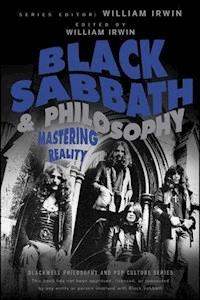
Black Sabbath and Philosophy E-Book
17,99 €
Mehr erfahren.
- Herausgeber: John Wiley & Sons
- Kategorie: Geisteswissenschaft
- Serie: The Blackwell Philosophy and Pop Culture Series
- Sprache: Englisch
A philosophical look at heavy metal's dark masters of reality, Black Sabbath Black Sabbath is one of the world's most influential and enduring rock bands. Dubbed "the Beatles of heavy metal" by Rolling Stone, they helped to define a genre with classic songs like "Paranoid", "Iron Man", and "War Pigs", songs whose lyrics reveal hidden depth and philosophical insight. Their songs confront existential despair, social instability, political corruption, the horrors of war, and the nature of evil. This book explores the wide range of profound ideas in the band's music and lyrics to help you understand Black Sabbath as never before. * Discusses and debates essential Black Sabbath topics and themes, such as the problem of evil, "War Pigs" and the nature of just war theory, whether or not Sabbath is still Sabbath without Ozzy, and whether "evil is in the ear of the beholder" * Gives you new perspectives on Black Sabbath's music and lyrics * Provides a deeper appreciation and understanding of Ozzy Osbourne, Tony Iommi, Geezer Butler, Bill Ward, and Ronnie James Dio * Brings some of history's heaviest thinkers to bear on the band's music, from Aristotle and Nietzsche to Schopenhauer and Marx So . . . can you help me, occupy my brain? Yes! Start reading Black Sabbath and Philosophy.
Sie lesen das E-Book in den Legimi-Apps auf:
Seitenzahl: 365
Veröffentlichungsjahr: 2012
Ähnliche




















Contents
Introduction
Acknowledgments
Part I NECESSARY EVIL
Chapter 1: Beyond Good and Evil
“Life Has No Meaning, and Death’s His Only Friend”
“I’ve Seen the Future and I’ve Left It Behind”
“I Just Believe in Myself, ’Cause No One Else Is True”
Unfinished Symphonies
Chapter 2: Masters of a Better Possible Reality
Evil Is a Problem
Pictures of Evil
Imagining a Better Reality
Evil on Stage
Chapter 3: “Is It the End, My Friend?” Black Sabbath’s Apocalypse of Horror
Birmingham Apocalypse
Last Things
Satan Smiling: War and Judgment
Sabbath Bloody Sabbath: Death and Deliverance
Planet Caravan: Journeys of Time and Space
The End Is Near
Part II PLAYING DEVIL’S ADVOCATE
Chapter 4: Black Sabbath and the Sound of Evil
Sinister Sounds
Ask Sabbath
(Fretting) Hand of Doom
“Going Through (Key) Changes . . .”
Sabbath Matters
Chapter 5: The Worst of All Possible Worlds
One Shot at Glory
But Against All Odds …
For Those Who Sow in Flames, an Explanation
The Original Diabolus in Musica
Some Final Seeds of Hate
Chapter 6: Tony Iommi’s Hand of Doom
The Phenomenology of Minds, Bodies, and Little Bits of Plastic
Tony Iommi’s Creative Freedom and the Birth of Heavy Metal
Part III THE DARK ART OF METAL
Chapter 7: The Art of Black Sabbath
Bringing Aristotle up to Date
Aristotle Joins Black Sabbath
The Need for Dark Art
The Need to Shake up Your Mind
Sweet Leaf?
Chapter 8: Black Sabbath and the Problem of Defining Metal
Why Do We Need Categories?
Metal Conditions?
All in the Sabbath Family
Black Sabbath as a Prototype for Heavy Metal
Go Forth and Find New Prototypes
Chapter 9: Saint Vitus Dance
The Devil’s Dictionary
What About Paint Vomited onto a Canvas?
Coughing Art
Was Doom in the Air?
Standards of Doom
Sons of Sabbath
Chapter 10: Gods, Drugs, and Ghosts
In Praise of Sweet Leaf and COKE-Cola
The Birth of Tragedy and the Birth of Heavy Metal
Goat Songs and Clowns
A Satanic Interlude
If Nietzsche Had Been a Black Sabbath Fan
What Is This That Stands Before Me?
Warning: Not for Mere Mortals
Part IV IS IT STILL SABBATH WITHOUT OZZY?
Chapter 11: It’s Not Sabbath Unless Ozzy’s the Singer (But It’s Fine If You Disagree)
Mastering Metaphysical Reality: Why Geezer Butler Isn’t a Plank of Wood
Behind the Wall of Thought Experiments
Avoiding the Fictional Seduction of Bad Metaphysics
Chapter 12: Fightin’ Words
Bands vs Line-Ups
A Sabbath By Any Other Name Would Be as Black
Going Through Changes
Criteria, Bloody Criteria
How Essential Is the Ozzman?
Which “Sabbath” Is Really Sabbath?
Chapter 13: The Name Remains the Same—But Should It?
On This Album, the Role of the Singer Will Be Played By …
I Saw It, I Saw It, I Tell You No Lies
Treating People Just Like Pawns in Chess
No Stranger to Record Companies
Sick and Tired … of Changes
Part V SYMPTOMS OF THE UNIVERSE
Chapter 14: Wicked World
“People Got to Work Just to Earn Their Bread”
“Day of Judgment, God Is Calling”
“Black Sabbath”
“The Wizard”
“N.I.B.”
“Wicked World”
“War Pigs”
Final Judgment
Chapter 15: “Demons, Dreamers, and Madmen”
Ozzy’s Insanity and Descartes’ Demon
How Not to Fall “Into the Void” of Skepticism
What Can Ozzy Know?
Is This Cause to Be Paranoid?
Chapter 16: “As the War Machine Keeps Turning”
War Is Hell
Why Should They Go Out to Fight?
Necessary Evil or Overkill?
Until the Day the War Drums Beat No More
When War Is Obsolete
“Win the Fight for Peace”
Chapter 17: Stop Stereotyping Sabbath
Let’s Not Be Hasty Here . . .
Practically Clubbing Women
Cavemen Get a Bad Rap and a Bad Rep
She Was My Woman . . . I Loved Her So . . .
Crunchy Pleasure
Contributors
Index
The Blackwell Philosophy and Pop Culture Series
Series Editor: William Irwin24 and PhilosophyEdited by Jennifer Hart Weed, Richard Davis, and Ronald Weed30 Rock and PhilosophyEdited by J. Jeremy WisnewskiAlice in Wonderland and PhilosophyEdited by Richard Brian DavisArrested Development and PhilosophyEdited by Kristopher Phillips and J. Jeremy WisnewskiThe Avengers and PhilosophyEdited by Mark D. WhiteBatman and PhilosophyEdited by Mark D. White and Robert ArpBattlestar Galactica and PhilosophyEdited by Jason T. EberlThe Big Bang Theory and PhilosophyEdited by Dean KowalskiThe Big Lebowski and PhilosophyEdited by Peter S. FoslThe Daily Show and PhilosophyEdited by Jason HoltFamily Guy and PhilosophyEdited by J. Jeremy WisnewskiFinal Fantasy and PhilosophyEdited by Jason P. Blahuta and Michel S. BeaulieuGame of Thrones and PhilosophyEdited by Henry JacobyThe Girl with the Dragon Tattoo and PhilosophyEdited by Eric BronsonGreen Lantern and PhilosophyEdited by Jane Dryden and Mark D. WhiteHeroes and PhilosophyEdited by David Kyle JohnsonHouse and PhilosophyEdited by Henry JacobyThe Hunger Games and PhilosophyEdited by George Dunn and Nicolas MichaudInception and PhilosophyEdited by David JohnsonIron Man and PhilosophyEdited by Mark D. WhiteMad Men and PhilosophyEdited by James South and Rod CarvethMetallica and PhilosophyEdited by William IrwinThe Office and PhilosophyEdited by J. Jeremy WisnewskiSouth Park and PhilosophyEdited by Robert ArpSpider-Man and PhilosophyEdited by Jonathan SanfordTerminator and PhilosophyEdited by Richard Brown and Kevin DeckerTrue Blood and PhilosophyEdited by George Dunn and Rebecca HouselTwilight and PhilosophyEdited by Rebecca Housel and J. Jeremy WisnewskiThe Ultimate Harry Potter and PhilosophyEdited by Gregory BasshamThe Ultimate Lost and PhilosophyEdited by Sharon KayeWatchmen and PhilosophyEdited by Mark D. WhiteX-Men and PhilosophyEdited by Rebecca Housel and J. Jeremy Wisnewski
This edition first published 2013© 2013 John Wiley & Sons, Inc.
Wiley-Blackwell is an imprint of John Wiley & Sons, formed by the merger of Wiley’s global Scientific, Technical and Medical business with Blackwell Publishing.
Registered OfficeJohn Wiley & Sons, Ltd, The Atrium, Southern Gate, Chichester, West Sussex, PO19 8SQ, UK
Editorial Offices350 Main Street, Malden, MA 02148-5020, USA9600 Garsington Road, Oxford, OX4 2DQ, UKThe Atrium, Southern Gate, Chichester, West Sussex, PO19 8SQ, UK
For details of our global editorial offices, for customer services, and for information about how to apply for permission to reuse the copyright material in this book please see our website at www.wiley.com/wiley-blackwell.
The right of William Irwin to be identified as the author of the editorial material in this work has been asserted in accordance with the UK Copyright, Designs and Patents Act 1988.
All rights reserved. No part of this publication may be reproduced, stored in a retrieval system, or transmitted, in any form or by any means, electronic, mechanical, photocopying, recording or otherwise, except as permitted by the UK Copyright, Designs and Patents Act 1988, without the prior permission of the publisher.
Wiley also publishes its books in a variety of electronic formats. Some content that appears in print may not be available in electronic books.
Designations used by companies to distinguish their products are often claimed as trademarks. All brand names and product names used in this book are trade names, service marks, trademarks or registered trademarks of their respective owners. The publisher is not associated with any product or vendor mentioned in this book. This publication is designed to provide accurate and authoritative information in regard to the subject matter covered. It is sold on the understanding that the publisher is not engaged in rendering professional services. If professional advice or other expert assistance is required, the services of a competent professional should be sought.
Library of Congress Cataloging-in-Publication Data
Black Sabbath and philosophy : mastering reality / edited by William Irwin. p. cm. – (The Blackwell philosophy and pop culture series) Includes bibliographical references and index.
ISBN 978-1-118-39759-6 (pbk.) – ISBN 978-1-118-39760-2 (emobi) – ISBN 978-1-118-39761-9 (epub) 1. Black Sabbath (Musical group) 2. Music and philosophy. 3. Rock music–History and criticism. I. Irwin, William, 1970– ML421.B57B54 2012 782.42166092′2–dc23
2012026658
A catalogue record for this book is available from the British Library.
Cover photograph: © Michael Ochs Archives/Getty ImagesCover design: Wendy Mount
Dedicated to Connie Santisteban, the muse of pop culture who has guided this book series
Introduction
“What Is This That Stands Before Me?”
The tape would stop in the middle of “N.I.B.” whenever Ozzy sang “My name is Lucifer, please take my hand.” That was enough to convince my 13-year-old self that something sinister was at work. The play button would pop up, and I would freak out. Together the songs produced a witches’ brew of guilt, fear, fascination, and intoxication. Listening to Sabbath I felt that I was doing something forbidden yet necessary, like losing my virginity. Maybe I should have heeded the tape’s ominous warning, but here I am 30 years later. Adolescent obsession has become adult appreciation.
We don’t just listen to Black Sabbath; we are haunted by them. The music and lyrics stay with us long after the songs stop playing. There is genius in the simplicity of the unforgettable riffs, and there is hidden depth in the lyrics, which confront existential despair, social instability, political corruption, the horrors of war, and the nature of evil. The name of the band is Black Sabbath, but don’t be misled. They are all about shades of gray. As with most great art, Sabbath’s songs are rich, suggestive, and ambiguous, often undercutting one message with its opposite. Sabbath flirt with the occult but embrace the divine. They tell cautionary tales of heroin’s hand of doom while themselves snowblind or high on sweet leaf. And they don’t passively plead to give peace a chance to the tune of jangling guitars; they rage in the “fight for peace” to the beat of war drums. Paradoxically, their anti-war lyrics, infused with hope and love, are sung to the tune of pounding, hyper-masculine music.
Black Sabbath are the Beatles of heavy metal. They changed everything. More than 40 years later, Sabbath’s music is still too aggressive for most people, and it’s still not played on the oldies station. But questions linger. What makes Sabbath sound evil? Is evil in the ear of the beholder? What personal and cultural conditions led them to create heavy metal? Is it still Black Sabbath without Ozzy? Is it still Black Sabbath when Tony Iommi is the only original member? We don’t aim to give the final word in answer to these questions, but we do aim to challenge the reader and stir the cauldron a bit.
Contrary to the Spinal Tap stereotype, Sabbath inspires deep thought. And this book brings together professional deep thinkers—most are philosophy professors by trade—to address some perennial questions. Philosophy is the love of wisdom; it is about discovering truth and facing reality. And, as it turns out, Plato, Aristotle, Schopenhauer, and Nietzsche can help us take Ozzy, Tony, Geezer, and Bill to a deeper level. But keep in mind that our interpretations of Sabbath’s lyrics aim to highlight the philosophical significance of the lyrics rather than to recover their original intention.
Each chapter is meant to stand alone. So, although the chapters have been arranged in an order that makes sense, they can be read in any order you choose. This also means that some of the chapters overlap in the biographical information they recount and the songs they discuss. You’ll read about the back streets of Birmingham and the opening lines of the song “Black Sabbath” more than once. The contributing authors don’t all agree with each other, and the reader certainly isn’t obliged to agree with their interpretations. This is more about questions and opinions than answers and facts.
Because of the excitement about the reunion of the original line-up announced on 11/11/11, this book focuses primarily on the Ozzy years. While that may disappoint some fans, the good news is that we have left the door open for a follow-up book, Heaven & Hell and Philosophy. Nor do we deal much with Ozzy’s solo career. So who knows? There may be two more books to come!
We’re taking Sabbath seriously and we’re not apologizing. So if you’d like to master reality, start reading Black Sabbath and Philosophy. We’ll introduce you to your mind.
Acknowledgments
They Sold Their Souls for Rock ‘n’ Roll
No book about Sabbath would be complete without liner notes. But you won’t find here a list of famous musicians or guitar manufacturers. Nothing so exciting. You will, though, find the names of some awesome people. If you ever have the chance to meet any of these folks you’ll be glad you did.
For taking me through a hole in the sky and dealing with my megalomania, I thank all my friends from the metal daze of my misspent youth, especially Sissy Dugan, Rob Guldner, J.R. Lombardo, Troy Marzziotti, and Joe Schmidt.
For providing great insight and saving me from making mistakes with this book, I thank James Bondarchuk, Per Broman, Jason Eberl, Søren R. Frimodt-Møller, Ted Gracyk, Joel McIver, and Sandy Shapshay.
For her unflagging enthusiasm and support, I thank Connie Santisteban and her team at Wiley. They have been a joy to work with on this book and on this series. I owe Connie and Co. a debt of gratitude that will not soon be repaid. For coming in to finish the job and bring this book through production and into stores, I thank Jeff Dean and his team at Wiley-Blackwell. I am very fortunate to work with such professionals.
For offering invaluable feedback on every chapter of this book, I thank Joseph Bongiorno, author of the forthcoming book, Black Sabbath: The Illustrated Lyrics. No one knows more about Sabbath’s lyrics than Joe.
For being a great team and for teaching me lots about both Sabbath and philosophy, I thank the contributing authors of this book. It has been a pleasure to work with you and I hope I’ll have the opportunity to work with you again.
I wish I could thank Ozzy, Tony, Geezer, and Bill for being personal friends of mine who helped make this book a reality. But to me they are larger-than-life figures before whom I would simply bow like Wayne and Garth, proclaiming that I’m not worthy. Still, I thank them for the music that means so much to me and without which this book would just have the rather silly title And Philosophy.
Most of all, I thank some people I know very well, my wife Megan from Mayberry and my two headbanging children, Daniel and Kate.
Part I
NECESSARY EVIL
Chapter 1
Beyond Good and Evil
Facing Your Demons With Black Sabbath and Existentialism
William Irwin
You know about the lost Black Sabbath album, right? They recorded it with Ozzy in 1999, but legal battles kept it from being released. It was supposed to be called Beyond Good and Evil. Here’s the track list:
Side A
Side B
Of course, as a never-say-die Sabbath fan, you know there is no lost album. Still, this could easily be a list of Sabbath song titles. What it really is, though, is a list of book titles, books written by existentialist philosophers: Søren Kierkegaard (1813–1855), Friedrich Nietzsche (1844–1900), Jean-Paul Sartre (1905–1980), and Albert Camus (1913–1960). As the titles indicate, the existentialists, like Sabbath, play with dark, macabre, and blasphemous themes.
Lesen Sie weiter in der vollständigen Ausgabe!
Lesen Sie weiter in der vollständigen Ausgabe!
Lesen Sie weiter in der vollständigen Ausgabe!
Lesen Sie weiter in der vollständigen Ausgabe!
Lesen Sie weiter in der vollständigen Ausgabe!
Lesen Sie weiter in der vollständigen Ausgabe!
Lesen Sie weiter in der vollständigen Ausgabe!
Lesen Sie weiter in der vollständigen Ausgabe!
Lesen Sie weiter in der vollständigen Ausgabe!
Lesen Sie weiter in der vollständigen Ausgabe!
Lesen Sie weiter in der vollständigen Ausgabe!
Lesen Sie weiter in der vollständigen Ausgabe!
Lesen Sie weiter in der vollständigen Ausgabe!
Lesen Sie weiter in der vollständigen Ausgabe!
Lesen Sie weiter in der vollständigen Ausgabe!
Lesen Sie weiter in der vollständigen Ausgabe!
Lesen Sie weiter in der vollständigen Ausgabe!
Lesen Sie weiter in der vollständigen Ausgabe!
Lesen Sie weiter in der vollständigen Ausgabe!
Lesen Sie weiter in der vollständigen Ausgabe!
Lesen Sie weiter in der vollständigen Ausgabe!
Lesen Sie weiter in der vollständigen Ausgabe!




