


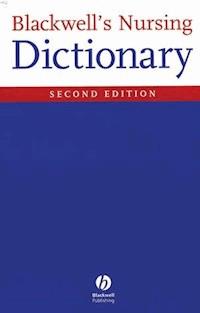
Blackwell's Nursing Dictionary E-Book
23,99 €
Mehr erfahren.
- Herausgeber: John Wiley & Sons
- Kategorie: Fachliteratur
- Sprache: Englisch
"This dictionary is clear, concise and easy to use…My advice to anyone wishing to purchase a nursing dictionary would be to…buy this one"
Journal of Advanced Nursing (on the first edition)
All the information you’ll ever need - in one dictionary!
Key features
* Over 15,000 entries
* Comprehensive - much more information than a pocket dictionary
* Informed by current nursing research and clinical practice
* Includes latest UK legislation and policy changes
* Accessible, authoritative and contemporary
* Invaluable and informative appendices
Appendices include:
· Normal values
· Lists of websites for key nursing journals and organizations
· The NMC code of professional conduct
· QAA benchmarking standards
· Nursing research, Information technology and emergency care
· Continuing professional development and PREP requirements
“very user friendly”
European Journal of Cancer Care (on the first edition)
Sie lesen das E-Book in den Legimi-Apps auf:
Seitenzahl: 2500
Veröffentlichungsjahr: 2013
Ähnliche




















CONTENTS
FOREWORD
LIST OF CONTRIBUTORS
ACKNOWLEDGEMENTS
PRONUNCIATION
ABBREVIATIONS
A
B
C
D
E
F
G
H
I
J
K
L
M
N
O
P
Q
R
S
T
U
V
W
X
Y
Z
APPENDICES
Appendix 1 NORMAL VALUES
1 Weights and measures
2 Temperature
3 Laboratory values
4 Fractions and multiples
5 Body mass index (BMI)
Appendix 2 USEFUL NURSING AND OTHER HEALTH-CARE ORGANIZATION ADDRESSES
Voluntary Organizations and Support Groups
Appendix 3 Nursing and other journals Sian Maslin-Prothero
1 General journals
2 Specialist journals
Appendix 4 NURSING AND MIDWIFERY COUNCIL CODE OF PROFESSIONAL CONDUCT
Appendix 5 EMERGENCY CARE
The unconscious patient
Cardiopulmonary resuscitation (CPR)
Disorders of airway and breathing
Choking
Asthma
Disorders of the circulation
Hypovolaemic shock
Cardiogenic shock
Anaphylactic shock
Fainting
Bleeding
Burning and scalds
Disorders of consciousness
Head injuries
Convulsions
Cerebral vascular disorders
Hypoglycaemia
Poisoning
Injury to bone, muscle or joints
Conclusion
Appendix 6 UNDERSTANDING AND IMPLEMENTING CLINICAL NURSING RESEARCH
Introduction
Defining clinical research
Working collaboratively: international research
Researching nursing practice
Methods for clinical research
Objectivity and subjectivity
Scientist-practitioner
Practitioner-researcher
Motivation for research
Using literature to underpin clinical practice
Developing critical appraisal skills and evaluating clinical research
Research governance: conducting research in clinical practice
Support for clinical research
Conclusion
Appendix 7 INFORMATION TECHNOLOGY IN NURSING AND HEALTHCARE
The place of computers in health care
Important issues for nurses
The way ahead
Conclusion
Appendix 8 CONTINUING PROFESSIONAL DEVELOPMENT AND PREP
The UKCC’s PREP requirements
The PREP (CPD) standard
The PREP (practice) standard
Auditing PREP
Recording CPD: Personal Professional Profile
Meeting the standard
Professional development
What are your personal professional development needs?
Common questions
Appendix 9 THE QUALITY ASSURANCE AGENCY FOR HIGHER EDUCATION: BENCHMARKING1
Foreword
An emerging health professions framework
A Expectations of the health professional in providing patient/client services
B The application of practice in securing, maintaining, or improving health and well-being
C Knowledge, understanding, and skills that underpin the education and training of health-care professionals
Benchmark statement for nursing
Nature and extent of programmes in nursing
A The nurse as a registered health-care practitioner; expectations held by the profession, employers and public
B Principles and concepts: applications to nursing practice
C Knowledge, understanding, and associated skills that underpin the education and training of nurses
Teaching, learning and assessment
Academic and practitioner standards
A Working as a professional in health care: expectations
B Principles and concepts: application
C Subject knowledge, understanding, and associated skills
© 1994 Blackwell Science, 2005 by
Blackwell Publishing Ltd
Editorial offices:
Blackwell Publishing Ltd, 9600 Garsington Road, Oxford OX4 2DQ, UK
Tel: +44 (0)1865 776868
Blackwell Publishing Asia Pty Ltd, 550 Swanston Street, Carlton, Victoria 3053, Australia
Tel: +61 (0)3 8359 1011
The right of the Authors to be identified as the Authors of this Work has been asserted in accordance with the Copyright, Designs and Patents Act 1988.
All rights reserved. No part of this publication may be reproduced, stored in a retrieval system, or transmitted, in any form or by any means, electronic, mechanical, photocopying, recording or otherwise, except as permitted by the UK Copyright, Designs and Patents Act 1988, without the prior permission of the publisher.
First published 1994
Reprinted 1997, 1998, 2001, 2002
Second edition published 2005
This second edition is a comprehensive revision of the first edition of Blackwell’s Dictionary of Nursing, first published in 1994. The first edition was updated and adapted from Duncan’s
Dictionary for Nurses by Helen A. Duncan, published by Springer Publishing Co. Inc., New York, in 1989. Permission for this adaption is acknowledged.
Library of Congress Cataloging-in-Publication Data is available
ISBN 1-4051-0534-8
A catalogue record for this title is available from the British Library
Set in 8 on 9pt Times
by Kolam Informations Services Pvt. Ltd, Pondicherry, India
by CPI Bath
The publisher’s policy is to use permanent paper from mills that operate a sustainable forestry policy, and which has been manufactured from pulp processed using acid-free and elementary chlorine-free practices. Furthermore, the publisher ensures that the text paper and cover board used have met acceptable environmental accreditation standards.
For further information on Blackwell Publishing, visit our website:
www.blackwellnursing.com
FOREWORD
It gives me great pleasure to introduce this edition of Blackwell’s Nursing Dictionary. Those contributing to this edition have produced an excellent textbook, one that will be an invaluable resource and practical guide for both students of nursing and more experienced nurses in clinical practice, research, policy and higher education.
The resources included in this edition cover an impressive range of useful information on professional practice. It includes normal definitions and measures, details of professional organisations and journals, continuing professional development, the Code of Professional Practice, the quality assurance framework for higher education and a guide to understanding and implementing clinical research in practice. The dictionary will, without doubt, add to our understanding of a range of professional issues in clinical practice across all areas of nursing.
The volume of information needed by nurses is increasing all the time, and more and more patients will turn to nurses for health-related information, trusting in them for appropriate help and support. There is a growing desire among patients and the public to take more control of their own health, and to have high quality personalised care, including better access to information and wider choice about their care and treatment. Most patients would like to be more involved in their care and provided with more information about their treatment, tests and investigations.
While much has been achieved, we still need to shift the culture of the NHS from one of dependency to one of increased independence and self care. The language we use – and the way we use it – is an important factor in shifting the balance of power in our relationships with patients and carers.
We need to ensure that patients and carers experience effective communication that is sensitive to their individual needs and preferences, and that it promotes high quality care for the patient.
This highlights the importance of using straightforward language, keeping information up to date and factual, and avoiding jargon and abbreviations in our day-to-day contact with patients and carers. We need to communicate technical and evidence-based information in a way that matches the patient’s level of understanding, checking that information given is understood and the meaning is the same for all involved. This will involve developing new relationships with patients, where we see information from the patient’s perspective, where information is reviewed by patients, carers and nurses to ensure it is accessible to them and applicable to their needs. We need to look at how we use information and develop a greater awareness of the use of language and its influence on our relationships with patients. Used effectively, it can be a key factor in establishing trusting relationships between patients and nurses.
The contributors have put together an excellent resource and a valuable tool for all areas of nursing. The real challenge lies in how we use this knowledge to build our relationships with patients and carers – so that they are fully engaged in their own care, the way it is planned and delivered, and personalised to their individual needs and choices.
Sarah MullallyChief Nursing OfficerDepartment of HealthEngland
LIST OF CONTRIBUTORS
Professor Dawn Freshwater PhD BA (Hons) RGN RNT FRCN DipPsych
Professor of Mental Health and Primary Care, IHCS, Bournemouth
University, UK, and Edith Cowan University, Perth, Australia
Dawn is Professor of Mental Health and Primary Care at IHCS Bournemouth University and is leading the development of an Academic Research Centre in Practice with North and Southwest Dorset NHS Trusts. Having completed her nurse training in 1983 she worked in both acute and community settings before undertaking her first degree at the Institute of Advanced Nurse Education, Royal College of Nursing, later completing her PhD at University of Nottingham. The focus of her work has been on critical reflexivity, practice-based research, and therapeutic practice, and she has successfully managed a number of funded research projects in these areas. It was for this work that she was awarded the Sigma Theta Tau Honor Society distinguished nurse researcher award (2000) and a Fellowship of the Royal College of Nursing (2002). She is widely published in her field, with her books being translated into other languages. She sits on a number of editorial boards and committees, including the International Association for Human Caring and the Florence Nightingale Foundation.
Garfield J. Griffiths BEd (Hons) DipN RN ONC RCNT
Senior Lecturer, University of the West of England, Bristol, UK
Garfield Griffiths qualified as a general nurse in South Wales (1970), he practised as a staff nurse on a male mixed speciality ward and went on to specialize in orthopaedics at The Royal National Orthopaedic Hospital, London. In 1973 he took up his first charge nurses post at The Prince of Wales Hospital, Wales. Three years later he became a clinical teacher to the orthopaedic course in that hospital. During this time he studied for the RCN Clinical Teachers Certificate and the London University Diploma in Nursing. His current post is senior lecturer at The University of the West of England, where he has held the roles of award route leader for the Diploma in Professional Studies Award and field leader for the post-qualifying modules.
Dr Sian E. Maslin-Prothero RN RM DipN CertEd MSc PhD
Senior Lecturer at the School of Nursing and Midwifery,
University of Southampton, UK
Sian has worked in academic, education, clinical nursing, and midwifery in a variety of settings in both the United Kingdom and overseas. She has a Master of Science degree from the University of Bristol and a Doctor of Philosophy from the University of Nottingham. Her research interests include policy and practice in the NHS, and the recruitment of women to breast cancer clinical trials, user and carer involvement in health and social care. Sian believes in helping individuals to fulfil their potential by fostering skills and strategies that encourage them to be creative, critical thinkers who can respond to the dynamic health-care environment and the requirements of users.
Abigail Masterson MN BSc RGN PGCEA
Abi has run her own consultancy company since January 1998. Prior to this she held clinical, education, and research posts in organizations including St. Bartholomew’s Hospital, the Royal College of Nursing, and the Department of Social Medicine and School for Policy Studies at the University of Bristol. She works with many local and national and international healthcare organizations to develop policies, review services, and carry out research into new roles and service developments across the healthcare professions. Abi has both a Bachelors and Masters degree in nursing, and has a varied list of publications, particularly in new role development, competence assessment, and health policy.
Les Storey FRCN RGN MSc PGDipHE
Principal Lecturer, Faculty of Health, University of Central Lancashire, UK
Les qualified in 1970 and spent over 14 years in operating theatres before moving into the fields of education and research. Since 1989 he has been involved nationally and internationally in the development and implementation of competency-based approaches within nursing and healthcare. He has been involved in managing a number of research and development projects, has published widely and presented papers at a number of international and national conferences. In 2000 he was conferred as a Fellow of the Royal College of Nursing for his work on competency-based education, and in 2001 was awarded the Edith Cavell scholarship by the Florence Nightingale Foundation.
ACKNOWLEDGEMENTS
When we agreed to undertake this project neither of us realized the amount of effort and concentration that would be required, not only of us, but also of the individuals who had agreed to provide their time and intellect. We would like to thank those people who have supported us in the development and completion of what we believe is a dictionary that is nursing focused, drawing on the dynamic and contemporary health-care context that we now enjoy. In particular, we would like to acknowledge Professor Veronica Bishop, Alison Twycross, Theo Stickley, Abi Masterson, Linda Antoniw Sarah Fisher, Julia Wynn, Tom Tait, Mary Foss, Liz Walsh, and Elizabeth Rosser. We would also like to thank Beth Knight and the staff at Blackwell Publishing for their encouragement and advice.
D.F.S.M-P.
The publishers would like to thank Nursing Times for permission to reproduce the handwashing diagram on page 55, reprinted from the sixth edition of The Royal Marsden Hospital Manual of Clinical Nursing Procedures, edited by Lisa Dougherty and Sara Lister and published in 2004 by Blackwell Publishing Ltd; and the Royal Marsden Hospital for permission to reproduce the figures from the same source on pages 494 and 596. Other illustrations in the Dictionary are taken from the following, all published by Blackwell Publishing, who would like to acknowledge their endebtedness to these authors:
Barrett, J. (1983) Accident and Emergency Nursing.
Bray, J.J. Cragg, P.A. Macknight, A.D.C. Mills, R.G. and Taylor, D.W. (1989) Lecture Notes on Human Physiology Second Edition.
Gibson, J. (1981) Modern Physiology and Anatomy for Nurses Second Edition.
Hickman, M. (1985) Midwifery Second Edition.
Middleton, D. (1986) Nursing 2.
Moffat, D.B. (1987) Lecture Notes on Anatomy.
Appendix 4 is reproduced by permission of the Nursing and Midwifery Council, and Appendix 9 by permission of The Quality Assurance Agency for Higher Education.
PRONUNCIATION
The system of pronunciation used has deliberately been kept simple. Words that the nurse might have difficulty pronouncing are broken down into their component syllables and respelled phonetically. The accented syllables are indicated by a slanting mark at their terminations (′).
Vowels
Vowels may be pronounced long or short. When short, they are unmarked and are pronounced as follows:
a
as in fat or father
o
as in for or hot
e
as in bed
oo
as in tool
i
as in fit
u
as in but
When long, they are given a long mark and are pronounced as follows:
ā
as in tame
ō
as in over
ā
as in he
ū
as in use
ī
as in time
Other long vowels are:
ah as in spa
ai as in air
aw as in saw
Words that end with y are usually pronounced as though they ended with a short i, as, for example, chemistry (kem′ -is-tri).
Consonants
Consonants ordinarily take the common English language pronunciation. When this is not the case, the word is respelled phonetically, for example:
c may be pronounced as s or k as in cicatrix (sik′ -a-triks)
ch may be pronounced as k as in psychosis (sī-k′ -sis)
g may be pronounced as j as in pharyngeal (far-in′ -jē-al)
ph is usually pronounced as f as in physical (fiz′ -i-kal)
psy is pronounced as sī as in psyche (sī′ -kē)
-sion may be pronounced shun as in compassion (kom-pa′shun) or zhun as in explosion (eks-plī′zhun)
-tion is usually pronounced shun.
ABBREVIATIONS
AA
Alcoholics Anonymous
ABC
airway, breathing, and circulation
Abd
abdomen
ABE
acute bacterial endocarditis
ABGs
arterial blood gases
ACE
angiotensin-converting enzyme
ACTH
adrenocorticotrophic hormone
ADH
antidiuretic hormone
ADHD
attention deficit hyperactivity disorder
ADL
activities of daily living
ADP
adenosine diphosphate
AF
atrial fibrillation
AFP
alpha-fetoprotein
AHF
antihaemophilic factor
AI
(1) aortic insufficiency; (2) artificial insemination
AID
artificial insemination using donor semen
AIDS
acquired immune deficiency syndrome
AIH
artificial insemination using husband’s semen
ALG
antilymphocyte globulin
ALS
(1) advanced life support; (2) amyotrophic lateral sclerosis; (3) antilymphocyte serum
AMP
adenosine monophosphate
ANF
antinuclear factor
ANOVA
analysis of variance
anti-HBc
antibody against hepatitis B core antigen
anti-HBe
antibody against hepatitis B e antigen
anti-HBs
antibody against hepatitis B surface antigen
APCL
accreditation (assessment) of prior certificated learning
APEL
accreditation (assessment) of prior experiential learning
APL
accreditation (assessment) of prior learning
APT
alum-precipitated diphtheria toxoid
ARC
AIDS-related complex
ASD
atrial septal defect
ASO
antistreptolysin O
ATP
adenosine triphosphate
ATS
antitetanus serum
ATT
antitetanus toxoid
A-V
atrioventricular
BA
Bachelor of Arts
BACP
British Association of Counselling and Psychotherapy
BAI
Beck anxiety inventory
BAOT
British Association of Occupational Therapists
BBB
blood–brain barrier
BCC
basal cell carcinoma
BCG
bacillus Calmette–Guérin
bd
bis die
(used in prescriptions, meaning twice daily)
BDI
Beck depression inventory
BEd
Bachelor of Education
BHS
Beck hopelessness scale
BIT
binary digit
BLS
basic life support
BMA
British Medical Association
BMI
body mass index
BMR
basal metabolic rate
BN
Bachelor of Nursing
BNF
British National Formulary
BP
blood pressure
BSc
Bachelor of Science
BSE
bovine spongiform encephalopathy
CAL
computer-assisted learning
CAPD
continuous ambulatory peritoneal dialysis
CARATS
Counselling, Assessment, Referral, Advice, and Throughcare Scheme
CAT
computerized axial tomography
CATS
Credit Accumulation Transfer System
CBT
cognitive behavioural therapy
CCETSW
Central Council for the Education and Training in Social Work
CCF
congestive cardiac failure
CCU
(1) coronary care unit; (2) cardiac care unit
CD
controlled drug
CDC
Centers for Disease Control (USA)
CD-ROM
compact disc read-only memory
CF
cystic fibrosis
CHAI
Commission for Health-care Audit and Inspection
CHC
Community Health Council
CHD
coronary heart disease
CHF
congestive heart failure
CHI
Commission for Health Improvement
CINAHL
Cumulative Index to Nursing and Allied Health Literature
CJD
Creutzfeldt–Jakob disease
CMHT
community mental health team
CMV
cytomegalovirus
CNO
Chief Nursing Officer
CNS
(1) central nervous system; (2) clinical nurse specialist
COAD
chronic obstructive airways disease
COPD
chronic obstructive pulmonary disease
COSHH
Control of Substances Hazardous to Health
CPA
Care Programme Approach
CPAP
continuous positive airways pressure
CPD
continuing professional development
CPK
creatinine phosphokinase
CPN
community psychiatric nurse
CPPIH
Commission for Patient and Public Involvement in Health
CPR
cardiopulmonary resuscitation
CPU
central processing unit
CRP
C-reactive protein
CSF
cerebrospinal fluid
CSP
Chartered Society of Physiotherapists
CSSD
Central Sterile Supplies Department
CSSU
Central Sterile Supply Unit
CT
computed tomography
CV
curriculum vitae
CVA
cerebrovascular accident
CVP
central venous pressure
CVS
(1) cardiovascular system; (2) chorionic villus sampling
CXR
chest x-ray
D and C
dilatation and curettage
DASE
Denver Articulation Screening Examination
DBT
dialectical behavioural therapy
DC
direct current
DDA
Disability Discrimination Act
DES
diethylstilboestrol
DI
donor insemination
DIC
disseminated intravascular coagulation
DipHE
Diploma in Higher Education
DipEd
Diploma in Education
DipN
Diploma in Nursing
DipNEd
Diploma in Nursing Education
DLCC
Disabled Living Centres Council
DN
district nurse
DNA
deoxyribonucleic acid
DOA
death on arrival
DOH
Department of Health
DPhil
Doctor of Philosophy
DPT
diphtheria–pertussis–tetanus (vaccine)
DQ
developmental quotient
DRC
Disability Rights Commission
DSM IV
Diagnostic and Statistical Manual of Mental Disorders
, 4th edition
DSPD
dangerous and severe personality disorder
DTP
diphtheria–tetanus–pertussis (vaccine)
DTs
delerium tremens
DVT
deep vein thrombosis
EBL
enquiry-based learning
EBM
evidence-based medicine
EBP
evidence-based practice
EC
European Community
ECG
electrocardiogram
ECT
electroconvulsive therapy
ECV
external cephalic version
EDD
expected date of delivery
EDTA
ethylenediamine-tetra-acetic acid
EEG
electroencephalogram
EKG
electrocardiogram
ELISA
enzyme-linked immunosorbent assay
EMG
electromyogram
ENT
ear, nose and throat
ERG
electroretinogram
ERPC
evacuation of retained products of conception
ESR
erythrocyte sedimentation rate
EU
European Union
EUA
examination under anaesthetic
FBC
full blood count
FBS
fasting blood sugar
FEV
forced expiratory volume
FPCert
Family Planning Certificate
FRC
functional residual capacity
FRCGP
Fellow of the Royal College of General Practitioners
FRCN
Fellow of the Royal College of Nursing
FRCOG
Fellow of the Royal College of Obstetricians and Gynaecologists
FRCP
Fellow of the Royal College of Physicians
FRCPath
Fellow of the Royal College of Pathologists
FRCPE
Fellow of the Royal College of Physicians of Edinburgh
FRCPI
Fellow of the Royal College of Ireland
FRCPsych
Fellow of the Royal College of Psychologists
FRCR
Fellow of the Royal College of Radiologists
FRCS
Fellow of the Royal College of Surgeons
FRCSE
Fellow of the Royal College of Surgeons of Edinburgh
FRCSI
Fellow of the Royal College of Surgeons of Ireland
FSH
follicle-stimulating hormone
FVC
forced vital capacity
GABA
gamma-aminobutyric acid
GFR
glomerular filtration rate
GGTP
gamma-glutamyl transpeptidase
GH
growth hormone
GHIH
growth hormone inhibiting hormone
GHRH
growth hormone releasing hormone
GI
gastrointestinal
GIFT
gamete intrafallopian transfer
GM
genetically modified
GMC
General Medical Council
GP
general practitioner
GSCC
General Social Care Council
GTN
glyceryl trinitrate
GUM
genitourinary medicine
GVHD
graft-versus-host disease
HAZ
Health Action Zone
Hb
haemoglobin
HBcAg
hepatitis B core antigen
HBeAg
hepatitis B e antigen
HBIG
hepatitis B immunoglobulin
HBsAg
hepatitis B surface antigen
HBV
hepatitis B virus
HC
head circumference
HCA
health-care assistant
hCG
human chorionic gonadotrophin
HCO
health-care officer
HCV
hepatitis C virus
HDL
high-density lipoprotein
HDU
high dependency unit
HEI
higher education institutions
HGC
Human Genetics Commission
Hib vaccine
Haemophilus influenzae
type B vaccine
HImP
Health Improvement Programme
HIV
human immunodeficiency virus
HMSO
Her Majesty’s Stationery Office
HoNOS
Health of the Nation Outcome Scale
HPC
Health Professions Council
HPV
human papilloma virus
HRT
hormone replacement therapy
HSV
herpes simplex virus
HTLV
human T-cell leukaemia–lymphoma virus
HV
health visitor
HVCert
Health Visitor’s Certificate
HTML
hypertext markup language
IBD
inflammatory bowel disease
IBS
irritable bowel syndrome
ICAS
Independent Complaints Advocacy Service
ICD
International Classification of Diseases
ICN
International Council of Nurses
ICPs
integrated care pathways
ICU
Intensive Care Unit
IDDM
insulin dependent diabetes mellitus
IM&T
information management and technology
IPPB
intermittent positive pressure breathing
IPPV
intermittent positive pressure ventilation
IPV
inactivated poliovirus vaccine
IQ
intelligence quotient
IRP
Independent Reconfiguration Panel
IT
information technology
ITU
intensive therapy unit
IU
International Unit
IUCD
intrauterine contraceptive device
IUD
intrauterine device
IV
intravenous
IVF
in vitro
fertilization
IVI
intravenous infusion
IVP
intravenous pyelogram
IVT
intravenous therapy
LDH
lactic acid dehydrogenase
LDP
Local Delivery Plan
LFT
liver function test
LH
luteinizing hormone
LHRH
luteinizing hormone releasing hormone
LMP
last menstrual period
LREC
Local Research Ethics Committee
LRT
lower respiratory tract
LSD
lysergic acid diethylamide
LSP
Local Strategic Partnership
LVF
left ventricular failure
MA
Master of Arts
MAO
monoamine oxidase
MBA
Master of Business Administration
MCH
mean cell haemoglobin
MCV
mean cell volume
MD
Doctor of Medicine
MDMA
methylenedioxymethamphetamine
ME
myalgic encephalomyelitis
MEd
Master of Education
MI
myocardial infarction
MIND
National Association for Mental Health
MMR
measles, mumps, and rubella vaccine
MPhil
Master of Philosophy
MRC
Medical Research Council
MREC
Multi Research Ethics Committee
MRI
magnetic resonance imaging
MRSA
methicillin-resistant
Staphylococcus aureus
MRV
minute respiratory volume
MS
multiple sclerosis
MSc
Master of Science
MSU
midstream specimen of urine
NA
Nomina Anatomica
NatPaCT
National Primary and Care Trust Development
NBM
nil (nothing) by mouth
NCSC
National Care Standards Commission
NCVQ
National Council for Vocational Qualifications
NDU
Nursing Development Unit
NEC
necrotizing enterocolitis
NeLH
National Electronic Library for Health
NG
nasogastric
NHS
National Health Service
NHSCRD
National Health Service Centre for Reviews and Dissemination
NICE
National Institute for Clinical Excellence
NICU
neonatal intensive care unit
NIDDM
non-insulin-dependent diabetes mellitus
NIPPV
non-invasive positive pressure ventilation
NMC
Nursing and Midwifery Council
NMR
nuclear magnetic resonance
NPN
non-protein nitrogen
NREM
non-rapid eye movements
NRR
National Research Register
NSAIDs
non-steroidal anti-inflammatory drugs
NSFs
National Service Frameworks
NTO
National Training Organisation
NVQ
National Vocational Qualification
ONS
Office of National Statistics
OPCS
Office of Population Censuses and Surveys
OR
odds ratio
OTC
over the counter
PAF
performance assessment framework
PALS
Patient Advice and Liaison Service
PBL
problem-based learning
p.c.
after meals
PCA
patient-controlled analgesia
PCG
Primary Care Group
PCO
2
partial pressure of carbon dioxide
PCR
practitioner-centred research
PCT
Primary Care Trust
PD
personality disorder
PEEP
positive end expiratory pressure
PFI
Private Finance Initiative
PPD
Purified Protein Derivative
PREP
Post-Registration Education and Practice
p.r.n.
whenever necessary
PROMIS
problem-oriented medical information
PSI
psycho-social intervention
PTSD
post-traumatic stress disorder
PUO
pyrexia of undetermined origin
PV
polycythaemia vera
PVC
premature ventricular contraction
QAA
Quality Assessment Agency for Higher Education
QCA
Qualifications and Curriculum Authority
QUALYs
quality adjusted life years
RAE
Research Assessment Exercise
RCTs
randomized controlled trials
REM
rapid eye movements
RNA
ribonucleic acid
SAD
seasonal affective disorder
SARS
severe acute respiratory syndrome
SCBU
special care baby unit
SCID
severe combined immunodeficiency disease
SCM
State Certified Midwife
SCOTEC
Scottish Technical Education Council
SD
standard deviation
SE
standard error
SHO
senior house officer
SIDS
sudden infant death syndrome
SNOMED
Systemized Nomenclature of Medicine
SPSS
Statistical Package for Social Sciences
SQA
Scottish Qualifications Authority
SRN
State Registered Nurse
stat
statim
STD
sexually transmitted disease
STI
sexually transmitted infection
SVQ
Scottish Vocational Qualification
SVT
supraventricular tachycardia
TABS
temperature, airway, beathing, sugar
TB
tuberculosis (tubercle bacillus)
tds
three times daily
TEDs
thrombo embolic deterrent (stockings)
TENS
transcutaneous electrical nerve stimulation
TIA
transient ischaemic attack
TOP
termination of pregnancy
TOPV
trivalent oral poliovirus vaccine
TPI
Treponema pallidum
immobilization (test)
TPN
total parenteral nutrition
TPR
temperature, pulse, respiration
TQM
total quality management
TRIC
trachoma and inclusion conjuctivitis
TSH
thyroid-stimulating hormone
TURP
transurethral resection of tumour
TV
tidal volume
UKCC
United Kingdom Central Council for Nursing, Midwifery and Health Visiting
ung
unguent
(ointment)
UNICEF
United Nations International Children’s Fund
UTI
urinary tract infection
UVA
ultraviolet light A
UVB
ultraviolet light B
VC
vital capacity
vCJD
variant Creutzfeldt-Jakob disease
VDU
visual display unit
VF
ventricular fibrillation
VSD
ventricular septal defect
VSO
Voluntary Service Overseas
VT
ventricular tachycardia
WBC
white blood cells/count
WDC
Workforce Development Confederation
WHO
World Health Organization
WTE
Whole Time Equivalent
www
world wide web
ZIFT
zygote intrafallopian transfer
A
Ar: Chemical symbol for argon.
a-; an-: Prefixes denoting absence, separation, away, away from, without, not, less, lacking, lack of; a — when used before a consonant; an—when before a vowel.
AA: Abbreviation for Alcoholics Anonymous (q.v.).
ab-: Prefix denoting absent, away from, off, negative, separation, departure from, outside, deviating from.
abacterial (ā-bak-tā′ -ri-al): Without bacteria; free from bacteria. A. MENINGITIS aseptic meningitis, see under MENINGITIS.
abaragnosis (a-bar-og-nō′ -sis): Lack or loss of the conscious perception of weight, or of the ability to estimate weight.
abarthrosis (ab-ar-thrō′ -sis): Diarthrosis (q.v.).
abarticulation (ab′ -ar-tik-ū-lā′ -shun): 1. The dislocation of a joint. 2. A synovial or freely movable joint; e.g., the hip. See DIARTHROSIS.
abasia (a-bā′ -zi-a): Inability to walk, or unsteadiness of gait, due to motor incoordination. ASTASIA A. see under ASTASIA. — abasic, abatic, adj.
abatement (a-bāt′ -ment): A decrease or lessening of a symptom or of pain. — abate, v.
Abbott-Miller tube: A long double-lumen intestinal tube with an inflatable balloon attached to the distal end; used in certain diagnostic tests, to treat an obstruction in the small intestine, and to relieve distension of the intestine.
ABC: In emergency medicine, refers to Airway, Breathing, and Circulation in regard to priority of care.
Abd: Abbreviation for abdomen (q.v.).
abdomen (ab′ -do-men): The belly. The largest body cavity; lies between the thorax, from which it is separated by the diaphragm, and the pelvis; is enclosed by a wall made up of muscles, the vertebral column and the two ilia; contains the stomach, small and large intestine, liver, gallbadder, pancreas, spleen, the descending aorta and inferior vena cava, and (behind the peritoneum) the kidneys and ureters. It is lined with a serous membrane, the peritoneum, which is also reflected over most of the organs as a cover. ACUTE A. term for a pathological condition within the belly that requires immediate surgery; PENDULOUS A. that which occurs when the anterior wall relaxes and the abdomen sags or hangs down; SCAPHOID A. an A. in which the anterior wall ‘caves in’. — abdominal, adj. See .
Lesen Sie weiter in der vollständigen Ausgabe!
Lesen Sie weiter in der vollständigen Ausgabe!
Lesen Sie weiter in der vollständigen Ausgabe!
Lesen Sie weiter in der vollständigen Ausgabe!
Lesen Sie weiter in der vollständigen Ausgabe!
Lesen Sie weiter in der vollständigen Ausgabe!
Lesen Sie weiter in der vollständigen Ausgabe!
Lesen Sie weiter in der vollständigen Ausgabe!
Lesen Sie weiter in der vollständigen Ausgabe!
Lesen Sie weiter in der vollständigen Ausgabe!
Lesen Sie weiter in der vollständigen Ausgabe!
Lesen Sie weiter in der vollständigen Ausgabe!
Lesen Sie weiter in der vollständigen Ausgabe!
Lesen Sie weiter in der vollständigen Ausgabe!
Lesen Sie weiter in der vollständigen Ausgabe!
Lesen Sie weiter in der vollständigen Ausgabe!
Lesen Sie weiter in der vollständigen Ausgabe!
Lesen Sie weiter in der vollständigen Ausgabe!
Lesen Sie weiter in der vollständigen Ausgabe!
Lesen Sie weiter in der vollständigen Ausgabe!
Lesen Sie weiter in der vollständigen Ausgabe!
Lesen Sie weiter in der vollständigen Ausgabe!
Lesen Sie weiter in der vollständigen Ausgabe!
Lesen Sie weiter in der vollständigen Ausgabe!
Lesen Sie weiter in der vollständigen Ausgabe!
Lesen Sie weiter in der vollständigen Ausgabe!
Lesen Sie weiter in der vollständigen Ausgabe!
Lesen Sie weiter in der vollständigen Ausgabe!
Lesen Sie weiter in der vollständigen Ausgabe!
Lesen Sie weiter in der vollständigen Ausgabe!
Lesen Sie weiter in der vollständigen Ausgabe!
Lesen Sie weiter in der vollständigen Ausgabe!
Lesen Sie weiter in der vollständigen Ausgabe!
Lesen Sie weiter in der vollständigen Ausgabe!
Lesen Sie weiter in der vollständigen Ausgabe!
Lesen Sie weiter in der vollständigen Ausgabe!
Lesen Sie weiter in der vollständigen Ausgabe!
Lesen Sie weiter in der vollständigen Ausgabe!
Lesen Sie weiter in der vollständigen Ausgabe!
Lesen Sie weiter in der vollständigen Ausgabe!




