


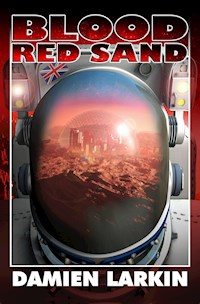
4,75 €
Mehr erfahren.
- Herausgeber: Dancing Lemur Press LLC
- Kategorie: Fantasy und Science-Fiction
- Sprache: Englisch
Mars will run red with Nazi blood…
After World War Two, Sergeant McCabe knew the British army could send him anywhere. He never imagined facing down another Nazi threat on Mars.
In New Berlin colony, rivalry between Generalfeldmarschall Seidel’s Wehrmacht and Reichsführer Wagner’s SS threatens bloodshed. The Reichsführer will sacrifice everything to initiate the secretive Hollow Programme and realise his nightmarish future for humanity.
McCabe, Private Jenkins, and the Mars Expeditionary Force must overcome bullet, bomb, and bayonet to destroy the Third Reich. While Jenkins fights to stay alive, McCabe forms an uneasy alliance with MAJESTIC-12 operatives known as the Black Visors. Will this be the final battle of World War Two or the first confrontation in an interstellar war?
Sie lesen das E-Book in den Legimi-Apps auf:
Seitenzahl: 413
Veröffentlichungsjahr: 2021
Ähnliche

















Damien Larkin
DANCING LEMUR PRESS, L.L.C.
Pikeville, North Carolina
“I’m awed by Damien Larkin’s imagination… So truly Heinlein.” – Phil Parker, author
“The many combat scenes keep the pages turning…” - Publisher’s Weekly
“Brilliant follow up to Big Red.” – Tripp Ainsworth, author
“Blood Red Sand is top class military sci-fi with plenty of heart pounding action sequences, excellent characterisation and a growing sense of mystery that readers will crave to uncover.” – Book Nest
“Non-stop action and mayhem” – Alex J. Cavanaugh, author
“An entertaining and pacy read and like the previous book 'Big Red'…” – S.D. Howarth
“Blood Red Sand is an absolutely brilliant science-fiction novel, one that’s simultaneously delightfully and unapologetically pulpy with a fantastic dieselpunk aesthetic, and yet also has a much more nuanced and complex background that Larkin carefully orchestrates and reveals in the latter half of the novel.” - SciFi and Fantasy Reviewer
“It was amazing…reads like a WWII story meets Doctor Who meets Quantum Leap…” – Sue Tingey
“This book has everything a science fiction fan wants; it has awesome technology, conflicted heroes, savage villains, a strange world, and an unknown future.” – Paper Never Refused Ink
“The action and violence is visceral. the world building is great, and once again we're given head scratching twists.” – Bar Corcoran
“A pulse-pounding, frenetic novel goes out on a high note and a bang, leaving the reader wanting to see where else this crazy story can go.” – C.D. Gallant-King, author
“…this is a high octane, full-throttle ride. Once the bullets start flying, they don't stop until the end. Larkin does a phenomenal job conveying the fear, confusion, and utter carnage of war.” – Charity Bradford, author
“The mix of history, science fiction and 'what if' makes for an exciting read… What I praise Damien most highly for is his ability to balance the fighting with the science fiction elements and still achieve complex characterisation. Nailed it.” - PS Livingston
“…the action NEVER ends in Blood Red Sand and will keep you reading and guessing til the last page.” – Michael Packard
Copyright 2021 by Damien Larkin
Published by Dancing Lemur Press, L.L.C.
P.O. Box 383, Pikeville, North Carolina, 27863-0383
http://www.dancinglemurpressllc.com/
ISBN 9781939844798
All rights reserved. No part of this publication may be reproduced, transmitted, or stored in a retrieval system in any form–either mechanically, electronically, photocopy, recording, or other–except for short quotations in printed reviews, without the permission of the publisher.
This book is a work of fiction. Any resemblance to actual events or persons, living or dead, is coincidental.
Cover design by C.R.W.
Library of Congress Cataloging-in-Publication Data
Names: Larkin, Damien, author.
Title: Blood red sand / Damien Larkin.
Description: Pikeville, North Carolina : Dancing Lemur Press, L.L.C.,
[2021] | Summary: "Mars will run red with Nazi blood... After World War
Two, Sergeant McCabe knew the British army could send him anywhere. He
never imagined facing down another Nazi threat on Mars. In New Berlin
colony, rivalry between Generalfeldmarschall Seidel's Wehrmacht and
Reichsführer Wagner's SS threatens bloodshed. The Reichsführer will
sacrifice everything to initiate the secretive Hollow Programme and
realise his nightmarish future for humanity. McCabe, Private Jenkins,
and the Mars Expeditionary Force must overcome bullet, bomb, and bayonet
to destroy the Third Reich. While Jenkins fights to stay alive, McCabe
forms an uneasy alliance with MAJESTIC-12 operatives known as the Black
Visors. Will this be the final battle of World War Two or the first
confrontation in an interstellar war?"-- Provided by publisher.
Identifiers: LCCN 2020054750 (print) | LCCN 2020054751 (ebook) | ISBN
9781939844781 (paperback) | ISBN 9781939844798 (ebook)
Subjects: LCSH: Nazis--Fiction. | Mars (Planet)--Fiction. | GSAFD:
Alternative histories (Fiction). | War stories. | Science fiction.
Classification: LCC PR6112.A746 B58 2021 (print) | LCC PR6112.A746
(ebook) | DDC 823/.92--dc23
LC record available at https://lccn.loc.gov/2020054750
LC ebook record available at https://lccn.loc.gov/2020054751
Dedicated to Commandant Pat Quinlan, and all the men of ‘A’ Company, 35thInfantry Battalion, Óglaigh na hÉireann (Irish Defence Forces) for their heroic actions during the siege of Jadotville. Thank you for your service. You will never be forgotten again. Further dedicated to the twenty-six Irish soldiers who gave their lives in the service of peace with Opération des Nations Unies au Congo (ONUC) 1960 – 1964.
TABLE OF CONTENTS
PART 1: TERRA’S BURDEN
PART 2: SAVAGE WARS OF PEACE
PART 3: KILL THEM ALL
PART 4: WOE TO THE VANQUISHED
PART 5: WE HAVE ALWAYS BEEN HERE
PART 1:
TERRA’S BURDEN
THE WHITE HOUSE, WASHINGTON DC
26TH JULY 1952
21.33 EST
The blazing streak of light ripped across the Washington sky, coming to a momentary halt over the White House. What could easily have been mistaken as a meteor now looked like a fiery star as a vessel hovered within General Hoyt Vandenberg’s eyeline. Tapping his finger on the window in the Oval Office, he glanced at President Truman. His commander-in-chief’s hand curled into a fist. Returning his attention to the spectacle outside, Vandenberg wondered how many eyes glared at them from within that blinding light, mocking everything the American people stood for. As quickly as that thought appeared, the vessel zipped off across the night sky again, turning and twisting in impossible zigzag patterns, showcasing its manoeuvrability.
“Same as last week, Mr. President,” Captain Ruppelt said, while leafing through the dossier in front of him.
“It’s the damned nerve of these Germans, Ed,” Truman snapped as he stepped away from the window. “It’s like slapping a man square in the face and then running away before he can hit you back. Damn cowardly.”
Vandenberg picked up his glass of scotch. “We can hit them anytime you like, Mr. President.”
Taking his seat behind the Resolute Desk, Truman nodded. Reaching for his own glass of bourbon, he turned about and continued to gaze at the streaks of light dancing and weaving across the Washington skyline.
“Don’t tempt me, Hoyt,” he said after an exasperated sigh. “I’d like nothing better than to give the order to shoot those Nazi dogs down, but we can’t show our hand too early, can we? No. We’ll have to let the Nazis have their damned moment. How are we on the development of our fleet?”
Vandenberg loosened the collar of his pristine uniform and paced towards the side of the desk. Searching for the right words, he walked around the Oval Office, and his gaze fell over the numerous pictures and monuments. Now, more than ever, this latest provocation by the exiled Nazi forces over the capital of the United States gave him the opportunity to take decisive action. He just had to sell it to the president.
“Construction is proceeding ahead of schedule, sir.” He moved closer to the window again and peered out. “It was a tough job for Wernher von Braun and the rest of Majestic-12 to reverse engineer the downed Nazi craft we recovered from Roswell, but my MJ-12 boys have created something spectacular. Our ships won’t be as fast as what the Germans have, but they’ll contain a lot more firepower. More importantly, they’ll have the room to ferry ground troops.”
President Truman turned in his seat, grabbed his glass, and took a sip of bourbon as he looked up at Vandenberg. “This again, Hoyt? I thought we’ve been over it. The commies will cry bloody murder if we dispatch American soldiers to Mars, and I’ll be damned if I let the Reds have the glory of fighting Earth’s first interplanetary war. Imagine that, Hoyt. The Reds on the Red Planet. Think of the propaganda victory, even if they did get there using American ships. I won’t sanction it. If it means putting up with Nazi shows of force like this, so be it.”
Vandenberg watched from the corner of his eye as President Truman pulled himself to his feet again and glared out the window. He knew the president well enough to understand that he simmered with anger more than he let on. Only a handful of people on the planet knew the truth about the end of World War Two and the Nazi leadership’s escape to colonies on Mars.
Even fewer knew of the strange, alien technology the Nazis used to make their escape and rebuild their fighting capacity. With all the resources the American government had at their disposal, Majestic-12 still hadn’t cracked the surface of the exiled Germans’ newfound technological prowess. But if there could be one thing Vandenberg remained certain about, it was that they couldn’t learn more until they seized control of Mars.
“We have another option, Mr. President,” Vandenberg said, causing Truman to look over at him. “At your behest, I’ve been continuing negotiations with my Soviet counterpart, and I believe we’ve had a breakthrough.”
He nodded at Captain Ruppelt, who rose to his feet from the couch in the centre of the room. Ruppelt selected one of the thick paper dossiers laid out in front of them, crossed the floor, and handed the files to Vandenberg.
Vandenberg took the dossier and passed it to the president. “The main argument we’ve been having with the Ruskies is who gets the glory. They don’t want our troops up there in case the rest of the world finds out that capitalists were the first to conquer another planet. Likewise, the last thing we want is a Soviet Republic of Mars. Neither side wants to fight side by side in case we infect each other with our respective ideologies.”
“Leading to what, Hoyt?” Truman asked as he leafed through the dossier.
Vandenberg approached the side of the Resolute Desk. “We use a proxy force, sir. We use a body of soldiers from countries that neither side fears as a real-world opponent to do the actual fighting. To get to the point, Mr. President, the Soviets are happy to proceed with my plan using British and French soldiers to do the dirty work.”
Truman tore away from his reading and looked up at Vandenberg with wide eyes and a gaping mouth. Rubbing his hand across his chin, he shook his head in disbelief. “The British and the French? After everything they’ve been through in the last decade? You must be joking, Hoyt. April Fool’s Day was months ago.”
“If I may, Mr. President, it’s all there in front of you. We utilise experienced, well-trained soldiers from countries that can’t interfere with our overall strategic goals. We use American ships and personnel to ferry them there, with both sides sending along military attaches for operational experience. The Soviets have agreed to the overall mission being under nominal Air Force control, since we own the fleet, but it’ll be MJ-12 and I that call the shots.”
President Truman reached for his glass again and emptied it in a single swallow. He quickly refilled it and took a momentary glimpse at the streaking lights racing across the sky outside before returning his attention back to Vandenberg. “You’re serious about this?”
“Yes, sir, Mr. President,” Vandenberg said with an affirmative nod. “It’s all there in black and white. We’ll have the fleet constructed by early next year. Factoring in a ten-month travel time, our forces will arrive in early 1954. We need to keep the Germans talking till then, maybe ensure one or two of their ships disappear to keep them on their toes. It’s doable, sir. My contacts within the British and French military have already signed off on it. We just need your signature.”
President Truman returned his focus to the dossier in front of him and continued to leaf through the pages. He scanned the words and studied the various graphs, maps, and bullet points of the plan.
“And your mole within this New Berlin colony, you believe they’re the real deal?” President Truman said.
“Yes, sir,” Vandenberg said, trying to conceal the hope that built in his voice. “We don’t know the mole’s identity, but we believe he’s a member of the Jewish resistance on Mars. Whoever he is, he’s given us full access to enemy troop movements, strength, and capabilities. He’s also committed to leading an uprising as soon as we land to tie the German forces down. Sir, this will be like a walk in the park.”
“All right,” President Truman said and picked up his pen. “If you say it can be done, do it.”
Vandenberg tried to look sombre as the president added his signature to the page and handed the dossier back to him. Biting down on the inside of his cheek to mask a victorious smile, he nodded at President Truman and turned to deliver the news to the rest of Majestic-12.
Soon, the rightful masters of the Red Planet would return to reclaim what had always been theirs.
ABOARD THE USAF NORTH CAROLINA, ORBITING MARS
15TH MARCH 1954
08.23 MST (MARS STANDARD TIME)
DAY 1
The deafening shriek of the siren filled Sergeant William McCabe’s ears and snapped him awake. The sickly-sweet smell that permeated his dreams receded as the fluid leaked from his capsule. Forcing his eyes open, he fought the urge to pry at the capsule door and remembered his training. He waited until his sleeping pod came fully upright and watched the last of the fluid empty through a grate at his feet. After removing the breathing mask covering his face, he paused until the light hanging over the transparent door of his pod turned green, and then he pulled down on the latch. He stumbled out of the capsule and fell onto his knees. The sounds of men shouting, roaring, and vomiting filled his ears.
“Remember your training,” he gasped in between dry retches. “Breathe through it, lads.”
Grunts, groans, and the splash of vomit hitting the grated floor echoed back at him in response. Willing his legs to work, he forced himself to his feet and grabbed at the capsule door for support. Trying to overcome the wave of nausea and disorientation that followed his escape from the sleeper pod, McCabe glanced around at his platoon. A quick headcount showed all looked to be alive, although every one of them worse for wear. The scientists had warned them of the effects of ten months in suspended animation, but their words did little justice to the horror of those first few moments.
“On your feet,” he ordered, trying to put as much steel in his voice as he could muster. “Mars Expeditionary Force or not, you’re Her Majesty’s soldiers. Start acting like it. Corporals, take charge. I want everyone ready for parade in ten.”
McCabe pulled open his locker beside his sleeper pod, removed his Lee-Enfield rifle, and leaned it up against the open pod door. Using a towel, he wiped his face and hair dry. After unzipping the one-piece body suit that covered him up to his neck, he dried himself and dragged on his battledress. As the seconds passed, his vision focused more, and the fog dispersed from his head.
“Jenkins,” he called out and paused to place a cigarette between his lips. “Stick on a pot of tea like a good lad.”
“Yes, Sergeant,” Private Jenkins called back.
Striking a match, McCabe lit his cigarette and then finished tying his boots. After a few minutes, Jenkins appeared with a plastic cup of scalding hot tea before scuttling back to his pod to finish dressing. Around him, and over the shouts of the corporals, soldiers bustled back and forth, eager to get their equipment ready for inspection.
With his battledress donned and his weapon at hand, he pulled open the drawer at the foot of his locker and studied the white EVA suit that gleamed up at him. He dragged the bottom half of the EVA suit over his legs and up to his waist before connecting the upper half. With everything secured, he slipped on the helmet and took a moment to get used to the bulkiness of it. Once he secured his backpack, he hooked the sling of his Lee-Enfield No. 5 Mk 2 rifle and patted the sleek features of the so-called ‘Jungle Carbine.’
“Sarge,” a voice rang out from across the room. “I think there’s a problem with my EVA suit.”
“What is it, Jenkins?” McCabe said and tapped at the console on his left arm.
“Well,” Jenkins started, “not to be smart or anything, Sergeant—”
“God forbid, Jenkins,” Private Murphy chimed in to muted laughter.
“Nah, I’m being serious,” Jenkins continued, while the platoon jeered him on. “The thing is, Sergeant. This EVA thing doesn’t look like the ones we trained with at the Atacama Desert base.”
“It’s the same,” McCabe replied.
The words only left his mouth when a thought struck him. He turned to face the half-dressed private and then gazed around at the rest of the platoon. Most of his soldiers stood partially kitted out in their EVAs and only Jenkins happened to spot the issue.
“I mean,” Jenkins persisted, “we’re going to Mars, you know, the Red Planet. Won’t wearing white make us stand out to the enemy?”
Everyone stopped what they were doing and stared at the private before checking their own equipment. Back at the Atacama Desert base, the Americans trained and drilled them using red-and-black khaki EVA suits. Here, every one of the suits were gleaming, pristine white. Set against the red and brown backdrop of the planet they were about to invade, that would make them easy targets for Nazi guns.
“Christ, he’s got a point,” Corporal Brown murmured when he approached McCabe. “We’ll stand out like a sore thumb. Fritz will shoot us like fish in a barrel.”
McCabe slid up the visor of his helmet as his mind raced for a solution to the glaring problem. “Send a runner to the CQ. See if he can rustle up any proper suits. Failing that, try to acquire red and black paint and have the lads do the best that they can.”
“On it, Sarge,” the corporal said with a nod and set off to grab the nearest soldier.
“Compliments of the lieutenant,” a voice said.
McCabe turned towards a young soldier standing at attention with a slip of paper in his hands. He took it, read the note in Lieutenant Barnes’ distinctive scrawl, and waved at the soldier to relax.
“Tell the lieutenant I’m on the way.” He turned to seek out Corporal Brown again. “Jim, I’ve been summoned to the bridge. Get everyone ready and make sure the drop ship is loaded with everything we need.”
“Understood, Sarge.”
Observing the flurry of activity continue around him, McCabe made for the exit. As he left, a group of American Air Force engineers entered their compartment, ready to perform final checks on the drop ship. The winding corridors outside appeared to be busy, too, with rows of Mars Expeditionary Force soldiers hurrying about while the American crewmen of the USAF North Carolina went about their tasks. He turned the first corner and saluted a Marine lieutenant when he came into view. The officer returned the gesture in the American style.
McCabe worked his way through the packed corridor until he arrived outside the entrance to the bridge. Two heavily armed Air Force Air Police soldiers scrutinised his identity badge before clicking on a comm button to announce his arrival. A few seconds passed until a green light lit up and the doors to the USAF North Carolina’s bridge slid open.
McCabe took a step forward and tried his best not to marvel at the rows of intricate desk stations and strange equipment that lined the bridge. American Air Force personnel bustled in all directions, checking various computer screens or speaking loudly into their headsets, co-ordinating every facet of the Allied fleet’s operations. Scanning the crowded bridge, he spotted Lieutenant Barnes speaking with a small group of MEF officers. He moved to join his superior officer and snapped his hand to his head in salute when the lieutenant turned about.
“Ah, Sergeant.” Lieutenant Barnes smiled as he returned the salute and waved at McCabe to relax. “I’m glad to see you made it through our long sleep. Is the platoon all accounted for? Any fatalities?”
“Fatalities? No, sir. I wasn’t aware there was a risk of fatalities in this portion of the mission.”
The lieutenant gave a sombre nod as he stepped away from the group of officers and beckoned at him to follow.
“Yes, indeed,” Barnes continued. “Unfortunately, we suffered several deaths while in status. System failures and all that. Thankfully, not too many but still a nasty way to go if you ask me, Sergeant. I’m afraid to say that Lieutenant Colonel Fairfax was amongst them. Once the Second Battalion is fully awakened, an announcement will be made.”
“Understood, sir. May I ask who has command of Second Battalion now?”
“Major Wellesley is assuming command until further notice. You’ve heard of him, I trust?
“Only his reputation, sir.”
A knowing smile crossed the lieutenant’s face. Clearing his throat, he pointed at something towards the far end of the bridge. “I thought you’d appreciate this before we go ground side, Sergeant.”
Barnes led the way through the crowds of gathering officers and crewmen and pushed his way politely towards the front of the bridge. He paused beside one of the long, rectangular reinforced windows and pointed into the bleak darkness outside. A smile crept across his face as he gestured at McCabe to follow his gaze.
“You see, Sergeant? Mars.”
McCabe made a conscious decision to clench his jaws together to stop them from gaping in surprise as he drank in the sight. He had seen pictures of Mars during the mission briefings, but those images failed to do the planet justice. A swirling mass of red and brown dangled in front of him, almost within hand’s reach. Fascination coursed through him at the sight of the alien image. He tried to soak up every detail and commit it to memory.
“Begging your pardon, sir,” he said, while studying the scene in front of him, “but according to mission protocol, we were to be woken a week prior to entering orbit to get battle ready.”
The lieutenant patted him on the shoulder and guided him away from the window, towards the entrance to the bridge.
“Yes,” Barnes said with a sigh of exasperation, “that was the plan until system malfunctions prevented us. Approximately half of the task force were activated on time with the remainder being woken today. A terrible mess if you ask me, but…” He trailed off with a shrug as a crowd of crewmen separated from a small group of officers.
A tall, plain-faced officer spun around and, catching the lieutenant’s eye, gave a friendly nod before his gaze fell to McCabe. As quick as he made eye contact, he turned away and buried himself in a map spread out in front of him.
“Major Wellesley,” Barnes said under his breath.
McCabe observed the officer but said nothing. Tales of Major “Mad Jack” Wellesley were rife amongst the rank-and-file of the Mars Expeditionary Force. The stories ranged from Mad Jack single-handedly taking out a string of bunkers during the D-Day landings to facing a platoon of Nazi soldiers armed only with a Bren light machine gun.
The more colourful recitations varied from Mad Jack murdering captured prisoners to wiping out entire villages in retaliation for the deaths of soldiers under his command. McCabe didn’t believe any of those tales. Yet, something about Major Wellesley’s presence sent a chill up his spine. True or not, the officer didn’t strike McCabe as someone he’d willingly cross in defiance with anything less than an armoured division behind him.
Barnes opened his mouth to speak again when a series of high-pitched wails rang out from every console on the bridge. McCabe, the officers, and soldiers of the MEF froze in position at the sound. The bridge crew of the USAF North Carolina sprang into action, furiously roaring orders into their headsets and punching commands into their workstations.
Red lights flashed in time with the blaring alarms that shrieked from unseen speakers, drowning out the panicked shouts of the North Carolina’s crew. The captain of the North Carolina raced towards the helm station right when the massive view screen at the front of the bridge came to life.
McCabe watched in confusion as an image of a red and yellow inferno consumed the entire screen before fading away, leaving dots of debris hanging against the background of a twinkling night sky. It took a further moment for him to realise he had witnessed the destruction of the fleet’s ships before the scope of what was happening struck home.
“We’re under attack!” someone screamed.
The sound of the alarms finally died, although the flashes of red remained.
The captain of the North Carolina took over the helm. “Battle stations!”
A split second later, the entire bridge shook. Anyone not strapped into a workstation stumbled about while the ship rumbled from a hidden force. Consoles hissed and exploded from energy surges, knocking the bridge crew to the deck.
Without any information and with no clue what to do, McCabe gripped a nearby railing for dear life as the ship rocked and shuddered from an unseen assault. Smoke choked the bridge as crew members battled to put out sporadic blazes carving through the machinery. Over the din of strange popping noises that echoed throughout the ship’s hull, the crew shouted to one another.
“Kamikaze attack.”
“Venting atmosphere.”
“Hull buckling.”
“Main power offline.”
“Engines gone.”
A hundred other words blended together over the cries of the men who desperately fought to regain control of their ship, but two words spurred McCabe into action.
“Abandon ship!” the captain roared.
The faces of his platoon screaming in terror moments before they were blown into the vastness of space pushed McCabe past the stunned officers of the MEF. As the ship vibrated from what sounded like another volley of attacks, he raced out of the bridge area and ran down the corridor towards their sleeper pods. The lights flickered and dimmed, casting an eerie aura on the halls of the dying vessel. Dozens of wounded or dead crewmen slumped along the debris-filled corridor. Shattered wall panels hissed electrical sparks at him.
Like a horrendous death rattle, a drawn-out screech of twisting metal filled McCabe’s ears from another thunderous round of explosions. He hit the deck and nearly lost his helmet in the process when he tumbled into a pile of corpses. He pulled himself up to the sounds of shrieks and fastened his helmet tighter before staggering through the darkening halls towards his platoon. He reached the entrance to their compartment when the final death blow landed.
The vessel shuddered upwards as if lifted into the hands of a giant before slamming back down, sending cascades of screeching throughout the hull of the ship. McCabe stumbled into the confused mass of his platoon and made right for the entrance to their dropship.
“Abandon ship!” he bellowed over the backdrop of explosions.
His platoon and anyone in the vicinity sprang into action and rushed towards the hatch of the dropship. Standing by the entrance, he urged them on, grabbing and pulling at anyone within hand’s reach. Screams of pain and confusion resonated from all around the darkening room, but in the dim light, McCabe couldn’t see anyone else. A series of booms lanced through the ship, picking up speed and fury as the sound roared closer to their position. With the drop ship crammed, he stepped in and banged on the airlock control panel.
Moments later, a final boom threw him to the deck when the dropship burst from its launch port on the outer hull of the USAF North Carolina. Through the tiny window port on the airlock, the once-hulking figure of their mothership disappeared in a crescendo of flame and shattered metal.
GOVERNMENT DISTRICT, NEW BERLIN COLONY, MARS
09.29 MST
DAY 1
Reichsführer Ernst Wagner repressed a smile as he studied the physique of the woman held behind the reinforced glass walls of her cage. Like a tigress, she stalked back and forth. She eyed the ring of SS guards waiting to extricate her from her prison cell. The pristine hospital robe she wore covered the contours of her body, yet the elegance of her movements was breath-taking. He had known many women before and after their exodus to Mars, but none compared to Anna Bailey.
The thick glass door slid open, and two SS guards stepped in with their batons at the ready. Anna stopped her pacing and stood to face them head on. Her bruised knuckles tightened into fists at her side when four more guards entered to form a picket in front of the entrance to the cell. Wagner watched in silence as she eyed them one at a time before a slight smile cracked across her swollen face.
From what he knew about Anna’s life, she grew up with a family that rubbed shoulders with the rich and the powerful. Funded by her British father’s aristocratic wealth and her American mother’s oil money, Anna had travelled the world, graced the highest social functions, and been the belle of every ball she ever attended. Her good humour and style lay matched by her beauty and wit. Her smile could turn even the most steadfast male to a drooling mess, while her charm could reduce him to putty in her hands. All of this and more rendered her the perfect MI6 operative. One capable of infiltrating the good graces of high-ranking Nazi party members before the war but now she paid the price for her treachery. Anna also held the key to advancing humanity’s fledgling grip on the stars.
The first guard took a step forward, his baton pointed at her, while he instructed Anna to step out of the room. She stood as motionless as a statue. Her gaze darted toward the baton, then towards the door, and finally to Wagner himself. A chill crept up his spine when those cold eyes looked through him, but his cheeks burned as she softened her gaze and flashed an endearing smile at him.
As swiftly as that smile appeared, it slipped from her face when one of the guards approached. In motions almost imperceptible to the human eye, Anna launched towards the guard in a lightning strike. Her fist slammed into his gut, and the bolt-like uppercut to his jaw lifted him off his feet. By the time the other guards reacted, Anna already held the first guard’s baton in her hand. In the blur of movement that followed, Wagner didn’t know whether to compare her to a sword fighter or a ballerina.
She smashed her baton into the nearest guard’s head, knocking him to the ground. Spinning about, she deflected an attack before ramming her knee into the groin of another SS soldier. The remaining three guards circled her and unleashed a simultaneous attack, but she swung about, slamming her elbow into the face of one while driving her foot into the chest of another with enough force to knock him halfway across the cell.
The last guard managed to react a split-second faster than Anna and caught her across the back of the head with his baton. She fell to her knees. The guards who managed to regain their composure piled on top of her in a desperate bid to subdue her. Anna bucked and shouted. Every point in her body was a trained weapon as she bit at their arms and gouged at their eyes with her fingers.
In the end, it took all six of the wounded guards to hold her down and attach handcuffs and ankle restraints. Once chained and on her knees, she ceased resistance. The guards slipped their batons into their belts, each one of them sporting bruises and cuts from her brutal attacks. Limping and wincing from pain, they lifted Anna to her feet and escorted her out of the cell.
“A fine workout today, Herr Reichsführer,” Anna said in perfect German as the SS guards walked her outside.
Wagner held up a gloved hand, stopping the guards in their tracks. He reached into his pocket and slipped out a silk handkerchief. After taking a step towards his prisoner, he dabbed it against her nose gently, wiping away a small trickle of blood.
“An unforgettable performance, as always, Miss Bailey,” he replied in English. “I’m glad you have your blood pumping. Today will require a lot more vigour than our usual endeavours.”
Anna flicked her head, moving stray hairs from her vision to look up at him with those deep, mesmerising eyes. Wagner tried to maintain his composure at the full force of her attention. He reminded himself to see past her soft, delicate features and remember that despite her natural beauty, she was his enemy. For as long as she had Jewish blood pumping through her veins, that was all she could ever be.
“So, today’s the day?” she said, without a hint of concern in her voice. “You’ve finally cracked it, Herr Reichsführer?”
“Yes.” With a smile, he slipped his handkerchief back into his pocket. “And you, Miss Bailey, will have the glory and honour of being our first successful test subject. You will be the first living subject of the Hollow Programme.”
He nodded at his guards to proceed when a door slammed open behind him. The guards flanked their prisoner and escorted her down a narrow hallway at the same time as Wagner spun about to see the enraged face of Generalfeldmarschall Seidel. Fury etched across the face of the leader of all Wehrmacht forces in the New Berlin military district.
Seidel’s eyes narrowed when they focused on him. His pounding steps echoed throughout the corridor as he marched towards Wagner. With a sweep of his hand, he opened his trench coat and unholstered his Walther P38. Grinding to a halt, he cocked the pistol and aimed it right at Wagner’s head.
“You have betrayed us all!” Seidel screamed, causing spittle to form at his mouth.
At the sound of his voice, several SS guards burst out of their offices with weapons drawn.Peering down the barrel of the gun, Wagner raised his hand. Without breaking eye contact with Seidel, he waited until the sound of doors closing signalled they were alone again.
“You question my loyalty, Herr Feldmarschall?”
Seidel took a step closer, pushing the gun to point-blank range. His hand remained firm and steady while his eyes burned with all the fires of hell. Under any other set of circumstances, Wagner held no doubts the veteran officer would shoot him dead on the spot.
“British soldiers have landed on Mars,” Seidel hissed.
“Yes, I read the reports, Herr Feldmarschall.”
Seidel’s face burned an even darker shade of red. “They would have had to travel for a year to get here. An entire year! And I heard nothing. Your SS ships engaged their ships. And I heard nothing. My entire force is hundreds of kilometres from here in the middle of a tactical training exercise. An exercise you were fully aware of! New Berlin is completely defenceless while British soldiers are landing, and still, I heard nothing. You have betrayed us all, Reichsführer Wagner. I will know why before I blow your brains out.”
From the look in his eyes, Wagner had no question about the generalfeldmarschall’s resolve.
“I have obeyed the Führer in all matters, this included, Herr Feldmarschall.”
A sliver of doubt cut across Seidel’s face at the mention of the Führer. Some of the red leaked from his cheeks, and his gaze flickered. His grip on the gun remained solid, but his finger loosened from the trigger.
“The Führer would never sanction this,” Seidel persisted with a slight shake of his head. “The Führer would never allow our enemies a foothold on this world and leave New Berlin defenceless.”
“It is not your place to question the will of the Führer,” Wagner said, putting steel into his own voice. He raised his hand in a slow, controlled motion until it approached the weapon centimetres from his forehead. With the tip of his gloved finger, he lowered the barrel of the gun until it pointed towards the floor.
Seidel kept on glaring at him, but his face no longer contorted in unbridled rage.
“The Führer has no desire to annihilate the British outright,” Wagner continued, adopting the tone of the school principal he once was. “The Führer wills them to be beaten by the force of German arms in honourable combat. Let them come to New Berlin, Herr Feldmarschall. Let them know suffering and defeat as they die on our doorstep.”
“I do not have adequate forces available to defend the colony. I’ve issued the recall order for all forces under my command, but it will be hours until they return. The British are already within the outer defensive parameter.”
“You have the garrison and my SS. If you need more, activate the Volkssturm.”
Seidel turned his head and spat in contempt. “The Volkssturm is filled with old men, invalids, and young boys. The British will cut them to pieces.”
Wagner took a step closer to the Wehrmacht commander. “You will fulfil the Führer’s orders, Herr Feldmarschall. If you are unable to do so, I suggest you put that gun into your mouth and pull the trigger. It would save us all a great deal of hassle. Your family included.”
Seidel’s face glowed red with rage once more. For a moment, his hand twitched on the gun. In the end, he did nothing. Wagner smirked, soaking up the blazing hatred in Seidel’s eyes.
“Good,” Wagner said with a clap of his hands to break the tension, “then it’s settled. Defend New Berlin, Herr Feldmarschall. Be ruthless. I look forward to reading your reports on our latest victory.”
With a smile on his face, Wagner turned away from his counterpart and made toward the long winding corridor.
“You won’t be joining us on the field of battle, I take it?” Seidel called after him in a mocking tone.
“No, Herr Feldmarschall,” Wagner said, without turning. “I’ll remain here building our legacy.”
LANDING ZONE ZULU - 200KM SOUTH-EAST OF NEW BERLIN
10.11 MST
DAY 1
Bullets snapped through the thin Martian atmosphere with savage precision. MEF soldiers screamed into their helmet mikes as they emerged from their shattered dropships and escape pods, only to be mowed down without seeing the faces of their killers. Rocket-propelled grenades from the enemy’s Panzerfausts slammed into the battered remnants of the downed MEF ships, murdering the survivors fighting to free themselves from the wreckage.
With battle-hardened determination, McCabe pushed aside the anger that rushed through him and focused on the job at hand. Bounding between the twisted hulls of the downed dropships and escape pods, bullets raced past, eager to cut him down. He paused at the airlock of a smashed craft, ducking as bullet ricochets pinged the metal-strewn landscape and yanked on the release catch. The airlock slid open, but in the dull light he saw piles of limbs and broken torsos thrown over each other in a grim testament to these soldiers’ final moments. With a shake of his head, he lifted himself up and scanned the rest of the battlefield.
What soldiers he could muster from the crash site had mobilised into firing positions, hastily making use of any cover they could find. Light machine guns chattered back at the enemy position ahead, but in the confusion he had yet to amass a force strong enough to go on the offensive. From the hundreds of columns of black smoke dotting the surrounding valley, it looked as though the entire battalion was scattered for kilometres in every direction. Dozens of EVA-clad soldiers ran toward McCabe’s rallying call, while more contacted him via their helmet comms advising of their ETAs and locations.
“Sergeant,” Corporal Brown called over the comm system, “I’ve confirmed our location. This isn’t our landing zone. It’s Landing Zone Zulu. We’re closer to New Berlin then we are to Germania colony. That’s the Russian Liberation Army shooting at us.”
Cursing under his breath, McCabe snatched up boxes of ammunition from the debris of a smashed dropship. Not only were they a thousand kilometres from their assigned landing zone, but they had landed point-blank on top of Russian collaborators who had defected to the Nazis during the war. These men feared being handed over to the Soviet authorities. To avoid that fate, they would fight to the death.
“Any sign of the Fifth or Sixth Battalion?” he called back. “This is their zone.”
“Negative, Sergeant. But there’s hundreds of crashed ships out there, and there’s some sort of jamming signal wreaking havoc with long range communications.”
“Of course there is,” McCabe said and sighed. “Hold tight, I’m coming back.”
Dodging and weaving between the piles of warped metal and mangled bodies, he bolted back to the lines, laden with what ammunition he could carry. He kept his gaze towards the grey structure that lay a few hundred metres away. His mind ran through a dozen scenarios. Lost in thought, he saw the hulking figure a second too late and ran full force into him. The EVA-clad soldier barely flinched from the impact. McCabe hit the ground. Out of instinct, he lifted his Lee-Enfield, but the soldier already had his own weapon aimed at him.
“You are British, yes?” a heavily accented voice said to him.
“Yes,” he replied, recognising the soldier’s weapon as an AK-47.
“Good. Then we are allies.”
The soldier lowered his weapon and extended a hand. Pulling him to his feet, the towering figure slapped a firm hand across McCabe’s EVA suit, dusting grains of rusty sand to the ground. Bullets continued to whizz past them, but the burly soldier appeared oblivious to the danger.
“Junior Sergeant Boris Alexeev, Red Army military attaché,” he said with a proud thump of his chest.
“How do I know you’re not one of them?” McCabe asked wearily.
“One of who?” Sergeant Alexeev said, cocking his head.
“Them.” McCabe nodded towards the sound of enemy gunfire. “The Russian Liberation Army. The collaborators.”
The hulking Russian turned towards the sound of the enemy gunfire and began shouting in his native tongue. Raising his AK-47, he aimed in the direction of the enemy bunkers and bounded towards the MEF positions, blasting his weapon. McCabe followed close behind until they reached one of the forward firing positions. He threw the boxes of ammunition towards Corporal Brown and his soldiers passed the ammo clips around. Alexeev leapt towards their Bren gun emplacements and began redirecting fire towards the enemy machinegun bunkers, all the while shouting in Russian.
“Is this all we have?” McCabe said, scanning the small groups of soldiers spread out across the wreckage.
“Half the platoon is over there,” Brown said with a nod of his head. “On the right flank it’s a mishmash of platoons from B, C, and D Company. A couple of Frenchies, too. All-in-all, I’d say we’re screwed, Sergeant. Probably best to pull back and regroup.”
McCabe examined the metal-strewn red sand and rocks in front of them. Aside from a few crashed wreckages, there was nothing but open ground. Any type of advance would leave them vulnerable to be mowed down by the RLA guns but withdrawing would give the enemy time to better prepare their defences. To his surprise, two machinegun bunkers guarding the main entrance fired on them while the rest stood silent. If anything, he hoped that meant the defenders lay unprepared and caught off guard by their sudden crash landing.
“We need to take those bunkers now,” McCabe said after a moment’s deliberation. “Here’s the plan. Corporal, I want you to take First Platoon and flank them on the left. I’ll lead what’s left of B and C Company and hit them on the right. We’ll leave D Company with our Russian junior sergeant to lay down as much suppressive fire as possible until we knock out those guns. Understood?”
“Understood, Sergeant.”
Corporal Brown relayed his orders over their comm system and waited until the surviving NCOs acknowledged it. McCabe reached into his combat belt and pulled out three smoke grenades. He threw them onto the littered terrain ahead of the platoon and readied the men to move. Smoke grenades spewed dense white smoke from up and down the line as the soldiers of the MEF prepared to charge.
With a single command from McCabe, everyone sprang into action.
The Bren light machine guns continued to chatter back in response to the Russian Liberation Army’s attacks. He kept his head down as he burst towards the scattered remnants of B and C Company, making use of whatever chunks of metal he could find for cover. On the left flank, the gunfire sounded when First Platoon attempted to flank the enemy positions, and he signalled at the soldiers to move. He jumped over the torn wreckage in front of him and charged through the billowing clouds of white smoke from the grenades, throwing more as he ran.
Bullets cracked past him as he dashed through the fog. Men yelled when enemy bullets found their mark, but McCabe held his nerve while he sprinted across the smoky, alien terrain. Seeing the bunker ahead, he roared at the soldiers under his command to keep up their advance. Those who carried heavier weapons took refuge behind the scant piles of scorched metal and opened up on the Russian guns. Everyone else followed McCabe as he surged ahead, firing his Lee-Enfield at the concrete and iron bunker.
The RLA’s guns sprayed unrepentant death on the advancing soldiers.
The platoons of B and C Company took to the dark red and brown sand. They crawled in waves towards their objective, and their colleagues covered them with as much fire as they could lash at the enemy bunker. Even with the dense swirls of white smoke blanketing the battlefield, men died in droves as they pressed onwards.
“Grenade!” McCabe called in warning before pulling the pin out and hurling the explosive.
He repeated the action with a second grenade and flung it at the bunker. The MEF soldiers kept their heads down until the grenades detonated. Pieces of concrete and shrapnel burst from the side of the bunker, but aside from a momentary pause, the enemy weapons showered lead on the invaders.
Cursing under his breath, McCabe inched forward again. Rusty sand and rock particles sprayed across his helmet visor as bullets raged across the ground in front of him. He pulled out another grenade, took careful aim, and threw it towards the target. This time, it landed in between the machine gun emplacements spouting from the bunker and disappeared into the darkness. The guns maintained fire until a deafening bang silenced them. The structure trembled and shook from the ammunition set off in a series of detonations. Heavy black smoke leaked from new cracks and exposures in the devasted bunker.
“Forward!” McCabe thundered and lifted himself to his feet.
He pushed ahead with the surviving members of the Second Battalion and swung around to the rear of the bunker with his Lee-Enfield at the ready. With a nod at the nearest soldier to try the entrance, he took up a firing stance.
The soldier unlatched the warped metal door to the bunker and swung it open. He tossed another grenade in for good measure before slamming the door shut. The detonation finished off anyone who could have survived the first blast, but the MEF soldiers lashed the bunker with bullets to be certain.
When McCabe swung his attention to the remaining bunker on his left flank, a series of bangs confirmed its destruction. He ordered all available units to converge on the entrance to the main enemy installation, while soldiers under his command took up an all-round cover position at the metal doors. McCabe made his way to the console hanging by the main entrance, and after studying the layout, shook his head.
“It’s going to take a codebreaker to crack through that,” Corporal Brown said, falling in beside him.
“Either that or some C4.”
Sergeant Alexeev joined them “You British,” he said in a half laugh, half sneer, “you don’t need explosives. Just some Soviet ingenuity.”
Shouldering past McCabe, the stocky Russian pulled a small cone-shaped object from one of his EVA suit’s compartments. He took a few moments to align the point with the console screen. Without warning, he drove the cone-like object into the console, splitting the screen and causing it to spit electrical sparks.
Undeterred, he twisted his hand while pushing the object deeper into the console circuitry. Corporal Brown opened his mouth to question the brawny Russian’s actions when the sound of machinery humming to life resonated from inside the blast doors. After a few seconds, the doors lifted. Confused shouts flared up from the other side.
Without prompting, the two MEF soldiers on either side of the door pulled their grenade pins and hurled them through the exposed entrance. Another series of explosions erupted, followed by the shrieks of the wounded.
“Forward!” McCabe roared and charged towards the smoke-filled entrance. “Move it! Move it! Move it!”
Bullets rained down on the MEF soldiers when they surged through the now-opened front entrance. Alarms wailed as atmosphere seeped from the massive warehouse behind the door. Grey-uniformed soldiers sprinted between various strange-looking trucks and crates, scrambling to heave on their own version of EVA suits. Above them, on walkways snaking around the perimeter of the building, EVA suit-wearing Russian soldiers poured out of unseen rooms, blasting sporadically at the MEF soldiers running to confront them.
The first wave of MEF soldiers took up firing positions on either side of the entrance. Bullets pinged down at them from every direction. Blood splattered across McCabe’s visor as a round punched through the head of the soldier in front of him. The fallen warrior’s body slammed hard onto the ground. Roaring in anger, McCabe braved the onslaught and raised his Lee-Enfield towards the enemy above. In careful, controlled actions, he aimed at a stream of enemy defenders. Focusing on the lead Russian soldier, he exhaled, squeezed the trigger, and watched his bullet find its mark. Before the enemy soldier had fallen, McCabe’s sight fell on the next soldier in line, and he fired again.




