


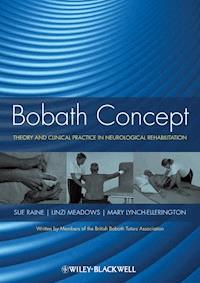
Bobath Concept E-Book
62,99 €
Mehr erfahren.
- Herausgeber: John Wiley & Sons
- Kategorie: Fachliteratur
- Sprache: Englisch
Authored by members of the British Bobath Tutors Association, Bobath Concept: Theory and Clinical Practice in Neurological Rehabilitationis a practical illustrated guide that offers a detailed exploration of the theoretical underpinning and clinical interventions of the Bobath Concept.
The evolution of the Bobath concept is brilliantly captured in this volume. The recognition that the best inhibition may come from engaging the patient in normal activities is an example of the way one of the notions central to the original Bobath Concept has developed. In short, the Bobath Concept lies at the heart of an approach to neurorehabilitation that is ready to take advantage of the rapidly advancing understanding, coming from neuroscience, of brain function in, in particular, of the effects of and responses to damage, and the factors that may drive recovery. It is no coincidence that neuroplasticity figures so prominently in the pages that follow.’
Emeritus Professor Raymond Tallis BM BCh BA FRCP FMedSci LittD DLitt FRSA
This book guides the reader through general principles to more specific application of neurophysiological principles and movement re-education in the recovery of important areas, including moving between sitting and standing, locomotion and recovery of upper limb function.
Bobath Concept: Theory and Clinical Practice in Neurological Rehabilitationwill be invaluable to undergraduate and qualified physiotherapists /occupational therapists and all professionals working in neurological rehabilitation.
- Covers the theoretical underpinning of the Bobath Concept.
- Presents a holistic, 24-hour approach to functional recovery.
- Focuses on efficient movement and motor learning, to maximise function.
- Forges links between theory and clinical practice.
- Illustrated throughout.
Sie lesen das E-Book in den Legimi-Apps auf:
Seitenzahl: 355
Veröffentlichungsjahr: 2013
Ähnliche




















Contents
Foreword
Preface
Contributors
Acknowledgements
1. The Bobath Concept: Developments and Current Theoretical Underpinning
Sue Raine
Introduction
The founders and development of the Bobath Concept
Current theory underpinning the Bobath Concept
Systems approach to motor control
Clinical application of the theory underpinning the Bobath Concept
Summary
References
2. An Understanding of Functional Movement as a Basis for Clinical Reasoning
Linzi Meadows and Jenny Williams
Introduction
Normal movement versus efficient movement
Compensatory strategies
Motor control and motor learning
Requirements of efficient movement
Summary
References
3. Assessment and Clinical Reasoning in the Bobath Concept
Paul Johnson
Introduction
Models of clinical reasoning and the Bobath Concept
Key characteristics of assessment using the Bobath Concept
Basis for clinical reasoning
Illustrating clinical reasoning using the Bobath Concept
Summary
References
4. Practice Evaluation
Helen Lindfield and Debbie Strang
Introduction
Evaluation in the context of the International Classification of Function, Disability and Health
Factors influencing measurement selection
Measurement properties
Measures
Summary
References
5. Moving Between Sitting and Standing
Lynne Fletcher, Catherine Cornall and Sue Armstrong
Introduction
Clinical considerations from the literature
Phases of sit to stand
Movements from standing to sitting
Effects of ageing
Sit to walk
Clinical aspects
Movement in functional contexts
Clinical example
References
6. The Control of Locomotion
Ann Holland and Mary Lynch-Ellerington
Introduction
Key aspects of bipedalism
The gait cycle
Use of body weight support treadmill training in the Bobath Concept
Assistive devices
Outcome measures
Summary
References
7. Recovery of Upper Limb Function
Janice Champion, Christine Barber and Mary Lynch-Ellerington
Introduction
The importance of postural control in upper limb function
The shoulder complex
Functional reach
The hand
Early treatment and management of the hand
Assessment of the hand
Contactual hand-orientating response
Selective strength training of the intrinsic muscles of the hand
Summary
References
8. Exploring Partnerships in the Rehabilitation Setting: The 24-Hour Approach of the Bobath Concept
Clare Fraser
Partnerships in the rehabilitation environment
The early days
Overcoming sensory deprivation and stimulating body schema
Scheduling the day – opportunities for practice
Return to work
Summary
References
Index
This edition first published 2009
© 2009 by Blackwell Publishing Ltd
Blackwell Publishing was acquired by John Wiley & Sons in February 2007. Blackwell’s publishing programme has been merged with Wiley’s global Scientific, Technical, and Medical business to form Wiley-Blackwell.
Registered office
John Wiley & Sons Ltd, The Atrium, Southern Gate, Chichester, West Sussex, PO19 8SQ, United Kingdom
Editorial offices
9600 Garsington Road, Oxford, OX4 2DQ, United Kingdom
2121 State Avenue, Ames, Iowa 50014–8300, USA
For details of our global editorial offices, for customer services and for information about how to apply for permission to reuse the copyright material in this book please see our website at www.wiley.com/wiley-blackwell.
The right of the author to be identified as the author of this work has been asserted in accordance with the Copyright, Designs and Patents Act 1988.
All rights reserved. No part of this publication may be reproduced, stored in a retrieval system, or transmitted in any form or by any means, electronic, mechanical, photocopying, recording or otherwise, except as permitted by the UK Copyright, Designs and Patents Act 1988, without the prior permission of the publisher.
Wiley also publishes its books in a variety of electronic formats. Some content that appears in print may not be available in electronic books.
Designations used by companies to distinguish their products are often claimed as trademarks. All brand names and product names used in this book are trade names, service marks, trademarks or registered trademarks of their respective owners. The publisher is not associated with any product or vendor mentioned in this book. This publication is designed to provide accurate and authoritative information in regard to the subject matter covered. It is sold on the understanding that the publisher is not engaged in rendering professional services. If professional advice or other expert assistance is required, the services of a competent professional should be sought.
Library of Congress Cataloging-in-Publication Data
The Bobath Concept: Theory and clinical practice in neurological rehabilitation / edited by Sue Raine, Linzi Meadows, Mary Lynch-Ellerington.
p. ; cm.
Includes bibliographical references and index.
ISBN 978-1-4051-7041-3 (pbk. : alk. paper) 1. Movement disorders—Patients—Rehabilitation. 2. Bobath, Berta. 3. Bobath, Karel. 4. Motor learning. I. Raine, Sue. II. Meadows, Linzi. III. Lynch-Ellerington, Mary.
[DNLM: 1. Bobath, Berta. 2. Bobath, Karel. 3. Central Nervous System Diseases—rehabilitation. 4. Physical Therapy Modalities. 5. Rehabilitation—methods. WL 300 B663 2009]
RC376.5.B63 2009
616.8’3—dc22
2008053126
A catalogue record for this book is available from the British Library.
Set in 10/12 pt Palatino by Macmillan Publishing Solutions, Chennai, India
1 2009
Dedication
This book is dedicated to all of our patients and students from whom we have learnt and through whom we have developed. This book is dedicated to the memory of Pam Mulholland, MCSP, Bobath Tutor, our colleague and friend.
Foreword
As a physician and neurorehabilitationist whose primary professional concern has been with adult patients, it may seem strange that I feel so deeply indebted to Karel and Berta Bobath, who devoted much of their lives to the rehabilitation of children with neurological problems, especially cerebral palsy. And yet, it is true. I believe that the beneficent influence of the Bobaths on our approach to neurological rehabilitation has been incomparable, and all of us who are involved in the care of people struggling to overcome the impact of neurological damage owe them a debt of gratitude. Things that we now take for granted were regarded as heretical or eccentric when the Bobaths started out on their careers so many years ago and developed an approached which combined science, and a deeply humane concern for the plight of individuals, with neurological damage with something we might call ‘clinical nous’.
The results are plain to see for all those who have long enough memories. When I began my career as a doctor in the 1970s, stroke patients were not welcomed on medical wards and rehabilitation services were poorly developed. The nihilism of Hughlings Jackson, the father of British neurology – encapsulated in his observation that ‘You can’t treat a hole in the brain’ – summarised the prevailing attitude. The physiotherapy these patients received was often misguided, having an orthopaedic bias, as Sue Raine notes in her contribution: massage, heat, passive and active movement techniques such as the use of pulleys, suspension and weights. The results were dreadful: stroke patients routinely ended up with severe flexion of the upper limbs (with the fingers curled over so tightly that hygiene was almost impossible), extension of the lower limbs and foot drop, so that walking was a perilous business – requiring circumduction at the hip – and not infrequently, the chronic misery of severe shoulder pain. Inappropriate splints and walking aids added to the demoralisation of the patient.
As a junior doctor, I assumed that this wretched state of affairs was an inevitable consequence of stroke. It was not until the Bobath revolution started to gain a foothold in the UK that I began to see that things might be otherwise. At the heart of the revolution was, as the title of this book indicates, a concept. And at the heart of this concept was an understanding that if you are going to promote recovery and independence, then you must (to use Geoffrey Kidd’s phrase) ‘talk to the nervous system in a language it understands’. At any rate, it meant an approach that was remote from the ‘orthopaedic’ strategy that had preceded the Bobath approach. This seems common sense now, but for many years this central notion met with incomprehension or scepticism, particularly among non-physiotherapists – including, I have to admit, myself.
Precisely, how one talks to the nervous system in a language it understands is described in practical detail in this superb book, which is a distillation of the expertise of leading neurophysiotherapists who have been central to the application and the development of the Bobath Concept in the UK. In a series of wonderfully lucid chapters, the authors combine a profound knowledge of the underlying neurophysiology of normal and abnormal movements with the insights that come from many years of practical experience. The key to the Bobath approach is understanding where the patient is ‘at’. This ranges from assessing the impairment and consequent motor behaviour to determining the patient’s expectations, fears, hopes and beliefs.
One of the most important aspects of the Bobath Concept is acknowledging the crucial role, in the case of upper motor lesions, of loss of inhibitory control and consequent spasticity. The possibility of influencing increased tone through afferent input led to the notion of ‘reflex inhibiting postures’ and less static ‘reflex inhibiting patterns’. Connected with this was the suggestion that the main problem in patients was not muscle weakness but abnormal coordination of movement patterns and abnormal (usually increased) tone. This is part of a systems approach to motor control, which goes through the Bobath Concept like ‘Brighton Rock’ through Brighton Rock, although this has evolved radically, as will be discussed presently.
The beneficent influence of the Bobath Concept goes beyond particular techniques. If the key to neurological rehabilitation is ‘talking to the nervous system in a language it understands’, then it is not sufficient for the patient to receive a few bouts of physiotherapy – say, an hour a day on weekdays and nothing at the weekend – and then be treated in a way that will undo the effects of skilled hands on care. Rehabilitation should be 24 hours a day and it should therefore be a team effort: under the direction of the skilled interdisciplinary team, motor recovery is promoted continuously and consistently. The Bobath Concept, what is more, has helped to remind us that the patient requiring neurorehabilitation is not just a nervous system in a cranium and a spine but a person in, and trying to cope with, and make sense of, a complex world.
The complexity and richness of the Bobath concept is evident in the present volume. The history and theory of the concept is set out clearly by Sue Raine in the opening chapter, which makes important connections with current notions of the plasticity of the brain. Linzi Meadows and Jenny Williams focus on functional movement, teasing apart the elements that are required for efficient movement: postural control, balance strategies, patterns of movement and the determinants of muscle strength, endurance, speed and accuracy. Paul Johnson analyses a skill central to the science, art and craft of physiotherapy: assessment and clinical reasoning. The interaction between assessment and treatment ensures the continuous revision of the treatment plan in the light of the response and the evolution of the patient’s condition. Evaluation is a central feature of true professionalism. This topic is covered by Helen Lindfield and Debbie Strang in their chapter. Their thoughtful discussion of outcome measures is itself a measure of the commitment of Bobath therapists to looking critically at the effects of their treatments.
Subsequent chapters on progressing from sitting to standing and on the control of locomotion reveal the power of the Bobath approach in analysing the building blocks not only of efficient movement but, more broadly, of efficient activity and independent life. The case studies are, as one might expect, illuminating and instructive. Here, as elsewhere in the book, the real challenges of the real world are present. The chapter devoted to the recovery of upper limb function is an inspiring reminder of the reasons why we no longer see the appalling upper limb outcomes that I referred to at the beginning of this foreword. The final chapter – on the 24-hour approach of the Bobath Concept – underlines one of the distinctive contributions that the British Bobath Tutors Association (BBTA) has made to the entire rehabilitation process.
All intellectual revolutions run the danger, once they are established practice, of becoming as dogmatic as the practice and theory they revolted against, and Bobath Concept, for a while, looked like being no exception. That which was once progressive seemed like erecting a barrier to further progress, with the initial insights and hypotheses of the Bobaths being regarded as unassailable truths. A case in point relates to the veto against muscle-strengthening exercises, on the grounds that they might increase spasticity (and hence reduce function) and that muscle strength was less important than tone and higher aspects of integrated movement. Subsequent research carried out in the 1990s showed that not only did muscle-strengthening exercises not increase spasticity but also they appeared to have a beneficial effect.
It is probably because the Bobath approach attracted the most gifted practitioners, with the most critical minds and with the strongest commitment to improving neurorehabilitation, that this period of dogma was short-lived. Under the leadership of neurophysiotherapists such as Mary Lynch-Ellerington, FCSP, BBTA have encouraged a rethink of the Bobath Concept – without undermining the fundamental insight and vision – and encouraged an evidenced-based approach to the rehabilitation of neurologically damaged patients. As Karel Bobath himself pointed out, ‘the Bobath Concept is unfinished, we hope it will continue to grow and develop in years to come’. It is now recognised that postural weakness and the loss of feed-forward control in respect of anticipatory postural adjustments is the primary source of impairments, and the so-called hypertonicity that was central to the Bobaths’ thinking is now seen to be a reaction associated with trying to function against a background of a loss of postural control and voluntary movement. The role of neural and non-neural components of adverse muscle tension is also recognised and treated specifically. This is consistent with the BBTA vision of seeing the patient as someone who has individual problems and who needs ‘activating’.
The evolution of the Bobath Concept is brilliantly captured in this volume. The recognition that the best inhibition may come from engaging the patient in normal activities is an example of the way one of the notions central to the original Bobath Concept has developed. In short, the Bobath Concept lies at the heart of an approach to neurorehabilitation that is ready to take advantage of the rapidly advancing understanding – coming from neuroscience, of brain function, in particular – of the effects of and responses to damage and the factors that may drive recovery. It is no coincidence that neuroplasticity figures so prominently in the pages that follow.
While many researchers – including myself – have in the past criticised the Bobaths for seeming to establish a school in a state of rivalry with other schools, this is certainly no longer true. There is an open-minded willingness to document what is done with patients and to evaluate outcomes using appropriate tools. And this is not altogether surprising: the Bobath Concept itself was a key stimulus to the transition from intuition-based empirical approaches to the increasingly neuroscience-based therapies that are now emerging, and which Bobath practitioners are incorporating into their work with patients. The fact that neurological rehabilitation is now firmly located as the top table in medicine – signalled by a report from the Academy of Medical Sciences Restoring Neurological Function. Putting the Neurosciences to Work in Neurorehabilitation (2004) – owes much to the advocacy of the Bobath movement. Meanwhile, the fundamental ethos of Bobath – the patient as partner, rehabilitation tailored to the patient’s current situation, and rehabilitation as a 24/7 activity rather than being confined to discrete sessions – remain in place. For physiotherapy, however scientifically based it becomes, will always be in addition an art, a craft and an expression of the therapist’s humanity, addressed to the patient as a whole human being.
The great German philosopher Frederick Nietzsche said that ‘one ill rewards a teacher if one remains always a pupil’. For this reason, the Bobaths, the teachers of a generation of therapists, will be well pleased with what their pupils and the pupils of their pupils have made of the Bobath Concept, taking it to new places, giving it a different emphasis. This book is a landmark, as important as Berta Bobath’s seminal text. Contemporary therapists – from students to senior practitioners – will find it an invaluable guide and an inspiring example. The book will doubtless run into many editions as its influence on practice will lead to progressive improvement in the way physiotherapists approach the complex needs of patients who suffer the devastating blow of serious neurological injury. The editors and authors deserve our congratulations and thanks. The Bobath Concept should be to hand wherever neurological rehabilitation is practised.
Emeritus Professor Raymond Tallis,
BM, BCh, BA, FRCP, FMedSci, LittD, DLitt, FRSA
Preface
The British Bobath Tutors Association (BBTA) is an organisation of expert clinicians within the UK who specialise in the assessment and treatment of adults with neurological impairments utilising the Bobath Concept. All BBTA members maintain their clinical skills by working directly with patients in either the public or private sector. The primary responsibility of BBTA is to disseminate the current understanding and practice of the Bobath Concept to qualified physiotherapists and occupational therapists on postgraduate courses and to support the training process of new tutors.
BBTA is a member organisation of the International Bobath Instructors Training Association (IBITA) and has strong links worldwide. Members of BBTA provide education and training to therapists both within the UK and abroad.
The theoretical basis and application of the Bobath Concept has continued to develop with considerable growth in knowledge areas such as neuroscience, neuromuscular plasticity, motor control and motor learning. Although fundamentally the concept has the same core principles, its application has evolved in line with current evidence. For many years, the developments within the Bobath Concept have been disseminated through introductory, basic and advanced Bobath courses. These courses facilitate clinical reasoning and its application, based upon an understanding of efficient functional movement, the systems control of movement and the principles of motor learning. Individuals with neurological pathology take part in the courses and contribute to the educational experience.
The popularity of the courses has continued to grow and therapists often ask whether there is a textbook they can refer to in order to support their learning. It is with this in mind that this book has been written, so that it can be a reference for therapists to develop a deeper insight into the clinical application of the Bobath Concept.
This book is intended to provide both undergraduate and postgraduate health professionals with many of the elements felt to be important in understanding the clinical reasoning process used in the application of the Bobath Concept. The book is structured in such a way that the first four chapters guide the reader in gaining an understanding of the current theory before moving to the application of the Bobath Concept into clinical practice. From this foundation, Chapters 5–7 consider the application in depth, with clinical examples in the areas of moving between sitting and standing, control of locomotion and the recovery of function of the upper limb. Chapter 8 considers the 24-hour approach of the Bobath Concept to neurore-habilitation and the need for exploring partnerships in the rehabilitation setting.
The aim of this book is to provide the therapist with an understanding and ability to apply the principles of the contemporary Bobath Concept and to promote and enable greater clinical effectiveness and to optimise the functional outcome for all patients in the area of neurorehabilitation. The primary objective is to improve the quality of life of all the patients we treat.
Contributors
Sue Raine is the Clinical Lead Physiotherapist at Walkergate Park for Neurorehabilitation and Neuropsychiatry and a Bobath Tutor.
Linzi Meadows is a Clinical Director of the Manchester Neurotherapy Centre and Neurological Teaching Centre and an Advanced Bobath Tutor.
Jenny Williams is a Senior Physiotherapist at the Stroke and Head Injury Clinic in Warrington and a Bobath Tutor.
Paul Johnson is a Clinical Lead Physiotherapist in Neurology at Gateshead Health NHS Foundation Trust and a Bobath Tutor.
Helen Lindfield is Principal Physiotherapist at the Wolfson Rehabilitation Centre, Wimbledon and a Bobath Tutor.
Debbie Strang is a Team Lead Physiotherapist at Hairmyers Hospital, Glasgow and a Bobath Tutor.
Lynne Fletcher is a Clinical Director of the Manchester Neurotherapy Centre and Neurological Teaching Centre and an Advanced Bobath Tutor.
Catherine Cornall is a Physiotherapy Clinical Specialist at the National Rehabilitation Hospital, Dun Laoghaire, Ireland and a Bobath Tutor.
Sue Armstrong is a Clinical Specialist for Gwent NHS Trust and a Bobath Tutor.
Ann Holland is a Clinical Specialist (Physiotherapy) at the National Hospital for Neurology and Neurosurgery at Queens Square, London and a Bobath Tutor.
Mary Lynch-Ellerington is a Fellow of the Chartered Society of Physiotherapy and a Senior Bobath Instructor.
Janice Champion is a Specialist Clinician at Medway Maritime Hospital, Gillingham, Kent and a Bobath Tutor.
Christine Barber is the Director of Therapy Services at the Bobath Centre for Children with Cerebral Palsy and Adults with Neurological Disability and a Bobath Tutor.
Clare Fraser is a Team Leader in Neurological Physiotherapy at the Wirral University Teaching Hospital NHS Foundation Trust and a Bobath Tutor.
Acknowledgements
Our very deep gratitude goes to our colleagues in BBTA, Alan Bass, Anna Hamer and Pam Mulholland, who so willingly gave their time, to proofread all of the chapters and offer professional advice and support.
For their contribution to Chapter 3 we thank Ann Holland and Liz Mackay, and for Chapter 7 we thank Lynne Fletcher. For data collection and analysis with Chapter 6 we thank Professor Jon Marsden and Dr Gita Ramdharry. For the generous use of his diagrams we thank Dr Nigel Lawes. For reading and reviewing so constructively we thank Professor Michael Barnes. We feel privileged to have had Professor Raymond Tallis write the foreword of this book.
For her support throughout we thank Carol Morrison our secretary at BBTA. Our very special thanks are owed to the patients and their families who have kindly allowed their case histories and aspects of their clinical treatment to form such a major part of this book.
1.
The Bobath Concept: Developments and Current Theoretical Underpinning
Sue Raine
Introduction
There are a number of neurological approaches used in the management of the patient following a neurological deficit. The Bobath Concept is one of the most commonly used of these approaches (Davidson & Walters 2000; Lennon 2003), and it offers therapists working in the field of neurological rehabilitation a framework for their clinical interventions (Raine 2006). This chapter will provide the reader with an overview of the Bobath Concept including the founders of the approach and its inception, the theoretical underpinning and its application into clinical practice.
Lesen Sie weiter in der vollständigen Ausgabe!
Lesen Sie weiter in der vollständigen Ausgabe!
Lesen Sie weiter in der vollständigen Ausgabe!
Lesen Sie weiter in der vollständigen Ausgabe!
Lesen Sie weiter in der vollständigen Ausgabe!
Lesen Sie weiter in der vollständigen Ausgabe!
Lesen Sie weiter in der vollständigen Ausgabe!
Lesen Sie weiter in der vollständigen Ausgabe!




