


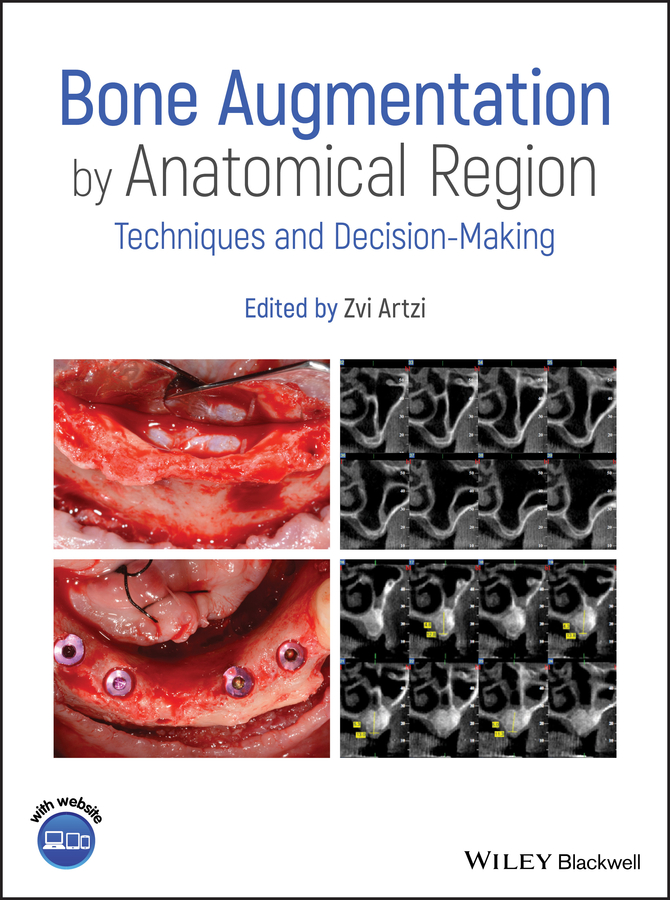
Bone Augmentation by Anatomical Region E-Book
148,99 €
Mehr erfahren.
- Herausgeber: John Wiley & Sons
- Kategorie: Fachliteratur
- Sprache: Englisch
Comprehensively describes bone augmentation techniques and their application to the different anatomical regions of the upper and lower jaws. Bone Augmentation by Anatomical Region is a unique, evidence-based guide focusing on each specific anatomical region - anterior maxilla, posterior maxilla, anterior mandible, and posterior mandible - in order to emphasize the correct implemented procedures needed to successfully perform oral osseous reconstruction. Numerous ridge augmentation techniques are covered, including: horizontal and vertical guided bone regeneration, autologous block transplantation, interpositional bone grafting, allogeneic blocks, sandwich technique, split-expansion ridge technique, and sinus floor grafting. Non-augmented approaches such as forced socket site extrusion and the installation of digitally printed implants are also presented and discussed. * Guides readers on tackling bone augmentation via anatomical region of the jaws and their related surrounding muscles, vascularization and innervation * Presents innovative augmentation techniques for the anterior maxilla, posterior maxilla, anterior mandible, and posterior mandible * Includes clinical photographs in each section and a decision tree to help readers select the appropriate surgical modality Bone Augmentation by Anatomical Region is a specialist resource suitable for dentists who practice implant dentistry, oral surgeons, oral and maxillofacial surgeons, periodontists, and postgraduate dental students in the above-mentioned disciplines. Please note Due to recently developments, part of Chapter 2 Biologic Conditions for Bone Growth and Maintenance: Managing the Oxidative Stress has been amended which will be available in all future reprints. All electronic versions have been updated.
Sie lesen das E-Book in den Legimi-Apps auf:
Seitenzahl: 1152
Veröffentlichungsjahr: 2020
Ähnliche




















Table of Contents
Cover
List of Contributors
Preface
Bone Augmentation by Anatomical Region: Techniques and Decision‐Making
Acknowledgement
About the Companion Website
Introduction
Why a book on Bone augmentation?
References
Part I: Basic Mechanisms
1 The Anatomy of the Maxilla and the Mandible
Bones
Muscles
Nerves
Blood Vessels
References
2 Biologic Conditions for Bone Growth and Maintenance
Background
Biological Status Associated with Oxidative Stress
Anxiety and Oxidative Stress
Local Anesthesia and Ischemia
Surgery and Oxidative Stress
Bone Healing After Implant Placement
Biomaterial Choice and its Effect on Oxidative Stress
Wound Healing, Growth Factors and Oxidative Stress
Conclusion: Surgical Procedures Must Be Close to the Biology!
BIBLIOGRAPHY BOOK CHAPTER A3
3 Biomaterials Selection – Cellular Interactions During Regenerative and Remodeling Phases
Introduction
Grafting Biomaterials
Cellular Interactions During Wound Healing Following Grafting Surgery
Summary and Conclusions
References
4 Allogeneic Bone Grafts
Allograft Remodeling and New Bone Formation
Screening, Sterility and Processing
References
5 The Role of Osteopromotive Membranes in Guided Bone Regeneration
Introduction
Properties of Barrier Membranes
Characteristics of Available Membranes
Biological Events During Guided Bone Regeneration
Pre‐clinical Applications of GBR Membranes
Clinical Applications of GBR Membranes
Biological Cues and Barrier Membranes
New Insights into the Osteopromotive Role of Barrier Membranes
Conclusions and Future Directions for Research
References
Part II: The Anterior Maxilla
6 Esthetic Considerations
Introduction
Case Evaluation and Decision Making
Clinical Concept
Acknowledgments
References
7 Soft Tissue Management in the Anterior Maxilla
Overview
Specific Issues for Soft Tissue Management in the Anterior Maxilla
Materials
Soft Tissue Management
References
8 Treatment Alternatives for Soft Tissue Procedures in the Maxilla
Introduction
Soft Tissue Management Before Implant Placement
Soft Tissue Management at the Time of Implant Placement
During the Implant Healing Phase
At Time of Implant Uncovering
After Second‐Stage Surgery
References
9 Modifications of Anterior Maxillary Sandwich Osteotomy for Vertical Bone Augmentation
Patient #1
Patient #2
Discussion
Summary
References
10 Autogenous Bone Block Transplantation in the Anterior Maxilla
Introduction
Biological Mechanism
Preoperative Clinical and Radiological Diagnosis
Anatomical Study of Donor Site (Figure 10.5)
Recipient Site Preparation
Donor Site
References
11 Allogeneic Block Grafts in the Anterior Maxilla
Introduction
3D Block Technique
A Step by Step of Three Severe Deficient Cases
References
12 Confronting Severe Deficiencies in the Anterior Maxilla
Implant Placement and an Enlarged Incisive Foramen
Implant Placement and the Impacted Canine
The Split‐Expansion Ridge (SER) Technique in the Anterior Maxilla
Vertical GBR in the Anterior Maxilla
Combined Periodontal/Periapical/Peri‐implant
A Complete Buccal Wall Socket Destruction
Cortico‐Cancellous (CC) Plate Transplantation for Enhancing Lip Support
The Thin Residual Ridge
References
13 Management of Complications in Anterior Maxilla During Guided Bone Regeneration
Introduction
Prevention of Complications in Guided Bone Regeneration in the Esthetic Zone
Conclusions
Acknowledgement
References
Part III: The Posterior Maxilla
14 Sinus Augmentation:
Historical Background
Technical Aspects
Case Selection
Adjunctive Biomaterials
Histologic Observations Following tSFE
The Smart Lift Technique
Other Trans‐Crestal Surgical Modalities
References
15 Sinus Augmentation
Introduction
Pre‐Op Evaluation
Surgical Technique (Figures 15.3.1 – 15.3.12 and 15.4)
Conclusions
Acknowledgment
References
16 Maxillary Sinus Floor Augmentation
Introduction
Sinus Augmentation Combined With Vertical Crestal Bone Regeneration
Sinus Augmentation Via a Window Within a Window
The Lateral Approach Via Two Windows
Overcoming Lateral Window – Socket Site Connection
Confronting a Huge Sinus Membrane Perforation
References
Part IV: The Anterior Mandible
17 Re‐establishment of Adequate Osseous Volume in an Atrophic Anterior Mandible
Immediate Restored Implant Placement in the Anterior Mandible
A Combined Guided Bone Regeneration and Immediate Placed and Restored Implant‐Supported Prosthesis
Vertical GBR to Precede Immediate Restoration
3D Reconstruction in the Anterior Mandible – the Autogenous Bone Block Transplantation
Confronting Catastrophes in the Anterior Mandible
References
18 Anterior Atrophic Mandible Restoration Using Cancellous Bone Block Allograft
The Partially Edentulous Patient
Surgical Technique
Edentulous Atrophic Mandible
Animal Research in h‐FDB Blocks
Conclusion
References
Part V: The Posterior Mandible
19 Options for Restoring the Atrophic Posterior Mandible – Vertical and Horizontal Bone Augmentation
Coronal Ridge Regeneration by Natural Tooth Extrusion
References
20 Cortico‐Cancellous Block (CCB) Transplantation in the Posterior Mandible
The J‐Graft Augmentation
Vertical Bone Augmentation
References
21 Allogeneic Block Grafts in the Posterior Mandible
References
Part VI: Other Advancing Techniques
22 Interpositional Bone Grafts
Introduction
Sandwich Interpositional Grafts
Vertical Augmentation with an Interpositional Graft at the Le Fort I Level in the Maxilla
Clinical Results of Le Fort I interpositional grafting
References
23 Preprosthetic Orthognathic Surgery
Evolution of Orthognathic Surgery
Summary
Acknowledgments
References
Part VII: Additional Related Subjects
24 Biofilms Around Dental Implants
Introduction
Microbial Biofilms: General Concepts
Peri‐Implant Biofilms: Characteristics of the Niche
Peri‐Implant Biofilms: Structure and Formation
Microbiology of Peri‐Implant Biofilms in Health and Disease
Summary and Conclusions
References
25 Prevention and Management of Peri‐Implant Diseases
Definitions of Peri‐Implant Health and Diseases
Prevalence of Peri‐Implant Diseases
Pathogenesis of Peri‐Implant Diseases
Diagnosis of Peri‐Implant Health and Diseases
Non‐Surgical Treatment of Peri‐Implant Mucositis and Non‐Surgical Treatment of Peri‐Implantitis
Surgical Treatment of Peri‐Implantitis
References
Index
End User License Agreement
List of Tables
Chapter 1
Table 1.1
Table 1.2
Chapter 3
Table A3.1 Wound healing phases during alveolar ridge regeneration. A flow ch...
Chapter 6
Table 6.1 Esthetic risk assessment.
Table 6.2 Classification of bone defects.
Chapter 14
Table 14.1 Amount of graft biomaterial (mg) to be used in tSFE procedures in ...
Table 14.2 Studies reporting data on treatment outcomes of the Smart Lift tec...
Chapter 15
Table 15.1 ENT contraindications to sinus elevation.
Table 15.2 Pre‐op prophylaxis and post‐op pharmacological therapy.
Table 15.3 Pharmacological treatment of graft infection well contained under ...
List of Illustrations
Chapter 1
Figure 1.1 Hard palate (inferior view). 1 – Incisive foramen, 2 – incisive s...
Figure 1.2 Orbit (anterior view). 1 – Frontomaxillary suture, 2 – nasomaxill...
Figure 1.3 Maxilla and mandible (lateral view). 1 – Infraorbital foramen, 2 ...
Figure 1.4 Posterolateral aspect of the maxilla. 1 – Maxillary tuberosity, 2...
Figure 1.5 Temporomandibular joint (sagittal section, lateral view). 1 – Tem...
Figure 1.6 Mouth floor (anteroinferior view). 1 – Anterior belly of the left...
Figure 1.7 Temporomandibular joint (sagittal section, lateral view) and asso...
Figure 1.8 Blood supply of the oral apparatus. 1 – Common carotid artery, 2 ...
Figure 1.9 Mandibular nerve branches. 1 – Mandibular nerve, 2 – anterior div...
Chapter 2
Figure 2.1 Consensus on Vitamin D levels. Lab test results are expressed in ...
Figure 2.2 Example of vitamin D daily tablets: dietary supplement.
Figure 2.3 Isotonic sodium bicarbonate 1.4%. pH= 10.
Figure 2.4 Apical mattress suture technique (horizontal).
Figure 2.5 Apical mattress suture: after the suture, the gum bead is the pro...
Figure 2.6 Soft brushing instruments kit.
Figure 2.7 Buccal flap with intact periosteum after soft brushing.
Figure 2.8 Bone organization: trabecular (T) and cortical bone (C) & Micro‐C...
Figure 2.9 Osteon and Havers canal in electronic microscopy.
Figure 2.10 Volkman Canals: emergence of vessels coming from the periosteum ...
Figure 2.11 Osteocytes linked together through canalicules containing inters...
Figure 2.12 Histology after bone graft with hydroxyapatite synthetic biomate...
Figure 2.13 Histology after graft with hydroxyapatite and β‐TCP.
Figure 2.14 Histology after graft with porcine xenograft.
Figure 2.15 Histology after graft with equine xenograft.
Figure 2.16 Histology after graft with bovine xenograft.
Figure 2.17 Histology after graft with bovine xenograft.
Figure 2.18 Histology after graft with bovine bloc xenograft.
Figure 2.19 Histology after graft with allogenic biomaterial.
Figure 2.20 Histology after autogenous bone graft.
Figure 2.21 Histology of a native trabecular bone.
Figure 2.22 Histology after sinus lift (cortical plate apically positioned):...
Figure 2.23 Histology after socket management with PRF alone: normal trabecu...
Figure 2.24 Behavior of materials under stress. When rigidity increases, the...
Figure 2.25 Bone remodeling decreases when implants are placed in contact wi...
Figure 2.26 Natural components of PRF include 1) cell types (platelets, leuk...
Figure 2.27 Fibrin clot in the tube after centrifugation
Figure 2.28 Higher number of leucocytes and VEGF found in PRF centrifuged at...
Figure 2.29 Higher number of gingival fibroblast cell migration from A‐PRF w...
Figure 2.30 The newer formulation of I‐PRF is a liquid formulation of PRF fo...
Figure 2.31 PRF clots formed to either make membranes or PRF plugs in the PR...
Figure 2.32 Implant placement into the sinus in combination with PRF. Notice...
Figure 2.33 Gingival recession of upper canine treated with PRF alone. Notic...
Figure 2.34 Multiple gingival recession of upper 8 maxillary teeth treated w...
Figure 2.35 MSCs collected through the different PRF protocols.
Figure 2.36 Different types of progenitor cells found in the i‐PRF.
Chapter 3
Figure 3.1 A CT scan of an upper first molar extraction site which has gone ...
Figure 3.2 The grafted dentin particles (D) are fully surrounded in direct c...
Figure 3.3 The grafted Geistlich Bio‐Oss® particles at 1 month already demon...
Figure 3.4 Direct bone to grafted HA/TCP (Straumann bone Ceramic®) particle ...
Figure 3.5 A high magnification of a 6‐month grafted HA/TCP particle fully s...
Figure 3.6 Changes in molecular and functional expression of macrophage duri...
Figure 3.7 Macrophages are key in sensing the grafted biomaterial (M) and in...
Figure 3.8 Histological section of a chronic inflammatory reaction that was ...
Figure 3.9 Histological section of ectopic bone forming in presence of bioac...
Figure 3.10 Histological section of ectopic bone forming in presence of bioa...
Figure 3.11 Histological section of ectopic bone forming in presence of bioa...
Chapter 4
Figure 4.1 Different human allografts after processing: granules (a), cancel...
Figure 4.2 SEM pictures (×100 magnification) illustrate the structure of a p...
Figure 4.3 Biopsy 5 months after implantation of processed human allograft. ...
Figure 4.4 Processed block allograft histology after 8 months of healing. Th...
Figure 4.5 SEM pictures (×50 magnification) Left image illustrates the struc...
Chapter 5
Figure 5.1 Microphotograph at 30 days of healing of a site where alveolar ri...
Figure 5.2 (a) Section at 7 days of healing, orcein stain. A limited amount ...
Figure 5.3 (a) Section after 7 days of healing, picrosirius red stain. At th...
Figure 5.4 (a) Section after 7 days of healing under scanning electron micro...
Figure 5.5 Graphical representation of a titanium dome. Each dome has a diam...
Figure 5.6 Horizontal bone regeneration around a dental implant, which was p...
Figure 5.7 After the extraction of an upper left second premolar, immediate ...
Figure 5.8 Particulate DBBM graft was placed under a titanium mesh to regene...
Figure 5.9 Clinical picture of patient presenting a hopeless upper left inci...
Chapter 6
Figure 6.1 Esthetic scores. PES/WES: 1) mesial papilla, 2) distal papilla, 3...
Figure 6.2 Classification of bone defects and the corresponding bone augment...
Figure 6.3 (a) Site 21 with a vertical soft tissue deficiency. (b) Extrusion...
Figure 6.4 (a) Fractured teeth 21 and 22 with caries – buccal view. (b) Frac...
Figure 6.5 (a) Missing tooth 11 and fractured tooth 12 – buccal view. (b) Mi...
Figure 6.6 (a) Site 21 with a vertical soft tissue deficiency, high‐scallope...
Figure 6.7 (a) Missing tooth 21 and discolored tooth 11 – buccal view. (b) M...
Figure 6.8 (a) Fractured tooth 22, thick gingival biotype, low‐scalloped gin...
Figure 6.9 (a) Horizontal and vertical ridge defect at sites 21 and 22 – buc...
Figure 6.10 (a) Missing tooth 13. (b) Vertical ridge defect. (c) Vertical ri...
Figure 6.11 (a) Edentuleous ridge site 13–22 and a removable provisional den...
Chapter 7
Figure 7.1 Soft tissue augmentation timing with respect to implant treatment...
Figure 7.2 Gain of keratinized tissue using a collagen matrix. Following pri...
Figure 7.3 Gain of mucosal thickness using a subepithelial connective tissue...
Figure 7.4 Gain of mucosal thickness using a three‐dimensional collagen matr...
Figure 7.5 Gain of mucosal thickness using a subepithelial connective tissue...
Figure 7.6 Gain of mucosal thickness using a three‐dimensional collagen matr...
Figure 7.7 Gain of keratinized tissue using a free gingival graft. One impla...
Figure 7.8 Coverage of the exposed implant surface using a subepithelial con...
Figure 7.9 Management of a mucosal recession around an implant using a three...
Chapter 8
Figure 8.1 (a) Aspect after serial tooth extractions and debridement. (b) A ...
Figure 8.2 (a) Four incisors indicated for extraction due to secondary decay...
Figure 8.3 (a) Pre‐operative aspect of the area, left incisor, rehabilitated...
Figure 8.4 (a) Lateral right incisor is indicated for extraction due to a ro...
Figure 8.5 (a) Panoramic x ray of the upper right segment shows peri‐apical ...
Figure 8.6 (a) Diagram. An intrasulcular incision is made on the palatal asp...
Figure 8.7 (a) Pre‐operative view of first right upper premolar, due to a bu...
Figure 8.8 (a) Pre‐operative aspect of upper front teeth. Extruded right cen...
Figure 8.9 (a) Pre‐operative aspect, thick frenum insertion close to the alv...
Figure 8.10 (a) Buccal aspect. A cleft in the central ridge area is evident,...
Figure 8.11 (a) Lower left segment. Minimal keratinized tissue band lingual ...
Figure 8.12 (a) Occlusal aspect, note buccal soft tissue contour before impl...
Figure 8.13 (a) Pre‐operative aspect, upper right incisor was indicated for ...
Figure 8.14 (a) Alveolar ridge at second stage implant surgery. (b) The pala...
Figure 8.15 (a) Buccal aspect of alveolar ridge prior to implant uncovering....
Figure 8.16 (a) Pre‐operative aspect shows lack of buccal keratinized mucosa...
Figure 8.17 (a) Occlusal aspect of alveolar ridge before implant uncovering....
Figure 8.18 (a) Buccal aspect. An implant has been placed to replace the lef...
Figure 8.19 (a) Lack of keratinized mucosa and strong frenum pull may be app...
Figure 8.20 (a) Missing four upper incisors. Two implants have been placed i...
Figure 8.21 (a) Occlusal aspect. Three implants have been placed to replace ...
Figure 8.22 (a) Aspect of an implant supported provisional restoration. Note...
Chapter 9
Figure 9.1 (a) Loss of maxillary anterior teeth due to periodontal disease l...
Figure 9.2 (a) A 41‐year‐old male had traumatically lost three incisor teeth...
Chapter 10
Figure 10.1 The panoramic radiograph demonstrated missing of two maxillary i...
Figure 10.2 The 3D morphology of the deficient ridge.
Figure 10.3 CBCT section cuts of the recipient anterior maxilla site.
Figure 10.4 CBCT section cuts of the retromolar donor site.
Figure 10.5 Anatomical study of donor site.
Figure 10.6 A mucoperiosteal full thickness flap was established to expose t...
Figure 10.7 Sequence of the bone block harvesting from the posterior mandibu...
Figures 10.8–10.10 The harvested bone blocks in shape and size.
Figures 10.11–10.12 The bone block were transplanted and stabilized by the f...
Figure 10.13 Bone block protection by a resorbable collagen membrane.
Figure 10.14 Soft tissue closure was established via horizontal mattress sut...
Figures 10.15–10.17 Re‐entry procedure disclosed a massive restored anterior...
Figure 10.18 An occlusal view demonstrated the amount of the established aug...
Figure 10.19 A surgical stent was applied for optimal positioning of the imp...
Figure 10.20 The fixation screws were removed prior to the implant placement...
Figure 10.21 The surgical try‐un pins verified accurate implant site prepara...
Figure 10.22 Implants placement.
Figure 10.23 Soft tissue closure via coronal sutures anchored by the immedia...
Figure 10.24 The final prosthesis phase.
Figures 10.25–10.28 Two years follow‐up.
Figure 10.29 A full thickness flap disclosed a knife‐edged residual ridge.
Figure 10.30 Preparation of the lateral retro molar of the posterior mandibu...
Figure 10.31 Xenograft particles were added to the recipient bed.
Figure 10.32 Autogenous bone block transplantation and stabilization.
Figure 10.33 Two fixation screws stabilized the block.
Figure 10.34 An occlusal view demonstrated the widening of the ridge by the ...
Figure 10.35 A resorbable collagen membrane was applied to protect the augme...
Figure 10.36 Full soft tissue closure was obtained.
Figure 10.37 The fixation screws were removed flaplessly.
Figure 10.38 The implant placement phase.
Figure 10.39 The final prosthesis.
Chapter 11
Figure 11.1 A 32‐year‐old woman lost many anterior maxillary teeth and part ...
Figure 11.2 Teeth and alveolar process lost after the trauma.
Figure 11.3 3D reconstruction of the maxillary 3 months after the trauma; be...
Figure 11.4 The syntherized prototype of the maxillary in a sterile environm...
Figure 11.5 Dehydrated allografts shaped and fixed on the sterile prototype....
Figure 11.6 The absorbable membrane is carefully shaped on the sterile proto...
Figure 11.7 Surgical step on the patient: after washing and rehydration the ...
Figure 11.8 Tension‐free closure with absorbable 5.0 monofilament suture. Ho...
Figure 11.9 The soft tissues after 8 months of healing.
Figure 11.10 A provisional partial removable denture is applied, without any...
Figure 11.11 Good graft incorporation at the second surgical step, after a 8...
Figure 11.12 Surgical guide in position.
Figure 11.13 The pilot drill works following the axis planned on the the sur...
Figure 11.14 Positioned implants: four in the grafted bone, one after extrac...
Figure 11.15 check of implant positions with the help of the overlapped surg...
Figure 11.16 Surgical reopening after three months of implant osteointegrati...
Figure 11.17 A fixed provisional screwed prosthesis is prepared for a better...
Figure 11.18 Screwed provisional prosthesis (a, b). Final ceramic restoratio...
Figure 11.19 Radiographic check of the final rehabilitation after three year...
Figure 11.20 Intraoral initial situation.
Figure 11.21 3D image showing the need to reconstruct the missing bone.
Figure 11.22 Allograft dry shaping on the sterile prototype.
Figure 11.23 Bone contouring.
Figure 11.24 Shaped bone block grafts on the prototype.
Figure 11.25 Pericardium membrane carefully shaped on the prototype.
Figure 11.26 Refreshing of the cortical layer of the receiving bed.
Figure 11.27 Allografts fixed on the receiving site.
Figure 11.28 Occlusal view of the graft. This increasing of the bone volume ...
Figure 11.29 Graft, before screw removal, at reopening surgery after 8 month...
Figure 11.30 Implants inserted in the lateral incisors position.
Figure 11.31 Overcorrection with slow resorbable biomaterial in order to avo...
Figure 11.32 Resorbable 5.0 suture.
Figure 11.33 Healing screws with palatal flap incision for shift and gain ke...
Figure 11.34 Soft tissues healing after 1 month.
Figure 11.35 Good esthetic appearance of perioral tissues obtained with the ...
Figure 11.36 Provisional PMMA prosthesis.
Figure 11.37 Definitive abutments and natural teeth ready for the final impr...
Figure 11.38 Final ceramic restoration.
Figure 11.39 Radiographic check after 3 years of loading/
Figure 11.40 Sterile prototype with the shaped grafts.
Figure 11.41 Washing and hydration of the graft.
Figure 11.42 Each graft in a separate sterile syringe, in order to have the ...
Figure 11.43 Schneiderian membrane elevation.
Figure 11.44 Biomaterial inside the maxillary sinus.
Figure 11.45 Repositioning of the bony window.
Figure 11.46 Flap elevation of the whole maxilla.
Figure 11.47 Mucoperiosteal incision in order to obtain the passivity of the...
Figure 11.48 Buccal flap passivated.
Figure 11.49 Fixation of the first two bone block grafts.
Figure 11.50 Maxillary jaw reconstructed with block grafts.
Figure 11.51 Protection of the grafts with pericardium membranes.
Figure 11.52 Resorbable 5.0 continue suture with horizontal mattress stitche...
Figure 11.53 Ct control after 8 months of healing, axial view.
Figure 11.54 Ct control after 8 months of healing, Panorex view.
Figure 11.55 Reopening after 8 months.
Figure 11.56 Osteosynthesis screw removal.
Figure 11.57 Surgical stent in position. Notice the bone‐teeth ratio.
Figure 11.58 Implant positioning.
Figure 11.59 Scan bodies for digital impression and immediate loading.
Figure 11.60 X‐ray control of the milled metal structure.
Figure 11.61 Resin keys for registration of the occlusion.
Figure 11.62 Screw‐retained prosthesis.
Figure 11.63 Smile esthetics and soft tissues support.
Chapter 12
Figure 12.1.1 (a) The upper right central incisor was missing due to a past ...
Figure 12.1.2 The implant site preparation collided with the enlarged incisi...
Figure 12.1.3 The symphysis serves as the donor site (a) for a cylindrical c...
Figure 12.1.4 The cylindrical block was press‐fitted to the incisive foramen...
Figure 12.1.5 At re‐entry, the transplanted bone block was completely integr...
Figure 12.1.6 The final prosthesis. Note the proximity to the natural roots ...
Figure 12.1.7 The final clinical outcome (prosthesis: Dr P. Segal).
Figure 12.2.1 The patient presented with a missing upper right first premola...
Figure 12.2.2 CT scan section cuts showed the course of the impacted canine ...
Figure 12.2.3 The upper right central and lateral incisors were extracted fo...
Figure 12.2.4 The histological diagnosis was a dentigerous cyst. The biopsy ...
Figure 12.2.5 The removal of the canine disclosed a large buccal plate fenes...
Figure 12.2.6 Bovine bone mineral filled the entire defect (a). Two layers o...
Figure 12.2.7 Soft tissue closure was obtained (a). The provisional prosthes...
Figure 12.2.8 The CT scan at 6 months post‐augmentation showed new osseous t...
Figure 12.2.9 Implants were placed with the aid of a computerized surgical g...
Figure 12.2.10 The final cross arch prosthesis upon OH accessibility check‐u...
Figure 12.3.1 (a) The patient presented with severe periodontal destruction ...
Figure 12.3.2 (a) Removal of the upper left incisors exposed the coronal par...
Figure 12.3.3 (a) Bovine bone mineral particles filled the entire defect sit...
Figure 12.3.4 (a) There was no masticatory keratinized tissue buccally to th...
Figure 12.3.5 The narrow knife‐edged ridge was exposed (a). The bucco‐lingua...
Figure 12.3.6 A split cut was performed along the pre‐maxilla alveolus (a). ...
Figure 12.3.7 The ridge split before (a) and after (b) the implant placement...
Figure 12.3.8 (a) Xenograft particles were added to fill the alveolar gaps a...
Figure 12.3.9 A wide expanded augmented ridge was evident during the implant...
Figure 12.3.10 A wide masticatory soft tissue band embraced the implant supe...
Figure 12.3.11 OHI performance is validated on the final prosthesis (prosthe...
Figure 12.3.12 The final esthetic appearance (a) and the final radiograph (b...
Figure 12.4.1 (a) The upper anterior dentition. The teeth were flared, there...
Figure 12.4.2 A palatal crestal incision was made to gain more keratinized m...
Figure 12.4.3 A cylindrical trephine bur was used to harvest a bone block fr...
Figure 12.4.4 The autogenous block was stabilized by the long fixation screw...
Figure 12.4.5 Full soft tissue closure was obtained by a coronally advanced ...
Figure 12.4.6 A provisional non‐soft tissue support was obtained via a solid...
Figure 12.4.7 The radiograph clearly demonstrated the new outline of the aug...
Figure 12.4.8 The new soft tissue outline was visible prior to the reentry p...
Figure 12.4.9 The exposure phase of the PTFE membrane.
Figure 12.4.10 The PTFE membrane was removed at the reentry phase (a) to dis...
Figure 12.4.11 The implant site was prepared via a surgical stent (a, b).
Figure 12.4.12 Two 3.75 × 10 mm implants were placed in the augmentation zon...
Figure 12.4.13 The implant cover screw exposure phase. Note the wide osseous...
Figure 12.4.14 Upon the cover screw exposure phase, an immediate provisional...
Figure 12.4.15 (a, b) The provisional prosthetic phase (prosthesis: Dr H. Ze...
Figure 12.5.1 (a) An upper right lateral implant prosthesis with marginal gi...
Figure 12.5.2 The faulty implant was removed in a counterclockwise direction...
Figure 12.5.3 An extensive alveolar bone resorption was accompanied by a per...
Figure 12.5.4 The residual ridge required 3D augmentation at 6 weeks post‐ex...
Figure 12.5.5 (a) A cylindrical bone block was harvested from the anterior n...
Figure 12.5.6 (a) Xenograft particles were added to prevent autogenous bone ...
Figure 12.5.7 (a) The soft tissue healing was immaculate. (b) A cone beam CT...
Figure 12.5.8 (a) The membrane was peeled out during the implant placement p...
Figure 12.5.9 Implants were placed in a complete augmented site.
Figure 12.5.10 Note the healthy peri‐implant soft tissue around the superstr...
Figure 12.5.11 (a) A PFM 2‐unit prosthesis was applied. (b) The periapical r...
Figure 12.6.1 The smile demonstrating the patient's chief complaint.
Figure 12.6.2 (a) There was gingival recession and fluctuant palpated soft t...
Figure 12.6.3 (a) Flap reflection revealed a denuded periapical upper centra...
Figure 12.6.4 (a) A soft tissue free connective tissue graft (CTG) was harve...
Figure 12.6.5 (a) Cortical perforations were performed to enhance vasculariz...
Figure 12.6.6 Anterior‐posterior (a) and occlusal (b) views of the soft tiss...
Figure 12.6.7 A bulbous augmented ridge was revealed at the re‐entry phase....
Figure 12.6.8 The implant placement phase. Note the preservation of the peri...
Figure 12.6.9 The final prosthesis (a). The occlusion (b). The peri‐apical r...
Figure 12.6.10 The esthetic outcome.
Figure 12.7.1 (a) A symptomatic soft tissue margin was palpated on the bucca...
Figure 12.7.2 (a) The periodontal probe showed a 11 mm probing depth at the ...
Figure 12.7.3 There was complete resolution of both lesions clinically (a) a...
Figure 12.8.1 The upper left central incisor exhibited buccal swelling and a...
Figure 12.8.2 The CT scan showed complete resorption of the buccal plate fol...
Figure 12.8.3 (a) The buccal bony plate was completely missing. (b) An 8 × 5...
Figure 12.8.4 Xenograft particles were added over the block (a) followed by ...
Figure 12.8.5 (a) A bulbous convex ridge was revealed at the re‐entry phase....
Figure 12.8.6 (a) The final prosthesis. (b) The final periapical radiograph....
Figure 12.8.7 The final esthetic outcome.
Figure 12.9.1 The buccal plate of the socket site of the upper right canine ...
Figure 12.9.2 (a) The recipient osseous bed was perforated prior to the tran...
Figure 12.9.3 Bovine bone mineral particles were added (a), followed by cove...
Figure 12.9.4 A remarkable augmented ridge was revealed at the re‐entry phas...
Figure 12.9.5 (a) The implant placement phase. (b) Implant placement on the ...
Figure 12.9.6 The final panoramic radiograph.
Figure 12.9.7 The final esthetic appearance (prosthesis: Dr J. Chernobelsky)...
Figure 12.10.1 A preoperative panoramic radiograph of an edentulous maxilla ...
Figure 12.10.2 The patient's profile demonstrated that the upper lip dropped...
Figure 12.10.3 The prefabricated diagnostic wax‐up (a) and the implant surgi...
Figure 12.10.4 There was a concaved thin crest at the anterior maxilla.
Figure 12.10.5 A large cortico‐cancellous plate was harvested from the later...
Figure 12.10.6 Buccal (a) and occlusal (b) views of the two cortico‐cancello...
Figure 12.10.7 Xenograft particles (Geistlich Bio‐Oss®) were applied in‐betw...
Figure 12.10.8 The postoperative panoramic X‐ray showed bilateral augmentati...
Figure 12.10.9 The ridge at the re‐entry phase. Note that all fixation screw...
Figure 12.10.10 The prefabricated acrylic cross arch prosthesis (a), which a...
Figure 12.10.11 An occlusal view of the final cross‐arch PFM prosthesis (pro...
Figure 12.10.12 A panoramic radiograph of the final maxillary prosthetic imp...
Figure 12.10.13 The patient's smile upon delivery of the final prosthesis.
Figure 12.10.14 The white demarcation sketch line distinguishing the differe...
Chapter 13
Figure 13.1 Classification of new generation PTFE membrane exposure.
Figure 13.2 view of the pre‐operative situation. Note the severe bone concav...
Figure 13.3 Occlusal view of the preoperative situation with scar tissue.
Figure 13.4 Sagittal view of the pre‐operative situation.
Figure 13.5 (a) Sagittal view of the cone beam CT scan. (b) Occlusal view of...
Figure 13.6 Per‐operative occlusal view.
Figure 13.7 Per‐operative lateral view.
Figure 13.8 d‐PTFE membrane secured with tacks. Note the adaptation of the n...
Figure 13.9 d‐PTFE membrane in place. Note the absence of contact to the adj...
Figure 13.10 Healing situation at 14 days post‐operative at the time of inte...
Figure 13.11 Occlusal view of the healing at 14 days post‐operative.
Figure 13.12 (a) Cone beam CT scan at 9 months post‐operative with adequate ...
Figure 13.13 Per‐operative view at the time of membrane removal and implant ...
Figure 13.14 Occlusal view at the time of re‐entry surgery: note the nice me...
Figure 13.15 Membrane removal showing newly formed bone.
Figure 13.16 Prosthetically driven implant placement. At this stage, the new...
Figure 13.17 Clinical view 4 months after implant placement at the time of s...
Figure 13.18 Suturing techniques after connective tissue graft. Second stage...
Figure 13.19 Pre‐clinical view of teeth 23 and 24: note the vertical discrep...
Figure 13.20 Peri‐apical radiograph of teeth 23 and 24 showing a compromised...
Figure 13.21 Per‐operative view after teeth extraction: note the attempt to ...
Figure 13.22 Clinical view at 8 weeks post‐operative: note the vertical defe...
Figure 13.23 Occlusal view at 8 weeks post‐operative: care should be taken t...
Figure 13.24 Per‐operative view: note the vertical defect.
Figure 13.25 d‐PTFE membrane in place secured with tacks on palatal and bucc...
Figure 13.26 Suturing techniques combining horizontal mattress sutures with ...
Figure 13.27 Occlusal view at 14 days post‐operative at the time of interrup...
Figure 13.28 Clinical view at 9 month post‐operative: note the significant i...
Figure 13.29 (a) Cone beam CT scan at 9 months post‐operative showing the no...
Figure 13.30 Clinical view at the time of membrane removal and implant place...
Figure 13.31 Lateral view at the time of membrane removal: note the 3D shape...
Figure 13.32 Clinical view of the newly formed bone after membrane removal: ...
Figure 13.33 Clinical view during implant bed preparation: note the vascular...
Figure 13.34 Clinical view after implant placement: note the bone volume gai...
Figure 13.35 Clinical view after implant placement: note the slightly apical...
Figure 13.36 Clinical view of the newly formed bone covered by a layer of bo...
Figure 13.37 Clinical picture during the first consultation. The 12 tooth wa...
Figure 13.38 Occlusal view after 4 weeks form tooth extraction. Note the int...
Figure 13.39 Frontal view pre‐operatively.
Figure 13.40 Frontal per‐operative view of the bone defect. Note a small ver...
Figure 13.41 Occlusal per‐operative view of the atrophic site after flap ele...
Figure 13.42 Tenting screw positioned. Note the buccal orientation of the sc...
Figure 13.43 D‐PTFE membrane positioned in the palatal aspect and the graft ...
Figure 13.44 D‐PTFE membrane secured on the buccal aspect.
Figure 13.45 Double layer sutures. Horizontal mattress deep suture in PTFE a...
Figure 13.46 Month 2 Type 2a d‐PTFE exposure on the buccal surface due to th...
Figure 13.47 Head of the tenting screw visible after localized membrane remo...
Figure 13.48 Month 4 Type 2a d‐PTFE exposure. The area has been monitored we...
Figure 13.49 Month 5 Type 2a d‐PTFE exposure. Note the significant soft tiss...
Figure 13.50 D‐PTFE membrane removal at month 5. Note the integrity and stab...
Figure 13.51 Frontal view of regenerated bone. The newly regenerated bone ap...
Figure 13.52 Occlusal view of regenerated bone showing a good volume.
Figure 13.53 A dental implant may be inserted at this stage. Note the loss o...
Figure 13.54 A localized GBR is performed with deproteinized bovine bone min...
Figure 13.55 A collagen barrier membrane is positioned to complete the GBR. ...
Figure 13.56 A second connective tissue graft harvested form the palate is u...
Figure 13.57 Final image of the implant supported restoration; frontal view....
Figure 13.58 Smile line of the patient. Thanks to the low smile line, the pa...
Chapter 14
Figure 14.1 Profile of the alveolar ridge and sinus floor in dentate and ede...
Figure 14.2 Percentage distribution of edentulous sites according to residua...
Figure 14.3 BAOSFE technique (Summers 1994b).
Figure 14.4 Cosci and Luccioli technique (2000).
Figure 14.5 Fugazzotto (2002) technique.
Figure 14.6 (a): Radiographic parameters according to smoking status (data a...
Figure 14.7 An Underwood's septum is present slightly distally at the site w...
Figure 14.8 (a) tSFE procedure in cases on inclined sinus floor with osteoto...
Figure 14.9 Example of two sinus cavity with different bucco‐palatal width: ...
Figure 14.10 Smart lift technique surgical sequence.
Figure 14.11 incremental tSFE technique (i‐tSFE) in case of sites with resid...
Figure 14.12 (a) Computed tomography scans showed a radiographic working len...
Figure 14.13 Extent of the sinus lift (SL) (mm) as measured on periapical ra...
Figure 14.14 Duration of the first 20 Smart Lift procedures (minutes) perfor...
Figure 14.15 Median severity of pain (VAS
pain
) as self‐reported during the f...
Figure 14.16 Patient distribution (%) in tSFE and lSFE groups according to n...
Figure 14.17 Patient distribution (%) in tSFE and lSFE groups according to t...
Figure 14.18 The periapical radiograph shows a reduced residual bone height ...
Figure 14.19 The step‐up surgical bur kit of the hydraulic sinus membrane el...
Figure 14.20 (a) The sequential surgical steps at the implant site (surgery:...
Figure 14.21 (a) The I‐Raise tube and implant body connector (top). The desi...
Figure 14.22 (a) As soon as the biomaterial insertion is completed, the impl...
Figure 14.23 The final prosthesis clinically (a) and radiographically (b) (p...
Figure 14.24 The CT scan demonstrates a diminished residual alveolus in the ...
Figure 14.25 (a) The first step of drilling is performed with a coarse round...
Figure 14.26 (a) The MIAMBE inflator. (b) The metal sleeve of the balloon th...
Figure 14.27 (a) An occlusal view of the three implants. (b) Demonstration o...
Figure 14.28 The final prosthesis (a) and in occlusion (b) and the periapica...
Chapter 15
Figure 15.1 Clinical indication based on residual bone height available.
Figure 15.2 Lateral approach: decision making process for the rehabilitation...
Figure 15.3.1 CBCT pre op evaluation.
Figure 15.3.2 The antrostomy is performed using a piezoelectric diamond roun...
Figure 15.3.3 Antrostomy leaving an island of bone attached to the Schneider...
Figure 15.3.4 The size of the antrostomy is determined by sinus anatomy.
Figure 15.3.5 The sinus membrane is elevated up to the nasal wall (medial wa...
Figure 15.3.6 Bone grafting is placed.
Figure 15.3.7 A collagen membrane is placed inside the antrostomy in order t...
Figure 15.3.8 A second collagen membrane is placed over the antrostomy.
Figure 15.3.9 Post‐op CBCT.
Figure 15.3.10 One stage implant insertion utilizing computerized guided sur...
Figure 15.3.11 Delivery of the final restoration and post‐op final periapica...
Figure 15.3.12 Panorex x‐ray 7 years follow‐up.
Figure 15.4 Clinical case: CBCT pre op evaluation, post‐op CBCT and periapic...
Figure 15.5 Simplified Antrostomy Design (S.A.D.) small window 3 mm wide by ...
Figure 15.6 Sinus membrane detachment is performed by a designated elevator ...
Figure 15.7 The window can be distally enlarged to address internal anatomy ...
Figure 15.8 In case of sinus membrane perforations PRF membranes could be us...
Figure 15.9 Another way to treat membrane perforation is suturing it with re...
Figure 15.10 Diagnostic algorithm for the management of post‐op complication...
Figure 15.11 Views of 2 different procedures in the same patient. A “standar...
Figure 15.12 A trans‐sinus implant allows only one cantilever at each side....
Figure 15.13 The upper left cuspid and first premolar are diagnosed as hopel...
Figure 15.14 Full thickness flap is elevated, a small antrostomy is performe...
Figure 15.15 Final prosthesis, post‐op periapical X‐rays and post‐op CBCT.
Chapter 16
Figure 16.1.1 (a) A periapical radiograph demonstrates a perio‐endo lesion a...
Figure 16.1.2 A lateral window is formed to expose the Schneiderian membrane...
Figure 16.1.3 A huge crestal vertical bone defect is evident. The plastic re...
Figure 16.1.4 A second membrane (Geistlich Bio‐Gide®) is gently perforated i...
Figure 16.1.5 The postoperative CT clearly demonstrates the two augmentation...
Figure 16.1.6 (a) A completely restored alveolar ridge is evident upon mucop...
Figure 16.1.7 The second stage implant placement of the median implant took ...
Figure 16.1.8 New bone (NB) formation is attached to the grafted particles (...
Figure 16.1.9 A CT micrograph in longitudinal and cross‐sections shows the a...
Figure 16.1.10 The final prosthesis from buccal (a) and lingual (b) aspects ...
Figure 16.2.1 The CT scan section cuts disclose a major septum that runs in ...
Figure 16.2.2 (a) The lateral window approach exposing the Schneiderian memb...
Figure 16.2.3 Xenograft particles (Geistlich Bio‐Oss®) are mixed with autoge...
Figure 16.2.4 The postoperative CT demonstrates the augmentation of both sin...
Figure 16.2.5 At the re‐entry phase: note the massive bone formation at the ...
Figure 16.2.6 The final prosthesis (a) and the periapical radiograph (b) (pr...
Figure 16.3.1 A sinus septa is evident above the upper right molar
Figure 16.3.2 A double window access was established (a). Xenograft particle...
Figure 16.3.3 The post‐op CT scan showed the augmentation anterior and poste...
Figure 16.3.4 A flapless approach (a) for the Implant placement procedure (b...
Figure 16.3.5 The flapless implant placement approach disclosed a masticator...
Figure 16.3.6 An allodermis (Oracell®) soft tissue graft (a) was applied to ...
Figure 16.3.7 The healed soft tissue at 3‐month post grafting bilaterally.
Figure 16.3.8 The final prosthesis from the lateral (a) and occlusal (b) asp...
Figure 16.3.9 The final panoramic radiographs
Figure 16.4.1 CT scan showed zero residual ridge height and actually no bord...
Figure 16.4.2 The outline of the lateral window and its relation to the seve...
Figure 16.4.3 Upon Schneiderian membrane elevation inwardly, the maxillary s...
Figure 16.4.4 The sub‐antral sinus area and the severe deficient ridge were ...
Figure 16.4.5 A bi‐phasic bio‐absorbable collagen membrane (Hypro‐Sorb®M) se...
Figure 16.4.6 Full soft tissue closure is of utmost importance to predict un...
Figure 16.4.7 Post‐op CT scan demonstrated not only the augmentation of the ...
Figure 16.4.8 At the re‐entry phase, a wide bulbous massive ridge was eviden...
Figure 16.4.9 Four implants were placed in the augmented ridge.
Figure 16.5.1 CT scan showed 0–1 mm ridge height and probably no bony wall a...
Figure 16.5.2 Upon the mucoperiosteal buccal flap, a huge perforation emerge...
Figure 16.5.3 The Schneiderian membrane torn margins were sutured in attempt...
Figure 16.5.4 Two layers of cross‐linked collagen membranes (Ossix®) were in...
Figure 16.5.5 Bovine bone mineral particles via a designated syringe (Geistl...
Figure 16.5.6 The post‐op CT scan actually verified the successful suturing ...
Figure 16.5.7 Four implants were placed in the augmented ridge/sinus.
Figure 16.5.8 The final implant‐supported prosthesis.
Chapter 17
Figure 17.1.1 A clinical (a) and periapical radiograph (b) showing a missing...
Figure 17.1.2 Cross‐sectional CT cuts showing adequate volume of bone for pl...
Figure 17.1.3 Post‐extraction and pre‐implant placement phase. The prefabric...
Figure 17.1.4 Implant site preparation guided by an acrylic surgical guide....
Figure 17.1.5 Implant gauges and the intermaxillary relationship.
Figure 17.1.6 Implants placed in a flapless approach mode.
Figure 17.1.7 An occlusal view of the implant neck in the fresh sockets of t...
Figure 17.1.8 The provisional bridgework adjusted via the peripheral acrylic...
Figure 17.1.9 The final restoration in full functional occlusion (prosthesis...
Figure 17.1.10 A peri‐apical radiograph of the final prosthesis.
Figure 17.2.1 The inflamed gingival tissue around the lower incisors (a) wit...
Figure 17.2.2 CT section cuts disclosing the possibility of dehiscence and/o...
Figure 17.2.3 An extensive buccal bone fenestration detected upon extraction...
Figure 17.2.4 Implant site preparation in accordance to the surgical guide (...
Figure 17.2.5 Placement of implants followed by temporary mounting of posts....
Figure 17.2.6 Xenograft particles (Geistlich Bio‐Oss®) applied as the biomat...
Figure 17.2.7 Double‐layering of collagen membrane (Bio‐Gide®) applied to ov...
Figure 17.2.8 Soft tissue closure around the implant superstructure.
Figure 17.2.9 The provisional immediate restoration seen as being free of an...
Figure 17.2.10 The final restoration that took place 6 months after the impl...
Figure 17.2.11 The final esthetic appearance.
Figure 17.3.1 (a) 2 screw‐type implants supporting a 3‐unit prosthesis repla...
Figure 17.3.2 A buccal (a) and occlusal (b) views of the resorbed ridge prio...
Figure 17.3.3 Performance of a vestibular sharp incision (surgery: Prof. Z. ...
Figure 17.3.4 A mucoperiosteal flap revealing a sharp vertical alveolar defe...
Figure 17.3.5 An osseous scraper (a) used to harvest autogenous bone chips (...
Figure 17.3.6 Stabilization by two fixation screws of a titanium interlacing...
Figure 17.3.7 Obtaining soft tissue closure via an advanced coronal flap, pr...
Figure 17.3.8 Immaculate soft tissue healing demonstrating a significant ede...
Figure 17.3.9 CT scan section cuts demonstrating significant hard tissue aug...
Figure 17.3.10 Exposure and removal of the non‐resorbable membrane upon re‐e...
Figure 17.3.11 Placement of a 3.7×16 SLA implant at the augmented site, foll...
Figure 17.3.12 The final prosthesis clinically (a) and radiographically (b) ...
Figure 17.4.1 The lower incisors exhibiting severe mobility. The gingival ti...
Figure 17.4.2 CT section cuts demonstrating a very narrow alveolar ridge. Th...
Figure 17.4.3 A residual anterior mandibular ridge at the crestal and apical...
Figure 17.4.4 The residual ridge width measuring only 2 mm buccolingually (s...
Figure 17.4.5 Cortical perforations conducted at the recipient bed to allow ...
Figure 17.4.6 An autogenous bone block harvested from the posterior line ang...
Figure 17.4.7 Two minor cuts established on the cortical aspect of the harve...
Figure 17.4.8 Stabilization of the block laterally and 4 mm vertically by 2 ...
Figure 17.4.9 Bovine bone mineral particles added over the block and to fill...
Figure 17.4.10 Application of a resorbable collagen membrane over the entire...
Figure 17.4.11 Full soft tissue closure obtained via a coronal advancing fla...
Figure 17.4.12 The healing at 3 months post‐grafting.
Figure 17.4.13 A considerable alveolar volume is evident at re‐entry, vertic...
Figure 17.4.14 Implant site preparation at the lower lateral incisor sites....
Figure 17.4.15 Implants placed at the lateral incisor sites. Note the expose...
Figure 17.4.16 Soft tissue closure around the implant superstructures.
Figure 17.4.17 Adjustment of the immediate provisional bridge via the periph...
Figure 17.4.18 The immediate provisional prosthesis on the day of implant pl...
Figure 17.4.19 Placing the final implant superstructures (a). The final pros...
Figure 17.4.20 The vital verification of easy OHI performance.
Figure 17.5.1 The deciduous lower incisors in an oligodontia patient (a). Th...
Figure 17.5.2 CT scan demonstrating a knife‐edged alveolar ridge which canno...
Figure 17.5.3 A preoperative occlusal view of the edentulous ridge.
Figure 17.5.4 Exposure of the extremely concaved thin ridge upon soft tissue...
Figure 17.5.5 Performance of cortical perforations at the recipient osseous ...
Figure 17.5.6 Cortico‐cancellous blocks obtained bilaterally (a, b) from the...
Figure 17.5.7 The 2 harvested bony plates (approx. 20 × 10–12 mm in dimensio...
Figure 17.5.8 Blocks trimmed to remove sharp margins.
Figure 17.5.9 Establishment of perforations on the transplanted blocks to ac...
Figure 17.5.10 Bovine bone mineral particles (Geistlich Bio‐Oss®) added to e...
Figure 17.5.11 A resorbable collagen membrane (Bio‐Gide®) covering the entir...
Figure 17.5.12 Establishment of an advancing coronal soft tissue closure. Bu...
Figure 17.5.13 CT scan showing a very good adaptation of the transplanted bl...
Figure 17.5.14 An occlusal view of the exposed augmented site (a). Note the ...
Figure 17.5.15 Implant sites prepared via CT navigation.
Figure 17.5.16 Full arch implant preparation via CT navigated stent (a). Imp...
Figure 17.5.17 Buccal (a) and occlusal (b) views of the placed implants.
Figure 17.5.18 Postoperative panoramic radiograph showing the implant positi...
Figure 17.5.19 Establishment of healthy soft tissue around the implant's sup...
Figure 17.5.20 The final prosthesis (a) and occlusion (b). The periapical ra...
Figure 17.5.21 Verification of easy OH performance in all areas.
Figure 17.6.1 The patient presenting with a faulty cracked prosthesis causin...
Figure 17.6.2 Periapical radiograph disclosing a previous faulty implant pla...
Figure 17.6.3 A probing depth around the purulent peri‐implant area of 6–8 m...
Figure 17.6.4 Exposure of the one‐piece implants upon flap reflection and de...
Figure 17.6.5 The anterior mandible exhibiting severe defects upon implants ...
Figure 17.6.6 Bovine bone mineral used as the filler biomaterial (a). Applic...
Figure 17.6.7 (a, b) – Soft tissue closure obtained while the transitional m...
Figure 17.6.8 Panoramic radiograph and CT section cuts of the augmented mand...
Figure 17.6.9 The computerized implant placement plan.
Figure 17.6.10 Exposure of the augmented ridge at the implant placement phas...
Figure 17.6.11 Placement of the implants via the CT‐navigated surgical guide...
Figure 17.6.12 An occlusal view of all five implants.
Figure 17.6.13 Synchronization of the angulated placed implant with the stra...
Figure 17.6.14 All implant superstructures seen as being parallel to each ot...
Figure 17.6.15 Attachment of superstructures to the implants followed by sof...
Figure 17.6.16 Application of an immediate functional screw‐retained prosthe...
Figure 17.6.17 The functional screw‐retained prosthesis at 1 month post oper...
Figure 17.6.18 Panoramic radiograph of the functional immediate loaded impla...
Figure 17.6.19 An occlusal view of the implant superstructures. Note the est...
Figure 17.6.20 (a, b) The final fixed screw‐retained PFM prosthesis (prosthe...
Figure 17.6.21 The final panoramic radiograph.
Figure 17.6.22 The patient demonstrated an excellent esthetic outcome.
Figure 17.7.1 The fixed prosthesis connected to 3 implants with significant ...
Figure 17.7.2 The periapical radiograph showing severe alveolar bone resorpt...
Figure 17.7.3 The implant superstructures with an inter‐proximal distance of...
Figure 17.7.4 Counter‐clockwise removal of the implants (surgery: Prof. Z. A...
Figure 17.7.5 Thorough degranulation of the site to disclose a huge vertical...
Figure 17.7.6 Bovine bone mineral added to fill the entire site.
Figure 17.7.7 Application of a stiffened cross‐linked collagen membrane char...
Figure 17.7.8 Soft tissue closure obtained by advancing coronal flaps.
Figure 17.7.9 At 4 weeks post‐procedure: incomplete soft tissue closure and ...
Figure 17.7.10 Addition of 2 supporting screws to support the over‐lattice G...
Figure 17.7.11 Bovine bone mineral added to fill‐in the augmented site at th...
Figure 17.7.12 A titanium interlacing PTFE (Teflon) membrane covering the bi...
Figure 17.7.13 Acquisition of non‐tensional soft tissue closure.
Figure 17.7.14 CT scan section cuts demonstrating the completion of the ridg...
Figure 17.7.15 The supporting screw heads at the exposure/implant placement ...
Figure 17.7.16 Removal of the supporting screws followed by the placement of...
Figure 17.7.17 Autogenous bone chips harvested from the implant site used to...
Figure 17.7.18 The implant superstructures and the surrounding mucosal tissu...
Figure 17.7.19 The final prosthesis, clinically (a, b) and radiographically ...
Figure 17.8.1 The prosthetic two one‐piece implants replacing the two lower ...
Figure 17.8.2 Exposure of the entire implant body outside the bony envelope ...
Figure 17.8.3 The 2 one‐piece implants after being screwed out with no hard ...
Figure 17.8.4 Harvesting of a cortico‐cancellous osseous block from the retr...
Figure 17.8.5 The stabilized block almost doubling the width of the osseous ...
Figure 17.8.6 Addition of xenograft particles to prevent future block resorp...
Figure 17.8.7 An overlay resorbable collagen membrane covering the entire si...
Figure 17.8.8 Performance of a releasing sub marginal incision to allow coro...
Figure 17.8.9 CT scan showing the amount of the lateral augmentation.
Figure 17.8.10 Evidence of a wide osseous table at the second stage of surge...
Figure 17.8.11 Placement of 2 implants. A buccal (a) and occlusal (b) views....
Figure 17.8.12 Application and adjustment of an immediate prefabricated prov...
Figure 17.8.13 The immediate restored implants during the healing period.
Figure 17.8.14 The final prosthesis, clinically (a), and radiographically (b...
Chapter 18
Figure 18.1 Preoperative CT.
Figure 18.2 Bone augmentation procedure – block in place.
Figure 18.3 Implant placement.
Figure 18.4 Final restoration.
Figure 18.5 Periapical radiograph after 3‐years follow‐up.
Figure 18.6 Photomicrograph of a bone biopsy at 6 months. Residual cancellou...
Figure 18.7 Preoperative lateral profile view.
Figure 18.8 Submental view demonstrating natural crease.
Figures 18.9–18.12 Preoperative CT.
Figure 18.13 The incision marked 5–10 mm caudal to the natural submental cre...
Figure 18.14 The mandibular inferior border exposed.
Figures 18.15–18.16 Bicortical, cancellous, allogeneic bone‐blocks fixed wit...
Figure 18.17 The blocks covered with particles.
Figure 18.18 The blocks covered with a collagen long‐lasting membranes.
Figure 18.19 The skin sutured.
Figure 18.20 The integrity of the intraoral mucosa was maintained due to the...
Figure 18.21 Improvement in patient's profile at the end of the surgical pro...
Figure 18.22 CT at week 24 (Right).
Figure 18.23 CT at week 24 (Left).
Figure 18.24 Intraoral soft tissue integrity except a small screw perforatio...
Figures 18.25–18.26 Fixation screws removed.
Figure 18.27 Barely distinguishable connection between the initial mandible ...
Figure 18.28 Intraoral view at the end of implant placement.
Figure 18.29 Panoramic radiograph after implant placement.
Figure 18.30 Panoramic radiograph after implant exposure.
Figure 18.31 Panoramic radiograph of final porcelain fused to metal fixed IS...
Figure 18.32 Intraoral view of final porcelain fused to metal fixed ISP.
Figure 18.33 Calcein labelling of the mineralizing fronts were clearly visib...
Figure 18.34 Bone‐implant‐contact is evident along the implant surface at th...
Chapter 19
Figure 19.A Two mental orifices can be identified.
Figure 19.1.1 The clinical (a) and the peri‐apical/bitewing radiographs of t...
Figure 19.1.2 The 1st and 2nd molars which scheduled for extraction. Buccal ...
Figure 19.1.3 Root molars were separated (a) followed by extraction (b). Not...
Figure 19.1.4 Implants are placed immediately and the post extraction phase ...
Figure 19.1.5 The final prostheses (a). The peri‐apical radiograph demonstra...
Figure 19.2.1 A very thin ridge is presented.
Figure 19.2.2 (a) Upon soft tissue reflection, a knife‐edged is exposed. (b)...
Figure 19.2.3 The crest is going under the split‐expansion technique using a...
Figure 19.2.4 (a) Three implants are placed. (b) Bovine bone mineral particl...
Figure 19.2.5 At the implant cover screw exposure phase, an impressive wide ...
Figure 19.2.6 The final prosthesis (a) and the peri‐apical radiograph (b) (p...
Figure 19.3.1 The narrow posterior mandibular ridge is presented, clinically...
Figure 19.3.2 (a) Upon buccal and lingual flap reflection, three implant dot...
Figure 19.3.3 (a) The implant placement phase guided by the surgical stent. ...
Figure 19.3.4 (a) Xenograft particles are filling all inter‐proximal gaps. (...
Figure 19.3.5 (a) Matured healing showed a very wide bucco‐lingual ridge. (b...
Figure 19.4.1 (a) An occlusal pre‐operative view of a very narrow ridge. (b)...
Figure 19.4.2 A very narrow ridge is disclosed (a). Cortical perforations of...
Figure 19.4.3 Before the implant placement phase, CT scan demonstrate the am...
Figure 19.4.4 Upon soft tissue flap reflection, the PTFE is peeled 1ff (a), ...
Figure 19.4.5 (a) An occlusal view of the superstructures. The final prosthe...
Figure 19.5.1 Buccal (a) and lingual (b) aspects of a typical posterior mand...
Figure 19.5.2 Upon a full muco‐periosteal flap, a broad flat resorbed ridge ...
Figure 19.5.3 The prefabricated surgical stent dictates the accurate positio...
Figure 19.5.4 3–4 mm of the implants' neck are exposed.
Figure 19.5.5 Autogenous bone chips were harvested from the retromolar area ...
Figure 19.5.6 Upon the re‐entry procedure, the membrane was peeled off (a), ...
Figure 19.5.7 Note the amount of the vertical augmented bone (arrows) that w...
Figure 19.5.8 The final prosthesis in functional occlusion as shown clinical...
Figure 19.6.1 The lower right missing molars exhibits a severe vertical bone...
Figure 19.6.2 The surgical stent guides the future implant position in a hor...
Figure 19.6.3 Implants were placed while their cervical area remained expose...
Figure 19.6.4 Bone chips are harvested by a cortical scraper from the mandib...
Figure 19.6.5 At the reentry, the e‐PTFE membrane is gently exposed and peel...
Figure 19.6.6 The final prosthesis – clinically (a) and radiographically (b)...
Figures 19.7.1 The atrophic ridge as shown in the panoramic CT scan (a). The...
Figure 19.7.2 The atrophic ridge is lacking masticatory mucosa (a). Decellul...
Figure 19.7.3 The incision is performed in a safe wide zone of masticatory m...
Figure 19.7.4 Implants are placed while their cervical part stay exposed. Co...
Figure 19.7.5 A PTFE membrane is trimmed and stabilized to the buccal bony s...
Figure 19.7.6 At the reentry phase, the GTR membrane is exposed (a) and remo...
Figure 19.7.7 The final prosthesis (a) and the peri‐apical radiograph (b) (p...
Figure 19.8.1 The design of the periosteal implant in the extremely resorbed...
Figure 19.8.2 The course of the fixation screws and their proximal relation ...
Figure 19.8.3 The periosteal implant in the diagnostic model.
Figure 19.8.4 The periosteal implant is securely stabilized by the fixation ...
Figure 19.8.5 Soft tissue healing is established around the implant superstr...
Figure 19.8.6 The final prosthesis (a) and the radiograph (b).
Figure 19.9.1 Panoramic scan demonstrates the diminished residual height for...
Figure 19.9.2 The design of the periosteal implant by illustrated sketch on ...
Figure 19.9.3 The periosteal implant on the model.
Figure 19.9.4 The periosteal implant is securely stabilized by five fixation...
Figure 19.9.5 The final screw‐retained prosthesis from buccal (a) and lingua...
Chapter 20
Figure 20.1.1 The lower left posterior ridge is extremely resorbed as viewed...
Figure 20.1.2 A cortico‐cancellous plate is harvested from the external obli...
Figure 20.1.3 Xenograft particles are added to fill all gaps and to complete...
Figure 20.1.4 At 6 months, the site is re‐exposed (a) and the fixation screw...
Figure 20.1.5 Implant site preparation via the surgical stent, in an interma...
Figure 20.1.6 Implants are placed in a wide augmented osseous table
Figure 20.1.7 The final prosthesis, clinically (a), and radiographically (b)...
Figure 20.2.1 Note the very thin keratinized mucosa. (b) Free connective tis...
Figure 20.2.2 A cortico‐cancellous block is harvested from the external obli...
Figure 20.2.3 Bovine bone mineral particles (Geistlich Bio‐Oss®) are added t...
Figure 20.2.4 The site is re‐exposed and the fixation screws are removed.
Figure 20.2.5 The implant placement phase.
Figure 20.2.6 The final prosthesis (a). The occlusion (b). The final peri‐ap...
Figure 20.3.1 (a) The atrophic ridge is almost at the level of the floor of ...
Figures 20.3.2 Soft tissue reflection disclosed a wide bone crest in proximi...
Figure 20.3.3 (a) The symphyseal area is serving as the bone block source. (...
Figure 20.3.4 (a) Four 12 mm titanium screws ensured vertical stabilization ...
Figures 20.3.5 Soft tissue healing is evident (a). Note the reduced inter‐ma...
Figures 20.3.6 At 6 months, the ridge is re‐exposed (a), fixation screws are...
Figures 20.3.7 The final prosthesis (a) and the bite wing radiograph (b) (pr...
Chapter 21
Figure 21.1 3D reconstruction of implant planned position.
Figure 21.2 Implant planning, Panorex image.
Figure 21.3 Implant planning, cross‐section image.
Figure 21.4 Cuboid of known dimensions virtually positioned near the anatomi...
Figure 21.5 Required passages to position the bone cuboid in order to recons...
Figure 21.6 The block is “melted” with the residual bone and becomes moldabl...
Figure 21.7 The block is modeled in order to reproduce the anatomic structur...
Figure 21.8 Check of implant planning with the graft in position. Notice the...
Figure 21.9 Image of the STL file which will be sent to the tissue bank that...
Figure 21.10 Checking the milled graft on a previously sterilized syntherize...
Figure 21.11 Cortical micro drill perforation of the receiving site by means...
Figure 21.12 Fixation of allogeneic bone block with 2 mm diameter osteosynth...
Figure 21.13 5.0 monofilament synthetic suture: horizontal mattress stitches...
Figure 21.14 Implants positioned in the new‐formed bone.
Figure 21.15 After removing the mounting device the correct positioning of t...
Figure 21.16 Healing of the soft tissues.
Figure 21.17 Healing screws in position, with attention to splitting the ker...
Figure 21.18 Screwed definitive metal‐ceramic prosthesis: occlusal view (cou...
Figure 21.19 Screwed definitive metal‐ceramic prosthesis: buccal view. (cour...
Figure 21.20 Radiological check after 12 months of loading (courtesy of Dr: ...
Chapter 22
Figure 22.1 Bone resorption classification in quarters in the single implant...
Figure 22.2 New blood vessels coming from the residual bone have to bridge a...
Figure 22.3 Usually onlay grafting is followed by soft tissue surgery (vesti...
Figure 22.4 Options for vertical bone augmentation in an outpatient setting ...
Figure 22.5 (a) Panoramic x‐ray showing a moderate vertical deficiency in th...
Figure 22.6 (a) Atrophic maxilla in a 70‐year‐old lady, who has been edentul...
Figure 22.7 During traditional Le fort I osteotomy the sinus membranes are n...
Figure 22.8 (a) Atrophic maxilla with anterior flappy ridge due to a combina...
Chapter 23
Figure 23.1 (a) and (b) An 18‐year‐old patient with amelogenesis imperfecta ...
Figure 23.2 (a)–(e) All molar teeth are partially or full impacted. Erupted ...
Figure 23.3 Intraoral periapical radiographs revealed no missing teeth, a re...
Figure 23.4 Pretreatment lateral view (cephalometric): The patient was diagn...
Figure 23.5 Panoramic (a) and cephalometric (b) images after total clearance...
Figure 23.6 Fabrication of temporary bridge II on operated models for intrao...
Figure 23.7 Panoramic (a) and cephalometric (b) images after orthognathic su...
Figure 23.8 (a) and (b) Postoperative clinical view: note improved facial ha...
Figure 23.9 Final prosthesis was fabricated in the 6‐month post‐operative pe...
Figure 23.10 Clinical frontal view of the patient at the completion of the t...
Chapter 24
Figure 24.1 Close up low‐temperature scanning electron microscopy (LT‐SEM) a...
Figure 24.2 Diagram and close up low‐temperature scanning electron microscop...
Figure 24.3 Dental implant and peri‐implant tissues sections. Adapted from V...
Figure 24.4 Image obtained by Scanning Electron Microscope (SEM) of biofilm ...
Figure 24.5 Image obtained by Confocal Laser Scanning Microscopy (CLSM, 20×)...
Figure 24.6 Image obtained by Scanning Electron Microscope (SEM) of biofilm ...
Figure 24.7 Image obtained by Scanning Electron Microscope (SEM) of biofilm ...
Figure 24.8 Image obtained by Scanning Electron Microscope (SEM) of biofilm ...
Figure 24.9 Image obtained by Confocal Laser Scanning Microscopy (CLSM, 20×)...
Figure 24.10 Image obtained by Confocal Laser Scanning Microscopy (CLSM, 20×...
Figure 24.11 Colonies of
Aggregatibacter actinomycetemcomitans
growing in a ...
Figure 24.12 Colonies of
Porphyromonas gingivalis
growing in blood agar cult...
Chapter 25
Figure 25.1 Titanium hand instruments Curettes (Medesy ®) for debridement of...
Figure 25.2 PI instrument (EMS ®) used to decontaminate implant surfaces
Figure 25.3 NiTi peri‐implant Brush (Hans Korea ®) used to improve surface d...
Figure 25.4 Case I: Radiograph at delivery of restoration displaying excess ...
Figure 25.5 Three years following delivery of the cemented restoration, muco...
Figure 25.6 – Radiograph showing the crater‐shaped bony defect. Excess cemen...
Figure 25.7 The crater‐shaped bony defect is visible following mucoperiostea...
Figure 25.8 Deproteinized bovine bone mineral granules (Geistlich Bio‐Oss®) ...
Figure 25.9 Transmucosal healing of implant 45 following flap adaptation and...
Figure 25.10 Post‐operative radiograph showing the peri‐implant defect fille...
Figure 25.11 Periapical radiograph showing hard tissue fill mesially and dis...
Figure 25.12 Clinical situation of implant 45 ten years after regenerative t...
Figure 25.13 Case 2: Radiographic image of four implants associated with pro...
Figure 25.14 Upon cemented fixed PFM prosthesis removal, probing depth was 7...
Figure 25.15 A full muco‐periosteal flap was conducted and an extensive bone...
Figure 25.16 The implants following mechanical and chemical treatment (a). D...
Figure 25.17 Primary closure of the flaps over the membrane was achieved.
Figure 25.18 The implant site at 18‐month post treatment, a buccal (a) and a...
Guide
Cover
Table of Contents
Begin Reading
Pages
iii
iv
v
xi
xii
xiii
xiv
xv
xvii
xix
xxi
xxii
1
3
4
5
6
7
8
9
10
11
12
13
14
15
16
17
18
19
20
21
22
23
24
25
26
27
28
29
30
31
32
33
34
35
36
37
38
39
40
41
43
44
45
46
47
48
49
50
51
52
53
54
55
56
57
58
59
60
61
62
63
64
65
66
67
69
70
71
72
73
74
75
76
77
78
79
80
81
82
83
84
85
86
87
88
89
90
91
92
93
95
97
98
99
100
101
102
103
104
105
106
107
108
109
110
111
112
113
114
115
117
118
119
120
121
122
123
124
125
126
127
128
129
131
132
133
134
135
136
137
138
139
140
141
142
143
144
145
146
147
148
149
150
151
152
153
154
155
156
157
158
159
160
161
162
163
164
165
166
167
169
170
171
172
173
174
175
176
177
178
179
180
181
182
183
184
185
186
187
188
189
190
191
192
193
195
196
197
198
199
200
201
202
203
204
205
206
207
208
209
210
211
212
213
214
215
216
217
218
219
220
221
222
223
224
225
226
227
228
229
230
231
232
233
235
236
237
238
239
240
241
242
243
244
245
246
247
248
249
250
251
252
253
254
255
257
258
259
260
261
262
263
264
265
266
267
268
269
270
271
272
273
274
275
276
277
278
279
280
281
283
284
285
286
287
288
289
290
291
292
293
294
295
296
297
298
299
300
301
302
303
304
305
306
307
308
309
310
311
312
313
314
315
316
317
318
319
320
321
322
323
324
325
326
327
329
331
332
333
334
335
336
337
338
339
340
341
342
343
344
345
346
347
348
349
350
351
352
353
354
355
356
357
358
359
360
361
362
363
364
365
366
367
368
369
370
371
372
373
374
375
376
377
379
380
381
382
383
384
385
386
387
388
389
390
391
392
393
394
395
396
397
398
399
401
402
403
404
405
406
407
408
409
410
411
412
413
414
415
416
417
418
419
420
421
422
423
424
425
426
427
428
429
431
432
433
434
435
436
437
438
439
440
441
442
443
444
445
446
447
448
449
450
451
452
453
455
456
457
458
459
460
461
462
463
464
465
466
467
468
469
471
472
473
474
475
476
477
478
479
480
481
482
483
484
485
486
487
489
490
491
492
493
494
495
496
497
498
499
500
501
502
503
504
505
506
507
508
509
510
511
512
513
514
515
516
517
518
519
520
521
522
523
524
525
526
527
528
529
530
531
532
533
534
535
536




