


9,99 €
Mehr erfahren.
- Herausgeber: Glagoslav Publications B.V. (N)
- Kategorie: Gesellschafts- und Liebesromane
- Sprache: Englisch
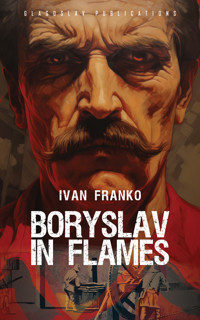
Boryslav in Flames by Ivan Franko is a pioneering novel that depicts the rise of the labour movement in Western Ukraine. The story unfolds against the backdrop of the industrial revolution in the Austro-Hungarian Empire during the 1860s. As industry burgeons in Boryslav, a nascent working class emerges, inspired by socialist ideals – a unique phenomenon in mostly agrarian Galicia.
Central to the narrative is Benedio, a lowly mason’s assistant who organizes the striking workers. This is offset against the impulsive rebelliousness and violence purveyed by the Basarab brothers.
Woven throughout this tapestry of labour strife is a “Romeo and Juliet” subplot of romance between the offspring of two affluent oil tycoons.
Serialized in the Lviv magazine Svit from 1880 to 1881, the novella remained unfinished, due to the magazine’s closure. It was eventually published as a book in 1922.
Over time the novel has undergone evolving interpretations. Initially lauded as a portrayal of the budding labour movement, it was later dissected for its intricate character psychology and examination of wealth and power dynamics. Franko’s representation of the perspectives of the workers continues to provoke critical analysis, solidifying its status as a seminal work in Ukrainian literature.
This book has been published with the support of the Translate Ukraine Translation Program.
Das E-Book können Sie in Legimi-Apps oder einer beliebigen App lesen, die das folgende Format unterstützen:
Seitenzahl: 492
Veröffentlichungsjahr: 2023
Ähnliche


















Boryslav in Flames
Ivan Franko
Translated byYuri Tkacz
Glagoslav Publications
Boryslav in Flames
by Ivan Franko
First published in Ukrainian as Борислав сміється in 1922
Translated from the Ukrainian by Yuri Tkacz
This book has been published with the support of the Translate Ukraine Translation Program
Introduction © Marko Pavlyshyn, 2023
Proofreading by Stephen Dalziel
Cover image © Max Mendor, 2023
English translation © 2023, Glagoslav Publications
Book cover and interior book design by Max Mendor
© 2023, Glagoslav Publications
www.glagoslav.com
ISBN: 9781804841105 (Ebook)
First published in English by Glagoslav Publications in November 2023
A catalogue record for this book is available from the British Library.
This book is in copyright. No part of this publication may be reproduced, stored in a retrieval system or transmitted in any form or by any means without the prior permission in writing of the publisher, nor be otherwise circulated in any form of binding or cover other than that in which it is published without a similar condition, including this condition, being imposed on the subsequent purchaser.
Contents
Introduction
Chapter 1
Chapter 2
Chapter 3
Chapter 4
Chapter 5
Chapter 6
Chapter 7
Chapter 8
Chapter 9
Chapter 10
Chapter 11
Chapter 12
Chapter 13
Chapter 14
Chapter 15
Chapter 16
Chapter 17
Chapter 18
Chapter 19
Chapter 20
Chapter 21
About the Translator
About the Author
Glagoslav Publications Catalogue
Introduction
In January 1881 the first issue of Svit (The World, but also Light), a journal of literature, politics and scholarship published in Lviv and dedicated to the propagation of socialist ideas, contained the first instalment of a novel about labour and capital. Its setting was the oil mining town of Boryslav, one of the few industrial sites of the province of Galicia in the Austro-Hungarian Empire. The novel, Boryslav in Flames as it is called in Yuri Tkacz’s translation (its Ukrainian title was Boryslav smiiet’sia – Boryslav is Laughing), appeared serially in Svit until the journal ceased publication in September 1882; the novel was never completed. Its author, Ivan Franko (1856–1916), not 25 years of age when publication of the novel began, already had a substantial body of literary work to his name: a novel in the Gothic manner, short prose works on peasant life and its hardships, the realist early stories of his Boryslav cycle, and numerous as yet unpublished poems. Franko was also notorious as a political firebrand, the translator of a chapter of Marx’s Capital and the author of numerous political essays with such titles as “Solidarity,” “Workers and Employees” and “A Catechism of Economic Socialism.” He had twice been arrested by the Austrian authorities for his political views and activities (two more arrests would follow later).
In the course of Franko’s life material hardship proved no barrier to his prodigious industriousness in an extraordinarily broad array of fields: poetry, prose and drama; literary scholarship and criticism; philology and folklore studies; translation and editorship; as well as party politics, political organisation and political journalism. His political convictions evolved with time. Always dedicated to the ideal of human liberation from injustice and oppression, Franko came to the conviction that the precondition for the achievement of an individual’s social rights and political freedoms was the liberation from foreign dominion of the nation within whose compass alone those rights and freedoms could be secured. In the twentieth century Franko came to be viewed as one of the triad of Ukraine’s pre-eminent cultural nation-builders, alongside the poet Taras Shevchenko (1814–1861) and the dramatist and poet Lesia Ukrainka (1871–1913).
In Franko’s lifetime the territory inhabited by Ukrainians was divided between the Russian Empire, home to more than 80% of Ukrainians, and the empire of the Habsburgs, where more than 6 million Ukrainians lived, mainly in eastern Galicia and northern Bukovina. In the Russian Empire tsarist edicts of 1863 and 1876 placed onerous restrictions on Ukrainian-language publication and cultural activity. One of the consequences was that Lviv, the capital of Galicia, became the main cultural and intellectual centre for the whole of Ukraine, just as it was a significant hub of Polish and Jewish culture and politics.
Franko was born in the village of Nahuievychi, less than fifteen kilometres from Boryslav. His father was the village blacksmith, while his mother was one of the large number of persons in Galicia who were of aristocratic descent, but so impoverished that their material conditions differed little from those of peasants. Franko identified himself with society’s lower estates, famously referring to himself as a “peasant’s son.” He attended school in the nearby city of Drohobych, the business centre for the Boryslav oilfields. As a child he was exposed to stories about the Boryslav mines: “I listened to those stories as if to fantastic tales of distant enchanted lands. Boryslav with its horrors and its wild anecdotes and wild leaps of fortune, its strange industries, strange way of life and strange people fuelled my imagination.”1 Franko had occasion to visit Boryslav during his school years and to observe the way of life of workers there. The experience was undoubtedly vivid in his memory as, during his university years in Lviv, he became active in the socialist movement and read works by such socialist thinkers as Ferdinand Lassalle and Friedrich Lange and his Ukrainian compatriots in the Russian Empire Mykhailo Drahomanov (1841–1895) and Serhii Podolyns’kyi (1850–1891).
The economy of Galicia was overwhelmingly agricultural. Peasants, emancipated from serfdom after the revolution of 1848, remained in a state of poverty so dire that many could not support their families by working their small tracts of land. From the 1880s onward, many emigrated. Boryslav was one of the few places in Galicia where peasants could augment their income by taking seasonal work in industry.
Oil mining commenced in Boryslav in the 1850s. The region also proved to have major deposits of ozokerite, or mineral wax. Prior to the advent of the internal combustion engine the refined end products were used mainly for lighting. As historian Yaroslav Hrytsak shows, an industrial boom ensued, in the course of which Boryslav’s population exploded from 759 in 1850 to 12,439 in 1900. Workers came from the surrounding Ukrainian rural areas and nearby Jewish shtetls, but also from ethnically Polish western Galicia; there were also a small number of professionally experienced miners from the Czech lands and Prussia. About half of the workforce was Ukrainian, one quarter Polish and one quarter Jewish – an obstacle, as Hrytsak points out, to the evolution of a sentiment of worker solidarity. As for the industrialists, in Boryslav they were mainly Jewish, in contrast to some other Galician oil-mining sites, where Polish capital prevailed. The Boryslav enterprises, of which there were some hundreds, were generally small until the 1890s, when laws imposing minimum safety standards and mandating the use of modern equipment put many out of business. By the early twentieth century the industry was dominated by large foreign firms.2 In the 1880s Boryslav saw practically no labour unionisation and little worker unrest. It was not until the consolidation of the industry into larger enterprises and the increase in the permanent (as distinct from seasonal) workforce that significant worker activism led by Polish, Ukrainian and Jewish social democrats emerged, culminating in a major strike in 1904.3
Readers of Boryslav in Flames will readily notice that the social phenomena which Franko describes as prevailing at the time of his writing would come into being only two decades later. In 1879, writing to Ol’ha Roshkevych, he acknowledged the anticipatory quality of the book he was planning:
This will be a novel somewhat larger in scope than my previous ones. Along with the life of Boryslav workers it will also show “new people” [proletarians with a developed class and ethical consciousness] at work – in other words, it will show not what is [at present] the case but, as it were, the full embodiment of what now exists only embryonically. […] The main idea is to show what in reality does not [yet] exist in the context of what does exist and in the colours of what exists.4
What is it, then, that does not yet exist, but is projected in the novel as desirable? It is the set of values espoused by the bricklayer and workers’ organiser Benedio, the hero of one of the novel’s two interwoven plot lines (the other concerns the family lives of two industrialists), as well as the organisational principles and resistance strategies that Benedio introduces. Benedio’s objectives are fair pay for miners, scaled to take account of the difficulty and danger of different kinds of work, and decent working conditions: insurance for workers in the event of injury or disablement; financial support for the families of workers killed or incapacitated at the workplace; the establishment of a fund providing for the subsistence of workers during strikes; and respectful treatment of miners by their employers. At the same time Benedio strives, successfully, to establish a high degree of worker organisation, solidarity and discipline, resolute picketing against strike-breakers and a clear focus among miners on practical measures that bring advantage to all workers in the industry. What Benedio explicitly does not wish for, and what energises Andrus Basarab, another member of the workers’ leadership group, is resistance in the form of revenge: violent action with no goal beyond punishing employers. It is clear that the “author” – the structuring intelligence responsible for the construction of the work and the arguments that it implies – sides with Benedio, however egregious the abuses committed by the employers and their lackeys might be, and however understandable the outrage and pain of Andrus and the great majority like him.
To make these points, and to sharpen the focus on the conflict in the Boryslav oil industry as a class conflict, Franko represents the social and economic situation in his fictionalised Boryslav as somewhat simpler than the state of affairs in the real Boryslav of the early 1880s. In order to render plausible the rapid development of worker solidarity and the swift dissemination of information among them, the novel depicts workers as a culturally homogeneous group. No ethnic descriptors are applied to them, though their real-world counterparts belonged, as pointed out above, to several groups. Employers and overseers, on the other hand, are consistently identified as Jews and as members of a single ethno-cultural community. The confrontation between labour and capital is presented as a conflict, not between a multiethnic workforce and employers mainly of Jewish background, but between workers and Jews. The workers’ adversaries – the “Jews” – are represented in almost wholly negative terms, whether drawn as a collective or revealed through detailed portraiture, as in the case of the two capitalists Hermann Goldkrämer and Leon Hammerschlag. Their motivations are never good; personal profit is their only value, deceit their chief method, compassion for workers non-existent. In instances where characters of Jewish ethnicity are not directly involved in exploitative economic activity, they are represented as deviant in other ways. Goldkrämer’s wife Rifka suffers from what readers are guided to recognise as hysteria, which is explained as the result of this simple and uneducated working woman’s transition into a life of leisure, luxury and boredom. The Goldkrämers’ son Gottlieb, poorly endowed with intelligence but spoilt by his adoring mother, grows up lazy, talentless except when exercising emotional blackmail, verbally and physically violent, and obsessive in his fixation on objects of desire. The sole exception is Hammerschlag’s daughter Fanny, an embodiment of the literary stereotype of the beautiful and virtuous Jewess who shines by contrast to her environment.
Boryslav in Flames thus appears to replicate without objection, indeed to share, the prejudicial view of Jews characteristic of much of European, and especially central and east European, society of its time. This is difficult to reconcile with Franko’s quite different attitude to Jews attested in his life practice and some, though not all, of his other literary and journalistic works. He was involved in the endeavours of a socialist committee associated with the journal Praca (Labour) to establish a Ukrainian-Polish-Jewish political party for workers and peasants, and his fluency in Yiddish qualified him to interact with the party’s potential Jewish constituency. In the aftermath of pogroms in the Russian Empire in 1881 he wrote a cycle of poems, “Ievreis’ki melodii” (Jewish Melodies), based on Jewish folklore that he had recorded, expressing sympathy with the victims. Jewish characters are represented with warmth in such novellas as “Poluika” (The Barrel, 1899) and “Gava” (Crow, 1888). Philosemitic and antisemitic elements stand side by side in Franko’s work. As Hrytsak puts it,
Franko’s socialist views led him to defend the weak and the downtrodden, and where the Jewish community was concerned, his sympathies lay with poor Jews who were exploited by wealthy Jews. But the need to defend the poor non-Jewish population forced him into a confrontation with the entire Jewish community which, in his view, demonstrated a high level of internal solidarity on the question of the exploitation of Ukrainian and Polish workers and peasants.5
Franko’s depiction of miners gaining the upper hand in their struggle against capital is one factor that distances the content of Boryslav in Flames from the reality of the 1880s attested by historical sources. Other features of the novel that stretch plausibility are the heavy reliance of its plot on coincidence, the impossibly short timeframes in which complex transformations of collective habits of thought and practice are supposed to take place, and the hyperbole that accompanies the description of the behaviour of characters intended to be perceived as eccentric or disturbed.
Imperfect correlation with what is generally perceived as “reality,” however, by no means disqualifies a work from being classified as “Realist,” as Boryslav in Flames generally has been in Ukrainian literary history. Realism is the conventional designation of a period and a style in the literature and other arts; features generally shared by works regarded as Realist which are readily found in Boryslav in Flames include attentive description of social relations, emphasis on the underlying (genetic or environmental) causes of human behaviours, nuanced description of psychological states, and a critical authorial stance toward prevailing forms of human oppression. The erudite Franko was familiar with the contemporary Realist canon, including Balzac, Flaubert, Dickens, Eliza Orzeszkowa and Ivan Turgenev. He was alert to the Positivist thought of Auguste Comte and the idea that society was subject to general laws and knowable through science as the physical world is knowable. He held in high esteem the work of Émile Zola and Zola’s advocacy of a literature scientistic and objective in its analysis of the laws that determine human behaviour. He did not, however, find satisfaction in the cool detachment of what Zola termed “Naturalism,” proposing in his essay “Literature, its Tasks and its Most Important Features” (1878) a literature that would not merely offer an accurate image of society, but seek to change society for the better. This would be a literature of “scientific realism”:
Like contemporary science, literature must labour on the field of human progress. Its tendency and method must be scientific. It collects and describes the facts of everyday life, caring only for truth, not for aesthetic rules, and at the same time it analyses these facts and draws conclusions from them. That is its scientific realism. By these means it shows forth the flaws in the social order where science may not always be capable of penetrating (in everyday life, in the psychological development of drives and human passions), and strives to ignite in its readers the will and the power to combat such flaws. That is its progressive tendency (emphases in the original).6
Objective description, analysis, the drawing of conclusions and the correction of social faults: such were the tasks that Franko in his essay set for modern literature, and such, evidently, were the goals that he set himself when writing Boryslav in Flames. His success in achieving them, as the preceding discussion has sought to show, was mixed.
How should readers in the third decade of the twenty-first century assess this unfinished, from our contemporary perspective ideologically awkward, late nineteenth-century novel? One way of valuing it is to see it as a document of an historical period. The novel is a vehicle for understanding, not so much Boryslav and the intersection of social, cultural, economic and political forces that it embodied – the novel is too partisan and too one-sided in its vision for that – but one contemporary perspective upon that reality. It is a perspective energised by a powerful drive to defend justice and humanity, yet limited by its own ethical blind spots. It is also possible to apprehend Boryslav in Flames as an important document of one station along the complex creative path of a remarkable and gifted individual. Franko was one of the giant intellectual figures of Europe at the end of the nineteenth and the beginning of the twentieth centuries, unjustly invisible to much of the world because the country and the culture from which he came and which he did much to shape were themselves scarcely visible to the world, occluded by the shadows of two imperialisms. Finally, however, it is possible to appreciate Boryslav in Flames as the literary scholar Tamara Hundorova has done: “The veracity and vividness with which characters familiar from earlier works of the Boryslav cycle are depicted, the picturesqueness of descriptions and the plasticity of mass scenes, the attention paid to the inner world of individuals, the introduction of the parallel plot line from the life of the Galician bourgeoisie […] secure the intrinsic worth of this literary text.”7 We value Boryslav in Flames not for what it documents, but for what, when all is said and done, it is: a story well told.
Marko Pavlyshyn
1Ivan Franko, “U kuzni (iz moikh spomyniv)” [In the Blacksmith’s Shop (From my Memoirs)], Zibrannia tvoriv u piatdesiaty tomakh [Collected Works in Fifty Volumes], Vol. 21 (Kyiv: Naukova dumka, 1979), p. 164.
2Yaroslav Hrytsak, Ivan Franko and his Community, trans. Marta Olynyk ([Edmonton]: Canadian Institute of Ukrainian Studies Press; [Cambridge, MA]: Harvard Ukrainian Research Institute; Brookline, MA: Academic Studies Press, 2018), pp. 246-49. Hrytsak’s study, first published in Ukrainian in 2006, is to be recommended as an invaluable guide to Franko’s life and the social and political context in which Boryslav in Flames was written and received.
3Hrytsak, p. 251.
4Ivan Franko, letter to O. M. Roshkvych, c. 14 March 1879, Zibrannia tvoriv, Vol. 48 (1986), pp. 205-06.
5Hrytsak, pp 312-20; quotation p. 320.
6Franko, “Literatura, ii zavdannia i naivazhnishi tsikhy,” Zibrannia tvoriv, Vol. 26 (1980), p. 13.
7Tamara Hundorova, Franko ne kameniar / Franko i kameniar [Franko: Not a Stonecutter / Franko: Also a Stonecutter] (Kyiv: Krytyka, 2006), p. 63.
Chapter1
The sun indicated that it was nearing midday. The town hall clock struck eleven hastily and dolefully. A building supervisor left the small group of cheerful, well-dressed gentlemen from Drohobych who were strolling along the alleys near the Catholic church in the shade of blossoming horse chestnut trees. Waving his polished cane about, he crossed the street to join the workers at a new construction site.
“Well, Master Mason,” he called out, “are you ready?”
“Everything is ready, sir.”
“Well, time to sound the end of the workday then!”
“Yessir!” replied the Master Mason and, turning to his assistant, who was standing by his side and putting the finishing touches to a huge foundation stone cut from sandstone in nearby Popeli, said: “Come there, Benedio, you dimwit! Didn’t you hear the building supervisor say we need to sound the end of the workday? Shake a leg there!”
Benedio Synytsia set aside his masonry hammer and hastened to fulfill the Master Mason’s order. Dodging among the scattered rocks littering the ground, he sprinted as fast as his thin, wiry legs would carry him, panting and turning blue from the effort. He made his way to a tall fence, where a board hung suspended by two ropes. Alongside it, hanging from similar ropes, were two wooden mallets used to strike the board, a device employed to signal the start or end of work. Running up to the fence, Benedio grabbed the mallets with both hands and began pounding them against the board with all his might.
Clatter! Clatter! Clatter! The joyous, loud barking of the ‘wooden bitch’ sounded across the building site. This was how the masons had dubbed the device.
Clatter! Clatter! Clatter! Benedio thundered incessantly, smiling at the board he was torturing so mercilessly. And all the masons who were busy working on the large site, some carving stones for the foundations and some slaking lime inside two deep containers, all the men who were digging trenches for the foundations, the carpenters behind them who were chipping away like woodpeckers at the hefty fir logs and oak beams, the sawyers who were cutting planks with hand saws, the bricklayers who were stacking the newly-delivered bricks – all these workmen who were scurrying about like ants on a parade ground, moving things, chipping away, staggering, moaning, rubbing hands, joking and laughing – everyone stopped working like a huge, hundred-armed machine, whose frantic movements were terminated by pressing a single button.
Clatter! Clatter! Clatter! Benedio refused to stop, although everyone had long since heard the barking of the ‘wooden bitch.’ The masons, had been hunched over the boulders, clanging loudly against the hard sandstone surface, causing sparks to fly from time to time from under their masonry hammers. Now, having dropped their instruments, they straightened their backs and spread their arms wide to fill their lungs to capacity with air. Some, who preferred to kneel while working, slowly rose to their feet. Lime hissed and gurgled in the lime-pit, as if it were furious that it had been earlier thrown into the fire and was now tossed back into the water. The sawyers left their saw suspended in the timber beam; it hung there, its upper handle resting against the beam, while the wind played with the free end. The diggers pressed their spades into the soft clay, and jumped out of the deep trenches being readied for the foundations. Meanwhile, Benedio had stopped his clattering, and all the workmen, covered in crumbs of brick and clay, with wood shavings and stone chips on their clothes, hands and faces, began to assemble at the front corner of the new building, where the Master Mason and the building supervisor were standing.
“And how, if you please sir, should we lower this stone into place?” the Master Mason asked the building supervisor, resting his coarse strong hand on the hewn foundation stone, which, although it lay flat on small wooden rollers, almost reached up to the Master Mason’s waist.
“How should we lower it?” repeated the building supervisor in a drawl, as he cast a glance at the stone through his monocle. “Well, on sticks, of course.”
“Won’t that be a little too dangerous, if you please, sir?” added the Master Mason.
“Dangerous? Who for?”
“Well, obviously, not for the stone, but for the people,” the Master Mason replied with a smile.
“A-hah! Come on! Dangerous! Don’t be afraid, nothing will happen to anyone! We’ll lower it into place!”
And the building supervisor wrinkled his forehead gravely and pursed his lips tightly together, as if he himself was already straining and lowering the foundation stone into its appointed place.
“We’ll lower it safely!” he repeated once more, this time with utter certainty, as if he was convinced that his strength alone would be enough for the undertaking. The Master Mason shook his head in disbelief, but said nothing.
Meanwhile, the people who had been strolling in small groups along the ‘alleys’ around the Catholic church, began to slowly drift toward the construction site. Leading the way was the owner of the new building, Leon Hammerschlag, a tall and stately man with a round-trimmed beard, a straight nose and lips like red raspberries. He was very cheerful on this day, talkative and witty, sharing jokes with those around him and, apparently, entertained everyone following him, for they all gathered and huddled around him. Nearby, in another throng, was Hermann Goldkrämer, the most respectable (in other words, the wealthiest) of the town’s inhabitants. He was more reserved, quiet, and even somewhat unhappy, although he tried hard not to show it. Then came the other businessmen, rich people from Drohobych and Boryslav, some government officials and one outlying landowner, a great friend of Hammerschlag, possibly because his entire estate was in Hammerschlag’s pocket.
All these men dressed in fashionable black frock coats, in overcoats made of expensive fabric, in shiny black top hats, wearing gloves, with canes in their hands and rings on their fingers. They were in stark contrast to the grey mass of workers, whose adornments included sprays of red brick dust or white streaks of lime. The cheerful chatter of both groups seemed to bring them closer together.
The whole parade ground at the corner of Panska and Zelena streets was filled with people, wood, stones, bricks, wooden cladding and piles of clay, and resembled a large ruin. Only the wooden shed standing in the remains of the orchard, looked lively and alluring. It was decorated with green spruce at the entrance and hung with carpets inside. Servants were rushing about inside and around it, shouts and curses filled the air… They were preparing food to celebrate the laying of the foundation stone for Hammerschlag’s new home. And another unusual guest looked on with great surprise at this crowd of assembled people and objects. It was a tiny individual, and everyone observed it with curiosity and wonder.
“Benedio,” asked a worker smeared with clay, “why have they hung that goldfinch there?”
“They must be thinking of doing something with it,” Benedio replied.
All the workers whispered among themselves and looked at the goldfinch flitting about in the wire cage hung on a long shaft above the trench, but no one knew what it was for. Even the Master Mason had no idea, although he pretended to be in the know and answered the workers’ questions with the words:
“Oh, you’d like to know everything, wouldn’t you! Thou shalt grow old when thou knowest all things!”
Having recovered from its initial fright due to the sudden influx of the crowd of people, the goldfinch was hopping about on the perches of its cage, picking at hemp seeds with its beak. Occasionally, standing on the top perch, it fluttered its red and yellow wings and chirped thinly: “Ti-kili-tlin! Chirrup, chirrup! Kool-kool-kool!”
Leon Hammerschlag’s head appeared above the murmuring crowd. He jumped onto the foundation stone and loudly addressed those present:
“Ladies and gentlemen, neighbours and benefactors!”
“Quiet! Quiet! Shoosh!” a voice rang out and the crowd grew quiet.
Leon continued:
“Thank you very, very much for being so kind as to honour me with your presence on this occasion, which is so important for me today…”
“Oh, the pleasure is all ours!” several voices, both coarse and high-pitched, responded.
“Ah, here come our ladies! Gentlemen, first, let’s congratulate the ladies!” And Hammerschlag disappeared again into the crowd, while several of the younger gentlemen went out to the street where several carriages with ladies had just arrived. The gentlemen helped them out of the carriages and escorted them to the square, where a place had been prepared for them beside the huge block of stone.
The ladies were, for the most part, old and unattractive Jewish women who tried to hide their lack of youth and beauty with a lavish and ostentatious display of wealth. Silks, satins, sparkling jewels and gold shone on them. They constantly checked their dresses, taking care not to bring them in contact with the chips of red brick and stone, or the equally dirty workers. Only Fanny, Hammerschlag’s daughter, stood out among the ladies precisely because of what the others lacked – youth and beauty. In their midst she appeared like a blooming peony alongside withered thistles. The younger men from among those assembled, flocked around her, and a lively, vocal conversation soon ensued among them, while the other ladies, after their initial customary exclamations of astonishment and shrill, rehearsed good wishes to the property owner, became somewhat reticent and began looking around, as if waiting for some performance to begin. Their anticipation quickly spread to the others. The cheerful chatter died away. It was evident that with the arrival of the ladies, an air of boredom and forced restraint had descended upon those gathered, which seemed of no benefit to anyone.
Hammerschlag was flustered. He seemed to have forgotten that he had started a speech a moment earlier and wandered about, initiating conversations about unrelated topics with various people, but nothing seemed to flow well. Suddenly, he found himself in front of Hermann, who stood silently, leaning against a pile of wood and surveying the building site, as if he were considering buying it.
“And why is your wife not present, dear neighbour?” Leon said, smiling.
“Forgive me,” Hermann replied, “she must be feeling unwell.”
“Ah, I’m sorry to hear that! And I had hoped…”
“It’s alright,” Hermann tried to appease him, “she’s no bigwig! I’m sure we can do without her!”
“No, my dear neighbour! Please don’t say such things… How can you? My Fanny, poor child, how happy she would be if she were to have such a mother!”
The insincerity of these words was evident in Leon’s face and eyes, but his mouth, obeying his determined will, spoke them, and his mind tried to justify them, as required by self-interest.
Suddenly, from the direction of the meadow where a tall whitewashed synagogue was visible, there came a loud exclamation and commotion. All the guests and workers turned their eyes in that direction. After a short while, what appeared to be a black storm cloud appeared in the street – it was a Jewish qahal surrounding the rabbi, who would be performing the consecration of the foundations to the new house.
Soon, the entire square was flooded with Jews, who, as was their custom, spoke all at once, loudly and quickly, moving around like ants in a disturbed anthill, examining everything and appraising everything with their eyes. They sighed and shook their heads, as if marvelling at Leon’s wealth and regretting that it was not in their hands. The few Christian gentlemen who were present fell silent and moved to one side, feeling out of place here. The local squire frowned and bit his lip in anger, finding himself amid a crowd which paid him no respect. Surely, deep inside, he was cursing his ‘dear friend Leon’ vehemently, but he did not leave, choosing to stay until the end of the ceremony, after which refreshments were to be served.
The general clamour in the square not only persisted, but grew louder. The goldfinch, startled by the sudden influx of this noisy crowd dressed in black, began to flutter in its cage and crash into the wires. Two attendants led the rabbi, an old grey-haired man with a long beard, by the arms and brought him right up to the foundation stone. A tight circle of people pressed around him, as if everyone wanted to be beside the rabbi, even though there was hardly enough room for everyone. Because of the shouts of the crowd, and the pushing and shoving, it was impossible to hear what the rabbi was reciting over the foundation stone. But whenever the attendants responded to his prayers with a shout of ‘umayn,’ meaning ‘amen,’ the rest of the crowd repeated ‘umayn’ after them.
In the bell tower next to the church, right opposite the building site, a huge bell began to toll, signalling noon. Following this, all the other bells in Drohobych’s churches joined in. It seemed as if the air above Drohobych was moaning with sorrowful voices, among which the chaotic, many-voiced ‘umayn’ sounded even more mournful and sad. Upon hearing the bells, the workers removed their hats and began to make the sign of the cross. One of the attendants approached Leon and bowing before him, began to whisper:
“May God bless you and the work you have begun here. We have finished.” Then, leaning even closer to Leon, he said more softly: “You see, the Lord God has sent you a sign that everything will augur well for you, whatever you intend to do.”
“A good sign? What do you mean?” Leon asked.
“Can’t you hear that the Christian bells are doing you a good service and invoking the blessing of the Christian God? It means that all Christians will willingly serve you. They will help you achieve whatever you set out to do. These bells are a good omen!”
Had Leon heard such words from someone else, he probably would have laughed in their face. He liked to present himself as a freethinker in front of others, but deep down, like all ignorant and self-centred people, he was superstitious. So now, knowing that no one had overheard the attendant’s conversation, he gladly accepted the good omen and placed a tenner into the attendant’s outstretched hand.
“This is for you and the synagogue,” Leon whispered, “and may the Lord be praised for the good sign!”
Delighted, the attendant resumed his place beside the rabbi, and immediately began to whisper to the other attendant, who was apparently asking how much Leon had given them.
Meanwhile, the building supervisor began to direct the workers.
“Alright, lads, grab your poles!” he shouted. “Benedio, you hopeless dimwit, where’s your pole?”
The commotion in the square grew even louder. The rabbi was led aside, the Jews made way for the workers who were about to move the huge foundation stone and lower it into its designated place in the deep trench. The ladies pressed forward curiously, panting. They were keen to see how the enormous rock would be moved. The goldfinch continued to chirp merrily in its cage and with its broad blinding face the sun smiled down from the deep-blue cloudless sky.
The building supervisor’s orders were quickly carried out. Across the small path, where the foundation stone needed to be moved, four logs were placed, each as thick as the ones the stone was currently resting on. Two similar logs were placed across the trench where the stone was to be lowered. Workers surrounded the foundation stone with their poles in hand, to start it moving and break its obstinate stillness. Some joked and laughed, calling the foundation stone a ‘grey cow’ that so many people were trying to herd into a barn.
“Move along, giddy up!” one fellow teased, nudging the stone along.
But then the building supervisor’s command sounded, and everyone went quiet. In the crowded square, the only sounds that could be heard were the breathing of the people and the chirping of the goldfinch in its cage.
“Alright, let’s go! One, two, three!” the building supervisor shouted. And ten wooden poles, like ten huge fingers, lifted the stone from both sides, and it slowly rolled along the tracks, crunching loudly on the gravel underneath.
“Hurrah! Hey! Keep pushing it, so that it doesn’t stop moving!” the workers shouted cheerfully.
“Keep it moving!” the building supervisor called out at the top of his voice.
The workers strained again. The gravel crunched once more, the rollers creaked under the weight of the foundation stone and, like a huge tortoise, it crawled slowly forward. There was joy on the faces of the assembled guests, the ladies were smiling, and Leon whispered to one of his ‘neighbours’:
“Just you look at that! Say what you will, but man is indeed the true master of nature! There is no force he cannot overcome. Here is this mighty stone, this heavy burden, and it moves at his behest.”
“Exactly,” added the ‘neighbour,’ “the power there is in a community of people! United effort works wonders! Would one person ever be able to achieve something like this?”
“Yes, yes, united effort, that’s quite a powerful phrase!” Leon replied.
“Hurrah, altogether now! Come on!” cheered the workers. The stone was already above the trench, resting on two crossbeams, which under its weight became deeply embedded in the ground on both sides of the trench. But now came the most challenging part – to lower the stone properly into the trench.
“Come on, lads, move a leg there!” commanded the building supervisor. The workers scattered in an instant to both sides of the trench and placed five pairs of thick poles under the stone.
“Right under its ribs we go! Let’s make its heart jump,” the workers joked.
“Now lift it! And as soon as the crossbeams are moved to one side, when I shout: ‘Now!’, all of you are to pull out your poles together and scramble away from the trench! Understood?”
“Understood!”
“But all at once! Anyone who is late will be in trouble!”
“Alright, alright!” shouted the workers and pressed down on the poles to raise the foundation stone. Slowly, almost reluctantly, it detached itself from the crossbeams on which it lay, and rose a few inches. All hearts involuntarily trembled. The workers, red with exertion, held the stone on the poles above the trench, waiting for the crossbeams to be removed and the building supervisor to give the signal to remove the poles from under the stone.
“Now!” barked the building supervisor amid the prevailing silence, and nine of the workers, together with their poles, scattered in opposite directions. And the tenth? Along with the muffled thud of the foundation stone dropping into its designated position, the assembled crowd heard a dull, piercing moan.
“What was that? What’s happened?” people began to murmur. Everyone began pushing closer to the trench, trying to see what had happened.
A simple thing had occurred. Nine workers had simultaneously pulled their poles out from under the stone, but the tenth, a mason’s assistant named Benedio Synytsia, had been a split second too late and that moment could have cost him his life. With all its weight the stone had jerked the pole out of his hands. It struck Benedio across his body and luckily had missed his head. Benedio let out a moan and fell lifelessly to the ground.
The sand splashed upward in a cloud where his pole had fallen. The workers rushed up to Benedio in mortal alarm.
“What’s wrong? What’s happened?” the guests clamoured. “What’s going on?”
“One of the poles has struck a worker.”
“Is he dead? Oh, my God!” the ladies began to murmur.
“No, he’s alive!” one of the workers called out.
“He’s alive! Ah!” Leon exhaled, for his heart had clenched after he heard Benedio’s cry.
“Is he badly injured?”
“No, not really!” boomed the building supervisor’s voice, whose knees had begun to tremble for no apparent reason.
The crowd murmured and pressed around the injured man. The ladies gasped and squealed, their mouths becoming contorted, as they demonstrated their sensitivity and soft-heartedness. Leon felt a vague buzzing in his head, and was unable to string his words together. Even the goldfinch in its cage chirruped mournfully and fluttered into the corners, as if it too couldn’t bear to witness human suffering. Benedio still lay in the same place, pale as chalk, unconscious, with clenched teeth. The pole had knocked the wind out of him, catching him on the side with its sharp edge, and tearing through his shirt and skin. It had gouged a wound from which blood was now flowing.
“Water! Water!” the workers shouted, as they tried to revive Benedio and bandage his wound. Water was brought, the wound was bandaged, and the bleeding was stopped, but they were having a hard time to revive him. The blow had been very strong and in a dangerous place. A cloud of uncertainty once again settled over the assembled crowd.
“Take him out there into the street!” Leon eventually called out. “Or better still, take him home and summon a doctor!”
“Lively, there!” the building supervisor urged them on.
While two workers grabbed Benedio by the hands and feet and carried him through the crowd to the street, the Master Mason approached the building supervisor from behind and tapped him on the shoulder. The building supervisor gave a start and turned sharply, as if he had been stung by nettles.
“See there, sir, I was right…”
“What are you talking about? What did you say?”
“I told you,” the Master Mason whispered calmly, “not to lower the foundation stone with poles, because it’s too dangerous.”
“Eh, you fool! It’s only because that idiot was probably drunk and didn’t jump back in time, it’s his own fault!” the building supervisor responded angrily and turned away. The Master Mason shrugged his shoulders and grew silent. But the building supervisor felt a sharp pain deep inside and was fairly seething with anger.
Meanwhile, it was time to conclude the foundation stone laying ceremony. The attendants led the rabbi to a small yet sturdy ladder, and he climbed down to the bottom of the trench, where the foundation stone lay in its required position. A deep rectangular hole had been carved into the upper surface of the stone, and around it were fresh splotches of blood from Benedio’s wound. The rabbi muttered another prayer, and then threw a small silver coin into the carved hole in the stone. The rabbi’s attendants did the same, and then the other guests began to climb down into the trench and toss coins, some larger and some smaller, onto the foundation stone. The ladies shrieked and swayed on the steps, supported by the men, except for Leon’s daughter Fanny, who proudly and boldly descended into the trench and threw in a ducat. After this, the other ladies and gentlemen began to climb down into the trench one by one. A descendant of Polish nobility who was right behind Hermann, shot a sideways glance at the wealthy capitalist when he threw a shiny golden ducat with a clink onto the stone. The nobleman only had a silver rinsky1 in his pocket, and so as not to lose face, he swiftly unclipped one of his gold cufflinks and tossed it into the hole.
The line of guests stretched for quite some time, the gold and silver coins clinked for a long while, filling the depression in the stone with a lustrous wave. Waiting for the Master Mason’s instructions, the workers stood beside the trench and looked on enviously at the whole ceremony. Finally, the last coin was tossed in, leaving the depression almost full. Leon, who was standing by the steps and amicably shaking the hands of everyone coming out of the trench (he even exchanged kisses with Hermann and the old nobleman out of sheer joy), now stepped forward and ordered that the slab and the cement be brought to seal the foundation stone. The workers rushed to fulfill his orders, while he came up to the cage with the goldfinch.
“Tweet-tweet! Chirrup, chirrup! Kool-kool-kool!” chirped the bird, suspecting nothing, as Leon approached. Its delicate, clear song resonated in the still air like glass. Everyone fell silent, curiously watching the conclusion of this solemn foundation laying ceremony. Leon took the cage with the bird from the post, held it aloft, and said:
“My fellow neighbours, my dear guests! This is a big day for me, a very big day. A man who wandered for forty years through desolate deserts and sailed turbulent seas, has today for the first time spied the calm of a peaceful harbour. Here, in the happy town of Drohobych, I have decided to weave a nest for myself, which will become a part of the beauty and glory of this city…”
“Bravo, bravo!” the guests shouted, interrupting his speech.
Leon bowed, smiling, and continued:
“Our parents taught us that if you want to start a venture fortuitously, if you want to complete it fortuitously, and if you want to enjoy its fruits fortuitously, you must first bring together the spirits of a place. Do you believe in spirits, ladies and gentlemen? Maybe there are those among you who don’t. I must confess, I believe in them. Strong, mysterious spirits dwell here in this soil, in these blocks of stone, in this sizzling lime, in these human hands and heads. Only with their help will my house become my stronghold. They will bring good fortune and defend it. And to unite these spirits, we are making a sacrifice here today, a sacrifice in blood, which is the aim of today’s solemn ceremony. So that wealth and prosperity – not only for me, but for the whole city – blossom in this house, you threw a golden seed into the furrow in the stone with your kind hands. So that health, joy and beauty – not only for me, but for the whole city – may dwell in this house, I sacrifice to the spirits of this place a lively, healthy, cheerful and beautiful songbird!”
With these words Leon thrust his hand into the cage. “Pee-pee-pee!” the small bird squeaked, fluttering about and hiding in the corners, but Leon deftly caught it and brought it out of the cage. The goldfinch fell silent in his hand, looking about with frightened eyes. Its red-feathered chest looked like a large bloodstain in Leon’s hand. Leon took out a red silk thread and tied the goldfinch’s wings and legs with it, and then went down the steps into the trench. Everyone was silent. The workers brought in a large slab of stone and placed cement around the edges of the hole in the foundation stone, so that it could be sealed straight away. After whispering a few more words, Leon took off the golden ring from his finger and threw it among the other treasures in the depression, placing the goldfinch on top. The bird lay calmly on its cold death bed of gold and silver, and only its small head was turned upward, toward the sky, toward its bright, spacious abode. And then a large cold slab covered the living creature from above, this living burial affirming the future happiness of the house of Hammerschlag…
At that moment Leon looked to one side and saw traces of another sacrifice on the foundation stone – human blood, the blood of the mason’s assistant, Benedio. The blood, already congealed on the stone, shook him to the core. He saw that perhaps the ‘local spirits’ were making fun of his words and were accepting a sacrifice that was not at all as innocent as his own. It appeared to him that this second, terrible, human sacrifice would hardly benefit him. The drops of blood adhering to the stone in the dark trench looked like the black heads of iron nails, which were drilling into the foundations of his magnificent building, making holes in it and eating away at it. He suddenly felt cold and confined in the trench, and scrambled out as fast as he could.
Guests pressed around him, wishing him well. Hermann shook his hand and announced loudly for all to hear:
“May that small treasure, sown with friendly hands in the foundation stone of your house, grow and multiply a thousand times. May it become the foundation stone of the glory and wealth of your line!”
“Just as your house is now founded on a foundation of solid stone and gold,” another nobleman added loudly from the other side, “may the happiness and prosperity of your family now be based on sincere friendship and the goodwill of all people!”
Leon eagerly shook the hands of his guests, cheerfully thanked them for their friendship and service, promised to work in the future only with the people and for the people – and yet his heart was filled with a cold twilight, through which he could see large black menacing drops of blood, like living iron nails, piercing and hollowing out the foundations of his happiness. He sensed a certain coldness in the words of his guests, for it was obvious that envy lurked deep in their hearts.
Meanwhile, under the guidance of the building supervisor, the workers began to lay bricks on all sides of the foundation stone and quickly raised a wall inside the trench. The clocktower struck one o’clock.
“Well, that’s enough work for now, good people!” Leon called out. “You need to enjoy yourselves as well. There are not too many days like this in my life, so let it be a festive day for you as well. They’ll bring you beer and snacks presently, and you, Master Mason, please keep order among the workers!”
“Thank you, sir!”
“And I ask you, my dear guests, to follow me. Fanny, my child, be a darling and look after the ladies! Come, please!”
Chatting merrily, the guests walked among the piles of bricks, stones and timber to a wooden hut decorated with wreaths and colorful bunting, for refreshments. Only the rabbi and his attendants, together with a few other Hasidim left, not wishing to sit at the same table with those eating non-kosher food.
While the gentlefolk were enjoying themselves in the wooden hut, the workers sat in a wide circle in the open air on the rocks. Two assistants poured beer, another two distributed slices of bread and dried fish. However, the workers were somehow very taciturn. The incident with Benedio had affected everyone deeply, and they didn’t approve of the strange Jewish rite behind the laying of the foundation stone. Why brick in a live bird? As if this would bring happiness? But who knows, maybe that was the case… After all, someone had invented the saying: ‘For gentlemen to wine and dine, chickens must die.’
The workers who had taken Benedio home, finally returned and began to recount how Benedio’s old mother was frightened and wept profusely, seeing her only son passed out and covered in blood. At first, the poor woman thought that he had died, but when they managed to bring him around, she was comforted like a child, rushing up to him and kissing him tearfully, sobbing uncontrollably.
“You know what, lads,” said the Master Mason, “we should do something to help the poor fellow, because if he’s poorly and unable to work, then I don’t know how the two of them will manage. After all, the old woman won’t be able to feed them both!”
“That’s true, so true!” shouted the workers from all sides. “After we are paid, we can donate five kreutzers2 each. It’s nothing for us, but a great help for them.”
“And what about the building supervisor,” said one of the masons, “won’t he be donating anything? After all, this whole misfortune occurred because of him!”
“Just as well it finished at that,” said another. “The foundation stone could have just as easily crushed the lot of us!”
“He has to be told that he too needs to chip in to help the poor injured fellow.”
“But I’ll leave it to you to tell him,” said the Master Mason. “I refuse to.”
“Alright, then, all of us will tell him!” the men said in unison.
At that moment the building supervisor emerged from the hut to look in on the workers. His face was flushed a deep red from the wine he had consumed, and his glistening cane flew very deftly from one hand to the other.
“How are things, my children!” he exclaimed as he approached the men.
“All’s well, sir,” replied the Master Mason.
“Well, make sure it stays that way!” he retorted and turned to go back inside.
“We would like to make a request of you, sir,” said a voice from among the workers. The building supervisor turned around:
“Of me?”
“Yes,” everyone buzzed.
“Well, what is it?”
“That you, sir, would be so kind as to join us in helping out the assistant who was injured today.”
The building supervisor stood there without saying a word, his face turning a deeper shade of crimson, a sign that the request of the workers had upset him terribly.
“Me?” he said finally. “And why come to me with such a request? Was it my fault or what?”
“Well, sir, we are not to blame either, but it seems to us that it is appropriate to help the poor fellow. He is weak, he won’t be able to work for some time, and he and his old mother need something to survive on.”
“If you like, go ahead and help him, but it’s nothing to do with me! Why do I need to help some useless ragamuffin! Really!” The building supervisor turned away angrily and began to walk back, but then one of the workers, outraged by the conversation, said loudly:
“Eh, just look at this ‘gentleman,’ will you! He’s the one most to blame for Benedio being injured! If it had been him who was struck down, I surely would have spared even ten kreutzers, not just five, to help the wretch!”
“What?” the building supervisor suddenly roared with all his might and rushed up to the seated workers. “Who said that?”
There was silence.
“Who dared say that? Hah?”
No one made a sound.
“Master Mason, you were sitting here: who said that? Speak up, or I’ll fire you instead of that good-for-nothing!”
The Master Mason surveyed the workers and said calmly:
“I don’t know.”
“Don’t you just? Then I don’t know you either. Off you go!”
“It was me who spoke,” said one of the workers, getting up. “I said, and I’ll say it again, that you’re an utter wretch if you don’t want to donate toward that poor worker. And you can shove your work…!”
The building supervisor was livid, he was so enraged that he couldn’t utter a single word. Meanwhile, the worker picked up his mason’s square, trowel and measure and, bidding his comrades farewell, calmly made his way toward the marketplace. The other workers were silent.
“Ah, you rascals and slackers!” boomed the building supervisor. “He’s a useless worker! All he does is lie about on his stomach like a dead pig in the mud. Just wait, I’ll teach you all some order! I’ll show you how to work! You useless good-for-nothings!” And, still shaking with anger and cursing all the rabble in this world, the building supervisor returned to join the gentlefolk.
In the meantime, everyone was enjoying themselves in the hut. After refreshments, the servants collected the empty bowls and plates, and in their place set out glasses and bottles of wine. The glasses were quickly filled and the wine untangled people’s tongues, giving rise to gaiety and clamour. Fragrant smoke from expensive cigars wafted toward the wooden ceiling, drifting outside in a thin wisp through an open window. Leon’s servants circulated among the guests, serving them whatever they desired. Some of the guests sat in groups, while others stood or walked about, chatting, joking or engaged in business dealings.
Leon did not leave Hermann’s side. Today, for the first time, he had come to know this great Boryslav tycoon and felt a strange affinity toward him. Until now, they had regarded each other as adversaries. Leon had arrived in Boryslav two years earlier, already with considerable capital. He was more educated than Hermann, was well-versed in commerce, and had read books on mining, and thought that it was enough for him to simply appear in Boryslav, and things would fall at his feet. He would become an absolute nobleman. He had plans to buy up extensive and very suitable tracts of land for mining, to acquire machines for faster and cheaper extraction of the earth’s treasures, to improve the prestige of the entire oil industry, be able to raise and lower market prices at will. But things turned out to be completely different.
Boryslav already had its established powers, and Leon found it challenging to compete with them, with Hermann being the most formidable figure among them. Leon had initially been infuriated by the apparent reluctance of the old Boryslav businessmen to accept him, particularly Hermann, whom he regarded as a simple, uneducated peasant. Leon had attempted various strategies to retaliate, never missing an opportunity to demonstrate his superiority over Hermann. Despite Hermann’s indifference to Leon’s provocations, he made it difficult for him to conduct business, intercepting shares that Leon wanted to buy, luring across his best workers, all the time pretending that he knew nothing about such matters. This was too much for Leon, who saw that he could get nowhere this way. True, he had been lucky in Boryslav: he had found several rich veins of wax, and the oil flowed well from many of his shafts; but Leon justly feared that fortune would not always be in his favour, that it might in the future spurn him, and in that case, it was better to have firm friends rather than firm enemies. And it also transpired that after the death of his wife, with time Leon decided to establish himself here, to settle down in peace and put down roots in the locality, and in his old age enjoy the fruits of his restless, passionate life, providing a good life for his only daughter. The ultimate thing here was to have a circle of friends, rather than enemies.
Furthermore, Leon had learned that Hermann had an only son in Lviv, apprenticed to a merchant, and his thoughts dwelled on the fact that Hermann’s son and his Fanny would make a fine couple; instead of fighting and undermining each other, the two biggest powerhouses in terms of capital, could come together, bound by close family ties. And in his imagination Leon was already building golden castles on these uncertain foundations.
“You see, dear neighbour,” he said to Hermann, “I don’t quite know myself what it is that makes me long to have my own calm, quiet and happy place. For up until now I have been like a migratory bird: now here, now there. But now it’s time to settle down!”
“I agree,” said Hermann, who seemed to be very interested in the course of the conversation.
“God did not give me a son like you, that’s true, but I have a daughter, a kind child. To see her happy, with a loving husband, surrounded by children – oh, that is my only wish in life.”
“God willing, your wish will come true.”
“I would really like that… Oh, and a circle of good friends like you, my dear neighbour, and I wouldn’t ask for anything more…”
“As for me,” Hermann said, smiling, “I won’t run away from Drohobych anytime soon, so you can always count on me being at your service.”
“Oh, I know,” said Leon and firmly squeezed Hermann’s hand. “I know that you are a sincere, good man! You won’t believe how long I’ve wanted to get to know you better… And how about your son? True, I haven’t had the honour of getting to know him personally, but he already seems such a sweet and dear person, like my own child.”
Hermann grimaced a little at the memory of his son. It was as if he had suddenly bitten into a peppercorn in a honey cake.
“My son…” he said reluctantly. “Thank you for your kind words! He works as best he can.”
“Please, don’t say such things!” Leon exclaimed. “I myself know that the son of such a father would probably not sit around idle for too long! Ah, my dear neighbour, how happy I would be, if we could both come closer together, become closer in everything so that…” He broke off and looked at Hermann, who looked back at him, unsure what he was hinting at.




