


9,99 €
Mehr erfahren.
- Herausgeber: Glagoslav Publications B.V. (N)
- Kategorie: Gesellschafts- und Liebesromane
- Sprache: Englisch
Many of the stories in this volume deal with the life of a young boy growing up in Galicia, in the far east of the Austro-Hungarian Empire in the mid-1800s. They depict the poverty and difficult conditions in the region at that time. Although autobiographical in nature, Ivan Franko wrote that the stories could not unreservedly be considered a part of his autobiography, because in all of them he had allowed himself a fair amount of creative freedom.
Franko’s stories often deal with people’s struggles with their own conscience, agonizing over the morality of their actions. From those of a young boy having killed a bird, to those of a prisoner having killed a cellmate.
After his second arrest for his strident socialist views in 1880, Franko wrote the deeply psychological novella “Down and Out in Boryslav” in one night under extremely difficult conditions. In it he showed how different people reacted to being unjustly incarcerated.
From the torment imposed on children by Catholic schools of the time to the inner monologue of a burglar being punished by his victim, when reading Franko’s prose, one has the stark impression of a director’s movie camera shooting scene after scene.
The interests and aspirations of the common people were the cause to which Ivan Franko devoted all of his many and varied talents. Throughout his literary career his creative effort was invariably focused on working-class people and their struggle for a better future.
This book has been published with the support of the Translate Ukraine Translation Program.
Das E-Book können Sie in Legimi-Apps oder einer beliebigen App lesen, die das folgende Format unterstützen:
Seitenzahl: 519
Veröffentlichungsjahr: 2024
Ähnliche


















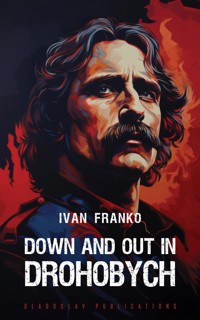
Down and Out in Drohobych
Ivan Franko
Translated byYuri Tkacz
Glagoslav Publications
Down and Out in Drohobych
by Ivan Franko
Translated from the Ukrainian by Yuri Tkacz
This book has been published with the support of the Translate Ukraine Translation Program
Proofreading by Stephen Dalziel
Cover image © Max Mendor, 2024
English translation © 2024, Glagoslav Publications
Book cover and interior book design by Max Mendor
© 2024, Glagoslav Publications
www.glagoslav.com
ISBN: 978-1-80484-182-2 (Ebook)
First published in English by Glagoslav Publications in November 2024
A catalogue record for this book is available from the British Library.
This book is in copyright. No part of this publication may be reproduced, stored in a retrieval system or transmitted in any form or by any means without the prior permission in writing of the publisher, nor be otherwise circulated in any form of binding or cover other than that in which it is published without a similar condition, including this condition, being imposed on the subsequent purchaser.
Contents
Little Myron
The Pencil
Schön Schreiben
The Mykytych Oak Tree
Hryts at School
The Forest Nymphs
The Duel
My Crime
In the Blacksmith’s Shop
In the Carpentry Workshop
The Humorous Reverend
The Mustard Seed
Borys Hrab
Under the Hayrick
My Meeting with Oleksa
Down and Out
The Peasant Commission
About the Author
About the Translator
Glagoslav Publications Catalogue
Little Myron
Little Myron was a peculiar child. His father took great delight in him, often proclaiming him to be exceptionally intelligent. But then a father can be partial, especially one such as Myron’s. He was an older man who had eagerly awaited the birth of his child, and any child would have been considered precious to him, regardless of their actual abilities. The neighbours quietly whispered among themselves that Myron was ‘not quite like other children’. He would walk around gesturing wildly, muttering to himself, picking up a stick and swishing it through the air, deadheading weeds. With other children, he was shy and unassertive. And when he did speak up, his words were so peculiar that older folks merely shrugged their shoulders in response.
“Vasyl,” little Myron said to little Vasyl, “what’s the biggest number you can count to?”
“Me? And what number am I supposed to count to? Five, seven, parkateen.”
“Parkateen! Ha-ha-ha! And how much is parkateen?”
“How much is it meant to be? I have no idea!”
“Well, it means nothing at all. Sit down with me and we’ll count together!”
Vasyl sat down, and Myron began to count, tapping a stick on the ground as he uttered each number: “One, two, three, four…”
Vasyl listened for a while, then got up and ran off. Myron didn’t even notice: he sat there, tapping away and counting on and on. Along came old man Riabyna, coughing, clearing his throat, and sighing. But Myron was oblivious to him, he was in his own world. The old man stopped nearby and listened… Myron had already reached four hundred.
“Ah, you little imp, you!” the old man uttered in his usual slightly nasal voice. “What are you up to here?”
Startled, little Myron looked up at Riabyna with frightened eyes.
“You’re beating the holy earth there, eh? Don’t you know that the earth is our mother? Give me that stick!”
Myron handed him the stick, not quite understanding what the old man wanted from him. Riabyna flung the stick into the nettles. Myron almost cried, not so much because of the stick, but because the old man had interrupted his counting.
“Run off home and say the Lord’s Prayer before you start causing any more trouble!” said the old man sternly and he shuffled off. Myron watched him go for a long time, unable to understand why the old man was angry or what he had wanted of him.
Little Myron loved nothing more than running alone through the green meadows festooned with flowers, among the broad leaves of burdock and the fragrant wild chamomile. He delighted in the sweet scent of dew-covered clover and revelled in being covered from head to toe in sticky burdock burrs. And then there was the stream, which one had to cross to reach the pasture. Nestled in the hills, it was small and tranquil, with steep rugged banks, a clay bottom, and gurgling shallows paved with small stone blocks overgrown with soft weed, its long silky strands resembling green hair. The river was magical and Myron was drawn to it. He loved to sit there for hours on end, nestled in the tall green grass or among the dense leafy undergrowth of the riverbank. He would sit and gaze into the rippling water, at the flickering grass swaying in the current, at the small fish that occasionally darted out of their hollows or emerged from deeper pools, scooting along the bottom, chasing water insects, then poking their blunt, whiskered heads out of the water, grabbing a mouthful of air, before disappearing into their hiding places, as if they had just tasted some rare tidbit. Meanwhile, the sun beat down from the cloudless blue sky, warming Myron’s shoulders and his entire body, but the leafy cover shielded him from its harsh rays. He enjoyed this. His small grey eyes darted about, his childish forehead became wrinkled as thoughts began to stir in his mind.
‘Now look at the sun above,’ he thought, ‘why is it so small, when daddy claims it’s very big? There’s probably just a little hole cut out in the sky for it, so you can’t see all of it!’
But then another thought began to stir in his head:
‘But how can that be? There’s a small hole where it rises, and another one where it sets. So does the hole travel along with the sun across the sky?’
This became too much for him to comprehend, and he promised himself that as soon as he got home, he would ask his dad what kind of hole had been cut out in the sky for the sun?
“Myron! Myron!” he heard someone calling from afar. It was his mother. Myron jumped up and dashed along the riverbank to the shallow crossing, but then suddenly stopped. He had crossed the river many times before, and nothing had happened, but now he noticed something different. He was standing facing the sun, staring into the water, and instead of the usual shallow water, pebbles, and soft green strands of weed, he saw an extremely deep blue stretch of water. He didn’t understand that the sky was being reflected from the water, and he stopped. How could he venture into such deep water? And where had it appeared from all of a sudden? He stood and carefully examined the depths. Everything was the same. He squatted. Yes, everything was the same, except that near the bank he could see the familiar pebbles, and hear the usual murmur of the water in the shallows. He turned away from the sun: the deep water disappeared and the crossing was shallow once more. This discovery both reassured and surprised him. He began to turn in all directions, trying to understand, and marvelled at this strange phenomenon. And he completely forgot that his mother had called him!
Little Myron stood there for a long time, sometimes bending down, sometimes turning around, but still unable to bring himself to venture into the water. It seemed to him that at any moment, amid the shallow pebbly crossing, the earth would open up and a bottomless blue pit would appear in the stream, and he would fly headlong into the depths, disappearing like a twig thrown into a deep dark well. Who knows how long he would have stood there at the crossing, had the neighbour Martyn not appeared, on his way with his forks and rakes to the hayfield.
“Why are you standing here? Your mum’s been calling you. Why aren’t you heading home?”
“I want to, but I’m scared.”
“Of what?”
“Look there!” and he pointed to the bottomless deep blue water. Martyn did not understand.
“What’s there to be scared of? It’s shallow water.”
“Shallow?” Myron asked sceptically. “But look how deep it is!”
“Deep? It’s not deep at all,” retorted Martyn and, without removing his moccasins, made his way across the river, barely getting his feet wet. This emboldened Myron, and he crossed to the other side and ran home uphill through the garden.
“What a foolish boy! Five years old and still afraid of crossing the river,” muttered the neighbour as he set off to deal with his mown hay.
When all the adults had left the house in summer to work in the fields, Myron stayed behind, but not inside the house. He was afraid of being indoors. Afraid of the ‘old men in the corners’, meaning the shadows, afraid of the bulging chimney, black inside from soot, afraid of the rough wooden hook embedded in the trapdoor in the ceiling, so that it could be propped open to allow smoke to escape from the burning kindling used to provide light in the house in winter. Myron remained outside. There he could play, pick plants and divide them up, build little houses with twigs and sticks from the woodpile, or just lie on his back and bask in the sun, gazing into the blue yonder and listening to the chirping of sparrows in the young apple trees. He enjoyed this, until a cloud seemed to pass across his childish forehead as another thought crossed his mind.
‘What allows people to see things? The sky, the plants, mummy and daddy?’ The question popped into his head out of nowhere. ‘And what allows people to hear things? The screech of a hawk, the clucking of hens… What allows me to hear these sounds?’
It seemed to him that people used their mouths to see and hear. He opened his mouth and there it was: he could see and hear everything…
‘Maybe not! Maybe people use their eyes?’
He closed his eyes tightly. There, he couldn’t see a thing. He opened them – he could see and hear. He closed them again – he couldn’t see, but he could hear this time.
Aha, so that’s how it worked! You could see with your eyes, but how did you hear? Once more he opened and closed his mouth – he could hear. Then he closed and opened his eyes – he could hear everything. Suddenly he had a thought – what if he tried poking his fingers into his ears. There was a rustling sound. What was that? He could hear the rustling, but not the clucking of the hens or the screech of the hawk. He pulled his fingers out – he could hear the clucking, but not the rustling sound. He repeated this with the same result.
‘What can this be?’ Myron thought to himself. ‘Aha, I know now! With my ears I hear the clucking, and with my fingers – the rustling sound! Of course!’
He tried it again and again – yes, that was exactly the way it was!
And when the reapers came back to have lunch, he raced up to his father, skipping with excitement.
“Daddy, Daddy! I know something!”
“What is it, my child?”
“I know that people see with their eyes.”
A smile played on his father’s face.
“And they hear clucking with their ears, and rustling sounds with their fingers.”
“What, what?”
“Yes, just like that! If you don’t poke your fingers into your ears, you can hear the hens clucking, but if you do, you only hear a rustling noise.”
His father burst out laughing, while his mother glared sternly at Myron and, waving a wooden spoon at him, declared:
“Go, you little troublemaker! You’re big enough to have been married off already, and yet you talk such nonsense? Why don’t you ever think before you blurt something out…? Of course, people hear everything with their ears! Both the noise and the clucking.”
“But why can’t you hear both at the same time? Why can you hear the clucking only when you don’t cover your ears, and when you do, you hear the rustling noise?” the boy asked. “Here, try it!” And to convince her, he poked his fingers into his ears.
His mother mumbled something, but she was unable to find an answer to the question.
Myron’s biggest problem was with thinking! He just couldn’t think properly, and that was that. Whatever he said was always somehow not right, not as it should be, and his mother or other people would say to him:
“Dingbat, why don’t you think before you speak, instead of flailing about like a fisherman striking the water with his oars!”
But no matter how hard poor Myron struggled to gather his thoughts and come up with something smart to say, he just couldn’t manage it. Eventually Myron came to the conclusion that he simply was unable to think!
Once, the whole family was sitting down to a meal around a large table in the middle of the room. His mother was serving cabbage. It was a delicious cabbage dish, with bacon and it even had cooked grain mixed in. Everyone was eating in silence. Little Myron took a couple of bites, then noticed how quiet it had become in the house, not a peep from anyone. Out of the blue, he felt that it was up to him to say something. But what? He needed to think things through first, or else everyone would laugh, and his mother might even scold him. What should he say? And little Myron began to think hard. His spoon, as he moved it from the bowl to his mouth, suddenly froze in mid-air along with his hand. His eyes stared into empty space, then became inadvertently fixed on the Mother of God icon hanging on the wall. His lips began to move, as if he was whispering something.
The servants noticed this. They glanced at one another, nudged each other with their elbows, and the maid even whispered to old Ivan:
“Watch out, he’s about to blurt out some nonsense.”
“Heaven only knows,” Myron began slowly, “why the Holy Mother keeps looking and looking, but never eats any of this cabbage…?”
Poor Myron, despite his struggle, couldn’t come up with anything better, perhaps because he was trying so hard to think ‘like people’.
There was laughter, he was ridiculed, and the usual reprimand from his mother left poor Myron in tears.
“I’m sorry, I just can’t think like other people!” he said, as he wiped away his tears.
What will become of this boy? What kind of flower will bloom from this little bud? It is not hard to foresee. One can come across quite a few such unique people in our villages. From a young age they are quite different to other people in the way they walk, their looks and the cut of their hair, together with their speech and actions. If such a child spends their life in the confines of a thatched village house, without being exposed to wider experiences, without obtaining a clearer knowledge, and if from a young age their narrow-minded relatives begin to inculcate in them a need to act ‘as other people do’, the child’s innate inclination toward being unique will simply be suppressed. All the unused and thwarted abilities of the child will wither and die in the bud, and those like little Myron will grow into poor farmers, or worse still, their unfulfilled vivacity and energetic character will push them toward the dark side – they will become bullies, sorcerers who believe in their own phantoms, and they will confuse others with their sincere heart.
But if such a child encounters a loving and broad-minded father who wants to provide his child a window into the world and is prepared to go the extra mile, then what? Do you think the child’s fate will be better, as most people would understand this? Hardly! In school, the child will grasp at knowledge at an astonishing rate, imbibing it like a sick person would fresh air, and end up enthralled by the truths of science and a burning desire to apply them to life. Little Myron will then become a fervent preacher of such truths, bringing them like a candle among the dark and the oppressed, into village homes… In any case, an enviable fate would not await him! He would curse both prison walls and dungeons, denouncing the violence men perpetrate against men, and would end up either perishing somewhere in poverty, solitude, and degradation in some attic, or behind bars. He would carry the seeds of some deadly disease that would prematurely drive him into the grave or, having lost faith in lofty truths, he would start to drown his despair in liquor. Poor little Myron…!
1879
The Pencil
Please don’t think for a moment that I am spinning a yarn or that the title of this narrative is some kind of metaphor. No, indeed, it really is about a pencil. Not a whole one, but a piece of it, let’s say, three inches long. And yet, if someone were to argue that it was three and a half inches long, I wouldn’t go to court over it. But I know full well that it wasn’t four inches long. I could, as lawyers say, ‘affirm under penalty of perjury’, or as our people from Yasenytsia-Silna say, “swear and swear again, as sure as the world stands.” Three and a half inches, no more, that was the length of the hero of this tale. Although it’s been quite a few years since I met with our hero, or rather, since I last saw the pencil, because could it really see me with its sharpened nose? And even then, it lay in the darkest corner of my school bag for a whole day and a half, buried under books! In fact, it must have been at least sixteen years ago, plenty enough time to forget even a close friend. But I haven’t forgotten about our hero, about those three and a half inches of pencil, encased in dark-red wood, hexagonal and polished to a golden sheen, with the inscription ‘Mittеl’1 embossed in silver on its blunt end; at the other end it was sharpened – not too sharp, but not too blunt either, just right for a rural schoolboy.
One winter’s morning, looking just like this, it lay on the snow in the Yasenytsia schoolyard, beside the path the pupils had trodden that morning. It was a fine, wonderful morning. There was a gripping frost and the tiny flakes of snow floating in the air were completely transparent, visible only when the sunlight caught them and made them sparkle like diamonds. The pencil wasn’t embedded in the frozen, glistening snow, but lay on the surface. Its polished wood gleamed in the sun, and the embossed silver letters were visible from afar. Surely, some pupil, rushing to school, had dropped it. It lay there, its black, sharpened nose pointing toward the school building, as if trying to indicate to every passerby that its rightful place was there; as if pleading with its silver gaze to be taken away from its albeit nice, but very cold bed and brought into the school, from where the noise of boys waiting for their teacher spread far and wide across the village.
Now, be honest, what would you do if you happened across such a ‘Mittеl’ lying in such an inappropriate place? I think that 90 percent of you, not suspecting it to be the hero of a narrative, let alone of a newspaper article or a brief mention in the press, would simply pick it up and put it in your pocket. The other 10 percent, undoubtedly, wouldn’t even bother bending down to grab it.
I must confess, I belonged to those 90 percent, which means, suspecting nothing bad, I stooped to pick it up and, not having an accessible pocket, slipped it into my leather school bag with my books. But what was not so ordinary was that I was very pleased with my find. I was a poor village boy and at my age had never owned a pencil, always having to write with a cursed goose quill, which dripped ink, splattering and scattering it so terribly under the pressure of my hand. And now suddenly I had found a pencil! And such a nice one too! True, I had only caught a glimpse of it lying in the snow, because as soon as I grabbed it, I quickly slipped it into my bag, as if afraid that the sun, shining so brightly, would steal it from my hand. Another interesting thing about this operation was that it never occurred to me that another pupil might have lost it – this never even crossed my mind.
I mean, really! Which schoolboy here loses pencils! It must have been some unknown gentleman who had come to see the teacher. He must have somehow lost that pencil in some strange way. Maybe it was a peddler to whom the teacher had sold a cow the year before; maybe this pencil had been lying here since then and no one had noticed it, poor thing. Maybe it had fallen from the sky during the night along with the snow? After all, grandma said that frogs occasionally fell from the sky. So why couldn’t pencils fall as well? This was what I was thinking as I made my way through the schoolyard. Well, can’t a six-year-old schoolboy think such things? But no! I really liked that pencil. I kept my hand inside my bag, holding onto the pencil. I turned it this way and that, trying to guess its shape, to restore its form before my eyes. In short, my imagination was constantly spinning and fluttering around the pencil, like a butterfly around a flower. It kept at bay any thought that the pencil might belong to one of the schoolboys, and that I would need to return it to its rightful owner.
The classroom was already full of pupils. Some were sitting at their desks and mumbling through their homework, anxiously glancing at the door, wondering if the teacher was coming. Others, the braver ones, were walking around the classroom, picking fights, bumping into desks, doodling various things with chalk on the blackboard, and quickly erasing them with a wet cloth that served as an eraser. No one asked about the pencil. This pleased me greatly, and I quickly slid across another desk and sat in my usual spot. As I took out a textbook for the lesson, I heard the pencil rattle against the leather of my bag, and I trembled all over – unsure if it was out of joy or some vague anxiety.
Finally, the teacher arrived and the lesson began. Nothing! The lesson finished, the teacher left, and the noise and chatter started as usual. No one mentioned the pencil. I sat looking around and trembling, like a thief with stolen goods, afraid that someone might come and demand the pencil from me. But no one wanted the pencil. The pupils either walked about or studied, or misbehaved and jostled one another. Stepan Leskiv, my good friend, came up to me.
“Hey, it looks to me like you haven’t learnt your sums today. You’ll be in big trouble! And if the teacher tells me to beat you up, well, expect the worst!”
What a rascal that Stepan was! He knew that arithmetic was my weak point and loved to tease me about it. But I knew that he was just joking. Besides, I was not afraid of the teacher because I had learnt how to count (writing numbers up to 100). I sure did! Who was it, that had spent all day yesterday writing numbers with their finger on misted windowpanes?
“You shouldn’t worry so much about me,” I answered. “Careful you don’t end up in hot water yourself!”
Wonder of wonders! I had wanted to respond to Stepan in jest, with a smile, kindly – but for some reason I answered very bitterly, angrily, with such a sullen voice that it made me feel bad inside! Indeed, I even felt my whole face flush with embarrassment. Stepan stood before me for a moment, not saying a word, looking at me in bewilderment, and then walked away, as if saddened that he had upset me with his joke. He liked me a lot, that gentle, quiet, courteous, and kind boy! Why had I responded so harshly? Why had I upset him? After all, he was only joking, and there was no reason to react like that!
Such thoughts crossed my mind as Stepan walked away and quietly sat at his desk. He was a small, sandy-haired eight-year-old boy. His father was a poor peasant, and lived next door to my uncle, with whom I was staying. So, both of us boys often spent time together. Stepan’s father had once been a wealthy man, they say, but a great fire and various other misfortunes had ruined his farm. He was a tall, strong man, with a stern face, getting about with his head hung low, and he spoke with a rough, sharp voice. For some unknown reason I was scared of him and considered him to be a harsh man. In contrast, Stepan took after his mother, a quiet, gentle woman with a serene smile, kind face, and bright greyish eyes. Which is why more than once, while hiding behind the fence in the pasture, I waited for old man Leskiv to leave the house, so that I could run over to play with Stepan for a while. True, we often argued, as children are wont to do, but never for long. Being hot-headed and quick to start a fight, I was usually also the first to make up, and Stepan would inevitably smile sweetly, as if to say: ‘See, I knew all along that you couldn’t do without me!’
Why had I been so angry with Stepan right now? Although no, I clearly felt that I was not angry with him at all! On the contrary, his sad, miserable look made me feel sorry for him. I felt ashamed of something, not yet realising what it was, and forgot all about the pencil. After these impressions had faded, I again noticed the bag before me, and my attention once more was drawn to the pencil; I began to imagine what it would be like to the touch and, for a while, completely forgot about Stepan and his abject look.
The teacher entered the classroom, the lesson began and slowly finished; and still there was not a word from anyone about the pencil.
The third lesson was Arithmetic. That lofty and terrifying science was conducted in a way where the teacher would call a pupil to the blackboard, tell him to write numbers with chalk, and all the other boys had to write the same numbers in their notebooks. The teacher constantly walked among the desks, checking here and there to see if everyone was writing, and writing correctly.
Before the lesson had begun, I heard a commotion in the back row where Stepan was sitting. There were some anxious, fragmented questions and answers, but because of the overall noise in the room, I couldn’t follow what the talk was about. Still, something stirred inside me, an unease arose within me. I thought to myself: ‘I won’t take out my pencil now; I’ll write as usual with my pen, even though I’m sick of it.’
The teacher entered. After taking a moment to catch his breath, he stood up from his desk and called me to the blackboard. I came out, frightened and trembling, because writing, whether it was numbers or letters, was always a tough nut for me to crack: various symbols always came out crooked, hook-like, or sprawling, so that they usually resembled an old fence where every post stuck out in different directions, and the crossbars pointed into thin air, unable to connect with the posts. But what could I do? The teacher had called my name, so I had no choice but to go. I stood at the blackboard, taking the cleaning rag in my right hand and the chalk in my left.
“Thirty-five!” the teacher called out and turned around to face me. “Ah, you dunce, how are you holding that chalk? Going to write with your left hand, eh?”
I switched the unfortunate tools of wisdom in my hands, then raised my right hand as high as I could and barely reached halfway up the blackboard. The task of writing the number ‘35’ on the blackboard was very difficult because it involved writing some particularly tricky numbers. Yesterday, while practicing with my finger on the windowpane, I spent a long time thinking about how to write that cursed three, to make it look nice and round with a little notch in the middle. There was no one to ask for help, so I decided to write it starting from the middle notch, first drawing the upper curve, and then the lower curve. That’s how I learned to write it at home, and now, with a trembling hand, I tried to replicate this on the blackboard. But unfortunately, my hand was shaking, and I had barely any strength, so no matter how hard I pressed the chalk to the board, the wretched strokes kept coming out very thin and wispy, so that they were barely visible. With great effort, I drew the number three.
“Finished already?” the teacher shouted and spun around to face me.
“No… not yet,” I replied and, covered in cold sweat, set about writing the number five, obviously according to my own method, that is starting from the bottom.
“What’s this?” exclaimed the teacher and rushed up to me. “How are you writing it? Eh?”
I said nothing as my trembling hand finished drawing the number on the blackboard. My number ‘five’ looked more like an upside-down letter ‘L’ than a round-bellied, crested ‘five’.
“You lump of pork belly (the teacher’s usual way of addressing pupils), don’t you know how to write a ‘five’?”
Without waiting for an answer, the teacher took a wide ruler from his table and grabbed hold of my hand. The chalk went flying to the ground and a loud slap echoed across the classroom. My palm reddened and seemed to puff up, and I felt as if ants were running under my skin. Because I have been good at withstanding pain since childhood, I only winced.
“So, you don’t know how to write a ‘five’? Haven’t you seen me writing it? Then look how it’s done. Like this!” The teacher grabbed the chalk and with a flourish first wrote a large five on the blackboard, and then an exact copy of it on my forehead (alright, maybe it wasn’t as flowing and distinct).
“Continue writing,” he yelled at me. “Forty-eight!” I took the chalk and began writing. The teacher watched me for a moment longer. The ‘four’ satisfied him, and he continued walking among the desks.
“Why aren’t you writing?” he shouted menacingly at the boys, who watched half-smiling, half-terrified at what was happening at the blackboard. After the teacher’s exclamation, all heads bowed like heavy ripening ears of wheat being pressed down by the wind.
“And you, class captain, how have you written your ‘three’?” the teacher asked one fellow.
Instead of an answer, instead of an explanation, there came the sound of a ruler striking his hand.
“And what’s that above the ‘five’?” he asked another fellow.
“The ink dripped from my pen, sir.”
Another slap across the knuckles.
“And you, reverend, why aren’t you writing?” he asked a third fellow.
“I’ve… lo… please, sir,” I heard Stepan Leskiv’s voice almost in tears.
“What?” the teacher shouted angrily.
“I’ve lost my pencil somewhere, sir.”
At that moment, the chalk fell out of my hand for some reason. I repeat: I had no clue as to why, because I was certain that the pencil lying peacefully in my bag was not Stepan’s. No way in the world! Yet, still, at his words I became so frightened and my hand began to tremble so much, that the chalk slipped out of my hand like a slippery eel. Luckily the number was already written, because I wouldn’t have been able to write it otherwise.
“Right,” exclaimed the teacher, “you’ve lost it? Just you wait, I’ll teach you!”
What the teacher actually wanted to teach Stepan, only the good Lord knew. All we pupils knew was that two days earlier the teacher had had a big argument with Stepan’s father and, evidently, was only looking for an excuse to take revenge on the boy; moreover, we saw that today the teacher was tipsy, which meant that a beating was inevitable.
“Quick march to the middle of the room!” he yelled at Stepan. The poor boy must have known what was awaiting him and moved slowly; the teacher grabbed him by his long blond hair and dragged him into the middle of the room.
“Stand here! And you,” he swung around to face me, “have you finished writing there?”
“Yes, sir.”
“Sit down! And you, boy, to the blackboard!”
After uttering these words, the teacher gave Stepan a push. I breathed a little easier, partly because I was sitting in a safe place, and partly because I thought Stepan might not be punished for losing his pencil since the teacher had sent him to the blackboard, and I knew Stepan was good at writing. But hearing the teacher’s annoyed voice as he dictated numbers to Stepan, and seeing him become steadily more angry as Stepan wrote everything correctly, I felt a sense of dread. It weighed on me, and a voice seemed to whisper inside me that if Stepan got into trouble over the pencil, I would partly be to blame. How such strange thoughts had surfaced in my head, I had no idea, but the only certain thing was that I was shaking like an aspen leaf.
Stepan kept writing numbers, filling the entire blackboard. The teacher constantly watched him, hoping to catch him at some mistake, but to no avail.
“That’s enough!” the teacher shouted. “And now lie down!”
“But why, sir?” Stepan asked.
“Why? You want to know why? Lie down immediately!”
When I heard these words, I felt as if I was being choked. The teacher searched for a cane in the last row, while poor Stepan, pale and trembling, stood by the blackboard, clutching a rag in his hands.
“Why am I being punished, sir?” Stepan asked once more through his tears, as the teacher approached him with a cane in his hand.
“Lie down!” yelled the teacher and, without waiting, grabbed Stepan by the hair, flipped him over onto the chair, and began beating him with the cane as hard as he could. Stepan cried out in pain, but his cries only seemed to irritate the tipsy teacher even more.
“So that you’ll know next time not to go losing pencils!” he shouted in a breathless, cracked voice, and the cane whistled through the air even louder as it struck the poor boy’s body.
The things that were going through my head during that long, terribly difficult moment? The first thought that occurred to me was to stand up and say that I was to blame for everything, that I had Stepan’s pencil, that I had found it and hadn’t returned it to him. But my fear of the cane’s whistle seemed to pin me to my seat, tying my tongue, and gripped my throat with iron pincers. Stepan’s cries pierced my chest. I became drenched in cold sweat; I distinctly felt the sharp pain of the cane, felt it all over my body so acutely, that all my muscles involuntarily convulsed and trembled, and loud sobs emanated from my throat, loud enough for the whole class to hear. Yet fear cast such a pall over everyone that, despite the grave-like silence, no one heard my sobbing.
And still the teacher did not stop his beating! Poor Stepan was already hoarse, his face had turned blue, his fingers gripped the teacher’s knees convulsively, his legs flailed in the air, but the cane continued to whistle through the air. With every whistle, with every slap on Stepan’s thick linen shirt, thirty children’s hearts in the classroom trembled and contracted, as Stepan uttered fresh cries of pain and despair. I no longer remember – and have no wish to remember! – what was happening to me during those dreadful moments, what feelings coursed through my body, what pain penetrated my joints, what thoughts flashed through my mind. But no, there were no thoughts at all! I sat cold and rigid, like a stone! Even now, sixteen years later, when I recall that moment, it seems to me that it had left me overwhelmed for a long time, it was like receiving a blow to the head with a rock. I felt that if there had been many such moments in my childhood, I would have turned out like one of those dim-witted children which we see by the hundreds in every primary school in our region, those unfortunate children, physically and spiritually abused, whose nerves have been dulled from a young age by being exposed to such terrible, repulsive scenes, and whose brains have been stunted from the age of six by the actions of such teachers.
At last, the whistle of the cane stopped. The teacher let go of Stepan. Powerless, exhausted, and breathless, he rolled onto the dais. Red as a beet, the teacher dropped his cane and settled into the chair from which Stepan had just fallen. He caught his breath for a while without uttering a word. The whole class was deathly silent. Only the sound of the poor Stepan’s laboured breathing and convulsive sobbing could be heard.
“Can you get up?” the teacher whispered, kicking him in the side.
After a moment Stepan barely got to his feet, holding onto the table.
“Back to your desk! And know better than to lose your pencil next time!”
Stepan returned to his desk. The class was silent once more. The teacher had obviously sobered up somewhat and realized that he had done wrong by beating the boy so severely. He knew that it was not wise to provoke old man Leskiv and the thought irritated him even more. He jumped up and began to pace about the classroom silently, breathing heavily.
“Ah, the ragamuffins, the scoundrels!” he exclaimed while pacing about, and it was hard to tell if he was referring to us children or the absent residents of Yasenytsia.
For a long time, he continued to pace about the room, snorting and grumbling something under his breath, and then he turned to face us and screamed:
“Home time!”
But even this usually very magical phrase, which promised us at least a day of freedom from the burden of school wisdom, now seemed to fall on deaf ears. Anxiety and uncertainty had stunned all the pupils and robbed them of their acuity. It took a second, louder shout from the teacher for everyone to stand up for prayers.
After saying prayers, the pupils moved from their desks and began to leave the classroom without the usual noise and commotion; everyone walked slowly, casting cautious glances at the teacher, who stood by his table until all the boys had left. Each one felt crushed. Stepan was sobbing as he walked, and when he glanced at the teacher as he was leaving the classroom, the teacher threatened him with his fist. I was practically the last pupil to leave and could barely lift my feet. I was so terribly afraid and ashamed, that I wished I could have sunk into the ground at that moment. I don’t know, maybe a criminal feels the same weight on his shoulders after killing someone, as I felt then. Nothing in the world would have compelled me then to look at Stepan. I imagined his pain so acutely, that I felt I was suffering no less than he was, and meanwhile that accursed inner voice kept whispering inside me that his suffering was all my doing, because of that pencil! Yes, now something clearly told me that it was his pencil which I had found! And what would seem more natural than to go up to him now and return his lost pencil! But no! Though it seemed natural, it was completely impossible for me to do, crushed as I was by fear, sorrow, and shame. It wasn’t as if I still wanted to keep the pencil for myself anymore – no way! It now weighed like a heavy rock in my bag, burning my hand from a distance. Nothing in the world would have made me touch it now, or even look at it! If only someone could have grabbed my bag and emptied it so that the pencil would fall out and Stepan could take it – oh, how happy I would have been then! But nothing of the sort happened, and it was not something on the minds of the other pupils.
As soon as we were out of the classroom and had left the teacher’s yard, everyone surrounded Stepan, who was still sobbing, and began to ask him how and where he had lost his pencil, and what kind of pencil it was. Some loudly criticized the teacher, others felt sorry for Stepan and told him that he needed to complain to his dad.
“How do I know where I lost it?” sobbed Stepan. “But what will my dad say now! He bought me the pencil only the day before yesterday in town, and I’ve gone and lost it! Oh, oh, oh!” the poor boy began to cry, fearing his father no less than the teacher.
“Don’t cry, silly, don’t be afraid,” the boys tried to comfort him, although none were keen to be in Stepan’s shoes.
“Yeah, don’t cry!” Stepan replied sadly. “He’ll kill me because of that pencil! Six kreutzers, he said he paid for it in town… And he said if I lost it, he’d take the hide off my back! Oh, oh, oh!”
I couldn’t listen to Stepan. Each of his words were like a pin being driven into me. I ran quickly home, shaking all over, pale and breathless.
“Oh, fighting with the boys again!” my aunt yelled as soon as I entered. “Why are you out of breath, like some retriever! Ah, you scoundrel, you good-for-nothing, incompetent, worthless wretch!”
My aunt was still a girl in her twenties. She was ‘very good’ – at least that much could be said about her tongue, which liked to ‘earn its keep’ – and was never short of a word.
I hung my schoolbag on a hook and sat down to eat without saying a word. After eating, I sat at the table and grabbed a book, not to study what we had been assigned for the following day – homework was the last thing on my mind! I sat over the book like a log, reading the same words over and over a hundred times, not comprehending a thing of what I was reading. I tried not to think about Stepan, the teacher, or old man Leskiv, but their faces kept appearing before me, giving me the chills, gnawing at me, and tormenting me like a sinner’s memories of past misdeeds. I so wished for evening to come sooner, but it seemed to never come. I was afraid to look at my schoolbag with the pencil, as if it were some terrible burrow, and the pencil inside it – a snake.
I won’t recount how I tormented myself until evening finally came. The nightmares I had that night, how I screamed as I ran and hid in my dreams from flying lizards with sharp snouts and the word ‘Mittel’ inscribed in large letters on their backs, and how a stick with six equal sides and covered in shiny yellow bark, sharpened at both ends, kept pricking me – let all that pass into oblivion. Suffice to say that when I got up in the morning, I felt like I had been beaten or boiled alive in a pot. To top it off, my aunt scolded me for tossing about and screaming all night, keeping her from sleeping.
Early that morning, before I had set off for school, uncle came home from the village and, after removing his course woollen gloves, began to recount various news he had picked up in the village.
“Tell me, why did the teacher give Leskiv’s Stepan such a hiding yesterday?” uncle suddenly asked me. The question frightened the daylights out of me, I felt as if someone had doused me with boiling water.
“Ah… ah… ah… that… he lo… lo… lo…”
“What’s the matter, have you forgotten how to speak?” auntie exclaimed. “So, what happened to Stepan there?” she asked uncle.
“The teacher beat him so badly yesterday because of some pencil, that the poor lad barely made it home.”
“What pencil?”
“Well, it turns out his dad bought him a pencil on Monday, and he lost it yesterday. The teacher was drunk and began to beat the lad black and blue, as if he was to blame. Listen, the poor lad barely made it home. And when he got home, he told them what had happened and that bear of a father of his lost it and began to beat the child! Grabbed him by the hair and began to kick him with his boots! Good Lord! The old woman burst into tears and began to scream, the boy fainted, they barely managed to revive him with cold water. They say that he’s in bed now, unable to move! How can you torture a child like that…!”
Before uncle had finished talking, I burst loudly into tears and interrupted his conversation.
“And what’s with you?” uncle asked in bewilderment.
“Have you gone crazy, lad, or what?” auntie exclaimed.
“I… I… I…” I babbled, sobbing, unable to finish the sentence.
“Well, come on, out with it!” uncle said in a gentle voice.
“I… found… Stepan’s pencil!”
“You found it? Where? When?”
“Yesterday, in the schoolyard in the snow,” I said a little more boldly now.
“Well, and why didn’t you give it back to Stepan?”
“I didn’t know it was his, and he never asked if anyone had found it.”
“And later, after school?”
“I… I was afraid.”
“Afraid? What the club-footed devil were you afraid of?” auntie asked, but I said nothing in reply.
“Well, and where’s that pencil now?”
“It’s in my schoolbag.”
Uncle went up to my schoolbag and removed the unfortunate pencil. I dared not even look at it.
“Well, good people, will you take a look here, over such a silly little thing that poor lad was beaten black and blue! May hell swallow the two of them!”
Uncle spat on the ground and left the house, taking the pencil with him. Auntie pushed me out of the house and off to school. I sobbed along the way, and tears rolled involuntarily down my face, but at least I felt much better.
That day and the whole of the following week, Stepan did not come to school, remaining in bed. Besides, that week the teacher suddenly took poorly as well: my uncle guessed that old man Leskiv must have ‘worked him over’ well. Whether that was the case or not, I never did find out for sure – suffice to say that I didn’t see Stepan for two whole weeks. Oh, how much I dreaded meeting him now! In my restless dreams I often saw his kind, peaceful face, still blue from the beatings, pained and thin, and his gentle grey eyes looked at me with reproach! But when I finally did see him, when I heard his voice, all the torment and unrest of the past few days seemed to come alive all at once in my soul, but only for a brief instant. Stepan was once more his usual healthy and cheerful self. He spoke to me kindly, as if nothing had happened between us; there was no mention of the pencil. Did he know that I had his pencil and was the cause of his pain? I have no idea. It was enough that we never mentioned that pencil again.
1879
1German: Medium.
Schön Schreiben
In the spacious second-grade classroom of the Basilian Fathers’ elementary school in Drohobych it was so quiet you could hear a pin drop. The calligraphy class would be starting soon, dreaded not so much because of the subject itself, as because of the person teaching it. In the Basilian school, the fathers themselves taught all the subjects, except for the art of handwriting, for which they hired a layman, a former steward or tutor, Mr Valko. Mr Valko still seemed to think that he was a steward, even though he no longer carried a whip. But he saw no reason to abstain from using a cane and never neglected to make appropriate use of it. Naturally, the children, subjected to the authority of such a teacher for a mere hour, sat trembling in anticipation, and calligraphy became their greatest torment.
Little Myron was the only pupil sitting calmly, almost cheerfully at his desk. He wondered why it had suddenly become so quiet in the classroom as soon as some brave soul, sent into the corridor as a look-out, rushed into the classroom and announced: “Valko’s coming!” At that moment, silence fell over the class. Little Myron had not yet encountered Mr Valko. He had just arrived from a village school, his father had enrolled him in the second grade of the Basilian Fathers’ elementary school, and today was his first class in calligraphy. Although he was quite weak in handwriting back in the village school, not knowing how to properly hold a pen or draw a smooth straight line, he was still only a child, not preoccupied with worries about what he did not yet know. He was surprised by the sudden silence but didn’t dare ask any of his neighbours, with whom he was still barely acquainted, about the reason. And, after all, it didn’t concern him much. Amid the silence, dreadful and anxious for the others, he indulged more comfortably in his favourite pastime, musing about his native village. It wasn’t that he longed to be there, for he knew that he would see his parents every Monday. He simply imagined how wonderful it would be to return home in the summer, to dash through the pastures, sit by the river, or wander in search of minnows; these were thoughts brimming with joy, clarity, and brilliance, rather than sadness or longing. Little Myron luxuriously dived into the beauty of the natural world that blossomed in his imagination amid the grey, cold walls of the Basilian school, oblivious to the looming threat hanging over the class.
“Hey, why haven’t you prepared your notebook for writing?” whispered one of Myron’s neighbours, nudging him in the side.
“Huh?” Myron responded, unpleasantly awakened from his golden daydream.
“Get your notebook ready for writing!” the fellow repeated, showing Myron how to arrange his notebook, inkwell, and pen according to Mr Valko’s instructions.
“He’s coming, he’s coming!” a whisper spread through the class, as if some fearsome king was approaching, as the footsteps of the calligraphy teacher echoed in the corridor. The classroom door opened and Valko entered. Myron glanced at him. The teacher bore no resemblance to any king. He was a man of average height, with closely cropped hair on a round, sheep-like head, with a reddish short-clipped moustache and a small Spanish beard. His broad face and wide, strongly developed cheekbones, along with his large, protruding ears, gave him an appearance of someone who was obtusely stubborn and carnivorous. His small frog-like eyes were set deeply in their sockets, gleaming somewhat malevolently and unpleasantly.
“Very well!” he exclaimed menacingly, closing the door behind him and waving his slender cane about. At these words, it was as if some breeze on a cloudy summer’s day had lowered all the wheat ears in the field – so did all eighty-five of the pupil’s heads in class bow down over their blue and red lined notebooks. Every pupil’s pen trembled in their hand. Only little Myron, still unfamiliar with Valko’s temperament, sat facing the front of the class, staring at the new teacher.
“And what about you?” shouted Valko, glaring at him, and took several steps toward him.
Little Myron was seized with sudden dread. By some unconscious impulse, he curled his body into the same posture that his classmates had already assumed a minute earlier.
Valko took the chalk in his hands, approached the blackboard and, with a flourish of his hand, began to write. At first, he wrote only letters, in lowercase and uppercase, then vowels and consonants, without any particular meaning. But then he progressed to words, and finally to whole sentences, such as: ‘God created the world’, ‘Man has two hands’, ‘Earth is our mother’. Having thus exhausted his wisdom and demonstrated his rich knowledge of calligraphy with numerous flourishes and long, sausage-like tails, Valko laid down the chalk, stepped back, glanced once more with satisfaction at the writing on the blackboard, and then, turning around to face the trembling class, shouted menacingly:
“Write!”
His scholarly activity had happily ended at that moment, and now his activity as a steward began. To demonstrate this clearly, he shook his fingers vigorously to be rid of the scholarly chalk dust and took his cane in his hands. Like an eagle watching prey from above, he surveyed the classroom, then descended from the dais and began his inspection.
The first pupil unfortunate enough to attract his attention was a small, weak, and very frightened little schoolboy. Sweating all over, he bent over his writing, trying with all his might to keep his pen steady in his trembling fingers, constantly glancing at the board in an attempt to reproduce on paper the same hooks, loops, and sausage-like curves that the skilled teacher’s hand had drawn on the blackboard. But alas, his hand trembled, the hooks, loops, and sausages came out jagged and uneven – even his disobedient pen kept twisting about in his fingers, squeaking and splattering ink, as if it was angry about something and wanted to escape from his grip as quickly as possible.
Valko towered over him like an executioner beside his victim and, smiling maliciously, without saying a word, began to observe the boy’s work. The poor lad sensed trouble and completely lost control of his hand and the disobedient pen.
“Is this how you write?” Valko slowly hissed, but his cane whistled through the air lightning-fast and struck the poor boy’s shoulders like a snake.
“Ooh-oh-oh!” the boy screamed, but immediately grew silent as he caught the teacher’s menacing serpent-like gaze.
“Can’t you write any better than that?” Valko asked.
“I can, I can!” the boy stammered, not even knowing what he was saying.
The steward-teacher might have truly believed that the boy was able to write better and that he was only pretending to write badly just to annoy him, or perhaps because he enjoyed being caned.
“Well, take care then!” And Valko moved on without verifying what beneficial results his thorough teaching method had produced. In any case, he couldn’t care less about these results – he was only a steward now and nothing more. His eyes had already turned to the other side of the room, searching for a fresh victim. There sat a little Jewish boy, who, according to the old habit of his people, wrote backwards, trying to reproduce Valko’s flourishes from right to left, from the end of the line to the beginning. He had already completed one line this way and was starting another with the words ‘sot god a z k sir’. The finished line looked more or less acceptable, but the new, unfinished one, which started from the end, caught Valko’s eye.
“What are you writing there, Moishe?” he shouted, rushing up to the lad.
Valko called all the Jews in class Moishe – unless they were the sons of wealthy city bigwigs, whom he held in great respect. The Jewish boy, whose name was Jonah Turteltaub, hearing the shout and seeing the approaching enemy, shrank back and curled up like a snail in its shell, stopping his writing.
“Ha, ha, ha!” chortled Valko, looking at the writing.
“Sir…” began the boy, but then grew quiet.
“Come here!”
And without waiting for Jonah to get out of his desk, he grabbed him by the ear and dragged him to the middle of the room.
Seeing the poor, trembling, and slobbering Jonah, the whole class burst into loud laughter, even though everyone was trembling and cowering in their seats. But such is the power of tyrannical oppression, that as soon as the tyrant smiles, everyone under his yoke will laugh, regardless of the fact that they are actually laughing at their own misfortune.
“Come to the board! Now, write!”
Valko erased part of his own writing with his hand and shoved the stick of chalk into the boy’s hand. The boy began to write in his usual way, from right to left. The class burst into laughter again, Valko smiled, but then his face suddenly darkened, and he turned to address the back row, where the biggest and strongest boys were sitting, and shouted:
“Come here, and give him a helping hand!”
The boy trembled all over and mumbled something, but his two classmates quickly rushed to him and dragged him onto the dais. Silence descended on the classroom. Instead of laughter, pale faces watched from every corner of the room – only Jonah’s painful screams echoed from the brick walls of the Basilian monastery.
“That’s enough!” said Valko and Jonah returned to his desk, sobbing.
Having accomplished this highly pedagogical act, Valko resumed his inspection of the classroom, and once again, the blows of his cane landed upon the shoulders and hands of the unfortunate boys.
It was hard to say what impression this lesson had made on Myron. He trembled from time to time, as if with a fever; there was ringing in his ears and everything spun before his eyes as if in a storm. It seemed to him that this storm would not pass him by either, and every blow from the terrifying teacher seemed to fall on him. The written words and lines danced before his eyes, swelled and became entangled, looking worse than they actually were. He didn’t even realize that he had stopped writing – a grey haze appeared before his eyes.
“Is this how you write?” Valko hollered above his head.
Myron flinched, grabbed hold of the pen, dipped it in ink, and dragged it across the paper like an ox pulling a plough.
“Don’t you know how to hold the pen?”
“No, I don’t, sir!” whispered Myron.
“What?” Valko roared. “Haven’t I shown you a dozen times already?”
Myron stared in bewilderment at Valko’s angry face. But instead of answering, Valko struck the boy in the face with his clenched fist. Little Myron fell onto the desk like a mown-down stalk of wheat, then slid from the desk onto the floor. Blood covered his face.
“Pick him up!” Valko commanded. Two boys, the same ones who had just beaten up Jonah, raced from the back of the classroom and lifted the unconscious Myron.
His head lolled about on his neck and hung down lifelessly.
“Hurry and fetch some water!” Valko commanded and looked at Myron again.
“Who is this boy?” he asked.




