


9,15 €
Mehr erfahren.
- Herausgeber: Prosperity House Media
- Kategorie: Bildung
- Sprache: Englisch
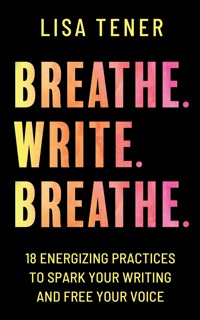
Breathe. Write. Breathe.: 18 Energizing Practices to Spark Your Writing and Free Your Voice
Imagine writing your creative best effortlessly, whenever you wish.
In this ground-breaking guide, award-winning author Lisa Tener revolutionizes the writing experience. New, seasoned, and aspiring writers will find a unique blend of practical exercises and innovative techniques to tap into your inner wellspring of creativity.
As Lisa leads you on a journey of self-discovery and transformation, you’ll harness the power of mindful movement and breath to free your authentic voice, silence your inner critic, and ignite your imagination like never before. Enjoy instant access to video training and audio meditations—via the convenience of QR codes—making the experience especially engaging.
Going beyond writing prompts, Breathe. Write. Breathe. promises to revitalize your writing process. Immerse yourself in its pages and prepare to witness your writing flow with unparalleled ease, your creativity soar to new heights, and your journey as a writer evolve into an enlivening adventure.
Get ready to embark on this transformative journey today with Breathe. Write. Breathe. and unlock the writer’s life you’ve always dreamed of living.
Award-winning author Lisa Tener is known for helping writers easily access creative flow and bring forth their best work. Lisa served on the faculty of Harvard Medical School’s CME publishing course for over a dozen years. Lisa holds two degrees from MIT and is certified by RP Qigong to teach Empowerments and Happiness Qigong. Her book The Joy of Writing Journal won five book awards.
Das E-Book können Sie in Legimi-Apps oder einer beliebigen App lesen, die das folgende Format unterstützen:
Seitenzahl: 235
Veröffentlichungsjahr: 2024
Ähnliche

















Praise for Breathe. Write. Breathe.
“Lisa Tener’s Breathe. Write. Breathe. beautifully explains the essential connection between mindful breathing and regular writing. All writers, and especially the millions of blocked and resistant writers, will benefit from the simple, easy-to-follow practices eloquently described in Breathe. Write. Breathe. Highly recommended!”
—Eric Maisel, author of dozens of creativity books, including Unleashing the Artist Within
“Most writers would learn astrophysics if it helped unlock the holy grail of writing flow. But Lisa Tener shows us how to consistently write with magic…in a way that’s as easy as BREATHING. This is such a fresh approach to writing…and this hypnotic book is like enjoying a creative writing retreat, in usable chunks for everyday life. I’m excited about all the great writing that Breathe. Write. Breathe. will unleash in this world.”
—Tama Kieves, USA Today featured visionary career coach and bestselling author of Inspired & Unstoppable: Wildly Succeeding in Your Life’s Work!
“Breathe. Write. Breathe. touched me deeply, because it approaches writing in a whole new way. Lisa Tener focuses on digging deep into oneself, on centering oneself, and on writing from the spiritual core of one’s being. Lisa provides excellent and unusual suggestions that will help you better understand yourself and your book (or writing) so you can develop your voice naturally and enhance your craft whether you are a beginner or a pro.”
—Padma Venkatraman, award-winning author of The Bridge Home (Global Read Aloud Selection) and four other multi-award winning middle grade and YA novels
“Something truly magical happened while reading Breathe. Write. Breathe. One exercise, in particular, transported me on an incredible journey, revealing that I was in the midst of a deep, metaphoric process of rediscovering joy and untapped creativity.”
—Renee Baribeau, author of Winds of Spirit
“With wit and honesty, Lisa Tener invites writers at all stages to find inspiration on the page through guided meditation, physical movement and breathwork. Grounded in research and filled with thoughtful writing prompts and exercises that promote mindfulness, Breathe. Write. Breathe. is both an accessible and useful resource and a playful and unique jumping off point for tapping into one’s creative potential. This book will certainly breathe new life into your writing practice, and it may even help you feel more present in other aspects of your daily life.”
—Julie Gerstenblatt, author of Daughters of Nantucket
“Not since childbirth class have I thought about breathing in so meaningful a way. Lisa Tener’s Breathe. Write. Breathe. shares practical, engaging, and fun ways to be present—exactly where you want to be when writing. It’s like having your very own breathing coach right there with you encouraging you each step of the way. Read this book, and your creative and authentic voice will soar!”
—Robin Kall, podcaster/host of Reading with Robin, event host and championof books and their authors
“In gorgeous, dreamy prose (Tener, a book coach, knows her craft!), Breathe. Write. Breathe. balances warm encouragement with sound practical advice. Pick an approach or mix and match (there’s plenty to choose from), but rest assured, these powerful exercises go beyond helping you grow as a writer; they help you grow as a person.”
—Dr. Craig Malkin, author of Rethinking Narcissism
“Creativity is the great healer, and Lisa Tener’s brilliant book presents potent methods for tapping into this transformative part of ourselves. Unlike other books on writing, Breathe. Write. Breathe. doesn’t just help us hunt for the muse in our minds, but rather grounds our creativity in body experience. By integrating ancient breathwork practices from qigong and yoga with creative writing, the book shows us how to tap into our subconscious. This is where our creative powers lie waiting for expression not only on the page but in our personal growth, as well. Finally, a book on writing that addresses the whole person—mind, body, and spirit.”
—Dr. Adam Zwig, singer-songwriter and psychologist
“Lisa’s wisdom, insight, and exercises were instrumental in helping me finish my book proposal and ultimately get my book published. I highly recommend Breathe. Write. Breathe. to any writer looking to bring more creativity and clarity to their writing process.”
—Carla Naumburg, PhD, author of How to Stop Losing Your Sh*t with Your Kids, Ready Set Breathe, and more
“Lisa Tener’s Breathe. Write. Breathe. is a must-read book for those who write.Through heart-felt stories and thought-provoking life observations, Lisa will open your mind to many joyful possibilities to explore with your writing. Once you experience her well-explained breathing exercises and innovative writing prompts, you will truly come to know the amazing benefits of deep breathing and understand how it is the ultimate source of power, strength, flexibility, speed, health, and vitality. Use this insightful book to learn to breathe deeply and realize your full creative writing potential.”
—Lynne Heinzmann, award-winning author of But Cats Don’t Talk, Frozen Voices, and more
“Laptop. Coffee cup. Tension. These are a writer’s daily companions. No one knows this better than Lisa Tener, consummate coach and editor. In this book, she shares wise, easy, time-tested techniques to banish the companion no writer needs—tension. I’m not meditative. I don’t have a place of stillness. But, hey, they worked for me.”
—Jacquelyn Mitchard, author of The Deep End of the Ocean
“Lisa Tener’s Breathe. Write. Breathe. is a beautifully written and engaging guide for writers seeking inspiration and practical tools for getting their creative juices flowing. Informed by her expertise as a writing coach and writer, as well as by her personal explorations of ancient and modern healing traditions, Lisa’s book explores the connections between breath, mindfulness, and creativity. Not only will you learn how to connect with your inner muse, you’re quite likely to enhance your overall health and well-being!”
—Patricia Muehsam, MD, pioneering physician and award-winner author of Beyond Medicine
“Let yourself play in these profound pages and your words will flow forward easily...as a radiant and prolific writer.”
—SARK, author/artist, PlanetSARK.com
Copyright ©2024 by Lisa Tener
All rights reserved. No part of this book may be reproduced in any form or by any electronic or mechanical means without written permission from the author except for the following:
a) The use of brief quotations in a book review, blog post, or article when attributed to the author.
b)The use of brief quotations on social media when attributed to the author.
c)The sharing of the public video links in this book.
To request permission, contact the author at lisatener.com/contact
The content of this book is for education and entertainment purposes only and is not intended to diagnose, treat, cure, or prevent any condition or disease, including mental health conditions. The reader understands that this book is not intended as a substitute for consultation with a licensed practitioner. The use of this book implies the reader’s acceptance of this disclaimer.
Cover design: Tamara Monosoff
First printing June 2024
ISBN: 978-1-957565-01-9
Table of Contents
Foreword
INTRODUCTION
Chapter 1
Chapter 2
Chapter 3
Chapter 4
Chapter 5
Chapter 6
Chapter 7
Chapter 8
Chapter 9
Chapter 10
Chapter 11
Chapter 12
Chapter 13
Chapter 14
Chapter 15
Chapter 16
Chapter 17
Chapter 18
Afterword
List of Practices
My Notes
Writing Prompts for Adventurers
ACKNOWLEDGEMENTS
Recommended Resources for You
GLOSSARY
About the Author
Foreword
Every time I talk with Lisa Tener, I get an infusion of energy.
We first met at a networking gathering at a mutual friend’s house. I already knew of Lisa. As a writer and a coach myself, I had found her website while checking out my competition and was shocked to discover that such a highly regarded writing coach lived somewhat nearby. (We both live in the magical—and tiny—state of Rhode Island, where everything is somewhat nearby). Lisa taught on the faculty of Harvard Medical School’s continuing medical education publishing course. She was an award-winning coach. Her clients’ books were bestsellers. Even as I appreciated the example she set, I was intimidated by her.
At the meeting, we gathered in a circle—some of us seated on couches, others on foot stools or hard-backed chairs dragged in from the dining room—and took turns introducing ourselves. I almost fell off my ottoman when Lisa said her name.
When it was my turn to introduce myself, I swallowed hard and said that I too was a writer and a coach and that I’d recently published a book called A Year of Daily Calm. Had I seen Lisa smile when I said that? Or was I imagining it? Not wanting to appear too eager, I took a deep breath and turned my head to hear the person sitting to my left introduce herself, hoping it would steady my racing heart.
After our sharing was over and we mingled and partook of snacks, Lisa came up to me and said, “It’s so great to meet you. Your book sounds right up my alley! Maybe we could write a book together someday.” I left that meeting walking on clouds—I’d made a friend and gotten an idea, all while having fun and socializing.
This combination of enjoyment, inspiration, and connection is Lisa’s specialty. Since then, we have walked on the beach where she has shared her favorite qigong moves with me. We’ve attended book signings together and strolled around afterward, sharing ideas while eating ice cream. I even had her as a guest on my first podcast, How to Be a Better Person, where Lisa led me through the Meet Your Muse exercise that she shares in Chapter 3.
I loved creating the podcast, but felt burned out from writing and releasing five episodes a week at that time. I was lucky enough to have sponsors, but now that I was contractually obligated to deliver a certain number of listens every month, I felt I couldn’t take a break. I reached out to Lisa to see if she had any advice. She had the perfect exercise, she said, and offered to talk me through it while I recorded so it could not only help me, but also be a podcast episode that helped others. (And I would have one less podcast episode to write that week!)
I closed my eyes as Lisa guided me along an imagined path to a clearing in a forest. In my mind’s eye I found myself standing beside an enormous tree, with a grandmotherly gnome peeking her head out of a door located at the tree’s base. She invited me into her cozy home—I miraculously made it through the tiny opening—and handed me a platter piled high with cookies. I asked this gnome how I could keep going without feeling buried in work, and she gestured to the platter of cookies as if to say that I didn’t need new tips to share. I already had plenty.
I didn’t know what to make of it at first, but over the next few weeks I realized I could replay old episodes and ended up airing previously released episodes for six months. My numbers stayed high, my sponsors happy, and taking time off from creating new episodes gave me space to realize I needed to shift formats and topics. (Sometimes, you are so consumed with the doing that you don’t see any other options.) Now on my podcast I interview writers about how they stay connected to their creativity, which fills my well and is a lot less work. And it all started thanks to one of the exercises you’ll encounter in this book.
Many listeners also reported to me that Lisa’s Meet Your Muse exercise helped them find a creative solution to a vexing situation or helped them write from a more inspired place.
The time you spend with Lisa on these pages, experiencing the simple yet powerful exercises she shares, will open doors in your mind and your heart to possibilities, ideas, and energy that existed all long—they just needed an invitation to make themselves known. This book provides that opening. I can’t wait to see where it leads you, and your writing, next.
Kate Hanley
Author, How to Be a Better Person, Stress Less, and A Year of Daily Calm; Host, Finding the Throughline podcast
INTRODUCTION
Find Your Breath and Free Yourself to Write
What does breathing have to do with writing?
The short answer: I stumbled upon a connection that forever changed my writing life.
Before: Experiences of creative flow were fleeting. I suffered through long fallow stretches of little or no writing. While I started many books, I only completed and published one over the course of two decades.
All of this changed when I incorporated simple, ancient, and time-tested movement and breathing practices into my writing routine. The words flowed consistently and with ease. My creativity flourished. I wrote from a higher state of being, if you will, and it showed. My prose grew more precise and uplifting. I had more to offer my readers and myself. I became a prolific writer.
The experience was surprising, spontaneous, and joyful. I felt exhilarated, took more risks, returned to experimenting with poetry from time to time. I had fun writing blog posts, published chapters in books on creativity, and began work on several of my own books. I published the first of those—The Joy of Writing Journal—and won five book awards! I read my poetry in public and learned that it touched people.
I took this discovery into my work with aspiring authors, writers, and people who wanted to improve their writing for work or creative fulfillment. Coaching clients and participants in my Get Your Writing Done and Bring Your Book to Life® programs reported a similar uplift in their writing practices:
Those who were stuck experienced breakthroughs.Former procrastinators became consistent and thriving writers.The writing often improved, becoming more original as writers found and expressed an authentic internal voice. They took risks on the page that paid off in potent prose or poetry.Those who wrote for work found that their emails, reports, and other communication improved dramatically and catapulted their success in unanticipated ways.They accessed new levels of wisdom, insight, humor, playfulness, and beauty as writers and people.Writing became a delight, a joy, even an ecstatic act.What will the practices in Breathe. Write. Breathe. do for you? I expect you’ll find much of what my clients, students, and I have enjoyed. Perhaps more.
Use Breathe. Write. Breathe. to Its Fullest
You can work through Breathe. Write. Breathe. on your own or enjoy the adventure with a friend. Alternatively, you may want to go through it the first time on your own, and engage a friend, colleague, or writing group the second time around.
BREATHE.
In each chapter in a section titled “BREATHE,” you’ll learn one or more generally quick breathing/movement practices designed to relax you, activate your creativity, and put you in a state of flow. Most of them come from ancient spiritual and health traditions, such as yoga, Chinese Taoist arts like qigong and tai chi, Sufism, Kabbalah, and Buddhist meditation. These traditions offer breathing and movement exercises that are easy to learn, though they may take years to master. The good news is you don’t need to be a master to start benefiting creatively from your very first try.
I also draw upon practices I created and employ regularly with my coaching clients, and other exercises I learned from colleagues, mentors, and even online sources (all credited). The rich variety of options can expand your creative consciousness, and experience your writing in ever-expanding ways. While it may be easiest to try these exercises in the order presented, you are welcome to skip around and find an exercise especially fitting for your mood, challenge, or goal.
The intent is to experiment, with an open mind, and see what works for you. I invite you to discover the ways in which different practices influence your writing process. Perhaps several will enter your repertoire of creativity boosters. One day, you may feel inclined to be still and breathe deeply. Another day, you may need active movement to get your creative stream flowing.
Most practices have an associated video or audio. The link is at the end of the exercise if it’s important to read the text once before practicing. Otherwise, you will find the video/audio link before the written instructions. You are welcome to scan the QR code with your cell phone to watch or listen to the recording, or type the URL into your browser to watch or listen, or just to follow the written instructions. A digital device isn’t required, but it can be helpful, particularly with more involved practices, or if you want to be led through a meditation or other experience with your eyes closed.
WRITE.
After the “BREATHE.” section of each chapter, you’ll come to “WRITE.”—with a series of writing prompts. Consider them jumping-off points. Try one or several. If you read a prompt and feel inspired to take it in a new direction, by all means do so. Let your intuition guide whether to use the prompts, or instead to return to any ongoing projects or work at hand—an essay, article, screenplay, proposal, short story, or book, for example. There’s no right or wrong here. You might try a prompt one day, and dive right into your ongoing work the next time. Have fun experimenting. If a prompt feels inspiring but not right for the moment, fold a corner of the page and return to it at another time.
Please note that an ongoing project is not necessary. You may simply use these exercises to practice: writing, breathing, opening up to new creative realms, taking risks, trusting your intuition, working with symbols and metaphor, etc. In short, anything you want to practice. Allow for the possibility that your response to these exercises may generate a complete piece—flash fiction, a poem, a short story, an essay, or even a novel.
In addition, you may find that a prompt resonates with a project you have set aside. A Hay House author who participated in my weekly writing program shared that while she had no trouble writing the how-to portion of her chapters, she struggled to find compelling narratives to draw readers into each topic. The prompts provided an opening into her chapters that circumvented linear thinking, initiated creative associations with the rest of the material, and provided apt stories to engage readers in delightful and surprising ways. You, too, may find the prompts relating in some magical way with your other writing. Keep an eye out for such synchronicities and gifts!
In the back of Breathe. Write. Breathe. you’ll find a list of all the practices in the book, so it’s easy to return to a specific one you might want to revisit. “My Notes,” which follows, offers a place for recording thoughts on your favorite practices: what you experienced, what you liked, and any challenges that came up.
Do you need to respond to all the prompts? Absolutely not. However, I encourage you to try them all, as you may find certain exercises help for different challenges, genres, or moods. The variety encourages experimentation and innovation—plus it’s fun! And you may find many exercises to return to over time.
If a practice in Breathe. Write. Breathe. holds particular power for you, stick with it for a few days before moving to the next one. It’s nourishing to be a writer who reads, but even more important to be one who writes. By delving into a practice for a few days, you support the habit of writing.
If you have any questions or want to share your experience, go to LisaTener.com/Breathe, or just share your comments on any blog post of mine. I promise to answer.
If you want to start with a writing prompt, but the one in a particular chapter doesn’t feel right in the moment, turn to “More Writing Prompts for Adventurers” in the back of the book—you are sure to find one that inspires you—or go to the Facebook Group “Write and Create with Lisa Tener” for more. You can also ask others for their favorite practices and prompts for particular uses.
JOIN THE FACEBOOK GROUP:
Write and Create with Lisa Tener
https://www.facebook.com/groups/writeandcreatewithlisatener
Let’s begin our journey together.
Author’s Notes
In addition to stimulating creativity, many of the practices in Breathe. Write. Breathe. offer great benefits to your well-being, such as relaxation, rejuvenation, increased blood and lymph flow, and more. Some of the practices in this book are more energetic than others. If you experience pain, dizziness, or other discomfort, stop the practice. If in doubt, consult your medical practitioner before practicing. Listen to your body and don’t ever force a practice. You can also find ways to tailor a practice to your needs: You can imagine doing it in your mind, rather than doing it physically. Or you can do it sitting rather than standing. Be creative and mindful.In the first two chapters, I refer to research studies. For detailed information on these studies, see the References section at the back of the book.Chapter 1
Breathe for Inspired Writing
“When you move slower than the world, and breathe more deeply than the world, you awaken a consciousness beyond any world.”
—Matt Kahn, teacher, healer, author
Some funny things happened on the way to my becoming a prolific writer.
One involves a nickname I gave myself in college—“Queen of the Shallow Breath.” Because, while taking an acting class, I noticed that everyone else in the class seemed to “get it.” I watched their bellies round and expand followed by their solar plexuses and then their chests. I watched the progression of their breath as it filled their lungs from deep in the lobes seemingly up to their collarbones. Me? I felt like I was wearing a corset that had been laced so tightly I almost had to gasp for air. As the class focused its attention on so-called “belly breathing,” I was baffled. Didn’t understand it; didn’t know how to do it no matter how hard I tried. And I tried hard.
I also noticed that I was absolutely the worst actor in that class. Something about the breath gave my classmates access to their creative genius. This was my introduction to the power of breathing—or, at least, to observing its power and its relationship to creative flow as it related to acting.
After graduation, the yoga and tai chi classes I took helped me become more consistently open to this state of creative flow.
Then, along came Leah Franklin, who had just returned to our hometown after five years of studying qigong—the ancient Chinese tradition that works with the mind, breath, and body movement—with a Grand Master from China. Hearing her talk about “qi”—or “life force”—I knew I wanted some of that! Maybe it could help more than my energy, too. My writing felt “off” (when I wrote at all). Could this breathing be the key to what I had missed in acting class, the secret to creative abundance?
In Leah’s introductory breathing workshop, she taught us how to breathe fullyinto our lower abdominal pelvic floor or “dantian,” loosely translated as “sea of qi” or “elixir field.” Once we got the hang of breathing deeply and expanding the dantian, we were taught additional breathing techniques that helped us connect energetically with the natural world.
My long-term fatigue evaporated, and creativity took its place. I became a productive writer—as if someone had turned on the spigot for my writing to flow anytime, anywhere, with ease. And it didn’t matter what form it took—blog posts, books, poems, journaling. I found that writing after qigong practice, in particular, produced consistently inspiring results. The combination of deep breathing and movement provides a calm yet energized state from which spontaneity emerges in one’s writing and fresh ideas flow.
I learned to breathe deeply—“abdominal” or belly breathing became the best friend my writing has ever had, way up there with the words themselves.
Please join me in the exercises that follow to nurture your own magnificent friendship with your breath!
Natural Stance
Natural Stance properly positions the body for relaxation and provides optimal benefit from many practices you will learn in this book.
Watch the video of Natural Stance and follow along, or use the script below to practice.
WATCH THE VIDEO:
Natural Stance
https://lisatener.com/natural-stance
Natural Stance
Stand with your feet shoulder-width apart and parallel. Imagine growing roots from your feet, deep into the earth.Unlock, or slightly bend, your knees.Tuck your tailbone, as if sitting on a tall stool.Relax your shoulders. You may want to roll your shoulders back and down a couple of times to help them relax. Or scrunch them up as you breathe in, and release your shoulders down as you exhale with an “ah” sound. Tuck your chin.Rest the tip of your tongue on the roof of your mouth, behind your front teeth.Relax your jaw and gently smile.Relax all the muscles in your face.Imagine someone lengthening your neck and spine by pulling you up by the hair in the center of your crown.Congratulations, you are in Natural Stance!Breathing Through Writer’s Block
If we’re not aware of our bodies and our breath, we’re not present. And when we’re not present, it’s difficult to communicate with our readers because we’re not open to our full experience; we’re resisting something—sensation, emotion, unease. Once we connect with our bodies through the breath, we have access to the sensory memories required for good writing. We can recall deeply how things look, feel, smell, taste, and sound; therefore, we can generate an experience for our readers. This somatic access brings our writing to life.
The other day, while working on a blog post, I got stuck. I had trouble connecting the various ideas in the post. I scanned my body and realized I’d been holding my breath and resisting sensation. Rather than breathing fully and being present, I was lost in my head.
I got up from my chair and did Qigong Bouncing—a practice you will learn in Chapter 2—to relax my body. Then I took a few gentle breaths that began deep in the belly, expanding into my solar plexus and up into my chest. I focused on the flow of my breath and nothing else.
When I returned to the blog post, I felt softened, as if the previous hard edges dissolved. The internal tension I had felt, melted. I saw clearly how to connect the ideas in my article.
Research shows that deep abdominal breathing relaxes the mind and the body. Studies also show that when the mind relaxes, creativity flourishes. Breathe deeply and you relax, allowing you to open up to the creative flow.
These two steps can make all the difference in your writing:
1. Breathe mindfully to become relaxed, aware, and present.
2. When you are present, cultivate self awareness and embodied presence to choose the scenes, dialogue, specific words, and ways of communicating that will stir—and be meaningful to—your readers.
If you are writing a memoir, this presence helps you remember minute details from your past. If writing how-to or other prescriptive nonfiction, this presence offers an intimate connection with your readers so you can anticipate their needs. For poetry or fiction, this presence expands access to infinite possibilities and potential for innovation.
As you practice the following breathing technique, you will likely experience some relaxation and subtle shifts. Over time, breathing will become more robust, more fluid, opening up new inner—and outer—worlds.
Time to breathe.
BREATHE.
Breath Awareness and Abdominal Breathing
Abdominal Breathing
It’s often easiest to practice abdominal breathing while lying down, but you can do it sitting or in Natural Stance as well, especially as you become more practiced. Read the instructions. If you prefer to be led through the exercise, play the audio at the end of the exercise.
Lie on a mat on the floor or on a bed with a pillow under your knees. A pillow under your head is fine, too.Place your right hand on your belly below your navel, and the left hand just below your ribs.Slowly breathe in through your nose focusing on the area below your right hand, as you watch your lower belly rise, then your upper belly rise.As you exhale through pursed lips, tighten your abdominal muscles, pulling the belly towards your spine and allowing the belly to return to its original position.Practice this for two or three minutes, or more.Practice as you listen to the abdominal breathing audio:
LISTEN TO THE AUDIO:
Abdominal Breathing
https://lisatener.com/abdominal-breathing
Breathing from the belly like this turns on the parasympathetic nervous system, the part that relaxes you, helping you access your full creative range. For our purposes, in writing, this will be a powerful tool. If you want to become a ninja breather, you can continue to work on abdominal breathing at a more advanced level.
Advanced Practice
Eventually, you’ll want to experience the breath effortlessly filling your lower belly, near the perineum, below your navel, above your navel, and gently into your solar plexus and chest, as well. An even, continuous, smooth inhale and exhale. Many teachers only have you fill the belly and not the chest, but my qigong teacher emphasized the importance of the full breath that begins in the belly and expands the whole respiratory canal. Over time, you can extend your practice to five to ten minute sessions, three or more times a day.




