


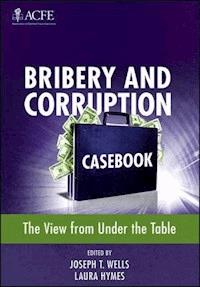
Bribery and Corruption Casebook E-Book
60,99 €
Mehr erfahren.
- Herausgeber: John Wiley & Sons
- Kategorie: Fachliteratur
- Sprache: Englisch
Real case studies on bribery and corruption written by expert fraud examiners Bribery and Corruption Casebook: The View from Under the Table is a one-of-a-kind collection of actual cases written by the fraud examiners who investigated them. These stories were hand-selected from hundreds of submissions and together form a comprehensive, enlightening and entertaining picture of the many types of bribery and corruption cases in varied industries throughout the world. * Each case outlines how the bribe or corruption was engineered, how it was investigated, and how perpetrators were brought to justice * Written for fraud investigators, auditors, compliance officers, and corporate lawyers * Reflects the recent crackdown on bribery and prosecution of cases under the Foreign Corrupt Practices Act (FCPA) * Also by Dr. Joseph T. Wells: Fraud Casebook, Principles of Fraud Examination, and Computer Fraud Casebook This book reveals the dangers of bribery and corruption and the measures that can be taken to prevent it from happening in the first place.
Sie lesen das E-Book in den Legimi-Apps auf:
Seitenzahl: 763
Veröffentlichungsjahr: 2012
Ähnliche




















Contents
Cover
Title Page
Copyright
Dedication
Preface
Chapter 1: The Hot-Tub Highwaymen
Building an Empire
Swimming Trips
More Tips, Lips & Sips
Court Date
Going Back for Seconds
About the Author
Chapter 2: Trouble Brewing
A Little Paranoia Isn’t Such a Bad Thing
Investigating Accountants and Beyond
The Jig Is Up
Show Me the Money
About the Authors
Chapter 3: In the State’s Interest
Less than Arm’s Length?
The “Hip Pocket” Concept
Italian Food and Interviews
The Outcome of the Investigation
About the Author
Chapter 4: Odd Bedfellows
A Pillar of the Community
Prosecution Is Onboard
The Gambling Bond
Pine Wood Audit
About the Author
Chapter 5: When Bribery Becomes a Way of Doing Business
The Merger
In the Media
Kickoff Interviews and Analyses
A Slow Process
A Different Kind of Interview
About the Author
Chapter 6: Kickbacks for Comic Books
A Close Team
Interviewing Made Easy
The Case Becomes Mine
The Diamond Pyramid
The Paper Freeway
The Interview
Presenting a Final Case
About the Author
Chapter 7: Interrupted Production
The End of the Beginning
Mordida (Bite) por Favor
Let the Fun Begin
What’s an FCPA?
Accounting Magic or Not?
Make It Happen
Slings and Arrows
Where’s the Mole?
Pearls Before Swine
Finale
About the Author
Chapter 8: High-Plains Grifter
State Grant Program
CAO Consultant
Open for Business
A Simple Scam
Limits of the Investigation
About the Authors
Notes
Chapter 9: Getting a Free Ride
The City
Trouble at the Department of Transportation
The Scam Exposed
A New Case
Tailing the Suspect
The Benefits of Cooperation
About the Author
Chapter 10: Conflicting Interests, Conflicting Cultures
A Forced Partnership
Multicultural Ethics
The Sheik
Reviewing the Records
Scratching an Itch
Opposing Interviews
Going Their Separate Ways
Analysis in Retrospect…
The “Corporate Answer”
About the Author
Note
Chapter 11: But We Thought He Was Saving Us Millions
A Cautious Start
The Interview Strategy
Uncovering the Corrupt Partners
The Final Cost
About the Author
Chapter 12: The Construction of a Fraud
Bonfield Homes
Launch Reports
The Opportunity
Inconsistencies in the Reports
Suspicious Lumber Invoices
Interviews
Good Guys Sometimes Finish Last
About the Author
Chapter 13: The Summer Bribe
A Beleaguered City
Tackling the Problem Premises
The Bribe
The Allegation
The Investigation
The Solution
About the Author
Chapter 14: Brazen Bank Manager
Nasdall Bank
Suspicious Lifestyle
Documentation Review and Interviews
Identifying Helen’s Methods
Staff Kickbacks
The Arthur Williams Connection
Admissions
About the Author
Chapter 15: In Bed with the Tax Man
Early Warning Signs
Fieldwork
The Audit Becomes an Investigation
Suspicious Behavior
The Flamboyant Tax Assessor
Client Anxiety
About the Author
Chapter 16: High-Rise Rollers
The Allegation
The Plan
The Winners
The Losers
The Director
The Deputy
About the Author
Chapter 17: Decorum Across the International Date Line
Special Materials Build Special Relationships
The First in a Series
Learning the Culture
Getting My Feet Wet
Reading the Body Language
Busting the Bid Rig
Spreading the Word
Meeting Marty
Motivation
About the Author
Chapter 18: The Kickback Mine
Taking a Gamble
The Cold Shoulder
The Benefits of Cooperation
About the Author
Chapter 19: A Sweet Deal
Inspiring Company History
Open Communication and Odd Phone Calls
The Insider’s Deal
Small but Significant Outcome
About the Author
Chapter 20: Da’ Money
A Quick Review
Developing an Investigation
From the Plant to the Corner Office
Computer Forensic Review
Sometimes It Really Is That Easy
And Other Times It’s Not
Complete Candor
The Obstacle to a Confession
About the Author
Chapter 21: The Seemingly Upstanding Citizen
Weeks Earlier
Getting the Ball Rolling
Following the Money Trail
Bringing the Investigation to the Suspects’ Doorsteps
Figuring Out the Jigsaw Puzzle
Awaiting Justice
About the Author
Chapter 22: Big Dangers from a Small Vendor
Naritomo
The New Kid
Vendor Audit
Double-Cross
Complete Turnaround
About the Author
Chapter 23: A Drop in the Ocean
Puzzling Payments
Records Review
Black-Cash Operations
Logistics, Customs and Parallel-Import Schemes
Kickbacks to Customers
Culture of Corruption
About the Author
Chapter 24: The Professor and the Deputy
Setting the Scene
Breakthrough Turned Disaster
Preliminary Interview
The Intermediary
Paradeplatz, Zurich
The Bearded Man
The Lucky Break
Off to Barcelona
Attempted Extortion
Laudrup Flees
Fingers in the Cookie Jar
About the Author
Chapter 25: Calling for Kickbacks
Too Close for Comfort
The Direct Approach
Launching a Full Investigation
It’s All in the Phone Calls
Showdown in the Conference Room
The Grand Total
About the Author
Chapter 26: Going Green in Mexico
The Salesman
Unknown Exposure
The Secret Hiding in the Books
Assumed Kickbacks
Conflicting Evidence
About the Author
Chapter 27: A Wolf in Sheep’s Clothing
Credit Spikes
Expanding the Team
Delivering the Bad News
About the Author
Chapter 28: Dances with Fraud
Friend of the Tribe
Meet the Tribe
School Visit
Unsubstantiated Violations
Accepting Defeat
About the Author
Chapter 29: The Corrupt Public Servant
Initial Searches
Second Round of Searches
Custodial Interviews
The Full Story
The Finishing Touches
Favorable Judgments
About the Author
Chapter 30: Romance, Jewels and Kickbacks: All in a Day’s Work
Out in the Field
Interviews and Invoices
Unable to Stop
About the Author
Chapter 31: Power Corrupts and Absolute Power Corrupts Absolutely
In the Slammer
A Diamond in the Rough
All Clear
You Have the Right to Remain Silent
Anything You Say or Do Can Be Used Against You
You Have the Right to Speak to an Attorney
If You Cannot Afford an Attorney, One Will Be Appointed for You
Follow the Money
Justice Is Blind
About the Author
Chapter 32: For Love or Money?
Sandy’s Special Customer
Caribou Title
Private Lenders
Shared Collateral
State of Fraud
Conspirator or Victim?
Save It for a Rainy Day
The Hope of Civil Recovery
About the Author
Chapter 33: Ethical Governance: A Mandate for Outsourcing
Opportunities in Outsourcing
The Things You Can Learn over Coffee
Process Evaluation
Happy Outcome
Returning to Rhodo
Investigating When the Suspect Knows
My Team’s Turn
Breaking the Bad News
About the Author
Chapter 34: Friends and Lovers in High Places
Training for Corruption
Trying to Keep It Quiet
Start Sorting
Too Close and Personal
Excessive Compensation Packages
Justice for All
About the Author
Chapter 35: Kickbacks on Demand
The Anonymous Informant
Keeping It Quiet
Time to Get Tough
The Confession
The Second Confession
A Cooperative Supplier
Recovery
About the Author
Chapter 36: High-Flying Ambition
Smith Williamson
The Last Person We Suspected
Unannounced Audit
Interviewing Made Easy
About the Author
Chapter 37: The Cleaner Who Swept His Way to the Top
The Reno Reach
The Whistleblower
The Big Picture
Search Warrants
The Sixteen Suspects
About the Author
Chapter 38: Sorry, This Fraud Has Been Disconnected
NyTel USA
The DCC Project
How It’s Supposed to Work
Dan’s Way
Getting Involved
Building Blocks
Referral to the FBI
About the Author
Chapter 39: Bid Rigging and Kickbacks Under the Bridge
Regional Transportation District
FBI Investigation
An Eye-Opening Trial
Post-Trial Recovery
About the Author
Index
Copyright © 2012 by Association of Certified Fraud Examiners. All rights reserved.
Published by John Wiley & Sons, Inc., Hoboken, New Jersey. Published simultaneously in Canada.
No part of this publication may be reproduced, stored in a retrieval system, or transmitted in any form or by any means, electronic, mechanical, photocopying, recording, scanning, or otherwise, except as permitted under Section 107 or 108 of the 1976 United States Copyright Act, without either the prior written permission of the Publisher, or authorization through payment of the appropriate per-copy fee to the Copyright Clearance Center, Inc., 222 Rosewood Drive, Danvers, MA 01923, (978) 750-8400, fax (978) 646-8600, or on the Web at www.copyright.com. Requests to the Publisher for permission should be addressed to the Permissions Department, John Wiley & Sons, Inc., 111 River Street, Hoboken, NJ 07030, (201) 748-6011, fax (201) 748-6008, or online at www.wiley.com/go/permissions.
Limit of Liability/Disclaimer of Warranty: While the publisher and author have used their best efforts in preparing this book, they make no representations or warranties with respect to the accuracy or completeness of the contents of this book and specifically disclaim any implied warranties of merchantability or fitness for a particular purpose. No warranty may be created or extended by sales representatives or written sales materials. The advice and strategies contained herein may not be suitable for your situation. You should consult with a professional where appropriate. Neither the publisher nor author shall be liable for any loss of profit or any other commercial damages, including but not limited to special, incidental, consequential, or other damages.
For general information on our other products and services or for technical support, please contact our Customer Care Department within the United States at (800) 762-2974, outside the United States at (317) 572-3993 or fax (317) 572-4002.
Wiley also publishes its books in a variety of electronic formats. Some content that appears in print may not be available in electronic books. For more information about Wiley products, visit our web site at www.wiley.com.
Library of Congress Cataloging-in-Publication Data:
ISBN 978-1-118-24878-2 (book); 978-1-118-28263-2 (ebk); 978-1-118-28339-4 (ebk); 978-1-118-28710-1 (ebk)
To Kathleen Hymes, a shining example of honesty in sharp contrast to the corrupt individuals in these pages
Preface
Corruption is not a new development for humankind. As long as there have been recorded accounts of human history, there have been stories of deceptive self-dealing and betrayal for personal gain. We need to look no further than the Roman Empire for countless examples of corruption, bribery, political dishonesty and discarded alliances. The civilization that helped establish a blueprint for modern democratic governments also created a model for just about every corruption scheme imaginable.
Take the account of Emperor Nero’s rise to power as an example. He gained the title of emperor amid rumors that his mother, Agrippina, poisoned her own husband and Nero’s stepfather, then-emperor Claudius, so her son could ascend to the throne. Nero was still a teenager at the time, and Agrippina believed she would be able to direct the course of the empire by manipulating her son. However, when Nero began asserting his own power and eschewing his mother’s influence, Agrippina turned her hopes to her stepson Britannicus. As the birth son of Claudius (although he was younger than Nero), Britannicus could challenge Nero for the throne — a threat the emperor took seriously.
As the story goes, Nero first poisoned the 15-year-old Britannicus to assert himself as Rome’s rightful leader and then arranged for his mother to be killed. After these shocking crimes, he embarked on a spree of executions to eliminate senate members he did not trust and anyone else he considered a political threat. And there we have the framework for a leader to corruptly consolidate and establish his power.
Modern corruption has become slightly more subtle and, luckily, we see fewer outright assassinations these days, but that comfort does nothing to reduce the damage that this fraud still causes. Black’s Law Dictionary defines corruption as “depravity, perversion, or taint; an impairment of integrity, virtue, or moral principle; esp., the impairment of a public official’s duties by bribery.” Corruption can include conflicts of interest, bribery, economic extortion and illegal gratuities. It is everywhere — an insidious, communicative disease that plagues private industry, public service and the political process. It destroys trust, bottom lines, careers and even lives. As the cases in this collection demonstrate, no one is immune to corruption. Try as we might to implement controls and procedures to prevent ourselves and our employers or businesses from becoming victims, cunning criminals make it their goal to circumvent our hurdles in pursuit of their own self-interest.
Most people have heard of Rod Blagojevich. You might think of President Barack Obama when you hear his name, or you might simply picture that trademark Blago hair. Either way, in the past few years he has become a poster boy for corruption. In 2008, when then-Senator Obama was elected to the presidency, he left a vacant U.S. Senate seat up for grabs in Illinois. As governor of Illinois, Rod Blagojevich had the authority to appoint someone to fill the vacant senate seat, but he abused his gubernatorial power and solicited bribes and other favors from parties who had an interest in the seat. As part of the investigation into Blagojevich’s suspected corruption, the FBI wiretapped his phone. Perhaps the most infamous sound bite to come from those recordings was the one where he described his position as “f___ing golden” and said he wouldn’t give the appointment away “for f___ing nothing.” The recorded evidence turned out to be the most damning against Blagojevich, and he was eventually found guilty of 17 out of 20 criminal charges, including bribery and attempted extortion. He was sentenced to 14 years in prison.
Corruption is not confined to the political circus. Public and private companies often suffer losses, both financial and reputational, from the corrupt actions of owners, executives and staff members. The primary anti-corruption legislation in the United States is the Foreign Corrupt Practices Act (FCPA), a law that Congress enacted in 1977. The FCPA makes it illegal for U.S. companies or individuals acting anywhere in the world to directly or indirectly offer or pay anything of value to foreign officials to obtain or retain business. In addition to U.S. citizens and enterprises, the FCPA also applies to foreign companies that have securities registered in the United States or file reports with the Securities and Exchange Commission, and to foreign individuals and companies that take any action to promote a corrupt payment while in the United States.
Remember the Siemens bribery scandal in 2008? The German engineering firm was undergoing scrutiny in the United States and Europe based on claims that staff and managers paid bribes to foreign officials in various countries to secure lucrative contracts. The amounts were staggering; for example, according to a Frontline article called “At Siemens, Bribery Was Just a Line Item,” one single accounting employee at Siemens claimed to oversee an annual “bribery budget” of $40 to $50 million. That is just one staff member at a company that employed thousands. The company faced FCPA charges in the United States and eventually reached a settlement agreement that included paying $800 million in fines. At the same time Siemens settled another case, this one in Europe, for hundreds of millions of dollars as well. In total, Siemens paid $1.6 billion to settle corruption charges around the world.
In 2010, news emerged of another multimillion-dollar international corruption scheme. Six oil and gas companies (Transocean Inc., Tidewater Marine International Inc., Pride International Inc., Noble Corporation, Shell Nigeria Exploration and Production and Global Santa Fe Corporation) and one shipping company (Panalpina) were accused of bribing officials in various countries for the ability to import equipment into the countries without paying the necessary taxes and fees. This case was also settled and the companies collectively agreed to pay $236 million in fines.
According to the ACFE’s 2010 Report to the Nations on Occupational Fraud and Abuse, corruption cases accounted for 32.8 percent fraud cases during the reporting period, and the median loss per case was $250,000. To prevent and detect corruption schemes, it helps to be aware of the common red flags associated with such frauds. In 45.6 percent of corruption cases in the Report to the Nations, the perpetrators displayed unusually close ties with a vendor or customer. The second most common behavioral red flag was living beyond their means, as seen in 42 percent of cases. Clearly, corruption is a costly fraud, and knowing what warning signs to watch for might help business owners prevent future cases.
In this book, you will read corruption cases from around the globe, large and small, punished and unpunished. We have changed the names of people, places and companies to maintain the anonymity of those involved, but the facts of the cases are genuine. These are real corruption cases, investigated by members of the ACFE. All profits from this book will be donated to the ACFE Scholarship Foundation in the hope that future fraud fighters will receive the education they need to carry the torch into the next generation.
Publishing a book is a collaborative effort, and this one was no exception. The members of the ACFE who submitted case studies to this project deserve the lion’s share of recognition for all their hard work. It was a pleasure collaborating with these professionals who are out in trenches every day. Without their efforts, this book would not be in your hands right now. In addition, we would like to thank ACFE editors Laura Telford and Diane Calmes for providing invaluable editing assistance. Stacey Rivera and Natasha Andrews-Noel at John Wiley & Sons are consummate professionals and made the sometimes-tumultuous publishing process run seamlessly.
Bribery and corruption are among the oldest and most primitive fraud schemes that humans commit. People have been acting corruptly for centuries, and they don’t appear to be slowing down. “It’s just the cost of doing business in foreign countries.” This weak excuse is commonly offered by corporate officers facing charges of violating the FPCA. However, committing fraud should never be a cost of doing business. The greater awareness we, as a community, can bring to this issue, the greater our power will be to combat it. Whether you are a practitioner, educator or simply a concerned citizen, we hope this book will motivate you to continue the fight.
Dr. Joseph T. Wells, CFE, CPA Laura Hymes, CFE Austin, Texas April 2012
CHAPTER 1
The Hot-Tub Highwaymen
TED WENDLING
As companions, William Lassiter and Larry Evans appeared to be an unlikely pair. An urbane, college-educated entrepreneur, Lassiter had carved out a lucrative niche in the domestic snow-removal market by patenting a durable, carbide snowplow blade guard that extended the blade’s cutting edge, thereby increasing its life span. In contrast, Evans was a high-school dropout, a crude, overweight, uncultured laborer who liked to hunt and fish. Evans’ grooming habits included a weekly toilette that he conducted in the privacy of his dingy office at the Ohio Department of Transportation (ODOT) in which he would cut his fingernails and toenails, leaving the yellowed clippings strewn under his desk.
Dissimilar as Lassiter and Evans were, fortune had cast them into an economic symbiosis that made them fast friends: Evans, the equipment superintendent at ODOT’s Cleveland district office, awarded millions of dollars in business to the Lassiter Blade Company. In turn, Lassiter treated Evans to all-expenses-paid trips to Las Vegas and spent thousands of dollars on fishing excursions aboard “Captain Larry’s” private Lake Erie charter fishing boat, the Walleye Warrior.
As the men bobbed together in Lassiter’s hot tub on a warm summer night, surrounded by other ODOT vendors and dancers from Lips & Sips, a Cleveland strip club, they toasted to their mutual success. Lassiter’s summertime soirees, dubbed “Fat Man Soup” parties by some of the dancers, were blue-collar bacchanalias that included other people who were feeding off of ODOT’s largesse: Craig Horford, a germaphobic information technology whiz whose climate-control company had a lock on all of the ODOT district office’s HVAC work; Dennis Pfister, the ODOT facilities manager who managed Horford’s contract and worked down the hall from Evans; and Jennifer Moore, a young Lips & Sips dancer who had clawed her way into Pfister’s wallet by duping him into believing that he had sired her four-year-old daughter. As Pfister often boasted to his ODOT colleagues, not bad for a 63-year-old.
Missing on this evening was Fred Waxman, another ODOT vendor who had helped furnish an apartment for Moore and had picked up bar tabs for Pfister all over northeast Ohio in exchange for hundreds of thousands of dollars in unbid ODOT garage-door contracts. Waxman had been invited but had been unable to attend. Also missing was Evans’ top purchasing official, Rick Rogers, who was working his own side deals with the Lassiter Blade Company and some of Evans’ other vendors.
“Where’s Dennis?” Lassiter asked Evans.
“I think he’s in the house with Ruby,” Evans responded. Lassiter, a divorced father who had left his wife for a stripper and now shared custody of their two daughters, had learned long ago that Evans and Pfister were a matched pair. But as fond as he was of Evans, he considered Pfister to be untrustworthy and a lecherous boor. Lassiter stalked into the house, quickly found the missing couple and escorted them outside. Sliding back into the hot tub, Lassiter hissed into Evans’ ear: “They were in my daughter’s bedroom!”
Lesen Sie weiter in der vollständigen Ausgabe!
Lesen Sie weiter in der vollständigen Ausgabe!
Lesen Sie weiter in der vollständigen Ausgabe!
Lesen Sie weiter in der vollständigen Ausgabe!
Lesen Sie weiter in der vollständigen Ausgabe!
Lesen Sie weiter in der vollständigen Ausgabe!
Lesen Sie weiter in der vollständigen Ausgabe!
Lesen Sie weiter in der vollständigen Ausgabe!
Lesen Sie weiter in der vollständigen Ausgabe!
Lesen Sie weiter in der vollständigen Ausgabe!
Lesen Sie weiter in der vollständigen Ausgabe!
Lesen Sie weiter in der vollständigen Ausgabe!
Lesen Sie weiter in der vollständigen Ausgabe!
Lesen Sie weiter in der vollständigen Ausgabe!
Lesen Sie weiter in der vollständigen Ausgabe!
Lesen Sie weiter in der vollständigen Ausgabe!
Lesen Sie weiter in der vollständigen Ausgabe!
Lesen Sie weiter in der vollständigen Ausgabe!
Lesen Sie weiter in der vollständigen Ausgabe!
Lesen Sie weiter in der vollständigen Ausgabe!
Lesen Sie weiter in der vollständigen Ausgabe!
Lesen Sie weiter in der vollständigen Ausgabe!
Lesen Sie weiter in der vollständigen Ausgabe!
Lesen Sie weiter in der vollständigen Ausgabe!
Lesen Sie weiter in der vollständigen Ausgabe!
Lesen Sie weiter in der vollständigen Ausgabe!
Lesen Sie weiter in der vollständigen Ausgabe!
Lesen Sie weiter in der vollständigen Ausgabe!
Lesen Sie weiter in der vollständigen Ausgabe!
Lesen Sie weiter in der vollständigen Ausgabe!
Lesen Sie weiter in der vollständigen Ausgabe!
Lesen Sie weiter in der vollständigen Ausgabe!
Lesen Sie weiter in der vollständigen Ausgabe!
Lesen Sie weiter in der vollständigen Ausgabe!
Lesen Sie weiter in der vollständigen Ausgabe!
Lesen Sie weiter in der vollständigen Ausgabe!
Lesen Sie weiter in der vollständigen Ausgabe!
Lesen Sie weiter in der vollständigen Ausgabe!
Lesen Sie weiter in der vollständigen Ausgabe!




