Table of Contents
Title Page
Copyright Page
Foreword
Preface
PART ONE - Board Leadership and Dynamics
CHAPTER ONE - A Blueprint for Building Better Boards
THE DUELING PHILOSOPHIES OF GOVERNANCE
THE BOARD AS A HIGH-PERFORMANCE TEAM
THE BLUEPRINT: BUILDING BETTER BOARDS
BOARD-BUILDING: TAKING STOCK
THE KEY ISSUE: APPROPRIATE ENGAGEMENT
MAPPING THE BOARD’S FOCUS AND ENGAGEMENT
SUMMARY
CHAPTER TWO - Board Composition
ALIGNING COMPOSITION WITH ENGAGEMENT
PRACTICAL ISSUES IN THE DIRECTOR NOMINATION PROCESS
DUE DILIGENCE BY CANDIDATES
INTEGRATION OF NEW DIRECTORS
SUMMARY
CHAPTER THREE - Director Performance
DIRECTOR ROLES AND EXPECTATIONS
TYPES OF PROBLEM DIRECTORS
DIRECTOR PERFORMANCE ISSUES
INDIVIDUAL DIRECTOR EVALUATIONS
SUMMARY
CHAPTER FOUR - Board Leadership: Structures and Roles
ANSWERING THE LEADERSHIP QUESTION
THE CONTEXT OF THE DEBATE
NEW APPROACHES TO GOVERNANCE
THE NACD COMMISSION: A RANGE OF OPINIONS
DEFINING THE ROLES OF LEAD DIRECTOR AND NONEXECUTIVE CHAIRMAN
LEADERSHIP OF BOARD COMMITTEES
SUMMARY
CHAPTER FIVE - Board Work Processes
MANAGING THE INFORMATION FLOW
MANAGING AGENDAS AND MEETINGS
MAKING THE MOST OF EXECUTIVE SESSIONS
SUMMARY
CHAPTER SIX - The Role of Leaders in Shaping Board Culture
THE BOARD AS AN ANOMALY: WHAT MAKES IT DIFFERENT
UNDERSTANDING THE TRADITIONAL BOARD CULTURE
THE CULTURE OF THE ACTIVELY ENGAGED BOARD
SHAPING AND CHANGING THE BOARD’S CULTURE
SUMMARY
PART TWO - Critical Areas of Work
CHAPTER SEVEN - Engaging the Board in Corporate Strategy
THE BOARD’S ROLE IN STRATEGY: PUTTING THE PIECES TOGETHER
UNDERSTANDING STRATEGIC ACTIVITY
ENGAGING THE BOARD IN STRATEGY
KEY ELEMENTS OF A VALUE-ADDED ENGAGEMENT PROCESS
A FRAMEWORK FOR STRATEGIC THINKING AND DECISION MAKING
REQUIREMENTS FOR EFFECTIVE BOARD ENGAGEMENT IN STRATEGY
SUMMARY
CHAPTER EIGHT - CEO Performance Evaluation
THE CONTEXT: CEO PERFORMANCE AND ACCOUNTABILITY
CLARIFYING THE PURPOSE OF THE PROCESS
IMPLEMENTING THE CEO EVALUATION PROCESS: CRITICAL ROLES AND ACTIVITIES
DEFINING PERFORMANCE DIMENSIONS AND MEASURES
SELECTING OBJECTIVES AND SPECIFYING MEASURES
GATHERING ASSESSMENT FEEDBACK
COMMUNICATING WITH THE CEO
SUMMARY
CHAPTER NINE - The Board’s New Roles in CEO Succession
SUCCESSION GONE WRONG
THE NEW ENVIRONMENT OF CEO SUCCESSION
EVOLVING MODELS OF THE CEO SUCCESSION PROCESS
CRITICAL SUCCESS FACTORS IN COLLABORATIVE SUCCESSION MANAGEMENT
PLANNING A SUCCESSFUL TRANSITION
A UNIQUE CASE: REPLACING THE FOUNDER
SUMMARY
CHAPTER TEN - The Board’s Role in Corporate Crises
THE BOARD’S INDISPENSABLE ROLE
CRISIS PREPARATION AND MITIGATION
CRISES INVOLVING THE CEO
SUPPORTING AND ADVISING THE CEO
RECOVERY AND LEARNING
IMPLICATIONS FOR THE BOARD
SUMMARY
CHAPTER ELEVEN - Board Assessment
BOARD ASSESSMENT IN THE CONTEXT OF BOARD-BUILDING
THREE BOARD ASSESSMENT METHODOLOGIES
BOARD ASSESSMENT FEEDBACK SESSIONS
ASSESSMENT OF BOARD COMMITTEES
ASSESSING THE CHAIRMAN OR LEAD DIRECTOR
INTEGRATING MANAGEMENT’S PERSPECTIVE INTO THE BOARD ASSESSMENT
SUMMARY
PART THREE - Emerging Issues Outside the United States
CHAPTER TWELVE - Special Issues in Corporate Governance in Canada
CANADIAN NONEXECUTIVE CHAIRS
CROWN CORPORATION BOARDS
EFFECTIVE GOVERNANCE IN FAMILY-CONTROLLED COMPANIES
SUMMARY
CHAPTER THIRTEEN - U.K. Corporate Governance
THE REGULATORY FRAMEWORK
IMPACT OF THE HIGGS REVIEW
BOARD PERFORMANCE
BOARD EVALUATION
RELATIONS WITH SHAREHOLDERS
LIABILITY
THE FUTURE
SUMMARY
Conclusion
Appendix: 2004 NACD Blue Ribbon Commission on Board Leadership
Notes
References
Acknowledgments
The Authors
Index
Copyright © 2006 by Mercer Delta Consulting LLC.
Published by Jossey-Bass A Wiley Imprint 989 Market Street, San Francisco, CA 94103-1741 www.josseybass.com
No part of this publication may be reproduced, stored in a retrieval system, or transmitted in any form or by any means, electronic, mechanical, photocopying, recording, scanning, or otherwise, except as permitted under Section 107 or 108 of the 1976 United States Copyright Act, without either the prior written permission of the publisher, or authorization through payment of the appropriate per-copy fee to the Copyright Clearance Center, Inc., 222 Rosewood Drive, Danvers, MA 01923, 978-750-8400, fax 978-646-8600, or on the Web at www.copyright.com. Requests to the publisher for permission should be addressed to the Permissions Department, John Wiley & Sons, Inc., 111 River Street, Hoboken, NJ 07030, 201-748-6011, fax 201-748-6008, or online at http://www.wiley.com/go/permissions.
Limit of Liability/Disclaimer of Warranty: While the publisher and author have used their best efforts in preparing this book, they make no representations or warranties with respect to the accuracy or completeness of the contents of this book and specifically disclaim any implied warranties of merchantability or fitness for a particular purpose. No warranty may be created or extended by sales representatives or written sales materials. The advice and strategies contained herein may not be suitable for your situation. You should consult with a professional where appropriate. Neither the publisher nor author shall be liable for any loss of profit or any other commercial damages, including but not limited to special, incidental, consequential, or other damages.
Readers should be aware that Internet Web sites offered as citations and/or sources for further information may have changed or disappeared between the time this was written and when it is read.
Jossey-Bass books and products are available through most bookstores. To contact Jossey-Bass directly call our Customer Care Department within the U.S. at 800-956-7739, outside the U.S. at 317-572-3986, or fax 317-572-4002.
Jossey-Bass also publishes its books in a variety of electronic formats. Some content that appears in print may not be available in electronic books.
Library of Congress Cataloging-in-Publication Data
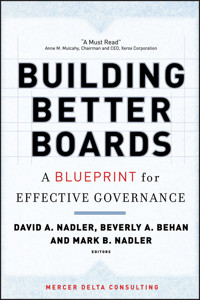
Building better boards : a blueprint for effective governance / David A. Nadler, Beverly A. Behan, Mark B. Nadler, editors ; foreword by Jay W. Lorsch. p. cm.
Includes bibliographical references and index.
ISBN-13 978-07879-8180-8 (alk. paper) ISBN-10 0-7879-8180-X (alk. paper)
1. Boards of directors. 2. Corporate governance. 3. Boards of directors—Canada. 4. Corporate governance—Canada. 5. Boards of directors—Great Britain. 6. Corporate governance—Great Britain. I. Nadler, David. II. Behan, Beverly. III. Nadler, Mark B. HD2745.B.4’22—dc22
2005028782
Foreword
I am pleased to write this foreword to Building Better Boards for two reasons. First, I have long had a high regard for David Nadler and his colleagues at Mercer Delta Consulting. I first encountered David in 1972 at Harvard Business School, where he was a first-year student enrolled in my course on human behavior in organizations. I soon realized that David had unusual insight and a special skill for understanding how groups of people function. With a great deal more education and experience, he has become one of the world’s foremost experts on top management teams and groups.
David also practices what he preaches. He has built a first-rate and highly collaborative consulting firm, and he and his colleagues understand top management teams very well. Now, in this book, they are applying that understanding to an even higher-level group: boards of directors.
This is the second reason I am pleased to be writing this introduction. Boards of directors are critically important institutions to the success of business firms, and in fact, to the global economy. If boards fail, companies fail. We have seen this simple but important truth play out time and again in the United States over the past several years, and there is similar evidence in the United Kingdom and other advanced economies of Europe. Some of these failures are the products of accounting misconduct and fraud, such as Ahold and Parmalat in Europe and Enron, Tyco, and WorldCom in the United States. But there are other, less dramatic examples of the connection between board failures and company failures. The performance shortfalls, management succession problems, and strategic missteps at companies like Hewlett-Packard, Merck, and Morgan Stanley are clear recent indicators that when companies have problems, they can be traced back to dysfunction in the boardroom.
Most proposed solutions to fix such boardroom failings have been in the form of new laws (Sarbanes-Oxley in the United States), new guidelines (the Higgs Review in the United Kingdom), or new regulations (U.S. listing requirements at NYSE and Nasdaq). Although new requirements help pressure boards to be more effective, they only take us so far. The real action is around the board table and among the groups of people we call boards of directors. That is what this book is about—how to improve the actual functioning of boards. Like my own recent book Back to the Drawing Board: Designing Corporate Boards for a Complex World (with Colin Carter), David and his colleagues put the focus on where the real action is—in the boardrooms of the world’s companies.
This book presents sound and practical advice about how to build effective boards. It is thorough in that it examines who should be on the board and how to judge the performance of these individuals, the leadership of the board, and the critical activities that boards should perform. In my judgment, the advice is sound. Although each board must adapt these ideas to its own circumstances, I have no doubt that doing so will lead to boards that are truly effective in governing their companies.
JAY W. LORSCH, Louis E. Kirstein Professor of Human Relations at Harvard Business School
Preface
It says something fairly significant about the evolution of corporate governance that throughout the first fifteen years of my career as a consultant to CEOs, I hardly paid any attention to boards. They just didn’t matter.
For twenty-five years now, my colleagues and I have worked with CEOs on issues of organization, leadership, and change. This is closein, sometimes intense work on issues at the top of the CEO’s agenda: the design of the organization, change management, leadership development, culture transformation, and strategy. But for our first fifteen years as a firm, through the mid-1990s, our work never directly involved the board of directors. Sometimes we’d help our clients prepare for board presentations on matters such as management succession or changes in the organization or the strategy. But we never engaged directly with the board; in fact, we rarely spent much time talking about the board with our clients. The board, as such, wasn’t an important element of governance; it was just another meeting, a passive audience for presentations.
Things began to change in the 1990s. Like everyone else, we watched with considerable interest the dramatic and unprecedented boardroom upheavals of 1992-93, when directors suddenly shook off their lethargy and unceremoniously removed the CEOs of some of the leading U.S. companies. In addition, we had the good fortune to encounter some forward-thinking CEOs who wanted to engage their boards in new and different ways. They asked us to help them figure out how to involve their boards constructively in critical issues such as strategy and CEO succession. As we began to work with these CEOs and their boards, we started to form some new insights into the board’s historical problems and potential value.
We realized that boards were, at their essence, groups or teams of people trying to get work done, albeit in a very unique context and set of circumstances. We realized also that we had something to contribute, because we brought expertise in leadership and team effectiveness based on our years of consulting to executive teams in organizations.
Although we knew a lot about the dynamics of teams and behavior at the top of major corporations, we concluded we needed to learn more about boards. We put together a study group in our firm, led by our colleague Chuck Raben. We used a variety of means to explore the phenomenon of boards and corporate governance, including asking my “old” professor, Jay Lorsch, of Harvard Business School, to help us learn about the specific dynamics of boards. Finally, in the year 2000, as our company (Delta Consulting Group) was acquired by Mercer and we changed our name to Mercer Delta Consulting, we decided to officially launch a practice in corporate governance and board effectiveness. We added new talent with deep expertise, most notably David Nygren, a renowned expert on governance and adviser to numerous corporate and nonprofit boards, and Beverly Behan, a lawyer with extensive board-level experience.
Little did we know in the summer of 2000 how prescient our moves would turn out to be. This was before Enron, Anderson, and WorldCom imploded. No one had yet heard of Sarbanes-Oxley or the New York Stock Exchange listing requirements. It was a different world, but one that was soon to change.
So we began to work with boards, both as direct clients and through our CEO relationships. In the beginning, in the wake of the corporate scandals and the avalanche of new laws and listing requirements, most boards were narrowly fixated on the issue of compliance. But as time went on, and it became obvious that minimal compliance was only remotely associated with improved governance, many boards began thinking about how to make a meaningful contribution to improving their companies’ leadership and performance.
As our work expanded and our insights deepened, we followed our long-standing tradition of publishing what we were learning in a variety of venues. At a certain point, we concluded that we had something of value to offer to a larger audience—hence, this book.
Building Better Boards draws heavily from three sources of information. First and foremost, it builds on the work that we have done at Mercer Delta over the past decade with more than fifty corporate boards in the United States, Canada, and Western Europe. This opportunity to observe, advise, and interact with boards has provided us with a front-row seat on the inner workings of corporate governance, grounding our insights in real experience.
Second, this book draws on a broad and rigorously structured stream of research that has expanded our understanding beyond our firsthand experiences. In collaboration with Ed Lawler and the Center for Effective Organizations at the University of Southern California’s Marshall School of Business, we conducted annual surveys of directors in 2003 and 2004. These surveys provided us with important insights into the changing practices at more than two hundred U.S. corporate boards. Throughout this book, we’ll frequently refer to data derived from these USC/Mercer surveys.
Third, in 2004 we were active participants in the National Association of Corporate Directors (NACD) Blue Ribbon Commission on Board Leadership. Jay Lorsch and I cochaired this commission, and we were aided by our colleagues from Harvard Business School and Mercer Delta Consulting. The NACD has conducted many Blue Ribbon Commissions over the years, and they have made outstanding contributions to our knowledge of corporate governance. For this commission, we decided to take a different approach, however. We formed a broad-based commission composed of about fifty directors, CEOs, chairmen, academics, and corporate governance experts (see the appendix for a list of commissioners). In advance of our commission meeting, our staff conducted in-depth, one-on-one interviews of at least an hour with each of the commissioners. We used direct transcripts to do a computer-aided content analysis of the interviews as input to our commission meeting and the final report. The interviews provided us with a rich database of more than two thousand discrete comments (usually a paragraph in length), and we have used this database (with the kind permission of the NACD) as a basis for important parts of this book. (These comments will be referred to as the NACD or Blue Ribbon Commission interviews.)
Our goal was to bring together our experience, the USC/Mercer quantitative data, and the NACD interview qualitative data into a meaningful set of insights. Our hope is that these insights, and the perspectives offered through this book, will be of use to all those engaged in the critically important work of building better boards.
October 2005
New York City
DAVID A. NADLER
PART ONE
Board Leadership and Dynamics
CHAPTER ONE
A Blueprint for Building Better Boards
David A. Nadler Mark B. Nadler
There’s a story once told by Felix Rohatyn, the renowned investment banker who served on literally dozens of corporate boards during his illustrious career. In the 1960s, he joined his first board, at the Avis car rental company, and was welcomed by the CEO with this piece of wisdom: “A really good board is one that only reduces the efficiency of the company by 20 percent.”1
That pretty well sums up the low esteem in which boards have been held over the years. It certainly captures the disdain harbored by many CEOs who viewed their boards as inconsequential at best, and at worst, as meddlesome obstacles to the efficient exercise of executive power. The possibility that boards might actually contribute some element of value just didn’t factor into the equation.
It’s time for some new math.
Today, boards have reached a historic fork in the road. In the wake of an unprecedented series of corporate scandals in both the United States and Western Europe, maintaining the status quo simply isn’t an option. We’ve known for years that traditional boards were generally passive, compliant, and unproductive assemblages of individuals who would gather periodically to rubber-stamp the CEO’s edicts. It turns out that was the best scenario. The corporate scandals of recent years aimed the spotlight on one board after another where the pervasive cronyism, cowardice, and collusion produced a toxic combination of sloth and sleaze. Those revelations, and the public demand for corporate reform, are forcing boards to look in the mirror and ask themselves profound questions about what role they should play in governing their organizations and how to constructively manage the shifting balance of power between the board and the CEO.
Every board faces a choice. On one hand, they can take the path of least resistance—minimal compliance with the new technical requirements imposed by legislators and stock exchanges. To be sure, compliance is important, but in our view it represents nothing more than the lowest common denominator of sound governance, a corporate version of the Hippocratic oath: “Above all, do no harm.”
Lesen Sie weiter in der vollständigen Ausgabe!
Lesen Sie weiter in der vollständigen Ausgabe!
Lesen Sie weiter in der vollständigen Ausgabe!
Lesen Sie weiter in der vollständigen Ausgabe!
Lesen Sie weiter in der vollständigen Ausgabe!
Lesen Sie weiter in der vollständigen Ausgabe!
Lesen Sie weiter in der vollständigen Ausgabe!
Lesen Sie weiter in der vollständigen Ausgabe!
Lesen Sie weiter in der vollständigen Ausgabe!
Lesen Sie weiter in der vollständigen Ausgabe!
Lesen Sie weiter in der vollständigen Ausgabe!
Lesen Sie weiter in der vollständigen Ausgabe!
Lesen Sie weiter in der vollständigen Ausgabe!
Lesen Sie weiter in der vollständigen Ausgabe!
Lesen Sie weiter in der vollständigen Ausgabe!
Lesen Sie weiter in der vollständigen Ausgabe!
Lesen Sie weiter in der vollständigen Ausgabe!
Lesen Sie weiter in der vollständigen Ausgabe!
Lesen Sie weiter in der vollständigen Ausgabe!
Lesen Sie weiter in der vollständigen Ausgabe!
Lesen Sie weiter in der vollständigen Ausgabe!