


34,79 €
Mehr erfahren.
- Herausgeber: Packt Publishing
- Kategorie: Wissenschaft und neue Technologien
- Sprache: Englisch
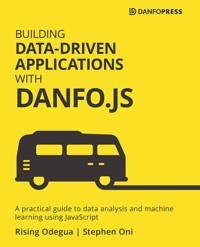
Most data analysts use Python and pandas for data processing for the convenience and performance these libraries provide. However, JavaScript developers have always wanted to use machine learning in the browser as well. This book focuses on how Danfo.js brings data processing, analysis, and ML tools to JavaScript developers and how to make the most of this library to build data-driven applications.
Starting with an overview of modern JavaScript, you’ll cover data analysis and transformation with Danfo.js and Dnotebook. The book then shows you how to load different datasets, combine and analyze them by performing operations such as handling missing values and string manipulations. You’ll also get to grips with data plotting, visualization, aggregation, and group operations by combining Danfo.js with Plotly. As you advance, you’ll create a no-code data analysis and handling system and create-react-app, react-table, react-chart, Draggable.js, and tailwindcss, and understand how to use TensorFlow.js and Danfo.js to build a recommendation system. Finally, you’ll build a Twitter analytics dashboard powered by Danfo.js, Next.js, node-nlp, and Twit.js.
By the end of this app development book, you’ll be able to build and embed data analytics, visualization, and ML capabilities into any JavaScript app in server-side Node.js or the browser.
Das E-Book können Sie in Legimi-Apps oder einer beliebigen App lesen, die das folgende Format unterstützen:
Seitenzahl: 395
Veröffentlichungsjahr: 2021
Ähnliche



















Building Data-Driven Applications with Danfo.js
A practical guide to data analysis and machine learning using JavaScript
Rising Odegua
Stephen Oni
Danfopress is an imprint of Packt Publishing
Building Data-Driven Applications with Danfo.js
Copyright © 2021 Packt Publishing
All rights reserved. No part of this book may be reproduced, stored in a retrieval system, or transmitted in any form or by any means, without the prior written permission of the publisher, except in the case of brief quotations embedded in critical articles or reviews.
Every effort has been made in the preparation of this book to ensure the accuracy of the information presented. However, the information contained in this book is sold without warranty, either express or implied. Neither the authors, nor Packt Publishing or its dealers and distributors, will be held liable for any damages caused or alleged to have been caused directly or indirectly by this book.
Packt Publishing has endeavored to provide trademark information about all of the companies and products mentioned in this book by the appropriate use of capitals. However, Packt Publishing cannot guarantee the accuracy of this information.
Group Product Manager: Kunal Parikh
Publishing Product Manager: Aditi Gour
Senior Editor: Roshan Kumar
Content Development Editor: Tazeen Shaikh
Technical Editor: Sonam Pandey
Copy Editor: Safis Editing
Project Coordinator: Aparna Ravikumar Nair
Proofreader: Safis Editing
Indexer: Rakhi Nair
Production Designer: Roshan Kawale
First published: September 2021
Production reference: 1190821
Published by Packt Publishing Ltd.
Livery Place
35 Livery Street
Birmingham
B3 2PB, UK.
ISBN 978-1-80107-085-0
www.packt.com
To the memory of my father, Odegua, for all the sacrifices and dedication to ensure I have a good life. To my mother, Success Odegua, thank you for all the support. To my siblings, Kelvin, Harrison, Peace, Efosa, and Jerimiah, I love you all.
– Rising Odegua
I dedicate this to my parents (Mr and Mrs Oni) and to my lovely younger sister, and also to my friends and everyone who supported me during this period.
– Stephen Oni
Contributors
About the authors
Rising Odegua is the co-creator of Danfo.js and Dnotebook. He is a software and machine learning engineer with experience building data-driven applications in languages such as Python and JavaScript. Rising is actively engaged in building the developer ecosystem by giving talks, providing direct/indirect mentorship, working on open source projects, hosting meetups, and writing tutorials.
Stephen Oni is the co-creator of Danfo.js and Dnotebook. He is a software developer at Datopian, building data-driven platforms and tools. He is also an open source developer building tools that intersect the web and machine learning.
About the reviewers
Gant Laborde is an owner of Infinite Red, mentor, adjunct professor, published author, and award-winning speaker. For 20 years, he has been involved in software development and is still going strong today. He is recognized as a Google Developers Expert in web and machine learning, but informally he is an open sourcerer and aspires to one day become a mad scientist. He blogs, videos, and maintains popular repositories for the community. He is CIO and owner of Infinite Red, a React Native and AI consulting company. He is also the author of Learning TensorFlow.js (O'Reilly Media, Inc.). Special thanks to the TensorFlow.js community for being welcoming, and to my loving family for their support.
Matvii Hodovaniuk is a full-stack developer. He likes to work with JavaScript tools and explore new technologies. He works on writing skills and tools that can help him with writing both code and text during his free time.
Table of Contents
Preface
Section 1: The Basics
Chapter 1: An Overview of Modern JavaScript
Technical requirements
Understanding the difference between let and var
var allows the redeclaration of variables
var is not a blocked scope
Destructuring
Spread syntax
Spreading or unpacking an iterable into an array
Creating new objects from existing ones
Function arguments
Overview of scopes and closures
Scope
Closure
Understanding Array and Object methods
Array methods
Objects
Understanding the this property
Arrow functions
Promises and async/await
Cleaning callbacks with promises
async/await
Object-oriented programming and JavaScript classes
Classes
Inheritance
Setting up a modern JavaScript environment with transpilers
Babel
Webpack
Unit testing with Mocha and Chai
Setting up a test environment
Summary
Section 2: Data Analysis and Manipulation with Danfo.js and Dnotebook
Chapter 2: Dnotebook - An Interactive Computing Environment for JavaScript
Technical requirements
Introduction to Dnotebook
Setup and installation of Dnotebook
Basic concepts behind interactive computing in Dnotebook
Cells
Code cells
Markdown cells
Persistence/state
Writing interactive code
Loading external packages
Loading CSV files
Getting a div container for plots
Gotchas when using a for loop
Working with Markdown cells
Creating a Markdown cell
Adding images
Headings
Lists
Saving notebooks
Summary
Chapter 3: Getting Started with Danfo.js
Technical requirements
Why you need Danfo.js
Installing Danfo.js
Introducing Series and DataFrames
Series
DataFrames
Essential functions and methods in Danfo.js
loc and iloc indexing
Sorting
Filtering
Arithmetic operations
Logical operations
Data loading and working with different file formats
Transforming a DataFrame into another file format
Summary
Chapter 4: Data Analysis, Wrangling, and Transformation
Technical requirements
Transforming data
Replacing missing values
Removing duplicates
Data transformation with the map function
Data transformation with the apply function
Filtering and querying
Random sampling
Encoding DataFrames and Series
Combining datasets
DataFrame merge
Data concatenation
Series data accessors
Calculating statistics
Calculating statistics by axis
Summary
Chapter 5: Data Visualization with Plotly.js
Technical requirements
A brief primer on Plotly.js
Using Plotly.js via a script tag
Fundamentals of Plotly.js
Data format
Configuration options for plots
Plotly layout
Creating basic charts with Plotly.js
Creating statistical charts with Plotly.js
Creating histogram plots with Plotly.js
Creating box plots with Plotly.js
Creating violin plots with Plotly.js
Summary
Chapter 6: Data Visualization with Danfo.js
Technical requirements
Setting up Danfo.js for plotting
Adding Danfo.js to your code
Downloading a dataset for plotting
Creating line charts with Danfo.js
Creating scatter plots with Danfo.js
Creating box and violin plots with Danfo.js
Making box and violin plots for a Series
Box and violin plots for multiple columns
Box and violin plots with specific x and y values
Creating histograms with Danfo.js
Creating a histogram from a Series
Creating a histogram from multiple columns
Creating bar charts with Danfo.js
Creating a bar chart from a Series
Creating a bar chart from multiple columns
Summary
Chapter 7: Data Aggregation and Group Operations
Technical requirements
Grouping data
Single-column grouping
Double-column grouping
Iterating through grouped data
Iterating through single- and double-column grouped data
Using the .apply method
Data aggregation of grouped data
Data aggregation on single-column grouping
Data aggregation on double-column grouping
A simple application of groupby on real data
Summary
Section 3: Building Data-Driven Applications
Chapter 8: Creating a No-Code Data Analysis/Handling System
Technical requirements
Setting up the project environment
Structuring and designing the app
App layout and the DataTable component
Implementing DataTable components
File upload and state management
Creating different DataFrame operation components
Implementing the Describe component
Implementing the Query component
Implementing the Df2df component
Implementing the Arithmetic component
Implementing the chart component
Implementing the ChartPlane component
Implementing the ChartViz component
Integrating ChartViz and ChartPlane into App.js
Summary
Chapter 9: Basics of Machine Learning
Technical requirements
Introduction to machine learning
A simple analogy of a machine learning system
Why machine learning works
Objective functions
Evaluation metrics
Machine learning problems/tasks
Supervised learning
Unsupervised learning
Machine learning in JavaScript
Applications of machine learning
Resources to understand machine learning in depth
Summary
Chapter 10: Introduction to TensorFlow.js
Technical requirements
What is TensorFlow.js?
Installing and using TensorFlow.js
Setting up TensorFlow.js in the browser
Installing TensorFlow.js in Node.js
Tensors and basic operations on tensors
Creating tensors
Operating on tensors
Building a simple regression model with TensorFlow.js
Setting up your environment locally
Retrieving and processing the training dataset
Creating models with TensorFlow.js
Creating a simple three-layer regression model
Training the model with the processed dataset
Making predictions with the trained model
Summary
Chapter 11: Building a Recommendation System with Danfo.js and TensorFlow.js
Technical requirements
What is a recommendation system?
Collaborative filtering approach
Hybrid filtering approach
The neural network approach to creating a recommendation system
Building a movie recommendation system
Setting up your project directory
Retrieving and processing the training dataset
Building the recommendation model
Training and saving the recommendation model
Making movie recommendations with the saved model
Summary
Chapter 12: Building a Twitter Analysis Dashboard
Technical requirements
Setting up the project environment
Building the backend
Building the Twitter API
Building the text sentiment API
Building the frontend
Creating the Search component
Creating the ValueCounts component
Creating a plot component for sentiment analysis
Creating a Table component
Summary
Chapter 13: Appendix: Essential JavaScript Concepts
Technical requirements
Quick overview of JavaScript
Understanding the fundamentals of JavaScript
Declaring variables
Data types
Conditional branching and loops
JavaScript functions
Summary
Why subscribe?
Other Books You May Enjoy
Packt is searching for authors like you
Share Your Thoughts
Share Your Thoughts
Once you've read Building Data-Driven Applications with Danfo.js, we'd love to hear your thoughts! Please click here to go straight to the Amazon review page for this book and share your feedback.
Your review is important to us and the tech community and will help us make sure we're delivering excellent quality content.
Section 1: The Basics
This section introduces JavaScript and the Node.js framework. These concepts are needed in order to fully understand and use Danfo.js. It also introduces how to set up an environment for modern JavaScript using Babel and Node.js, and also teaches the reader some basics of code testing.
This section comprises the following chapters:
Chapter 1, An Overview of Modern JavaScript




