


75,99 €
Mehr erfahren.
- Herausgeber: John Wiley & Sons
- Kategorie: Wissenschaft und neue Technologien
- Sprache: Englisch
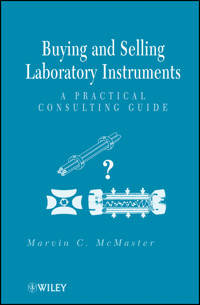
A time-tested, systematic approach to the buying and selling of complex research instruments Searching for the best laboratory instruments and systems can be a daunting and expensive task. A poorly selected instrument can dramatically affect results produced and indirectly affect research papers, the quality of student training, and an investigator's chances for advancement. Buying and Selling Laboratory Instruments offers the valuable insights of an analytical chemist and consultant with over four decades of experience in locating instruments based upon both need and price. It helps all decision makers find the best equipment, service, and support while avoiding the brand-loyalty bias of sales representatives so you can fully meet your laboratory's requirements. The first section of the book guides buyers through the hurdles of funding, purchasing, and acquiring best-fit instruments at the least-expensive price. It explains how to find vendors that support their customers with both knowledgeable service and application support. Also offered is guidance on adapting your existing instruments to new applications, integrating new equipment, and what to do with instruments that can no longer serve in research mode. The second section explains the sales process in detail. This is provided both as a warning against manipulative sales reps and as a guide to making the sale a win-win process for you and your vendor. It also shows you how to select a knowledgeable technical guru to help determine the exact system configuration you need and where to find the best price for it. Added bonuses are summary figures of buying sequence and sales tools and an appendix containing frequently asked questions and memory aids. Buying and Selling Laboratory Instruments is for people directly involved in selecting and buying instruments for operational laboratories, from the principle investigator to the person actually delegated with investigating and selecting the system to be acquired. Sales representatives; laboratory managers; universities; pharmaceutical, biotech, and forensic research firms; corporate laboratories; graduate and postdoctoral students; and principle investigators will not want to be without this indispensible guide.
Sie lesen das E-Book in den Legimi-Apps auf:
Seitenzahl: 267
Veröffentlichungsjahr: 2010
Ähnliche


















Table of Contents
Title Page
Copyright
Preface
Part ONE: Purchasing Laboratory Instruments
Chapter 1: Selecting Laboratory Instruments
1.1 Modular HI Systems
1.2 Systems-In-A-Box
1.3 Automation
1.4 Data Archival and Recovery
Chapter 2: Step-By-Step Purchasing
Chapter 3: Analytical Instrument Specifications
3.1 Dedicated Packages Versus Component Systems
3.2 Critical Features of Laboratory Instruments
3.3 Dedicated Analysis Facilities
Chapter 4: Finding The Best Price
4.1 Price Quotations
4.2 Government Service Administration (GSA) Pricing
4.3 Instrument Selection
4.4 Demonstration Equipment Discounts
4.5 Discounting in Kind
4.6 The Modular Trap
4.7 Buying Used Equipment
4.8 New System Warranties
Chapter 5: Grants and Bidding
5.1 Logical Bidding Specifications
5.2 Dealing With Purchasing Agents
5.3 Using GSA Pricing
5.4 Quantity Discounting
Chapter 6: Instrument Vendor Support
6.1 In-House Demonstrations and Seminars
6.2 User Training Schools
6.3 Vendor Application Development Laboratories
6.4 Technically Trained Sales Representatives
6.5 Vendor-Sponsored Technical Meetings
6.6 Postsales Support
6.7 Cost of Consumables
Chapter 7: Laboratory Instrument Service
7.1 Quality is Job 1, Quality Service is Job 2
7.2 Separating Instrument and Application Problems
7.3 Reverse-Order Diagnosis
7.4 Service Resources
7.5 Spare Parts Inventory
7.6 Diagnosing Grounding and Static Problems
Chapter 8: Recycling The System
8.1 The Dedicated Recycled System
8.2 Technician Training Instruments
8.3 University Instrument Donation
8.4 Used-Instrument Resale
8.5 Metal Recycling
Part TWO: A Guide to the Selling Process
Chapter 9: Buying Relationships
9.1 Win/Lose Selling Relationships
9.2 Win/Win Selling Relationships
9.3 Buying Hardware, Service, and Support
9.4 Advantages of A Profitable Vendor
9.5 Getting What You Pay for and Need
Chapter 10: Sales Justification
10.1 Emotional Decision Making
10.2 Reasons for an Instrument Selection
10.3 Purpose of the Decision
10.4 Path to A Sales Decision
10.5 The Qualifying Sales Interview (ADMANO)
Chapter 11: Profiling the Sales Call
11.1 Training Salespeople
11.2 Hot Button Analysis (HBA)
11.3 Selling to Each Hot Button Type
Chapter 12: Objections In The Sales Process
12.1 Systematic Selling
12.2 Assistance of Sales Tools
12.3 Use of Demonstration Equipment
Chapter 13: Step-by-Step Instrument Selling
Chapter 14: Closing The Sale
14.1 Assumptive Closes
14.2 Manipulative Closes
14.3 Final Closing and The Lost Sale Close
Chapter 15: The Laws of Selling
15.1 Salespeople are Made, not Born
15.2 You Only Have One Chance to Make a Good First Impression
15.3 Salespersons Ask Questions, not Make Statements
15.4 Fear of Loss is More Important than Desire for Gain
15.5 If You do not Ask, the Answer is Automatically No
15.6 Listen More than You Talk
15.7 Objections are a Sign of Interest
15.8 Do not Argue, Ask for Clarification
15.9 Body Language can Defuse Sales Tension
15.10 Emotional Buying and Logical Justification
15.11 People Want to be Fair
15.12 Honesty is Good Business
15.13 Never Criticize an Opponent
15.14 Tanstaafl
15.15 Explaining Quality or Apologizing for the Price
15.16 The Word Sales Comes from Serving
Chapter 16: Handling Problems
16.1 Warranties and Customer Expectations
16.2 Dealing With a Lemon
16.3 Instrument Success Goals
16.4 Providing Application Support
16.5 Territory Management
16.6 Confidentiality
16.7 Sales Integrity
Frequently asked Questions
A.1 Frequently Asked Purchasing Questions
A.2 Frequently Asked Questions about New Instruments
A.3 Frequently Asked Questions about the Selling Process
Memory Aids, Figures, and Tables
Glossary of Purchasing and Sales Terms
Troubleshooting Quick Reference
D.1 Troubleshooting the Purchase
D.2 Troubleshooting the Sale
Selected Reading List
Index
Copyright © 2010 by John Wiley & Sons, Inc. All rights reserved.
Published by John Wiley & Sons, Inc., Hoboken, New Jersey.
Published simultaneously in Canada.
No part of this publication may be reproduced, stored in a retrieval system, or transmitted in any form or by any means, electronic, mechanical, photocopying, recording, scanning, or otherwise, except as permitted under Section 107 or 108 of the 1976 United States Copyright Act, without either the prior written permission of the Publisher, or authorization through payment of the appropriate per-copy fee to the Copyright Clearance Center, Inc., 222 Rosewood Drive, Danvers, MA 01923, (978) 750-8400, fax (978) 750-4470, or on the web at www.copyright.com. Requests to the Publisher for permission should be addressed to the Permissions Department, John Wiley & Sons, Inc., 111 River Street, Hoboken, NJ 07030, (201) 748-6011, fax (201) 748-6008, or online at www.wiley.com/go/permission.
Limit of Liability/Disclaimer of Warranty: While the publisher and author have used their best efforts in preparing this book, they make no representations or warranties with respect to the accuracy or completeness of the contents of this book and specifically disclaim any implied warranties of merchantability or fitness for a particular purpose. No warranty may be created or extended by sales representatives or written sales materials. The advice and strategies contained herein may not be suitable for your situation. You should consult with a professional where appropriate. Neither the publisher nor author shall be liable for any loss of profit or any other commercial damages, including but not limited to special, incidental, consequential, or other damages.
For general information on our other products and services or for technical support, please contact our Customer Care Department within the United States at (800) 762-2974, outside the United States at (317) 572-3993 or fax (317) 572-4002.
Wiley also publishes its books in a variety of electronic formats. Some content that appears in print may not be available in electronic formats. For more information about Wiley products, visit our web site at www.wiley.com.
Library of Congress Cataloging-in-Publication Data:
McMaster, Marvin C.
Buying and selling laboratory instruments : a practical consulting guide / Marvin C. McMaster.
p. cm.
Includes index.
ISBN 978-0-470-40401-0 (cloth)
1. Scientific apparatus and instruments–Marketing. 2. Laboratories–Equipment and supplies–Marketing. I. Title.
QC185.M36 2010
681′.750688–dc22
2009045873
Preface
Buying laboratory instruments is one of the most expensive undertakings of the research director. A wide variety of instruments are required to deal with research problems, and to be effective, they must fit the laboratory's needs. A poorly selected instrument can dramatically affect the results produced and indirectly can affect the research papers produced, the quality of training provided to the investigator's students, and the investigator's chances for career advancement. There are major problems in ensuring that the customer is buying the right instrument at the best price and that the customer will be able to get vendor service and support to keep the instrument up and running to produce results.
Many people mistakenly believe that the research director selects and buys the major instrumentation for the laboratory. The principal investigator may pay for the instrumentation, but almost always a senior technician, graduate student, or postdoctoral student does the actual buying. These people are the ones who will be using the instruments and are most familiar with the laboratory's requirements. They investigate the available models, acquire specifications and price quotations, compare the services offered and the reputations of various manufacturers, and recommend the equipment needed. In many cases, they write the funding proposals and bidding specifications. An exception to this scenario is the case of a new professor or a new laboratory investigator, who has just come from a training environment, is acquainted with the selection procedure, or has not acquired an experienced senior technician. This person may make his or her own buying decisions.
My laboratory instrument experience began in graduate school and in a variety of postdoctoral studies. I used many types of analytical and separation instruments to purify and identify the research mixtures I was studying. I helped select new instruments as needed. When I moved on to company research laboratories, pilot plants, and production facilities, I recommended new analytical systems that were needed for my work and wrote bidding specifications to purchase the instruments. As a professional sales and technical support representative for 25 years for major instrument companies, I helped potential customers create funding proposals and bidding specifications, and I helped them select and order the needed instruments.
I was involved in the installation when possible, trying to ensure that the instrument was actually used, and also supported customers in solving their research and cost-for-test analytical problems. When I sold to either a university facility, a contract laboratory, or a commercial laboratory, I first made a courtesy call on the principal investigator, who then referred me to the buyer in the laboratory. There the actual selling started, and it continued until price negotiations were complete and a commitment to buy was made.
But the sales representative works for the vendor and has primarily the vendor's welfare in mind. It is true that vendors are interested in establishing a long-term relationship with the customer, but generally, they are not as interested as the customer in creating an exact fit of the least expensive solution to the customer's problem. Many vendors feel that their commitment ends when the instrument is shipped and installed in the customer's facility. They do not have a long-term commitment to making sure that the customer is successful in using the instrument.
At the moment, I occupy a unique position. I am a consultant and technical writer with no commitment to any instrument vendor. I have a broad technical background in medicine, and in organic chemistry, analytical chemistry, and biochemistry, that allows me to better understand the problems being investigated and helps me to serve as a guide to the purchase of the correct equipment.
I have always sold as a consular salesman, a partner in ensuring the laboratory instrument's successes. This is not a typical sales relationship. I have observed, after sales were completed, many instrument disasters and research misfits, and I have seen ways that these system misfits might have been avoided.
In Section I of this book, I try to guide instrument buyers through the shoals of funding, purchasing, and acquiring best-fit instruments at the least expensive price. This section provides information on how to find vendors that support customers with both knowledgeable service and application support. It also offers guidance on how to adapt existing instruments to new applications, how to automate and integrate these instruments with other instruments in the laboratory, and what to do with them when they move beyond their useful life in the research laboratory.
In Section II of the book, I provide a guide to the sales process to make the purchaser aware of what is going on and how to determine if the sales representative is either trying to help select the correct instrument for the customer's needs or manipulating the customer into purchasing the more elaborate and expensive system the vendor is trying to unload. I believe in a win/win sales process that leaves both the customer and the vendor satisfied with the sale.
Throughout my sales career, I have told my customers that a salesman like me, with a Ph.D. and my technical background, was an expensive investment for an instrument company. To be cost effective, I neeeded to sell them four systems even if they were only buying a single detector at the moment. To make this happen, my goal was to make them so successful that they would expand that detector into a full system, buy again and again from me, and send me other customers who would buy additional systems.
That is not a common sales attitude, but it is a successful technique for building loyal customer accounts. Many salespersons focus only on the bottom line of the immediate sale, and meeting their company's monthly sales quota is their most important sale criterion. When the sale is made and the instrument is paid for, they feel no further commitment to the customer until the customer is ready to purchase another instrument. To me, this is shortsighted and destructive to a long-term sales relationship. Every selling opportunity is a new event for these I win/you lose salespersons, often carrying a negative burden from the last sale and leading to the public's perception of salespersons as belonging in a professional category somewhere between those of prostitutes and actors—certainly not someone customers would want working with their laboratory personnel.
If you insist on becoming a salesperson, approach this career as a professional and do not assume, like many, that “Anybody can sell. You just need to go out and do it.” Learn to serve, study the profession, and become a true win/win salesperson. The techniques presented in this book can serve as a starting point, but you will need to find books by successful salespersons, study them, apply the information and practice, practice, practice until you improve.
A true win-win salesperson is someone you turn to when you want to solve a laboratory problem. This person should be able to help you define your needs and fill them with the right instrument at a fair price. He or she should help you get the equipment up and running and be there as a resource that the laboratory can use again in the future. Such a salesperson is a rare and valuable resource, and should be sought out and encouraged by referring him or her to other investigators seeking to purchase equipment in your institution. Like a good wine, this type of salesperson gets better with age and frequent use.
Part ONE
PURCHASING LABORATORY INSTRUMENTS
1
Selecting Laboratory Instruments
As a young salesman, I usually got involved in buying fairly late in the selection process. Most often I began with a sales call when a potential customer responded to an interest card in a technical magazine, asked our company for a pricing quotation, or received a referral by a colleague.
Lesen Sie weiter in der vollständigen Ausgabe!
Lesen Sie weiter in der vollständigen Ausgabe!
Lesen Sie weiter in der vollständigen Ausgabe!
Lesen Sie weiter in der vollständigen Ausgabe!
Lesen Sie weiter in der vollständigen Ausgabe!
Lesen Sie weiter in der vollständigen Ausgabe!
Lesen Sie weiter in der vollständigen Ausgabe!
Lesen Sie weiter in der vollständigen Ausgabe!
Lesen Sie weiter in der vollständigen Ausgabe!
Lesen Sie weiter in der vollständigen Ausgabe!
Lesen Sie weiter in der vollständigen Ausgabe!
Lesen Sie weiter in der vollständigen Ausgabe!
Lesen Sie weiter in der vollständigen Ausgabe!
Lesen Sie weiter in der vollständigen Ausgabe!
Lesen Sie weiter in der vollständigen Ausgabe!
Lesen Sie weiter in der vollständigen Ausgabe!
Lesen Sie weiter in der vollständigen Ausgabe!
Lesen Sie weiter in der vollständigen Ausgabe!
Lesen Sie weiter in der vollständigen Ausgabe!
Lesen Sie weiter in der vollständigen Ausgabe!
Lesen Sie weiter in der vollständigen Ausgabe!
Lesen Sie weiter in der vollständigen Ausgabe!




