


Erhalten Sie Zugang zu diesem und mehr als 300000 Büchern ab EUR 5,99 monatlich.
- Herausgeber: Éditions de l'Emmanuel
- Kategorie: Religion und Spiritualität
- Sprache: Englisch
This handbook has been written for the formation of all members of the Emmanuel Community, and it also speaks to all people who want to live a 100% Christian daily life. It is divided into six parts:Living in the Emmanuel Community, Life in the Holy Spirit, Living with Brothers and Sisters, Living with God, Living in Freedom, and Living in the World without belonging to the World. Based on the great Tradition of the Church, it stimulates commitment by inviting the reader to personal reflection and exchange. This course in formation can be taken with an individual companion or in a group. This book will tell you all you ever wanted to know about the Emmanuel Community and that you never dared to ask!
Sie lesen das E-Book in den Legimi-Apps auf:
Seitenzahl: 686
Veröffentlichungsjahr: 2017
Das E-Book (TTS) können Sie hören im Abo „Legimi Premium” in Legimi-Apps auf:
Ähnliche








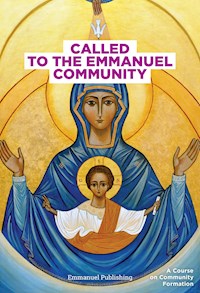
Called to the Emmanuel Community
A Course on Community Formation
Translated by Joan Barclay Lloydfrom Melbourne (Australia)
Nihil obstat,Paris, 27 June 2015
Fr. De CHAIGNON
Imprimatur,Paris, 27 June 2015
M. VIDAL, Vicar General
Conception couverture : © Christophe Roger
Photo couverture : © D.R.
Compostion : Soft Office (38)
© Éditions de l’Emmanuel, 2015
89, bd Auguste-Blanqui – 75013 Paris
www.editions-emmanuel.com
ISBN : 978-2-35389-624-0
Dépôt légal : 3e trimestre 2015
Preface
The fundamental objective of the formation of the lay faithful is an ever-clearer discovery of one’s vocation and the ever-greater willingness to live it so as to fulfil one’s mission.
Formation is not the privilege of a few, but a right and duty of all.
Saint John Paul II, Christifideles laici, n. 58 and 63.
One’s journey in the Emmanuel Community is a call to live the vocation of a baptized person: a call to holiness, supported by prayer, fraternal life, the sacraments, and mission.
During the Step of Welcome and Discernment (SWD), you advance in tandem with the coordinators of the Community in order to authenticate that call. The basic formation that is proposed to you here is a necessary tool for that discernment. This book provides you with a progressive discovery of the Emmanuel charism through a course adapted to community life in the world.
This itinerary corresponds to a time of maturation that leads to the statutory step of commitment. But, more profoundly, this formation is designed to assist the human and spiritual growth of each person. In effect, as we respond freely to God, our life becomes more orderly, opening up the way to our sanctification.
Christian life is a progressive path, and some objective criteria are indispensable for sustaining that progression. We therefore propose that you discover these elements step by step.
The Lord suits his call to our strengths. He makes us advance in stages, according to our history, our personality, and our capacities. In this way we receive the grace for each day, according to the stage that we are at, and according to the effort needed. The Church’s teaching and wisdom are such that she leads us like a mother along this road.
The themes that are proposed to you in this book can be taken up again according to your needs during your community journey, and particularly on the occasion of the annual renewal of your commitment. This is not in fact automatic; nor is it a ritual; but it is truly a means of favouring and showing the way of holiness to each person, in the light of regularly reconsidering the question of our commitment.
During the Stage of Welcome and Discernment, you will be asked to travel a certain distance. A clear aim will be to enable you to choose community life in Emmanuel in a free and responsible manner.
The subjects proposed here will permit you to discover the Community from the inside. It is not possible to see it clearly from the outside, and that also involves the big risk that you will remain with your first impressions. If your call is to the Emmanuel Community, at the end of the Stage of Welcome and Discernment you will have to declare your consent to it at the time of your commitment, with a full understanding of what it entails.
Some of you –indeed the majority– are invited, in your respective provinces, to a specific course for members in the Stage of Welcome and Discernment: this can be in local gatherings, with teachings, or by participating in a Formation Maisonnée1, with some DVDs. You will refer to corresponding themes in this book.
It may happen that you do not participate –for various reasons– in a course of this kind. In that case, you can discover in this book what you need to know about community formation. Take your time, but be sure to read and truly work through these documents. You will find in them all the basics of community life and, I am sure, the answers to the questions you are asking.
Each theme is accompanied by a selection of Materials for Further Study, which will enable you to deepen your knowledge of the subjects treated, to reflect on the way they can be lived out in everyday life, and also how you can share with the maisonnée the discoveries you have made.
Helped by your companion, you will also try to discover all aspects of your journey. During your time of companioning you will be able to discern how you can begin progressively to put these teachings into practice. The itinerary is well marked out, but there are several ways of going through it and especially of putting it into practice. So, for example, the themes of this book appear in a certain order, but the organization of the formation in your regions and in your sectors may follow a different order for practical and pastoral reasons. You yourself may be attracted to a theme treated further on. Feel free! Don’t hesitate to start to discover the graces of the Emmanuel Community in following your own path. In this way you will be able to discover the foundations, which support the whole edifice, and therefore keep on going for a long time.
Finally, remember one essential item: in the spiritual life, discouragement is the only thing that is not useful. Let yourself be attracted and strengthened gradually by the path taken, so as to witness in your turn to the fire of the Love and Mercy of Christ. In this way let us follow in the footsteps of the Servant of God Pierre Goursat, who founded the Emmanuel Community in the Catholic Church.
Do not be afraid to entrust your formation to Mary, Mother of Emmanuel, so that she can guide you, especially when it seems most difficult to you.
So, let us set out joyfully!
Laurent LandeteModerator
1 Translator’s note: In this book we use the French word “maisonnée”, as in the Customary of the Emmanuel Community. We believe the equivalent word in English, “household”, carries other meanings, and we prefer to use the French term.
Note on the Method of Study
The formation given by the Emmanuel Community for people in the Stage of Welcome and Discernment usually takes two years. This book essentially goes through the teachings on the life of the Emmanuel Community. As Laurent Landete has explained in the preface, it has been written in such a way that it can be used flexibly. The coordinators of each province or country are responsible for initial formation in community. The community dimension of the formation itself will be valued in every possible way.
For each theme, this book provides some Materials for Further Study, which will allow you to learn more about the theme through reading different texts, by asking questions, by speaking with your companion, or by sharing with your maisonnée. We think it is important to insist on the necessity of working personally through the Materials for Further Study, in order to appropriate the proposed formation. A simple reading of the various themes is not enough.
Numerous biblical references are suggested in the Materials for Further Study. We have deliberately not cited the texts themselves: it is important for each person to be familiar with the Bible, to take it in hand, to open it, to search for references and to read it. This forms part of community formation. We advise you to read and to work through this book with your Bible always at hand. Pope Francis reminded members of the Catholic Charismatic Renewal gathered in Rome: “In the beginning, one said of you charismatics that you always had a Bible, or the New Testament, on you… Do you still have it today? I am not so sure about that! If not, return to your first love: always carry the Word of God in your pocket, or in your handbag. Always have the Word of God with you!”2
Each set of Materials for Further Study also suggests that you make some small decisions. This point is very important and has formed part of the grace of the Community since its inception. Pierre Goursat insisted a lot on this method of helping us to advance very concretely in the spiritual life: take the smallest decision possible, only one at a time, note it down, and keep to it. In the Materials for Further Study, we propose various possibilities for such decisions. You are free to choose one, or even another one that is inspired by the Holy Spirit, or one that your companion advises you to make.
2 Pope FRANCIS, Speech to the participants of the 37th national convocation of the Renewal in the Spirit, Olympic Stadium, Rome, 1 June 2014.
Materials for Further Study
The Universal Call to Holiness
Holy Scripture
• Ephesians 1: 3-10: the Father’s loving plan
• Matthew 19: 16-26: With God all things are possible
• 1 Thessalonians 4: 3: the will of God is our sanctification
• Matthew 5-7: The sermon on the Mount, charter of a life of holiness
Texts to read and meditate upon
I) VATICAN II (Lumen Gentium, nos. 39-40)
39. The Church, whose mystery is being set forth by this Sacred Synod, is believed to be indefectibly holy. Indeed Christ, the Son of God, who with the Father and the Spirit is praised as "uniquely holy," loved the Church as His bride, delivering Himself up for her. He did this that He might sanctify her. He united her to Himself as His own body and brought it to perfection by the gift of the Holy Spirit for God's glory. Therefore in the Church, everyone whether belonging to the hierarchy, or being cared for by it, is called to holiness, according to the saying of the Apostle: "For this is the will of God, your sanctification". However, this holiness of the Church is unceasingly manifested, and must be manifested, in the fruits of grace which the Spirit produces in the faithful; it is expressed in many ways in individuals, who in their walk of life, tend toward the perfection of charity, thus causing the edification of others; in a very special way this (holiness) appears in the practice of the counsels, customarily called "evangelical." This practice of the counsels, under the impulsion of the Holy Spirit, undertaken by many Christians, either privately or in a Church-approved condition or state of life, gives and must give in the world an outstanding witness and example of this same holiness.
40. The Lord Jesus, the divine Teacher and Model of all perfection, preached holiness of life to each and everyone of His disciples of every condition. He Himself stands as the author and consummator of this holiness of life: "Be you therefore perfect, even as your heavenly Father is perfect". Indeed He sent the Holy Spirit upon all men that He might move them inwardly to love God with their whole heart and their whole soul, with all their mind and all their strength and that they might love each other as Christ loves them. The followers of Christ are called by God, not because of their works, but according to His own purpose and grace. They are justified in the Lord Jesus, because in the baptism of faith they truly become sons of God and sharers in the divine nature. In this way they are really made holy. Then too, by God's gift, they must hold on to and complete in their lives this holiness they have received. They are warned by the Apostle to live "as becomes saints", and to put on "as God's chosen ones, holy and beloved a heart of mercy, kindness, humility, meekness, patience", and to possess the fruit of the Spirit in holiness. Since truly we all offend in many things we all need God's mercies continually and we all must daily pray: "Forgive us our debts".
Thus it is evident to everyone that all the faithful of Christ, of whatever rank or status, are called to the fullness of the Christian life and to the perfection of charity; by this holiness as such a more human manner of living is promoted in this earthly society. In order that the faithful may reach this perfection, they must use their strength accordingly as they have received it, as a gift from Christ. They must follow in His footsteps and conform themselves to His image seeking the will of the Father in all things. They must devote themselves with all their being to the glory of God and the service of their neighbour. In this way, the holiness of the People of God will grow into an abundant harvest of good, as is admirably shown by the life of so many saints in Church history.
2) SAINT POPE JOHN PAUL II(Apostolic Exhortation Christifideles laici, nos. 16-17)
Called to holiness
16 […] Everyone in the Church, precisely because they are members, receives and thereby shares in the common vocation to holiness. In the fullness of this title and on equal par with all other members of the Church, the lay faithful are called to holiness: "All the faithful of Christ of whatever rank or status are called to the fullness of Christian life and to the perfection of charity". "All of Christ's followers are invited and bound to pursue holiness and the perfect fulfilment of their own state of life".
The call to holiness is rooted in Baptism and proposed anew in the other Sacraments, principally in the Eucharist. Since Christians are reclothed in Christ Jesus and refreshed by his Spirit, they are "holy". They therefore have the ability to manifest this holiness and the responsibility to bear witness to it in all that they do. The apostle Paul never tires of admonishing all Christians to live "as is fitting among saints" (Eph 5:3).
Life according to the Spirit, whose fruit is holiness (cf. Rom 6:22;Gal 5:22), stirs up every baptized person and requires each to follow and imitate Jesus Christ, in embracing the Beatitudes, in listening and meditating on the Word of God, in conscious and active participation in the liturgical and sacramental life of the Church, in personal prayer, in family or in community, in the hunger and thirst for justice, in the practice of the commandment of love in all circumstances of life and service to the brethren, especially the least, the poor and the suffering.
The Life of Holiness in the World
17. The vocation of the lay faithful to holiness implies that life according to the Spirit expresses itself in a particular way in their involvement in temporal affairs and in their participation in earthly activities. Once again the apostle admonishes us: "Whatever you do, in word or deed, do everything in the name of the Lord Jesus, giving thanks to God the Father through him" (Col 3:17). Applying the apostle's words to the lay faithful, the Council categorically affirms: "Neither family concerns nor other secular affairs should be excluded from their religious programme of life". Likewise the Synod Fathers have said: "The unity of life of the lay faithful is of the greatest importance: indeed they must be sanctified in everyday professional and social life. Therefore, to respond to their vocation, the lay faithful must see their daily activities as an occasion to join themselves to God, fulfil his will, serve other people and lead them to communion with God in Christ".
The vocation to holiness must be recognized and lived by the lay faithful, first of all as an undeniable and demanding obligation and as a shining example of the infinite love of the Father that has regenerated them in his own life of holiness. Such a vocation, then, ought to be called an essential and inseparable element of the new life of Baptism, and therefore an element which determines their dignity. At the same time the vocation to holiness is intimately connected to mission and to the responsibility entrusted to the lay faithful in the Church and in the world. In fact, that same holiness which is derived simply from their participation in the Church's holiness, represents their first and fundamental contribution to the building of the Church herself, which is the "Communion of Saints". The eyes of faith behold a wonderful scene: that of a countless number of lay people, both women and men, busy at work in their daily life and activity, oftentimes far from view and quite unacclaimed by the world, unknown to the world's great personages but nonetheless looked upon in love by the Father, untiring labourers who work in the Lord's vineyard. Confident and steadfast through the power of God's grace, these are the humble yet great builders of the Kingdom of God in history.
3) SAINT FRANCIS DE SALES (Introduction to the Devout Life, part I, chapter III)
When God created the world He commanded each tree to bear fruit after its kind; and even so He bids Christians, -- the living trees of His Church, –to bring forth fruits of devotion, each one according to his kind and vocation. A different exercise of devotion is required of each– the noble, the artisan, the servant, the prince, the maiden and the wife; and furthermore such practice must be modified according to the strength, the calling, and the duties of each individual.
I ask you, Philotheus, my child, would it be fitting that a Bishop should seek to lead the solitary life of a Carthusian? And if the father of a family were as regardless in making provision for the future as a Capuchin, if the artisan spent the day in church like a Religious, if the Religious involved himself in all manner of business on his neighbour's behalf as a Bishop is called upon to do, would not such a devotion be ridiculous, ill-regulated, and intolerable? Nevertheless such a mistake is often made, and the world, which cannot or will not discriminate between real devotion and the indiscretion of those who fancy themselves devout, grumbles and finds fault with devotion, which is really nowise concerned in these errors.
No indeed, Philotheus, my child, the devotion which is true hinders nothing, but on the contrary it perfects everything; and that which runs counter to the rightful vocation of any one is, you may be sure, a spurious devotion.
Aristotle says that the bee sucks honey from flowers without damaging them, leaving them as whole and fresh as it found them; --but true devotion does better still, for it not only hinders no manner of vocation or duty, but, contrariwise, it adorns and beautifies all.
Throw precious stones into honey, and each will grow more brilliant according to its several colour: --and in like manner everybody fulfils his special calling better when subject to the influence of devotion: --family duties are lighter, married love truer, service to our King more faithful, every kind of occupation more acceptable and better performed where that is the guide.
It is an error, nay more, a very heresy, to seek to banish the devout life from the soldier's guardroom, the mechanic's workshop, the prince's court, or the domestic hearth. […] Be sure that wheresoever […] we may be, we must aim at the perfect life.
4) SAINT THERESE OF LISIEUX(History of a Soul, Manuscript A1)12
I often asked myself why God had preferences, why all souls did not receive an equal measure of grace. I was filled with wonder when I saw extraordinary favours showered on great sinners like St. Paul, St. Augustine, whom He forced, so to speak, to receive His grace. In reading the lives of the Saints I was surprised to see that there were certain privileged souls, whom Our Lord favoured from the cradle to the grave, allowing no obstacle in their path which might keep them from mounting towards Him, permitting no sin to soil the spotless brightness of their baptismal robe. And again it puzzled me why so many poor savages should die without having even heard the name of God.
Our Lord has deigned to explain this mystery to me. He showed me the book of nature, and I understood that every flower created by Him is beautiful, that the brilliance of the rose and the whiteness of the lily do not lessen the perfume of the violet or the sweet simplicity of the daisy. I understood that if all the lowly flowers wished to be roses, nature would lose its springtide beauty, and the fields would no longer be enamelled with lovely hues.
And so it is in the world of souls, Our Lord’s living garden. He has been pleased to create great Saints who may be compared to the lily and the rose, but He has also created lesser ones, who must be content to be daisies or simple violets flowering at His Feet, and whose mission it is to gladden His Divine Eyes when He deigns to look down on them. And the more gladly they do His Will the greater is their perfection.
I understood this also, that God’s Love is made manifest as well in a simple soul, which does not resist His grace as in one more highly endowed. In fact, the characteristic of love being self-abasement, if all souls resembled the holy Doctors who have illuminated the Church, it seems that God in coming to them would not stoop low enough. But He has created the little child, who knows nothing and can but utter feeble cries, and the poor savage who has only the natural law to guide him, and it is to their hearts that He deigns to stoop. These are the field flowers whose simplicity charms Him; and by His condescension to them Our Saviour shows His infinite greatness. As the sun shines both on the cedar and on each little flower, as if it were the only one on earth, so Our Lord takes care particularly of each soul as if there were no other like it—just as in nature all the seasons are so disposed that on the appointed day the humblest daisy shall unfold its petals. In the same way everything corresponds to the good of each soul.
Questions to ask
Personally
• How do I nourish my desire for holiness?
• How do I grow in faith?
• How can I become a saint?
• How do I live in friendship with the Holy Spirit, the Sanctifier?
• In what ways is the Community a means to help me in my journey towards holiness?
With your companion
• At what concrete point is the Lord asking me to grow towards holiness today?
• Which grace of the Community can help me today to advance in holiness?
In the Maisonnée
• Do I pray for the holiness of my brothers and sisters in the maisonnée?
• How does the Maisonnée help me to respond to the call to holiness?
• What small decision will help me at this moment to grow in holiness?
Decisions you could make
• Pray for my brothers and sisters in the Maisonnée and in the Community, that they will become saints.
• Write down the little decision I have made in order to advance in holiness
• Go to confession at least once a month
Bibliography13
•Documents of VATICAN II, Dogmatic Constitution on the Church, Lumen gentium, chapter V.
•JOHN PAUL II, Apostolic Exhortation, Christifideles Laici “On the Vocation and Mission of the Lay Faithful in the Church and in the World”, 30 December 1988.
•Saint Francis de SALES, Introduction to the Devout Life, Image Books/ Doubleday: New York, 1989.
•Mother TERESA, A simple path, New York, 1995.
•Words of Pierre Goursat: collected and presented by Martine Catta, Editions Emmanuel, Paris, 2014.
•Saint THERESE of Lisieux, Story of a Soul, ICS Publications, Washington DC, 1996.
•Donna ORSUTO, Holiness, Continuum Press: London 2006.
•Ralph MARTIN, The Fulfillment of all Desire: A Guidebook for the Journey to God Based on the Writings of the Saints, Emmaus Road Publishing, Steubenville, Ohio, 2006.
12. Sainte THERESE de Lisieux, Histoire d’une âme. Manuscripts autobiographiques, Paris, Ed. De ‘Emmanuel, 2015, pp. 20-22.
13 Translator’s note: in the original, the author naturally referred only to French books. I have substituted English versions of these works, where possible. In addition, I have cited some other books on the subject known to me.
Theme 2
Why the Emmanuel Community?
Aims
• To understand how God has taught us in the history of salvation: that God does not save us independently or others
• To realize that the Community is given to us to help us respond to the call to holiness
We have just seen, in the previous theme, that the Community is given to us to help us on the road to sanctity. If the Lord calls us to community life, it is therefore important for our life as baptized persons. It is a special way gradually to understand the Lord, to love him, and to witness to him, for that is our vocation. In fact it is the purpose of our life! Saint John reminds us: “Now this is eternal life, that they may know you, the only true God, and Jesus Christ whom you have sent” (John 17: 3). The Lord gives us the means, which are prayer, the sacraments, and the Church –we need the cells of the Church, where we meet the Lord, in order to live with him and witness to him.
In order to affirm that community life is an important grace for our Christian life, we must first return to the Word of God; then we shall see the reasons for belonging to a community.
The work of God in the History of Salvation
The Old Testament
Genesis recounts the creation of the world. God creates the great lights. He creates the waters, he creates the earth and all that teems upon it –in Genesis 1: 26. And then something admirable happens: God stops his creating. Up till then, he had spoken and acted in an imperative mode: “Let there be light” etc. Suddenly, there is a kind of stop, a little as though God wanted to reflect on what he was going to do next, and he says: “Let us make man in our image, in our likeness” (Genesis 2: 26).
This creation of man is astonishing for two reasons.
First of all, at the beginning of the creation, all the verbs were in the singular and, all of a sudden, there is a plural “let us make”. All the Fathers of the Church have seen in this plural the affirmation that our God is Trinity, that there is a communion of Love in God; that in God there are three Persons, the Father, the Son and the Holy Spirit. As a result, God who created us is already Himself a mystery of communion.
Secondly, when God says: “Let us make man in our image”, it is as though He stopped and took a different approach, with a particular respect and a special delicacy, at this extraordinary moment when he began to create the summit of creation: man. God created man in his image and in his likeness. He who is Trinity, therefore created man to be in communion too, not only with God, but also with others. The text affirms: “male and female he created them” (Genesis 1: 27). As soon as he created a human being, God gave him a companion. In Chapter 2 of Genesis, it says, “It is not good for man to be alone” (Genesis 2: 18).
From the very first verses of Genesis, then, God calls us to live in community. The family is certainly the first community in society and in the Church. Later, through the whole history of the Old Testament, one sees that God calls people: Abraham, Isaac, and Jacob, and through them, there is the promise of descendants and a people. One notices that God’s project is not only to bless them and to lead them, but through them to construct a people and a community. The notion of a people –a community– is an integral part of the Old Testament.
Let us note also that God’s election is always for a mission: when God calls a person, it is always for others. He calls Abraham to be the father of a numerous people, the chosen people. He calls Moses to bring his people out of slavery in the land of Egypt and to lead them to the Promised Land. He calls the prophets to correct his people who are wandering. In every vocation there is a strong community dimension.
The New Testament
The Gospels show us that Jesus also gathered a community of apostles and disciples around him. For three years, supported by some women who accompanied them (cf. Luke 8: 3), they lived a true community life, with moments of evangelization together, moments of retreat when Jesus addressed them away from the presence of the crowds, and free moments of festivity, rest and fraternal life. They had a common purse, which was kept by Judas Iscariot (




