


12,99 €
Mehr erfahren.
- Herausgeber: John Wiley & Sons
- Kategorie: Wissenschaft und neue Technologien
- Serie: Digital Field Guide
- Sprache: Englisch
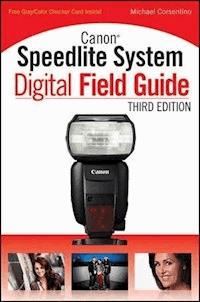
Get enlightened with this detailed coverage of Canon's Speedlite system If you use a digital SLR camera, then you understand just how critical it is to have a capable flash. A Canon Speedlite shines a whole new light on taking photos with a Canon DSLR. This full-color, in-depth guide takes you beyond the standard manual that accompanies a Canon Speedlite and shows you the types of settings you can use on your camera when working with off-camera flashes. You'll explore the possibilities of wireless lighting with multiple speedlites as well as the creative effects you can achieve. Author, teacher, and professional photographer Michael Corsentino demystifies setting up a speedlite, synchronizing the speedlite equipment, and determining lighting ratios. He provides you with detailed, real-world information on using all of Canon's various Speedlite models including the new 600EX-RT and covers other Canon lighting system components such as the ST-E2 Wireless Transmitter, Macro Ring Lite, and Macro Twin Lites and OC-E3 Off-Camera Shoe Cord. * Highlights how the Canon Speedlite system is a must-have accessory for exploring a new world of digital photo possibilities * Covers a number of Canon's Speedlites, including the 600EX-RT, 580 EX II, 430 EX II, 270 EX and 270 EX II, and the 320 EX * Shows you how to create an inexpensive and portable wireless studio lighting system that can go where you go * Demystifies setting up the speedlite, synchronizing the equipment, and figuring out lighting ratios Canon Speedlite System Digital Field Guide, 3rd Edition is a handy guide that shares real-world information and untangles the complexities of using the Canon Speedlite system.
Sie lesen das E-Book in den Legimi-Apps auf:
Seitenzahl: 403
Veröffentlichungsjahr: 2012
Ähnliche



















Canon® Speedlite System Digital Field Guide, 3rd Edition
Canon®Speedlite System Digital Field Guide 3rd Edition
Michael Corsentino
Canon® Speedlite System Digital Field Guide, 3rd Edition
Published by John Wiley & Sons, Inc.10475 Crosspoint Boulevard Indianapolis, IN 46256 www.wiley.com
Copyright © 2012 by John Wiley & Sons, Inc., Indianapolis, Indiana
Published simultaneously in Canada
ISBN: 978-1-118-11289-2
Manufactured in the United States of America
10 9 8 7 6 5 4 3 2 1
No part of this publication may be reproduced, stored in a retrieval system or transmitted in any form or by any means, electronic, mechanical, photocopying, recording, scanning or otherwise, except as permitted under Sections 107 or 108 of the 1976 United States Copyright Act, without either the prior written permission of the Publisher, or authorization through payment of the appropriate per-copy fee to the Copyright Clearance Center, 222 Rosewood Drive, Danvers, MA 01923, (978) 750-8400, fax (978) 646-8600. Requests to the Publisher for permission should be addressed to the Permissions Department, John Wiley & Sons, Inc., 111 River Street, Hoboken, NJ 07030, 201-748-6011, fax 201-748-6008, or online at http://www.wiley.com/go/permissions.
Limit of Liability/Disclaimer of Warranty: The publisher and the author make no representations or warranties with respect to the accuracy or completeness of the contents of this work and specifically disclaim all warranties, including without limitation warranties of fitness for a particular purpose. No warranty may be created or extended by sales or promotional materials. The advice and strategies contained herein may not be suitable for every situation. This work is sold with the understanding that the publisher is not engaged in rendering legal, accounting, or other professional services. If professional assistance is required, the services of a competent professional person should be sought. Neither the publisher nor the author shall be liable for damages arising herefrom. The fact that an organization or Web site is referred to in this work as a citation and/or a potential source of further information does not mean that the author or the publisher endorses the information the organization of Web site may provide or recommendations it may make. Further, readers should be aware that Internet Web sites listed in this work may have changed or disappeared between when this work was written and when it is read.
For general information on our other products and services or to obtain technical support, please contact our Customer Care Department within the U.S. at (877) 762-2974, outside the U.S. at (317) 572-3993 or fax (317) 572-4002.
Wiley publishes in a variety of print and electronic formats and by print-on-demand. Some material included with standard print versions of this book may not be included in e-books or in print-on-demand. If this book refers to media such as a CD or DVD that is not included in the version you purchased, you may download this material at http://booksupport.wiley.com. For more information about Wiley products, visit www.wiley.com.
Library of Congress Control Number: 2012941786
Trademarks: Wiley and the Wiley logo are trademarks or registered trademarks of John Wiley & Sons, Inc. and/or its affiliates. Canon is a registered trademark of Canon, Inc. All other trademarks are the property of their respective owners. John Wiley & Sons, Inc. is not associated with any product or vendor mentioned in this book.
About the Author
Michael Corsentino is an award-winning contemporary wedding and portrait photographer, Adobe Photoshop and Adobe Lightroom expert, author, national speaker, and workshop leader based in Northern California. Shooting digitally since 1999, he made his first exposure when he was 12 years old and hasn’t put his camera down since.
His 35-year love affair with the magic and science of photography is more passionate today than ever. Stylish, dramatic, edgy, and modern images set Michael’s photography apart. His award-winning blend of photojournalism, fashion, and editorial styles have made him an in-demand portrait and destination wedding photographer.
Equally passionate about educating, Michael loves to share his lighting and posing secrets, post-processing techniques, time-saving workflow strategies, and shooting philosophy with other photographers during his inspiring workshops and speaking engagements.
Credits
Senior Acquisitions Editor
Stephanie McComb
Project Editor
Kristin Vorce
Technical Editor
Michael Guncheon
Copy Editor
Beth Taylor
Editorial Director
Robyn Siesky
Business Manager
Amy Knies
Senior Marketing Manager
Sandy Smith
Vice President and Executive Group Publisher
Richard Swadley
Vice President and Executive Publisher
Barry Pruett
Project Coordinator
Katie Crocker
Graphics and Production Specialists
Carrie A. Cesavice Andrea Hornberger
Christin Swinford
Quality Control Technician
Dwight Ramsey
Proofreading and Indexing
Susan Hobbs
BIM Indexing & Proofreading Services
Vertical Websites Project Manager
Laura Moss
Vertical Websites Assistant Project Manager
Jenny Swisher
Vertical Websites Associate Producer
Josh Frank
Shawn Patrick
Doug Kuhn
Marilyn Hummel
Dedication
To my dear mother, Stephanie, without your beautiful love, caring, and lifelong support of my artistic dreams, I wouldn’t be who I am today. Thank you so much!
To my father, Joseph, thank you for igniting the spark that turned into a wonderful 35- year love affair with the art, science, and magic of photography.
Acknowledgments
I owe a great debt of gratitude to the many wonderful people and innovative companies who have helped make this book a reality. Were it not for their generosity, time, and endless patience with all my crazy and repeated questions, this book would not have been possible.
A big thank you to the following companies and individuals who have generously provided equipment, educational materials, images, software, supplies, and technical assistance for this book: F.J. Westcott, Manfrotto Distribution, Lastolite, Honl Photo, MAC Group, ExpoImaging, iDC Photo, Drop it Modern, Syl Arena Photography, Kubota Image Tools, Nik Software, OnOne Software, Sylights.com, Amherst Media, TriCoast Photography, Backgrounds by Maheu, Canon U.S.A., The Eyelighter, MOLA Softlights, Fotodiox, Vello, Barbour Backdrops and Props, Shannon Michelle Photography, Gary Fong, PhotoshopCAFE, Steele Training, Photogenic, Fstoppers.com, Karl Taylor Photography, LEE Filters, ProPhoto Connect, HoneyGrids, Tether Tools, Think Tank Photo, California Sunbounce, Mike Larson Photography, RadioPopper, Photek, Lovegrove Consulting, Lightware Direct, Michael Bass Designs, Hildozine, Enlight Photo, Lensbaby, Don Gianatti Photography, Joe McNally Photography, Graphic Authority, and RPG Keys.
Special thanks to the talented photographers who’ve graciously contributed their images: Dennis Urbiztondo, Adam Duckworth, and Stacie Frazier.
Throughout my career, I’ve been lucky enough to connect with some truly amazing people in this industry and, in the process, have made many treasured friendships. There are so many individuals and companies who deserve special thanks for their support, help, and mentoring along the way. These are the folks who’ve believed in me from day one and shown incredible generosity and kindness for which I’ll always be grateful. For them I would do just about anything. They are Dennis Urbiztondo, Sal and Taylor Cincotta, Kevin Kubota and the Kubota Image Tools team, Andrew Funderburg, Skip Cohen, Scott Bourne, Christopher Becker, Stephanie Devaux, Elena Hernandez, Colin Smith, Kevin La Rue and the team at Nik Software, Mike Wong and the team at OnOne Software, Jules and Joy Bianchi, Joey Lawrence, Amber McCoy and my friends at F.J. Westcott, Doug Gordon, Charlie Moshure, Candice Cunningham, RC Concepcion, Mark Astmann, Frederick Van Johnson and, of course, Tim “I gotta run!” Riley.
Thanks to following photographers who have mentored, educated, and inspired me from afar through their websites, and blogs: David Hobby, Scott Kelby, Joe McNally, Syl Arena, and Chris Orwig. I am indebted to each of you for sharing your knowledge and passion as well as helping me and countless others become better photographers.
To Stephanie McComb, my awesome Acquisitions Editor, for her always-calming demeanor, handholding, and gentle yet firm adherence to the deadlines. She kept me on track, told me everything would be okay when I was stressed, organized all the details involved in producing this book, and was always quick to reply to my many, many questions.
To Kristin Vorce, my Project Editor, for her cheerful attention to all the bits and pieces of the book, for helping to organize my scattered brain, and for her patience while explaining the various processes to me again and again. She was a true pleasure to work with and her contributions definitely made this book better and made me look better!
To my fine editing team at Wiley for their marketing insight, skillful editing, and continuous support and encouragement.
A special shout out goes to my buddy, Dennis Urbiztondo. Thank you so much for your amazing friendship, endless patience, and support. You are one of a kind, and I’m honored to call you my friend. Everyone should be lucky enough to have a friend like you.
Finally, eternal thanks to my mother, Stephanie, for her boundless love, support, and infusing me with her love of the arts at an early age. Throughout my life, your encouragement, endless laughter, belief in my dreams, work ethic, and class have been my guiding light!
Introduction
Welcome to the Canon Speedlite System Digital Field Guide, 3rd Edition. Your Canon Speedlite and this book are a powerful combo! Together, they can help you create the photographs you’ve always wanted. With a little of your time and effort, this book will guide and inspire you to create images that you will be proud to present to clients and share with your family and friends. Flash technology evolves rapidly, bringing with it new features and capabilities. These are exciting opportunities for creative and business growth. The goal of this book is to get you excited about light by helping you understand the possibilities of your Speedlite System, the nuances of lighting, and camera flash terminology.
These powerful, handheld lights are simply amazing. Sophisticated in their features but simple enough to learn to operate, these technological marvels open a whole world of creative possibilities. With the Canon Speedlite System, you can literally just point and shoot! But why would you want to? That’s only half the fun. A Canon Speedlite is able to do the complex exposure calculations for you, balancing the flash exposure with the ambient lighting and allowing for a more natural look to your images. I’ll dig deeper and show you how to take control of your Speedlites by making creative and technical choices that will take your flash photography to the next level!
Learning how to understand and control your Speedlites is just the beginning. You will also learn about the different qualities of light and light modifiers, and when, how, and why you should use them. I will also cover light placement and styles of lighting for different and creative effects, and I’ll address posing and composition. This book takes you beyond “point and shoot” and starts you on the road to creating truly cool images.
Short History of Canon’s Speedlite System
The first Canon Speedlite that offered any type of automatic flash was the 300TL, introduced in 1986, which employed the TTL (Through-the-Lens) metering system and was designed to be used with the Canon T90 film camera.
Essentially, how the process of standard TTL auto flash worked was that a sensor in the camera measured the light reflected off the film plane. When the sensor determined that there was enough light to sufficiently expose a neutral subject, the flash automatically cut off. Although TTL was better than manually setting the flash, it did not always produce great results. Canon set out to improve this when it introduced A-TTL (Advanced Through-the-Lens).
The A-TTL auto flash system, first seen on the Canon T90 camera, was a great improvement, considering that before this, all calculations had to be done by hand. You had to measure the distance from the flash to the subject, figure out the guide number of the flash power, and decide how much power to use for the selected aperture that was required for the image.
A-TTL was Canon’s advancement on standard TTL auto flash. Available with the EZ-model Speedlites, A-TTL fired a preflash before the actual exposure while the camera was metering, thus determining the proper flash exposure while retaining readings for the ambient light. The camera then used both of these readings to provide a natural-looking picture by using the ambient light for the main exposure and light from the Speedlite as a fill flash. This was known in Canon’s nomenclature as “auto-fill reduction.” When the camera meter determined that there was not enough ambient light for proper exposure, the flash was then used as the main light for the subject’s exposure.
Although A-TTL seemed like a good thing, it did have a few shortcomings. Some of these included using a sensor on the flash to determine the light output instead of using a sensor in the camera, and having the preflash fire when the shutter button was half-pressed. It also wasn’t very useful when attempting to employ bounced flash techniques.
In 1995, Canon introduced E-TTL or Evaluative Through-the-Lens flash metering. The advancement on A-TTL was that E-TTL fired a low-power preflash immediately before the shutter opened, rather than when the shutter button was half-pressed.
Canon’s E-TTL metering system also improved on A-TTL by providing a more subtle and natural-looking fill flash when used in daylight situations. It did this by partly basing the exposure on the autofocus point that was locked onto the subject rather than by using an average of the light from multiple zones, as it had done in the past.
In 2004, with the advent of the EOS 1D Mark II, Canon introduced the E-TTL II metering system. This is very similar to the original E-TTL but with a couple improvements. Canon improved the way E-TTL II meters the scene. With E-TTL II, the camera takes a reading of the scene both before and after the preflash fires to help reduce false readings that can be caused by small, reflective substances in the scene. A second improvement was adding the capacity to use distance information supplied by the camera’s lens to help obtain the correct flash exposure.
What You’ll Learn from This Book
Although this book strives to be a great resource for learning about the Canon Speedlite System, please keep in mind that it is not meant to be the definitive guide for all things Speedlite. For that, you have your manual, which, as painful as it sounds, I suggest you read. Rather, this book is a digital field guide, small enough to be portable for easy reference in the field. It’s here to help you to understand your Speedlite’s capabilities, and to demystify its technical aspects, buttons, and menus. Along the way, you learn to take control and create flash photographs that really pop.
This book shows you what’s possible with your Speedlites, and how they can be used in different situations. I provide an overview of lighting patterns, throw in some helpful tips and tricks, and give you advice about what’s worked best for me. At the end of this book, in Appendix C, you’ll find a comprehensive list of continuing education options. I am excited to share my love of flash photography with you. The journey can be a little intimidating from time to time, but hang in there, have fun, and experiment. The rewards are well worth the trip!
Quick Tour
For many photographers, the small pop-up flashes on many prosumer cameras are the first electronic flashes they use. These built-in flashes do a fair job of introducing you to the concept of fill flash. They can also be somewhat effective for creating catch-lights in a subject’s eyes or for brightening small, shadowy areas. That’s where the benefits start to trail off.
Due to their small size and close proximity to the lens axis, pop-up flashes are prone to overexpose subjects that are too close to the camera. When pop-up flashes are used as the main light source, they create harsh shadows. After dealing with these limitations, most photographers are ready to make the leap into the world of external flash units like those in the Canon Speedlite System.
Lesen Sie weiter in der vollständigen Ausgabe!
Lesen Sie weiter in der vollständigen Ausgabe!
Lesen Sie weiter in der vollständigen Ausgabe!
Lesen Sie weiter in der vollständigen Ausgabe!
Lesen Sie weiter in der vollständigen Ausgabe!
Lesen Sie weiter in der vollständigen Ausgabe!
Lesen Sie weiter in der vollständigen Ausgabe!
Lesen Sie weiter in der vollständigen Ausgabe!
Lesen Sie weiter in der vollständigen Ausgabe!
Lesen Sie weiter in der vollständigen Ausgabe!
Lesen Sie weiter in der vollständigen Ausgabe!




