


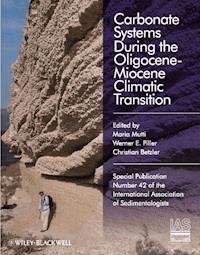
Carbonate Systems During the Olicocene-Miocene Climatic Transition E-Book
103,99 €
Mehr erfahren.
- Herausgeber: John Wiley & Sons
- Kategorie: Wissenschaft und neue Technologien
- Serie: International Association Of Sedimentologists Series
- Sprache: Englisch
The Oligocene and Miocene Epochs comprise the most important phases in the Cenozoic global cooling that led from a greenhouse to an icehouse Earth. Recent major advances in the understanding and time-resolution of climate events taking place at this time, as well as the proliferation of studies on Oligocene and Miocene shallow-water/neritic carbonate systems, invite us to re-evaluate the significance of these carbonate systems in the context of changes in climate and Earth surface processes. Carbonate systems, because of a wide dependence on the ecological requirements of organisms producing the sediment, are sensitive recorders of changes in environmental conditions on the Earth surface. The papers included in this Special Publication address the dynamic evolution of carbonate systems deposited during the Oligocene and Miocene in the context on climatic and Earth surfaces processes focusing on climatic trends and controls over deposition; temporal changes in carbonate producers and palaeoecology; carbonate terminology; facies; processes and environmental parameters (including water temperature and production depth profiles); carbonate producers and their spatial and temporal variability; and tectonic controls over architecture. This book is part of the href="http://www.sedimentologists.org/">International Association of Sedimentologists (IAS) Special Publications. The Special Publications from the IAS are a set of thematic volumes edited by specialists on subjects of central interest to sedimentologists. Papers are reviewed and printed to the same high standards as those published in the journal href="http://www.iasnet.org/publications/sed.php">Sedimentology and several of these volumes have become standard works of reference.
Sie lesen das E-Book in den Legimi-Apps auf:
Seitenzahl: 750
Veröffentlichungsjahr: 2011
Ähnliche




















Contents
Miocene carbonate systems: an introduction
CLIMATIC TRENDS AND CONTROLS OVER DEPOSITION
TEMPORAL CHANGES IN CARBONATE PRODUCERS
CARBONATE TERMINOLOGY
ENVIRONMENTAL CONTROLS OVER DEPOSITIONAL FACIES AND PROCESSES
CARBONATE PRODUCERS AND PALAEOECOLOGY
GEODYNAMIC CONTROLS OVER ARCHITECTURE
FUTURE INITIATIVES
REFERENCES
A synthesis of Late Oligocene through Miocene deep sea temperatures as inferred from foraminiferal Mg/Ca ratios
ABSTRACT
INTRODUCTION
METHODS
RESULTS
DISCUSSION
CONCLUSION
ACKNOWLEDGEMENTS
REFERENCES
Latitudinal trends in Cenozoic reef patterns and their relationship to climate
ABSTRACT
INTRODUCTION
DATABASE AND METHODS
RESULTS
DISCUSSION
CONCLUSIONS
REFERENCES
Carbonate grain associations: their use and environmental significance, a brief review
ABSTRACT
INTRODUCTION
EXISTING CLASSIFICATIONS OF CARBONATE-GRAIN ASSOCIATIONS
INFLUENCES ON CARBONATE-GRAIN DISTRIBUTION
DISCUSSION
CONCLUSION
ACKNOWLEDGEMENTS
REFERENCES
Temperate and tropical carbonate-sedimentation episodes in the Neogene Betic basins (southern Spain) linked to climatic oscillations and changes in Atlantic-Mediterranean connections: constraints from isotopic data
ABSTRACT
INTRODUCTION
GEOLOGICAL SETTING
UPPER MIOCENE-PLIOCENE PLATFORM CARBONATES IN THE MEDITERRANEAN-LINKED BASINS
ALTERNATING UPPER MIOCENE HETEROZOAN-PHOTOZOAN CARBONATE-SEDIMENTATION EPISODES
LOWER PLIOCENE HETEROZOAN CARBONATE-SEDIMENTATION EPISODE
CONCLUSIONS
ACKNOWLEDGMENTS
REFERENCES
Facies models and geometries of the Ragusa Platform (SE Sicily, Italy) near the Serravallian―Tortonian boundary
ABSTRACT
INTRODUCTION
GEOLOGICAL SETTING
STRATIGRAPHIC FRAMEWORK
METHODS
FACIES-ZONE MODELS AND PLATFORM GEOMETRY
DISCUSSION
CONCLUSIONS
ACKNOWLEDGMENTS
REFERENCES
The sensitivity of a tropical foramol-rhodalgal carbonate ramp to relative sea-level change: Miocene of the central Apennines, Italy
ABSTRACT
INTRODUCTION
GEOLOGICAL SETTING
METHODS
RAMP SEDIMENTS OF THE ”CALCARI A BRIOZOI E LITOTAMNI“ FORMATION
DISCUSSION
CONCLUSION
ACKNOWLEDGMENTS
REFERENCES
Facies and sequence architecture of a tropical foramol-rhodalgal carbonate ramp: Miocene of the central Apennines (Italy)
ABSTRACT
INTRODUCTION
GEOLOGICAL SETTING
METHODS
DEPOSITIONAL ENVIRONMENT
MAIN DISCONTINUITY SURFACES
SEQUENCE STRATIGRAPHY
DISCUSSION AND CONCLUSION
SUMMARY AND CONCLUDING REMARKS
ACKNOWLEDGEMENTS
REFERENCES
Facies and stratigraphic architecture of a Miocene warm-temperate to tropical fault-block carbonate platform, Sardinia (Central Mediterranean Sea)
ABSTRACT
INTRODUCTION
GEOLOGICAL SETTING AND STRATIGRAPHY
THE SEDINI LIMESTONE UNIT
SELECTED TRANSECTS
DISCUSSION
CONCLUSIONS
ACKNOWLEDGEMENTS
REFERENCES
Coralline algae, oysters and echinoids – a liaison in rhodolith formation from the Burdigalian of the Latium-Abruzzi Platform (Italy)
ABSTRACT
INTRODUCTION
GEOLOGICAL SETTING
METHODS
RESULTS
DISCUSSION
CONCLUSION
ACKNOWLEDGMENTS
REFERENCES
Palaeoenvironmental significance of Oligocene–Miocene coralline red algae – a review
ABSTRACT
INTRODUCTION
OLIGOCENE CORALLINE ALGAE
MIOCENE CORALLINE ALGAE
CONCLUSIONS
ACKNOWLEDGMENTS
REFERENCES
Molluscs as a major part of subtropical shallow-water carbonate production – an example from a Middle Miocene oolite shoal (Upper Serravallian, Austria)
ABSTRACT
INTRODUCTION
GEOLOGICAL SETTING
RESULTS
INTERPRETATION
CONCLUSIONS
ACKNOWLEDGEMENTS
REFERENCES
Echinoderms and Oligo-Miocene carbonate systems: potential applications in sedimentology and environmental reconstruction
ABSTRACT
INTRODUCTION
ECHINODERM SKELETON
GEOCHEMISTRY OF THE ECHINODERM SKELETON
ECHINODERM TAPHONOMY
ECHINODERMS AS COMPONENTS IN OLIGO-MIOCENE CARBONATES
ECHINODERMS AS PALAEOECOLOGICAL TOOLS IN OLIGO-MIOCENE SEDIMENTS
CONCLUSIONS
ACKNOWLEDGEMENTS
REFERENCES
ADDENDUM
Coral diversity and temperature: a palaeoclimatic perspective for the Oligo-Miocene of the Mediterranean region
ABSTRACT
INTRODUCTION
CORAL TAXONOMIC RICHNESS AND TEMPERATURE
TESTING THE “ENERGY HYPOTHESIS”
DISCUSSION
CONCLUSIONS
ACKNOWLEDGMENTS
REFERENCES
Late Oligocene to Miocene reef formation on Kita-daito-jima, northern Philippine Sea
ABSTRACT
INTRODUCTION
GEOLOGICAL SETTING
MATERIALS AND METHODS
BOREHOLE CARBONATES
REEF FORMATION ON KITA-DAITO-JIMA SINCE 25 Ma
CONCLUSIONS
ACKNOWLEDGMENTS
REFERENCES
Carbonate production in rift basins: models for platform inception, growth and dismantling, and for shelf to basin sediment transport, Miocene Sardinia Rift Basin, Italy
ABSTRACT
INTRODUCTION
GEOLOGICAL FRAMEWORK
OUTCROP DESCRIPTION
DISCUSSION
CONCLUSIONS
REFERENCES
Index
Other publications of the International Association of Sedimentologists
SPECIAL PUBLICATIONS
41 Perspectives in Carbonate Geology
A Tribute to the Career of Robert Nathan Ginsburg
Edited by Peter K. Swart, Gregor P. Eberli and Judith A. McKenzie
2009, 387 pages, 230 illustrations
40 Analogue and Numerical Modelling of Sedimentary Systems
From Understanding to Prediction
Edited by P. de Boer, G. Postma, K. van der Zwan, P. Burgess and P. Kukla
2008, 336 pages, 172 illustrations
39 Glacial Sedimentary Processes and Products
Edited by M.J. Hambrey, P. Christoffersen, N.F. Glasser and B. Hubbard
2007, 416 pages, 181 illustrations
38 Sedimentary Processes, Environments and Basins
A Tribute to Peter Friend
Edited by G. Nichols, E. Williams and C. Paola
2007, 648 pages, 329 illustrations
37 Continental Margin Sedimentation
From Sediment Transport to Sequence Stratigraphy
Edited by C.A. Nittrouer, J.A. Austin, M.E. Field, J.H. Kravitz, J.P.M. Syvitski and P.L. Wiberg
2007, 549 pages, 178 illustrations
36 Braided Rivers
Process, Deposits, Ecology and Management
Edited by G.H. Sambrook Smith, J.L. Best, C.S. Bristow and G.E. Petts
2006, 390 pages, 197 illustrations
35 Fluvial Sedimentology VII
Edited by M.D. Blum, S.B. Marriott and S.F. Leclair
2005, 589 pages, 319 illustrations
34 Clay Mineral Cements in Sandstones
Edited by R.H. Worden and S. Morad
2003, 512 pages, 246 illustrations
33 Precambrian Sedimentary Environments
A Modern Approach to Ancient Depositional Systems
Edited by W. Altermann and P.L. Corcoran 2002,
464 pages, 194 illustrations
32 Flood and Megaflood Processes and Deposits
Recent and Ancient Examples
Edited by I.P. Martini, V.R. Baker and G. Garzon
2002, 320 pages, 281 illustrations
31 Particulate Gravity Currents
Edited by W.D. McCaffrey, B.C. Kneller and J. Peakall
2001, 320 pages, 222 illustrations
30 Volcaniclastic Sedimentation in Lacustrine Settings
Edited by J.D.L. White and N.R. Riggs
2001, 312 pages, 155 illustrations
29 Quartz Cementation in Sandstones.
Edited by R.H. Worden and S. Morad
2000, 352 pages, 231 illustrations
28 Fluvial Sedimentology VI
Edited by N.D. Smith and J. Rogers
1999, 328 pages, 280 illustrations
27 Palaeoweathering, Palaeosurfaces and Related Continental Deposits
Edited by M. Thiry and R. Simon Coincon
1999, 408 pages, 238 illustrations
26 Carbonate Cementation in Sandstones
Edited by S. Morad
1998, 576 pages, 297 illustrations
25 Reefs and Carbonate Platforms in the Pacific and Indian Oceans
Edited by G.F. Camoin and P.J. Davies
1998, 336 pages, 170 illustrations
24 Tidal Signatures in Modern and Ancient Sediments
Edited by B.W. Flemming and A. Bartholoma
1995, 368 pages, 259 illustrations
23 Carbonate Mud-mounds
Their Origin and Evolution
Edited by C.L.V. Monty, D.W.J. Bosence, P.H. Bridges and B.R. Pratt
1995, 543 pages, 330 illustrations
REPRINT SERIES
4 SandstoneDiagenesis: Recent and Ancient
Edited by S.D. Burley and R.H. Worden
2003, 648 pages, 223 illustrations
3 Deep-water Turbidite Systems
Edited by D.A.V. Stow
1992, 479 pages, 278 illustrations
2 Calcretes
Edited by V.P. Wright and M.E. Tucker
1991, 360 pages, 190 illustrations
This edition first published 2010, © 2010 by International Association of Sedimentologists
Blackwell Publishing was acquired by John Wiley & Sons in February 2007. Blackwell’s publishing program has been merged with Wiley’s global Scientific, Technical and Medical business to form Wiley-Blackwell.
Registered office
John Wiley & Sons Ltd, The Atrium, Southern Gate, Chichester, West Sussex, PO19 8SQ, UK
Editorial offices
9600 Garsington Road, Oxford, OX4 2DQ, UK
The Atrium, Southern Gate, Chichester, West Sussex, PO19 8SQ, UK
111 River Street, Hoboken, NJ 07030–5774, USA
For details of our global editorial offices, for customer services and for information about how to apply for permission to reuse the copyright material in this book please see our website at www.wiley.com/wiley-blackwell
The right of the author to be identified as the author of this work has been asserted in accordance with the Copyright, Designs and Patents Act 1988.
All rights reserved. No part of this publication may be reproduced, stored in a retrieval system, or transmitted, in any form or by any means, electronic, mechanical, photocopying, recording or otherwise, except as permitted by the UK Copyright, Designs and Patents Act 1988, without the prior permission of the publisher.
Wiley also publishes its books in a variety of electronic formats. Some content that appears in print may not be available in electronic books.
Designations used by companies to distinguish their products are often claimed as trademarks. All brand names and product names used in this book are trade names, service marks, trademarks or registered trademarks of their respective owners. The publisher is not associated with any product or vendor mentioned in this book. This publication is designed to provide accurate and authoritative information in regard to the subject matter covered. It is sold on the understanding that the publisher is not engaged in rendering professional services. If professional advice or other expert assistance is required, the services of a competent professional should be sought.
Library of Congress Cataloguing-in-Publication Data
Carbonate systems during the Oligocene-Miocene climatic transition/edited by M. Mutti, W. Piller, and C. Betzler.
p. cm. - (Special publication… of the international association of sedimentologists; no. 42)
Includes bibliographical references and index.
ISBN 978-1-4443-3791-4 (hardcover: alk. paper)
1. Rocks, Carbonate. 2. Geology, Stratigraphic-Oligocene. 3. Geology, Stratigraphic-Miocene. 4. Paleoclimatology-Oligocene. 5. Paleoclimatology-Miocene. I. Mutti, M. (Maria) II. Piller, Werner E. III. Betzler, Christian.
QE471.15.C3C376 2010
552’.58-dc22
2010017502
A catalogue record for this book is available from the British Library.
Set in 10/12 pt Melior by Thomson Digital, Noida, India
Miocene carbonate systems: an introduction
MARIA MUTTI, WERNER PILLER and CHRISTIAN BETZLER
The Oligocene and Miocene comprise the most important phases in the long-term, step-wise global cooling that, during the Cenozoic, led from a greenhouse to an icehouse Earth. Recent major advances in the understanding and time-resolution of climate events taking place at this time, as well as the proliferation of studies on Oligocene and Miocene shallow-water/neritic carbonate systems, invite us to re-evaluate the significance of these carbonate systems in the context of changes in climate and Earth surface processes. These changes can be traced by the palaeoecology and palaeobiogeography of neritic and pelagic biota. Additionally, the skeletons of these biota represent archives for proxy data, such as stable isotopes. Stable isotopes can be used to trace steps of climate change and track associated changes in Earth surface processes such as continental weathering and runoff, sea-level changes, current circulation patterns, and surface water temperatures. As has been demonstrated during the past decades, carbonate systems, because of a wide dependence on the ecological requirements of organisms producing the sediment, are sensitive recorders of changes in environmental conditions on the Earth surface.
This Special Publication is based on scientific contributions presented at an international workshop entitled “Evolution of Carbonate Systems during the Oligocene-Miocene Climatic Transition” that took place in Potsdam in February 2005. The workshop, sponsored by the European Science Foundation (ESF) and the Deutsche Forschungsgemeinschaft (DFG), had the objective of addressing the dynamic evolution of carbonate systems deposited during the Oligocene and Miocene in the context on climatic and Earth surfaces processes specific for this time interval. In order to shed new light on this subject, this volume addresses a number of key issues including: climatic trends and controls over deposition; temporal changes in carbonate producers and palaeoecology; carbonate terminology; facies; processes and environmental parameters (including water temperature and production depth profiles); carbonate producers and their spatial and temporal variability; and tectonic controls over architecture.
CLIMATIC TRENDS AND CONTROLS OVER DEPOSITION
The main controls over shallow-water carbonate assemblages on shorter time scales are ambient water temperature, nutrient content, and salinity of the water masses. Palaeotemperature reconstructions, based on integrated oxygen-isotope records and Mg/Ca ratios of foraminifera tests show that important temperature variations took place during the Oligocene and Miocene, and that some are out of phase with the main glaciation events. Their magnitude is large enough to cause shifts in benthic communities.
The paper by Billups and Scheidereich discusses the application of Mg/Ca in foraminifera for separating the effect of temperature versus ice volume on oxygen isotope records. They illustrate examples from the Oligocene/Miocene boundary and the Middle Miocene. Of great relevance to carbonate studies, their results indicate that intervals of oxygen-isotope excursions are mostly out of phase with the reconstructed palaeotemperature changes. This implies that a simple correlation between carbonate facies changes and the oxygen-isotope curve is a flawed approach. Furthermore, the temperature fluctuations recorded by Ca/Mg variations at one single location are higher than previously assumed, and can reach several degrees Celsius in amplitude. This is sufficient to trigger significant faunal turnovers and the shifting of an environment from the tropical to the temperate domain.
It should be noted that the time resolution available in most shallow-water carbonate records is not adequate enough to be compared with climatic events as recorded by deep-sea records. In part, there is an intrinsic limitation regarding achievable age resolution of shallow-water strata. However, additional efforts should be made to achieve the best possible resolution, by integrating different dating schemes. This is necessary to resolve the entire climatic transition and its detailed effects on carbonate deposition.
TEMPORAL CHANGES IN CARBONATE PRODUCERS
Based on a literature compilation, Kiessling (2005) introduced the apparent paradox of expanding reef habitats during the Cenozoic at a time of longer term cooling. The greatest increase in recorded reef sites was from the Late Oligocene to the Early Miocene, whereas preserved reef volumes increased most strongly from the Early to Middle Miocene. Average reef diversity peaked in the Late Oligocene and then declined towards the Late Miocene, whereas the global diversity of scleractinian corals steadily increased through the Oligocene and Miocene, and there were almost no extinctions at the genus level across the Oligocene–Miocene boundary. Kiessling (2005) argued that neither climatic data nor any other quantified physico-chemical parameter are able to explain the large expansion of reefs across the Oligocene–Miocene boundary, thus implying a predominantly biological control.
In this volume, Perrin and Kiessling show that most Cenozoic buildups occur within a latitudinal belt broadly centred on the tropical regions and slightly shifted to the north. During the Cenozoic, the reef belt shows both gradual latitudinal shifts and latitudinal contraction/expansion. In particular, the latitudinal width of the reef belt seems to have been reduced near the Eocene-Oligocene boundary and increased again after the Rupelian. It was wider than today during most of the Miocene, its widest extension occurring during the Middle Miocene.
Bosellini and Perrin analyze patterns of generic richness and inferred palaeotemperatures for each stage of the Oligocene-Miocene time interval and compare it with global palaeoclimatic curves based on stable oxygen isotopes. Except for the Mid-Miocene Climatic Optimum, which is not recorded in the generic richness of the Mediterranean z-coral communities, their coral richness-derived palaeo-temperatures correlate with the palaeoclimatic trends based on the isotopic curves. Their results show a gradual increase of temperature from the Early to the Late Rupelian and a gradual widening of the temperature range after the Burdigalian by progressively adapting to a larger temperature range from the mid-Miocene onwards to the Messinian.
CARBONATE TERMINOLOGY
Researchers with different focuses and expertise tend to use different terminology to describe carbonate sediments. The general consensus is that this is a problem affecting communication and identification of the real scientific problems. Furthermore, using different terminology considerably reduces the possibility to compare different study areas. Currently, there are two major terminologies in use for the description of neritic carbonates. One is based on the observation of the most important sediment-forming components (chlorozoan, foramol: Lees & Buller, 1972; Lees, 1975), the other takes into account the feeding priorities of the carbonate-producing biota (hetero-zoan, photozoan: James, 1997). None of the systems ultimately allows the reconstruction of controlling factors, such as water temperature or nutrient content. It can be argued that only descriptive terms should be used and an interpretative terminology should be avoided. In this volume, Kindler and Wilson provide a review of carbonate grain associations, and stress the need for a purely descriptive nomenclature to define regionally important groupings of carbonate deposits.
ENVIRONMENTAL CONTROLS OVER DEPOSITIONAL FACIES AND PROCESSES
A major compilation at the Mediterranean scale published in 1996 (SEPM Concepts in Sedimentol-ogyand Paleontology, Volume 5), mainly focused on reefal (scleractinian) carbonate systems, but also brought attention to the existence of distinct systems referred to as “non-tropical” or “cool-water” carbonates. Over the last decade, a number of studies have focused on these carbonates and have generated debate over the environmental and climatic parameters controlling the occurrence of these carbonate systems.
The main controls over carbonate assemblages and the resulting depositional facies on shorter time scales are temperature, nutrients and salinity of the water masses in which the biota live, and on longer time scales are biological evolution, geodynamics and changes in palaeogeography. It is essential to understand the degree to which carbonate facies assemblages record the effects of temperature changes versus nutrients or other environmental changes. This issue is of relevance with regard to how changes in carbonate facies can be related to the climatic changes specific to the time interval. It has been observed that local parameters may play an overriding role that can mask the global signal. Therefore it is necessary to understand regional settings before making global implications. Topography and geomorphology of an area are important concerns that may strongly affect depositional systems.
Martin, Braga, Sanchez-Almazo and Aguirre give an overview of Miocene carbonate platforms in the western Mediterranean. Lithofacies changes of carbonate rocks in the stratigraphic record at the margins of the Neogene basins in southern Spain were mainly the result of temperature variations during the Late Neogene. These variations promoted the alternation of non-tropical and tropical carbonate deposition during the last 10Myr in the region. The authors state that heterozoan carbonates accumulated on ramps during sea-level lowstands, whereas photozoan carbonates accumulated during rising sea-level and highstands. Changes in sea-surface temperatures, reconstructed on the basis of fossil assemblages and stable isotope analyses, are considered to have been the major control.
Ruchonnet and Kindler present a study based on the Ragusa Platform in south-eastern Sicily and show how two different facies models must be used to describe the internal architecture of this carbonate edifice of latest Serravallian to Tortonian age. During the Late Serravallian, a heterozoan system dominated the inner ramp and was characterized by biota of the foramol association, with rhodoliths dominating the mid-ramp. During the Early Tortonian, a photozoan association dominated, with chlorozoan biota in the inner ramp and branching corallinaceans and rhodoliths in the middle ramp. This change in biotic assemblages had profound consequences for the overall geometry of the platform, which evolved from a Late Serravallian distally steepened ramp to a flat-topped platform in the Early Tortonian.
Brandano, Westphal and Mateu-Vicens discuss a case of Miocene carbonates from the central Apennines and analyze this record with regard to the problem of the sensitivity of a foramol-rhodalgal carbonate ramp to sea-level changes. They argue that the middle and outer ramp deposits are remarkably monotonous, implying that they do not record high-frequency sea-level fluctuations.
Brandano, Corda and Castorina integrate data from sedimentological and microfacies analyses to reconstruct the depositional model of a carbonate platform outcropping in the central Apennines. They recognize a narrow inner zone dominated by red algae and rhodoliths, a middle zone dominated by rhodoliths and larger foraminifera, and an outer ramp with three different subzones. These consist of a proximal zone dominated by bryozoan colonies, bivalves and echinoids, an intermediate zone with benthic and planktic foraminifera, echinoids and bivalves, and a distal zone with marls with silica-sponge spicules and calcarenites with mollusc, bryozoan and echinoid debris. The strati-graphic architecture reflects two second-order sequences.
Benisek, Marcano, Betzler and Mutti present a case study from the Sedini Limestone in northern Sardinia, where both heterozoan and photozoan assemblages occur, offering an ideal opportunity to demonstrate: (1) the importance of different biotic assemblages in determining the depositional architecture; and (2) the role of differential early diagenesis in stabilizing depositional facies, thus affecting depositional geometries. They recognize two depositional sequences. The lower one is a homoclinal ramp characterized by heterozoan assemblages. The upper sequence documents a progressive steepening of the carbonate platform slope and is dominated by photozoan assemblages. The differential distribution and amount of early cements in both sequences support the observed changes in overall depositional geometry. Early diagenetic features are rare in the lower sequence but rich and diverse in the upper sequence, allowing facies stabilization and the development of steep progradational slopes.
CARBONATE PRODUCERS AND PALAEOECOLOGY
The participation of a wide range of specialists with different expertise and professional backgrounds at the workshop provided a unique perspective into approaching the significance of carbonate facies in a broader palaeoecological and palaeoclimatic context. First, it is clear that the palaeoecological information that can be extracted from biotic assemblages is too often ignored by physical sedimentologists. For example, in addition to corals, molluscs, red algae, larger benthic foraminifera and echinoids all have a very clear palaeoecological signal, providing information on water depth, temperature and salinity, which are critical for sedimentological interpretations. However, this information is available in most cases only if the proper taxonomic identifications are made. Acquiring this information calls for very close co-operation across expertise boundaries. It was also noticed that bryozoa are the group of biocalcifiers least understood in terms of palaeoecological requirements. However, the discussion showed that palaeoecological reconstruction of carbonate sedimentary systems based on taxonomy also has its limits. Whereas Miocene and younger assemblages are very similar to Holocene associations, Oligocene and older assemblages have different compositions on the generic and species level.
In this volume, Brandano and Piller present a detailed palaeoecological study of a 7 m thick rho-dolith interval from the middle ramp of the Lower Miocene Latium-Abruzzi carbonate platform in central Italy. They describe in detail the morphology and the taxonomy of the corallines and provide criteria for a palaeodepth reconstruction. Sedi-mentological and biogenic criteria indicate a low energy environment. Therefore the movement of rhodoliths cannot be generated by palaeocurrents, but by biogenic activities, particularly those of regular echinoids.
Braga, Bassi and Piller provide a review of the palaeoenvironmental significance of coralline red algae occurring both in reef-related carbonates and as the main components in shallow-water hetero-zoan settings from temperate regions. They show how the known distribution of corallines in the Oligocene does not suggest any palaeogeographi-cal differentiation. In contrast, for the Miocene, the occurrence of taxa still living today allows the rough differentiation of the following palaeobiogeographic regions: (a) a tropical region (characterized by thick Hydrolithon plants and Aethesolithon); (b) a subtropical Mediterranean (with common Spongites and Neogonolithion species); and (c) a temperate region with shallow-water assemblages dominated by Lithophyllum. Furthermore, it is possible to identify changes in assemblages and growth forms occurring with depth, proving a very useful palaeobathymetric tool.
Harzhauser and Piller point out how molluscs are generally strongly underrated when interpreting carbonate systems in the circum-Mediterranean area, because of taphonomic loss and because taxo-nomic interpretation in thin-sections is difficult. They argue that this affects mostly small-sized gastropod species that, however, display a high diversity within modern carbonate systems. Mollusc shells may contribute up to 80% of the sediment within nearshore settings and especially around Miocene oolite shoals. Nevertheless, in most micro-facies studies this highly indicative and extremely species-rich group is just referred to as “gastropod”, “bivalve” or, at the most accurate, as “oyster” or “pectinid”. Obviously, such identifications are meaningless in terms of ecology or biogeography. They emphasize the importance of a classical, taxonomy-oriented palaeontology in any facies-analysis.
Kroh and Nebelsick show that echinoderms and their debris can contribute considerable sediment to Oligo-Miocene carbonate systems. They review the morphology of the echinoderm skeleton of all five extant echinoderm classes and discuss reproduction and growth of echinoderms, the chemistry of the skeleton, and the crystallography and diagenesis of echinoderm ossicles. The composition of the echinoderm fauna in carbonate environments and their abundance is also controlled by climate. Many groups are currently restricted to certain climate zones, and in particular the shallow water forms are sensitive to temperature changes. Additionally, echinoderms are useful tools for palaeoenvironmental reconstruction as they are sensitive to water agitation, currents, depth and type of substrate.
GEODYNAMIC CONTROLS OVER ARCHITECTURE
Geodyamic, by affecting topography and the subsidence regime of an area is a fundamental control that may strongly affect depositional systems. Iryu, Inagaki, Suzuki and Yamamoto present the results of investigations on a drill core on Kita-daito-jima, a carbonate island, lying ~350 km east of Okina-wa-jima (southwestern Japan). The reconstructed Oligocene to Pliocene age-depth section of Kita-daito-jima shows that: (1) reef formation on Kita-daito-jima was controlled by combined effects of sea-level changes and tectonic movements (subsidence and uplift); and (2) two types of reef formation may be recognized, the growth of which kept up with the subsidence of the island and the rapid reef formation which commenced at sea-level falls.
Vigorito and, Murru and Simone present sedimentary and architectural patterns of Miocene carbonate successions deposited in the Sardinia Rift Basin in three different physiographic settings: (1) narrow rift-related submerged valleys; (2) isolated fault-blocks in the axial portion of the rift; and (3) small basins located at the edge of the rift itself. Palaeophysiography and in turn pre-and syn-sedimentary tectonics appear to exert a major control over facies distribution and depositional architectures as well as over the location and morphology of the carbonate factories.
FUTURE INITIATIVES
Many possible future research topics were discussed at the workshop:
It is crucial to note the importance of sea-level changes and the necessity to enhance time-resolution to achieve a better fit and understanding of forcing mechanisms.One very interesting idea was to compare the role of nutrients and light adaptation to evolutionary patterns. This could be applied to the average depth of coral growth and to how the size of larger foraminifera (Lepidocyclina) changes with respect to depth of the photic zone (small-shallow, large-deeper).It is necessary to “bring some order” into the spatial and temporal distribution of these carbonate systems, to develop maps for different time slices, and to recognize spatial changes with latitude, as well as temporal changes associated with climatic evolution.Before such maps can be compiled, it is necessary to rationalize the terminology used, largely because the different terminologies and study approaches in use hinder the possibility of a direct comparison of existing data.Finally, studies on neritic carbonates should be better compared to basinal, pelagic records, where complementary information on climate and oceanographic parameters is recorded.We would like to thank all the reviewers who have helped to shape this volume, including Torsten Bickert, Dirk Nurnberg, Nancy Budd, Katharina Billups, Jochen Halfar, Jeff Lukasik, Cedric John, Toni Simo, John Reijmer, Andre Freiwald, Lucia Simone, Andrea Knoerich, Phil Bassant, Georg Warrlich, Giovanna della Porta, Wolf-Christian Dullo, James Nebelsick, Martyn Pedley, Thilo Bechstadt, Gregor Eberli, Finn Surlyk and Arndt Peterhansel.
REFERENCES
Kiessling, W. (2005) Long-term relationships between ecological stability and biodiversity in Phanerozoic reefs Nature,433, 410–413.
James, N.P. (1997) The cool-water carbonate depositional realm. In: Cool-water Carbonates (Eds N.P. James and J.A.D. Clarke). SEPM Spec. Publ.,56, 1–20.
Lees, A. (1975) Possible influence of salinity and temperature on modern shelf carbonate sedimentation. Mar. Geol,19, 59–198.
Lees, A. and Buller, A.T. (1972) Modern temperate-water and warmwater shelf carbonate sediments contrasted. Mar. Geol.,13, 67–73.
A synthesis of Late Oligocene through Miocene deep sea temperatures as inferred from foraminiferal Mg/Ca ratios
KATHARINA BILLUPS and KATHLEEN SCHEIDERICH[1]
School of Marine Science and Policy, University of Delaware, 700 Pilottown Road, Lewes, DE 19958, USA (E-mail: [email protected])
[1]Present address: Department of Geology, University of Maryland, College Park, MD20742, USA.
ABSTRACT
Published benthic foraminiferal Mg/Ca records have been compiled that span the latest Oligocene through Miocene, including new data for the South Atlantic. This synthesis, the first such of Mg/Ca data, necessitates consideration of uncertainties and limitations and provides a general perspective on the evolution of deep-sea temperatures over this period. Published Mg/Ca records show temperature patterns through the Miocene that are consistent with those first synthesized by Kennett (1985) utilizing isotope and other data. Accordingly, the early Miocene was an interval of relative warmth culminating in a climatic optimum at ~16 Ma that was characterized by the warmest (Mg-derived) temperatures of the past 20 million years. After the climatic optimum, palaeotemperatures dropped by 3–4 °C during the second major advance of Antarctic ice between ~15 Ma and 13 Ma. For the late Miocene, between 11 and 8.5 Ma, a distinct increase in benthic foraminiferal Mg/Ca ratios at two Atlantic sites provides evidence for deep to intermediate water circulation changes. Thereafter, temperatures close to modern are recorded at all sites. Assuming constant seawater Mg/Ca ratios through time, it can be concluded that the early Miocene climate was generally warmer than today and that by the late Miocene temperatures approached modern values.
Keywords Oligocene, Miocene, palaeotemperatures, palaeoclimate, palaeoceanography, foraminifera.
INTRODUCTION
The Miocene, a time of climatic extremes ranging from an early Miocene climatic optimum at about 16 Ma to the mid-Miocene period of ice growth on Antarctica between about 15 and 13 Ma, has long been of particular interest to palaeoceanographers. A volume synthesizing Miocene climate was published in 1985 in the context of the Cenozoic Paleoceanography Project (Kennett, 1985). Quantitative micropalaeontological data and stable- isotope records provided a view of the evolution of Miocene climate primarily based on results from the Deep Sea Drilling Project. Accordingly, multispecies planktonic oxygen-isotope records from throughout the world ocean suggested that during the early Miocene, surface-water temperatures were warm and meridional surface-water temperature gradients were small, with modern ocean conditions developing after the mid-Miocene expansion of the Antarctic ice sheet (Savin et al., 1985). Benthic foraminiferal faunal assemblages from the Pacific Ocean also indicated warm deep- waters and a less well-stratified water column, in comparison to the modern ocean (Woodruff et al., 1985). Many of the modern forms of benthic foraminifera first appeared during the mid-Miocene, indicative of deep water cooling (Woodruff et al., 1985). In short, these earlier studies documented a relatively warm early Miocene, followed by cooling of high-latitude surface and Pacific deep waters concurrent with mid-Miocene ice sheet expansion.
Much of what is known about past climate change (including the Miocene) comes from the oxygen-isotopic composition of benthic foraminifera. Although this proxy outlines large-scale climate change, the absolute magnitude and the relationship between ice growth and decay and ocean temperature changes cannot be determined uniquely. Foraminiferal δ18O values reflect the δ18O value of seawater due to global storage of ice at the poles and regional changes such as evaporation and precipitation at the sea surface, as well as the water temperature in which the organism calcifies. Thus, certain assumptions are required in order to interpret the records with respect to any of the palaeoenvironmental indicators (e.g. ice volume versus palaeotemperature). This inherently limits the degree to which past changes in temperature and ice-volume can be quantified.
Lesen Sie weiter in der vollständigen Ausgabe!
Lesen Sie weiter in der vollständigen Ausgabe!
Lesen Sie weiter in der vollständigen Ausgabe!
Lesen Sie weiter in der vollständigen Ausgabe!
Lesen Sie weiter in der vollständigen Ausgabe!
Lesen Sie weiter in der vollständigen Ausgabe!
Lesen Sie weiter in der vollständigen Ausgabe!
Lesen Sie weiter in der vollständigen Ausgabe!
Lesen Sie weiter in der vollständigen Ausgabe!
Lesen Sie weiter in der vollständigen Ausgabe!
Lesen Sie weiter in der vollständigen Ausgabe!
Lesen Sie weiter in der vollständigen Ausgabe!
Lesen Sie weiter in der vollständigen Ausgabe!
Lesen Sie weiter in der vollständigen Ausgabe!
Lesen Sie weiter in der vollständigen Ausgabe!




