


Erhalten Sie Zugang zu diesem und mehr als 300000 Büchern ab EUR 5,99 monatlich.
- Herausgeber: THP Ireland
- Kategorie: Fantasy und Science-Fiction
- Sprache: Englisch
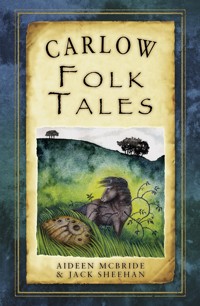
County Carlow, where stood Dinn Righ, the seat of the ancient kings of Leinster, is steeped in history, myth and legend which is celebrated in this selection of traditional tales from across the county, collected and retold by local storytellers Aideen McBride and Jack Sheehan. This selection will take you on an oral tour across the county and introduce you to such Carlow characters as Peter Nail, the 'Weight Thrower from Ratheaden'; Beauchamp Bagenal, the 'handsomest man in Ireland'; and St Finnian, the 'Teacher of the Saints'. You will discover how the Barrow River got its name, who threw the standing stone of Clonee, the dangers of digging for gold in the 'raths' and how Teresa Malone became the Heroine of Kilcumney. And on the way you will encounter fairies, witches and giants – as well as bouncing puddings and giant potatoes.
Sie lesen das E-Book in den Legimi-Apps auf:
Seitenzahl: 283
Veröffentlichungsjahr: 2014
Das E-Book (TTS) können Sie hören im Abo „Legimi Premium” in Legimi-Apps auf:
Ähnliche





CONTENTS
Title
Acknowledgements
Introduction
About Carlow
1 Dinn Righ
2 Labhraidh Loingsigh
3 How the River Barrow got its Name
4 Boramh – Cattle Tribute
5 Aghade
6 Saints of Carlow
7 Battle of Kilcumney
8 Follow Me Up to Carlow
9 Raymond le Gross
10 Eileen Kavanagh
11 Characters from Carlow
12 Myles Keogh
13 Wrath of the Raths
14 Witches and Giants
15 Strange Stories
16 Priests and the Church
17 Highwaymen
18 Wit and Humour
19 Stories for the Fireside
Sources and Collectors
Further Reading
Copyright
ACKNOWLEDGEMENTS
Our thanks to the following for whose time, help and guidance we are deeply grateful and whose encouragement kept us going: Dermot Mulligan Carlow County Museum, staff of Carlow County Library, Críostóir Mac Cárthaigh and the staff of the National Folklore Collection UCD, Dovie Thomason, Miceal Ross, Jim Shannon, Breda Moore, Mary Kelly, Martin Nevin, Richard Sheehan, Eddie Kinsella, Willie White, Bob Williams, Mark Sheehan, Jack Lynch, Richard Marsh, Steve Lally, Brendan Nolan, Joe Brennan and Susie Minto.
INTRODUCTION
Throughout the country storytellers are many and varied and each county can number its own, Carlow being no exception. But alas, for every well-known yarn spinner willing to step into the light to amuse there are as many who much prefer the shadows. Instead, these quiet ones pass their little gems across the bonnets of cars, leaning across a wall or gate and in pubs where you will see people in a huddle, leaning forward listening, and at times straightening up with a guffaw of laughter only to go back into the huddle again.
Unlike the seanachaí or folklorist, the storyteller prefers to exaggerate facts to their own satisfaction, and because they do many little truths become hidden in their stories for posterity.
Too often their names are forgotten even though their stories live on. In our own area there were people such as Peter Nail (O’Neill), the ‘Weight Thrower from Ratheaden’, Jim Tobin, blacksmith from Dunleckney, and Jack Tuite of the Green Road. All three lived within an ass’s bawl of each other, an area of about 2 square miles to the north-east of Bagenalstown. Many areas of similar size make up the county of Carlow and so there must be many more stories hidden out there waiting to be recorded.
Peter Nail won his title of weight thrower because of a claim he made that he had pitched a half-hundred weight 18ft. Considering that the weight was 56lb and Peter of slight build and no more than 5ft 7 or 8ins, the feat seemed Herculean to the listeners, and so after the suitable amount of argument Peter admitted it was down a well he had thrown the weight.
If you should go to have your ass or pony shod with Jim Tobin, it is likely that you would leave well satisfied with the job done and a story to muse over. It could be one about the man with the big cheque book or some dog or goat that could do extraordinary things. He might even tell you about a farmer, ‘up the way’, who had a hogget that would only read the paper on Sundays. Hogget? That’s right, a pet lamb that grew into a sheep. On Sundays, when the family had finished their midday meal, they would bring out some boiled potato skins and bits of cake wrapped in a newspaper and lay it out in the paddock for the pet to enjoy. From a distance it looked like the sheep was standing over the paper looking at it, reading.
Then there was Jack Tuite and all he needed was a listener anywhere, anytime to tell about eels and the extraordinary things they could do, or of where he knows there is a billhook’s nest with two saws and a hatchet in it. In every community there were such people and still are today.
We are deeply grateful to those who had the foresight to collect stories from such people across the country in the 1930s. From Carlow alone we have drawn from the collections of Br Luke in Bagenalstown; Edward O’Toole in Rathvilly; Seosamh Céitinn on the Leighlin Hills and Patrick McDonnell in Tinryland, all housed in the National Folklore Collection in UCD.
We didn’t get the time to visit all the places we wished, or to speak to half the people we thought might know stories to add to this collection, there was so much material to draw from. For each story we have included here there are at least as many more still out there; to gather every single one would take more time than we had, and scores of books, but maybe this can be a beginning to a new collection of stories from the Carlow area.
Researching the book has involved meeting people, rekindling acquaintances with old school friends and neighbours, making new connections, reading interesting articles. It has meant hours of trawling through web pages and web sites (it is amazing what you can find by ‘googling’ a word or phrase) and coming across gems such as CELT, which has digitised so many of the ancient manuscripts for all to share.
We have enjoyed the journey of researching and gathering the material for this book. We hope you enjoy what you read here, and that it will entice you to record the stories you remember of your own community to share with others.
Jack Sheehan and Aideen McBride
2013
ABOUT CARLOW
Carlow County is the second smallest county in Ireland and easy to find on the map shaped as it is like a carrot. It is bordered to the east by the Blackstairs and Wicklow Mountains and to the west by the Leighlin Hills. The picturesque Barrow Valley, noted for its rich land and beautiful landscape, lies between. The Barrow, Slaney and Burren rivers are the main rivers of the county, and the canal which runs alongside the Barrow creates a waterway linking New Ross Harbour and Dublin City.
The views both of the mountains and from the mountains and hills are very striking. It may have been the beauty of this landscape which helped inspire Cecil Frances Alexander while writing the hymn ‘All Things Bright and Beautiful’ during a visit to Burgage House in Leighlinbridge.
The Gaelic name for the county is Ceatharlach, meaning ‘four lakes’, or it could be Catherlach, meaning ‘the city on the lake’ – similar pronunciation but very different meanings. There are no lakes to be found now in County Carlow.
Carlow inhabitants are nicknamed ‘Scallion Eaters’ (pronounced ‘ate-rs’). This name probably comes from the fact that during famine years large crops of parsnips, scallions and other vegetables were grown in the county and sent by train to Dublin for sale in the markets. Maybe a bit like Wexford today is associated with strawberries and new potatoes, Carlow was associated with scallions. I can’t say we eat any more than any other county today but the nickname has stuck.
Carlow County has seen its share in some of the major events of world history. The county is home to the dolmen with the largest capstone in Europe (weighing over 100 tons) which stands just outside Carlow town at Brownshill. Dinn Righ near Leighlinbridge was the seat of the ancient kings of Leinster; St Patrick passed through the county during his preaching and baptised some of the local kings. Many of the place names have associations with the saints who came to the county to set up their monasteries and places of hermitage. Richard III crossed the Barrow at Leighlinbridge to wage war on the Kavanaghs in Garryhill as the bridge in Leighlin was the only place to cross the River Barrow. Graine Mhaol was held captive for a while in Leighlin Castle. During the fourteenth and fifteenth centuries Carlow town was the capital of Ireland, marking the edge of the Pale. Much of the rebellious activities of the Gaelic clans during that time passed through the town either in person or in being talked of.
Today the county is a seemingly quiet one, noted for its fishing and off-the-beaten-track tourist spots. Carlow town is a vibrant, lively town, the first town in either Britain or Ireland to have electric street lighting (1891) and now home to thousands of students at the Austin Waldron Institute of Technology.
Over the years there have been scientists (Tyndall), mathematicians (Haughton), entrepreneurs (Wolsey) and storytellers (Jim Nolan), all of whom have brought a little of their light to shine on the place of their roots.
If you live in Carlow you’ll know all this; if you don’t and ever have a chance to visit, take it. There are some lovely trails set up now in the county, for walkers there are a number of walks, long and short, both along the Barrow track and up the Blackstairs Mountains. For those interested in history there are three saints’ trails which will bring you from one side of the county to the other following the sites and lives of the saints, and the motor enthusiast can always follow the route of the 1903 Gordon Bennett Cup race which drove through Carlow, Kildare and Laois. If the stories we have gathered here strike you, you can always use the map opposite to visit the places connected with them.
1
DINN RIGH
HOW LEINSTERCAMETOBECALLED ‘LEINSTER’
Dinn Righ was the ancient seat of the kings of Leinster and sat on the River Barrow about 2 miles from where Old Leighlin is now. In the time when it was a seat of high power, the territory was known as ‘Gallins’. This is the story of how the name ‘Leinster’ came to the province.
A long, long time ago, Ugaine Mór was King of all Ireland; not only of all Ireland, but of parts of Western Europe as well – as far as the Mediterranean Sea, or so it is said. Ugaine was married to Ceasair Chruthach, daughter of the King of France. They had twenty-two sons and two daughters and to each was given a portion of Ireland to rule.
Only two of Ugaine’s children had children of their own, and they were Labhraidh Lorc and Cobhthach Cael mBreagh (‘Cobhthach Cael’ for he was a thin man, and ‘mBreagh’ for those were the territories over which he ruled). After forty years ruling Ireland and Western Europe, Ugaine was slain by Badhbhchadh, his own brother. The victory was short lived, for in less than two days Badhbhcadh too was dead, slain by Ugaine’s son Labhraidh Lorc in revenge for the murder of his father. ‘Lorc’ means to murder a kinsman and it was for the killing of his uncle that Labhraidh earned that name.
Labhraidh Lorc ruled for two years, but his brother Cobhthach grew both in jealousy and power, and wished to rule Ireland himself. He planned and plotted, and had a message sent to his brother, claiming he had died. Labhraidh, of course, set out to be at the burial of his brother and show his grief. He arrived to see the bier set up and the corpse (or so he thought) of his brother lying there ready to be burned. Labhraidh went directly to the bier and cried and sorrowed. He lamented and laid his own body across the corpse of Cobhthach Cael mBreagh – as was the custom. But Cobhthach was not dead; he pulled out a small knife and stabbed Labhraidh, killing him, and then murdered Ollioll Aine – the son of Labhraidh Lorc. Only Labhraidh’s grandson was left, a young boy called Maen, and Cobhthach sent for him too. He was going to force him to eat parts of the bodies of his father and grandfather but Maen fell dumb and speechless in disgust. Cobhthach let the boy go.
Maen fled to Corca Duibhne where he spent some time with Scoiriath King of West Munster before heading to France to the people of his great-grandmother, Ceasair Chruathach. For nearly fifty years Maen remained in France with some close friends who constantly reminded him of his right to return to Ireland. He was a popular figure and many Irishmen came to France to join him there and urge him to return home and take back his kingdom, the kingdom of his father. Among his supporters was Moiriath, daughter of Scoiriath. She had heard the stories of Maen, of all that had befallen him and the fame he was earning in France, and she fell in love with him. She sent her harper Craiftine to France to find Maen and to sing to him the song she had composed for him, telling him of her love. Maen loved the song, the words and the tune. When those around him saw this, they pressed him again to return to Ireland and take back his territories. The King of France gave Maen an army of 2,200 men and so Maen, nearly fifty years after he had left, set sail to return to Ireland.
Maen and his men arrived in Wexford where they learned that Cobhthach had taken up residence in Dinn Righ, so they marched day and night till they came to that place. His army of 2,200 men was armed with lances known as ‘laighin’, each of which had a broad greenish/blue head, probably made of copper. Nothing like this had ever been seen in Ireland before.
Maen arrived at Dinn Righ on the River Barrow and entered the fort. Who knows what surprise he brought with him, for some stories say that at this time Cobhthach was weakening and growing feebler. Maen killed Cobhthach and the thirty other princes and nobles who were gathered with him, and burned down the palace.
A druid who came upon the slaughter asked, ‘Who has done this?’
He was told it was the loingsigh, meaning ‘mariner’ or ‘boatman’.
‘Does he speak?’ asked the druid.
‘Labhraidh’ was the reply, meaning ‘he speaks’, and from then Maen was known as ‘Labhraidh Loingsigh’ – the speaking boatman.
Labhraidh Loingsigh took his place as king and ruled for ten years. He married Moiriath the daughter of Scoiriath who had sent Craiftine to France with the song. They lived in Dinn Righ, and the old name for the area, ‘Gallins’, was replaced with ‘Laighin’ in reference to the broad greenish-blue bladed lances which Labhraidh Loingsigh had brought into the country. In Gaelic the province’s name is still Laighin, though the anglicised version has become ‘Leinster’, and the Leinster men are said to have had a great affinity with France ever since that time.
There is little to see of Dinn Righ now, just a mound on the side of the River Barrow not far from Leighlinbridge and Old Leighlin. But there is another story told of Labhraigh Loingsigh.
2
LABHRAIDH LOINGSIGH
Once there was a king named Labhraidh Loingsigh. He might have been a good king but he had a secret he didn’t want anyone to find out about. You see Labhraidh Loingsigh had two big hairy horse’s ears. He was ashamed and embarrassed about these two ears and did everything in his power to keep them out of sight from all the world. He let his hair grow long and straggly and unkempt to cover his ears, and wore a brath, or blanket, over his head at all times.
One day his mother came to him and said, ‘Labhraidh, look at the state of you, with your long tangled straggly hair. It’s time you did something about the way you look. It’s time you got your hair cut!’
‘But ma, I can’t,’ replied Labhraidh. ‘If I go and get my hair cut the hairdressers will see my ears and they’ll all be laughing at me.’
‘Suit yourself,’ said his mother, ‘but no king in Europe is going to take you seriously and you looking so untidy and unkempt!’
Well, Labhraidh spent some time reflecting on his situation and after a while he came up with a plan, which he felt would solve his dilemma. He would get the hairdresser to cut his hair and then he would chop off the hairdresser’s head so they couldn’t tell anyone about his ears.
That was Labhraidh’s plan, and whatever you or I might think of it, Labhraidh thought himself very clever to come up with it. And so it happened that twice a year a hairdresser would come to Dinn Righ to cut the king’s hair. They would brush his hair, and comb his hair; they would see the two hairy horse’s ears and say, ‘Oh, Your Majesty, did you know that you have two horse’s ears?’ Labhraidh would say nothing, but when their work was done, they would be taken down to the dungeons and never seen again.
Well, people noticed that the hairdressers were going into the castle, but not coming out again. So, the hairdressers that were left changed their jobs and instead of remaining hairdressers they became bakers and teachers, storytellers and farmers.
Eventually there came the day that there was only one hairdresser left in all of the area, a young man not long since a boy and the only son of a poor widow woman. Now, this widow woman was so old that she couldn’t work for herself any more and the only income she had in the world was the few pennies her son earned from his hairdressing. She was terrified of what would happen if her son were to go into the king’s castle and not return. Where would she get the money to pay the rent? Where would she get the money to buy food? She’d be put out of her home to starve on the side of the road. She had begged her son to change his job, but he wouldn’t. He loved the work he did. Nothing in his life gave him more pleasure than cutting people’s hair.
One day the dreaded letter arrived from the king. He needed a hairdresser and the young man would have to go. His mother went to the castle with him. She came before King Labhraidh Loingsigh and pleaded with him.
‘Oh Your Majesty,’ she said. ‘Please sir, look at me. I am an old woman. I am past the days when I would have worked for myself. All I have in the world are the few pennies my son earns. If he doesn’t return home to me today where will I find the money to pay my rent? I’ll be thrown out of my home on to the side of the road. Where will I find the money to buy food? I’ll die of starvation on the side of the road. Please, please don’t take my son from me.’
Labhraidh Loingsigh looked at the old woman and took pity on her. He promised her that he would release her son home to her once his work had been done.
The young man went to the king’s room and set to work. He brushed the king’s hair, and he combed the king’s hair, then he saw the two horse’s ears.
‘Oh Your Majesty,’ said he. ‘Did you know that you have two horse’s ears?’
The king looked sternly at him. ‘Don’t say a word about my ears to anybody or I’ll have your head chopped off,’ he said.
‘I won’t, I won’t. I promise,’ said the boy and he went on with his work. When he finished, the king released him home to his mother as he had promised.
The widow was delighted to see her son return home and asked all kinds of questions about the castle and the king. The boy described the rooms and hall, and all that he had seen in the castle, and went on to talk about the king.
‘Oh Mam, he has lovely fine hair and I saw his two …’ Just in time, he clapped his hand over his mouth and stopped himself from giving away the secret. He would have to be much more careful in future and mind what he was saying.
The next day the young man found himself in the local village when he bumped into a group of his friends.
‘Hello,’ says they. ‘So, any news for us, anything strange happening these days?’
‘Well lads,’ said the widow’s son, pleased and proud with himself. ‘I was in the king’s castle, so I was, and I was cutting the king’s hair, and I saw his two …’ Just in time again, the boy clapped his hand over his mouth and stopped himself from revealing the king’s secret.
He was so afraid now that he might tell somebody the secret, that he stopped talking. He kept his lips tight and spoke to nobody. At night, he was afraid he might talk in his sleep so he did everything he could think of to keep himself awake. He put nails and pins in his bed, and he pinched himself all night. In the daytime, he was so tired from want of sleep that he couldn’t eat properly. Over time, he got weaker and weaker and poorer and poorer in health till in the end he couldn’t leave his bed.
His mother was concerned and called for the doctor. The doctor checked the boy all over. He listened to his heart, listened to his chest, listened to his back. He looked in his eyes, looked in his ears, looked down his throat. He checked him up and down and finally said:
‘Hmm, I can find nothing wrong with his boy. He hasn’t got measles, mumps or rubella. He hasn’t got cow pox, small pox or chicken pox. He hasn’t got a cough, cold, flu or swine flu. All that’s wrong with him is that he has something he needs to talk about, and he’d want to start talking!’
‘But I promised,’ cried the young man weakly from his bed.
‘Well you don’t have to tell a person,’ replied the doctor. ‘You could tell a horse, or wall, or dog. Just say it out loud!’
So off went the young man to find a place to tell his secret. He wandered down the lane and passed a cow looking over the hedge, but he didn’t fancy telling the cow. He passed a great big granite gate post, but he didn’t fancy telling the gate post. Then he saw ahead of him, in the middle of a field, a little mound on which grew a lone sycamore tree. ‘Yes,’ he thought, ‘this is the place to tell my secret.’
He made his way up to the tree and making sure he was alone he whispered his secret into the tree:
‘Labhraidh Loingsigh has horse’s ears. The king has horse’s ears.’ Immediately, he felt a little better, so he said it again. ‘Labhraidh Loingsigh has horse’s ears. The king has horse’s ears.’
He felt much better, and as he walked home he could feel the spring come back into his step.
Now, it happened that there was a fine musician who lived in those parts, a well-known harpist who was out looking for a piece of wood to make a new harp. And you’ll never guess, but of all the trees he could have chosen he chose a great big branch from that very same sycamore tree to make his new harp. He cut off the branch and took it back to his workshop. He cut it and carved it, sanded it and shaped it, and from it made a beautiful harp. He was just fixing the strings to it and tuning them in when a messenger came to say that the king was having a feast and that he wanted the musician to come and play a few tunes.
‘Very well,’ thought the harpist. ‘I will give the king a special gift.’ And, taking the new harp up under his arm, he made his way to the castle. When he came before the king and all those gathered at the king’s feast, he bowed low, showed the new harp to the king and said, ‘Your Majesty, this is a brand-new harp. I have just finished making it. It has never been played, so as a special gift, I give you the first tune played on the strings of this harp.’
The king was very impressed and the musician sat to play. He ran his fingers over the strings of the harp, but … oh … that harp didn’t play ordinary music. No. That harp began to sing and it sang out:
‘Labhraidh Loingsigh has horse’s ears. The king has horse’s ears.’
The king was shocked. The court was shocked. Everyone stopped what they were doing and stared at Labhraidh. Labhraidh didn’t know what to do or where to look, but in the end he decided to do what is always the best thing to do in these circumstances and that is – to tell the truth. He stood up, took off the brat he wore over his head and let up his two horse’s ears.
‘That’s right,’ he said. ‘I have two horse’s ears, and I suppose now you think I’m not good enough to be your king, hmph!’
One of the men at the feast stood up.
‘Your Majesty,’ he said. ‘We don’t care about your ears. Look at me,’ and this man had the biggest nose you can imagine. Not only was it a big nose but it was covered in every type of wart, spot and pimple. It was an awful ugly looking thing. ‘Look at my nose,’ he continued. ‘It’s an awful ugly nose but that doesn’t bother my friends, because they know it’s not how you look on the outside that is important, but how you are on the inside. If you’re good and kind and fair that’s what’s important.’
‘You are so right,’ said the king. ‘It is much more important to be good and kind and fair. What a fool I’ve been to be so worried about my horse’s ears.’
And from that day on, Labhraidh Loingsigh let his ears up for all the world to see. He did his best to be a good king and a kind king and a fair king, and he never cut off another hairdresser’s head again.
3
HOWTHE RIVER BARROWGOTITS NAME
The River Barrow is the second-longest river in Ireland, and the longest of the Three Sister Rivers (the other two being the Nore and the Suir). It flows a total of 192km from its source in the Slieve Bloom Mountains in County Laois, through Kildare, the entire length of Carlow, through Kilkenny and Wexford, finally flowing into the sea just south of New Ross. The Irish for the Barrow is An Bhearrú which means ‘boiling’, and this is the story of how the river got its name.
In the distant past, during the time of the Tuatha Dé Dannan, there lived a man named Dian Cécht. Also known as Cainte, he was the father of Cian, Ceitheann and Cú, and grandfather to Lugh Lamhfada (of whom there are many stories in the mythology of Ireland). Dian Cécht was the healer for the Tuatha Dé Dannan people and it was Dian Cécht who, with the help of the smith, Creidhne, fashioned the silver arm for Nuada after the first battle of Moytura. It was Dian also who built the well at Slane where all could bathe and be healed of any illness or wound – except decapitation!
One day, Morrigú, the fierce goddess of battle, gave birth to a child who was hideous and filled with evil. It was foreseen that this child would bring harm, destruction and ruin to Ireland. So, it was advised that it should not be let live.
Dian Cécht killed the creature, and just to be sure it could do no more harm he took its heart and cut it open. Within that heart there were three poisonous serpents, which, if they had been let live, would have grown so large that they could have eaten the entire population of Ireland.
Dian Cécht killed the three serpents and just to be sure they could do no more harm he built a fire to burn them. When the serpents were burnt, Dian took the ashes and, just to be sure they could do no more harm, he threw the ashes of the serpents into a nearby river. The river boiled with the poison from the ashes and every living thing in that river was killed. From that day on, the river has been known as ‘the boiling’ or An Bhearrú – the Barrow.
The poison from that time must have worn off, for the Barrow today is a healthy river. There is plenty of fishing there for the serious and casual fisher, and lots of plants and insects and wildlife to see. It is one of the few rivers in the country where swimming events are still organized – the Rose Bowl and Half-Mile races are still swum annually at Bagenalstown.
4
BORAMH – CATTLE TRIBUTE
Back in the mists of time in the first century AD Tuathal Teachtmhair, who had been denied his place as rightful king of Ireland, returned. His mother had fled to Scotland forty years earlier when Tuathal was still in her womb, and now he returned to avenge his father. Tuathal became king and ruled for forty years, and during that time he had two daughters, Dairine and Fithir.
Tuathal gave his daughter Dairine in marriage to Eochaid Ainchenn, the King of Leinster. Afterwards though, Eochaid thought that maybe Fithir might have made a better bride; he took Dairine, locked her up in a room and went back to Tara to see Tuathal. With a great pretence to sorrow and heartbreak, Eochaid told Tuathal the news of his daughter’s death. Tuathal was much saddened but seeing the upset of Eochaid offered him Fithir as his wife. Eochaid accepted and Fithir came to live with him.
However, when Fithir arrived she found her sister Dairine alive, though locked up, she felt the shame of her sister being an unwanted wife, and died of that shame. Dairine was so distraught at Fithir’s death that she died of grief. When news of the happening came to Tuathal (and it did get to Tuathal) he was greatly angered and sought a punishment which would be felt not only by the King of Leinster, Eochaid Ainchenn, but by all the people of Leinster as well. He set a fine, a tribute to be paid every two years by the men of Leinster to the men of the North. According to the annals of Clonmacnoise that fine – boramh – consisted of: 150 cows, 150 hogs; 150 coverlets or pieces of cloth for beds; 150 cauldrons, with 2 passing cauldrons consisting in breadth and depth of five fists for the king’s own brewing; 150 couples of men and women in servitude to draw water on their backs for brewing; 150 maids and the King of Leinster’s own daughter in servitude … all this to be paid every two years.
Well, for centuries this continued, up to the time of St Moling. St Moling went and asked the older people and historians if they knew of any prophecy regarding the boramh as to when it would cease. All they knew was that it would be a cleric who would bring about an end to it.
‘Well, you never know,’ said St Moling, ‘Maybe I myself might be that cleric, I will go and see if I can get the boramh remitted.’
Moling headed for Tara, where he found little welcome.
‘What have you come for?’ asked the king.
‘For respite from the boramh,’ answered Moling.
‘For how long?’
‘For one year.’
‘Too long.’
‘Half a year then,’ said Moling.
‘No!’
‘A quarter of a year.’
‘No!’
‘Till Monday then.’
‘So be it,’ said the king.
‘Are we agreed?’ asked St Moling.
‘We are agreed,’ said the king.
‘You are bound then to look for no boramh till Monday,’ said St Moling.
‘I will not look for the boramh till Monday,’ repeated the king.
‘Monday of Doomsday!’ said St Moling.
Well, that was that, the king thought he had got away with just a few days, but Monday of Doomsday is the end of the world. From that day on, the Leinstermen never had to pay the boramh again.
5
AGHADE
Niall of the Nine Hostages (Naoigiolla) is a name well known in Ireland. Keeping hostages was part of the way of rule at that time. It was a way to guarantee that your opponents would keep their word. When an agreement was reached, especially after some altercation, your opponent left a hostage with you as a guarantee they would keep their side of the agreement; if they broke it, well, then you had the right to kill the hostage. It was a great incentive to think carefully about what you agreed to and make sure you could keep it. It is said that Niall always had nine hostages (hence the name), five from Ireland (Ulster, Munster, Leinster, Connaught, and Meath), and one from each of Scotland, France, Saxony and Britain. He was a powerful leader and led many raids into Britain, one of them being the raid which captured Patrick and brought him here as a slave.
It is also reported that he led raids to Europe and fought in the Alps where some say he died. This story, however, happened in Ireland, on the banks of the River Slaney in a little place known today as Aghade.




