


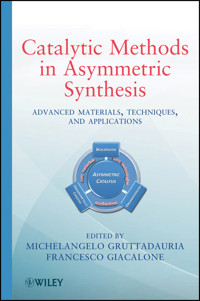
Catalytic Methods in Asymmetric Synthesis E-Book
150,99 €
Mehr erfahren.
- Herausgeber: John Wiley & Sons
- Kategorie: Wissenschaft und neue Technologien
- Sprache: Englisch
This book covers advances in the methods of catalytic asymmetric synthesis and their applications. Coverage moves from new materials and technologies to homogeneous metal-free catalysts and homogeneous metal catalysts. The applications of several methodologies for the synthesis of biologically active molecules are discussed. Part I addresses recent advances in new materials and technologies such as supported catalysts, supports, self-supported catalysts, chiral ionic liquids, supercritical fluids, flow reactors and microwaves related to asymmetric catalysis. Part II covers advances and milestones in organocatalytic, enzymatic and metal-based mediated asymmetric synthesis, including applications for the synthesis of biologically active molecules. Written by leading international experts, this book consists of 16 chapters with 2000 References and illustrations of 560 schemes and figures.
Sie lesen das E-Book in den Legimi-Apps auf:
Seitenzahl: 1073
Veröffentlichungsjahr: 2011
Ähnliche




















Table of Contents
Cover
Title page
Copyright page
DEDICATION
PREFACE
FOREWORD
CONTRIBUTORS
PART I: NEW MATERIALS AND TECHNOLOGIES: SUPPORTED CATALYSTS, SUPPORTS, SELF-SUPPORTED CATALYSTS, CHIRAL IONIC LIQUID, SUPERCRITICAL FLUIDS, FLOW REACTORS, AND MICROWAVES
CHAPTER 1 RECYCLABLE STEREOSELECTIVE CATALYSTS
1.1. INTRODUCTION
1.2. CHIRAL PHOSPHINES
1.3. CHIRAL ALKALOIDS
1.4. BISOXAZOLINES
1.5. SALEN-TYPE LIGANDS
1.6. ENZYMES
1.7. CHIRAL DIAMINES, DIOLS, AND AMINOALCOHOLS
1.8. CONCLUSIONS
CHAPTER 2 RECYCLABLE ORGANOCATALYSTS IN ASYMMETRIC REACTIONS
2.1. GENERAL ASPECTS
2.2. ASYMMETRIC EPOXIDATION
2.3. ASYMMETRIC SYNTHESIS OF α-AMINO ACIDS VIA PTC
2.4. DESYMMETRIZATION
2.5. ALDOL REACTION
2.6. MICHAEL REACTION
2.7. KETONE REDUCTION
2.8. DIELS–ALDER REACTION
2.9. FRIEDEL–CRAFT-TYPE REACTION
2.10. ASYMMETRIC REDUCTION
2.11. MISCELLANEOUS
2.12. MULTISUPPORTED CATALYST-MEDIATED REACTIONS: THE ULTIMATE GOAL IN ASYMMETRIC SYNTHESIS
2.13. CONCLUSIONS
CHAPTER 3 SYNTHESIS AND CHARACTERIZATION OF SUPPORTED CHIRAL CATALYSTS
3.1. INTRODUCTION
3.2. TYPES AND FEATURES OF SOLID SUPPORTS
3.3. HOW TO CONVERT A HOMOGENEOUS CATALYST INTO A HETEROGENEOUS ONE
3.4. CHARACTERIZATION OF SUPPORTED CHIRAL CATALYSTS
CHAPTER 4 SYNTHESIS OF CHIRAL CATALYSTS SUPPORTED ON ORGANIC POLYMERS
4.1. INTRODUCTION
4.2. THE PREPARATION OF CHIRAL CATALYSTS SUPPORTED ON ORGANIC POLYMERS THROUGH POSTMODIFICATION
4.3. THE PREPARATION OF CHIRAL CATALYSTS SUPPORTED ON ORGANIC POLYMERS ACCORDING TO BOTTOM-UP STRATEGIES
4.4. CONCLUSIONS AND OUTLOOK
CHAPTER 5 SELF-SUPPORTED CHIRAL CATALYSTS
5.1. INTRODUCTION
5.2. ENANTIOSELECTIVE TRANSESTERIFICATION
5.3. ENANTIOSELECTIVE HYDROGENATIONS
5.4. ENANTIOSELECTIVE EPOXIDATION
5.5. ENANTIOSELECTIVE SULFOXIDATION
5.6. MICHAEL ADDITION
5.7. CARBONYL-ENE REACTION
5.8. ADDITION OF DIETHYLZINC TO ALDEHYDES
5.9. RING-OPENING REACTION OF EPOXIDES
5.10. MISCELLANEOUS
5.11. SUMMARY AND OUTLOOK
ACKNOWLEDGMENTS
CHAPTER 6 CATALYSIS WITH CHIRALLY MODIFIED METAL SURFACES: SCOPE AND MECHANISMS
6.1. INTRODUCTION TO CHIRALLY MODIFIED METAL SURFACES
6.2. ASYMMETRIC REACTIONS AT CHIRALLY MODIFIED METAL SURFACES
6.3. THE DEVELOPMENT OF A MODEL FOR THE CINCHONA ALKALOID MODIFIED PLATINUM ASYMMETRIC HYDROGENATION
6.4. CONCLUSIONS
CHAPTER 7 CHIRAL IONIC LIQUIDS FOR ASYMMETRIC REACTIONS
7.1. INTRODUCTION
7.2. SYNTHESIS OF CILS
7.3. CILS AS REACTION MEDIA AND CHIRAL REAGENTS
7.4. MISCELLANEOUS APPLICATIONS
7.5. CONCLUSION AND PROSPECTS
ACKNOWLEDGMENTS
CHAPTER 8 ASYMMETRIC REACTIONS IN FLOW REACTORS
8.1. INTRODUCTION
8.2. HOMOGENEOUS ASYMMETRIC CATALYTIC REACTIONS
8.3. HETEROGENEOUS ASYMMETRIC CATALYTIC REACTIONS
CHAPTER 9 ASYMMETRIC CATALYTIC SYNTHESIS IN SUPERCRITICAL FLUIDS
9.1. INTRODUCTION
9.2. BASIC PROPERTIES OF SCCO2 FOR THE APPLICATION IN ORGANIC SYNTHESIS
9.3. ENZYME-MEDIATED ASYMMETRIC SYNTHESIS
9.4. METAL COMPLEXES-MEDIATED ASYMMETRIC SYNTHESIS
9.5. CONCLUSIONS
CHAPTER 10 MICROWAVE-ASSISTED TRANSITION METAL-CATALYZED ASYMMETRIC SYNTHESIS
10.1. INTRODUCTION
10.2. ALLYLIC SUBSTITUTION REACTIONS
10.3. THE HECK REACTION
10.4. ASYMMETRIC REDUCTIONS (OR SATURATIONS)
10.5. RHODIUM-CATALYZED CONJUGATE ADDITION REACTIONS
10.6. THE SUZUKI–MIYAURA REACTION
10.7. EPOXIDE OPENING
10.8. MISCELLANEOUS TRANSFORMATIONS
10.9. CONCLUSION
ACKNOWLEDGMENTS
PART II: RECENT ADVANCES IN ORGANOCATALYTIC, ENZYMATIC, AND METAL-BASED MEDIATED ASYMMETRIC SYNTHESIS
CHAPTER 11 RECENT ADVANCES ON STEREOSELECTIVE ORGANOCATALYTIC REACTIONS. ORGANOCATALYTIC SYNTHESIS OF NATURAL PRODUCTS AND DRUGS
11.1. INTRODUCTION
11.2. ENAMINE CATALYSIS
11.3. IMINIUM CATALYSIS
11.4. DIENAMINE CATALYSIS
11.5. SOMO ACTIVATION
11.6. BRØNSTED ACID AND HYDROGEN BOND CATALYSIS
11.7. BRØNSTED BASE CATALYSIS
11.8. BIFUNCTIONAL CATALYSIS
11.9. PHASE TRANSFER CATALYSIS
11.10. CONCLUSIONS AND FUTURE PERSPECTIVE
CHAPTER 12 RECENT ADVANCES IN BIOCATALYSIS APPLIED TO ORGANIC SYNTHESIS
12.1. BIOCATALYSIS: INTRODUCTION
12.2. OXIDOREDUCTASES
12.3. TRANSFERASES
12.4. USE OF HYDROLASES IN BIOCATALYTIC PROCESSES
12.5. RECENT BIOCATALYZED METHODOLOGIES EMPLOYING LYASES
12.6. ISOMERASES
CHAPTER 13 PEPTIDES FOR ASYMMETRIC CATALYSIS
13.1. INTRODUCTION
13.2. CYANATION OF ALDEHYDES AND STRECKER REACTION
13.3. PEPTIDE-CATALYZED ASYMMETRIC 1,4-CONJUGATE ADDITION REACTIONS
13.4. PEPTIDE-CATALYZED ASYMMETRIC ALDOL REACTIONS
13.5. PEPTIDE-CATALYZED ASYMMETRIC MORITA–BAYLIS–HILLMAN REACTIONS
13.6. PEPTIDE-CATALYZED STETTER REACTION
13.7. PEPTIDE-CATALYZED REGIOSELECTIVE ACYLATION REACTIONS
13.8. PEPTIDE-CATALYZED ASYMMETRIC α-FUNCTIONALIZATIONS
13.9. PEPTIDE-CATALYZED DESYMMETRIZATION REACTION
13.10. PEPTIDE-CATALYZED KINETIC RESOLUTIONS
13.11. PEPTIDE-CATALYZED ASYMMETRIC PROTONATION REACTIONS
13.12. PEPTIDE-CATALYZED ASYMMETRIC TRANSFER HYDROGENATION REACTIONS
13.13. SUMMARY
CHAPTER 14 SILICATE-MEDIATED STEREOSELECTIVE REACTIONS CATALYZED BY CHIRAL LEWIS BASES
14.1. INTRODUCTION
14.2. STEREOSELECTIVE C–H BOND FORMATION
14.3. STEREOSELECTIVE C–C BOND FORMATION
14.4. RING-OPENING REACTION OF EPOXIDES
14.5. MISCELLANEOUS
14.6. OUTLOOK AND PERSPECTIVES
CHAPTER 15 RECENT ADVANCES IN THE METAL-CATALYZED STEREOSELECTIVE SYNTHESIS OF BIOLOGICALLY ACTIVE MOLECULES
15.1. INTRODUCTION
15.2. ENANTIOSELECTIVE REDUCTIONS
15.3. ENANTIOSELECTIVE OXIDATIONS
15.4. ASYMMETRIC ADDITIONS
15.5. ASYMMETRIC CYCLOADDITIONS
15.6. CYCLIZATIONS AND REARRANGEMENTS
CHAPTER 16 STEREOSELECTIVE NITROGEN HETEROCYCLE SYNTHESIS MEDIATED BY CHIRAL METAL CATALYSTS
16.1. INTRODUCTION
16.2. METAL-CATALYZED ENANTIOSELECTIVE ADDITIONS OF AMINES AND AMINE DERIVATIVES TO UNSATURATED CARBON–CARBON BONDS
16.3. CONCLUSIONS AND FUTURE DIRECTIONS
Index
Copyright © 2011 by John Wiley & Sons, Inc. All rights reserved
Published by John Wiley & Sons, Inc., Hoboken, New Jersey
Published simultaneously in Canada
No part of this publication may be reproduced, stored in a retrieval system, or transmitted in any form or by any means, electronic, mechanical, photocopying, recording, scanning, or otherwise, except as permitted under Section 107 or 108 of the 1976 United States Copyright Act, without either the prior written permission of the Publisher, or authorization through payment of the appropriate per-copy fee to the Copyright Clearance Center, Inc., 222 Rosewood Drive, Danvers, MA 01923, (978) 750-8400, fax (978) 750-4470, or on the web at www.copyright.com. Requests to the Publisher for permission should be addressed to the Permissions Department, John Wiley & Sons, Inc., 111 River Street, Hoboken, NJ 07030, (201) 748-6011, fax (201) 748-6008, or online at http://www.wiley.com/go/permissions.
Limit of Liability/Disclaimer of Warranty: While the publisher and author have used their best efforts in preparing this book, they make no representations or warranties with respect to the accuracy or completeness of the contents of this book and specifically disclaim any implied warranties of merchantability or fitness for a particular purpose. No warranty may be created or extended by sales representatives or written sales materials. The advice and strategies contained herein may not be suitable for your situation. You should consult with a professional where appropriate. Neither the publisher nor author shall be liable for any loss of profit or any other commercial damages, including but not limited to special, incidental, consequential, or other damages.
For general information on our other products and services or for technical support, please contact our Customer Care Department within the United States at (800) 762-2974, outside the United States at (317) 572-3993 or fax (317) 572-4002.
Wiley also publishes its books in a variety of electronic formats. Some content that appears in print may not be available in electronic formats. For more information about Wiley products, visit our web site at www.wiley.com.
Library of Congress Cataloging-in-Publication Data
Gruttadauria, Michelangelo.
Catalytic methods in asymmetric synthesis : advanced materials, techniques, and applications / Michelangelo Gruttadauria, Francesco Giacalone.
p. cm.
ISBN 978-0-470-64136-1 (hardback)
1. Asymmetric synthesis. 2. Catalysis. I. Giacalone, Francesco. II. Title.
QD262.G78 2011
541'.395–dc22
2011006415
oBook ISBN: 978-1-118-08799-2
ePDF ISBN: 978-1-118-08797-8
ePub ISBN: 978-1-118-08798-5
This book is dedicated to Prof. Renato Noto
PREFACE
Catalytic asymmetric synthesis is the “art” of promoting the exclusive achievement of an enantiomer over another with the help of substoichiometric amounts of a proper catalyst. This frontier field of research experiences, day after day, an exponential growth, and in the meantime it evolves in a parallel manner in thousands of laboratories all over the world. This continued evolution has led in the last decade to the astounding discovery of a new foundational pillar in the field. In fact, similar to the well-established biocatalysis and organometallic catalysis fields, in the last decade a third column called organocatalysis is strongly helping chemists with new additional tools in the preparation of three-dimensional chemical structures. However, due to fast developments in the field, with new concepts and methods almost daily being discovered, it is difficult to carefully describe it in a given moment.
In this book we tried to take an instant picture of the most recent methods, applications, and techniques exploited in asymmetric synthesis. We gathered an authoritative list of worldwide experts in their corresponding areas of interest and asked them to contribute to this project. In order to cover the more important aspects of asymmetric synthesis that in the last recent years have received considerable interest from the scientific community, the book has been divided in two parts.
In the first part new materials and technologies are collected. Chapters 1 and 2 focus on the recycling of stereoselective catalysts and organocatalysts, respectively, which paves the way to more sustainable processes. Chapters 3 and 4 are devoted to the synthesis and characterization of covalently supported chiral catalysts on both inorganic and polymeric organic supports. The most important aspect is that these materials can be easily separated from the reaction mixture and reused several times without affecting their efficiency. On the other hand, very recently metal-organic supramolecular polymers, constituted by self-complementary units or by orthogonal supramolecular building blocks, have emerged as powerful microporous heterogeneous catalysts; these are highlighted in Chapter 5. Next, chirally modified metals employed in the asymmetric hydrogenation of prochiral double bonds with special emphasis on the mechanistic aspects of the processes involved are discussed in Chapter 6. Then, in Chapters 7–10, asymmetric catalysis in alternative green reaction media such as ionic liquids or supercritical fluids will be thoroughly addressed as well as the use of enabling technologies such as continuous flow or microwave-assisted reactors.
In the second part the most relevant and recent advances regarding the three pillars of asymmetric catalysis will be described. Particularly, much attention will be devoted to the synthesis of natural products mediated by organocatalysts, metal-free organic compounds of relatively low molecular weight and simple structure (Chapter 11), as well as to the use of the more structurally complex enzymes (Chapter 12) or natural and synthetic peptides (Chapter 13), meant as simplified versions of biocatalysts, in asymmetric catalysis.
Chapter 14 covers chiral silicon-based Lewis bases, which play an important role as promoters of a large variety of stereoselective reactions. Finally, the last two chapters cover the most recent and innovative advances in the field of chiral metal catalysis with special emphasis on the applications for the synthesis of biologically active molecules (Chapter 15) and the stereoselective nitrogen heterocycle synthesis, since nitrogen heterocycles play a central role in many biologically active molecules.
This book will serve to introduce the reader to the wide field of asymmetric catalysis, giving him or her an insight into the current status of the area. Moreover, the presence in one book of two interconnected and complementary aspects may allow teachers to give a wider overview of the topic and, at the same time, give an advantage to the students.
We would like to acknowledge once again all the contributors, the efforts of whom have made the publication of this book come true. We want to thank also Jonathan Rose and all the people at Wiley-Blackwell that supported us during the whole adventure.
MICHELANGELO GRUTTADAURIA
FRANCESCO GIACALONE
Palermo
March 2011
FOREWORD
There will always be a need for organic synthesis. New compounds will always be required for evaluation as pharmaceuticals, agrochemicals, dyestuffs, materials, and for a host of other purposes. In the context of organic synthesis, the need for asymmetric synthesis to provide efficient access to enantiomerically enriched materials is a supreme challenge and the development of catalytic processes for asymmetric synthesis is at the forefront of advances in this area.
Modern advances in catalytic asymmetric synthesis include not only the recognition and application of organic catalysts together with improved ligands and transition-metal based catalysts, but also the introduction of solid supported catalysts, flow systems, and homochiral organic liquids. Advances in biotechnology are also providing improved and more generally applicable enzymic processes for asymmetric synthesis. The need for innovative partition and extraction procedures has led to the use of supercritical fluids and fluorous reagents and solvents. Microwave heating can also provide much faster reactions than conventional heating and the demand for environmentally acceptable processes requires the minimisation of waste whether from reagents or solvents and so the use of recyclable catalysts and atom efficiency are of paramount importance not least for industrial processes.
So this is a large and rapidly evolving field!
In this timely and very broadly based volume of recent advances in asymmetric synthesis, technological as well as chemical advances are presented. The use of solid supported and recyclable catalysts is discussed with a range of polymer and other solid supports considered in detail. The question of how to convert a homogeneous catalyst into a heterogeneous one is addressed together with procedures for the characterisation of solid supported catalysts. The benefits of different catalyst supports are also presented alongside self-supported catalysts, chiral ionic liquids, and chirally modified metal surfaces. Asymmetric synthesis in flow systems and in supercritical fluids in considered together with microwave heating for asymmetric catalysis. Finally recent advances in asymmetric catalysis are presented in the context of many different types of reaction.
This book will be useful not only to experts in the field but also to all synthetic organic chemists involved in asymmetric synthesis of chiral compounds. Post-graduate students and post-doctoral researchers will also find it an invaluable introduction to an important and burgeoning field.
ERIC J. THOMAS
School of Chemistry
The University of Manchester
April 2011
CONTRIBUTORS
CARLOS A. M. AFONSO, CQFM, Centro de Química-Física Molecular and IN—Institute of Nanosciences and Nanotechnology, Instituto Superior Técnico, 1049-001 Lisboa, Portugal; iMed.UL, Faculdade de Farmácia da Universidade de Lisboa, Av. Prof. Gama Pinto, 1649-003 Lisboa, Portugal.
CARMELA APRILE, Facultés Universitaires Notre-Dame de la Paix (FUNDP), 61 rue de Bruxelles, B-5000 Namur, Belgium.
ALFONS BAIKER, Department of Chemical and Applied Biosciences, ETH Zurich, Switzerland, Wolfgang-Pauli-Str. 10, ETH Hönggerberg, HCI E 133, CH-8093 Zürich, Switzerland.
MAURIZIO BENAGLIA, Dipartimento di Chimica Organica e Industriale, Università degli Studi di Milano, via Golgi 19, 20133 Milano, Italy.
SHERRY R. CHEMLER, Department of Chemistry, The State University of New York at Buffalo, Buffalo, NY 14260.
KUILING DING, State Key Laboratory of Organometallic Chemistry, Shanghai Institute of Organic Chemistry, Chinese Academy of Sciences, 345 Lingling Road, Shanghai 200032, China.
SIMON C. ELMORE, Cardiff University, School of Chemistry, Main Building, Park Place, Cardiff CF10 3AT, United Kingdom.
CATALINA FERRER, Unitat de Recerca en Síntesi Asimètrica (URSA-PCB), Institute for Research in Biomedicine (IRB Barcelona), and Departament de Química Orgànica, Universitat de Barcelona, Baldiri Reixac 10, 08028 Barcelona, Spain.
MATTHIAS FREUND, Department of Chemistry and Pharmacy, Chair of Organic Chemistry I, University of Erlangen-Nuremberg, Henkestrasse 42, 91054 Erlangen, Germany.
HERMENEGILDO GARCIA, (b) Instituto de Tecnología Quimica CSIC-UPV, Av. de los Naranjos s/n, Universidad Politécnica de Valencia, 46022 Valencia, Spain.
ANNIE-CLAUDE GAUMONT, Laboratoire de Chimie Moléculaire et Thioorganique, UMR CNRS 6507, INC3M FR 3038, ENSICAEN & Université de Caen, 14050 Caen, France.
YVES GÉNISSON, CNRS-UMR 5068, Synthèse et Physicochimie de Molécules d’Intérêt Biologique, Université Paul Sabatier, 118 route de Narbonne, 31062 Toulouse cedex 9, France.
FRANCESCO GIACALONE, Department of Molecular and Biomolecular Sciences (STEMBIO), Section of Organic Chemistry, University of Palermo, Viale delle Scienze, Ed. 17, 90128 Palermo, Italy.
PEDRO M. P. GOIS, iMed.UL, Faculdade de Farmácia da Universidade de Lisboa, Av. Prof. Gama Pinto, 1649-003 Lisboa, Portugal.
GONZALO dE GONZALO, Departamento de Química Orgánica e Inorgánica, Instituto Universitario de Biotecnología de Asturias, University of Oviedo, 33006 Oviedo, Spain.
VICENTE GOTOR, Departamento de Química Orgánica e Inorgánica, Instituto Universitario de Biotecnología de Asturias, University of Oviedo, 33006 Oviedo, Spain.
MICHELANGELO GRUTTADAURIA, Department of Molecular and Biomolecular Sciences (STEMBIO), Section of Organic Chemistry, University of Palermo, Viale delle Scienze, Ed. 17, 90128 Palermo, Italy.
FRÉDÉRIC GUILLEN, CNRS-UMR 6014, COBRA, IRCOF, Université de Rouen, rue Tesnière, 76821 Mont-Saint-Aignan, France.
STEFANIA GUIZZETTI, Dipartimento di Chimica Organica e Industriale, Università degli Studi di Milano, via Golgi 19, 20133 Milano, Italy.
HONGCHAO GUO, Department of Applied Chemistry, China Agricultural University, 2 Yuanmingyuan West Road, Beijing 100193, China.
TORE HANSEN, Department of Chemistry, University of Oslo, P.O. Box 1033 Blindern, NO-0315 Oslo, Norway.
TOR ERIK KRISTENSEN, Department of Chemistry, University of Oslo, NO-0315 Oslo, Norway.
MATS LARHED, Department of Medicinal Chemistry, Organic Pharmaceutical Chemistry, BMC, Uppsala University, Box 574, SE-75123 Uppsala, Sweden.
IVÁN LAVANDERA, Departamento de Química Orgánica e Inorgánica, Instituto Universitario de Biotecnología de Asturias, University of Oviedo, 33006 Oviedo, Spain.
TOMOKO MATSUDA, Department of Bioengineering, Graduate School of Bioscience and Biotechnology, Tokyo Institute of Technology, 4259 Nagatsuta, Midori-ku, Yokohama, Japan, 226-8501.
CECILIA MONDELLI, Department of Chemical and Applied Biosciences, ETH Zurich, Switzerland, Wolfgang-Pauli-Str. 10, ETH Hönggerberg, HCI E 133, CH-8093 Zürich, Switzerland.
CARLOS M. MONTEIRO, CQFM, Centro de Química-Física Molecular and IN—Institute of Nanosciences and Nanotechnology, Instituto Superior Técnico, 1049-001 Lisboa, Portugal.
RENATO NOTO, Department of Molecular and Biomolecular Sciences (STEMBIO), Section of Organic Chemistry, University of Palermo, Viale delle Scienze, Ed. 17, 90128 Palermo, Italy.
LUKE R. ODELL, Department of Medicinal Chemistry, Organic Pharmaceutical Chemistry, BMC, Uppsala University, Box 574, SE-75123 Uppsala, Sweden.
PAOLO P. PESCARMONA, Centre for Surface Chemistry and Catalysis, K.U. Leuven, Kasteelpark Arenberg 23, 3001 Heverlee, Belgium.
JEAN-CHRISTOPHE PLAQUEVENT, CNRS-UMR 5068, Synthèse et Physicochimie de Molécules d’Intérêt Biologique, Université Paul Sabatier, 118 route de Narbonne, 31062 Toulouse cedex 9, France.
MONIKA RAJ, Indian Institute of Science Education and Research, Bhopal Transit Campus: ITI Campus (Gas Rahat) Building, Govindpura, Bhopal—460 023 India.
MUNAWWER RASHEED, Cardiff University, School of Chemistry, Main Building, Park Place, Cardiff CF10 3AT, United Kingdom.
ANTONI RIERA, Unitat de Recerca en Síntesi Asimètrica (URSA-PCB), Institute for Research in Biomedicine (IRB Barcelona), and Departament de Química Orgànica, Universitat de Barcelona, Baldiri Reixac 10, 08028 Barcelona, Spain.
SERGIO ROSSI, Dipartimento di Chimica Organica e Industriale, Università degli Studi di Milano, via Golgi 19, 20133 Milano, Italy.
VINOD K. SINGH, Indian Institute of Science Education and Research, Bhopal Transit Campus: ITI Campus (Gas Rahat) Building, Govindpura, Bhopal—460 023 India.
ALEXANDRE F. TRINDADE, CQFM, Centro de Química-Física Molecular and IN—Institute of Nanosciences and Nanotechnology, Instituto Superior Técnico, 1049-001 Lisboa, Portugal.
SVETLANA B. TSOGOEVA, Department of Chemistry and Pharmacy, Chair of Organic Chemistry I, University of Erlangen-Nuremberg, Henkestrasse 42, 91054 Erlangen, Germany.
ANGELO VARGAS, Department of Chemical and Applied Biosciences, ETH Zurich, Switzerland, Wolfgang-Pauli-Str. 10, ETH Hönggerberg, HCI E 133, CH-8093 Zürich, Switzerland.
XAVIER VERDAGUER, Unitat de Recerca en Síntesi Asimètrica (URSA-PCB), Institute for Research in Biomedicine (IRB Barcelona), and Departament de Química Orgànica, Universitat de Barcelona, Baldiri Reixac 10, 08028 Barcelona, Spain.
THOMAS WIRTH, Cardiff University, School of Chemistry, Main Building, Park Place, Cardiff CF10 3AT, United Kingdom.
VIACHESLAV ZGONNIK, CNRS-UMR 5068, Synthèse et Physicochimie de Molécules d’Intérêt Biologique, Université Paul Sabatier, 118 route de Narbonne, 31062 Toulouse cedex 9, France.
PART I: NEW MATERIALS AND TECHNOLOGIES: SUPPORTED CATALYSTS, SUPPORTS, SELF-SUPPORTED CATALYSTS, CHIRAL IONIC LIQUID, SUPERCRITICAL FLUIDS, FLOW REACTORS, AND MICROWAVES
CHAPTER 1
RECYCLABLE STEREOSELECTIVE CATALYSTS
CARLOS M. MONTEIRO, ALEXANDRE F. TRINDADE, PEDRO M. P. GOIS, AND CARLOS A. M. AFONSO
1.1. Introduction
1.2. Chiral phosphines
1.2.1. Hydrogenation
1.2.2. Hydroformylation
1.2.3. Cycloaddition
1.2.4. Allylic substitution
1.3. Chiral alkaloids
1.4. Bisoxazolines
1.4.1. Py-BOX ligands
1.4.2. BOX ligands
1.4.3. Aza-BOX and phe-BOX ligands
1.5. Salen-type ligands
1.6. Enzymes
1.7. Chiral diamines, diols, and aminoalcohols
1.7.1. TsDPEN-type ligands
1.7.2. Chiral aminoalcohols
1.7.3. BINOL-type ligands
1.8. Conclusions
References
1.1. INTRODUCTION
Asymmetric catalysis constitutes an important subject, generating thousands of published works every year. Still, the application of such methodologies in the chemical industry is rather limited due to the high cost of the chiral ligands and/or noble metals used in such transformations. Additionally, sometimes the final products contain high levels of metal contamination derived from catalysts descomplexation or degradation phenomena, which can became a serious drawback if the metal is toxic, particularly for the pharmaceutical and food industries. For these reasons, there are still advantages to using the chiral building blocks readily available in nature or by applying resolution of optical isomers [1].
Stereochemical and chemical efficiency of a certain transformation are, in principle, better reproduced and predicted in homogeneous catalysis than in heterogeneous catalysis. The presence of the heterogeneous support in a reaction vessel can create, in some cases, unpredictable results (negative vs. novel positive effects) [2]. The choice of the heterogeneous support for the catalysis is a crucial decision. Some properties like high thermal, chemical and physical stabilities, chemical inertia, and homogeneous-like behavior are highly desirable. Furthermore, the catalyst is easily recovered using just filtration or extraction techniques that are impossible to be applied in homogeneous catalysis [3].
Amorphous and ordered silicas, clays, and highly cross-linked polymers are the standard supports to heterogenize a homogeneous catalyst. The principal immobilization mechanisms consist of ligand grafting, metal coordination, microencapsulation, electrostatic interactions, and ion exchange [3] (see also Chapters 3 and 4).
It is possible to combine the advantages of homogeneous and heterogeneous systems by running reactions with catalysts that have been chemically linked to soluble macromolecules like oligomeric and/or low cross-linked soluble polymers, poly(ethylene glycol) (PEG), and dendritic structures. The supported homogeneous catalyst can be precipitated at the end of the reaction by addition of a cosolvent and recovered like a heterogeneous system [3].
The reutilization of asymmetric catalysts and the reactions media was possible using greener solvents like water, ionic liquids (ILs), PEG, perfluorinated solvents, and supercritical CO2 (scCO2), which constitute alternatives to volatile organic solvents. Water appears as the cheapest solvent, bearing unique characteristics that differ from the others solvents: it is cheaper, most abundant in nature, and proven to have some unexpected beneficial effects in organic transformations [3, 4].
The need to transfer the asymmetric catalysis methodology to large-scale synthesis technology is a crucial goal for synthetic organic scientists worldwide. There are many contributions toward achieving this goal in the literature [2, 5]. In 2002, Chan et al. combined all these type of transformations or chiral ligands [6], or self-supported heterogeneous catalysts [7], or solvent-free transformations [8]. In 2009, Trindade et al. [3] updated the earlier Chan et al. work [2], covering a broader number of transformations and all type of catalyst recycling methodologies. Other reviews were published in the literature, where the majority focused on catalyst immobilization for both chiral and achiral organic transformations, but they do not cover all types of reported catalysts immobilization processes [9]. From the reviews that focus only on enantioselective catalysis, some cover only one transformation performed with heterogeneous catalysts [10].
This chapter provides an overview of our selection transformations and all types of catalyst (except organocatalysts) recycling methodologies described up to March 2010.
Lesen Sie weiter in der vollständigen Ausgabe!
Lesen Sie weiter in der vollständigen Ausgabe!
Lesen Sie weiter in der vollständigen Ausgabe!
Lesen Sie weiter in der vollständigen Ausgabe!
Lesen Sie weiter in der vollständigen Ausgabe!
Lesen Sie weiter in der vollständigen Ausgabe!
Lesen Sie weiter in der vollständigen Ausgabe!
Lesen Sie weiter in der vollständigen Ausgabe!
Lesen Sie weiter in der vollständigen Ausgabe!
Lesen Sie weiter in der vollständigen Ausgabe!
Lesen Sie weiter in der vollständigen Ausgabe!
Lesen Sie weiter in der vollständigen Ausgabe!
Lesen Sie weiter in der vollständigen Ausgabe!
Lesen Sie weiter in der vollständigen Ausgabe!
Lesen Sie weiter in der vollständigen Ausgabe!
Lesen Sie weiter in der vollständigen Ausgabe!




