


4,99 €
Mehr erfahren.
- Herausgeber: Books on Demand
- Kategorie: Ratgeber
- Sprache: Englisch
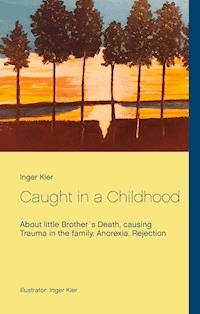
Inger Kier has met in her Psychologist Office clients with Anorexia and refusing food as a behaviour problem. She has now looked at her own childhood, when she lost her little brother, when she was 5 years old. In Psychodynamic Therapy they worked in the therapy "here and then" and looking för repeating pattern in adult life and in childhood. She can see, that she developed a pattern after her little brother´s death., which was a trauma in her family. She analyses anorexia and rejection and her lack of aggressivity after her little brother´s death.
Das E-Book können Sie in Legimi-Apps oder einer beliebigen App lesen, die das folgende Format unterstützen:
Seitenzahl: 35
Veröffentlichungsjahr: 2017
Ähnliche


















Earlier books:
Kärlek över Atlanten 2016
Match made in Heaven 2016
Dedication to my Dear Mother
I was 5 years old, when my little brother, 3 years old, suddenly dies. The cutest brother imaginable with lightblonde curls. Why did this happen, my family?
This was a horrible experience. I have been told, that I myself had ear infections and lied to bed. We had many ear infections in my family. It was said, that we "inherited" this after dad, who as a child had many ear infections. I remember, that I often had to go to the cottage hospital in my town with terrible earache for a whole night. The doctor cut a hole in the ear drum and the goods ran out.
This was such a wonderful feeling, when it ran out and the pain stopped.
I cannot only describe it as the calm after the storm or the good for evil or Paradise for Hell.
My little brother and our cousins were out on a pond near our house and suddenly the ice broke and he fell into the water with his legs.
Mom, I don't know if she was there or if the cousins called out for her, got him up out of the water the fastest she could. Later in the evening, he will get high fever, over 105 F degrees.
Mom went with him to the hospital. At that time, no parents remain in hospitals with children, so she left my little brother there. It must have been terrible to leave him, as small as he was.
After a few hours they'll call from the hospital and says he is dead.
He had pneumonia and could not be rescued. At that time there was no penicillin, which could have saved him. I have also heard that he drank water from the flower vase, for he was so thirsty. Is there an after construction or is it the truth? Why was no one there and gave him the water? Is it truth, it is horrible, that it could be like that.
My dad is in Copenhagen and get the message, that his son died and hurries home. One can understand, as drama this is for my parents.
Dad has told me, that he was flying home from Copenhagen and he was met by a car at the airport, who took him home. After this day are all "dark" in my home. At least I felt so. The furnitures were dark and the walls with them.
We had experienced the II World War, not as in close range but had felt a fear of Nazis to come to Sweden.
Mom pulled down the blind literally! I can think of, this, losing a child, was a disaster for my parents. Something so terrible to you should not occur. But this happened and after this day was nothing alike.
During the war, we had had the dark curtains for windows black so no light trickling out, as revealed to the enemy, where the cities existed. I remember, Dad came home painted black in his face. He was called up and guarded the Islands in the archipelago. He had a semaphore, as he waved to the others called in the islands, if something suspicious was in the air or on the water. There he was in months.
During this time, it was the rationing of coffee, milk, cheese, butter, etc. You have to have ration cards and when you used it, for example, coffee, so you could not buy more that month. Number of ration cards were counted out after, how many children they had in the family. I remember that after the war, I was eating an orange for the first time. It was delicious! Even tomatoes were now eating after the war.
Of course the people knew of the threat from Nazi Germany and a fear, that Sweden would be occupied, as was done with Norway. I remember the towers built during the war in our small town, where they, the military, could climb up and see if any enemy was approaching. I remember, that he was in an Office, darkened for the enemy and where he also served as a conscripted during war time.
No one was out in the evenings, for it was pitch dark. No street lamps were lit. Black, black ... dark, dark.




