


Erhalten Sie Zugang zu diesem und mehr als 300000 Büchern ab EUR 5,99 monatlich.
- Herausgeber: THP Ireland
- Kategorie: Fantasy und Science-Fiction
- Sprache: Englisch
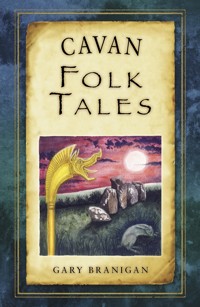
The history of Cavan, affectionately known as 'The Lakeland County', is made up of a rich tapestry of folk tales, myths and legends. It is said to be the home of the wailing banshee of the McCabes, the site of Finn MacCool's last resting place (where his fingers can still be seen) and where, legend has, it a young girl came perilously close to marrying the devil. In this book Gary Branigan will take you on a journey through Cavan's past, recalling the myths and legends that shaped the area's history from the early exploits of heroes such as Cúchulainn and the Gobán Saor to the more recent stories of the last highwayman 'Captain' Mooney and the tragedy of the Great Hunger. Also featuring tales of cursing stones, fairy gold, mermaids, pookas and dragons, it will take you into a remarkable world where you can let your imagination run wild.
Sie lesen das E-Book in den Legimi-Apps auf:
Seitenzahl: 244
Veröffentlichungsjahr: 2016
Das E-Book (TTS) können Sie hören im Abo „Legimi Premium” in Legimi-Apps auf:
Ähnliche

















Dedicated to Jeannette, Tara, Aoife, and Rory
First published in 2016
The History Press Ireland
50 City Quay
Dublin 2
Ireland
www.thehistorypress.ie
The History Press Ireland is a member of Publishing Ireland, the Irish Book Publisher’s Association.
This ebook edition first published in 2016
All rights reserved
Text © Gary Branigan, 2016
Illustrations © Elena Danaan, 2016
The right of Gary Branigan to be identified as the author of this work has been asserted in accordance with the Copyright, Designs and Patents Act 1988.
This ebook is copyright material and must not be copied, reproduced, transferred, distributed, leased, licensed or publicly performed or used in any way except as specifically permitted in writing by the publishers, as allowed under the terms and conditions under which it was purchased or as strictly permitted by applicable copyright law. Any unauthorised distribution or use of this text may be a direct infringement of the author’s and publisher’s rights, and those responsible may be liable in law accordingly.
EPUB ISBN 978 0 7509 8153 8
Original typesetting by The History Press
eBook converted by Geethik Technologies
CONTENTS
Acknowledgements
Introduction
1. HISTORY
Bishop Bedell and the Templeport Bible
The Maxwells of Farnham
From Quilca to Lilliput
The Last Highwayman
The Great Hunger and the Union Workhouse
Bonfire of the Black and Tans
Beaufighter Plane Crash on St Mogue’s Island
2. LEGENDARY FIGURES
Finn MacCool’s Fingers
St Patrick and the Idol of Crom Cruach
Balor and the Glas Gaibheann
An Gobán Saor
Setanta and the Hound of Culainn
Cormac Mór and Cormac Beag
Diarmuid and Gráinne
Bricín the Surgeon
3. FABLED PLACES
Maguire’s Chair
Mogue of Inis Bréachmhaigh
The Red Road to Arva
The Worm Ditch
The Giant’s Leap
How Lough Gowna was Formed
The Nine Yew Trees of Derrylane
4. ANCIENT KNOWLEDGE
Cures
Weather Lore
Moll’s Shebeen
Ancient Crafts
Fishing and Hunting
Customs at Weddings, Funerals, and Wakes
Calendar Days
5. MYTHICAL CREATURES
Fairy Gold
The Shannon Pot
The Dobharchú of Lough Sheelin
The Pooka of Cuilcagh
The Wailing Banshee of the McCabes
The Royal Palace of the Three Counties
The Ghost of Cabra Castle
How to Catch a Leprechaun
Marriage of the Merrow
The Mermaid and the Princess
6. MAGICAL HAPPENINGS
The Fast Sprinter
Michael and the Haunted House
The Greedy Fox
Araild and the Card Game
The Hare and the Old Woman
The Dragon
O’Hanlon of Ulster
Waking Katie
Johnny and the Moon
Mick McAheaney’s Misfortune
The Charm
St Brigid’s Head
Bride of the Devil
Getting the Hump
The King of France’s Daughter
Will o’ the Wisp and the Man from Downstairs
The Man with Big Feet
The Sheaf of Wheat
7. WISDOM
Riddles
Seanfhocial – Wise Old Irish Sayings
Lucky Days
8. FOOLISHNESS
Billy the Amadán
Three Confused Buttermaids
Willy the Fool
The Foolish Pair
9. CAUTIONARY TALES
The Cursing Stones
Cillian of Mullagh and Kilian of Würzburg
Rich Brother, Poor Brother 180
An Féar Gortach Agus An Fóidín Mearbhaill
Harvey’s Treasure
Lake of the Physician
The Turf Cutter’s Wake
The Offended Well
The Poor Lad and the Evil Stepmother
ACKNOWLEDGEMENTS
So much has been written of the rich indigenous culture extant in our fair isle. From language, custom, dress, music, and folklore, the island peoples on the western fringes of Europe are celebrated for their unique way of life.
Within Ireland, many localities have their own idiosyncrasies and home-grown customs, stories, and lore, borne out of local history and local circumstance.
The lakeland county of Cavan is no exception, and this book was created with the intention of sharing and celebrating some of its wealth of local stories and lore.
Many of these stories are old and have been handed down through generations whilst others are more modern, showing the continuance of the Irish traditions of the seanchaí and of Irish storytelling. In reading through the various tales gathered here, the reader will be transported to a former time and place of yore, long gone, but forever preserved.
I would like to express my sincere gratitude to the many people, past and present, for the kind assistance, guidance, and encouragement received, both directly and indirectly, during the compilation of this book.
Research facilities at the National Library of Ireland, Ulster Folk and Transport Museum in Holywood, Cavan County Museum, National Museum of Ireland (Country Life), Royal Society of Antiquaries of Ireland, Office of Public Works, Ordnance Survey Ireland, UCD, and the various local historical, folkloric and heritage societies have all been invaluable, and thanks go to the wonderful staff who maintain them.
Special mention deserves to go to Críostóir Mac Cárthaigh of the National Folklore Collection at UCD; to local storyteller Ali Isaac for inspiring so many aspiring storytellers; to John Middleton and James Mathews, for editing and proofreading; to Maureen Slough, John Boylan, and Stephen McEntee for local guidance and valuable advice: to Ronan Colgan and Beth Amphlett of The History Press Ireland for their endless patience and for ongoing assistance during the publication process; and to Elena Danaan of Awen’s Gift Creations, who created the absolutely amazing images for the book, and to whom I owe a significant debt of gratitude.
Thanks also to the many others – too many to mention here – who assisted in various ways in bringing this book to completion.
Finally, words alone cannot express my sincere gratitude and appreciation to Jeannette, Tara, Aoife and Rory, for the love, support, encouragement and patience they have shown throughout this journey.
Gary Branigan
Cavan, 2016
INTRODUCTION
My contribution to this collection of folk tales is in my capacity as a storyteller, and, for the most part, not as an academic or historian. Fact and fable are inextricably woven into the fabric of the Irish gene, and it is not always possible to separate them. However, I have attempted to be as faithful as I can to both.
The medium of telling stories and singing songs is the way the Irish have been able to come to terms with fortune and misfortune alike. Many of the stories collected here have been handed down from generation to generation, by local people for local people; others are more modern. In both cases, it is my hope and belief that anybody will be able to pick up this book and easily enjoy the rich bounty of Cavan’s storytelling tradition. In selecting tales for inclusion in this publication, I have tried my best to include a range generally representative of the county as a whole.
Cavan, affectionately known as ‘The Lakeland County’ and ‘The Breffni’, is one of the three border counties within the province of Ulster that is located in the Republic of Ireland. Covering some 730 square miles of rugged and scenic terrain with its beautiful 365 lakes, County Cavan has a current and growing population of circa 75,000. The majority of the county is sparsely populated, with many of its people residing in larger towns of Bailieboro, Belturbet, Cootehill, Kingscourt, and Cavan town.
The county is characterised by drumlin countryside dotted with many rivers, lakes, and hills, with the highest point being Cuilcagh Mountain, at 2,182ft high. The source of many rivers can be found in the county, among them the rivers Erne, Blackwater, and of course the mighty Shannon, which emerges from the darkness of the mysterious Shannon Pot.
Derived from the Irish An Cabhán, meaning ‘The Hollow’, Cavan possesses a rich tapestry of history, legend, and folklore. From the earliest times of Fionn MacCumhaill to the monastic influences of St Cillian and St Feidhlim, from the medieval battles for control of the East Bréifne kingdom to the mass displacement of the natives through forced plantation and avoidable famine, Cavan has had more than its fair share of significant events over the millennia. It is central to many of Ireland’s most famous and fantastic myths and legends.
1
HISTORY
BISHOP BEDELL AND THE TEMPLEPORT BIBLE
The Rt Revd William Bedell was an Anglican churchman who served as Lord Bishop of Kilmore. He was martyred during the Irish Rebellion of 1641, during the time of the Reformation. Born at Black Notley in Essex, Bedell was educated at Emmanuel College in Cambridge, where he became a fellow and subsequently took orders.
In 1607, he was appointed chaplain to Sir Henry Wotton, then English ambassador at Venice, where he remained for four years, acquiring a great reputation as a scholar, theologian, printer, and missionary to the faithful living under Roman Catholic tyranny of the Inquisition.
In 1627, because of his ceaseless efforts for nationalist evangelism, he was appointed provost of Trinity College, Dublin, despite having no prior connection with Ireland. Thus, he was at the forefront of advancing the Irish Reformation when he decreed that the church services, including the New Testament, be read in the Irish language so that the monoglot masses might understand their messages in contrast with the Catholic method of reading in Latin to a clueless congregation.
In 1629, he was appointed to become Bishop of Kilmore and Ardagh, and set out to reform the abuses of his diocese, which had been notorious for its corruption and bribery. Additionally, to further promote literacy and religious enlightenment, he encouraged the use of the Irish language in all aspects of ecclesiastical affairs, and personally undertook the duties generally discharged by the bishop’s lay chancellor. He also appointed only Irish speakers to parishes to further his mission to the common folk.
Bedell is noted for commissioning the translation of the Bible into the Irish language, the translation of which was undertaken by the Protestant Rector of Templeport parish, the Revd Muircheartach Ó Cionga.
Bedell was a man of simple life, often walking miles on foot or on horse, travelling the dangerous byways. This was a particularly dangerous period as Irish Catholic nobles and leaders who adhered to ancient privileges of the chieftainship had made common cause with Catholic powers in Europe in causing treason, sabotage, and general warfare. Indeed, Bedell made a point of entering anti-Protestant and especially anti-English areas, encouraging and providing assistance to converts to Protestantism, including supporting them whilst studying for the ministry.
Bedell was also noted for his even application of the law in prosecuting the guilty and providing help against corruption, regardless of a person’s religious adherence. For instance, he sided with the Catholics of Kilmore against the excess of Alan Cooke, the incumbent chancellor of the diocese. However, the Church courts found that Cooke had legally acquired the right as chancellor and the bishop was unable to remove him.
However, because of his support within the common Irish, especially the Catholic Irish leadership fearful of his standing, Bedell was considered a high-value target by Irish Catholic rebels. With the outbreak of the Irish Rebellion of 1641, the local warlords, led by the O’Reillys, took control of the area. Nonetheless, whilst support for the rebellion had yet to bear full fruit, the rebel leadership trod carefully around the popular bishop. Thus, the O’Reillys ‘gave comfortable words to the Bishop’ and Bedell’s house at Kilmore in County Cavan was left untouched.
Indeed, because of Bishop Bedell’s popularity among Catholic and Protestants alike, not only did Protestant Irish refugees flock to him; he also appealed to Catholics who were unwilling to join the rebellion. As the rebellion grew increasingly bloody and entire Protestant families were murdered, Bedell’s property became a place of refuge for hundreds of families from the area seeking shelter from the rebel insurgents.
In the end, however, the rebels insisted upon the immediate release into their capture of all who had taken shelter in his house. Knowing full well that they would likely be mass murdered, the bishop refused. Having isolated the bishop and the refugees, the rebels believed they could murder the bishop and refugees in silence. They mounted an assault, seized Bedell and other known missionaries of the Reformation, and imprisoned them on the nearby island castle of Lough Oughter, Cloughoughter Castle.
Here, Bedell and others were imprisoned for several weeks and tortured. When the rebellion began to subside, his captors, fearing for their own safety, forced him into signing a deposition and a remonstrance from his captors, ‘pleading on their behalf for graces from King Charles’. Freed, Bedell was now released into the care of his friend Denis Sheridan but the imprisonment and torture had worked their damage. Shortly after his release, Bedell died from his wounds and exposure on 7 February 1642.
Bishop Bedell was afforded the dignity by his captors of being buried next to his wife Leah at Kilmore, where he received an honourable funeral in the presence of his O’Raghallaigh (O’Reilly) captors. At his funeral, a Roman Catholic priest, Father Farrelly, was heard to say, ‘May my soul be with Beddell’s’.
THE MAXWELLS OF FARNHAM
There are few families in more modern times that have had more influence on the county than the religious and stately Maxwell family.
Approximately 2 miles from the county town is the present-day Radisson Blu Farnham Estate Hotel, with its fine old house and accompanying lakes, wooded areas, and open pasture lands. In former times, this plush pad was the residence of the Maxwell family ever since their arrival from Lanarkshire, Scotland, way back in 1664, during the time of the plantations.
With their family motto of ‘Je suit prêt’, meaning ‘I am ready’, they soon built a fine estate by improving the local landscape and the look of the estate grounds and local areas. Unlike many others of the planted ascendancy, they also saw it as part of their lot to give the tenants that lived within the borders of their estate a better shot at life. They employed various inspectors, whose job it was to report on and recommend improvements to the diet, living conditions, and education of those resident there.
The Maxwells were fervently religious and employed ‘moral agents’ who kept an eye on the locals to make sure that they were behaving themselves and not indulging in unsuitable activities. This was a big catch to receiving their charity. Among other things, the tenantry were bound to observe the Lord’s Day, refrain from cursing, and not involve themselves in the distillation or consumption of alcohol. We can only imagine it was a bundle of laughs living there at that time.
The fine grounds of Farnham drew many admirers, with one young topographer in the nineteenth century saying that it was ‘one of the finest places that I have ever seen in Ireland’. He also declared that the lakes within the estate were ‘uncommonly beautiful; extensive and have a shore extremely varied’.
Sadly, the Lord and Lady Farnham were killed in the Abergele train disaster in 1868. The tenants erected a statue in his honour in Cavan town, which now stands in front of the new Johnston Library. They deemed it fit not to erect a statue of the good Lady – more’s the pity.
FROM QUILCA TO LILLIPUT
The Dean of St Patrick’s Cathedral in Dublin, Jonathan Swift, was an ambitious and accomplished man, if not a bit of a strange fish. He was an unusual man of his day and, having being raised by his uncle, had an unusual outlook on life and the world that he saw. He is generally regarded as being the greatest satirist who ever wrote in the English language, often bitter and delightfully humorous in equal measure.
Whilst staying with his friend Revd Thomas Sheridan in Quilca House, near the present-day Mullagh village, in the early seventeenth century, he worked on two of his major works, Tale of a Tub, and the much more well-known Gulliver’s Travels.
Despite being a very welcome guest of the Sheridans and waited on hand, foot and finger, he composed a poem whilst he was there showing that he was not a particularly gracious and appreciative gent.
To Quilca, a Country House not in Good Repair
Let me thy Properties explain,
A rotten Cabin, dropping Rain;
Chimnies with Scorn rejecting Smoak;
Stools, Tables, Chairs, and Bed-steds broke:
Here Elements have lost their Vses,
Air ripens not, nor Earth produces:
In vain we make poor Sheelah toil,
Fire will not roast, nor Water boil.
Thro’ all the Vallies, Hills, and Plains,
The Goddess Want in Triumph reigns;
And her chief Officers of State,
Sloth, Dirt, and Theft around her wait.
THE LAST HIGHWAYMAN
In the days of the highwaymen, a chief robber by the name of ‘Captain’ Mooney had his quarters in amongst the trees of an old man-made island lair on Lough Ramor, not far from the town of Virginia. He, of course, was not a real captain but this was a title bestowed upon him by the local people, who held him in such high esteem.
The captain is said to have been tough and fearless but kind and just in all his dealings with every man and woman whose path he crossed. He discharged his duties with the utmost diligence and care, and those duties were to guarantee the provision of the poor people in the district as only a highwayman can.
Mooney’s territory covered many of the approach roads to the town, and both he and his men would camouflage themselves, hide amongst the gorse and brambles and lie in wait for a passing carriage. When a vehicle belonging to someone possessing a certain level of wealth – usually a landlord or rich gent – did eventually pass, he and his men would jump out and seize it at gunpoint and relieve the passengers of their possessions.
When he got back to his lair on the crannóg, he divided up the spoils to share with the poor and distressed of the parish. If a poor person in the district was in need of anything, they would go to Captain Mooney and he would make sure that they were given what they needed; it was for this reason that he was loved by the poor.
In those days there was no police, and it was the men of His Majesty’s Revenue who carried out the same duties. The revenue men, acting on the orders of the wealthy, offered a reward of £100 to anybody who would provide information leading to the capture of the captain.
On a particularly dark and blustery night, Captain Mooney and a companion lay in wait for an unsuspecting traveller, as they had done before on many an occasion. When a suitable target came by Mooney and his man jumped out, forced the carriage to a halt and robbed the old rich man inside, who was a gent by the name of Burke. The revenue men just happened to be in the vicinity at the time and heard the screams of the man, so blew their whistles and gave immediate chase to the men, tracking them by their muddy boot prints all along the way.
In a bid to escape, the men found themselves forced to wade through the Blackwater River at the ferry house, and it was here that the revenue men caught up with them. They were thigh high in the water when the officers fired a shot at them, hitting Mooney’s companion in the arm, and making him lose his footing. He was carried down the river and into the lake by the water’s current. He was not heard from ever again and it can only be assumed that he sank to the muddy depths of Lough Ramor.
The captain continued across the river, discarding his loot on the way to make his pockets lighter. He kept going as fast as he could but unfortunately for him, he got his foot caught in an eel trap set at the bottom of the river and fell into the water. The revenue men chose to take the man alive and brought him to the local barracks for to be incarcerated pending his trial. They could not believe their luck in securing the capture of the Captain Mooney.
The following day, he was brought to Cavan town for his trial and the Justice of the Peace deemed it necessary to sentence him to penal servitude in Van Diemen’s Land; it was here that he ended his days.
There had not been another highwayman in the locality since that time.
THE GREAT HUNGER AND THE UNION WORKHOUSE
There were very bad times in Ireland long ago. It was over 150 years ago now when the vicious blight travelled over on the warm air from Europe and afflicted the potatoes in the ground, causing them to turn black and rotten.
The people all over the island only had small plots of land from which to feed their families and the only thing they had to grow were lumper potatoes. The disease afflicted the lumper the worst and the people were left with nothing to eat, practically overnight.
It wasn’t long before the people started to die of starvation, and the heavy odour of rotten spuds and death settled over the land. People were dying so quickly that they could not make coffins fast enough, and there are even stories of people being buried alive. There is one particular story of a man who was being placed into a grave when he awoke, saying, ‘Do not bury me for I am not yet dead.’ The doctor at the graveside, who had lost his mind through sheer exhaustion, said, ‘You are a liar! The doctor knows best,’ and the trench was filled in.
Out of desperation, the poor people tried to sow the rotten potatoes the next year in the hope of getting a crop, but nothing grew, and many were so desperate that they ate the grass in the hope of getting some sustenance. There were twice as many people living in Ireland then as there are now, as many have since left this life or this land for places better.
Many of those who stayed used to leave their houses in the mornings and go around from place to place looking for something, anything, to eat. Many still ended up in the union workhouses. These workhouses were places set up to look after those who could not look after themselves, and many workhouses were horrid places, full of desperate people in desperate situations.
One day, a man named Jimmy was tending to his wife Mary at home; seeing that she was quickly fading away through lack of nourishment, the realisation came over him that she was in need of admission to the workhouse in nearby Bawnboy. He thought to himself ‘For surely, as bad as life is outside the great walls of the workhouse, life would be a crumpeen better inside.’ He lifted Mary on to the back of their cart and, seeing as they sold their donkey long previous for provisions, he had to fasten the harness around himself and pull the cart with herself onboard the 5-mile trip all the way to the workhouse.
Pulling the cart was no mean feat for Jimmy given his also weak state of health. He arrived at the workhouse with his back nearly broken just as the sun was setting. He spoke with the mean-spirited superintendent, who berated him for turning up at such an ungodly hour. ‘So much for charity,’ he thought to himself. Poor Jimmy and Mary were left to sleep out in their cart under the rain with only a woollen blanket to shield them from the elements.
The next morning, they awoke to the sound of the birds singing and the inmates of the workhouse toiling in the fields. They arose in their damp, mould-ridden clothes and met with the superintendent and the resident priest, Father Doyle.
The two officials sat them down and harshly interrogated them about Mary’s background and why they should let her in. Eventually, they grudgingly agreed to admit the poor creature and, upon giving Mary her uniform, directed her to the infirmary where she would be treated.
Jimmy returned home and prayed that poor Mary would recover but when he rose the next day, he had a visit from the neighbour. ‘I’m sorry for your loss, a Shéamais,’ said he.
‘What are you talking about?’ replied Jimmy. The neighbour told Jimmy that he had heard of poor Mary’s passing in the workhouse. Dropping his rosary beads, Jimmy ran over the hill as fast as he could until he reached the workhouse. ‘Where is my Mary? I hear she is dead!’ said he to Father Doyle.
‘That cannot be, for I only gave her Holy Communion earlier this morning in the infirmary, so I did.’
They rushed to the infirmary to find her bed empty, and the doctor who informed them both that ‘It was not that Mary who died at all, but another.’ He turned to see the corpse of ‘the other Mary’ still in her bed and, realising what had happened, all three rushed out to the burial ground and dug the freshly piled earth with their bare hands.
They got down to her shroud and Mary let out a gasp of air. Father Doyle lifted her into the infirmary and after a few days poor Mary recovered. She regained her strength after some weeks and left with her Jimmy for Australia.
BONFIRE OF THE BLACK AND TANS
2016 is the centenary of the great rebellion that took place in the capital and around the country, where proud Irishmen and Irishwomen took up arms against the Crown to protect our own and take back what is, and always was, Irish.
The British Crown forces set up and sent over a new battalion of men who came to be known as the Black and Tans. In reality, they were no more soldiers than ruffians are.
A man named Mahaffey owned a very prosperous business in the local town, situated right in the centre. It was a very large shop that included grocery, drapery, boots, shoes, and hardware. In fact, so large was the premises that there were between twenty and twenty-five hands constantly employed by Mahaffey. Like most young men in the country at the time, the assistants at this shop openly sympathised with the Irish movement for freedom.
A number of days previous, a troop of the Royal Irish Constabulary were ambushed on the back roads with the inspector being shot dead and the others being injured.
The Black and Tans came into the town one evening shortly after and maliciously set fire to the thatch roof, not concerning themselves if there was anybody inside or for the loss of property.
The whole building and stock on the premises at the time were consumed in the conflagration, but luckily those Crown-appointed cowards did not get the satisfaction of killing anybody on this occasion, as the burning was anticipated and precautions had been taken.
This is only one incident of many such events caused by the thuggish Tans.
BEAUFIGHTER PLANE CRASH ON ST MOGUE’S ISLAND
The wee island birthplace of St Mogue has been used as a burial ground for hundreds if not thousands of years. It is no bigger than a sod of earth in Templeport Lake with a small church and burial ground of twenty-five headstones. It is now officially closed for funerals except for a select few families whose ancestors already have the privilege of being interred there. It is not difficult to see why people should wish to be laid to rest in such a peaceful and beautiful location.
It is said that the soil that clings to the inside walls of the island church has the power to protect the possessor from sudden death, particularly from fire and drowning. So powerful is this Mogue’s Clay that it is said to have saved the life of one Mary McGovern of Corlough, who travelled on the ill-fated liner, the Titanic and who carried some of the sacred clay on her person.
On a dark and stormy St Patrick’s night in 1943, the island was the scene one of the defining incidences of Cavan’s history. On that fateful night, a Beaufighter aeroplane JL710 took off from the airstrip at Port Ellen in Scotland on a routine test flight to the Mediterranean region. On board were Pilot Richard Kutura and Navigator Tommy Hulme. During the flight bad weather took its toll, a situation exacerbated by a damaged radio and dwindling fuel.
Hardly being able to see and with warning signals flashing on the dash, the pilot decided that there was no option but to eject. They strapped on their parachutes and when they were over a seemingly sparsely populated area, they left the aircraft.
Shortly afterwards they set down safely in nearby Corlough and Swanlinbar and watched helplessly as their plane carried on unmanned through the night sky. The loud noise of the engine brought people out of their houses from far and wide to watch, with many of the people coming from a dance in the nearby workhouse. They witnessed the plane slowly spiralling downwards until it finally crashed into Templeport Lake at the edge of St Mogue’s Island. The pilot and the navigator made their way over the border into the north.
The locals went in search of the aircraft across the lake and bog in an effort to help; some even got lost along the way. Seeing the tail of the aircraft protruding from the lake at the island, a local rector by the name of Armstrong got into his small boat and rowed out to see if there was anybody still onboard, but seeing that there was not, he quickly departed for fear of an explosion.
For weeks afterwards, divers went out to the wreckage, taking souvenirs. It was not long before the army took control of the wreckage and brought the remaining craft over the border to be taken by RAF officials there.




