


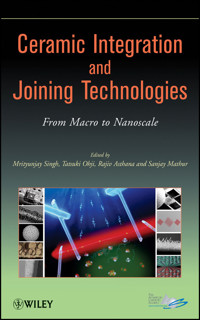
Ceramic Integration and Joining Technologies E-Book
169,99 €
Mehr erfahren.
- Herausgeber: John Wiley & Sons
- Kategorie: Fachliteratur
- Sprache: Englisch
This book joins and integrates ceramics and ceramic-based materials in various sectors of technology. A major imperative is to extract scientific information on joining and integration response of real, as well as model, material systems currently in a developmental stage.
This book envisions integration in its broadest sense as a fundamental enabling technology at multiple length scales that span the macro, millimeter, micrometer and nanometer ranges. Consequently, the book addresses integration issues in such diverse areas as space power and propulsion, thermoelectric power generation, solar energy, micro-electro-mechanical systems (MEMS), solid oxide fuel cells (SOFC), multi-chip modules, prosthetic devices, and implanted biosensors and stimulators. The engineering challenge of designing and manufacturing complex structural, functional, and smart components and devices for the above applications from smaller, geometrically simpler units requires innovative development of new integration technology and skillful adaptation of existing technology.
Sie lesen das E-Book in den Legimi-Apps auf:
Seitenzahl: 1330
Veröffentlichungsjahr: 2011
Ähnliche




















Table of Contents
Cover
Title page
Copyright page
PREFACE
CONTRIBUTORS
PART I: INTRODUCTION
1 CERAMIC INTEGRATION ACROSS LENGTH SCALES: TECHNICAL ISSUES, CHALLENGES, AND OPPORTUNITIES
INTRODUCTION
INTEGRATION ISSUES IN ADVANCED TECHNOLOGY SYSTEMS
MICROELECTRONICS AND NANOELECTRONICS
ENERGY
AERONAUTICS AND GROUND TRANSPORTATION
INTEGRATION ACROSS DOMAINS AND LENGTH SCALES
SCIENCE AND TECHNOLOGY FOR MACROSCALE INTEGRATION
INTEGRATION ISSUES IN ENERGY GENERATION AND DEVICE FABRICATION
INTEGRATION ISSUES AT THE NANOSCALE AND IN BIOLOGICAL SYSTEMS
PART II: SCIENCE AND TECHNOLOGY FOR MACROSCALE INTEGRATION
2 CERAMIC COMPONENT INTEGRATION BY ADVANCED BRAZING TECHNOLOGIES
INTRODUCTION
WETTABILITY, RESIDUAL STRESSES, AND JOINT RELIABILITY
JOINT DESIGN
JOINING OF CMCS
CONCLUSIONS
ACKNOWLEDGMENTS
3 JOINING AND INTEGRATION ISSUES OF CERAMIC MATRIX COMPOSITES FOR THE NUCLEAR INDUSTRY
INTRODUCTION
ITER
JET
CONCLUSION
FUSION REACTORS BEYOND ITER
CMCS IN ADVANCED FISSION REACTORS
CONCLUSIONS
ACKNOWLEDGMENTS
4 AIR BRAZING: A NEW METHOD OF CERAMIC–CERAMIC AND CERAMIC–METAL JOINING
INTRODUCTION
METHODS OF CERAMIC BRAZING
THE AIR BRAZING CONCEPT
AIR BRAZE FILLER METAL DESIGN: THE Ag–CuO SYSTEM
COMPOSITIONAL MODIFICATIONS TO THE Ag–CuO SYSTEM
SUMMARY
5 DIFFUSION BONDING OF SILICON CARBIDE AS AN ENABLING TECHNOLOGY FOR THE FABRICATION OF COMPLEX-SHAPED CERAMIC COMPONENTS
INTRODUCTION
EXPERIMENTAL
RESULTS AND DISCUSSION
CONCLUSIONS
ACKNOWLEDGMENTS
6 INTEGRATION OF CARBON–CARBON COMPOSITE TO METALLIC SYSTEMS FOR THERMAL MANAGEMENT APPLICATIONS
INTRODUCTION
MATERIALS FOR THERMAL MANAGEMENT
CARBON–CARBON COMPOSITES
INTEGRATION OF CARBON AND C/C COMPOSITES WITH METALS
JOINT INTEGRITY, MICROSTRUCTURE, AND COMPOSITION
MECHANICAL PROPERTIES OF C–C COMPOSITE/METAL JOINTS
THERMAL AND THERMOMECHANICAL CONSIDERATIONS
SUMMARY AND FUTURE PROSPECTS
7 CONTACT INTERACTION IN CARBON–METAL SYSTEMS FOR JOINING AND INTEGRATION
INTRODUCTION
WETTING OF GRAPHITE AND DIAMOND BY METALS NONREACTIVE TO CARBON
WETTING OF GRAPHITE BY GROUP VIII METALS
CARBIDE-FORMING METALS IN CONTACT WITH CARBON
WETTING OF GRAPHITE BY NONREACTIVE TO CARBON MELTS WITH THE ADDITION OF CARBIDE-FORMING METALS
THE INTERRELATION BETWEEN THERMODYNAMIC AND INTERFACIAL ACTIVITIES OF COMPONENTS IN WETTING SOLIDS BY MELTS
WETTING OF GRAPHITE BY GROUP VIII METAL MELTS WITH THE ADDITION OF REACTIVE AND NONREACTIVE METALS
RELATIONSHIP BETWEEN THE PHASE DIAGRAMS, THE INTERFACE STRUCTURE AFTER HARDENING, AND THE TYPE OF WETTING ISOTHERM
HIGH-PRESSURE EFFECT ON WETTING OF GRAPHITE AND DIAMOND BY METAL MELTS
CONCLUSIONS
PART III: INTEGRATION ISSUES IN ENERGY GENERATION AND DEVICE FABRICATION
8 INTEGRATION TECHNOLOGIES FOR FERRITES AND POWER INDUCTORS IN CERAMIC CIRCUIT BOARDS
INTRODUCTION
DEVICE PHYSICS
SYNTHESIS OF FERRITES
MAGNETIC PROPERTIES
EMBEDDED POWER INDUCTORS
CERAMIC MULTILAYER TRANSFORMERS
CONCLUSION
ACKNOWLEDGMENTS
9 OXIDE THERMOELECTRIC POWER GENERATION
INTRODUCTION
THERMOELECTRIC POWER GENERATION
THERMOELECTRIC OXIDE MATERIALS
DEVICE TECHNOLOGY
MODULES
CONCLUSION
10 INTEGRATION TECHNOLOGIES FOR SOLID OXIDE FUEL CELLS (SOFCS) AND OTHER ELECTROCHEMICAL REACTORS
INTRODUCTION
BASIS OF ELECTROCHEMICAL REACTORS
SOFC AND RELATED RESEARCH AND DEVELOPMENT
MICRO-SOFC DEVELOPMENT
ELECTROCHEMICAL DE-NOX REACTOR AND OTHER APPLICATIONS FOR THE CLEAN CAR TECHNOLOGY
11 INTEGRATION TECHNOLOGIES FOR SENSORS
INTRODUCTION
MICRODISPENSING METHOD
DEVICE FABRICATION
SENSOR PERFORMANCE
SUMMARY
12 ON-CHIP INTEGRATION OF FUNCTIONAL HYBRID MATERIALS AND COMPONENTS IN NANOPHOTONICS AND OPTOELECTRONICS
MONOLITHIC INTEGRATION TECHNIQUES
NANOFABRICATION TECHNIQUES
GENERAL SELF-ASSEMBLY TECHNIQUES
SAMS
ASSEMBLY OF NANOCRYSTALS
ALIGNMENT OF NANORODS USING DC ELECTRIC FIELD
ASSEMBLY OF NANOSTRUCTURES USING DEP AND OPTOELECTRONIC TWEEZERS (OETS)
NANOSKYVING: A NEW METHOD TO PRODUCE ARRAYS OF NANOSTRUCTURES
13 INTEGRATION OF MULTIFUNCTIONAL PROPERTIES IN THERMAL BARRIER COATINGS BY CHEMICAL VAPOR DEPOSITION
INTRODUCTION
TBC PROCESS
HIGH-SPEED COATING BY CONVENTIONAL CVD
HIGH-SPEED COATING BY LASER CVD
SUMMARY
14 THE CHANGING PHYSICS IN METAL INTERCONNECT RELIABILITY
BRIEF OVERVIEW OF INTERCONNECTION FAILURES
THE CHANGING PHYSICS OF EM
THE CHANGING PHYSICS OF SOLDER JOINT FAILURE
CONCLUSIONS
15 INTEGRATION ISSUES OF BARIUM STRONTIUM TITANATE THIN FILM FOR TUNABLE MICROWAVE APPLICATIONS
INTRODUCTION
BST DEVICE TECHNOLOGY FOR TUNABLE MICROWAVE APPLICATIONS
BST: STRUCTURE AND PROPERTIES
BST VARACTOR TECHNOLOGY
DEPOSITION TECHNOLOGIES FOR BST THIN FILMS
PROPERTIES INFLUENCING INTEGRATION ISSUES IN BST THIN FILMS
SUMMARY
ACKNOWLEDGMENTS
16 AEROSOL DEPOSITION (AD) INTEGRATION TECHNIQUES AND THEIR APPLICATION TO MICRODEVICES
INTRODUCTION
AD METHOD
ROOM TEMPERATURE IMPACT CONSOLIDATION (RTIC)
DEPOSITION PROPERTIES AND FILM PATTERNING
OTHER SIMILAR METHODS AND COMPARISON WITH THE AD METHOD
ELECTRICAL PROPERTIES OF AD FILMS
DEVICE APPLICATION
SUMMARY
ACKNOWLEDGMENTS
PART IV: NANO- AND BIOINTEGRATION
17 ADVANCES IN NANOINTEGRATION METHODOLOGIES: PATTERNING, POSITIONING, AND SELF-ASSEMBLY
INTRODUCTION
NI OF CERAMICS
NI OF PARTICLE ASSEMBLIES
18 INTEGRATION OF NANOWIRES IN NEW DEVICES AND CIRCUIT ARCHITECTURES: RECENT DEVELOPMENTS AND CHALLENGES
INTRODUCTION
1-D NANOSCALE BUILDING BLOCKS: SYNTHESIS AND GROWTH MECHANISM
STRUCTURE–PROPERTY CHARACTERIZATION AND RELATIONSHIP
DEVELOPMENT OF NANODEVICE ARCHITECTURES
SUMMARY
ACKNOWLEDGMENTS
19 INTEGRATING DIAMOND- LIKE CARBON INTO NANOSTRUCTURE DESIGNS (FABRICATING MICROSCALE AND NANOSCALE ARCHITECTURES OF DIAMOND-LIKE CARBON FILMS)
BASICS OF MICROMECHANICAL AND NANOMECHANICAL DEVICES
PREPARATION AND PROPERTIES OF DLC
DLC MECHANICAL DEVICES: FABRICATION AND PERFORMANCE
THE FUTURE OF DLC MICRO/NANOARCHITECTURES
ACKNOWLEDGMENT
20 SYNTHESIS, PROPERTIES, INTEGRATION, AND APPLICATIONS OF VERTICALLY ALIGNED CERAMIC NANOSTRUCTURES
INTRODUCTION
VERTICALLY ALIGNED CERAMIC NANOSTRUCTURE SYNTHESIS METHODS
PROPERTIES OF 1-D NANOSTRUCTURES
APPLICATIONS OF NANOWIRES AND INTEGRATION WITH THE DEVICES
21 NANOINTEGRATION BASED ON THIN-FILM TECHNOLOGY
INTRODUCTION
SPONTANEOUS ORDERING OF NANOSTRUCTURES
SELF-ORGANIZATION WITH TEMPLATE OR SCREENING METHODS
VLS GROWTH
PATTERNING TECHNIQUES
PHOTOLITHOGRAPHY AND ELECTRON-BEAM LITHOGRAPHY
NANOLITHOGRAPHY
NANOWIRE ELECTRONICS
SUMMARY
22 MASS-MANUFACTURABLE NANOWIRE INTEGRATION: CHALLENGES AND RECENT DEVELOPMENTS
INTRODUCTION
NANOWIRE FABRICATION
NANOWIRE ALIGNMENT AND POSITIONING
NANOWIRE INTERCONNECTION
BRIDGED NANOWIRES
CONCLUSION
ACKNOWLEDGMENTS
23 USABILITY OF INK-JET PRINTING TECHNOLOGY AND NANOMATERIALS IN ELECTRICAL INTERCONNECTIONS, ELECTRONIC PACKAGING, AND SYSTEM INTEGRATION FOR MICROELECTRONICS APPLICATIONS
INTRODUCTION
PRINTABLE ELECTRONICS AND INK-JET PRINTING TECHNOLOGIES
NANOPARTICLES AND THEIR APPLICABILITY TO INK-JET PRINTING TECHNOLOGY
INK-JET PRINTING IN MICROELECTRONICS APPLICATIONS
THE ENVIRONMENTAL ASPECTS OF PRINTABLE ELECTRONICS
CONCLUSIONS
24 BIOINTEGRATION OF PROSTHETIC DEVICES
INTRODUCTION
STRUCTURE OF BONE
CERAMICS FOR ARTIFICIAL JOINTS
CERAMICS FOR BONE SUBSTITUTES
BIOINTEGRATION BETWEEN BIOACTIVE CERAMICS AND LIVING BONE
REQUIREMENT FOR ARTIFICIAL MATERIALS TO FORM APATITE
FUNCTIONAL GROUPS EFFECTIVE FOR APATITE NUCLEATION
BIOACTIVE METALS
BIOACTIVE CERAMICS–POLYMER COMPOSITE
BIOACTIVE INORGANIC–ORGANIC HYBRIDS
BIOACTIVE CEMENTS
SUMMARY
Index
Copyright © 2011 by The American Ceramic Society. All rights reserved.
Published by John Wiley & Sons, Inc., Hoboken, New Jersey.
Published simultaneously in Canada.
No part of this publication may be reproduced, stored in a retrieval system, or transmitted in any form or by any means, electronic, mechanical, photocopying, recording, scanning, or otherwise, except as permitted under Section 107 or 108 of the 1976 United States Copyright Act, without either the prior written permission of the Publisher, or authorization through payment of the appropriate per-copy fee to the Copyright Clearance Center, Inc., 222 Rosewood Drive, Danvers, MA 01923, (978) 750-8400, fax (978) 750-4470, or on the web at www.copyright.com. Requests to the Publisher for permission should be addressed to the Permissions Department, John Wiley & Sons, Inc., 111 River Street, Hoboken, NJ 07030, (201) 748-6011, fax (201) 748-6008, or online at http://www.wiley.com/go/permissions.
Limit of Liability/Disclaimer of Warranty: While the publisher and author have used their best efforts in preparing this book, they make no representations or warranties with respect to the accuracy or completeness of the contents of this book and specifically disclaim any implied warranties of merchantability or fitness for a particular purpose. No warranty may be created or extended by sales representatives or written sales materials. The advice and strategies contained herein may not be suitable for your situation. You should consult with a professional where appropriate. Neither the publisher nor author shall be liable for any loss of profit or any other commercial damages, including but not limited to special, incidental, consequential, or other damages.
For general information on our other products and services or for technical support, please contact our Customer Care Department within the United States at (800) 762-2974, outside the United States at (317) 572-3993 or fax (317) 572-4002.
Wiley also publishes its books in a variety of electronic formats. Some content that appears in print may not be available in electronic formats. For more information about Wiley products, visit our web site at www.wiley.com.
Library of Congress Cataloging-in-Publication Data:
Ceramic integration and joining technologies : from macro to nanoscale / editors: Mrityunjay Singh . . . [et al.].
p. cm.
Includes index.
ISBN 978-0-470-39122-8 (hardback)
1. Ceramic materials. 2. Manufacturing processes. 3. Joints (Engineering) I. Singh, M. (Mrityunjay)
TA455.C43C4626 2011
620.1'4–dc22
2010053092
oBook ISBN: 978-1-118-05677-6
ePDF ISBN: 978-1-118-05675-2
ePub ISBN: 978-1-118-05676-9
PREFACE
There is an ever-increasing interest in research and development on integration technologies across length scales driven by the discovery of new materials and demonstration of their application potential. New and emerging materials require adaptive or innovative approaches to integrate them into components, assemblies, devices, and systems. Integration is, therefore, pervasive and cuts across disciplinary boundaries. It is recognized as a key enabling technology that connects innovation in materials with manufacturing. Yet, at present, there is no book-length treatment of integration of advanced materials, particularly ceramics offering authoritative and comprehensive coverage of innovative research on integration bridging various research domains. Much of the technical know-how on integration is either privy to the practitioners within such domains or those with special interest in it.
It is this pervasive nature of integration and current scarcity of a comprehensive resource dealing with it that motivated us to present the state of the art on ceramic integration in diverse fields in a single volume. The collective knowledge presented in the 24 chapters of this volume captures the diversity and unity of joining and integration methodologies across disciplines and length scales. The book addresses joining and integration issues at the macro-, micro- and nanoscales in diverse areas such as aerospace, nuclear and thermoelectric power, microelectromechanical systems, solid oxide fuel cells, multichip modules, prosthetic devices, and many others. The book envisions integration in a broad sense as a key enabler of advanced technology.
Our contributors, all frontline researchers and practitioners in their respective technical areas, represent universities, industry, and government and private research organizations of 12 different nations. They present contemporary perspectives on how integration is viewed and implemented in key application areas within their respective fields. We hope that this volume will stimulate fresh thinking and exchange of ideas and information on approaches to ceramic integration across fields and offer seminal insights into transformative solutions to challenges of integrating new and emerging materials into advanced technology components and systems.
New or transformative knowledge is not discovered in the same logical and structured manner as organized knowledge that gives identity to a discipline. New pathways often emerge from synergy between innovative and evolving approaches within diverse fields that conceivably lack commonality. It is our belief that such synergies may be facilitated by bringing a truly diverse group of practitioners on a common platform. World-class educational and research institutions across continents have begun to incorporate knowledge about integration into their professional studies curricula to train students in this niche area of materials and manufacturing. We believe that the book will serve the educational and research needs of both practitioners and graduate students involved and interested in joining and integration. Whereas the book does not aim to establish the pedagogical foundation in the science and technology of joining and integration, it provides in-depth cutting-edge treatment of selected areas that are widely recognized to be of critical importance.
We are grateful to all of our revered authors for their valuable contribution. We are indebted to John Wiley & Sons and their publication staff, in particular Rebekah Amos, for her wonderful support during the preparation of the book.
Mrityunjay Singh
Ohio Aerospace Institute, NASA Glenn Research Center, USA
Tatsuki Ohji
National Institute of Advanced
Industrial Science and Technology (AIST), Japan
Rajiv Asthana
University of Wisconsin-Stout, USA
Sanjay Mathur
University of Cologne, Germany
CONTRIBUTORS
R. Aggarwal, Department of Materials Science and Engineering, North Carolina State University, Raleigh, NC
Jun Akedo, National Institute of Advanced Industrial Science and Technology (AIST), Tsukuba, Ibaraki, Japan
Rajiv Asthana, University of Wisconsin-Stout, Department of Engineering and Technology, Menomonie, WI
Masanobu Awano, National Institute of Advanced Industrial Science and Technology (AIST), Shimo-Shidami, Moriyama-ku, Nagoya, Japan
S. Barth, Department of Chemistry, University College Cork, Cork, Ireland
Umur Caglar, Department of Electronics, Tampere University of Technology, Tampere, Finland
Valentina Casalegno, Politecnico di Torino, Dipartimento di Scienza dei Materiali e Ingegneria, Chimica-DISMIC, Torino, Italy
Daniel H. C. Chua, Department of Materials Science and Engineering, National University of Singapore, Singapore
J. T. Darsell, Energy Science and Technology Division, Pacific Northwest National Laboratory, Richland, WA
Hilmi Volkan Demir, Department of Electrical and Electronics Engineering, and Department of Physics, Nanotechnology Research Center, and Institute of Materials Science and Nanotechnology, Bilkent University, Ankara, Turkey
Talha Erdem, Department of Electrical and Electronics Engineering, Department of Physics, Nanotechnology Research Center, and Institute of Materials Science and Nanotechnology, Bilkent University, Ankara, Turkey
Monica Ferraris, Politecnico di Torino, Dipartimento di Scienza dei Materiali e Ingegneria Chimica-DISMIC, Torino, Italy
Delphine Flahaut, National Institute of Advanced Industrial Science and Technology (AIST), Ikeda, Osaka, Japan
Yoshinobu Fujishiro, National Institute of Advanced Industrial Science and Technology (AIST), Shimo-Shidami, Moriyama-ku, Nagoya, Japan
Ryoji Funahashi, National Institute of Advanced Industrial Science and Technology (AIST), Ikeda, Osaka, Japan
Takashi Goto, Institute for Materials Research, Tohoku University, Aoba-ku, Sendai, Japan
Venkataraman Gurumurthy, Electrical Engineering Department and Nanotechnology Research and Education Center, University of South Florida, Tampa, FL
Michael C. Halbig, U.S. Army Research Laboratory, Vehicle Technology Directorate-Glenn Site, NASA Glenn Research Center, Cleveland, OH
Koichi Hamamoto, National Institute of Advanced Industrial Science and Technology (AIST), Shimo-Shidami, Moriyama-ku, Nagoya, Japan
F. Hernández-Ramírez, EME/XaRMAE/IN2UB, Department of Electronics, University of Barcelona, Barcelona, Spain
Yuejin Hou, Division of Circuits and Systems, School of EEE, Nanyang Technological University, Singapore
M. Saif Islam, Integrated Nanodevices and Systems Research, Electrical and Computer Engineering, University of California, Davis, CA
Jolanta Janczak-Rusch, EMPA, Swiss Federal Laboratories for Materials Science and Technology, Dübendorf, Switzerland
C. Jin, Joint Department of Biomedical Engineering, University of North Carolina, Chapel Hill, NC
Masakazu Kawashita, Graduate School of Biomedical Engineering, Tohoku University, Aoba-ku, Sendai, Japan
Supriya Ketkar, Electrical Engineering Department and Nanotechnology Research and Education Center, University of South Florida, Tampa, FL
J. Y. Kim, Energy Science & Technology Division, Pacific Northwest National Laboratory, Richland, WA
Atsuko Kosuga, National Institute of Advanced Industrial Science and Technology (AIST), Ikeda, Osaka, Japan
Kunihito Koumoto, Graduate School of Engineering, Nagoya University, Furo-cho, Chikusa-ku, Nagoya, Japan
Ashok Kumar, Mechanical Engineering Department and Nanotechnology Research and Education Center, University of South Florida, Tampa, FL
Xijun Li, Department of Materials Science and Engineering, National University of Singapore, Singapore
O. B. Loginova, V.N. Bakul Institute for Superhard Materials, National Academy of Sciences of Ukraine, Kiev, Ukraine
Pauliina Mansikkamäki, Department of Electronics, Tampere University of Technology, Tampere, Finland
Yoshitake Masuda, National Institute of Advanced Industrial Science and Technology (AIST), Shimo-Shidami, Moriyama-ku, Nagoya, Japan
S. Mathur, Institute of Inorganic Chemistry, University of Cologne, Cologne, Germany
Ichiro Matsubara, National Institute of Advanced Industrial Science and Technology (AIST), Shimo-Shidami, Moriyama-ku, Nagoya, Japan
Richard Matz, Siemens Corporate Technology, Munich, Germany
Toshiki Miyazaki, Graduate School of Life Science and Systems Engineering, Kyushu Institute of Technology, Wakamatsu-ku, Kitakyushu, Japan
R. J. Narayan, Joint Department of Biomedical Engineering, University of North Carolina, Chapel Hill, NC
Maiko Nishibori, National Institute of Advanced Industrial Science and Technology (AIST), Shimo-Shidami, Moriyama-ku, Nagoya, Japan
Tatsuki Ohji, National Institute of Advanced Industrial Science and Technology (AIST), Shimo-Shidami, Moriyama-ku, Nagoya, Japan
Chikara Ohtsuki, Graduate School of Engineering, Nagoya University, Furo-cho, Chikusa-ku, Nagoya, Japan
Jussi Pekkanen, Department of Electronics, Tampere University of Technology, Tampere, Finland
Ville Pekkanen, Department of Electronics, Tampere University of Technology, Tampere, Finland
V. M. Perevertailo, V.N. Bakul Institute for Superhard Materials, National Academy of Sciences of Ukraine, Kiev, Ukraine
D. Pliszka, Nanoscience and Nanotechnology Initiative, National University of Singapore, Singapore, and Institute of Physics, Pomeranian University in Slupsk, Slupsk, Poland
J. D. Prades, EME/XaRMAE/IN2UB, Department of Electronics, University of Barcelona, Barcelona, Spain
S. Ramakrishna, Nanoscience and Nanotechnology Initiative, Department of Mechanical Engineering, and Division of Bioengineering, National University of Singapore, Singapore
A. Romano-Rodriguez, EME/XaRMAE/IN2UB, Department of Electronics, University of Barcelona, Barcelona, Spain
Milena Salvo, Politecnico di Torino, Dipartimento di Scienza dei Materiali e Ingegneria Chimica-DISMIC, Torino, Italy
Nigel M. Sammes, Department of Metallurgical and Materials Engineering, Colorado School of Mines, Golden, CO
Ataur Sarkar, Integrated Nanodevices and Systems Research, Electrical and Computer Engineering, University of California, Davis, CA
H. Shen, Inorganic and Materials Chemistry, University of Cologne, Cologne, Germany
Woosuck Shin, National Institute of Advanced Industrial Science and Technology (AIST) Shimo-Shidami, Moriyama-ku, Nagoya, Japan
Mrityunjay Singh, Ohio Aerospace Institute, NASA Glenn Research Center, Ceramics Branch, Cleveland, OH
S. Sundarrajan, Nanoscience and Nanotechnology Initiative, National University of Singapore, Singapore
Toshio Suzuki, National Institute of Advanced Industrial Science and Technology (AIST), Shimo-Shidami, Moriyama-ku, Nagoya, Japan
Cher Ming Tan, Division of Circuits and Systems, School of EEE, Nanyang Technological University, Singapore
Saori Urata, National Institute of Advanced Industrial Science and Technology (AIST), Ikeda, Osaka, Japan
Jani Valkama, Department of Electronics, Tampere University of Technology, Tampere, Finland
W. Wei, Department of Materials Science and Engineering, North Carolina State University, Raleigh, NC
K. S. Weil, Energy Science & Technology Division, Pacific Northwest National Laboratory, Richland, WA
Toshiro Yamaguchi, National Institute of Advanced Industrial Science and Technology (AIST), Shimo-Shidami, Moriyama-ku, Nagoya, Japan
PART I: INTRODUCTION
1
CERAMIC INTEGRATION ACROSS LENGTH SCALES: TECHNICAL ISSUES, CHALLENGES, AND OPPORTUNITIES
Mrityunjay Singh,1 Tatsuki Ohji,2 Rajiv Asthana,3 and Sanjay Mathur4
1Ohio Aerospace Institute, NASA Glenn Research Center, Cleveland, Ohio
2National Institute of Advanced Industrial Science and Technology (AIST), Nagoya, Japan
3University of Wisconsin-Stout, Menomonie, Wisconsin
4University of Cologne, Cologne, Germany
INTRODUCTION
The discovery of new and innovative materials has been known to culminate in major turning points in human history. The Bronze Age, the Iron Age, and, in our own times, the age of silicon are all considered as historical benchmarks that have transformed human civilization and have opened theretofore unforeseen possibilities for economic growth and societal impact. These progressive and defining periods in the history of humankind are marked not only by materials innovations (e.g., Damascus steel, used to make swords during 1100–1700 AD) but also, more importantly, by the transformation of new materials into goods usable for war, the arts, and commerce. The transformative impact and functional manifestation of new materials have been demonstrated in every historical era by their integration into new products, systems, assemblies, and devices.
INTEGRATION ISSUES IN ADVANCED TECHNOLOGY SYSTEMS
In modern times, the integration of new materials into usable products has a special relevance for the technological development and economic competitiveness of industrial societies. Current and evolving integration issues span such diverse areas as aeronautics, space, energy, nuclear power, thermoelectric (TE) power, nanoelectromechanical and microelectromechanical systems (MEMS), solid oxide fuel cells (SOFCs), multichip modules (MCMs), prosthetic devices, and many others.
MICROELECTRONICS AND NANOELECTRONICS
Integration is critically important in microelectronics at the wafer, chip, and package levels and is a means to achieving compact designs and cost reduction. Integration technology is used in the manufacture of MEMS, display devices, radio frequency (RF) components, and a number of other microelectronic components. In such applications, integration challenges are manifested in soldering, metallization, service reliability, joint degradation, vacuum seals, and other areas. Highly complex and sophisticated integration technologies are used in the construction of devices with semiconductor chips and in the development of methods to connect MEMS components.
MCMs integrate a number of unique functions into a system and consist of a group of advanced functional electronic devices that permit size reduction. MCMs combine integrated circuits (ICs) based on different materials and provide reliable low-cost integration technology to combine several ICs with a functional substrate. MCMs are designed based on thin-film multilayer structures on ceramic, silicon or metal that can offer the highest integration density per layer. They are usually built using joining and surface modification technology, such as sputtering and plating. The biggest advantage of joining is the ability to join any dissimilar materials if their surface mechanical properties, in terms of flatness, smoothness, and cleanliness, are sufficiently good.
Lesen Sie weiter in der vollständigen Ausgabe!
Lesen Sie weiter in der vollständigen Ausgabe!
Lesen Sie weiter in der vollständigen Ausgabe!
Lesen Sie weiter in der vollständigen Ausgabe!
Lesen Sie weiter in der vollständigen Ausgabe!
Lesen Sie weiter in der vollständigen Ausgabe!
Lesen Sie weiter in der vollständigen Ausgabe!
Lesen Sie weiter in der vollständigen Ausgabe!
Lesen Sie weiter in der vollständigen Ausgabe!
Lesen Sie weiter in der vollständigen Ausgabe!
Lesen Sie weiter in der vollständigen Ausgabe!
Lesen Sie weiter in der vollständigen Ausgabe!
Lesen Sie weiter in der vollständigen Ausgabe!
Lesen Sie weiter in der vollständigen Ausgabe!
Lesen Sie weiter in der vollständigen Ausgabe!
Lesen Sie weiter in der vollständigen Ausgabe!
Lesen Sie weiter in der vollständigen Ausgabe!
Lesen Sie weiter in der vollständigen Ausgabe!
Lesen Sie weiter in der vollständigen Ausgabe!
Lesen Sie weiter in der vollständigen Ausgabe!
Lesen Sie weiter in der vollständigen Ausgabe!
Lesen Sie weiter in der vollständigen Ausgabe!
Lesen Sie weiter in der vollständigen Ausgabe!
Lesen Sie weiter in der vollständigen Ausgabe!




