


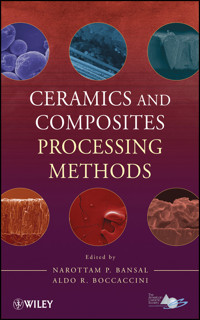
Ceramics and Composites Processing Methods E-Book
169,99 €
Mehr erfahren.
- Herausgeber: John Wiley & Sons
- Kategorie: Fachliteratur
- Sprache: Englisch
Examines the latest processing and fabrication methods There is increasing interest in the application of advanced ceramic materials in diverse areas such as transportation, energy, environmental protection and remediation, communications, health, and aerospace. This book guides readers through a broad selection of key processing techniques for ceramics and their composites, enabling them to manufacture ceramic products and components with the properties needed for various industrial applications. With chapters contributed by internationally recognized experts in the field of ceramics, the book includes traditional fabrication routes as well as new and emerging approaches in order to meet the increasing demand for more reliable ceramic materials. Ceramics and Composites Processing Methods is divided into three sections: * Densification, covering the fundamentals and practice of sintering, pulsed electric current sintering, and viscous phase silicate processing * Chemical Methods, examining colloidal methods, sol-gel, gel casting, polymer processing, chemical vapor deposition, chemical vapor infiltration, reactive melt infiltration, and combustion synthesis * Physical Methods, including directional solidification, solid free-form fabrication, microwave processing, electrophoretic deposition, and plasma spraying Each chapter focuses on a particular processing method or approach. Collectively, these chapters offer readers comprehensive, state-of-the-science information on the many approaches, techniques, and methods for the processing and fabrication of advanced ceramics and ceramic composites. With its coverage of the latest processing methods, Ceramics and Composites Processing Methods is recommended for researchers and students in ceramics, materials science, structural materials, biomedical engineering, and nanotechnology.
Sie lesen das E-Book in den Legimi-Apps auf:
Seitenzahl: 1031
Veröffentlichungsjahr: 2012
Ähnliche




















Table of Contents
Cover
Title page
Copyright page
PREFACE
CONTRIBUTORS
PART I: DENSIFICATION
1 SINTERING: FUNDAMENTALS AND PRACTICE
1.1 INTRODUCTORY OVERVIEW
1.2 PHYSICAL DESCRIPTION
1.3 VISCOUS SINTERING
1.4 SOLID-STATE SINTERING
1.5 LPS
1.6 DENSIFICATION AND DEFORMATION IN CONSTRAINED SINTERING
1.7 MICROSTRUCTURE-BASED MODELS
1.8 STRESS-ASSISTED SINTERING
1.9 FIELD-ASSISTED SINTERING (FAST)
1.10 SINTERING PRACTICE
1.11 SUMMARY
ACKNOWLEDGMENT
2 THE ROLE OF THE ELECTRIC CURRENT AND FIELD DURING PULSED ELECTRIC CURRENT SINTERING
2.1 INTRODUCTION
2.2 GRAIN GROWTH DURING SINTERING
2.3 MASS TRANSPORT DURING SINTERING PROCESSES
2.4 MACROSCOPIC PECS EFFECTS
2.5 MICROSCOPIC PECS EFFECTS
2.6 CONCLUSIONS AND FUTURE PROSPECTS
ACKNOWLEDGMENTS
3 VISCOUS-PHASE SILICATE PROCESSING
3.1 INTRODUCTION
3.2 SURFACE NUCLEATION
3.3 OVERALL CRYSTALLIZATION OF GLASS POWDERS
3.4 VISCOUS SINTERING
3.5 VISCOUS SINTER RETARDATION
3.6 APPLICATIONS AND PROCESSES
ACKNOWLEDGMENTS
ABBREVIATIONS
PART II: CHEMICAL METHODS
4 COLLOIDAL METHODS
4.1 INTRODUCTION
4.2 INTRODUCTION TO CERAMIC PROCESSING
4.3 ADDITIVES FOR CERAMIC PROCESSING
4.4 INTRODUCTION TO COLLOIDAL SCIENCE
4.5 RHEOLOGY OF CERAMIC SUSPENSIONS
4.6 SHAPING
4.7 CONCLUDING REMARKS
5 PROCESSING AND APPLICATIONS OF SOL–GEL GLASS
5.1 INTRODUCTION AND BACKGROUND
5.2 METHOD/TECHNIQUE/APPROACH
5.3 APPLICATIONS
5.4 GENERAL DISCUSSION
5.5 CONCLUDING REMARKS AND FUTURE DIRECTIONS
ACKNOWLEDGMENTS
6 GELCASTING OF CERAMIC BODIES
6.1 INTRODUCTION AND BACKGROUND
6.2 GEL-CASTING SYSTEMS
6.3 THE GEL-CASTING PROCESS: CASTING THROUGH SINTERING
6.4 APPLICATIONS IN PROCESSING/FABRICATION OF GELCAST CERAMICS
6.5 CHALLENGES AND OPPORTUNITIES IN GELCASTING
6.6 FINAL REMARKS
ACKNOWLEDGMENTS
7 POLYMER PROCESSING OF CERAMICS
7.1 INTRODUCTION
7.2 SILICON-CONTAINING PRECERAMIC POLYMERS: SYNTHESIS, CROSS-LINKING, AND CERAMIZATION
7.3 PDC MONOLITHS: FILLER-CONTROLLED PYROLYSIS
7.4 PDC FIBERS
7.5 PDC COATINGS AND MEMBRANES
7.6 PDC FOAMS
7.7 MICROFABRICATION OF PDC-BASED COMPONENTS FOR MICROELECTROMECHANICAL SYSTEMS (MEMS) APPLICATIONS
7.8 NONCONVENTIONAL PROCESSING TECHNIQUES
7.9 CONCLUSION
ACKNOWLEDGMENTS
8 CHEMICAL VAPOR DEPOSITION OF STRUCTURAL CERAMICS AND COMPOSITES
8.1 INTRODUCTION
8.2 CVD OF NONOXIDE STRUCTURAL CERAMICS AND COMPOSITES
8.3 CVD OF OXIDE STRUCTURAL CERAMICS AND COMPOSITES
8.4 CONCLUDING REMARKS AND FUTURE DIRECTIONS
9 CVI PROCESSING OF CERAMIC MATRIX COMPOSITES
9.1 INTRODUCTION AND BACKGROUND
9.2 DETAILED DESCRIPTION OF THE CVI METHOD
9.3 APPLICATIONS IN PROCESSING/FABRICATION OF CERAMICS AND COMPOSITES
9.4 GENERAL DISCUSSION
9.5 CONCLUDING REMARKS AND FUTURE DIRECTIONS
10 REACTIVE MELT-INFILTRATION PROCESSING OF FIBER-REINFORCED CERAMIC MATRIX COMPOSITES
10.1 INTRODUCTION
10.2 RMI
10.3 PROCESS MODELING
10.4 MICROSTRUCTURE AND PROPERTIES OF MELT-INFILTRATED COMPOSITES
10.5 APPLICATIONS
10.6 CONCLUSIONS AND FUTURE DIRECTIONS
11 COMBUSTION SYNTHESIS: AN UPDATE
11.1 INTRODUCTION
11.2 THEORETICAL CONSIDERATIONS
11.3 ELECTROMAGNETIC FIELD CS
11.4 GRAVITY-ASSISTED CS
11.5 CONCLUDING REMARKS
ACKNOWLEDGMENTS
PART III: PHYSICAL METHODS
12 DIRECTIONAL SOLIDIFICATION
12.1 INTRODUCTION
12.2 BACKGROUND
12.3 FABRICATION METHODS
12.4 CERAMIC EUTECTIC SYSTEMS
12.5 APPLICATIONS OF CERAMIC EUTECTICS
12.6 CONCLUSIONS AND FINAL REMARKS
ACKNOWLEDGMENTS
13 SOLID FREE-FORM FABRICATION OF 3-D CERAMIC STRUCTURES
13.1 INTRODUCTION
13.2 CAD
13.3 COMPONENT DEPOSITION AND POSTPROCESSING
13.4 CONCLUSIONS
14 MICROWAVE PROCESSING OF CERAMIC AND CERAMIC MATRIX COMPOSITES
14.1 PRINCIPLES OF DIELECTRIC HEATING
14.2 MICROWAVE APPLICATORS
14.3 MICROWAVE PROCESSING OF CERAMICS AND COMPOSITES
14.4 ADVANTAGES/DISADVANTAGES OF MICROWAVE PROCESSING OF CERAMICS AND COMPOSITES
14.5 CONCLUDING REMARKS: SCALE-UP AND INDUSTRIAL PERSPECTIVES
15 ELECTROPHORETIC DEPOSITION
15.1 INTRODUCTION
15.2 MECHANISMS AND FUNDAMENTALS OF EPD
15.3 APPLICATIONS OF EPD
15.4 FUTURE DEVELOPMENTS
15.5 CONCLUSIONS
ACKNOWLEDGMENTS
16 PROCESSING OF CERAMICS BY PLASMA SPRAYING
16.1 INTRODUCTION AND BACKGROUND
16.2 DETAILED DESCRIPTION OF THE TECHNIQUE
16.3 APPLICATIONS IN PROCESSING/FABRICATION OF CERAMICS AND COMPOSITES
16.4 GENERAL DISCUSSION
16.5 CONCLUDING REMARKS AND FUTURE DIRECTIONS
ACKNOWLEDGMENTS
Index
Copyright © 2012 by The American Ceramic Society. All rights reserved.
Published by John Wiley & Sons, Inc., Hoboken, New Jersey.
Published simultaneously in Canada.
No part of this publication may be reproduced, stored in a retrieval system, or transmitted in any form or by any means, electronic, mechanical, photocopying, recording, scanning, or otherwise, except as permitted under Section 107 or 108 of the 1976 United States Copyright Act, without either the prior written permission of the Publisher, or authorization through payment of the appropriate per-copy fee to the Copyright Clearance Center, Inc., 222 Rosewood Drive, Danvers, MA 01923, (978) 750-8400, fax (978) 750-4470, or on the web at www.copyright.com. Requests to the Publisher for permission should be addressed to the Permissions Department, John Wiley & Sons, Inc., 111 River Street, Hoboken, NJ 07030, (201) 748-6011, fax (201) 748-6008, or online at http://www.wiley.com/go/permissions.
Limit of Liability/Disclaimer of Warranty: While the publisher and author have used their best efforts in preparing this book, they make no representations or warranties with respect to the accuracy or completeness of the contents of this book and specifically disclaim any implied warranties of merchantability or fitness for a particular purpose. No warranty may be created or extended by sales representatives or written sales materials. The advice and strategies contained herein may not be suitable for your situation. You should consult with a professional where appropriate. Neither the publisher nor author shall be liable for any loss of profit or any other commercial damages, including but not limited to special, incidental, consequential, or other damages.
For general information on our other products and services or for technical support, please contact our Customer Care Department within the United States at (800) 762-2974, outside the United States at (317) 572-3993 or fax (317) 572-4002.
Wiley also publishes its books in a variety of electronic formats. Some content that appears in print may not be available in electronic formats. For more information about Wiley products, visit our web site at www.wiley.com.
Library of Congress Cataloging-in-Publication Data:
Ceramics and composites processing methods / edited by Narottam P. Bansal, Aldo R. Boccaccini.
p. cm.
Includes bibliographical references and index.
ISBN 978-0-470-55344-2
1. Ceramic materials. 2. Composite materials. I. Bansal, Narottam P. II. Boccaccini, A. R. (Aldo R.)
TA455.C43C469 2012
666–dc23
2011041443
PREFACE
NAROTTAM P. BANSAL AND ALDO R. BOCCACCINI
There is increasing interest in the application of advanced ceramic materials in areas as diverse as transport, energy, environment, communications, health, and aerospace. The increasing scope for the utilization of ceramic materials in a wide range of applications makes the in-depth understanding of processing technologies more necessary than ever before, which can lead to ceramic products and components having the desired properties and performance in-service. This book was conceived to offer in a single volume a broad selection of key processing techniques for ceramics and their composites incorporating different chapters written by internationally recognized experts in their respective fields. This book includes traditional fabrication routes as well as advanced approaches, which are being developed to tackle the increasing demand for more reliable ceramic materials.
This book is divided into three sections: “Densification,” “Chemical Methods,” and “Physical Methods.” The fundamentals and practice of sintering, pulsed electric current sintering and viscous phase silicate processing are covered in the first section on Densification. The Chemical Methods section consists of eight chapters covering colloidal methods, sol–gel, gel casting, polymer processing, chemical vapor deposition, chemical vapor infiltration, reactive melt infiltration, and combustion synthesis. The chapters on directional solidification, solid free-form fabrication, microwave processing, electrophoretic deposition, and plasma spraying are included under Physical Methods. Each chapter is focused on a particular processing method/approach based on the expertise of the respective authors who are specialists and internationally renowned researchers from various countries. The readers of this book will thus be able to find at one place state-of-the-art and comprehensive information on various approaches, techniques, and methods for processing and fabrication of advanced ceramics and ceramic composites.
This book is directed toward scientists, engineers, technologists, and researchers working in the industry, national research laboratories, and academia with interest in traditional and advanced ceramics as well as ceramic composites. Senior undergraduates as well as graduate students pursuing a degree in ceramics or materials science and engineering will also find this book useful. All the chapters are stand-alone pieces. Some duplication, especially in the introductory sections, and nonuniformity of symbols and nomenclature may be present.
This book is the result of truly an international effort with contributions by authors from 10 different countries. The editors are grateful to all the authors for their valuable contributions as well as their cooperation, which led to the timely publication of this volume. Thanks are due to Ms. Anita Lekhwani, Senior Acquisitions Editor for Chemistry, Biotechnology, and Materials Science, John Wiley & Sons, Inc., for her help, cooperation, and understanding through the entire publication process of this book.
Narottam P. Bansal
Cleveland, Ohio
Aldo R. Boccaccini
Erlangen, Germany
CONTRIBUTORS
Narottam P. Bansal, NASA Glenn Research Center, Structures and Materials Division, Cleveland, OH
Laxmidhar Besra, Institute of Minerals and Materials Technology (IMMT), Bhubaneswar, Orissa, India
S. B. Bhaduri, Departments of MIME and Surgery, University of Toledo, Toledo, OH
Aldo R. Boccaccini, Institute of Biomaterials, University of Erlangen-Nuremberg, Erlangen, Germany
Rajendra K. Bordia, Department of Materials Science and Engineering, University of Washington, Seattle, WA
Héctor Camacho-Montes, Basic Science Department, Institute for Engineering and Technology (UACJ), Cd. Juarez, Chih., Mexico
Maria Cannio, Department of Materials and Environmental Engineering, University of Modena and Reggio Emilia, Modena, Italy
Bruce Dunn, Department of Materials Science and Engineering, University of California at Los Angeles, Los Angeles, CA
Katherine T. Faber, Department of Materials Science and Engineering, Robert R. McCormick School of Engineering and Applied Science, Northwestern University, Evanston, IL
Takashi Goto, Institute for Materials Research, Tohoku University, Japan
S. G. Huang, K.U.Leuven, Department of Metallurgy and Materials Engineering (MTM), Heverlee, Belgium
Emanuel Ionescu, Technische Universität Darmstadt, Institut für Materialwissenschaft, Darmstadt, Germany
Esther H. Lan, Department of Materials Science and Engineering, University of California at Los Angeles, Los Angeles, CA
A. Laptev, K.U.Leuven, Department of Metallurgy and Materials Engineering (MTM), Heverlee, Belgium and Donbass State Engineering Academy, Department of Mechanical Engineering, Kramatorsk, Ukraine
Andrea Lazzeri, Department of Chemical Engineering, Industrial Chemistry and Materials Science, University of Pisa, Pisa, Italy
Cristina Leonelli, Department of Materials and Environmental Engineering, University of Modena and Reggio Emilia, Modena, Italy
Jennifer A. Lewis, Department of Materials Science and Engineering, University of Illinois, Urbana, IL
Rodrigo Moreno, Instituto de Cerámica y Vidrio, CSIC, Madrid, Spain
Ralf Müller, BAM Federal Institute for Materials Research and Testing, Berlin, FRG
Saša Novak, Department for Nanostructured Materials, Jožef Stefan Institute, Ljubljana, Slovenia
Víctor M. Orera, Instituto de Ciencia de Materiales de Aragón, CSIC-Universidad de Zaragoza, Facultad de Ciencias, Zaragoza, Spain
José I. Peña, Instituto de Ciencia de Materiales de Aragón, CSIC-Universidad de Zaragoza, Facultad de Ciencias, Zaragoza, Spain
Stefan Reinsch, BAM Federal Institute for Materials Research and Testing, Berlin, FRG
Ralf Riedel, Technische Universität Darmstadt, Institut für Materialwissenschaft, Darmstadt, Germany
Noah O. Shanti, Department of Materials Science and Engineering, Robert R. McCormick School of Engineering and Applied Science, Northwestern University, Evanston, IL
James E. Smay, School of Chemical Engineering, Oklahoma State University, Stillwater, OK
O. Van der Biest, K.U. Leuven, Department of Metallurgy and Materials Engineering (MTM), Heverlee, Belgium
K. Vanmeensel, K.U. Leuven, Department of Metallurgy and Materials Engineering (MTM), Heverlee, Belgium
Robert Vaßen, IEF-1, Forschungszentrum Jülich GmbH, 52425 Jülich, Germany
Paolo Veronesi, Department of Materials and Environmental Engineering, University of Modena and Reggio Emilia, Modena, Italy
J. Vleugels, K.U. Leuven, Department of Metallurgy and Materials Engineering (MTM), Heverlee, Belgium
Natalie Wali, Honeywell Aerospace, Phoenix, AZ
J.-M. Yang, Department of Materials Science and Engineering, University of California, Los Angeles, CA
PART I DENSIFICATION
1
SINTERING: FUNDAMENTALS AND PRACTICE
RAJENDRA K. BORDIA AND HÉCTOR CAMACHO-MONTES
1.1 INTRODUCTORY OVERVIEW
Although sintering has been practiced for thousands of years [1], significant advances in scientifically understanding the phenomenon have been made only in the last six decades. In a broad sense, sintering is the extension of the contact area between powder particles by the transport of material to or around pores under appropriate conditions of temperature, pressure, and environment [2]. The goal of the sintering practice, in general, is to produce a coherent body (from rather fragile green bodies) with controlled microstructure, in some cases with controlled porosity [3, 4]. The emphasis of sintering theory, modeling, and analysis is to predict the path of the microstructural development and its dependence on controllable parameters (e.g., temperature, time, environment, and particle size).
Numerous attempts have been made to model the sintering phenomenon, and many experimental studies have been conducted to evaluate the theories and also the important effects of process parameters. Some of the important aspects of the sintering theory and practice are reviewed in this chapter. Readers are referred to many excellent reviews, monographs, and textbooks for a more in-depth study [5–16]. Section 1.2 deals with the physical description of the process, viz., the stages of sintering and the thermodynamic driving force for sintering. The next three sections deal with the classical models for sintering (Section 1.3 for viscous sintering, Section 1.4 for solid-state sintering, and Section 1.5 for liquid-phase sintering [LPS]). Section 1.6 focuses on constrained sintering and Section 1.7 summarizes the advanced kinetic and microstructural evolution models. Section 1.8 focuses on the effect of external stresses on sintering. Section 1.9 focuses on the newly discovered significant effect of external fields on sintering. Finally, in Section 1.10, some of the important aspects of sintering practice are presented.
1.2 PHYSICAL DESCRIPTION
1.2.1 The Stages of Sintering
It is widely accepted to divide the overall sintering process in three sequential stages. In general, these stages are not discrete, and usually, there is a considerable overlap between two consecutives ones. These stages are defined according to the morphology of the grains and the porosity.
The first stage or the initial stage of sintering corresponds to the situation when necks are forming and growing between particles, and they remain distinct as shown schematically in Figure 1.1a,b. At the end of this stage, the contact area increases by up to 20% with only a small densification (interparticle penetration). Consequently, the compact densification is only a few percent. A marked decrease in the specific surface area of the compact occurs due to surface smoothing. The grain boundaries between the particles remain in the contact plane due to the tensile stresses resulting from the surface tension.
Figure 1.1. Illustrations of the stage of sintering: (a) initial stage—spheres in tangential contact; (b) near the end of the initial stage, the neck between particles starts to grow; (c) intermediate stages with continuous pore channels at grain edges and large contact area between grains; (d) final stage, tetrahedral pores at four grain intersections.
Reprinted with permission from Coble [17], copyright 1961, American Institute of Physics.
The second stage, or the intermediate stage of sintering, is characterized by a more or less continuous network of pore channels along the grain edges (Fig. 1.1c). During this stage, the pore channel shrinks and grains grow. Most of the densification, and also the growth in the contact area, occurs during this stage.
The pore channels continue to shrink until they pinch off and form isolated spheriodized pores (Fig. 1.1d). This marks the beginning of the third or the final stage of densification. In this stage, the pore volume fraction asymptotically approaches zero. In some cases, these closed pores may trap gases, making their elimination difficult.
1.2.2 The Thermodynamic Driving Force
There is broad agreement in the literature regarding the driving force for sintering. The starting particulate configuration is far from the equilibrium state, and the driving force comes from the excess free energy. Hence, the reduction of the free energy is taken as the sintering driving force.
This excess free energy exits in the powder compact due to the large surface area and defects. In the classical sintering literature, emphasis has been on the excess free energy due to surfaces. As sintering proceeds, porosity decreases, leading to a reduction of the solid–vapor interfacial area. The solid–vapor interfaces are replaced by solid–solid interfaces. When grain growth occurs, the solid–solid interfacial area also decreases. Thermodynamically, the change in free energy can be written as
(1.1)
where δGsystem is the change in the free energy of the sintering system, γSV is the energy per unit area of the solid–vapor interface, and γSS is the energy/area of the solid–solid interface. In this equation, during sintering, the first term is negative since the area of the solid–vapor interface (ASV) decreases. Considering that grain growth implies a decrease of the solid–solid interface, the second term may be either positive or negative since grain boundary area (ASS) may increase or decrease depending on how fast grain growth is going on. If grain growth does not occur, the second term is always positive as grain contacts grow during sintering. As long as is negative, a driving force for sintering exits.
Lesen Sie weiter in der vollständigen Ausgabe!
Lesen Sie weiter in der vollständigen Ausgabe!
Lesen Sie weiter in der vollständigen Ausgabe!
Lesen Sie weiter in der vollständigen Ausgabe!
Lesen Sie weiter in der vollständigen Ausgabe!
Lesen Sie weiter in der vollständigen Ausgabe!
Lesen Sie weiter in der vollständigen Ausgabe!
Lesen Sie weiter in der vollständigen Ausgabe!
Lesen Sie weiter in der vollständigen Ausgabe!
Lesen Sie weiter in der vollständigen Ausgabe!
Lesen Sie weiter in der vollständigen Ausgabe!
Lesen Sie weiter in der vollständigen Ausgabe!
Lesen Sie weiter in der vollständigen Ausgabe!
Lesen Sie weiter in der vollständigen Ausgabe!
Lesen Sie weiter in der vollständigen Ausgabe!
Lesen Sie weiter in der vollständigen Ausgabe!




