


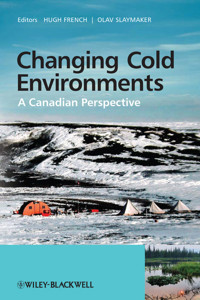
Changing Cold Environments E-Book
51,99 €
Mehr erfahren.
- Herausgeber: John Wiley & Sons
- Kategorie: Wissenschaft und neue Technologien
- Sprache: Englisch
Changing Cold Environments; Implications for Global Climate Change is a comprehensive overview of the changing nature of the physical attributes of Canada's cold environments and the implications of these changes to cold environments on a global scale. The book places particular emphasis on the broader environmental science and sustainability issues that are of increasing concern to all cold regions if present global climate trends continue. Clearly structured throughout, the book focuses on those elements of Canada's cold environments that will be most affected by global climate change - namely, the tundra, sub-arctic and boreal forest regions of northern Canada, and the high mid-latitude mountains of western Canada. Implications are considered for similar environments around the world resulting in a timely text suitable for second and third year undergraduates in the environmental or earth sciences courses.
Sie lesen das E-Book in den Legimi-Apps auf:
Seitenzahl: 562
Veröffentlichungsjahr: 2011
Ähnliche




















Contents
Cover
Title Page
Copyright
List of Contributors
The Editors
Contributing Authors
Preface
Glossary
Part One: Spatial and Temporal Variability of Canada's Cold Environments
Chapter 1: Cold Canada and the Changing Cryosphere
1.1 Introduction
1.2 The Cryosphere
1.3 Cold Canada
1.4 Cold Climates
1.5 Arctic and Alpine Considerations
1.6 Canada's Physical Geography
References
Discussion Questions
Some Useful Internet Sources
Chapter 2: The Late Quaternary Glaciation of Northern Canada
2.1 Introduction
2.2 Landforms and the Late Quaternary Glaciations
2.3 Late Quaternary Sea Level Change and its Relationship to Glaciation History
2.4 Late Quaternary Glaciation and Deglacial History
2.5 Wider Implications of Canadian Arctic Ice Sheet Dynamics
2.6 Holocene Glacial Events
References
Discussion Questions
Some Useful Internet Sources
Chapter 3: The Evolution of Polar Desert and Tundra Ecosystems
3.1 Introduction
3.2 The Nature of the Environment
3.3 Ecology of Arctic Plants
3.4 Vegetation Zonation
3.5 Arctic Oases
3.6 Long term Evolution of Canadian Arctic Ecosystems
3.7 The Quaternary
3.8 Postglacial Climate and Vegetation Change in Arctic Canada
References
Discussion Questions
Some Useful Internet Sources
Chapter 4: Remote Sensing and Canadian Snow Climatology
4.1 Introduction
4.2 The Importance of Snow in the Earth System
4.3 Snow Measurements in Canada
4.4 Remote Sensing of Snow
4.5 Snow Variations Inferred from Remote Sensing Observations
4.6 Discussion
4.7 Conclusion
4.8 Acknowledgement
References
Discussion Questions
Some Useful Internet Sources
Part Two: The Changing Cryosphere
Chapter 5: The Changing Climates
5.1 Introduction
5.2 Late Pliocene
5.3 Quaternary History
5.4 Postglacial Conditions
5.5 The Last Two Millennia
5.6 Recent Changes
5.7 The Future
References
Discussion Questions
Some Useful Internet Sources
Chapter 6: Snow and Runoff: Processes, Sensitivity and Vulnerability
6.1 Introduction
6.2 Snow Accumulation
6.3 Land Cover
6.4 Snow Ablation
6.5 Snowmelt Runoff Processes
6.6 Streamflow
6.7 Snowmelt Floods in Large Basins
6.8 Snow Vulnerability
References
Discussion Questions
Some Useful Internet Sources
Chapter 7: Permafrost Distribution and Stability
7.1 Introduction
7.2 Distribution of Permafrost
7.3 Thermal Regime of Permafrost
7.4 Permafrost and Climate Change
7.5 Conclusions
References
Discussion Questions
Some Useful Internet Sources
Chapter 8: Sea Ice in Canada
8.1 Introduction
8.2 What is Sea Ice?
8.3 The Physical Nature of Sea Ice
8.4 Spatial and Temporal Distribution of Sea Ice
8.5 Sea Ice and Climate Change
8.6 Implications for Northern Communities, Economic Development and the Environment
References
Discussion Questions
Some Useful Internet Sources
Chapter 9: Lake and River Ice in Canada
9.1 Introduction
9.2 Role in the Climate System
9.3 Climatic Controls
9.4 Historical Trends and Linkages to Climate
9.5 Future Ice Regime Projections
9.6 Implications of Ice Regime Changes
References
Discussion Questions
Some Useful Internet Sources
Part Three: The Ever-Changing Scenery
Chapter 10: Climate Change and the Central Canadian Treeline
10.1 Introduction
10.2 The Central Canadian Treeline Zone Today
10.3 Current Warming at the Central Canadian Treeline
10.4 Response of the Central Canadian Treeline to Warming Temperatures
Acknowledgements
References
Discussion Questions
Some Useful Internet Sources
Chapter 11: Geomorphic Change in Northern Canada
11.1 Introduction
11.2 Lessons from the Past
11.3 Freezing, Thawing and Bedrock Instability
11.4 Warming Permafrost
11.5 Changes in Azonal Processes
11.6 Geotechnical Implications of Warming Permafrost
11.7 Conclusions
References
Discussion Questions
Some Useful Internet Sources
Chapter 12: Geomorphic Change in Canada's Temperate Mountains
12.1 Introduction
12.2 Present Morphology
12.3 Spatial Variability of Ecology and Morphology
12.4 Hydroclimate and Cryospheric Phenomena
12.5 Rates and Kinds of Geomorphic Processes
12.6 Disturbances Regimes and Landscape Transitions
12.7 Conclusions
References
Discussion Questions
Some Useful Internet Sources
Chapter 13: Risk from Cold-climate Hazards in the Canadian Cordillera
13.1 Introduction
13.2 Cold-climate Hazards
13.3 Risk and Climate Variability
13.4 Conclusions
References
Discussion Questions
Some Useful Internet Sources
Chapter 14: Societal Aspects of Changing Cold Environments
14.1 Introduction
14.2 Cultural Pursuits and Indigenous Rights
14.3 Local and Broader Implications of Changing Sea Ice
14.4 Northern Governance
14.5 Conclusions
References
Discussion Questions
Some Useful Internet Sources
Chapter 15: The Changing Canadian Cryosphere, Globalization and Global Environmental Change
15.1 Introduction
15.2 The Question of Scale
15.3 Adaptive Management
15.4 Globalization
15.5 Conclusion
References
Discussion Questions
Some Useful Internet Sources
Colour Plates
Index
This edition first published 2012 © 2012 by John Wiley & Sons, Ltd
Wiley-Blackwell is an imprint of John Wiley & Sons, formed by the merger of Wiley's global Scientific, Technical and Medical business with Blackwell Publishing.
Registered office: John Wiley & Sons, Ltd, The Atrium, Southern Gate, Chichester, West Sussex, PO19 8SQ, UK
Editorial offices: 9600 Garsington Road, Oxford, OX4 2DQ, UK
The Atrium, Southern Gate, Chichester, West Sussex, PO19 8SQ, UK
111 River Street, Hoboken, NJ 07030-5774, USA
For details of our global editorial offices, for customer services and for information about how to apply for permission to reuse the copyright material in this book please see our website at www.wiley.com/wiley-blackwell.
The right of the author to be identified as the author of this work has been asserted in accordance with the UK Copyright, Designs and Patents Act 1988.
All rights reserved. No part of this publication may be reproduced, stored in a retrieval system, or transmitted, in any form or by any means, electronic, mechanical, photocopying, recording or otherwise, except as permitted by the UK Copyright, Designs and Patents Act 1988, without the prior permission of the publisher.
Designations used by companies to distinguish their products are often claimed as trademarks. All brand names and product names used in this book are trade names, service marks, trademarks or registered trademarks of their respective owners. The publisher is not associated with any product or vendor mentioned in this book. This publication is designed to provide accurate and authoritative information in regard to the subject matter covered. It is sold on the understanding that the publisher is not engaged in rendering professional services. If professional advice or other expert assistance is required, the services of a competent professional should be sought.
Library of Congress Cataloging-in-Publication Data
French, Hugh.
Changing Cold Environments: A Canadian Perspective / edited by Hugh French and Olav Slaymaker.
p. cm.
Includes bibliographical references and index.
ISBN 978-0-470-69968-3 (cloth) – ISBN 978-0-470-69969-0 (pbk.)
1. Cold regions. 2. Natural history–Canada. 3. Natural history–Canada, Northern. 4. Physical geography–Canada. 5. Physical geography–Canada, Northern. I. Title.
GB648.15.F74 2012
551.310971–dc23
2011017016
List of Contributors
The Editors
HUGH FRENCH taught at the University of Ottawa in the Departments of Geography (1967–2003), Geology (1982–1992) and Earth Sciences (1998–2003). He has broad experience of the cold non-glacial regions of the world. He is now Emeritus Professor, University of Ottawa and Adjunct Professor, Department of Geography, University of Victoria.
OLAV SLAYMAKER taught at the University College of Wales, Aberystwyth (1964–1968) and at the University of British Columbia in the Department of Geography (1968–2004). He is a geomorphologist interested in global environmental change. He has extensive experience of mountainous terrain and geomorphic systems. He is now Emeritus Professor, University of British Columbia.
Contributing Authors
DAVID BARBER holds the Canada Research Chair of Arctic System Science and is Director, Centre for Earth Observation Science, University of Manitoba. His research focuses on the causes and consequences of climate forcing of sea ice in the Arctic.
ROGER BARRY is former Director of the National Snow and Ice Data Center (NSIDC), in the Cooperative Institute for Research in Environmental Sciences (CIRES) and Distinguished Professor Emeritus in Geography, University of Colorado, USA. He has published 20 books and over 250 papers on Arctic and mountain climates, climate change and cryospheric science. He currently holds a Humboldt Prize Fellowship, 2009–2012.
CHRIS BURN holds the NSERC Northern Research Chair for Permafrost in the Yukon and Northwest Territories. He is Professor in the Department of Geography and Environmental Studies, Carleton University, Ottawa. He conducts field research in the Yukon and western Arctic Canada.
DAVID EVANS is Reader in Geography, Durham University, UK. He is a glacial geomorphologist who works in a wide range of glaciated landscapes, including Iceland, Arctic and western Canada, New Zealand and Northern Scandinavia. He has published widely on glacial landforms, glacial sedimentology and stratigraphy, and Quaternary palaeoglaciology.
KONRAD GAJEWSKI is Professor of Geography and Director of the Laboratory for Paleoclimatology and Climatology, University of Ottawa. He has published widely in the fields of arctic and subarctic paleoclimatology, paleoecology and paleolimnology.
JIM GARDNER is a physical geographer who has taught at the University of Waterloo and the University of Manitoba. He specializes in mountain geomorphology and hazards. He is now Adjunct Professor, Department of Geography, University of Victoria.
RICHARD KELLY is Professor, Department of Geography and Environmental Management, University of Waterloo and a group leader in the Interdisciplinary Centre on Climate change, University of Waterloo. His research interests are in snow and ice hydrology, especially the measurement of snow and ice from Earth-observing remote-sensing instruments
GITA LAIDLER is Assistant Professor, Department of Geography and Environmental Studies, Carleton University, Ottawa. Her research concerns the changes imposed on Inuit communities and their lifestyle by changing climate and associated environmental change. She works in Igloolik, Iqaluit and other northern settlements.
JENNIFER LUKOVICH is Research Associate at the Centre for Earth Observation Science (CEOS), University of Manitoba. Her research interests include the investigation of sea ice and atmospheric dynamics in the Arctic.
GLEN MACDONALD taught in the Department of Geography, McMaster University, 1984–1995, and is currently Director of the Institute of the Environment and Sustainability of the University of California Los Angeles, USA. He teaches in the UCLA departments of Geography and Ecology and Evolutionary Biology and conducts research on climate change, arctic and alpine tree lines, northern soil carbon and water resources.
JOHN POMEROY is Canada Research Chair in Water Resources and Climate Change and Director of the Centre for Hydrology, University of Saskatchewan. His research interests include snow hydrology, forest hydrology, frozen soils, and the hydrology of the mountains, prairies and northern Canada.
TERRY PROWSE is Professor of Geography, University of Victoria, and holds the Chair in Climate Impacts and Water Resources, University of Victoria. Current research interests include circumpolar cold regions hydrology and environmental effects of river ice.
MARK SERREZE is the Director of the National Snow and Ice Data Center (NSIDC) and Professor of Geography, University of Colorado, Boulder, USA. He has published extensively upon climate change and cryospheric issues.
MING-KO WOO is Emeritus Professor, School of Geography and Earth Science, McMaster University, and a professional hydrologist of the American Institute of Hydrology. He has conducted field studies in Canada and China, specializing in snow, permafrost, wetlands and water-related subjects.
Preface
Eighteen years ago we edited a volume called Canada's Cold Environments. It was a type of regional physical geography of northern Canada and its mountains. In its preface we set the tone by noting that ‘coldness is a pervasive Canadian characteristic, part of the nation's culture and history’. In spite of many indications that Canada has become a warmer place since 1993, coldness remains a pervasive and distinct Canadian characteristic. There is, however, sufficient change in the hydroclimate, and indeed in the ‘oekumene’ of Canada as a whole (those parts of Canada that are inhabited by permanent residents), to warrant a fresh look at Canada's changing physical environment. Moreover, the Canadian experience is a useful barometer against which similar changes in the other regions of the northern Polar World can be compared.
Whether or not the globe as a whole is experiencing a long term warming trend fuelled by increasing greenhouse-gas concentrations in the atmosphere or a cyclic and short term warming trend caused by geophysical drivers such as solar emission or changing Sun–Earth relations is a mega-problem upon which we are not willing or competent to comment. What we do know is that Canada's cold regions, and especially its arctic regions, are experiencing rates of warming that are unprecedented in the past millennium. We also know that human demands on the natural resources of Canada's cold regions are growing apace.
The most obvious changes relate to shrinking glaciers, reductions in annual sea ice extent, and longer duration of ice-free periods on rivers and lakes. These are physical realities that can be readily observed and measured. Others are more subtle. But these changes coincide with a period of increasing global demographic pressure and intensifying resource demand at a time when it is becoming clear that globalization is upon us. In addition, the sovereignty of Canada's Arctic may soon be questioned as the possibility of an ice-free sea route between Europe and the emerging economies of Southeast Asia becomes increasingly a reality. The net effect of these accelerating processes is to focus new and urgent attention on Canada's cold environments.
We have assembled 14 experts, in contrast with just nine in our earlier book. All have extensive Canadian experience. The new topics which now require separate chapter treatment are sea ice, river and lake ice, remotely sensed imagery and the ways in which the northern indigenous peoples (in this case the Inuit) interact with this rapidly changing environment. We have also given more space to ecological changes and provide deeper understanding of the glacial and postglacial histories of our cold environments. In this way we hope to counteract some of the more emotional responses to contemporary environmental change. It is our conviction that environments have always changed and continue to evolve. In fact, as a society, we can even be grateful for the rapid environmental changes of the last 2.5 million years (the Quaternary); many would argue that such changes have been partially responsible for stimulating the evolution of Homo sapiens. Thus, our emphasis upon current and future change indicates our own belief in our continued evolution.
In this volume we, and our contributors, have attempted to provide an authoritative, yet readable scientific statement about the nature of Canada's changing cold environments. We have not attempted a comprehensive geographic coverage. Instead, we have focused on the distinctive attributes of Canada's changing cold environments. Their temporal and spatial variability is central, as is the interaction of northern peoples with those environments. As in our earlier volume, the constraints and opportunities created by coldness for human activity are also considered.
We have both seen a progressive evolution of Canada as a pre-eminent cold-climate nation over the last 40 years. Thus, our objectives in undertaking an assessment of this change have been threefold. The first has been to provide insight into the ways in which biophysical processes are influenced by coldness at a range of scales. The second has been to provide a biophysical context for understanding the human geography of Canada. The third has been to examine current rates of environmental change and, if projected into the future, how those rates of change will affect Canada's cold environments.
We wish to thank the authors of the individual chapters for their willingness to join us in this venture and to share their experience and wisdom. Needless to say, not all of them provided material in a timely and efficient manner. But they have all achieved, in our opinion, the desired mix of authoritative information and accessible style. Our cartographers, Ole Heggen and Eric Leinberger, deserve special recognition for the quality of the figures and images.
Any lack of coherence and errors of fact or interpretation are our responsibility and we request your indulgence.
Hugh French Olav Slaymaker June 2011
Glossary
Active layerThe layer of ground above permafrost that freezes and thaws each year.AlbedoThe reflectivity of an entity. An albedo of 0 (1) indicates that all solar energy is absorbed (reflected).AlpA shoulder high on the side of a glacial trough.Arctic(1) Geographic definition: the area north of the Arctic Circle (latitude 66° 33′N); (2) Climatic definition: the region where the warmest monthly mean air temperature does not exceed 10 °C and the coldest is below 0 °C.AVHRR(Airborne Very High Resolution Radiometer). A sensor system deployed on NOAA satellites that returns 1.1 km resolution images of the Earth.BubnovA unit for quantifying rates of slope retreat or ground loss.Co-managementA co-management agreement is a management plan that specifies the objectives, partners to the agreement, and rights and responsibilities of the partners.Community-based researchA participatory approach to research in resource and environmental management.Comprehensive land claimsAboriginal title to land.CryosphereIce sheets, glaciers, sea ice, river and lake ice, snow, and both seasonally and perennially frozen ground.Debris flowA form of mass movement of a mixture of water, rocks, fine sediments and/or organic debris.Degree days(1) Growing degree-days (GDD) are usually measured from a threshold value of 5.5 °C and defined as Σ(Ta − 5.5) °C where Ta is mean air temperature for the day and Σ indicates that successive daily values are summed. (2) Freezing degree-days (FDD) are the summation of the daily temperatures that are below 0 °C.Disjunc(as used in ecology) An organism that is found in two locations that is separated by more than the usual dispersal distance.ELA(Equilibrium Line Altitude) A notional altitudinal line on a glacier where ablation balances accumulation.First year sea iceSea ice that has not yet survived a winter, with thicknesses ranging from 30 cm at the beginning of the season to 2 m near the end of the season.Flaw leadA linear crack in sea ice created by divergent winds and/or shear zones.Frazil iceSmall spicules of ice that nucleate in river flow under a slight amount of supercooling.FreshetThe rise in spring river flow, typically due to snowmelt.GeopoliticsAn area of geographical enquiry which considers space to be important in understanding the constitution of international relations.Governance(1) the nature of organizations and (2) the nature of the relations between organizations.Ground iceIce formed in freezing and frozen ground. Ground ice may constitute between 40–60% by volume of the upper 10 m of permafrost.Ground temperature envelopeThe graphical representation of the annual range in ground temperature with depth.Ice jamAn accumulation of fragmented ice floes that constricts the flow of water.JokulhlaupCatastrophic drainage of a subglacial or ice-dammed lake.KrummholzThe shrub form of trees, such as spruce, which are typically found in stressed environments.Latent heat of fusionThe heat given off or taken in by a material during a change of phase between liquid and solid states.Milankovitch effectsPeriodicities in the Earth's orbit due to changes in eccentricity (100 000 y), axial tilt (41 000 y) and precession of the spring equinox (23 000 y).MYI(Multi-year sea ice) Ice that has survived a summer melt season, with thicknesses ranging from 2–4 m as ice grows beneath the ice sheet.Natural hazardThe coincidence in space or time of extreme geophysical events and human use systems.NeoglaciationA local scale glacial advance that occurred during the Holocene Epoch.Nival regime streamflowThe discharge pattern of a stream that results from the melt of seasonal snow and ice.NordicitéA concept coined by the Québec geographer Louis-Edmond Hamelin to quantify what is understood by the term ‘northern’.NDVI(Normalized Difference Vegetation Index) A numerical indicator applied to remote sensing data that compares visible light and near infrared reflectance from the Earth's surface to determine vegetation density and health.Pancake iceCircular disks resulting from the accumulation of frazil ice crystals with a range in size from a few centimeters to 3–5 metres in diameter.ParaglacialNon-glacial processes conditioned by glaciation.Passive microwave radiationNaturally emitted radiation that can be observed by a radiometer.PeriglacialAn environment with permafrost and intense frost activity.PermafrostGround (soil or rock) that remains at or below 0 °C for at least two years.PhylogeographyThe distribution of organisms using molecular data.PhytogeographyThe distribution and abundance of plants.Polar amplificationAmplified temperature trends over the Arctic Ocean compared with the rest of the hemisphere.PolynyaA region of open water, where sea ice would normally be expected to occur, established by persistent divergent winds or upwelling of warm water.Proxy recordsSources such as tree rings, pollen, ice and sediment cores that allow past climatic conditions to be inferred.Quaternary PeriodThe last 2.6 million years (approximately) during which time many major glaciations occurred.Relict(as used in ecology). A taxon surviving in a region after being eliminated from most of its original distribution.Sea iceAn entity of frozen water that floats on the surface of the ocean.Sea ice concentration anomalyDepartures in sea ice concentration from a climatological mean.Sea ice dynamicsSea ice motion and circulation that is driven by atmospheric circulation and winds and/or ocean currents.Sea ice extentA measurement defined as the area with at least 15% ice concentration that is used to monitor the edge of sea ice.Seasonally frozen groundGround that remains frozen for part of the year.Sediment cascadeThe sequence of sediment production, transport and deposition.Snow albedo feedbackThe effect of changing the land surface from a snow-covered surface (high albedo) to a snow free surface (low albedo).SCA(Snowcover area) The extent of snow cover within a given area.Snow stratigraphyThe configuration of layering in the snow pack and variations in snow properties through the vertical profile.Snow sublimationThe process by which snow evaporates.SWE(Snow-water equivalent). The amount of melted water from a column of snow.Socioecological systemA system viewed with the understanding that what matters to humans is the environment as filtered through culture-specific perception and behaviour.Spectral reflectanceA critical property for differentiating surfaces in remote sensing.SubarcticA climatic and/or ecological term that refers to those areas where the mean monthly air temperatures do not exceed +10 °C for more than four months and where the coldest is below 0 °C.Thermal offsetThe difference in mean annual temperature between the ground surface and the top of permafrost.Thermal conductivityThe ability of a material to conduct heat.Thermal diffusivityThe ability of a medium to propagate a temperature disturbance.ThermokarstThe process by which terrain is modified when ice-rich permafrost thaws.TimberlineThe upper, altitudinal, limit of continuous closed forest stand. (1) In mountains, the forest may reach its upper limit as a closed stand and cease abruptly as a sharp line against a treeless alpine zone. (2) Alternatively, the forest gradually dissolves from a dense closed stand (timberline) to isolated trees and finally to stunted individuals.Transient layerThe layer at the top of permafrost that thaws from time to time due to climatic variation. The timescale for development of the transient layer is unfortunately undefined precisely, but it may be considered to be on the order of tens to hundreds of years.TreelineThe northern, latitudinal, limit of trees. The northern boundary of the subarctic approximates the treeline.VulnerabilityThe ability of an individual or group of people to anticipate, avoid, cope with and resist the impacts of a natural hazard.Wind chillAn index of the degree of atmospheric cooling experienced by a person. It is usually expressed as the temperature in still air that would correspond to the cooling generated by a particular combination of temperature and wind speed.Part One
Spatial and Temporal Variability of Canada's Cold Environments
Chapter 1
Cold Canada and the Changing Cryosphere
Hugh French1 and Olav Slaymaker2
1University of Ottawa
2University of British Columbia, Vancouver
1.1 Introduction
In a series of major reports, first initiated in 1990, the United Nations Intergovernmental Panel on Climate Change (IPCC) has been assessing the nature, impact and implications of current global climate change. The latest report (IPCC, 2007) concluded that warming of the climate system is unequivocal. A global temperature increase of about 0.2 °C per decade is projected for the coming two decades. It has also become clear that the cryospheric components of the climate system are closely linked to this global warming. Moreover, Canada, along with Russia and Greenland, shares the majority of the northern cryosphere.
The general thrust of the 2007 IPCC report, namely, that the Earth's climate is changing with negative consequences, has led to publication of a counter-document by the Nongovernmental International Panel on Climate Change (NIPCC), a non-profit research and educational organization based in the USA. This report (Singer and Idso, 2009) challenges the scientific basis behind the concerns that global warming is either man-made or would have harmful effects. It is argued that twentieth century warming has been moderate and, in fact, is not unprecedented.
We do not wish to enter this global minefield; we leave that to others. Instead, the aim of this book is to simply document the changing nature of Canada's cold environments and, by implication, outline the possible global impacts. We restrict the broader discussion to the northern hemisphere.
1.2 The Cryosphere
The main components of the cryosphere are snow, river and lake ice, sea ice, glaciers and ice caps, ice shelves and ice sheets, and frozen ground (Figure 1.1). Their relevance to climate change lies in: (i) their high surface reflectivity (albedo), (ii) the fact that all three phases of water (solid, liquid and vapour) coexist over the range of the Earth's temperatures and pressures, and (iii) the large amount of latent heat associated with the phase changes between water and ice. It follows that the cryosphere has a strong impact upon the surface energy balance. The presence or absence of snow or ice at the global scale is linked to temperature differences that affect global winds and the thermohaline circulation of the oceans. The latter is initiated by the outpouring of cold arctic waters through Fram Strait in the deep channel between Greenland and the Svalbard archipelago and goes on to circulate throughout the world's oceans.
Lesen Sie weiter in der vollständigen Ausgabe!
Lesen Sie weiter in der vollständigen Ausgabe!
Lesen Sie weiter in der vollständigen Ausgabe!
Lesen Sie weiter in der vollständigen Ausgabe!
Lesen Sie weiter in der vollständigen Ausgabe!
Lesen Sie weiter in der vollständigen Ausgabe!
Lesen Sie weiter in der vollständigen Ausgabe!
Lesen Sie weiter in der vollständigen Ausgabe!
Lesen Sie weiter in der vollständigen Ausgabe!
Lesen Sie weiter in der vollständigen Ausgabe!
Lesen Sie weiter in der vollständigen Ausgabe!
Lesen Sie weiter in der vollständigen Ausgabe!
Lesen Sie weiter in der vollständigen Ausgabe!
Lesen Sie weiter in der vollständigen Ausgabe!
Lesen Sie weiter in der vollständigen Ausgabe!
Lesen Sie weiter in der vollständigen Ausgabe!
Lesen Sie weiter in der vollständigen Ausgabe!
Lesen Sie weiter in der vollständigen Ausgabe!




