


78,99 €
Mehr erfahren.
- Herausgeber: John Wiley & Sons
- Kategorie: Geisteswissenschaft
- Sprache: Englisch
Presents a personal and thematic journey through English literature from Chaucer to the present
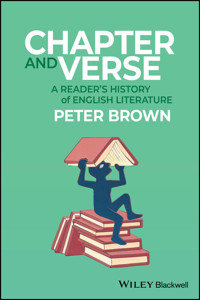
Chapter and Verse: A Reader's History of English Literature offers a compelling reimagining of literary history—one that places the reader's experience at the heart of the narrative. Unlike traditional surveys of English literature that prioritize chronology and critical consensus, Peter Brown's approach emphasizes the subjective, evolving relationship between reader and text. This unique perspective addresses a long-standing gap in the field, emphasizing the emotional and intellectual engagements that shape how literature is received, remembered, and reinterpreted across a lifetime.
Structured around thematic chapters—such as “Performance,” “Fragments,” and “Home”— Chapter and Verse spans the medieval to the contemporary, exploring Chaucer, Shakespeare, Eliot, and other canonical figures alongside neglected or overlooked authors such as Charlotte Dacre and Abdulrazak Gurnah. Each chapter blends literary analysis with personal narrative, beginning with formative reading experiences and culminating in a scholarly vantage point honed over decades of teaching. The result is both intimate and instructive, offering detailed engagements with texts and authors contextualized within broader literary movements.
Uniquely integrating personal memoir with a thematic and chronological overview of English literature, Chapter and Verse:
- Explores literature's emotional and transformative power through lived reading experiences
- Reflects decades of university-level teaching across the full span of English literary history
- Provides accessible entry points into complex literary periods through thematic framing
- Includes notes and recommended readings at the end of each chapter to encourage further exploration
- Offers a fresh pedagogical approach that highlights how personal engagement can enhance critical analysis
Chapter and Verse: A Reader's History of English Literature is a must-read for advanced secondary students, undergraduates, and postgraduates studying English literature, as well as general readers seeking a more personal connection to the history of English literature.
Sie lesen das E-Book in den Legimi-Apps auf:
Seitenzahl: 591
Veröffentlichungsjahr: 2025
Ähnliche


















Table of Contents
Cover
Table of Contents
Title Page
Copyright Page
Dedication Page
Timeline
Prologue
Notes
Acknowledgements
1 ‘In the Beginning …’
Initiation
The
Book of Common Prayer
Drama of the Liturgy
Mystery Plays
The Canterbury Crucifixion
Continuity and Change
Notes
2 ‘… Was the Word’
A Bookish Man
Hanley High School
Encountering Geoffrey Chaucer
Revolt
Notes
3
Romance
Carmountside
Romance
Chaucer Revisited
Embraces
The
Gawain
Poet
Thomas Malory
Notes
4 Translations
Translating and Adapting
Radical Shifts
William Langland
Allegory
Edmund Spenser
Philip Sidney
The Sonnet Craze
Notes
5 Performance
Roleplay
Shakespeare's Theatre
John Donne
Lancelot Andrewes
George Herbert
Silent Actors
John Milton
Aphra Behn
Notes
6 Difference
A Mistake
John Dryden
Alexander Pope
Jonathan Swift
Daniel Defoe
Henry Fielding
Laurence Sterne
In the Archives
New Perspectives
Notes
7 Margins
Relevance
William Blake
William Wordsworth and Samuel Taylor Coleridge
John Clare
Lord Byron
John Keats
Percy Bysshe Shelley
Mary Shelley
Charlotte Dacre
Jane Austen
Notes
8 Identity
Sink or Swim
Charlotte Brontë
Emily Brontë
Anne Brontë
W. M. Thackeray
Charles Dickens
George Eliot
Anthony Trollope
Robert Browning
Elizabeth Barrett
Notes
9 Fragments
Garbutt's Ark
Thomas Hardy
Joseph Conrad
D. H. Lawrence
Poetry of the First World War
Early T. S. Eliot
Notes
10 Home
The Sewing Kit
James Joyce
Virginia Woolf
George Orwell
Later Eliot
W. H. Auden
John Osborne
Samuel Beckett
Seamus Heaney
Abdulrazak Gurnah
Notes
Epilogue
Note
Index
End User License Agreement
Guide
Cover Page
Table of Contents
Title Page
Copyright Page
Dedication Page
Timeline
Prologue
Acknowledgements
Begin Reading
Epilogue
Index
Wiley End User License Agreement
Pages
iii
iv
v
xi
xii
xiii
xiv
xv
xvi
xvii
xviii
xix
1
2
3
4
5
6
7
8
9
10
11
12
13
14
15
16
17
18
19
20
21
22
23
24
25
26
27
28
29
30
31
32
33
34
35
36
37
38
39
40
41
42
43
44
45
46
47
48
49
50
51
52
53
54
55
56
57
58
59
60
61
62
63
64
65
66
67
68
69
70
71
72
73
74
75
76
77
78
79
80
81
82
83
84
85
86
87
88
89
90
91
92
93
94
95
96
97
98
99
100
101
102
103
104
105
106
107
108
109
110
111
112
113
114
115
116
117
118
119
120
121
122
123
124
125
126
127
128
129
130
131
132
133
134
135
136
137
138
139
140
141
142
143
144
145
146
147
148
149
150
151
152
153
154
155
156
157
158
159
160
161
162
163
164
165
166
167
168
169
170
171
172
173
174
175
176
177
178
179
180
181
182
183
184
185
186
187
188
189
190
191
192
193
194
195
196
197
198
199
200
201
202
203
204
205
206
207
208
209
210
211
212
213
214
215
216
217
218
219
220
221
222
223
224
225
226
227
228
229
230
231
232
233
234
235
236
237
238
239
240
241
242
243
244
245
246
247
248
249
250
251
252
253
254
255
256
257
258
259
260
261
262
263
264
265
266
267
Chapter and Verse
A Reader's History of English Literature
Peter Brown
This edition first published 2026© 2026 John Wiley & Sons Ltd
All rights reserved, including rights for text and data mining and training of artificial technologies or similar technologies. No part of this publication may be reproduced, stored in a retrieval system, or transmitted, in any form or by any means, electronic, mechanical, photocopying, recording or otherwise, except as permitted by law. Advice on how to obtain permission to reuse material from this title is available at http://www.wiley.com/go/permissions.
The right of Peter Brown to be identified as the author of this work has been asserted in accordance with law.
Registered OfficesJohn Wiley & Sons, Inc., 111 River Street, Hoboken, NJ 07030, USAJohn Wiley & Sons Ltd, New Era House, 8 Oldlands Way, Bognor Regis, West Sussex, PO22 9NQ, UK
For details of our global editorial offices, customer services, and more information about Wiley products visit us at www.wiley.com.
The manufacturer's authorized representative according to the EU General Product Safety Regulation is Wiley‐VCH GmbH, Boschstr. 12, 69469 Weinheim, Germany, e‐mail: [email protected].
Wiley also publishes its books in a variety of electronic formats and by print‐on‐demand. Some content that appears in standard print versions of this book may not be available in other formats.
Trademarks: Wiley and the Wiley logo are trademarks or registered trademarks of John Wiley & Sons, Inc. and/or its affiliates in the United States and other countries and may not be used without written permission. All other trademarks are the property of their respective owners. John Wiley & Sons, Inc. is not associated with any product or vendor mentioned in this book.
Limit of Liability/Disclaimer of WarrantyWhile the publisher and authors have used their best efforts in preparing this work, they make no representations or warranties with respect to the accuracy or completeness of the contents of this work and specifically disclaim all warranties, including without limitation any implied warranties of merchantability or fitness for a particular purpose. No warranty may be created or extended by sales representatives, written sales materials or promotional statements for this work. This work is sold with the understanding that the publisher is not engaged in rendering professional services. The advice and strategies contained herein may not be suitable for your situation. You should consult with a specialist where appropriate. The fact that an organization, website, or product is referred to in this work as a citation and/or potential source of further information does not mean that the publisher and authors endorse the information or services the organization, website, or product may provide or recommendations it may make. Further, readers should be aware that websites listed in this work may have changed or disappeared between when this work was written and when it is read. Neither the publisher nor authors shall be liable for any loss of profit or any other commercial damages, including but not limited to special, incidental, consequential, or other damages.
Library of Congress Cataloging‐in‐Publication DataNames: Brown, Peter, 1948– authorTitle: Chapter and Verse : A Reader’s History of English Literature / Peter Brown.Description: First edition. | Hoboken, NJ : Wiley, 2026. | Includes bibliographical references and index.Identifiers: LCCN 2025043320 (print) | LCCN 2025043321 (ebook) | ISBN 9780631219743 paperback | ISBN 9781118893913 adobe pdf | ISBN 9781118893906 epubSubjects: LCSH: English literature–History and criticism–Theory, etc. | Reader‐response criticism | LCGFT: Literary criticismClassification: LCC PR21 .B84 2026 (print) | LCC PR21 (ebook) | DDC 820.9–dc23/eng/20250929LC record available at https://lccn.loc.gov/2025043320LC ebook record available at https://lccn.loc.gov/2025043321
Cover Design: WileyCover Image: © Rob Miles
For Angela,
who reads me well.
Timeline
Mystery plays (Harrowing of Hell, Crucifixion)
mid 14th cent.
Liturgical drama (Barking
Visitatio
)
late 14th cent.
Sir Gawain and the Green Knight
late 14th cent.
William Langland,
Piers Plowman
late 14th cent.
Peasants’ Revolt
1381
Geoffrey Chaucer,
Troilus and Criseyde
mid 1380s
Geoffrey Chaucer,
Canterbury Tales
(Nun’s Priest’s Tale, Miller’s Tale, Franklin’s Tale)
before 1400
Wars of the Roses
1455–1487
Thomas Malory,
Le Morte Darthur
1470
Foundation of the Anglican Church
1534
Stephen Gosson,
The School of Abuse
1579
Edmund Spenser,
Faerie Queene
1590
Philip Sidney,
Astrophil and Stella
1591
Christopher Marlowe,
Dr Faustus
1592
William Shakespeare,
Hamlet
,
Henry IV
, part 1,
King Lear
,
A Midsummer Night’s Dream
1595–1606
King James Bible
1611
Lancelot Andrewes, ‘Sermon on Christmas Day’
1622
John Donne, ‘The Sun Rising’, ‘This Is My Play’s Last Scene’
1633
George Herbert, ‘The Collar’
1633
Closure of theatres
1642–1660
English Civil War
1642–1651
Restoration of the monarchy
1660
Book of Common Prayer
1662
Great Fire of London
1666
John Milton,
Samson Agonistes
1671
John Dryden,
Essay upon Satire
1679
Aphra Behn,
Oroonoko
1688
Alexander Pope,
Eloisa to Abelard
1717
Daniel Defoe,
Robinson Crusoe
1719
Jonathan Swift,
Gulliver’s Travels
1726
Henry Fielding,
Tom Jones
1749
Laurence Sterne,
Tristram Shandy
1759–1767
William Blake,
Songs of Innocence and of Experience
1794
William Wordsworth and Samuel Taylor Coleridge, Lyrical Ballads
1798 and 1802
Charlotte Dacre,
Zofloya
1806
Inclosure Act for Helpston
1809
Lord Byron, ‘English Bards and Scottish Reviewers’
1809
Framework Bill
1812
Lord Byron, ‘Stanzas to Augusta’
1816
John Keats,
Isabella: or, The Pot of Basil, ‘Ode to a Nightingale’, ‘Ode on a Grecian Urn’
1818–19
Mary Shelley,
Frankenstein
1818
Jane Austen,
Northanger Abbey
1818
Peterloo Massacre
1819
Percy Bysshe Shelley,
The Mask of Anarchy
1819
John Clare, ‘The Mores’, ‘The Fate of Genius’, ‘I Am’
1820–1835
Slavery Abolition Act
1833
W. M. Thackeray,
Barry Lyndon
1844
Irish Potato Famine
1845–1852
Emily Brontë,
Wuthering Heights
1847
Anne Brontë,
The Tenant of Wildfell Hall
1848
Charles Dickens,
David Copperfield
1849–1850
Elizabeth Barrett Browning, ‘The Runaway Slave’
1850
Robert Browning, ‘Fra Lippo Lippi’
1855
Charlotte Brontë,
The Professor
1857
George Eliot,
Adam Bede
1859
Anthony Trollope,
Lady Anna
1874
Thomas Hardy,
Tess of the d’Urbervilles
1891
Joseph Conrad,
Heart of Darkness
1899
D. H. Lawrence,
Sons and Lovers
1913
James Joyce,
Dubliners
1914
Poetry of the First World War, including verse by Laurence Binyon, Vera Brittain, Robert Graves, Ivor Gurney, A. E. Housman, John Masefield, Wilfred Owen, Siegfried Sassoon, Edward Thomas and others
1914–1918
Easter Rising
1916
T. S. Eliot,
The Waste Land
1920
Virginia Woolf,
Mrs Dalloway
1923
Universal suffrage
1928
Great Depression
1929–1939
George Orwell,
Coming Up for Air
1939
Second World War
1939–1945
T. S. Eliot,
Four Quartets
1943
W. H. Auden,
The Age of Anxiety
1945
Samuel Beckett,
Waiting for Godot
1953
John Osborne,
Look Back in Anger
1954
Seamus Heaney, ‘Digging’
1966
Abdulrazak Gurnah,
Pilgrims Way
1988
Prologue
Reading is a personal matter. We have individual preferences for one kind of writing over another, or for this author rather than that. We react to what we read in personal ways, finding likes and dislikes that are different from those of other readers. Our upbringing, cultural background, moods and personal circumstances all influence what we choose to read and how we respond to it. Occasionally we encounter a description or a poem that affects us deeply on a personal level, even to the point of changing us for better or worse. It is as if the book is reading us rather than being read. Some books have the power to do so again and again. But the book that works its magic for one person may be powerless to affect another.
What is at stake here is the way in which written stories and poems communicate. They do so one to one, directly and intimately, from the author to the reader, no matter how the process is dressed up in character, description, rhyme and other conventional trappings. There is always a person present in a piece of literature, even if it lacks characters: it is the author, engaged in an act of communication designed to appeal to the subjectivity of the reader. That is to say, the appeal is to the reader's imagination, thoughts, feelings and senses.
Defined like this, the personal quality of literary writing is what makes it distinct from other kinds of composition, such as scientific or philosophical writing, which has a more cerebral appeal, using objective evidence and logical argument to persuade its audience of particular conclusions. Which is not to say that literary composition does not appeal to the intellect. Far from it. It is just that the author of a literary work wants to invoke other, complementary, responses as well, and thereby to engage the whole person.
All too often, the personal impact of literature fades and is forgotten. What seemed profound in adolescence may look trite in maturity. But in other cases the original effect endures, clearly remembered and still felt. Then again, there are some works which when first encountered seem remote and inaccessible but which, when revisited, grow in meaning and significance. Over time, we deepen our understanding and appreciation of the works that continue to exert their power over us, and so form our own, individualised, reader's history.
There have been readers' histories as long as there have been readers, in the sense that each reader constructs their own sense of the development of literature, and of the place of one author in relation to another, on the basis of the books they encounter and of the supplementary knowledge they acquire. Nowhere is the existence of such histories more evident than in the records left by writers themselves.1 Geoffrey Chaucer, for example, writing in the later fourteenth century, regularly namedrops the works that he has read and leaves multiple traces of their influence on his own work. In the early 1800s, Jane Austen uses a person's reading history as an indicator of the quality of their character. For an individual's reading history is revealing. Patchy, quirky and idiosyncratic it may be, flitting back and forth between periods and countries, but it is eloquent testimony of that reader's interests, outlook and personality. What can give a reader's history its coherence and fascination is the extent to which it is a record of the books that left a mark, or were associated with a particular set of circumstances, or were channelled – for better or worse – by teachers. There is then a powerful sense of literature as formative and life‐changing, consolatory and uplifting.2
The reader's history stands in contrast to a more recent genre, the history of English literature that, by one means or another, attempts to provide comprehensive, objective coverage. It comes in many shapes and sizes and is invaluable for anyone needing to find their way about an influential body of imaginative writing that spans many centuries. At one extreme is the one‐volume summary that moves rapidly from one author to another, one period to another, without room for much discussion of individual examples. At the other extreme is the multi‐volume series that gives space in each book for the consideration of a single literary movement, such as Romanticism, or a single genre, such as poetry.3 As more writing is produced, and as literary research continues to make discoveries and argue for new syntheses, so histories of English literature need regular revision. They have an interesting history of their own, one that may be traced back to an early survey, Thomas Warton's The History of English Poetry, published in three volumes (1774–1781).4 The appearance of Warton's study at a time when Britain was developing its national identity on the world stage is not entirely coincidental. The history of its literature is one way in which a country promotes its distinctiveness.
Standard histories of English literature tend to neglect the subjective responses of individual readers.5 Beyond the domain of published reviews and memoir the evidence is hard to obtain, harder to quantify, although the more generalised history of reading is now a well‐established subdiscipline.6 Then again, the conventions of academic discourse tend to keep the reader's subjectivity at arm's length. Yet neglecting that personal dimension is an odd omission because without the engagement and purchasing power of readers there would be no literature. The transactions between author and reader are fundamental to literature's success in culture and commerce.
This book is an attempt to put a history of English literature back into the reader's court, by blending the idea of personal encounter with a chronological account of English literature. To do so I draw on my own subjective experiences – not that they are superior to or better than those of any other reader, but they have the benefit of being readily available and might, I hope, prompt similar reflections. Chapter and Verse tells the story of how I first began to understand the mysterious power of literature to attract, include, transport, excite, involve and transform its adherents. It describes some early encounters with texts ranging from comics to adventure stories to the Bible, gives some account of studying literature at school and university, and ends with my eventual discovery of a role as a researcher and teacher of literature.7
That personal narrative is not told in a strict order. It threads through and is subsidiary to the main story of the book, namely the evolution of English literature. Each chapter covers a particular phase, from the Middle Ages to the present day. I make no attempt at exhaustive coverage but instead offer a selection of texts, each discussed in some detail – a luxury not afforded to more exhaustive one‐volume summaries. The choice of texts is from my own reading history, conditioned as it is by many years of teaching in curricula that have covered the canon of literary texts. The selections are in accord with the particular theme that governs each chapter, with my enjoyment of the work of particular authors, and with a desire to provide a sense of coherence both between different texts and between the literary and personal elements. The chosen theme, be it ‘Performance’ or ‘Fragments’, also acts as a window on to a particular phase of English literature, one designed to encourage further exploration. The final section of each chapter provides some notes and further reading for the curious.
Crucial to the realisation of this book has been its own readers. On completing a draft of each chapter, I sent it out to a group of friends deliberately chosen for their diverse backgrounds, among them an earth scientist, a former history teacher, a professional dancer, a mature student studying for a PhD, a counsellor, an artist, a retired clergyman, a playwright, a civil servant. All have their own reading histories and from their different angles they have been generous with their comments and qualifications which I have used in the process of revising the entire book. They are not in any way responsible for the faults, biases and blind spots that remain.
A final word on the title of this book. ‘Chapter and verse’ refers to the customary way of citing biblical texts, which lie at the origins of my awareness of things literary. ‘Chapter and verse’ also alludes to the two major forms of literary expression, prose and poetry. And, as an idiomatic expression, the phrase describes the detail provided in the following pages about English literature and my involvement with it.
Paris and Canterbury 2024
Notes
1
For contemporary authors see Pandora Sykes, ed.,
What Writers Read: 35 Writers on Their Favourite Book
(Bloomsbury, 2022).
2
A prominent theme in A. L. Rowse,
A Cornish Childhood
(Cape, 1942), in which see esp. chap. 8: ‘Reading, Writing, Politics, Poetry’. There is a similar vein in
Memories & Opinions by Q: An Unfinished Autobiography
, ed. S. C. Roberts (Cambridge University Press, 1944), by Rowse's older friend and fellow Cornishman, Arthur Quiller‐Couch who, as King Edward VII Professor of English Literature, was instrumental in founding the English Faculty at the University of Cambridge.
3
Examples of the compressed, single‐volume variety are Andrew Sanders,
The Short Oxford History of English Literature
, rev. ed. (Clarendon Press, 1996); Michael Alexander,
A History of English Literature
(Macmillan, 2000); and Jonathan Bate,
English Literature: A Very Short Introduction
(Oxford University Press, 2010). At the other extreme see Franco Marucci,
History of English Literature
, trans. David Braithwaite et al., 8 vols. (Peter Lang, 2018–2019). As an indication of relative scale, Marucci devotes over 130 pages to the works of the Victorian novelist George Meredith (1828–1909) up to 1871, while Alexander covers all of Meredith in a single sentence.
4
A contemporary and acquaintance of Samuel Johnson, Warton (1728–1790) was a poet in his own right and became poet laureate in 1785. The three volumes of his
History of English Poetry
may be consulted online at Google Books. On the genesis of Warton's book, see René Wellek,
The Rise of English Literary History
(University of North Carolina Press, 1941).
5
Some account of this features in ‘The Reading Experience Database 1450–1945 (RED)’, described by Rosalind Crone, Katie Halsey, Mary Hammond and Shafquat Towheed in chap. 36 of
The History of Reading: A Reader
, ed. Towheed, Crone and Halsey (Routledge, 2011). The database is available for searching and browsing at
www.open.ac.uk/Arts/RED
.
6
A field of study that tends to cover many contingencies including patronage, printing technology, bookshops, distribution networks, literacy, censorship, education and politics. For more general overviews, see Alberto Manguel,
A History of Reading
(HarperCollins, 1996), Steven Roger Fischer,
A History of Reading
(Reaktion Books, 2003) and Martyn Lyons,
A History of Reading and Writing in the Western World
(Palgrave, 2010).
7
A notable academic biography, sprinkled with alllusions to literary texts, is that of Frank Kermode,
Not Entitled: A Memoir
(HarperCollins, 1996). See now Vybarr Cregan‐Reid,
We Are What We Read: A Life Within and Without Books
(Biteback Publishing, 2024), which takes aim at the decline in government support for humanities subjects.
Acknowledgements
I have been fortunate in my editors and publisher. Andrew McNeillie first implanted the idea for this book, and its development and growth have been nurtured since then by people who have displayed extraordinary reserves of patience and encouragement. They include Emma Bennett and Manish Luthra and more recently Pascal François, Nicole Allen, Ed Robinson and Louise Spencely. I am grateful also to the three anonymous readers of the typescript whose generous and constructive reports have resulted in numerous improvements to the text.
Along the way, friends and professional colleagues have shown a supportive interest in the progress of Chapter and Verse. Prominent among them are Ryan Brate, Paul Dimarco, David Ellis, Marion Glasscoe, David Herd, Lyn Innes, Gabriel Josipovici, Frank Mikus, Renaud Lampaert, Katia Ronzoni, Martin Scofield, Katie Sokolowska, David Wallace, Gerlinde Wilberg and Loren Wolfe.
As the chapters took shape I fielded them to a hand‐picked band of readers from various backgrounds. They are Oliver Brown, Louisa Brown, Laura Carosi, Angela Gallego‐Sala, Alice Gauthier, Grazyna Godlewska‐Vernon, Nicky Hallett, Bill Hornsby, Sylvia Hornsby, Doug Macari and Rob Miles. My heartfelt thanks to you all: your feedback has helped me to avoid numerous pitfalls. Those that remain are of my own making.
1‘In the Beginning …’1: How Religion Fostered Poetry, Narrative and Drama
Initiation
Our pew, which we use every Sunday, is at the back of the chapel, tucked under the gallery. It is cosy in there with my mother and sister, especially during the evening service. We are surrounded by solid wood. The floorboards are bare, unvarnished, but all of the other wooden surfaces are polished and used, the colour of honey. Behind us is the wooden framework of the entry porch, set with frosted glass. In front, more pews stretch across the body of the chapel down to the pulpit that rises above the congregation in a great wave of wooden steps. The place feels safe, as if we are in a vessel, an ark, floating free.
On the seat of our pew is a strip of thick material, like a miniature carpet, woven in a red and blue pattern. I stand with my back to the pulpit and use the seat as a desk. Paper and crayons lie scattered about. I am allowed to draw pictures while the evening service is in progress because there is nothing in it for children. I can hear my father's voice as he guides the congregation through the service. If I turn and look in that direction, peeping over the top of the pew in front, I can see him in the pulpit in the warm glow of a lectern light that catches the bright colour of the orange hood attached to his black gown. Ranged behind him are the choir seats and to one side the organ. Sometimes the choir sings unaccompanied and the voices sound raw.
My mother and sister, who is 12 years older than me and therefore a grown‐up, follow the service intently. Occasionally they glance in my direction with encouraging smiles. Sometimes, if I catch my sister's eye, I pull a face and that can give us a fit of the giggles. Then my mother's face turns red and she frowns at us until we stop. The time passes slowly and the service is longer than usual because it is followed by communion. That is when I am left alone while the grown‐ups go in turn to the wooden rail at the front of the chapel to receive bread and wine from my father while he mumbles something to them.
It is all quite mysterious, beyond my grasp, but I am aware that it is a special and serious business. Everyone frowns, quietly praying by themselves after receiving the bread and wine. Then suddenly the mood changes when the organ comes to life and we all sing the Hallelujah song. At that point I too feel happy because the service will soon be over and we can all go home. If the moon is out, it will come home with us to Pepys Road, peering over the rooftops of Raynes Park to watch our progress.
I attend the communion service with my family once a month and by dint of repetition and growing familiarity some of the words and phrases begin to stick. I know little or nothing of what they mean but enjoy their sound and rhythm. Tabernacle is quick, with lots of short beats. Transgression is slow and heavy. Chastisement hisses. I do recognise some words, but can't make sense of them, like stripes. There are stripes on a zebra, but my father says that with his stripes we are healed. What does that mean? There is one word I fully understand: trespassers, as in forgive us our trespassers, because that is the word written on the sign by the edge of the wood: Trespassers Will Be Prosecuted, which means ‘Keep Out’. It seems that trespassers will not necessarily be prosecuted but might be forgiven instead. The idea is comforting because the wood is an exciting place and never fails to draw me in.
Not only single words but whole turns of phrase begin to connect with my own life, like the regular references to bread. I enjoy the crusty end‐slice of newly baked loaves, spread with a generous helping of butter. My mother says that eating crusts will make me strong. Give us this day our daily bread has a note of doubt, as if a daily loaf should not be taken for granted, but on the other hand the supplier sounds supremely confident that all will be well: I am the Bread of Life: he that cometh to Me shall not hunger. The bread that I eat at home is the same as the bread my father offers to the grown‐ups at the communion rail. I have seen my mother cut a slice of bread into small squares for my father to share out. It seems that those who eat them would be grateful for anything. We are not worthy so much as to gather up the crumbs under Thy table. Perhaps they are hoping for a grand table with lots of feasting and drinking, so that what falls on the floor is worth having and not just breadcrumbs. The man they refer to is a Lord so there should be lots of food. Sometimes the communion service is called the Lord's Supper. Why then is there nothing but dry bread on offer? Even the wine isn't real but grape juice or Ribena. Yet clearly the Lord, like me, enjoys food. If he stands at your door and knocks and you open the door he will expect a meal. I will come in to him, and will sup with him, and he with me. He seems to be a kind man, who helps to carry things if they are too heavy, and who makes people rest if they have been working too hard.
Years later, having stopped attending any kind of religious event, there was a whole section of the Lord's Supper that I could still recite from memory, hearing the echo of my father's voice. It is the part where he, as the officiating minister, ate the first piece of bread and drank the first little glass of wine. As he did so he said words describing something that had happened many centuries before, but which was now being brought into the immediate present. It is the culminating point of the service, when you are reminded that there is a story that explains what is going on at the communion table. The kind and helpful Lord, who enjoyed hospitality, had been sharing a meal with others. Something terrible and unavoidable was about to happen that very night – his betrayal, leading to his death – and so the whole evening became heavy with sadness and significance. It was the last time he would share a meal with his friends and he wanted them to remember it. It was not just the Lord's Supper but the Last Supper:
The Lord Jesus, in the night in which He was betrayed, took bread; and when He had given thanks He brake it, and said, ‘This is My body which is given for you: this do in remembrance of Me.’ In like manner also the cup, after supper, saying, ‘This cup is the New Covenant in My blood: this do, as oft as ye drink it, in remembrance of Me. For as often as ye eat this bread and drink the cup, ye proclaim the Lord's death till He come.’
I now see these words, and the whole experience of communion, as an initiation into literature – its possibilities, variety and peculiar powers. Storytelling is at the centre of the service, but embedded in drama and expressed through rhythmic and figurative speech that is close to poetry. The overall effect is transformative: immersion in the service gives access to another state of being, wished for and longed for, through a process full of fluctuating emotions eventually channelled towards joy. There are regular allusions to an underlying ideology that make the transformation explicable. This therapeutic magic happens by assembling miscellaneous materials and genres in a way that seems higgledy‐piggledy but which is in fact highly artful, creating a new composite that is more than its individual parts. Through connection and fellowship, and by acknowledging vulnerability and requiring an open receptivity, the service enables an intimacy with oneself, with the soul, with others.
The episode in Christ's life described in the communion service is told in simple, matter‐of‐fact terms as a sequence of events and utterances, but it is by no means as simple as it seems. The Last Supper is a key stage in a larger cycle of events with fundamental significance for believers: the death and resurrection of Christ. The meal takes place on the night in which he will be betrayed, although the betrayal by Judas has not yet happened. Judas is present at the supper and will soon slip away to reveal Christ's whereabouts to his persecutors. Christ seems aware of his immediate and long‐term future: both of the impending betrayal and his subsequent death, which he memorialises with the bread and wine. He also looks beyond his death towards a ‘new covenant’, a revolution in systems of belief that his crucifixion will come to represent. Christ's death, burial and resurrection will provide a new dispensation for mankind, one in which evil and death can be overcome. It is the conjunction of simple, everyday acts – sharing bread and wine at a communal meal – with depth of meaning, the encapsulating of one in the other, that makes this pivotal episode so memorable, so haunting.
The communion service account of the Last Supper has a certain cadence and authority because it is a quotation from the Bible. It is an authentic part of the larger narrative of Christ's life, suffering and death – a window onto a more extensive story line as its climax approaches. Descriptions of the Last Supper occur in the Gospels of Mark (14: 22–25) and Luke (22: 9–20), but not quite as the communion service has it. Its version is from St Paul's first letter to the church at Corinth (I Corinthians 11: 23–26), in which he sets out some basic precepts of a new religion. So the story of the Last Supper as relayed through the communion service has already passed through the hands of at least three authors, each of whom has had an opportunity to insert his own emphases and agendas. It may be that Christ's apparent awareness of what the future holds is in part a product of authorial hindsight: knowing the outcome, the author can anticipate it by imbuing Christ with foreknowledge, thereby enhancing his aura of divinity. There are many aspects of the narrative of Christ's life that invite such authorial interventions. Another is the occasion that prompted the Last Supper: the feast of the Passover. Christ and his disciples had withdrawn to an upper room to celebrate and remember the occasion on which the exiled Jews were spared the fatal disease inflicted on their captors, the Egyptians. One commemorative feast is now replaced by another, the Passover by the Last Supper, one sacrificial lamb by another, the old covenant by the new, the Jewish faith by the Christian.
The Book of Common Prayer
The quotation from I Corinthians is not just from any Bible but from the King James Bible, otherwise known as the Authorised Version, first published in 1611 when Shakespeare was alive. The entire communion service as I experienced it was steeped in the language of the seventeenth century since it followed closely the Book of Common Prayer (1662).2 That helps to explain the service's literary allure: it deploys words and modes of expression that sound rich and strange because they are no longer in common use, though they still pack a punch: tabernacle … chastisement … trespasses … In like manner also the cup after supper … This is language from the golden age of English literature.
Like Shakespeare's writing, the communion service is a work of literature designed for performance, to be said aloud. The language is declamatory, sustaining its listeners' interest and attention through rhythm, balance and emphasis. One practice derives from the biblical technique of parallelism – that is, matching one statement with another that repeats the first but with some increments in meaning and effect. As well as being a rhetorical device it is a meditative one, creating a space around an initial idea so that it can be viewed reflectively, from different angles. Thus the tendency of humans to stray from virtue is stated twice over, using an image that recalls the role of Christ as a caring shepherd. The second statement adds to the first by suggesting that the straying is on account of personal preoccupations: All we like sheep have gone astray; we have turned every one to his own way. The suffering of Christ through wounding, bruising and chastisement, as a direct consequence of human erring, is described three times over: He was wounded for our transgressions, He was bruised for our iniquities: the chastisement of our peace was upon him. It is all the more puzzling and paradoxical, therefore, that the suffering of Christ, inflicted by ordinary mortals, is in turn the cause of their salvation. The three parallel statements conclude: With His stripes [wounds] we are healed.
Towards the end of the service the underlying poetry erupts into rhyme and regular metre with the hymn of joy, ‘Christ the Lord Is Risen Today’.3 Suddenly the organ bursts into life, faces become radiant, and Hallelujah! is sung at the end of every line. It is a hymn full of hope and certainty at the truth and value of Christ's resurrection. The world has been put to rights. Love has conquered hate, good has overcome evil. The tomb, with its sealed entrance and guard keeping watch, could not contain Christ. He has even defeated the devil and vanquished hell itself. With the organ, choir and congregation at full throttle it is difficult to resist being carried along by the ideas and sentiments:
Love's redeeming work is done;
Fought the fight, the battle won;
Vain the stone, the watch, the seal;
Christ hath burst the gates of hell:
Hallelujah!
At Easter, when the recollection of Christ's suffering and death becomes especially intense, other hymns punctuate the communion service. Again their language is curious, but vivid and memorable. O sacred head, once wounded / With grief and pain weighed down.4 The tune alternates major and minor chords, the lines by turn sounding assertive and compassionate, resolute then full of anguish.
Verse and prose are united in that staple of literary composition, metaphor. The human sinner is imaged as a sheep, prone to stray. Christ is the good shepherd. He is also sustaining, nourishing, the bread of life who will appease spiritual hunger. Broken bread stands for his tortured body. And so it goes on. The interplay of figurative and literal language is in constant motion. The metaphors, and especially the recurrent ones like bread, wine or sheep, are shorthand for a complex set of interrelated ideas. Their repeated use indicates the existence of an explanatory system to which the key symbols of the code allude, an explanatory system claiming to be a different, better or higher reality. According to the New Testament narratives, Christ himself encouraged such notions, not least at the inauguration of the Lord's Supper, where he turned everyday acts into ones full of significance. He broke the bread and said This is My body, soon to be broken on the cross. He passed round the cup of wine and said This cup is … My blood, soon to be shed. But there is more. It is not just that the bread and wine represent the broken body and flowing blood of Christ, but that the image of the crucified Christ itself signifies redemption for mankind, a ‘New Covenant’.
The communion service, which is at the very heart of Christian ritual and theology, uses metaphor to make an appeal that is visceral, elemental. It portrays spiritual needs in terms of hunger and thirst, being lost and alone, spiritual suffering as bodily violence. It offers the hope of food, drink, being found and accepted, healing. The service provides comfort, a public and communal ‘drawing near’ that counters isolation; the acknowledgement of sin produces cleansing through mercy and forgiveness; hearts sunk in despondency receive uplift and support; and troubled spirits are calmed with a sense of peace. The rewards go further. For its adherents the sacrament of communion effects a transition to a state of altered consciousness, allowing a glimpse of another kind of existence where joy, peace and goodness prevail and where defeat has become victory. That new covenant is in the realm of Angels and Archangels, and … all the company of Heaven.
Narrative, verse, declamatory statements uttered aloud, Shakespearean language, metaphor, emotional appeal, ideological superstructure – this is a rich literary mixture and its overriding shape is theatrical. It is not just that the story of Christ's betrayal, suffering and death is a kind of tragedy (though one that has a happy ending with his resurrection), but that the commemoration of it is staged, albeit in a church. There are the props of table, wine and bread; stage directions (The Table having a fair white linen cloth upon it, shall stand in some convenient place … the Minister, having come to the Table, shall say the following sentences); designated roles: the minister reproduces Christ's actions at the Last Supper while members of the congregation act as unworthy, submissive; a script, based on a dialogue between the minster and those attending the service; audience participation; symbolic action (eating the bread, drinking the wine); and the costume of clerical vestment. The whole effect, like that of any serious theatrical piece, is deeply cathartic.
Drama of the Liturgy
It is not only the communion service that is theatrical. Similar points could be made about other Christian liturgies, such as those concerning baptism, marriage or death. They too are examples of a broader category, ritual ceremony, found in all cultures.5 Ritual ceremonies exist to express and reinforce certain values and beliefs by repeating in public commemorative actions. In other words, public ritual of any kind is inherently dramatic. Just as the dramatic nature of ritual helps to explain the theatrical features of a Christian liturgy such as the communion service, so Christian liturgy itself is part of the root system of later developments in secular drama. That has not prevented Christian apologists from venting vociferous hostility towards the theatre from time to time, but it is the hostility of a jilted rival.
Theatrical effect was embedded in church ritual long before the Book of Common Prayer. The dramatic events that underpin the communion service – the crucifixion, Christ's descent into hell and his resurrection – were the focus of special attention. At Easter, priests re‐enacted these key episodes as part of the liturgy by assuming the roles of the biblical protagonists: Jesus, his disciples, the three Marys. Within the church a particular location known as the Easter sepulchre, of which examples still survive, provided the setting. An especially high number of the play texts for the Visitatio sepulchri (Visit to the Sepulchre) have been identified. They concern the moment when the three Marys (Mary Magdalene, Mary Salome and Mary the mother of James, one of Christ's disciples) visit Christ's tomb. One example from the late fourteenth century is unusual in having been performed mainly by women, the nuns of Barking Abbey in Essex, so there was no need for male priests to impersonate female figures.
To modern eyes the Barking Visitatio at first seems artificial and stilted, more like a highly formalised opera than a play that invites emotional involvement.6 The carefully choreographed action is slow, while the dialogue alternates with plainchant anthems, all in Latin. Yet the drama that unfolds contains poignant and revelatory events significant not only to the historical witnesses but, so the story would have it, to all humankind. The key figure, mediating between Christ and humanity, is Mary Magdalene. Her received history was that of a former prostitute, whose sins of the flesh Christ forgave, who had bathed his feet with her tears and dried them with her hair before applying expensive ointment (Luke 7: 37–50). Her profile was that of a sensual woman who connected with the world through her body and especially through touch. Because of her dedication to Christ she was made a saint by the church. At Barking her role is particularly prominent since the action unfolds in a chapel dedicated to her.
In the Barking Visitatio Mary Magdalene, along with the other Marys, once again carries ointment. They are going to Christ's tomb to tend his body. Yet when they arrive they find that the stone that had sealed the entrance has been rolled away and Christ's body has disappeared. An attendant angel asks whom they seek and explains that, as Christ had predicted, he has risen from the dead. In her grief at his absence, Mary Magdalene takes something tangible, Christ's head‐shroud, as consolation. In her sorrow she loiters near the tomb and encounters a figure she takes to be a gardener. She asks if he knows where Christ's body might be. He speaks one word, ‘Mary’, and Mary knows at once that the man is Jesus himself: ‘My lord!’ She reaches out, but he replies Noli me tangere, ‘Don't touch me’ for, he explains, he has not yet ascended to heaven. Mary is denied the bodily reassurance she craves, but it is she, a sinful woman, who is the first witness to Christ's resurrection. She shares her joyful discovery with the other Marys and they in turn rejoice, eagerly spreading the good news to the other disciples, singing Aleluia!
Mystery Plays
Meanwhile, on the streets of English towns such as York, Chester and Wakefield, the latent theatrical content of biblical narrative was being fully exploited in cycles of plays or ‘pageants’ that covered the entire span of Christian myth, from the Creation to the Last Judgement.7 Although still written by clerics, the chosen language was the local English dialect and each play was performed by the secular members of a different trade guild or ‘mystery’. The mystery cycles had not lost their connection with ritual: they were performed to celebrate the summer feast of Corpus Christi, marking the real presence of Christ in the eucharist.8 Church processional ritual was integrated with a display of civic identity. The mystery plays had a much wider appeal than liturgical drama, and were not averse to using comedy in order to engage interest.
A brief look at the Wakefield play of Christ's descent into hell (mid‐1400s) shows that the comedic element of the narrative, far from being eccentric, is in fact integral.9 Hell in the Wakefield play is represented architecturally as a city or castle. Christ's mission, after his death and before his resurrection, is to break down its doors and release the virtuous souls from limbo, a kind of departure lounge in hell for travellers in transit to Heaven. They include Adam and Eve and the prophets. Christ bears the wounds of his crucifixion and carries a cross to indicate his triumph over death. His approach to hell is figured as a gradually intensifying light – an encouraging sign for the virtuous but deeply disturbing to Satan and his crew, whose natural habitat is darkness. Overall there is a strong sense of destiny, of prophecy being fulfilled and wrongs righted. Jesus's opening speech recollects Adam's original sin in the garden of Eden that gave Satan so much power over human beings. The following scene shows Adam and the prophets ruing the gloom of hell and recalling the images of light through which they had foreseen the redemptive arrival of Christ. Meanwhile the devils who guard them are increasingly disturbed by the speechifying of their prisoners, are thrown into confusion, and attempt to secure the defences. All to no avail. They cannot prevent the penetration of the light and Christ's siege is irresistible. With the opening words of Psalm 24, Atollite portas principes [Lift up your gates, O ye princes], he breaks down the gates of hell and gives the virtuous their freedom. Yet Satan does not surrender: he detains Christ by engaging him in a closely argued dialogue as to what, in future, Satan's role should be. Christ explains that he, Satan, will still be the guardian of hell, which remains the home of reprobates such as Cain and Judas, but he will now be contained, bound in his own dungeon. Exit Satan, wailing.
There are many occasions for comedy. The fantastical names of the devils set them up as creatures not to be taken entirely seriously: Ribald, Beelzebub, Astarot, Anaball, Bell, Berith, Bellyall. They would have worn outlandish, hairy costumes, grotesque masks, have pulled faces and used obscene body language. The spoken language of the principal devils uses the alliterative verse of the play to convey bombast. It too sets them up for a fall. For example, Beelzebub says of the prophets that while he is ‘prynce and pryncypall / They shall never pas oute of this place’. Anyone watching the cycle of plays, who had seen similar petulant rants by proud tyrants such as Herod, would know that Beelzebub and his kin were about to come a cropper. Such utterances become a kind of comic catchphrase, arrogant but futile, as in the case of Satan, who repeatedly urges his fellow fiends to defeat Christ with ‘dyng that dastard downe!’ Not that they necessarily understand him or agree to do his bidding.
Hell is full of confusion, misunderstanding and subversion and, therefore, potential for knockabout humour. Ribald and Beelzebub, for example, are a comedy duo, with one acting as the fall guy for the other. While Ribald is anxious and fearful at the speechifying of the prophets and at the approach of Christ, Beelzebub is complacent and sees no danger that cannot be defended by the usual methods of reinforcing the gates and putting extra watch‐devils on the walls. When Satan himself is eventually roused to action he threatens Beelzebub for shouting too loudly: ‘if I com nar [near] / Thy brayn bot I bryste owte!’ As Christ gains the upper hand, Satan utters his rallying cry ‘To dyng that dastard downe!’ but Beelzebub retorts that it is easier said than done and enjoins Satan to stop Christ himself if he thinks it so easy: ‘Com thou thiself and serve hym so’. If the quarrelling is of the pantomime, slapstick variety it points to a deeper, but no less ridiculous, confusion of understanding. To the devils, the utterances of the prophets are nothing but an annoying ‘din’ that needs to be quashed, the cacophony of a ‘cursid rowte [company]’ – a case of the pot calling the kettle black. The ease with which the entire army of devils is overcome by one man is the final indicator of how ludicrous they are, how dimly they perceive the true significance of Christ as the fulfilment of prophecy.
It is not difficult to see why comedy has such a large role in this particular religious play: it ridicules the agents of sin, makes a joke of hell, and generally demeans the demonic – all of this in the interests of establishing, by contrast, the supremacy of Christ. He, like the prophets, is utterly serious and unfunny in his intentions and actions, which only seem the more powerful and whole by contrast with the masquerading and posturing of devils who cannot agree among themselves. Seriousness, solemnity and virtue are not easy to convey dramatically but their impact, through the prophets and Christ, is much more effective by contrast with the topsy‐turviness of hell. The function of comedy is formal and thematic as well as aesthetic. By harrowing hell, Christ released certain virtuous individuals born before him. They have been waiting in limbo. So in the strict sense the play is a comedy because – at least for the likes of Adam, Isaiah or John the Baptist – it is a story with a happy ending. Christ is redressing the havoc wreaked by Satan and his gang since they were ejected from heaven as rebellious angels. More, Christ's arrival reasserts their access to true mirth, or happiness, as opposed to the false merriment of hell – that is, heavenly joy. It is ‘myrth’ that Christ brings, ‘myrthes’ that Ribald detects spreading like wildfire among his detainees as Christ approaches, and ‘myrth’ that Moses makes with his fellows through joyful song at the end of the play. Finally, insofar as comedy is one aspect of wit, it is worth noting that the wittiest character is Christ himself. In the culminating dialogue, he and Satan engage in verbal sparring that, again, leaves Satan reduced. His wheedling ways are no match for the authority and wisdom of Jesus. Jesus thus emerges as the master of both wit and comedy in their full senses. By comparison, the belly‐laughter provoked by the devils seems of no lasting consequence.
The anonymous clerical author of the Wakefield plays had a talent for comedy. It surfaces again in his play about the flood, where Noah's wife is a shrew who steadfastly refuses to enter the ark and be saved from the rising waters – preferring instead to be drinking in the company of her gossips. In the end she has to be manhandled onto the boat by her sons. Another play, ostensibly about the nativity of Christ, devotes much of the action to the antics of the group of malcontent shepherds (more familiar with Yorkshire weather than that of Palestine) who witness an angelic vision announcing Christ's birth. Notably, an episode in which a renegade called Mak steals a sheep becomes a parody or inversion of the brief scene, full of tenderness, with which the play ends: the shepherds bringing gifts to the new‐born Jesus. In such plays, as well as in the harrowing of hell, the comedy does not jar but enriches the mood and meaning. Even if the content is religious, laughter does not seem out of place and, within each play, it has carefully defined boundaries, targets and applications.
The Canterbury Crucifixion
The comedy in a play by another author, who wrote a cycle of plays for the city of York, is in an entirely different register.10 It is what we might call today black or sick humour. The play concerns the great and sacred sacrifice which the communion service anticipates and commemorates: the crucifixion of Christ. While that title may recall the familiar image of Jesus on the cross, this play is about how, in practical terms, he got there. The work is performed by four sadistic buffoons called ‘Soldiers’. They have something of the grotesque and diabolic about them, their words and actions suggesting a certain kinship with Satan's men. Here again are the disparaging and ignorant remarks directed at Christ who is a ‘dote’ or fool, a ‘cursed knave’; the general inversion of perspective in which Jesus is a ‘faitour’ or deceiver; the sardonic attitude as when Christ is told he is about to receive his ‘hire’ or reward; the repartee that easily degenerates into squabbling; even turns of phrase familiar from their Harrowing cousins – one soldier cannot wait to kill Jesus and quieten him, even though Jesus is noticeably silent for most of the play: ‘Let ding him down, then is he done – / He shall not dere [harm] us with his din.’
But, unlike the devils of hell, the Crucifixion soldiers cannot so easily be laughed into oblivion for they are human beings, like the members of the audience, like Christ himself. And they are only doing their job. It is just that the details of their gruesome work are all‐engrossing, their dismissive jesting mutually reinforcing, to the point where the larger significance of their acts is beyond their grasp. They work under pressure, to a tight schedule, and have precious little time or inclination for reflection. So the general situation of the soldiers, blundering on blindly through the key episode of the Christian myth, is sadly comic, and so is the treatment of their work. The play is performed by the Pinners or nail‐makers, and is in one respect a celebration of their craft or mystery – the nails used to secure Christ to the cross became objects of veneration in their own right as ‘instruments of the passion’. Indeed, at one point they are brandished, with hammers, in front of the audience as if to underline their ritualistic as well as practical significance. The play is also a celebration of the Pinners' craft, since it demonstrates how to do a good job of nailing Christ to the cross. There is even a dig at another trade guild, that of the Carpenters, responsible for the resurrection play in the York cycle. For the soldiers discover that the carpentry of the cross is shoddy work: one of the guide‐holes designed to take the nail for Christ's feet has been bored in the wrong place.
Not that the soldiers are unduly solemn about what they do, or unduly sanctimonious about a rival guild. On the contrary, they revel in sending themselves up, to the point where the task seems to be heading towards failure or descending into farce in the manner of a Charlie Chaplin caper. They get on with the ‘business’ of crucifying Christ with a practised, blinkered efficiency. The cross is laid on the ground and Jesus – to the soldiers' astonishment and derision – lies down voluntarily on it. Having driven a ‘stub’ or short, thick nail into each hand, they discover at his feet the bodged job of the misbored guide‐hole. The solution is to tie a rope to Christ's ankles and stretch his body until his feet are in the right place. The soldier who suggests this remedy comes over as bossy, telling the others what to do. Another soldier tells him to forget his airs and graces and come and help with the work in hand. The bossy soldier agrees but in an aside declares he will help ‘Full snelly [swiftly] as a snail.’ The focus on comic repartee is not so much relief from the hideous torture of Christ as a way of framing and highlighting the horror of it. Three of the soldiers heave on the rope while the fourth drives in a nail. They grimly acknowledge that they have increased Christ's suffering: ‘asunder are both sinews and veins / On ilka [each] side’. Nor does the sadistic clowning stop there. When the moment comes to lift the cross from the ground, the soldiers find it too heavy, and career around hopelessly, groaning, shouting and complaining of their own pain even as they increase Christ's. They put down their load, find another method, and this time succeed in dropping the end of the cross into its mortise in the ground with a shuddering shock. But the mortise is another botched job. It is too wide, and the cross stands lopsided until secured with wedges.




