


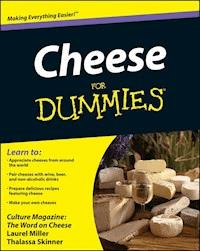
Cheese For Dummies E-Book
14,99 €
Mehr erfahren.
- Herausgeber: John Wiley & Sons
- Kategorie: Fachliteratur
- Sprache: Englisch
An accessible guide to selecting, cooking with, and making cheese From a pungent Gorgonzola to the creamiest Brie, the world of cheese involves a vocabulary of taste second only to wine. With the rise of artisanal cheeses, this once humble food made from curdled milk is now haute cuisine. And to make the new world of cheese less intimidating, Laurel Miller and Thalassa Skinner have created a handy primer to selecting cheese, pairing cheese with wine, cooking with cheese, and making cheese. In Cheese For Dummies, everyday cheese lovers will learn how to become true cheese connoisseurs. Not only will readers get a look at how different cheeses are made around the world, in Cheese For Dummies, they'll develop enough of a palate to discern which cheese is right for them. * Explains how to assemble the perfect cheese plate * Includes recipes for cooking with cheese * Details how to make five cheeses, including Mozzarella, Chevre, and Ricotta * Supplemented with a 16-page photo insert With artisanal and imported cheeses now common to mainstream grocery stores, the everyday cheese lover needs more than simply his nose to make the best choice. Offering wise (and delicious!) advice on every page, Cheese For Dummies is a guide for anyone interested in making every mealtime with cheese a special occasion.
Sie lesen das E-Book in den Legimi-Apps auf:
Seitenzahl: 627
Veröffentlichungsjahr: 2012
Ähnliche




















Cheese For Dummies®
Table of Contents
Cheese For Dummies®
by culture: the word on cheese,Laurel Miller, Thalassa Skinner
Foreword by Chef Ming Tsai Chef/owner of Blue Ginger and host of Simply Ming
Cheese For Dummies®
Published by John Wiley & Sons Canada, Ltd. 6045 Freemont Blvd. Mississauga, ON L5R 4J3www.wiley.com
Copyright © 2012 by John Wiley & Sons Canada, Ltd.
All rights reserved. No part of this book, including interior design, cover design, and icons, may be reproduced or transmitted in any form, by any means (electronic, photocopying, recording, or otherwise) without the prior written permission of the Publisher. Requests to the Publisher for permission should be addressed to the Permissions Department, John Wiley & Sons Canada, Ltd., 6045 Freemont Blvd., Mississauga, ON L5R 4J3, or online at http://www.wiley.com/go/permissions. For authorization to photocopy items for corporate, personal, or educational use, please contact in writing The Canadian Copyright Licensing Agency (Access Copyright). For more information, visit www.accesscopyright.ca or call toll free, 1-800-893-5777.
Trademarks: Wiley, the Wiley logo, For Dummies, the Dummies Man logo, A Reference for the Rest of Us!, The Dummies Way, Dummies Daily, The Fun and Easy Way, Dummies.com, Making Everything Easier, and related trade dress are trademarks or registered trademarks of John Wiley & Sons, Inc., and/or its affiliates in the United States and other countries, and may not be used without written permission. The Sustainable Kitchen is a registered trademark of Laurel Miller. All other trademarks are the property of their respective owners. John Wiley & Sons, Inc., is not associated with any product or vendor mentioned in this book.
Limit of Liability/Disclaimer of Warranty: The publisher and the author make no representations or warranties with respect to the accuracy or completeness of the contents of this work and specifically disclaim all warranties, including without limitation warranties of fitness for a particular purpose. No warranty may be created or extended by sales or promotional materials. The advice and strategies contained herein may not be suitable for every situation. This work is sold with the understanding that the publisher is not engaged in rendering legal, accounting, or other professional services. If professional assistance is required, the services of a competent professional person should be sought. Neither the publisher nor the author shall be liable for damages arising herefrom. The fact that an organization or Website is referred to in this work as a citation and/or a potential source of further information does not mean that the author or the publisher endorses the information the organization or Website may provide or recommendations it may make. Further, readers should be aware that Internet Websites listed in this work may have changed or disappeared between when this work was written and when it is read.
For general information on John Wiley & Sons Canada, Ltd., including all books published by Wiley Publishing, Inc., please call our distribution centre at 1-800-567-4797. For reseller information, including discounts and premium sales, please call our sales department at 416-646-7992. For press review copies, author interviews, or other publicity information, please contact our publicity department, Tel. 416-646-4582, Fax 416-236-4448.
For technical support, please visit www.wiley.com/techsupport.
Wiley publishes in a variety of print and electronic formats and by print-on-demand. Some material included with standard print versions of this book may not be included in e-books or in print-on-demand. If this book refers to media such as a CD or DVD that is not included in the version you purchased, you may download this material at http://booksupport.wiley.com. For more information about Wiley products, visit www.wiley.com.
Library and Archives Canada Cataloguing in Publication Data Cheese for dummies / Culture Magazine : The Word on Cheese, Laurel Miller, Thalassa Skinner. Includes index. 1. Cheese. 2. Cheesemaking. I. Miller, Laurel, 1969– II. Skinner, Thalassa III. Title: Culture magazine.
SF271.C44 2012 641.3’73 C2011-907378-1
ISBN 978-1-118-09939-1 (pbk); 978-1-118-14551-7 (ebk); 978-1-118-14552-4 (ebk); 978-1-118-14553-1 (ebk)
Printed in the United States
1 2 3 4 5 RRD 16 15 14 13 12
About the Authors
Laurel Miller is a Western U.S.-based food and travel writer, contributing editor at culture:the word on cheese, and culinary educator and owner of The Sustainable Kitchen. She grew up on a small California ranch raising dairy goats and a menagerie of other animals, which is what inspired her to teach people about sustainable agriculture and seasonal eating. When not writing or working part-time in a cheese shop, Laurel can be found indulging her street food obsession in the back alleys of the world. She is lactose intolerant.
Thalassa (Lassa) Skinner works as a cheesemonger in Napa, California, where she spends much of her time pairing local wines and beers with cheeses and infusing everyone she meets with the glories of cheese. She is a founder/owner of culture:the word on cheese and teaches classes at the San Francisco Cheese School and other venues throughout the Napa Valley and beyond. A dual citizen of both the United States and Australia, Lassa also has a home in South Australia’s Barossa Valley and may be the only person on earth who has managed, promoted, and helped grow farmers’ markets on two continents. Her dog Samantha (who is, in fact, an Aussie) has a distinctly cheese-centric palate and, though partial to camembert, has learned to accept that even she will have to wait until kidding season is complete before she can savor local goat milk cheeses again.
culture:the word on cheese, the first consumer magazine about cheese, and its website, www.culturecheesemag.com, was founded in 2008. Cheese embodies comfort yet oozes mystery. It conjures a better place and time, green swaths, happy cows, and ancient know-how. New cheesemakers appear each year. Shoppers seek wider selections of cheeses from specialty stores to supermarkets. The dizzying range of offerings comes from cow, goat, sheep, buffalo, or rarer animals’ milks, aged and fresh. Yet while we love it, we barely know it. That’s why culture magazine serves up the notable and obscure, with pairings and recipes, gorgeous photography, and introductions to dedicated farmers, makers, and mongers around the world. It’s why culture is the word on cheese!
Authors’ Acknowledgments
The authors wish to thank the following people, without whom this book would not have been possible:
To Tracy Barr, editor extraordinaire, for turning this into something we can be proud of, as well as for your patience, good humor, and talking us off the ledge more than once. To everyone at culture magazine for supporting this project (even when dubious) and helping us see it through to the very end: Kate Arding, Stephanie Skinner, Elaine Khosrova, Eilis Maynard, and Will Fertman. A special shout-out to a group of women who went the extra mile: Michele Buster, Cecile Delannes, Ursula Heinzelmann, Sheri LaVigne, Tami Parr, and Daphne Zepos. Thank you for putting up with us and our hundreds of e-mails! And an extra special thanks to Kate Arding, who willingly shared her considerable expertise and feedback when we most needed her, and provided the photography.
At Wiley: Anam Ahmed, Erika Zupko, and Lindsay Humphreys. And Robert Hickey—without whom this book would never have happened.
And to everyone else who provided expert advice, translation, support, contacts, recipes, or book contributions: Martin and Sarah Aspinwall, Barbara Backus, Joshua Bernstein, Josepha Bertolini, Giana Ciancio, Kathleen Cotter, Olivier Charbonneau, Bryan Dayton, Laure Dobouloz, Gordon Edgar, Jody Farnham, Will Fertman, Janet Fletcher, Camilla Ferenczi, Natalie Fryar, Jennifer Giambroni, Bryce Gilmore, Lionel Giraud, Malcolm Griffiths, Laurie Gutteridge, Ryan Hardy, Caroline Hostettler, Konrad Huesser, Ricardo Huijon, Christine Hyatt, Steve Jenkins, Mary Karlin, Paul Kinstedt, Betty Kloster, Jen Kruch, Andy Lax, Leah Mayor, Eilis Maynard, Max McCalman, Rebekah McCaul, Neville McNaughton, Drew Neiman, Patricia Michelson, Hilary Miller, Dr. Robert M. Miller, Lora Lea Misterly, Jeanne Rodier, Mark Roeland, Rebecca Sherman-Orozco, Fons Smits, Adam Spannaus, Cathy Strange, Bobby and Danette Stuckey, Will Studd, Ellen Sutton, Suzanne Swan, Ming Tsai, Juliana Uruburu, Bart van Kessel, Nancy Vineyard, Laura Werlin, Sarah Zaborowski, and Red Herring Design.
Laurel Miller wishes to thank: My family, for believing in my writing (P.S. Mom, the book is finished!); culture magazine for bringing me aboard this project; Sheri LaVigne of The Calf & Kid, for her mentorship, knowledge, and time. Grant Martin for tolerating my low output during the completion of this book; Charles Thoeming for his always sage advice; Juliana Uruburu, who told me about culture from the very beginning; and Sean, for everything else.
Lassa Skinner wishes to thank: My cheesemongering best man, Ricardo Huijon; my culture-d partners, who make everything happen; Michael Blum, for making that crucial decision that led to the book’s contract; Tony Bogar, whose support and sage words helped at crucial times; my ever-eager and forward-driving family; John Skovgaard, for listening and providing calm amidst the storm; Ellen Sutton, who had beer, wine, and grilled lamb ready when most necessary; and my wise, wonderful cheese industry mates who always listen, lend hands, and are there when needed most.
Publisher’s Acknowledgments
We’re proud of this book; please send us your comments at http://dummies.custhelp.com. For other comments, please contact our Customer Care Department within the U.S. at 877-762-2974, outside the U.S. at 317-572-3993, or fax 317-572-4002.
Some of the people who helped bring this book to market include the following:
Acquisitions, Editorial, and Vertical Websites
Editors: Robert Hickey, Anam Ahmed
Project Editor: Tracy L. Barr
ProductionEditor: Lindsay Humphreys
EditorialAssistant: Kathy Deady
TechnicalEditors: Kate Arding, Daphne Zepos
Recipe Tester: Emily Nolan
Nutrition Analyst: Patricia Santelli
Cover photo: © iStock/ rolfbodmer
Cartoons: Rich Tennant (www.the5thwave.com)
Composition Services
Project Coordinator: Kristie Rees
Layout and Graphics: Joyce Haughey, Sennett Vaughan Johnson, Corrie Niehaus, Lavonne Roberts
Proofreaders: Bryan Coyle, Susan Moritz, Lisa Stiers
Indexer: Rebecca R. Plunkett
Photos: Kate Arding, culture:the word on cheese
John Wiley & Sons Canada, Ltd.
Deborah Barton, Vice President and Director of Operations
Jennifer Smith, Publisher, Professional & Trade Division
Alison Maclean, Managing Editor, Professional & Trade Division
Publishing and Editorial for Consumer Dummies
Kathleen Nebenhaus, Vice President and Executive Publisher
Kristin Ferguson-Wagstaffe, Product Development Director
Ensley Eikenburg, Associate Publisher, Travel
Kelly Regan, Editorial Director, Travel
Publishing for Technology Dummies
Andy Cummings, Vice President and Publisher
Composition Services
Debbie Stailey, Director of Composition Services
Foreword
I have always loved cheese, and my travels throughout Europe over the years have fed this passion of mine. During my last stint in France, where I spent 2 1⁄2 years living and cooking in Paris, I developed a greater appreciation for the craft of cheesemaking and the role that cheese plays in French cuisine. Curiously enough, cheese is never served at the beginning of the meal. This is a purely American custom. Cheese is enjoyed at the end, before dessert, giving diners the opportunity to finish off their bottle of wine.
Cheese can also make it into your cooking repertoire. Personally, aged cheese is an ingredient I like to cook with because it is a great source of umami, the fifth taste of savoriness, which adds depth of flavor in a way similar to soy sauce. That’s why you will find Parmigiano Reggiano and Gorgonzola on the East-West menu of my restaurant Blue Ginger in Wellesley, Mass. I am fortunate to have the Wasik family, one of the country’s best cheesemongers, as neighbors. They have a stellar reputation for procuring the best cheeses and nurturing them in their cellar. I am proud to feature a Wasik’s Cheese Plate in the Lounge at Blue Ginger and at monthly wine dinners.
Cheese may be a familiar food, but it is a vast subject. This book provides the essential information you need in an easy-to-digest format and incorporates delicious serving suggestions. The material is extremely current, with content you won’t find in other resources. The folks at culture magazine bring years of experience and an educated palate to the table. They provide infallible guidance on how to assemble a cheese plate, and their wine pairing advice is spot on.
Cheese For Dummies is a title that should not be overlooked by foodies or self-professed cheese connoisseurs. This book will make you fall in love with cheese if you haven’t already. Now that great cheese is easy to find in local cheese shops and even grocery stores, you don’t have to travel the world to enjoy it.
Peace and Good Eating,
Ming Tsai Chef/owner of Blue Ginger restaurant and host of Simply Ming
Introduction
We may be cheese geeks, but we understand that, like wine, learning about cheese can be confusing, overwhelming, and (in the wrong hands) pretentious. Our goal is to demystify cheese — which is, after all, mostly milk — and help you feel comfortable with buying, tasting, and serving it. The best advice we can give you is, there are no “wrongs” when it comes to cheese, so have fun with it.
About This Book
Our goal throughout this book is to turn you on to cheese so that you can appreciate and enjoy it in all of its fresh, creamy, buttery, squeaky, hard, aged, crumbly, nutty, stinky glory. We also provide you with some inspired seasonal recipes featuring cheese and tempt you with descriptions of interesting styles and varieties (donkey milk or cheese mites, anyone?).
Each chapter is divided into sections, and each section contains information about a particular cheese-related topic, such as
How cheese is made and aged, and an overview of cheesemaking terms
The different styles of cheese and rind types and how to identify what you like
How to buy, serve, and store cheese economically and safely
How to pair cheese with different alcoholic and non-alcoholic beverages, make cheese-friendly cocktails, and create a cheese plate to remember
How to cook with cheese (we include simple, elegant, seasonal recipes for inspiration), how to make your own cheese plate condiments, and how to make ricotta, mozzarella, and other fresh cheeses
Whatever aspects of cheese interest you, this book is designed for dog-earring and flipping, so have at it!
Conventions Used in This Book
To help you navigate through this book, we’ve set up a few conventions:
Unless otherwise noted, cheeses that are named for the regions in which they originated (like Brie, which originated in the Brie region in France) are capitalized; others, like chèvre, the French word for “goat,” are lowercased.
Italic is used for emphasis and to highlight new words or terms that are defined.
Boldfaced text is used to indicate the action part of numbered steps.
Monofont is used for Web addresses.
In addition, the recipes in this book include preparation, cooking and processing times, and the yield you can expect from your efforts. All temperatures are Fahrenheit.
What You’re Not to Read
To help you navigate through the content in this book, we make it easy to identify what material you can safely skip. Sidebars and text preceded by the “Technical Stuff” or “Ask the Expert” icons aren’t required reading for you to gain a solid working knowledge of cheese, but they’re interesting tidbits that we think you’ll enjoy. We’ve also ensured that they’re educational, so if you like trivia — especially of the cheesy kind — we recommend giving them a look.
Foolish Assumptions
In writing this book, we made some assumptions about you:
You like, but don’t know anything about, cheese.
You know the basics about cheese but want more technical information and trivia.
You know a fair amount about cheese but want to delve more deeply into the technical, cultural, and historic aspects; learn more about pairing and tasting; or discover the professional facets of the cheese industry such as affinage, cheesemongering, or cheesemaking.
You’re knowledgable about wine, beer, or spirits, and want to know how to pair cheese accordingly (FYI: Wine For Dummies, Beer For Dummies, and Whiskey and Spirits For Dummies, all published by John Wiley & Sons, are excellent reference guides for pairing novices).
You’re into food and want to know how to put together a cheese plate, or you’re looking for delicious, cheese-centric, and home cheesemaking recipes.
How This Book Is Organized
One of our main goals while writing this book was to make the information easy to read, understand, and find. To that end, we organized this very broad subject into several sections, each containing chapters devoted to a particular cheese-related topic. Following is a quick run-down of the parts and the kinds of info you’ll find in each.
Part I: Getting to Know Cheese
This part is designed to give you fundamental knowledge about cheese. Here, we explore the history of cheese, its nutritional benefits, the basics of cheesemaking, the different styles of cheese and types of rinds, and how and why cheese is aged. We also take a look at terroir (the geography and climate of a place of origin) and discuss designation (the country- or European Union-specific terms for certain regional foods, beer, and wine), how those terms apply to cheeses of note, and why it’s important to designate these products.
You may be wondering why the information in these chapters is significant. Can’t you like a cheese without knowing any of this stuff? Sure. But by learning these things, you can begin to understand what you like about a cheese and increase your appreciation of it as a handmade product. This knowledge can also help you choose other cheeses, opening up a whole world that you may not have known existed. You’ll also gain an understanding of why artisan cheese is such an important cultural and subsistence food throughout much of the world, and why supporting domestic cheesemakers and small-scale agriculture is so crucial.
Part II: Choosing and Serving Cheese
This part shows you how to put the cheesemaking terminology and other information from Part I to good (tasting) use. In these three chapters, we explain how to use all of your senses to assess and flavor-profile cheeses so that you can discover what you like and don’t like. Once you know that, the rest is easy: We show you how to purchase cheese (including tips on how to talk to a cheesemonger like a pro), serve, and store cheese.
Part III: Cheese around the World
Pay a visit to this part for an armchair tour of cheese history, cheese culture, and types of cheeses from around the world. Here, you can find out how geography and climate play a major role in the style, production, and flavor of a cheese. Whether it inspires you to look for new varieties at your local shop or grocery store or to buy a plane ticket, you’ll learn that cheese has no language barrier.
Part IV: Eating, Drinking, and Cooking with Cheese
If you love cheese straight-up, chances are you enjoy cooking with it or pairing it with wine, beer, spirits, or non-alcoholic drinks, as well. In this part, we expand your cheese repertoire by explaining the basics of cooking with cheese; providing you with a variety of easy, seasonal recipes; and explaining the fundamentals of beverage pairing.
We also show you how to create an impressive cheese plate (and what to serve alongside) and provide you with essential information and recipes for home cheesemaking.
Part V: The Part of Tens
Whether you’re looking for unusual trivia (how about maggot cheese or milking a moose?), the most influential cheesemakers in the United States, or what cheese festivals are worth checking out, this part is where to find it.
Icons Used in This Book
To help you find specific kinds of information, we’ve included the following icons throughout this book:
This icon highlights any wisdom we have to offer about how to buy, serve, or store cheese, or suggested reading for the topic at hand.
When you see this icon, you know that we’re telling you essential cheese information. This is the stuff that you need to know.
This icon appears beside answers to common questions or insider info gleaned from cheese industry folks in all capacities.
We use this icon to point out technical information that we find fascinating, but that you don’t really need to know (our feelings won’t be too hurt if you skip it). Just think of these bits as fun trivia or ways to impress and educate your friends over a plate of (what else?) cheese.
This icon indicates how to best serve or pair a cheese with other foods or beverages, or what applications (cooking, melting, snacking, and so on) the cheese is best used for.
Where to Go from Here
Think of this book as a reference manual. It’s structured so that each chapter or section stands on its own. If you just want to know how to make a stand-out cheese plate or beverage pairing for your next party, head to Chapter 16. Chapters 3 and 4 break down the different styles of soft and hard cheeses and provide you with serving suggestions for each. If you want to know how cheese is made — from the animal to the plate — Chapter 2 takes you there. Bottom line: Where you go from here depends entirely on where your interest, or palate, takes you.
Part I
Getting to Know Cheese
In this part . . .
Although this book is intended for cheese neophytes, it’s got plenty of material for those of you in possession of more than just basic information. It doesn’t matter whether you can’t tell a camembert from a cheddar, or whether you’re a dedicated caseophile: The chapters in this part provide you with what you need to know to increase your cheese IQ.
Here, you discover the history of cheese, the various types of milk and how they affect the outcome of the final product; the basic steps of cheesemaking; the different styles of cheese and types of rinds; how and why cheese is aged; and the meaning of terroir and designations.
With this information in hand, you’re ready to launch into the rest of the book. But feel free to refer back to this part as your appetite and vocabulary for cheese grows.
Chapter 1
A Crash Course in Cheese
In This Chapter
Discovering the origins of cheese
Getting a background on cheese basics
Learning the health benefits of daily dairy consumption
Recognizing cheese as a global food
It’s hard to believe that something as complex, delicious, and diverse as cheese is made from just a few key ingredients. Thousands of different varieties of cheese are produced around the world from the milk of cows, goats, sheep, water buffalo, yaks, camels — even reindeer and horses. Depending upon the country, this ancient food can hold significant cultural, nutritive, and economic value.
In this chapter, we give you a brief overview of cheese: its history, why it’s good for you, where it comes from, and a few other basic nuggets. Consider the info here just enough to whet your appetite; you can find more detailed information on each of these topics and a slew of others in the upcoming chapters.
Accidents Happen: How Cheese Came to Be
We’d love to be the ones to provide a definitive answer to the much-debated question of how cheese was discovered. But the truth is, historians and archaeologists don’t have any conclusive evidence on who first made cheese, or where. The origin of cheese is believed to have occurred during the Neolithic period (beginning some 12,000 years ago), although some experts suggest it predates recorded history. Things are equally murky as to where said cheese was produced: Europe, Central Asia, North Africa, or the Middle East.
From oops!. . .
The most commonly held theory on the origin of cheese suggests that an Arab nomad unwittingly created the first batch of cheese after discovering the milk he’d stored in an animal-stomach bag (most likely that of a sheep) had curdled.
The idea certainly makes sense. After all, cured animal skins and organs were frequently used as vessels or containers for food and water, and the stomach lining of young ruminants (cud-chewing mammals) such as sheep, goats, and cows naturally contain rennet, the enzyme used to make cheese.
Thus, milk stored in an animal stomach, jostled around during a long day or days of traveling, and subject to a hot climate could very well result in the formation of cheese. But let’s face it: Folks have been letting milk ferment for thousands of years, so it’s very possible that cheese was “discovered” multiple times throughout history, in different parts of the world.
. . . To ahhh!
While there’s little doubt that cheese was first made or (more likely) discovered when milk, carried in a bag made from an animal stomach, curdled into cheese, intentional cheesemaking is believed to have originated with the domestication of sheep and goats, between 8,000 and 3,000 BCE. Some research shows the ancient Sumerians were the first to intentionally and systematically make cheese. Egyptian and Mesopotamian hieroglyphics also include cheese (we’d hate to depart for the Underworld without it, too).
However it came to be, cheesemaking today runs the gamut from humble subsistence food to culinary art form (with all due respect to Da Vinci!).
Crafting a high-quality cheese requires more than just good milk. Also needed is an understanding of microbiology, chemistry, and affinage (aging), as well as a well-trained palate. Even with these skills, a controlled environment is still an essential part of the cheesemaking process: you need to be able to create a consistent product (which may or may not have seasonal variations depending upon what the animals are eating; see Chapter 2) that is largely based upon stable and hygienic conditions.
Hankering for a hunk of cheese: The cheese industry today
Until the early 1980s, cooking for a living wasn’t necessarily deemed a particularly impressive occupation in the United States. In the early and mid-part of the 20th century, line cooks were traditionally former convicts, societal misfits, the uneducated, or down-on-their-luck loners. Hard to believe, right?
Today, culinary schools are filled to capacity, and kitchen work — one of the more stressful, unglamorous jobs imaginable — has a high-profile status attached to it. Since the era of the celebrity chef began, other food-and-drink-related occupations have joined the ranks of coolness: winemakers, farmers, craft brewers, coffee roasters, distillers, mixologists, charcuterers (makers of cured meat products), butchers, and cheesemakers. Skillfully growing or crafting a beautiful, delicious product from the most humble of ingredients is now recognized and celebrated as a viable career — something we find really exciting.
Cheesemongers are also having their moment. Walk into a cheese shop in Brooklyn, Seattle, San Francisco, or Chicago, and you’ll see that slinging dairy products is currently the hipster career of choice. We’re poking fun, but it’s really true that the cheese industry has, in the last five years, attracted the kind of alternative, Gen X/Y following currently saturating the restaurant, small farm, and artisan food industries.
What does this mean for the future of cheese, besides greater demand for mongers? Well, it means cheese has finally achieved a level of recognition and appreciation heretofore unseen in the United States. There’s even a Certification Exam for Cheese Professionals established to set standards of accreditation within the country (to find out more about this, go to www.cheesesociety.org/events-education/certification-2).
In addition, consumers are growing increasingly savvy about artisan cheeses, and it doesn’t appear their appetite will be sated anytime soon. Cheese shops are springing up across the nation, and with them, greater demand for cheese-related occupations such as buying, distributing, and cheesemaking. You’d be surprised how many mid-life career changers out there have ditched an urban, corporate existence for a herd of goats and a cheesemaking vat. While not all of these folks are successful, their intentions prove that there’s just something about cheese that nourishes both the body and soul.
Americans aren’t just curious about cheese; they’re crazy for it. The total cheese consumption per capita in the U.S. increased from 23.81 pounds in 1989 to 32.9 pounds in 2009 — and it’s still rising.
Those hipsters behind the cheese counter? Don’t dismiss them as a pop culture cliché. Here’s why:
If they’re working at a serious cheese shop or counter, odds are they’re highly trained and very knowledgeable about not just cheese, but food in general. They can likely tell you the best cheeses to use for specific recipes and what techniques work best, or how to pair that $40 per pound, 5-year aged domestic Gouda with a wine, craft beer, or whisky that will do it justice.
Unlike the wine industry, which until fairly recently had a reputation for pretense, the incoming generation of cheesemakers and cheesemongers are more interested in making good cheese accessible to everyone — not just those who can afford it. These younger industry employees are likely on a tight budget, and they’re just as happy to steer you toward a great, affordable snacking cheese or give you some wallet-friendly advice for your next dinner party. Likewise, cheese shops and counters that cut-to-order offer consumers a chance to taste a range of different varieties without spending a lot of money.
In Part II, we tell you everything you need to know about purchasing cheese, from where and how to buy it to what to tell the cheesemonger to ensure that you get something that suits your taste.
Key Things to Know about Cheese
The cheesemaking process has changed little over the centuries, despite increased knowledge about microbiology and chemistry. Cheesemakers are, in essence, like chefs, with a multitude of recipes at their fingertips. Their most important decisions, however, are what type of milk to use (cow, sheep, and goat milk are the most common) and how to ensure that milk is of the highest quality. In this section, we highlight some important general points about cheese. Head to Chapter 2 to find out about cheesemaking, from milk to mold (which, in this industry, is usually a good thing).
It’s alive!
Cheese is a living product, because of the cultures, mold, and bacteria it contains. This is why it continues to ripen as it ages (and why storing it properly is important). A sheep’s stomach may have worked well for storage back in the day (refer to the earlier section “From oops!...”), but for your health (as well as the best-tasting product), keep your cheese refrigerated and wrapped up. Chapter 7 has more information on storing cheese.
Styled out
Every style of cheese — fresh, semi-soft, washed rind, blue, semi-firm, or hard — has its special characteristics and properties, which are developed by making specific adjustments during the cheesemaking process. In Chapters 2, 3, and 4, we discuss what makes one cheese different from another.
The rind of a cheese is its skin. It’s an important part of the cheese that’s the result of bacteria and molds used during the cheesemaking process; these same microorganisms also work to create a specific style of cheese as dictated by the cheesemaker. The rind also protects the cheese so that it can age. With certain styles, such as surface-ripened cheeses, the rind is the actual mold that ripens and flavors the entire wheel, making it crucial to the end product.
The Internet is home to some great cheese resources. Check out the following:
culture: the word on cheese: Yes, that’s us, but we’re not shy! The culture online library profiles an extensive compendium of cheese varieties, compiled by our team of experts (www.culturecheesemag.com).
American Cheese Society: The American Cheese Society (ACS) is a professional industry organization that’s also open to consumers (www.cheesesociety.org).
It has its own language: Speaking cheese geek
Cheese is a complex subject, without a doubt. But the really difficult, technical stuff comes with its production. We provide you with the basics of cheesemaking in Chapter 2 so that you’re able to develop a working knowledge of how it’s made and the vocabulary that goes along with it. After all, you never know when you’ll need to say, “I think this surface-ripened could have used a bit more Geotrichum.” We kid.
What’s more important for you, as a cheese lover, to know is the terminology associated with the different styles of cheese and types of rinds. We break all of that information down for you in Chapters 2, 3, and 4. Even if you don’t commit these things to memory, as long as you know what qualities you like in a cheese — buttery, sharp, stinky — your cheesemonger can help you select something that you’ll enjoy.
What if you don’t have a cheesemonger? We understand that’s most often the case. After reading Chapter 5, in which we explain how to use your senses to evaluate cheeses, you’ll not only know what flavors and textures you like, but what types of milk and styles you prefer (to help you along, we also offer you suggestions on what to try the next time you’re shopping for cheese). Even without a cheesemonger present, as long as you know you want a stinky cheese or a strong blue, you’ll know what styles or key words to look for.
The point is, don’t be intimidated by cheese. As cheesemongers, we get a lot of customers who feel uncomfortable selecting a cheese for various reasons, and there’s no reason for you to feel that way.
If you don’t know how to pronounce the name of a foreign cheese, don’t sweat it. Most cheesemongers aren’t fluent in French/Italian/Spanish/German either, and we’ve all had to learn the correct way to say the names of certain cheeses. If you don’t want to make a stab at it, all you have to do is point to the cheese in question and ask something along the lines of, “Could I please try some of the French cow milk cheese in the lower right corner? How do I pronounce that, anyway?” Your cheesemonger will be more than happy to comply. We do provide pronunciation tips on some of the more esoteric cheeses in this book, but there are cheese books written with language skills in mind. One we recommend is The Cheese Lover’s Companion (HarperCollins), by Ron and the late Sharon Tyler Herbst.
You can enjoy it in a variety of ways
As we note earlier, one of the many truly great things about cheese is its diversity: in style, type of milk, flavor, recipe, and production method. Another great thing about cheese is its accessibility. You don’t need to spend a lot of money, own a passport, or be a certain age to enjoy a great cheese, nor do you require any prior knowledge or cooking ability whatsoever.
Anyone can slice off a hunk or put together an impressive cheese plate. (Don’t believe us? Turn to Chapters 7 and 15.) Cheese is an equal opportunity food, as well as an ingredient that can enliven everything from bread or salad to soups and dessert, as we show you in Chapters 17 and 18. You can also make fresh cheese yourself, even if the closest you’ve ever been to a cow is the milk in your latte (look at Chapter 19 for instructions and encouragement).
Ten reasons to eat some cheese, right now
As if you need a reason (especially after reading about the nutritional benefits that follow)! But we understand that cheese can be both a financially and calorically detrimental habit. So in case you need that extra nudge, here are some of our favorite reasons to buy a hunka:
Your cholesterol test results were fine.
It’s finally tomato season.
It’s Monday.
It’s Wednesday.
A friend has a bottle of 1982 Dom Perignon and doesn’t want to drink alone.
The dentist said, “No cavities.”
You met your deadline.
Housewarming gift — to yourself.
It’s spring (kidding season!), and your favorite cheese shop just received the first local chèvre of the year.
You need to increase your calcium intake — doctor’s orders!
Cheese! To Your Health
Cheese gets a bad rap for its high saturated fat content, and as a result, calorie counters often shun it — or substitute its plasticky, bland, low- or non-fat equivalent. Guess what? The health benefits of cheese and other dairy products far outweigh the drawbacks, and studies show that a moderate amount of dairy in your diet helps contribute to the prevention of tooth decay, as well as lowers cholesterol and promotes weight loss. Here are the details:
It inhibits tooth decay. Studies from the beginning of the 1990s show that the casein and whey proteins in cheese actually inhibit tooth decay, as well as strengthen teeth and help to restore enamel. Cheese also increases the flow of saliva, which washes away acids and sugars that contribute to tooth decay. Don’t ditch your toothpaste, but eating a small portion of semi-firm cheese after a meal is beneficial to your teeth and gums.
It’s loaded with good stuff. Cheese is an excellent source of calcium, phosphorous, vitamin A, and protein. High protein foods take more energy to metabolize, which assists with weight loss.
In general, goat milk contains more vitamins A and D than that of cow or sheep, but cow milk is higher in folic acid and zinc. Sheep milk has significantly more vitamins B2 and B12 and more conjugated linoleic acid (CLA) than goat or cow milk. In other words…eat ’em all!
It helps prevent certain diseases. Many cheeses are high in conjugated linoleic acid (CLA), which lowers cholesterol and helps prevent hypertension and diabetes. CLA and Omega-3 fatty acids are higher in cheese made from animals that have grazed exclusively on fresh grass. CLA levels are also more significant in certain types of cheese such as fresh, surface-ripened, and alpine styles. The nutritional value also varies depending upon the type of cheese and animal species it comes from.
What about its salt content? Salt is a necessary ingredient in cheese production, as we explain in Chapter 2, so if you’re really trying to cut sodium out of your diet, you might want to skip the cheese (remember, too, that salt adds flavor, so a cheese devoid of any would be pretty bland).
Parmigiano Reggiano is a lower sodium variety that’s very versatile and full-flavored, so it’s a win-win. It’s also lower in fat because it’s made with partially skimmed milk.
A food writer and registered dietician friend of Laurel’s once said, over a plate of Parmigiano Reggiano, “Everything in moderation. Including moderation.” We agree. Immoderately.
Budget Travel: Exploring the World through Cheese
Cheese is one of the most universal foods. It’s made and/or eaten on every continent except Antarctica, and most cultures eat dairy products in some form. We take you on a tour of the cheesemaking areas of the world in Part III.
Because cheese is so ubiquitous throughout the world, it makes for both an excellent armchair travel companion, as well as a fun way to explore other cultures when you’re on the road. With the proliferation of more specialized cheese distributors, esoteric imports (such as Paski sir, a delicious, hard sheep milk cheese from Croatia, or sheep milk feta from Australia) are available here in the United States, as are excellent pasteurized versions of “benchmark” cheeses such as Brie or camembert. Also available are incredible domestic cheeses coming from dairies with just 50 goats or 5 cows, and fine, clothbound cheddars produced in volume.
Flip through Part III to take a brief tour of the global cheese scene. You’ll be inspired to try cheeses from all over the world or, if you’re already a traveler, to discover cheese-centric destinations that may inspire your next jaunt (culture: the word on cheese highlights cheese-centric destinations in every issue).
At the risk of sounding redundant, cheese is one of the few foods that’s able, through a bit of organic and human-assisted alchemy, to truly provide a sense of place (much like wine). As you discover more about how cheese is made and as you try more cheeses, you’ll discover seasonal variations and subtle flavors that hint at the cheese’s origin (think of cows grazing on wild onion; goats browsing wild herbs; pasture grass growing from soil rich in minerals; wheels of cheese aging for months or even years in a natural limestone cave).
Or if that’s more geeked out than you care to get, just grab a glass of wine, a cold beer, or a dram of Scotch (see Chapter 16), and enjoy it with a nice wedge of cheese and some fresh bread — using our pairing tips. The cheese — and the choice — is up to you.
Chapter 2
Tracing Cheese from Farm to Table
In This Chapter
Exploring the different types of milk and how cheese is made
Examining what determines a cheese’s style
It’s hard to believe that something as complex, delicious, and downright diverse as cheese is made of just a few key ingredients. Hundreds of types of cheeses are made around the world — from the milk of cows, goats, sheep, water buffalo, yak, camels, reindeer, donkeys, and horses. Depending on the country, this ancient food can hold significant nutritive and cultural value.
In this chapter, we explore the basics of cheesemaking, starting with its key component, milk, and then move on to what makes one cheese’s style (the various categories of cheese, depending upon age, moisture content, texture, and rind) different from another.
Got Milk — and What Kind? Understanding Cheese’s Key Ingredient
The cheesemaking process has changed little over the centuries, despite increased knowledge about microbiology and chemistry. Cheesemakers are, in essence, like chefs, with a multitude of recipes or cheesemaking processes at their fingertips. However, cheesemakers’ most important decision is what type of milk to use, and then they have to ensure that that milk is of the highest quality.
Milk is such a commonplace food, most folks don’t give it much thought, unless they’re concerned about its fat content. Yet it’s an incredibly complex liquid, with seasonal and chemical variations, depending on the species it comes from. Milk is the key ingredient in cheese, and both the type of milk (cow, sheep, goat, and so on) and its composition (amount of water, milk fat, lactose, minerals, and so on) play essential roles in the kind of cheese produced and its quality.
White gold: A quick look at milk’s composition
Milk is composed of water and solids. Here, we break those down into the components most critical in cheesemaking:
Water: All milk is composed of at least 82 percent water; cow milk is over 87 percent water.
Butterfat: Also known as milk fat, butterfat is the natural fatty constituent of milk and the chief component of butter. (Clarified butter is milk fat without water or liquid.)
Protein: Casein (pronounced “cay-seen”) is the main protein in milk and is, together with butterfat, what becomes the solids (curds) when milk is coagulated to make cheese.
Lactose: The main sugar in milk.
Minerals: Calcium and phosphorous are the main mineral components of milk.
Different animal breeds have different chemical compositions to their milk. The best example is a Jersey cow versus a Holstein cow. The Jersey, which is significantly smaller than a Holstein, produces milk with higher butterfat, which is a great trait for making creamy, oozy cheeses, but not for longer-aged, drier cheeses. Generally, Holsteins produce more milk, but it’s lower in butterfat. Table 2-1 lists the average percentages of fat, protein, and lactose in the milk of different animals.
Keep in mind that fat content depends upon breed, climate, season, and so on. Jerseys, for example, have the highest butterfat content of the major dairy cattle breeds: up to 5.3 percent. That’s a big difference from Holstein milk, which averages 3.6 percent!
In addition, different breeds have been raised in specific geographic areas for centuries, and these animals have as much to do with the kind of cheese made from their milk as does their location and environment. Specific cheeses, like Parmigiano Reggiano (see Chapter 4 for information on this famous cheese), have strict laws that dictate the specific type of animal milk used, the region it must be produced in, and how the cheese is made. In this way, the relationship between milk and pasture is very much like wine grape varietals and regions.
Examining the three main milks used in cheesemaking
The three main milks used in cheesemaking are cow, goat, and sheep. Each has its own characteristics in terms of flavor, color, and texture, as well as differing butterfat contents and chemical compositions, depending upon the species and breed.
Over thousands of years, dairy animals have been domesticated and genetically selected to produce more milk. In addition, their natural lactation cycles (the period of time during which they produce milk to feed their young) have been extended to maximize milk (and thus cheese) yield and profit. The lactation periods we list in the next sections for the three main dairy species (cow, goat, and sheep) are generalities; many variables, including species, breed, climate, season, pasture, vegetation, supplementary feed or lack thereof, the herd management practices of the farmer, and so on, also impact both the quality of the milk and the length of lactation periods.
Having a cow
After giving birth, cows can lactate (produce milk, also known as freshening) from their mammary glands (in cows and other dairy animals, it’s called an udder) for as long as two years.
Cow milk ranges from deep to light, creamy yellow, depending on what the animal is eating and its breed. Its composition works well for most cheese styles. Cow milk is comparable to goat milk in terms of fat and protein content, but its composition is different, which affects how cheese is made. In general, cow milk has a medium weight in the mouth, as compared to goat milk, which is the lightest, and sheep milk, which has a slightly heftier feel.
Saving Bessie: Heritage breeds
The advent of modern agriculture has led to the development of a few select breeds of livestock and poultry, designed for maximum output to meet global demand for commodity products such as milk.
Sounds great, right? Before you answer, consider this: These animals have likely lost many crucial genetic traits that helped the original, often ancient (“heritage”) breeds they’re descended from. The loss of these traits can have dire consequences in the event of a widespread epidemic: Think of foot-and-mouth disease or Mad Cow disease (bovine spongiform encephalopathy). These “factory-farmed” animals are likely to have little to no disease resistance. Making matters worse, the diseases that affect livestock populations may develop antibiotic resistance as a result of the prophylactic drugs being routinely included in the animal feed as growth stimulants.
Heritage livestock and poultry breeds are again gaining in popularity because family farmers are realizing the importance of preserving genetic diversity, as well as preventing the extinction of the historic breeds still in existence.
Many heritage animals retain traits such as disease resistance, tolerance to climatic extremes, mothering traits (sometimes lacking in modern breeds, who are often separated from their young at birth), and physical characteristics that make them better suited to specific geographical environments. Some of these breeds are so scarce their estimated global population is less than 2,000 animals.
One example is the Red Devon cow, a breed that first arrived in the United States with the Pilgrims, via Southwest England. These handsome, russet-colored cattle are small, hardy, and a good multiuse animal for draft, milk, and meat. The Red Devon fell by the wayside over hundreds of years, with the development of hybrids. Now, however, Red Devons are slowly making a comeback, thanks to enterprises such as the Rare Breeds program in Colonial Williamsburg, Virginia.
For more information on heritage breeds, go to the American Livestock Breed Conservancy, www.albc-usa.org/.
Getting your goat
Goats can lactate for as long as 10 months after giving birth. Unlike cows, they favor brambles and thorny grasses in pasture, hence their reputation for eating anything — though in fact they’re rather finicky. Bright-white goat milk is leaner and less sweet in the mouth than cow, and the cheeses are usually described as having a citrus-like tang, which is the result of the milk’s chemistry.
Although goat milk has approximately the same fat and protein content as cow milk (although that also varies, depending upon breed), its fat globules are generally smaller, and its chemical composition makes it easier to digest. Goat milk is ideal for many people who have problems consuming dairy products (see the “Eating cheese when you’re lactose intolerant” sidebar if you have difficulty digesting dairy).
Recombinant bovine somatotropin, or rBST?
Recombinant bovine somatotropin (rBST) is a synthetic version of a naturally-occurring protein hormone produced by dairy cattle. This hormone, known as bST or bGH (bovine growth hormone), is produced by the pituitary gland, and its basic function is to regulate metabolism. rBST was developed (via genetic engineering) as an injectable to boost the milk production of dairy cows.
rBST was introduced into the commercial dairy industry in the early 1990s, and it soon came under close scrutiny. Cows treated with rBST have an increased likelihood of health problems ranging from lameness to mastitis (a serious infection of the udder). These conditions result in increased antibiotic use, which can result in antibiotic resistance.
Mounting evidence also shows that rBST has dire effects on human health, including an increase in antibiotic resistance, milk allergies, and cancer rates. The United States is the only industrialized nation to not ban the use of rBST.
U.S. consumers concerned about rBST in their milk supply haven’t managed to get its use banned, but the FDA now recommends that dairy producers who don’t use the hormone label their products as such. Look for the words “made from cows not treated with rBST” or similar phrasing on packaging.
Feeling sheepish
Some dairy sheep require a lush grass environment to be profitable dairy producers, but in general, they thrive in more challenging habitats, such as lowland scrub or sparse, mountainous terrain. Sheep produce milk for the least amount of time — only up to 6 or 7 months after giving birth — and their milk is quite different from both cow and goat milk, with far more butterfat and protein.
Like goats, sheep produce milk that is white in color (rather than yellow) because they convert the carotene in what they eat into vitamin A. Not surprisingly, sheep milk and cheeses made from sheep milk often taste like the smell of a clean wool sweater. Sheep produce significantly less milk than either goats or cows, but the milk is higher in solid content.
Exploring other milk options
In parts of Asia, the Middle East, Africa, and Europe, the milk of water buffalo, yaks (technically, only the males are called yaks; females are called dri or nak




