


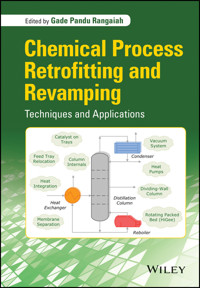
Chemical Process Retrofitting and Revamping E-Book
134,99 €
Mehr erfahren.
- Herausgeber: John Wiley & Sons
- Kategorie: Fachliteratur
- Sprache: Englisch
The proposed book will be divided into three parts. The chapters in Part I provide an overview of certain aspect of process retrofitting. The focus of Part II is on computational techniques for solving process retrofit problems. Finally, Part III addresses retrofit applications from diverse process industries.
Some chapters in the book are contributed by practitioners whereas others are from academia. Hence, the book includes both new developments from research and also practical considerations. Many chapters include examples with realistic data. All these feature make the book useful to industrial engineers, researchers and students.
Sie lesen das E-Book in den Legimi-Apps auf:
Seitenzahl: 739
Veröffentlichungsjahr: 2016
Ähnliche




















Dedication
In memory of my late parents: Gade Sakuntala Devi and Gade Gopala Swami, who nurtured and educated me
and
To my dearest wife: Puvvada Krishna Kumari, for her selfless support and devotion to our family
Chemical Process Retrofitting and Revamping
Techniques and Applications
Edited by
GADE PANDU RANGAIAH
Department of Chemical & Biomolecular Engineering National University of Singapore Singapore
This edition first published 2016 © 2016 John Wiley & Sons, Ltd
Registered officeJohn Wiley & Sons Ltd, The Atrium, Southern Gate, Chichester, West Sussex, PO19 8SQ, United Kingdom
For details of our global editorial offices, for customer services and for information about how to apply for permission to reuse the copyright material in this book please see our website at www.wiley.com.
The right of the author to be identified as the author of this work has been asserted in accordance with the Copyright, Designs and Patents Act 1988.
All rights reserved. No part of this publication may be reproduced, stored in a retrieval system, or transmitted, in any form or by any means, electronic, mechanical, photocopying, recording or otherwise, except as permitted by the UK Copyright, Designs and Patents Act 1988, without the prior permission of the publisher.
Wiley also publishes its books in a variety of electronic formats. Some content that appears in print may not be available in electronic books.
Designations used by companies to distinguish their products are often claimed as trademarks. All brand names and product names used in this book are trade names, service marks, trademarks or registered trademarks of their respective owners. The publisher is not associated with any product or vendor mentioned in this book.
Limit of Liability/Disclaimer of Warranty: While the publisher and author have used their best efforts in preparing this book, they make no representations or warranties with respect to the accuracy or completeness of the contents of this book and specifically disclaim any implied warranties of merchantability or fitness for a particular purpose. It is sold on the understanding that the publisher is not engaged in rendering professional services and neither the publisher nor the author shall be liable for damages arising herefrom. If professional advice or other expert assistance is required, the services of a competent professional should be sought.
The advice and strategies contained herein may not be suitable for every situation. In view of ongoing research, equipment modifications, changes in governmental regulations, and the constant flow of information relating to the use of experimental reagents, equipment, and devices, the reader is urged to review and evaluate the information provided in the package insert or instructions for each chemical, piece of equipment, reagent, or device for, among other things, any changes in the instructions or indication of usage and for added warnings and precautions. The fact that an organization or Website is referred to in this work as a citation and/or a potential source of further information does not mean that the author or the publisher endorses the information the organization or Website may provide or recommendations it may make. Further, readers should be aware that Internet Websites listed in this work may have changed or disappeared between when this work was written and when it is read. No warranty may be created or extended by any Promotional statements for this work. Neither the publisher nor the author shall be liable for any damages arising herefrom.
Library of Congress Cataloging-in-Publication Data
Chemical process retrofitting and revamping : techniques and applications / edited by G.P. Rangaiah. pages cm Includes bibliographical references and index. ISBN 978-1-119-01633-5 (cloth) 1. Chemical plants–Remodeling. 2. Chemical plants–Maintenance and repair. 3. Chemical plants–Equipment and supplies. I. Rangaiah, Gade Pandu, editor. TP155.5.C5128 2016 660–dc23
2015033565
Cover images: Main image: Courtesy of the editor and authors. Background image: from GettyImages, at http://www.gettyimages.com/photos/187591800?license=rf&family=creative&phrase=187591800&sort=best&excludenudity=true
A catalogue record for this book is available from the British Library.
CONTENTS
List of Contributors
Preface
Part I: Overview
Chapter 1: Introduction
1.1 Chemical Process Plants
1.2 Process Retrofitting and Revamping
1.3 Stages in Process Retrofitting/Revamping Projects
1.4 Conceptual Process Design for Process Retrofit/Revamp Projects
1.5 Research and Development in Process Retrofit/Revamp
1.6 Scope and Organization of this Book
1.7 Conclusions
References
Chapter 2: Project Engineering and Management for Process Retrofitting and Revamping
2.1 Introduction
2.2 Key Differences between Revamp and Grassroots Designs
2.3 Revamp Design Methodology
2.4 Project/Process Engineering and Management of Revamp Projects
2.5 Key Elements of Project Management
2.6 Revamp Options for Process Equipment
2.7 Conclusions
Acronyms
References
Notes
Chapter 3: Process Safety in Revamp Projects
3.1 Introduction
3.2 Lessons from Past Process Safety Incidents
3.3 Preliminary Hazard Review during Conceptual Design
3.4 Process Hazard Analysis (PHA)
3.5 Revision of PSI and Operator Induction
3.6 Pre-Start-up Safety Review (PSSR)
3.7 Management of Change (MOC)
3.8 Conclusions
Acronyms
Exercises
References
Notes
Part II: Techniques for Retrofitting and Revamping
Chapter 4: Mathematical Modeling, Simulation and Optimization for Process Design
4.1 Introduction
4.2 Process Modeling and Model Solution
4.3 Process Simulators and Aspen Custom Modeler
4.4 Optimization Methods and Programs
4.5 Interfacing a Process Simulator with Excel
4.6 Application to Membrane Separation Process
4.7 Conclusions
Acronyms
Appendix 4A: Implementation of Membrane Model in ACM
Appendix 4B: Interfacing of Aspen Plus v8.4 with Excel 2013
Appendix 4C: Interfacing of Aspen HYSYS v8.4 with Excel 2013
Exercises
References
Chapter 5: Process Intensification in Process Retrofitting and Revamping
5.1 Introduction
5.2 Methods of Process Intensification
5.3 Alternatives to Conventional Separators
5.4 Alternatives to Stirred Tank Reactor (STR)
5.5 Process Integration
5.6 Fundamental Issues of PI
5.7 Future of PI
5.8 Conclusions
Acknowledgement
Appendix 5A: Monographs, Reviews and Some Recent Papers
References
Chapter 6: Using Process Integration Technology to Retrofit Chemical Plants for Energy Conservation and Wastewater Minimization
6.1 Introduction
6.2 Graphical Design Tools for Retrofitting Process for Energy Conservation by Designing Heat Exchange Networks
6.3 Graphical Design Tools for Retrofitting Processes for Wastewater Reduction by Designing Water Recycle Networks
6.4 Conclusions
Appendix 6A: Illustrating the Water Recycle Network Design Guidelines
Exercises
References
Chapter 7: Heat Exchanger Network Retrofitting: Alternative Solutions via Multi-objective Optimization for Industrial Implementation
7.1 Introduction
7.2 Heat Exchanger Networks
7.3 HEN Improvements
7.4 MOO Method, HEN Model and Exchanger Reassignment Strategy
7.5 Case Study
7.6 Results and Discussion
7.7 Conclusions
Appendix 7A: Calculation of Nodal Temperatures
Exercises
References
Chapter 8: Review of Optimization Techniques for Retrofitting Batch Plants
8.1 Introduction
8.2 Batch Plant Typical Features
8.3 Formulation of the Batch Plant Retrofit Problem
8.4 Methods and Tools for Retrofit Strategies
8.5 Conclusions
References
Part III: Retrofitting and Revamping Applications
Chapter 9: Retrofit of Side Stream Columns to Dividing Wall Columns, with Case Studies of Industrial Applications
9.1 Introduction
9.2 Side Stream Column
9.3 Dividing Wall Column
9.4 Retrofit of an SSC to a DWC
9.5 Case Studies of Industrial Applications
9.6 Other Case Studies
9.7 Conclusions
Acknowledgements
Nomenclature
References
Chapter 10: Techno-economic Evaluation of Membrane Separation for Retrofitting Olefin/Paraffin Fractionators in an Ethylene Plant
10.1 Introduction
10.2 Olefin/Paraffin Separation in an Ethylene Plant
10.3 Membrane Model Development
10.4 Retrofitting a Distillation Column with a Membrane Unit
10.5 Formulation of Multi-objective–Optimization Problem
10.6 Results and Discussion
10.7 Conclusions
Appendix 10A: Membrane Model Validation
Appendix 10B: Costing of HMD System
Exercises
References
Notes
Chapter 11: Retrofit of Vacuum Systems in Process Industries
11.1 Introduction
11.2 Vacuum-generation Methods
11.3 Design Principles and Utility Requirements
11.4 Chilled-water Generation
11.5 Optimization of Vacuum System Operating Cost
11.6 Case Study 1: Retrofit of a Vacuum System in a Petroleum Refinery
11.7 Case Study 2: Retrofit of a Surface Condenser of a Condensing Steam Turbine
11.8 Conclusions
Nomenclature
Exercises
References
Notes
Chapter 12: Design, Retrofit and Revamp of Industrial Water Networks using Multi-objective Optimization Approach
12.1 Introduction
12.2 Mathematical Model of a Water Network
12.3 Water Network in a Petroleum Refinery
12.4 Multi-objective Optimization Problem Formulation
12.5 Results and Discussion
12.6 Conclusions
Acknowledgement
Nomenclature
Exercises
References
Chapter 13: Debottlenecking and Retrofitting of Chemical Pulp Refining Process for Paper Manufacturing – Application from Industrial Perspective
13.1 Introduction
13.2 Fundamentals of Chemical Pulp Refining
13.3 Theories of Chemical Pulp Refining
13.4 Types of Commercial Refiners
13.5 Laboratory and Pilot-scale Refining Investigation
13.6 Case Studies of Retrofitting Refining Process for Paper Mills
13.7 Conclusions
Exercises
References
Index
EULA
List of Tables
Chapter 1
Table 1.1
Chapter 2
Table 2.1
Table 2.2
Table 2.3
Table 2.4
Table 2.5
Table 2.6
Table 2.7
Table 2.8
Table 2.9
Table 2.10
Table 2.11
Table 2.12
Table 2.13
Table 2.14
Table 2.15
Table 2.16
Chapter 3
Table 3.1
Table 3.2
Table 3.3
Table 3.4
Table 3.5
Table 3.6
Table 3.7
Table 3.8
Table 3.9
Table 3.10
Chapter 4
Table 4.1
Chapter 5
Table 5.1
Table 5.2
Table 5.3
Table 5.4
Chapter 6
Table 6.1
Table 6.2
Table 6.A.1
Table 6.3
Table 6.4
Table 6.5
Table 6.6
Table 6.7
Chapter 7
Table 7.1
Table 7.2
Table 7.A.1
Chapter 8
Table 8.1
Table 8.2
Chapter 9
Table 9.1
Table 9.2
Table 9.3
Table 9.4
Chapter 10
Table 10.1
Table 10.2
Table 10.3
Table 10.4
Table 10.5
Table 10.6
Table 10.7
Table 10.8
Table 10.A.1
Table 10.A.2
Table 10.A.3
Table 10.A.4
Table 10.A.5
Table 10.B.1
Table 10.B.2
Chapter 11
Table 11.1
Table 11.2
Chapter 12
Table 12.1
Table 12.2
Table 12.3
Table 12.4
Table 12.5
Table 12.6
Chapter 13
Table 13.1
Table 13.2
Table 13.3
Table 13.4
Table 13.5
Table 13.6
Guide
Cover
Table of Contents
Preface
Pages
xiii
xiv
xv
xvi
1
3
4
5
6
7
8
9
11
12
13
14
15
16
17
19
20
23
24
25
26
27
28
29
30
31
32
33
34
35
36
39
40
41
43
53
54
55
56
57
58
59
60
61
62
63
65
66
67
68
69
71
72
73
74
75
76
77
79
81
82
83
84
85
86
87
88
90
91
92
93
94
95
96
97
99
100
101
102
103
104
105
106
107
108
109
110
111
112
113
114
115
116
117
118
119
121
122
123
124
125
126
127
129
130
131
132
133
134
135
136
137
138
139
140
141
142
143
145
146
147
148
149
150
151
152
153
154
155
156
157
158
159
160
161
162
163
164
165
167
168
169
170
171
172
173
174
175
176
177
178
179
180
181
182
183
184
185
186
187
190
191
193
194
195
196
198
199
200
201
202
203
205
206
207
208
209
210
211
212
213
214
215
216
217
218
219
220
221
222
223
224
225
226
227
228
229
230
237
238
239
240
241
242
243
244
245
246
247
249
251
252
253
254
255
256
257
258
259
260
261
262
263
264
265
266
267
268
269
270
271
272
273
274
275
276
277
278
279
280
281
282
283
285
286
287
288
289
290
291
292
295
296
297
298
299
300
301
302
303
304
305
306
307
308
309
310
311
312
313
314
315
316
317
318
319
320
323
324
325
326
327
328
329
330
331
332
333
334
335
336
340
341
342
343
344
345
346
347
348
349
350
351
352
354
355
356
358
359
361
363
365
366
367
368
369
370
371
373
375
376
377
378
379
380
381
382
383
384
385
386
388
389
390
391
392
394
395
396
397
398
400
401
402
403
404
406
407
408
409
410
411
412
413
414
415
416
List of Contributors
Catherine Azzaro-Pantel, Professor of Chemical Engineering, Université de Toulouse, Laboratoire de Génie Chimique, LGC UMR CNRS 5503, France (email: [email protected])
Raman Balajee, Process Safety Lead – Asia, Air Products Singapore Private Limited, Singapore (email: [email protected])
Russell F. Dunn, Department of Chemical and Biomolecular Engineering, Vanderbilt University, Nashville, USA and Polymer and Chemical Technologies, LLC, Nashville, USA (email: [email protected])
Ajit K. Ghosh, AKG Process Consulting, 33 McFarlane Court, Highett, Australia (email: [email protected])
Moonyong Lee, School of Chemical Engineering, Yeungnam University, Republic of Korea (email: [email protected])
Nguyen Van Duc Long, School of Chemical Engineering, Yeungnam University, Republic of Korea (email: [email protected])
Le Quang Minh, School of Chemical Engineering, Yeungnam University, Republic of Korea (email: [email protected])
W. Niu, Department of Chemical and Biomolecular Engineering, National University of Singapore, Singapore (email: [email protected])
S. (Shruti) Pandey, Department of Chemical and Biomolecular Engineering, National University of Singapore, Singapore (email: [email protected])
G.P. (Gade Pandu) Rangaiah, Department of Chemical & Biomolecular Engineering, National University of Singapore, Singapore (email: [email protected])
D.P. Rao, Formerly Professor of Chemical Engineering, Indian Institute of Technology, Kanpur, India and Managing Partner, Process Intensification Consultants, India (email: [email protected])
C.C.S. Reddy, Lead Process Design Engineer, Singapore Refining Company Private Limited, Singapore (email: [email protected])
Jarrid Scott Ristau, Department of Chemical and Biomolecular Engineering, Vanderbilt University, Nashville, USA and Polymer and Chemical Technologies, LLC, Nashville, USA (email: [email protected])
Shivom Sharma, Department of Chemical & Biomolecular Engineering, National University of Singapore, Singapore (email: [email protected])
Joonho Shin, Basic Materials & Chemicals R&D, LG Chem, Moonji-dong, Yuseong-gu, Republic of Korea (email: [email protected])
B.K. (Bhargava Krishna) Sreepathi, Department of Chemical & Biomolecular Engineering, National University of Singapore, Singapore (email: [email protected])
X.Z. Tan, Department of Chemical and Biomolecular Engineering, National University of Singapore, Singapore (email: [email protected])
Lesen Sie weiter in der vollständigen Ausgabe!
Lesen Sie weiter in der vollständigen Ausgabe!
Lesen Sie weiter in der vollständigen Ausgabe!
Lesen Sie weiter in der vollständigen Ausgabe!
Lesen Sie weiter in der vollständigen Ausgabe!
Lesen Sie weiter in der vollständigen Ausgabe!
Lesen Sie weiter in der vollständigen Ausgabe!
Lesen Sie weiter in der vollständigen Ausgabe!
Lesen Sie weiter in der vollständigen Ausgabe!
Lesen Sie weiter in der vollständigen Ausgabe!
Lesen Sie weiter in der vollständigen Ausgabe!
Lesen Sie weiter in der vollständigen Ausgabe!
Lesen Sie weiter in der vollständigen Ausgabe!
Lesen Sie weiter in der vollständigen Ausgabe!
Lesen Sie weiter in der vollständigen Ausgabe!
Lesen Sie weiter in der vollständigen Ausgabe!
Lesen Sie weiter in der vollständigen Ausgabe!
Lesen Sie weiter in der vollständigen Ausgabe!
Lesen Sie weiter in der vollständigen Ausgabe!




