


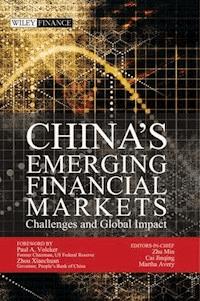
China's Emerging Financial Markets E-Book
69,99 €
Mehr erfahren.
- Herausgeber: John Wiley & Sons
- Kategorie: Fachliteratur
- Serie: Wiley Finance Editions
- Sprache: Englisch
"The 19th century belonged to England, the 20th century belonged to the US and the 21st century belongs to China. Invest accordingly." Warren Buffet This comprehensive resource presents the views of China's most highly respected economists, bankers, and policy makers--along with opinions from Western authorities--on the current state of banking and finance in China. Tracing the history of China's banking and finance system and looking toward its future, the book offers valuable insight for financial service providers, bankers, private equity and hedge fund managers, and equity research and credit analysts. Contributors to the book includes: Jamie Dimon -- Chairman & CEO, JPMorgan Chase Bank Guo Shuqing -- Chairman, China Construction Bank Paul Volcker -- Former Chairman, U.S. Federal Reserve Stephen S. Roach -- Chairman, Morgan Stanley Asia Wang Dongming -- Chairman, CITIC Securities Co., Ltd; and many more!
Sie lesen das E-Book in den Legimi-Apps auf:
Seitenzahl: 1064
Veröffentlichungsjahr: 2011
Ähnliche




















CONTENTS
Cover
Half Title page
Title page
Copyright page
Acknowledgments
Preface
Introduction
Principals underlying financial reforms
China’s financial system a decade ago
The pace of China’s financial reforms
Main aspects of Chinese financial reform
A systemic approach to China’s financial reforms
Overview
Section I: Growth during ongoing reform
Section II: Strengthening by opening to the outside
Section III: Facing new challenges
Section IV: Global integration and working together
Biographies
Editors-in-Chief
Authors
Section 1: Macro
Section 2: Banking
Section 3: Capital markets
Section 4: Insurance
Section 5: Monetary policy
Section 6: Services
Section 1: Macro
Chapter 1: Fundamental Issues and Challenges Facing the Chinese Economy Guo Shuqing
Basic changes in China’s economy since Reform and Opening
China’s unique economic issues
The agricultural sector
Industrial structure
Labor market issues
Human resources
Strategic measures
Chapter 2: China’s Global Challenge
China’s outward tilt
Unstable, unbalanced, uncoordinated, and unsustainable
Policy traction in a blended economy
The double-edged sword
Backsliding on globalization
Only a cycle
Chapter 3: China’s High Savings, Investment, and Growth Rates, and Arguments for the Rapid Development of Financial Markets
The Chinese economy since Reform and Opening
Demographics
Industrialization and urbanization
Industrialization, urbanization, and systemic reform
Economic imbalances
Chapter 4: The Evolution of Banking and Finance in China: Domestic and International Aspects
Progress since 1998
Immediate challenges
Economic Imbalances and Financial System Reform
Endnotes
Section 2: Banking
Chapter 5: China’s Banking Industry: Moving Forward in Accord with Reform and Opening
Historic changes in China’s banking industry
New challenges
Better banking regulation
Chapter 6: China’s Financial Transformation and New Challenges
Three decades of reform
Further reforms in progress
Local incorporation of foreign banks
The HSBC experience
New frontiers for Chinese banks
Banks and the environment
Conclusions
Chapter 7: Commercial Banking Reform
Background
Measures undertaken in this round of reform
The Accomplishments of the Comprehensive Reform of state-owned commercial banks since 2003
Endnote
Chapter 8: China’s Restructured Commercial Banks: Nomenklatura Accountability Serving Corporate Governance Reform?
Introduction
Corporate Governance Reform—Part of a Richer Reform Narrative
The Big Four and a Half
New Boards—Old Capital Structures
Huijin (China SAFE Investment Limited)
Foreign Strategic Investment
Corporate Governance Reform, but Unreformed Corporate Governance
Capital Structure Post-Corporatization; Powerless Foreign Equity Investors
Party Committees – The Emperor’s New Clothes
The NOMENKLATURA Stays in the Game
Governing an Octopus
Too Big to Fail
Measurement Deficit Soaring Stock Prices and Persistent NPLS
What has Corporatization, Public Listing, and Strategic Foreign Investment Accomplished?
Endnotes
Bibliography
Chapter 9: Prospects for Chinese Banks:Why Global Banks Are Drawn To China
JPMorgan Chase’s history in China
China’s Evolving Financial landscape
The relative strengths of foreign and domestic banks
Universal banking: The JPMorgan Chase experience
Are Chinese banks ready for offshore acquisitions?
Competition and partnership can go hand-in-hand
Chapter 10: Agricultural Financing in China: the Difficult Transition from a Planned to a Market System
Agricultural financing under the “single-function” bank system
Rural financing contracts
Rural bank branches decline
Rural funds flow toward cities
Rural areas turn to “irregular financing”
“Asset ownership” in rural areas makes it hard to get credit
Reform in China’s rural finance
Chapter 11: Retail Banking: Mastering Wealth Management to Capture Growth Opportunities
Anticipating the rise of retail banking and wealth management
Opportunities in premium banking
Misconceptions about premium banking
Prioritizing the customer relationship to ensure success
Develop a deep connection with clients
Provide an unparalleled value proposition
Ensure flawless execution
Charting a path to succeed in premium banking
Chapter 12: Growing China’s Retail Banking Business
Underlying conditions
The fast growth of the financial markets system
Changing rules of the game
Challenges and Opportunities
Section 3: Capital Markets
Chapter 13: Shanghai Stock Exchange: History and Prospects
History of the Shanghai Stock Exchange
The Shanghai Stock Exchange today
Future prospects
Financing world-class enterprises
The bond market
Going international
Chapter 14: China’s Securities Companies: Growth and Prospects
Fast initial growth
Restructuring
Weeding out period (from 2005)
Challenges
China’s securities industry: prospects
Meeting future challenges
Chapter 15: China’s Emerging Financial Markets: Challenges and Global Impact
The revolutionary goal
Progress to date
Process to date
Future challenges
Institutional investors
Selection of new issues
Expanding foreign investment choices
Expanding domestic investment choices
Introducing foreign expertise into securities firms
Conclusion
Endnote
Chapter 16: China’s Capital Markets
The Role of the Capital Markets in the Economy
Policies and Reforms in Recent Years
Regulation of Listed Companies
Comprehensive Restructuring of Securities Firms
Securities Issuance System Reform
The Fund Management Industry: Growing Institutional Investors
Legal System
Capital Markets: Problems that Need to be Addressed
Strategies and Prospects
Chapter 17: Opening, Reforming, and Growing China’s Bond Markets
Government Bonds
Corporate Bonds
Financial Bonds
Asset-Backed Securities
Market Systems
Evolution of Bond-Trading Methods
Depository and Clearing Systems
Opening of China’s Bond Market
The Unbalanced Structure of China’s Bond Markets
Unbalanced Investor Mix in China’s Bond Markets
Other Factors Constraining the Growth of China’s Bond Markets
Prospects
Chapter 18: China’s Asset Management Industry
The Start of Funds in China
Standardizing China’s Asset-Management Industry
Lessons
Wealth Management
Internationalization
New Financial Tools
Educating Investors
Chapter 19: Venture Capital/Private Equity in China
Early Days 1990 to 1998—Lessons Learned
1998–2003: Turning Point
The Growth Phase: 2004–2007
Looking Forward: 2008 and Beyond
Endnotes
Section 4: Insurance
Chapter 20: China’s Insurance Markets: Reform, Growth, and Prospects
A New Starting Point
Future Progress
Chapter 21: Strategy of China’s Largest Life Insurance Company, China Life
Structural Change to Financial Systems
Challenges and Opportunities: Life Insurance
Life Insurance:Strategic Opportunities
China Life Plans
Chapter 22: The Emergence of China’s Insurance Industry
Exploring the Way Forward
A New Golden Age of Growth
Prospects
Chapter 23: China’s Insurance Market
A 200-Year History
China’s WTO Commitments
Entry Strategy: Sino–Foreign Joint Ventures
Entry Strategy: Strategic Investments
Market Share Gains
Tackling the Human Resources Challenge
A Common Agenda
The Case for Market Liberalization
Addressing Concerns about Foreign Participation
Educating the Market
Driving Market Evolution
Conclusion
Endnotes
Chapter 24: China’s Social Security System: Issues and Prospects
History of China’s Social Security Reforms
Challenges
Section 5: Monetary Policy
Chapter 25: China’s Monetary Policy: Facing the Challenges of Financial Globalization
Selecting Monetary Policy Tools
Exchange Rate Adjustments
Global Influence of Policies
Chapter 26: Convertibility of RMB-denominated Capital Accounts: Process and Experience
Convertibility of Rmb-Denominated Capital Accounts
Chapter 27: China’s Money, Bond, and FX Markets
Money Market
Bond Market
Money Market, Bond Market, and Open Market Operation
FX Market
Conclusion
Endnotes
Bibliography
Chapter 28: Financial Futures Markets in China
Background: Financial Futures in China
Stock Futures: Growing China’s Capital Markets
Systemic Framework: The Path Ahead
Choosing Products
Chapter 29: China’s New Currency Regime and Onshore FX Markets
The CNY Exchange Rate Regime
Trading: CNY And FX Spot Onshore
The CNY Onshore and Offshore Forwards Markets
Re-Regulating the Capital Account
Section 6: Services
Chapter 30: China’s Legal System and the Financial Industry: The Past 30 Years
How China’s Financial Legal System Developed
China’s Financial Legal System
Financial and Legal System Reform
Future Developments
Chapter 31: Legal Services in the Field of Banking and Finance
China’s Legal Profession After Reform and Opening
Providing Legal Services to the Securities Industry
Providing Legal Services to Commercial Banks
Legal Services and the Insurance Industry
Legal Services and Overseas Private-Placement Funds
Legal Services and the Bond Industry
Legal Services and the Financial Industry
Conclusion
Endnotes
Chapter 32: The Accounting Profession in China: Review and Outlook
Review of the Accounting Profession in China: A Historical Perspective
The Profession Today and the Challenges Ahead
Recent Market Developments
Conclusion
Chapter 33: China’s Taxation and the Financial Industries
China’s Financial Taxation System: Main Components
Further Issues
Reform of the Financial Tax System
Index
China’s Emerging Financial Markets
Challenges and Global Impact
Copyright © 2009 John Wiley & Sons (Asia) Pte. Ltd.
Published in 2009 by John Wiley & Sons (Asia) Pte. Ltd.2 Clementi Loop, #02-01, Singapore 129809
All rights reserved.
No part of this publication may be reproduced, stored in a retrieval system or transmitted in any form or by any means, electronic, mechanical, photocopying, recording, scanning or otherwise, except as expressly permitted by law, without either the prior written permission of the Publisher, or authorization through payment of the appropriate photocopy fee to the Copyright Clearance Center. Requests for permission should be addressed to the Publisher, John Wiley & Sons (Asia) Pte. Ltd., 2 Clementi Loop, #02-01, Singapore 129809, tel: 65-64632400, fax: 65-64646912, e-mail: [email protected].
This publication is designed to provide accurate and authoritative information in regard to the subject matter covered. It is sold with the understanding that the Publisher is not engaged in rendering professional services. If professional advice or other expert assistance is required, the services of a competent professional person should be sought.
Other Wiley Editorial OfficesJohn Wiley & Sons, Inc., 111 River Street, Hoboken, NJ 07030, USA John Wiley & Sons, Ltd., The Atrium, Southern Gate, Chichester, West Sussex P019 8SQ, UK John Wiley & Sons (Canada), Ltd., 5353 Dundas Street West, Suite 400, Toronto, Ontario M9B 6H8, Canada John Wiley & Sons Australia Ltd., 42 McDougall Street, Milton, Queensland 4064, Australia Wiley-VCH, Boschstrasse 12, D-69469 Weinheim, Germany
Library of Congress Cataloging-in-Publication DataISBN: 978-0470-82249-4
Acknowledgments
First and foremost, the editors thank the 36 authors who came forward when they were called upon. They recognized the importance of and need for a comprehensive treatment of the subject.
China’s emerging financial systems are already a vital part of global systems. Little understood, they nonetheless will play a large role in the future. The financial debacle in the Western world in recent times has made obsolete the references to certain Western banks in this book. It has not changed the fundamental situation in China, however, and that situation is reflected in these chapters. The authors have provided a benchmark that shows where China stands today, 30 years after the start of the national policy to reform and open the country. They have also provided a baseline for the next era. Their words represent the concentrated intelligence of the most senior and far-sighted people in the field. We express our deep appreciation for their contributions.
Secondly, we thank the Ford Foundation for extending the grant that made this volume possible.
Finally, our publisher, John Wiley & Sons, has remained steadfast through the long and trying process. The Wiley team deserves grateful recognition for seeing this volume through to completion.
Zhu MinCai JinqingMartha Avery
PREFACE
There could not have been in all of history so rapid a development in a functional financial system, and in particular of banking institutions, as in China over recent decades. The old framework was a dominant state-owned and state-run “bank” providing funds for state-owned enterprises (SOEs) in accord with state-directed priorities. It was not, in fact, a banking system at all, which implies a variety of institutions free to respond to the needs of individuals and businesses.
An enormous effort has been required to achieve the needed transition. There was the huge financial cost implicit in dealing with the unpaid and unpayable obligations assumed under the old system by many SOEs that burdened bank balance sheets.
There was the broad political challenge of accepting and supporting a more decentralized, market-responsive financial system as a part of economic reform. Not least, there has been the intellectual and educational need to adapt to the methods and requirements of a more open and competitive economic environment.
Today, the state still has majority ownership of a small group of very large banks and insurance companies, but those institutions have private stockholders, in some cases with foreign participation. They have been joined by a growing number of smaller institutions established with private capital, and by a few affiliates of foreign banks and insurance companies.
A basic framework of supervision and regulation is in place, and a central bank has been provided with the essential tools for conducting monetary policy. International accounting standards are being introduced, along with growing attention to credit analysis, risk management, and the need to operate efficiently with a reasonable margin of profit.
Now there is room to compete in responding to business and individual needs; indeed, there is a necessity to do so. Success is dependent upon the ability to cover expenses, with a margin of profit. As a result, attention needs to be paid to efficiency, to developing a “credit culture” to protect against weak loans, and to provide the variety of financial services required for a modern economy.
Plainly, that process is incomplete. Virtually every chapter in this new volume is replete not just with reports of progress, but of unfinished business. Some of the analysis is technical and detailed, but the basic theme is quite clear.
Chinese banking has become part—a growing part—of the world of finance, supporting the rapid economic growth of China. The basic trend seems to me well-established—more sensitivity to market forces, growing flexibility in pricing, greater reliance on private capital, and, over time, more participation in foreign markets by Chinese banks and by foreign financial institutions in China.
In a country with more than a billion citizens, with massive needs for capital on the one hand, but an equally strong capacity to generate savings on the other, efficient financial intermediation is not an option. It has become an essential ingredient in the effort to sustain rapid growth within China, and a part of its increasing trade with other countries.
The Chinese system is still dominated by institutions, and particularly by very large institutions, with majority government ownership. But the driving force is more and more market-oriented, with a variety of services developing for individuals and with sources of credit for businesses. Lending to SOEs, while still substantial, is receding in relative importance, lending practices are more disciplined, and the provision of credit is increasingly responsive to the needs of business firms rather than to official direction.
No doubt, much remains to be done in terms of technology, in staff training, and in management, to meet the needs of the growing economy. My sense is that foreign participation is assisting in that process, and is capable of still greater contribution.
At the same time, those guiding and participating in the development of the Chinese financial market will want to be alert to important lessons of Western experience, the need to guard against speculative excesses, to maintain adequate capital and effective supervision, and, most importantly, to keep reasonable monetary stability. These lessons are necessary for all nations that want to benefit from a growing, productive economy able to compete effectively in the world.
Paul A. Volcker
INTRODUCTION
Zhou Xiaochuan
Governor, People’s Bank of China
One overarching conclusion can be made in reviewing the progress of financial reforms in China and in looking to the future: only firm adherence to Reform and Opening will allow us to make further progress and assure China’s financial and economic stability.
PRINCIPALS UNDERLYING FINANCIAL REFORMS
Improvements in China’s financial system and its ongoing alignment with market forces in recent years are due primarily to the process of Reform and Opening. Only by creating sound financial institutions can we participate in markets, take advantage of business opportunities, support growth in China’s as well as the world’s economy, and, finally, preserve stability.
The government has made it clear in recent years that it has firmly decided to achieve financial reform. At the same time, this cannot be accomplished in one fell swoop—it is a long process. Some actions can achieve fast-paced results, while others require the exten-ded accumulation of experience. The next stages will take ongoing determination. They will involve strengthening reforms in both economic and financial systems.
Reform is an exercise in systems engineering. The various parts of the process require integration and a high degree of popular participation. Reform of this sort is not a kind of guerrilla operation with dispersed forces; it requires a full-scale frontal attack.
Institutional reform is the foundation of financial stability. All new developments in financial markets present new challenges to financial stability. We can recognize the importance of preserving stability when we look at the subprime mortgage crisis in the US and related market volatility. Financial stability is closely related to the health of economic and financial institutions. The Chinese government has tried to maintain a balance among three key policy goals: reform, growth, and stability. One of the implications of the phrase “scientific approach to economic development” is that these three must preserve an appropriate balance. Balance must also be maintained in the relationship between government-directed macroeconomic measures and the self-adjusting mechanisms of microeconomic forces.
Progress in reforms to date gives us confidence that the next steps in Reform and Opening will succeed. It also allows China to put increasing weight on Reform and Opening in furthering economic growth by allowing reformed mechanisms to work. We have more experience now in this regard, and hence more confidence.
CHINA’S FINANCIAL SYSTEM A DECADE AGO
In looking at China’s financial reforms in the past few years, it is useful to remember the condition of our finances during the Asian Financial Crisis some 10 years ago. My personal summary of the situation back then includes the following observations.
The percentage of nonperforming loans (NPLs) in commercial banks was high. At the time of the crisis, the reported rate of NPLs was 25%, but due to problems in accounting standards, methods of classifying loans, and overall financial discipline, the market evaluation put the rate at more like 35–40%.
This high rate was brought on to a large degree by the intertwined nature of commercial loans and loans made in response to policy objectives. It was also related to the prevailing “credit culture” at the time. A common saying was that bank loans in China were mainly “relationship loans”; that is, essentially a function of one’s relationships.
Commercial banks were not operated as “enterprises” to an adequate degree 10 years ago. There was no clear mandate to run a bank with profit as the key objective; instead, banks were operating under the directives of government institutions. The process of enterprise reform had already begun in China at the time of the Asian Financial Crisis, but there had not yet been great progress. The concept of corporate governance had not even been broached in preliminary fashion. Government and regulatory organizations gave no guidance in appropriate governance measures—institutions generally proceeded with their own understanding of how to do things. In general, financial institutions at the time, like all government institutions, lacked business objectives and lacked both motivating and restraining mechanisms for accomplishing those objectives.
There was a sizable gap between international and Chinese laws, regulations, and rules. The gap between Chinese accounting standards and world standards was particularly large. China’s standard loan classification at the time mainly related to the term of the loan and was not, as it is now, divided into a five-tiered structure.
Standards for information disclosure of listed companies were woefully inadequate, so insider trading and share price manipulation were common. Financial reports were not significant since they relied on inadequate accounting standards. Key laws such as the Corporate Law, Securities Law, and Bankruptcy Law were incomplete at the time.
Capital markets in China were still in a rudimentary stage 10 years ago. With immature markets, price determination mechanisms were poor, investment rationale was not developed, and problems abounded.
Regulatory systems at the time of the Asian Financial Crisis were highly unsatisfactory. Throughout the crisis, China debated how best to set up more effective systems. In addition to regulatory systems, an improved overall environment required the setting up of a whole series of rules and regulations. Training of regulators was necessary to raise the level of professionalism and define regulatory goals—all of these had been absent and were now imperative. Setting up systems, organizations, rules, and procedures has been a key task in the intervening years.
Mechanisms for restraining certain behavior and for evaluating performance were insufficient. Indeed, it was unclear exactly what kind of mechanisms should be used with regard to financial institutions. During the crisis, the key criterion used by the Chinese government in judging a financial institution was the percentage of NPLs in its portfolio. It was difficult, however, to know which loans among those NPLs were policy-related loans and which were of a commercial nature. It was hard to differentiate the causes for NPLs, allocate responsibilities, and know how to balance provision for NPLs. In fact, focusing on NPLs was not an easy way to apply restraints on behavior or to evaluate the soundness of a bank. Using the Basel I capital adequacy ratios and core regulatory principles in restraining and evaluating financial institutions became an urgent task. At the same time, this was not an easy thing to accomplish since many commercial banks had negative capital adequacy ratios at the time.
Relatively severe financial pressures existed 10 years ago in the overall economy, and financial services and capacity to innovate in meeting challenges were inadequate. Since financial institutions were unhealthy, and since regulation was insufficient, there were strong financial pressures pulling in the opposite direction to reform. Basically, we could not encourage financial markets to develop and financial products to be developed out of fear that worse problems would appear, and indeed many problems did appear. Some financial institutions wanted to issue new products and some exchanges wanted to trade in new derivative products, but at the time, any application had little chance of being approved within a four- to five-year timeframe. The reason was that institutions were unhealthy, the risk was overly concentrated, and many felt that the new products would run into trouble. One important issue was that China knew it had to encourage the growth of institutional investors, since complex new products could not be sold to retail buyers. At that time, however, the number of Chinese institutional investors was extremely small and financial pressures made it hard for them to grow.
Confidence in the RMB sank at the time of the Asian Financial Crisis. Although China’s balance of trade had moved into a positive position by the 1990s, and foreign businessmen were investing in China, an examination of the international balance of payments in the 1990s shows mostly negative numbers, and at times the capital outflow was extreme. This showed a lack of confidence in the RMB with a strong trend toward capital flight. Under these conditions, currency controls were relatively stringent. Opportunities for Chinese businessmen to seize opportunities and participate in international markets were slim.
Administrative interference in banking operations was still prevalent at that time. From 1993, China began to encourage a division of state or government and business or enterprise, and to discourage government interference in policies relating to commercial-type loans of commercial banks. The central government did indeed begin to operate in this direction. There were substantial differences in the way regional governments responded, however.
During the Asian Financial Crisis, one of the main tasks of reform therefore was to insist that regional governments obey the demands of the central government in not applying administrative pressure to loan-making decisions.
THE PACE OF CHINA’S FINANCIAL REFORMS
From the previous section on the starting point of China’s financial reforms—at the time of the Asian Financial Crisis—we can see that taking action was an urgent necessity. Many international authorities described China’s situation back then in grave terms. Three basic evaluations surfaced: (1) that China’s financial system was a large time-bomb that could go off at any time; (2) that China’s commercial banks were technically insolvent; and (3) that China’s financial system would be a drag on its economic growth, making it impossible for the system to service the economy and support development.
Given this situation, the Chinese government was determined to carry out reforms. The ailments were multifaceted, but a unified, systematic, overall approach was necessary. It had to be carefully designed, organized, and executed in sequential stages. The Asian Financial Crisis was a tremendous shock to many Asian countries and China was no exception. Many outsiders thought that its effect on China was limited, but China too saw many institutions go bankrupt or close down at the time, and a large number of businesses faced serious losses. Consumer confidence eroded, the economy entered a deflationary period, and in fact the influence on China was extreme. From another angle, however, one could say that the experience hastened the recognition that reform was an urgent necessity.
Pressures were great at the time decisions were being made, but distinctions were made between fast-paced reforms and those that would require a more deliberate approach. The latter, according to the Chinese phrase, recognized that you cannot tug on growing shoots to make a plant grow faster, since you will simply pull up the roots. Longer term reforms included a change to the culture of credit, the development of institutional investors, investor education in rational decision-making, improvement of corporate governance structures, and so on. These were all going to take a long time. At that time, human resources that could enable corporate governance structures were generally not available. Independent directors or outside directors on Boards had to be put through special classes at local universities, in order to learn what was involved, to understand the responsibilities of Boards of Directors, to learn how to conduct proper meetings, and so on. Ten years ago, very few people had much experience in evaluating balance sheets and financial reports.
Other aspects of reform were more pressing. They required not only fast action, but the need to see fast results. One such matter was the need to stop the co-mingling of policy-type loans, made in furtherance of government policies, and commercial loans. Commercial banking had to be forced to enter the path of real commerce, in a way that met the requirements of business enterprises.
A second task was to clean up the balance sheets of financial institutions in a decisive way. Both the Asian Financial Crisis and the Japanese experience had shown that dilatory action was counter-productive. Action had to be decisive or problems would stay unresolved for years. Balance sheet problems would then affect the ability of the financial system to provide the necessary support for overall economic growth. In times of crisis, financial institutions focused on their own pressing problems and had no ability to contribute to building the economy.
A third matter was to establish modern standards of all kinds, including those relating to laws and regulations, accounting standards, disclosure requirements, loan classifications, and provisions and tax codes, and at the same time to set up guidelines for corporate governance. China actually did address these things quite briskly, but it is one thing to be quick in setting up standards and another to implement methods to enforce the standards.
A fourth task was to strengthen regulation. It was necessary to recognize the lessons of past experience and to change the organizational structure of financial regulation, while requiring that institutions themselves develop the human resources to meet regulatory requirements.
The fifth matter was to establish restraining mechanisms in requiring compliance with capital adequacy ratios. This included strengthening compliance with the Basel Accord in the banking system, and with comparable mechanisms in the securities and insurance industries. Without these, any improvement in financial institutions would be slow.
MAIN ASPECTS OF CHINESE FINANCIAL REFORM
Given the above considerations, the main components of China’s financial reform include the following issues.
1. Cleaning up and restructuring banks, and improving macroeconomic measures that allow the preconditions for their reform, then implementing a financial reorganization of state-owned commercial banks. The first banks to go through this process were the Bank of Communications, the Bank of China, the China Construction Bank, and later the Industrial and Commercial Bank of China. The process is ongoing and the next bank to undergo financial restructuring will be the Agricultural Bank of China.
2. Requiring that reconfigured financial institutions, including securities firms and insurance companies, become shareholder companies to the extent that is possible. This includes listing on exchanges, implementing control mechanisms, and setting up adequate corporate governance structures. Without a shareholder system and listing on exchanges, it is hard for corporate governance to take hold, given traditional influences. It is also hard to accomplish serious external oversight and regulation. At the same time, many measures related to opening to the outside have been beneficial in promoting the establishment and stability of corporate governance structures.
3. Truly changing all kinds of standards and rules. After the Asian Financial Crisis, China revised its accounting standards a number of times and these revisions greatly improved China’s standards, allowing them to approach international standards. In terms of classification of loans, China began to require strict adherence to a five-tiered classification system, to require capital adequacy ratios as in the Basel Accord, and it required a clear timetable for achieving results. Currently, most banks can comply with Basel I standards; Basel II is to be implemented in large banks within two to three years. In addition, progress has been made in information disclosure requirements and in corporate governance regulations.
4. Strengthening regulation—in 2003, China set up a Banking Regulatory Commission and strengthened the organizational structure of regulation. At the same time, it clarified regulatory principles.
5. Emphasizing the guidance mechanisms of currency policy. Macro-economic measures must be in alignment with the soundness of financial institutions. Institutions must approach the market in accord with government policy guidance with regard to currencies.
6. Doing away with outdated and excessive administrative controls. When financial institutions exhibit healthy operations, then they should be encouraged to become more involved in international markets, to compete with international institutions in their own lines of business, and to engage in product and organizational innovation. Circumstances have changed in China: we cannot always be requiring administrative review and approval for every new step. This includes entry into the market, initiating new products, and foreign exchange controls. All of these have to move forward in a new direction and become aligned with market forces.
7. Improving the “financial ecosystem”—in the past, administrative interference was concentrated more in certain financial affairs and certain regions. Regional governmental protection was extended in some cases relating to debts; inadequate enforcement in some cases meant that nationally based financial institutions were being taken advantage of on a regional basis. Local and regional-level governments used to feel this was fine, but a conceptual change is gradually penetrating the system in this regard. It is recognized that only with adequate enforcement and credibility will more financial resources be committed to regional development. Only if the regional financial ecosystem is well-managed, administrative interference is minimized, enforcement is adequate, and credibility is emphasized, will there be more resources in the future. Only then will the region’s economy move forward. This change has marked an extremely important conceptual shift since the time of the Asian Financial Crisis.
A SYSTEMIC APPROACH TO CHINA’S FINANCIAL REFORMS
Looking back at the content and the context of China’s financial reforms since the Asian Financial Crisis, we see that the Chinese government has proceeded in a sequential manner. One reform has been linked to the next, guided by careful research and design, and implemented in an organized fashion with sets of coordinated actions. Naturally, many unexpected things have happened in the course of economic and financial development. Generally speaking, though, the positive experience of systemic reform has guided the process.
Putting Chinese financial institutions on a healthy track has given them a basis on which to participate in international markets. We must maintain a high degree of vigilance, however, with regard to problems of risk and financial stability. The recent extreme perturbations in international financial markets remind us that markets are often not stable. Macroeconomic government policies and the ability of institutions themselves to moderate risk and maintain soundness are both extremely important aspects of financial security.
We will continue to press forward with ongoing financial reform and financial opening in China. In January 2007, a meeting of the Working Group on National Finance was held in Beijing. It laid out arrangements for the next stages, including the further development of capital markets, building up the insurance industry, reforming the State Development Bank, establishing depository insurance, and so on. Certain future steps can be foreseen, but the world economy continues to present us with new challenges and new circumstances. As we encounter obstacles, we will be making appropriate adjustments, and constantly moving forward with financial Reform and Opening.
OVERVIEW
China’s Emerging Financial Industries and Implications
Zhu Min
Group Executive Vice-President, Bank of China
China’s economic growth since reform policies started in 1978 is broadly recognized. For 30 years, the economy has maintained an astounding average annual growth rate of 9.6%. GDP reached US$4 trillion in 2008, making China the world’s third-largest economy after the United States (nearly US$14 trillion) and Japan (around US$4.3 trillion). Systemic reform over this period has brought fundamental changes, most importantly a parting of the ways with the old planned economy system. Production of state-owned enterprises (SOEs) was only 9.7% of GDP in 2008, down from 89.1% in 1978. The structure of China’s economy has also changed profoundly. If one divides economic production into three main areas of agricultural, industrial, and services, China’s GDP in 1978 was 28.2% agricultural, 47.9% in manufacturing, and 23.9% in services. By 2007, these percentages had changed to 11.3%, 48.6%, and 40.1%.
Urbanization has proceeded at a phenomenal pace. Eighteen percent of China’s population lived in cities in 1978; in 2007, almost half, or 44.9% of the population lived in cities. China’s “opening” policies have caused international trade to increase at an average of 23.6% per year over the course of 30 years. Total trade too has risen from 9.7% of GDP in 1978 to 66.4% of GDP in 2007. At the same time, China has maintained stable macroeconomic policies with financial deficits that are, on average, less than 1.1% of GDP. Inflation has been kept at a fairly low level. Incomes have shown constant increase: per capita GDP of US$280 in 1978 had risen to US$3,180 in 2008. Three hundred million people have been lifted out of poverty, and life expectancy in China has gone from 68 years in 1978 to 73 years in 2007.
These are extraordinary figures. China’s financial industries, however, have seen even more momentous change. In 1978, there was only one People’s Bank of China (PBC) responsible for the functions of a central bank, commercial banks, and everything to do with finance. China now has a banking structure that includes a variety of institutions: an independent central bank, policy banks responsible for funding state policy initiatives, large commercial banks, medium-sized commercial banks owned by shareholders, small municipal banks, and rural credit cooperatives. Assets in the banking industry as a whole have gone from RMB115.5 billion in 1978 to RMB52 trillion in 2007. This 500-fold increase has been achieved by growth with an average of nearly 20% per year. Savings deposits of Chinese citizens have gone from RMB21.1 billion in 1978 to RMB17.25 trillion in 2007, an 800-fold increase, with average annual growth of 25%. China’s stock markets began from a base of zero in late 1990, when the Shanghai Stock Exchange was founded. By the end of 2007, there were 1,550 listed companies on this exchange, and more than 132 million investor accounts of Chinese citizens. Market capitalization on the exchange totaled RMB32.7 trillion, equivalent to 140% of China’s GDP, making the Shanghai Stock Exchange the fifth-largest stock market in the world. In the 25 years since China declared in 1972 that it had neither domestic nor foreign debt, the country has assumed the responsibility for both. China first reissued government bonds in 1981. Since then, the bond market has gone on to include a fairly complete array of government bonds, corporate bonds, short-term financing, and asset-backed securities (ABS), on the scale of RMB12.3 trillion or some 47% of GDP. This has to be one of the most dramatic turnarounds in the history of finance.
Lesen Sie weiter in der vollständigen Ausgabe!
Lesen Sie weiter in der vollständigen Ausgabe!
Lesen Sie weiter in der vollständigen Ausgabe!
Lesen Sie weiter in der vollständigen Ausgabe!
Lesen Sie weiter in der vollständigen Ausgabe!
Lesen Sie weiter in der vollständigen Ausgabe!
Lesen Sie weiter in der vollständigen Ausgabe!
Lesen Sie weiter in der vollständigen Ausgabe!
Lesen Sie weiter in der vollständigen Ausgabe!
Lesen Sie weiter in der vollständigen Ausgabe!
Lesen Sie weiter in der vollständigen Ausgabe!
Lesen Sie weiter in der vollständigen Ausgabe!
Lesen Sie weiter in der vollständigen Ausgabe!
Lesen Sie weiter in der vollständigen Ausgabe!
Lesen Sie weiter in der vollständigen Ausgabe!
Lesen Sie weiter in der vollständigen Ausgabe!
Lesen Sie weiter in der vollständigen Ausgabe!
Lesen Sie weiter in der vollständigen Ausgabe!
Lesen Sie weiter in der vollständigen Ausgabe!
Lesen Sie weiter in der vollständigen Ausgabe!
Lesen Sie weiter in der vollständigen Ausgabe!
Lesen Sie weiter in der vollständigen Ausgabe!
Lesen Sie weiter in der vollständigen Ausgabe!
Lesen Sie weiter in der vollständigen Ausgabe!
Lesen Sie weiter in der vollständigen Ausgabe!
Lesen Sie weiter in der vollständigen Ausgabe!
Lesen Sie weiter in der vollständigen Ausgabe!
Lesen Sie weiter in der vollständigen Ausgabe!
Lesen Sie weiter in der vollständigen Ausgabe!
Lesen Sie weiter in der vollständigen Ausgabe!
Lesen Sie weiter in der vollständigen Ausgabe!
Lesen Sie weiter in der vollständigen Ausgabe!
Lesen Sie weiter in der vollständigen Ausgabe!
Lesen Sie weiter in der vollständigen Ausgabe!
Lesen Sie weiter in der vollständigen Ausgabe!
Lesen Sie weiter in der vollständigen Ausgabe!
Lesen Sie weiter in der vollständigen Ausgabe!
Lesen Sie weiter in der vollständigen Ausgabe!
Lesen Sie weiter in der vollständigen Ausgabe!
Lesen Sie weiter in der vollständigen Ausgabe!
Lesen Sie weiter in der vollständigen Ausgabe!




