


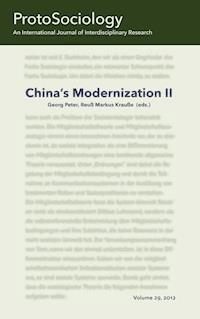
China's Modernization II E-Book
Erhalten Sie Zugang zu diesem und mehr als 300000 Büchern ab EUR 5,99 monatlich.
- Herausgeber: Books on Demand
- Kategorie: Geisteswissenschaft
- Serie: ProtoSociology
- Sprache: Englisch
The idea of only one way leading to a modern society seems to be hardly tenable. But even if we agree to this, our theories and terms describing modernization are gained on our own Western history. So social science has to reconsider its basic terms to describe China’s modernization, and maybe even the understanding of modernization itself. The second of two volumes on China’s modernization collects articles by leading Chinese and Western scientists focusing on the main conflicts and differences this process involves. In the first section – “On Contemporary Theory of Modernization” – Manussos Marangudakis represents Shmuel N. Eisenstadt’s concept of “Multiple Modernities and the Theory of Indeterminacy”, one of the best elaborated perspectives on modernity. “Changing China: Dealing with Diversity”, the second section, examines how China copes with dissent and discusses the significance of law and a civil society. Merle Goldman begins with “Dissent of China’s Public Intellectuals in the Post-Mao Era”. The “Modernization of Law in China – its Meaning, Achievements, Obstacles and Prospect” is the subject of Qingbo Zhang. Scott Wilson presents a Gramscian analysis of civil society in “China’s State in the Trenches”. And Francis Schortgen and Shalendra Sharma study how China is “Manufacturing Dissent: Domestic and International Ramifications of China’s Summer of Labor Unrest”. “Neoliberalism and the Changes in East Asian Welfare and Education” is the focus of the third section. Beatriz Carrillo Garcia investigates the “Business Opportunities and Philanthropic Initiatives” in China. “Time, Politics and Homelessness in Contemporary Japan” is the subject of Ritu Vij. Different school books show the “Educational Modernisation Across the Taiwan Straits” by David C. Schak. And Ho-fung Hung discusses the role of China in globalization following the question: “Is China Saving Global Capitalism from the Global Cri-sis?” The additional rubric “On Contemporary Philosophy” involves three articles about “International Development, Paradox and Phronesis” by Robert Kowalski, “The World in the Head” by Robert Cummins, and “Communication, Cooperation and Conflict” by Steffen Borge. Content and abstracts: www.protosociology.de
Sie lesen das E-Book in den Legimi-Apps auf:
Seitenzahl: 467
Veröffentlichungsjahr: 2015
Das E-Book (TTS) können Sie hören im Abo „Legimi Premium” in Legimi-Apps auf:
Ähnliche




















ProtoSociology
An International Journal of Interdisciplinary Research
Volume 29, 2012
China’s Modernization II
CONTENTS
O
N
C
ONTEMPARY
T
HEORY OF
M
ODERNISATION
Multiple Modernities and the Theory of Indeterminacy – On the Development and Theoretical Foundations of the Historical Sociology of Shmuel N. Eisenstadt
Manussos Marangudakis
C
HANGING
C
HINA:
D
EALING WITH
D
IVERSITY
Dissent of China’s Public Intellectuals in the Post-Mao Era
Merle Goldman
Modernization of Law in China – its Meaning, Achievements, Obstacles and Prospect
Qingbo Zhang
China’s State in the Trenches: A Gramscian Analysis of Civil Society and Rights-Based Litigation
Scott Wilson
Manufacturing Dissent: Domestic and International Ramifications of China’s Summer of Labor Unrest
Francis Schortgen and Shalendra Sharma
N
EOLIBERALISM AND THE
C
HANGES IN
E
AST
A
SIAN
W
ELFARE AND
E
DUCATION
Business Opportunities and Philanthropic Initiatives: Private Entrepreneurs, Welfare Provision and the Prospects for Social Change in China
Beatriz Carrillo Garcia
Time, Politics and Homelessness in Contemporary Japan
Ritu Vij
Educational Modernisation Across the Taiwan Straits: Pedagogical Transformation in Primary School Moral Education Textbooks in the PRC and Taiwan
David C. Schak
Is China Saving Global Capitalism from the Global Crisis?
Ho-fung Hung
O
N
C
ONTEMPORARY
P
HILOSOPHY
International Development, Paradox and Phronesis
Robert Kowalski
Précis of “The World in the Head”
Robert Cummins
Communication, Cooperation and Conflict
Steffen Borge
Contributors
Impressum
On ProtoSociology
Published Volumes
On Contempary Theory of Modernisation
MULTIPLE MODERNITIES AND THE THEORY OF INDETERMINACY – ON THE DEVELOPMENTAND THEORETICAL FOUNDATIONSOF THE HISTORICAL SOCIOLOGY OF SHMUEL N. EISENSTADT
Manussos Marangudakis
Abstract
The essay presents the parallel development of Shmuel Eisenstadt’s historical and theoretical sociology from a critical correction of structural functionalism found in The Political Systems of Empires to the full development of the theory of indeterminacy of his later works that culminated in the ‘multiple modernities’ thesis. The key factor that shapes the course of Eisentadt’s theoretical progress is the crucial role of various elites to fill the open space between actuality and potentiality creating and sustaining institutions that permit the development of structural differentiation according to some fundamental cosmological and cognitive principles that shape the course of historical development inside these social systems. Infusing structural-functionalism with a strong dose of conflict sociology, Eisenstadt came to the conclusion that social development is not a process of internal systemic growth, but the unintended consequence of the elites’ efforts to institutionally control free resources. And while this process in the pre-modern past led to the development of relatively distinct civilizations, in the framework of modernity has created a global framework of fundamental contradictions of tensions intrinsically irresolvable.
From the study of agrarian empires (1963), to his later works on axiality (1986), modernity (2002), and revolution (2006) Shmuel Eisenstadt remained equally concerned about understanding historical change and developing a sound sociological theory; in fact, he considered them to be the two sides of the same coin: social theory is useless if it does not correspond to reality, and reality makes sense only through the lenses of social theory. A case of truism as it sounds, for Eisenstadt it became a vehicle first to correct and then to alter in a rather radical way structural functionalism, both in its historical context and in substance; I will call it the ‘theory of indeterminacy’. And based upon this theory, he developed the most radical historic-sociological model to understand modernity since the development of convergence-modernization theory in the 1960s and World System Theory in the 1970s, the theory of ‘multiple modernities’.
Structural Functionalism Updated
Starting with the Political Systems of Empires (1963), the focus of Eisenstadt’s analysis was the systemic character of these regimes, the distinctive social structures and institutions that characterized them, and the social processes that were developed by their rulers to maintain the systemic boundaries of their empires. To achieve his goal, Eisenstadt employed a very particular methodology, that is, configurational analysis. To put it simply, configurational analysis is the analysis of the essential qualities of social structures, institutions, and patterned social actions that develop inside a social system and define it. Following this methodology, Eisenstadt first differentiated and conceptualized a social pattern (i.e., a configuration), then examined its essential characteristics, and finally interpreted its contribution to the maintenance of the systemic boundaries of the empire in question. The use of this methodology led to a very peculiar, even idiosyncratic, narration that would become the unique feature of all Eisenstadt’s works that will follow: eventless historical narration. The argument could be understood and followed only by readers who had already done their history homework; as for the rest, they could abandon all hope.
What is important about agrarian empires? They stand as peculiar institutions between antiquity and modernity without necessarily leading from the one to the other; in other words, without guaranteeing social evolution. Their peculiarity lies in their main and central characteristic: the institutionalization of autonomous political power, as well as the intentional development of ‘free resources’ and thus the intentional ‘encouragement’ of social differentiation on large scale, and above ethnic and city boundaries. Since ‘empires’ by definition extent beyond ethnic boundaries and geographic localities, their mere existence necessitated some form of political-institutional autonomy. Thus, for the writer, empires are the first instances of various systemic tensions and fusions between social and institutional structures and their derivates.
The key factor of the analysis of the agrarian bureaucratic empires is that of ‘free resources’, that is, means of social power that could be detached from their possessors and potentially be used by other social actors and groups, such as the peasantry that could either be controlled by the landed aristocracy, or be ‘free’ and thus strengthen the autonomy of the ruler vis. the aristocracy. Using ‘free resources’ as a guide, Eisenstadt examines the struggles between institutional actors and social groups to control such resources, and especially so between rulers and aristocracy. Following the specific historical developments, the author concludes that the social development of the agrarian empires was limited by the limited level of free resources; and that free resources were limited because traditional and undifferentiated political activities did not match political goals that were more differentiated. To put it in structural-functional terms, even though there was a ‘need’ for social differentiation, the political apparatus, in spite of the development of bureaucracy, did not ‘fulfill its functional role’; social and institutional development were not evolving hand in hand. Eisenstadt was questioning the cornerstone of structural functionalism.
While the conclusions of this magnum opus did not impress many as structural functionalism was becoming out of fashion when the book was first published, secondary findings of the study would lead Eisenstadt not only to a major reconstruction of structural functionalism, but to the construction of a new sociological theory and a new understanding of macro social development. First and foremost, Eisenstadt noticed that structural differentiation in the social system of the empires did not always lead to a corresponding institutional differentiation (as Parsonian structural functionalism assumed) but it was conditioned on the presence of political entrepreneurs or elites with a vision and ability to create original political institutions. Such a parallel development took place only when both components, i.e. semi-autonomous elites cum social differentiation, were present. Second, imperial political systems were ridden by internal contradictions inherent in their own existence – such as (a) between the creation and the control of free resources, (b) the goals of the rulers that bound the system and the inability of the system to implement the imperial polities, and (c) between the desire of the rulers to free themselves from ascriptive groups and functions and their ascriptive legitimation. And third, the fate of the empires depended on a combination of external threats and internal struggles or contradictions that were interwoven in the fabric of the imperial system itself.
The study’s findings were particularly critical of the evolutionary presumptions of structural functionalism: First, social change does not necessarily lead to structural differentiation. And second, even when structural differentiation leads to institutional developments, the latter might not be similar everywhere, but might lead similar social systems (e.g., empires) to different paths of institutional and structural developments. In a nutshell, structural differentiation and institutional formation are multi-directional: No social system could be taken for granted; institutional entrepreneurs are necessary for a social system to exist; the system cannot escape internal contradictions; the social system if under particular pressures might collapse.
In all, Eisenstadt infused structural functionalism with a good dose of agentic volition and uncertainty, but for the moment he had not altered the paradigm in any decisive way. According to Parsons, structural differentiation is an adaptive response of the social system to strains that restores equilibrium and functionality; what the system ‘needs’, structural differentiation ‘provides’. Eisenstadt shifted the epicenter of social change from systemic needs in general to political elites who satisfy their need for power by establishing new and more specialized, or focused, political institutions. But while there is a relief in the system, the status and power struggles of these new elites create new conflicts over scarce resources. Notwithstanding the significance of his critical comments, the Empires remained well embedded in the Parsonian framework as he remained committed to the problematique of adaptiveness, flexibility, systemic boundaries and productive capacity.
From Systemic Needs to the Institutionalization of Elites’ Power Struggles
This all started to change as Eisenstadt soon later shifted his focus of attention from social differentiation and organizational capacity to cultural forces like charisma, trust, solidarity, and religion; and from general social evolution to distinct civilizational paths.
The first step toward a more cultural analysis of the social system was taken in the new introduction of Political Systems of Empires (1969) and by a series of studies that paid attention to spiritual, symbolic and moral concerns and the ways they were articulated by political and intellectual elites.1 His rationale is clear enough: ecological factors and contingency put aside, a deep and permanent social division of labor and the specifics of a social system must derive from an arbitrary yet authoritative source, that is, a cultural orientation. Eisenstadt first applied the scheme by developing the analytical dimensions of the concept of centre and periphery relations conceived as dealing not only with the organizational aspects of the social division of labor but with their connection to charisma as a key ingredient of social order.2 As he had already distinguished between different types of centers in ancient and medieval social systems, he now came to recognize that this distinctiveness had much to do with the cultural orientations they articulate, and allow particular elite coalitions and ability to regulate and exploit social arrangements. Charisma was strongly linked to institution building through affecting major components of a social order, namely trust, solidarity, collectivities, regulation of power, the construction of meaning, and the legitimation of patterns of social interaction.
The significance of elites in affecting the structure of the social division of labor and of social systems, as well as the significance of the presence of a ‘centre’ from a ‘periphery’, were further elaborated in studies that explored the distinction between ‘organizational’ and ‘model-based centers’ as well as between ‘congruent’ and ‘non-congruent societies’ according to the distinctive structural role of the elites and elite functions such as regulation of power, trust and solidarity and the provision of models of cultural order. Examining the particularities of elite functions in various African social systems, Eisenstadt came to the conclusion that the level of stability and dynamism of a social system depended on the ability of the center to control and shape the periphery.3 The more specialized and culturally dissociated were the central elites from the structural differentiation of the periphery, the more autonomous they were, and more able to impose their will and their program upon it. Whenever a distinctive cultural order was developed in the center (that is, ‘model-based’ center – ‘non-congruent’ societies), the more difficult it was to interchange power and authority or to convert wealth into the symbolic functions of the center. The center could impose its authority on the periphery not by brute exercise of power, but by charismatic institutions developed and imposed by autonomous cultural elites detached from ascriptive units.
The argument emerging out of these studies was that the internal dynamics of a social system is closely linked to the relative autonomy of the elites, while the latter is closely related to cultural or even civilizational visions and programs cultural elites develop, visions that constitute potentially ‘free resources’ to be contested by counter-elites or social groups. To this argument decisive was the remark that there is an elective affinity between the substance of the cultural visions and the degree of autonomy of elites. And the more autonomous were these elites, the more able was the center not only to regulate existing social relations but also to attempt to transform the existing social order.
This argument was fully developed during the 1980s as Eisenstadt shifted his focus of attention to the examination of ‘Axial civilizations’ and their modern legacy. Axial civilizations, as they were understood by Eisenstadt, provide evidence for the power of cultural visions and of their bearers to shape societies forming enduring patterns of social interaction and organization.4
The Axial civilizations, arguably the most enduring forms of distinct social systems in the history of mankind, were formed in a short span of time around the 5th century BCE, when a series of archaic societies mutated into five distinct ‘civilizations’ based upon equally distinct, though homologous, cultural visions: Deuteronomic Judaism, Greek (platonic) philosophy, Confucianism, Buddhism, Hinduism. To these pristine and original visions later on were added two derivatives of Judaism: Christianity and Islam. These cultural visions, promulgated by a new social group of ‘intellectuals’ in turn became the decisive constituent ingredients of Israel, the Greco-Roman world, China, India, and later on of European Christianity and of the Muslim world, civilizations that were characterized by the institutionalization of specific cultural conceptions that perceived the cosmos as deeply divide between a mundane and a transcendental order.
The institutionalization of these visions created new clusters of semi-autonomous cultural elites of clerical nature (Jewish prophets, Greek philosophers, Christian priests, Chinese literati, Hindu Brahmins, Buddhist Sangha, and the Islamic ulama) who transformed the political elites, establishing above all a new ethical-political concept, ‘accountability’. The Axial civilizations came to verify not only the existence of non-congruent societies, but the decisive role intellectuals plaid in pushing social development ‘forward’, at higher levels of social complexity without any apparent pre-existing systemic ‘need’ for such a development. While in congruent societies the center was copying the social differentiation and division of labor of the periphery writ large (kinship, territoriality), in non-congruent societies social differentiation was marked by the development of distinct elite functions that became connected with new, prescriptive rather than ascriptive, collectivities with ecumenical overtones and applicability.
The development of autonomous cultural elites created new types of social dynamics between center and periphery, between political authority and social strata, and new types of solidarity and protest. Above all it facilitated new forms of social protest and social movements that challenged political power either on grounds of accountability or of proper interpretation of the principles of the resolution of the tension between immanent and transcendental domains. These new social movements were primarily different sects and heterodoxies that upheld different conceptions of ‘salvation’ as well as of the proper way to define and institutionalize alternative conceptions of the social and cultural order. As the, charismatic by now, center defined not only political authority but also the proper interpretation of the cultural vision, in these civilizations emerged the possibility of ideological and structural linkages between peripheral social movements of protest and political struggles for the control of the center, thus linking in systemic ways the relatively autonomous political and ideological networks of power. Thus, axiality gave rise to systemic coalitions of secondary elites and the first ‘ideological politics’.
Eisenstadt himself describes this major mutation as follows:
It is thus that there developed a new type of civilizational dynamics. These new dynamics of civilization transformed group conflicts into political class and ideological conflicts, cult conflicts into struggle between the orthodoxies and the heterodoxies. Conflicts between tribes and societies became missionary crusades for the transformation of civilizations. The zeal for reorganization informed by each society’s transcendental vision made the whole world at least potentially subject to cultural-political reconstruction, and in all these new developments the different sectarian movements and movements of heterodoxy played, for the reasons outlined above, a central role.5
According to the specificities of the various cosmological visions that emerged during the axial age and later on by Christianity and Islam, and according to the relative autonomy of the cultural elite from the political center, various configurations of salvation (as definitions of solution to the tension between the mundane and the transcendental order) emerged that actually shaped and sealed the socio-political trajectories of the corresponding civilizations.
For example, in India, the cultural elites retained a high degree of autonomy vis-à-vis the political center which remained secondary in importance for the duration of the Hindu civilization. In contrast, in China the Mandate of Heaven, though it did hold the Emperor accountable to the principle of cosmic harmony, did not fuel or legitimized political struggles based upon reinterpretations of the Mandate; Daoism and Buddhism remained confined and isolated in the periphery providing no challenge to the regime. Rather, there developed relatively weak ideological and structural linkages between movements of change, sects and secret societies, and central and peripheral secondary institutional elites. The otherwise numerous movements of protest did not have the capacity to be linked with the central political struggle, or to restructure the major premises of the imperial institutions. In imperial China the class of Confucian literati, being absolutely depended on the imperial power, with no autonomous resources of their own to draw from, remained loyal to the imperial principles and institutional arrangements, strongly oriented to the political center as the major arena for the implementation of the Confucian transcendental vision. In Byzantium, Christianity and the semi-autonomous Church gave rise to a high emphasis on accountability of the emperors to higher principles generating and legitimating a very intense level of political struggle in the name of the byzantine version of Mandate, that is the Emperor as the viceroy of Jesus Christ on Earth and the Empire as a reflection of Heaven on Earth, while Christian sects regularly challenged the imperial interpretation of the mundane and transcendental orders and of the proper meaning of ‘salvation’.
Such an argument challenged in a rather radical way the basic principle of structural functionalism, that is, institutions as tension-solving mechanisms, and put in question the whole idea of ‘systemic needs’. Construction of systemic boundaries and thus of systemic needs is effected through definitions of activities and interactions which cannot be arbitrary. Instead, they depend on ideological and symbolic evaluations that draw from basic ontological conceptions or worldviews that regulate social interaction and the flow of resources. It is these definitions that shape patterns of authority and power, models of hierarchies, modes of economic production etc. True, each type and each kind of social organization necessitates some basic institutional arrangements, not very different to the ones that Michael Mann specified and described in his theory of social networks.6 Yet, since there is no one single way to organize these functional arrangements, several types of functionally equivalent institutional arrangements may develop with very different boundaries, organizational structures and systemic links.
From Revised Structural Functionalism to Multiple Modernities
This might sound very much like Parson’s understanding of value institutionalization, yet Eisenstadt conceives it in a very different, paradoxical, way. Rather than solving the problem of internal tensions and systemic instability, institutionalization, as conceived by Eisenstadt, perpetuates instability albeit in a system that increasingly becomes more complex in a futile effort to escape instability. This is seen more clearly if we consider the three factors affect the construction of social order: The distribution of resources according to the predominate type of division of labor; the institutional entrepreneurs or elites able to mobilize and structure resources and social groups’ interests; and the nature of the ontological visions that inform the elites and derive from the major cultural orientations prevalent in the social system. Of these three factors, the last two constitute the cultural forms of social order: The institutionalization of the ontological visions concretizes charisma and meaning and crystallizes the activities, structure, boundaries, and the identity of the elites and elite coalitions. In other words, once the major ontological visions have been crystallized, center formation is bound to be developed in particular ways and functional prerequisites are set accordingly. Each ‘civilization’ then constructs its own environment, or civilization is the social transformation of each cosmological vision into particular ecological and social environments. But these cosmological visions do not determine the social system; rather they constitute general guidelines, or affordances, for social actors to develop various social patterns and institutions in wide civilizational frameworks, in the framework of which social division of labor, elite coalitions, and external factors participate and interwoven in various, historically specific, ways.
Furthermore, it is through these cultural arrangements of power that the social system changes. Social systems do not seek stability as such; rather they constitute organized efforts to secure access to resources, power and meaning in the framework of porous and precarious social systems. Culture provides means and ways to achieve such collective and selective goals, and as such it constitutes both an order maintaining and an order transforming factor. And while it provides legitimation to a given social order, it also provides the means to challenge it. The always present ‘need’ for legitimation and the fact that legitimation is not assumed but is an intentional and uncertain enterprise, denotes the not-for-given character of legitimation itself. This does not mean that culture is tautological. Instead, culture is the vehicle for order and change, and the specificities of culture affect the ways change and order are manifested. If social order is based upon an interpretation of the cosmological vision, then social change is based upon a reinterpretation of the same vision. The post-Octavian Roman empire desperately sought for a legitimating ideology to anchor its ecumenical claim and found it in episcopal Christianity; once the Nicene creed was established as the imperial ideology, the empire was forced to deal with legitimating issues that derived from various ‘sectarian’ and ‘heretic’ reinterpretations of this particular interpretation of the Christian beliefs, that where resolved either with dialectic syntheses (usually in the Christian West), or by the dissociation of the challengers from the political and ideological civilizational center (usually in the Christian East). In either case, one certain ‘solution’ was bound to become the cradle of a future crisis.
The significance of culture in general, and of the cosmological visions in particular, of shaping the trajectory of social development and of the social division of labor, is confirmed by the investigation of the most dramatic instances of social change, the Great Revolutions.7 While structural and psychosociological factors are useful in detecting and explaining the causes of the breakdown of a regime, they fail to explain the radical alteration of the basic premises of the regimes, and the outcome of the revolutionary process. Eisenstadt rightly notes that revolutions do not just signify a breakdown, or a stasis, but also the establishment of a new social system, a new social division of labor and a new political order that is legitimized and established by a new ontological vision, or, more precisely, by a radical reinterpretation of the old vision.8 The new vision becomes the guiding spirit for the radical alteration of the definition of truth, of trust, of the crystallization of new constellations of elites and elite boundaries, of social organizations and modes of social interaction and institutional patterns: The intensification of state power in post-revolutionary France but not in post-revolutionary America, in soviet Russia but not in post-revolutionary England or Latin America is to be explained not in functional-structural or class terms of balance of power, but in ideological terms: The revolutionary ‘imagined society’ was envisioned and promulgated in radically different ways by the specific revolutionary elites.
Yet, all civilizations are not equally prone to revolutionary changes. Instead, it is only this-worldly and combined this- and other-worldly civilizational frameworks that attract revolutionary processes; and in this framework, it is only imperial and imperial-feudal regimes that are open to revolutionary processes, that is, civilizational frameworks that consider the political arena as a proper means to resolve the tension and bridge the gap between the immanent and the transcendental orders, thus ‘achieving’ salvation. Yet, as it was mentioned earlier on, this tension is never really resolved, only updated and renewed. The reason is that the cultural programs of all Axial Civilizations in general, and of this-worldly (Confucian China) and combined this- and other-worldly (the three monotheistic) civilizations in particular are ridden with internal contradictions or antinomies that could be amassed into three categories: First is the contradiction between the vastness of the range of possibilities of transcendental visions as such, and the small range of possible implementations of these visions; second, the contradiction between reason and revelation of faith; and third the contradiction between materialization-institutionalization of the visions and freedom entailed in the charismatic dimension of social action and of personal experience.
These are antinomies, tensions, and contradictions that by definition could never be resolved. Yet, they ignite major projects of social change as their instigators, revolutionary institutional entrepreneurs, yearn to resolve a deep spiritual tension, to bridge the chasm between the sacred and the profane, to bring the ideals of justice and eternal harmony down to earth. Institutionalizations then, in general, and revolutions, in particular, neither constitute organizational responses to strain, nor a process of socialization, but an effort to resolve a perceived moral tension. What is institutionalized in revolutions is self-renewal and faith, exemplary cases of which are the Jacobin and fundamentalist movements and revolutions that define modernity. The inquiry into the Great Revolutions of modernity, the liberal revolutions of the early modernity (English, American and French), the socialists revolutions of mature modernity (Russian, Chinese, Vietnamese and Cuban), the revolutions in the Islamic world (Turkish and Iranian), a series of post-colonial nationalist revolutions in the third world, and the non-axial ‘revolutionary restoration’ of Japan, as well as the absence of revolutions in other civilizational centers, allow Eisenstadt to examine the legacy of the Axial civilizational patterns and their impact long after their imperial and feudal political regimes that nourished them vanished.
All these revolutions had one common denominator: autocratic modernizing regimes face the contradictions inherent in their own legitimation and collapsed under the pressures of modernizing social strata and semi-autonomous class of intellectuals who advocated a new vision for the future based upon total mobilization and participation of the periphery to the political center, promulgation of secular ecumenical values, charismatization of the revolutionary process, glorification of violence, the radical dissociation from the past, and trust in science, reason and volition, that humanity could control its fate and nature and achieve an eternally harmonious society.
Great Revolutions define the passage from agrarian empires to modernity and for Eisenstadt the passage from the study of classical Axial civilizations to the study of multiple modernities.9 And contrary to the liberal and Marxist perception of one unified universal system of modernity to be found in the ‘convergence’ or ‘world system’ theories, Eisenstadt reasons that, instead, we witness the development of several and parallel modern civilizations based upon different cultural premises, of different symbols and social patterns and of ideological and institutional internal dynamics.
This perspective entails a radically different understanding of modernity, that does not perceive modernity as a mechanism for the implementation of the cold logic of industrialism, capitalism, or formal liberal institutions, but instead recognizes value rationality as equally or even more important than instrumental rationality. The social system, any social system, still entails meanings that are linked to values of purposeful action. Indeed, Eisenstadt recognizes that modernity is a new civilization of specific components that are indeed universal. The cultural program of modernity entails a new conception of possibilities realizable through autonomous human, rational, action but at the same time it questions and challenges all kinds of certainty that premodern cultures were taking for granted. The essence of modernity is not the triumph of cold rationality over superstition and tradition, but the triumph of doubt over certainty. But it is not dissociated from the legacies of the Axial Age; in fact, it constitutes the doubt of the Axial certainties. Enter ‘multiple modernities’.
Multiple Modernities
The idea of ‘multiple modernities’ that emerged out of this problematique argues that modernity cannot be identified with the West and its own post-war path to modernization, even though for a while it did appear as the genuine carrier of the modernization process. The West was indeed the original, but is not the genuine carrier of modernity. The West, due its own internal dynamics, did develop multiple semi-autonomous centers of social power that eventually opened the path to the full development of the fundamental values and visions of modernity that via imperialism spread around the world. And since modernization entails a certain (but not exhaustive) trend toward structural differentiation across a wide range of institutions that were first developed in the West (in economic and political structures, in urbanization and education, in new individualistic lifestyles) the latter appeared as the authentic agent of modernity. Yet, it was soon realized that the adaptation of such social structures and institutions did not lead to a mergence of cultures or of cultural premises, but instead it lead to the constitution and reconstitution of a multiplicity of distinct cultural programs. These reconstructions of institutional and ideological patterns are carried out by specific actors in connection with activists and social movements pursuing different programs of modernity through various reinterpretations of the hegemonic cultural program. This all comes down to the argument that modernity and the West are not identical. Instead, modernity is a distinct civilization that is superimposed upon axial legacies; the latter, instead of withering away, they are modernized: they animate and guide the modern doubts and modern deconstructions.
This definition of modernity in effect multiplied Weber’s iron cage ad infinitum: There is not a singular iron cage, but as many as the global class of intellectuals is ready to envision and promulgate. We open up the gate of one iron cage, seeking freedom, meaning and self-fulfillment, only to find ourselves trapped into another, more comfortable, for a while, iron cage of our own device. Within different modern societies there develop different cultural meanings and programs of modernity according to the interpretation of the basic symbolic conceptions and legacies they inherent from their pre-modern, Axial past.
Of this multitude Eisenstadt finds important to concentrate on two types of political-cultural programs: The liberal on the one hand and the various Jacobin movements and regimes on the other. Starting from the latter, some of the Great Revolutions of modernity (the French, the Soviet, the Chinese and only recently the Iranian revolution), gave rise to the belief in the possibility of bridging the gap between the transcendental and the mundane orders, that is, of bringing in life utopian, secular or religious, visions through human action. Contrary to this, the liberal type of modernity acknowledges the legitimacy of multiple individual groups and interests and allowed for multiple interpretations of the common good.
Both liberal and Jacobin types offer solutions to the modern problematique, but they do so without escaping the modern curse. Utopian social movements and revolutions that promise the eradication of social tension and injustice are discredited as soon as the revolutionary passion is institutionalized into mundane bureaucratic institutions while tensions are magnified; conservative-authoritarian movements that promise stability, order and the return to metaphysical certainty of the glorious past do so at the expense of creativity, personal freedom, and social development. Even liberalism, the great winner of political modernity so far, is not free of pitfalls. Recognition of pluralism, of difference and of individual freedom do not solve the basic tensions and antinomies of modernity – liberalism provides a mode of peaceful coexistence, but it is void of any definition of a meaningful life, or of salvation. In fact it makes more visible the angst that lies in the heart of modern life, thus the selective affinity between liberalism and religious revivals of strong fundamentalist overtones in the US, or of liberalism and nationalism in Europe. In both cases personal, but meaningless liberty is attracted by an authoritarian but meaningful radicalism.
Late modernity does not signify the secularization of the great divide of transcendental and immanent domains, but the internalization of the divide; the centrality of human action in bridging the divide thus achieving salvation in this world forces the individual to reconstruct its personality, to recognize profanity and purity in society and in social institutions, and be engaged in purging acts of salvation. Liberalism has won the political race only to discover that the natural identity of interest and freedom to pursuit happiness does not provide permanent solutions to the perennial issue of salvation and the dark shadows of alienation.
This radical understanding of modernity is based upon the rejection of basic presumptions of structural functionalism, and above all the assumption that culture, social structure and agency are distinct realities inherently prone to growth, development, differentiation and specialization, as well as the assumption that processes inside them are routine or rational. Instead, Eisenstadt’s studies indicate that symbolic and organizational aspects of social life are interwoven, and that even though they constitute analytically distinct entities, they cannot be understood historically unless we consider them as constitutive of each other. Such an argument puts into question the whole idea of a natural evolution of pre-modern societies to modernity, as well as the more ‘political’ argument that the West constitutes the inevitable future of all societies.
The General Theory of Indeterminacy
The key-factor in Eisentadt’s understanding of historical change is the concept of ‘indeterminacy’, the open space that exists between the general capacities of the human species and the concrete specifications of the capacities it employs in a given time and a given social and ecological environment. And while the concept is used widely by ethologists, anthropologists and philosophers to denote the freedom of the species, vis. other animals, or for sweeping statements about human potential, for Eisenstadt it became the concept to denote both social order and social change, from the most general to the most specific form of human interaction.10
Social division of labor, an unavoidable consequence of the inability of the basic human unit, the family, to achieve self-sufficiency, is the basic organizational dimension of social interaction to achieve the goals that family cannot provide. Eisenstadt notes that indeterminacy permeates each and every aspect of the organizational life. It is found in the social interaction amongst actors (collective and/ or individual); it is located in-between actors and their goals; and in-between goal-seeking actors and the resources, since access of different actors to the major resources that are being produced, exchanged and distributed is not specified in any ‘objective’ way. Resources tend to be used in more than one way and for many different goals; social boundaries do not have an independent existence; symbols are open to interpretation; objects are arbitrarily signified as such by their signifiers and constantly open to new significations. Awareness of such kinds of indeterminacy intensifies fragility and changeability in a quest for more meaningful and more secure social interaction.
‘Rules’ constitute the answer to this problem of fragility and uncertainty; they stand for the crystallization of a specific response to the question of social organization. Rules specify social roles, institutional arrangements and the structuration of social hierarchies; the media of exchange, that is, money, power, influence and value commitments; systemic boundaries to define insiders and outsiders; and structural positions, differentiation and status assigned in the web of social networks. The principles regulating these ground rules of social interaction entail not only cognitive or symbolic, but also the normative dimensions of the basic organizational aspects of social organization, i.e., roles, status, and institutional formations, as well as the regulation of the production and distribution of resources.
Yet, any choice of rules, no matter how efficient and functional it might be, does not solve the perennial problem of a stable division of labor. The reason being that in time any set of organizational patterns generates new problems which eventually put into question the pattern of social interaction itself, its organizational premises, and eventually the rules that permeate them: The social division of labor cannot be taken for granted.
The problematic nature of the organizational aspects of the social division of labor generates uncertainties with respect to trust, regulation of power, construction of meaning, and legitimation of different patterns of social interaction. These issues define the systemic tendencies and ‘needs’ (in structuralfunctional terms) of social interaction, but, contra structural-functionalism they are not ‘given’; instead, they are effected by specific social processes in which the construction of meaning plays a central role. Meaning itself can never be fully accommodated or be complete as its sources are always restless: Insecurity, existential anxiety, and imagination, the basic and common to all human beings features of human reflexivity, are always out there seeking satisfaction and gratification. Yet, while the existentialists spoke about restless reflexivity in the abstract, Eisenstadt framed and integrated these three components of human reflexivity into a social analysis of two basic axes of meaning: The cosmological-ontological axis, and the axis that defines and specifies the tensions inherent in the symbolic structuring of social relations (hierarchy vs. equality, competition vs. solidarity, selective vs. collective goals, etc).
The two axes are substantiated in various codes, that is, ethical orientations focused on the evaluation of specific institutional arenas with broad implications for behavior and distribution of resources. Codes become the means to specify the proper allocation of resources, the construction of collective identities, the regulation of power, and the meaning of various basic components of life (meaning of nature, time, the substance of the world, etc). Code-orientations provide the tools to define the arenas of social life, and bind together the organizational and cultural aspects of social life. In the framework of specific institutions, code-orientations are turned to ‘ground rules’. Ground rules combine the definition and specification of the basic principles of the division of labor (trust, regulation of power and legitimation) with the regulation of the flow of resources. They specify the institutional boundaries of collectivities, the criteria of regulation of access to resources, the rules of justice, and the definition of collective and selective goals.
The theory of indeterminacy explains the mechanism that generates and stabilizes the institutional structures of every society in general and the multiple forms of modernity in particular. If indeterminacy, the wide ‘open spaces’ that surround tangible institutional formations, is the cause for the constant structuration of the social division of labor, social development itself is not an automaton-like process, bouncing back and changing course aimlessly at any instance of social deadlock or organizational dysfunction. Instead, social division of labor is guided by the general cultural codes and the cosmologicalontological axis which provides the general coordinates of social development itself. More important, these codes are activated and re-interpreted not by a mechanistic process of internal systemic necessity, but by the intentional action of ideological elites that trigger the mechanism of re-interpretation. True, the cosmological axis never acts alone, as it is conditioned by the second axis defined by the tensions caused by the internal contradictions of social interaction. But even this second axis is animated by the visions of the first; even when tensions are caused by general human predisposition (e.g., nepotism versus altruism, rationalism versus revelation) the actual form the tension adopts is structured at large in terms defined by the ontological categories of the cosmological axis.
The cosmological axis provides the raison d’être of ‘civilizations’ as a legitimate sociological concept. The second axis of meaning that permeates the symbolic structuring of social relations is common to all human communities; left alone, it cannot determine any long-term stability or continuity of any community. Stability and continuity can only be provided by the cosmological axis; it constitutes the heart of a social system and the foundation of its structural specificities. Civilization is nothing else but the materialization of the cosmological principles in a given time and space. This is the point of departure of Eisenstadt’s indeterminacy theory from other micro-cultural and materialist-economic theories of social action and order. For example, the theories of symbolic interaction and ethnomethodology do acknowledge and highlight the value of culture and of reflective metathinking, but they do not take into account the wider ontological frameworks in which various actors make sense of their world and interact with one another. As for macro theories of social development and differentiation, they either ignore cultural factors (e.g., world system theory), or consider them as obstacles for social development (e.g., classic and neo-convergence theory), or they understand them in essentialist and, even worst, in competitive terms (e.g., clash of civilizations theory). All of them fail to see them as living, constantly changing components of social action and order in constant interaction with one another, incubators of social forces with undetermined consequences.
Heuristic Breakthroughs and Outstanding Issues
In more substantive terms, Eisenstadt’s theory of modernity, vis-à-vis the more main-stream ones, stresses two arguments of particular importance to social research and theorizing. First, that there is no such thing as ‘pre-modern’ or ‘traditional’ society or behavior to be compared with one or many ‘modern’ ones; there is neither a single traditional, nor a single modern behavior, attitude, nor cognition, as Axial cultural predispositions affect the ontological premises of social interaction long before the advent of modernity. Each Axiality, notwithstanding their common recognition of the gap between the transcendental and the mundane order, differ greatly on the particular way they understand ‘salvation’: to put it simply, Judaic ‘obedience’, Greek ‘truth’, Confucian ‘harmony’, Buddhist ‘detachment’, Hindu ‘purification’, Christian ‘redemption’ and Muslim ‘submission’ differ greatly amongst them both in ontological terms and behavioral effects. The specific orientation of salvation (this-, other-, or a combination of this- and otherworldliness) in general, and the various structuration processes of the particular institutionalizations of these ontological maps, have deepened this basic distinctiveness and created a large variety of ‘traditionalisms’ that need to be examined and analyzed as distinct social systems rather than as many cases of ‘pre-modernity’ defined as mixtures of otherwise neutral social phenomena such as localism and nepotism.
Second, contra to some recent studies, ‘multiple modernities’ is not identical to religion and its institutional strength, to nationalism, to westernization, to secularism, or any particular ideology.11 Instead, multiple modernities denotes the institutionalization (at various and multiple levels of the social system) of particular semantic maps and symbolic codes that are inspired by particular ontological visions. To embrace the principles of multiple modernities and of the theory of indeterminacy means to examine the interplay of the two basic axes of the social system in each and every level of social interaction and institutional premises of a given ‘society’.
Having said that, the theory of multiple modernities (but not the theory of indeterminacy) tends to understate the fact that the imperialistic expansion of the West in the past, and the global dominance of the post-cold war liberal version of the West today, either by force or by example, has put enormous pressure on non-western countries to adopt western institutions of specific ontological presumptions that might contradict indigenous social structures. Thus, today, in great contrast to the medieval Axial imperial or imperial-feudal autonomous civilizations, we are faced with disparities between native social structures and imported western political, economic, and military institutions.
These tensions are particularly intense in countries and regions that initiated westernization programs from above declaring themselves to be either original or adopted parts of the West; countries whose ‘civil societies’ have not experienced the long and arduous spiritual journey of the western liberal individual and thus retain various versions of closed society structures. These societies experience not one, but two major cleavages: The ‘modernity’ cleavage between the ontological vision and the mundane reality of modernity itself, and the ‘modernization’ cleavage between imported western institutions and non-western social structures; thus the question whether civil society is strictly a western social phenomenon or not. It is the key sociological issue of the post-cold war era; it is the issue that will put to the test both the theoretical and historical aspects of Shmuel Eisenstadt’s sociology.
References
Eisenstadt, S. N. “Charisma and Institution Building: Max Weber and Modern Sociology”. Power, Trust and Meaning, 167–201. Chicago: Chicago University Press, 1995. Reprint from Max Weber on Charisma, edited by S.N. Eisenstadt. Chicago: Chicago University Press, 1968.
—. “Charisma and institution building: Max Weber and modern sociology.”’ Max Weber on Charisma and Institution Building, edited by S.N. Eisenstadt, VI-XI. Chicago: University of Chicago Press, 1963.
— (ed.). Multiple Modernities. London: Transaction Publishers, 2002.
— (ed.). The Origins and Diversities of Axial Age Civilizations. New York: Albany State University of New York Press, 1986.
—, M. Abitbol and N. Chazan. “The origins of the states reconsidered.” The Early State in African Perspective, edited by S.N. Eisenstadt. New York: E. J. Brill, 1988.
—. The Political Systems of Empires. New Brunswick: Transaction Publisher, 1993.
—. Power, Trust and Meaning. Chicago: Chicago University Press, 1995.
Mann, Michael.Sources of Social Power, vol. I. Cambridge: Cambridge University Press, 1986.
Marangudakis, Manussos. 2001. ‘The Medieval Roots of Our Ecological Crisis’. In Environmental Ethics 23 (2001), 243–260.
Stoeckle, Kristina. “European Integration and Russian Orthodoxy: Two multiple modernities perspectives.” European Journal of Social Theory, 14 (2011), 217–233.
1 S. N. Eisenstadt ‘Charisma and institution building: Max Weber and modern sociology’, in idem (ed.) Max Weber on Charisma and Institution Building, VI-XI. (Chicago: University of Chicago Press, 1963).
2 S. N. Eisenstadt, ‘Charisma and Institution Building: Max Weber and Modern Sociology’ in Power, Trust and Meaning (Chicago: Chicago University Press, 1995) pp. 167–201. Reprint from Max Weber on Charisma, S.N. Eisenstadt ed. (Chicago: Chicago University Press 1968)
3 S. N. Eisenstadt, M. Abitbol and N. Chazan ‘The origins of the states reconsidered’ in idem The Early State in African Perspective, (New York: E. J. Brill, 1988).
4 S. N. Eisenstadt (ed.). The Origins and Diversities of Axial Age Civilizations. (Albany State University of New York Press, 1986).
5 S. N. Eisenstadt. The Political Systems of Empires (Transaction Publisher, New Brunswick, 1993) p. xxxii
6 Michael Mann. Sources of Social Power, vol. I (Cambridge: Cambridge University Press, 1986).
7 S. N. Eisenstadt. The Great Revolutions and the Civilizations of Modernity.(Leiden: Brill Academic Press, 2006).
8 For a detailed description of how the Roman Catholic theology cultivated its own demise and the rise of secularism see: Manussos Marangudakis (2001) ‘The Medieval Roots of Our Ecological Crisis’ Environmental Ethics 23 (2) pp. 243–260.
9 S. N. Eisenstadt (ed.) Multiple Modernities. (London: Transaction Publishers, 2002).
10 S.N. Eisenstadt. Power, Trust and Meaning (Chicago: Chicago University Press, 1995) especially chapters 10–13.
11 For an example of a problematic way to employ the theory of multiple modernities see: Kristina Stoeckle (2011) ‘European Integration and Russian Orthodoxy: Two multiple modernities perspectives’ European Journal of Social Theory, 14 (2) 217–233.
Changing China: Dealing with Diversity
DISSENT OF CHINA’S PUBLIC INTELLECTUALS IN THE POST-MAO ERA
Merle Goldman
Abstract
During the reign of China’s Communist Party leader, Mao Zedong (1949–1976), any political or academic dissent was brutally suppressed. With Mao’s death in 1976, China, under the leadership of Deng Xiaoping and his successors, opened China to the outside world and loosened political controls over the intellectual community. As China moved to a market economy and engagement with the Western world, the party loosened controls over intellectual endeavors. Nevertheless, a small number of intellectuals who criticized party’ policies and publicly called for democratic reforms were silenced and a a number of them were imprisoned. Though, intellectuals enjoyed more personal and academic freedom in the post-Mao era, if they criticized the party’s policies or practices directly, they were ostracized from the intellectual community and a small number were imprisoned.
During the rule of the People’s Republic of China by the leader of the Communist Party, Mao Zedong, who reigned from 1949 until his death in 1976, China was governed by a totalitarian system. Mao and the party not only dominated the country’s political life, but also the economic, intellectual, artistic and personal lives of its subjects. With Mao’s death in 1976, his successor and former Long March comrade, Deng Xiaoping, became China’s paramount leader until his death n 1997. During this period, China moved from a totalitarian to an authoritarian regime. The party still dominated the political system and except for elections at the village level, determined the political hierarchy. At the same time, as China moved to a market economy and participated in the international community, controls over the economic, social, cultural, and personal lives of its populace were loosened. Along with China’s opening to the outside world, these changes made possible a degree of freedom in people’s personal, cultural and intellectual lives. Though an authoritarian one-party state, the party’s loosening of controls over people’s every-day lives unleashed a proliferation of ideas, activities and artistic endeavors outside the party’s control.
These changes in the post-Mao era also made possible the appearance of public intellectuals in the People’s Republic. Public intellectuals are not unique to Western civilization. They have played a major role throughout Chinese history. China’s pre-modern intellectuals, the Confucian literati, not only ran the governmental bureaucracies, they were viewed as the conscience of society. Their commitment to improving the human condition led them to assume responsibilities comparable to those of public intellectuals in the modern West. They were generalists, who publicly discussed and dealt with political, economic and social issues, organized philanthropic efforts, and supervised education. Moreover, a number of Confucian literati regarded it as their responsibility to criticize officials and even the Emperor when they believed their actions diverged from the Confucian ideals of morality and fairness.
Public intellectuals helped to bring about the end of China’s dynastic system during the Hundred Days of reform in 1898 in the late Qing dynasty and they prepared the way for the 1911 revolution, whose leader Sun Yatsen personified a public intellectual. Even though the Kuomintang government of Chiang Kaishek (1928–1949) attempted to stifle criticism, it was too weak to silence dissident intellectuals, who publicly criticized repressive officials and Kuomintang policies and advocated political reforms. With the exception of brief periods, such as the Hundred Flowers period, 1956–June 1957, it was only during the totalitarian rule of Mao Zedong (1949–1976) that China’s public intellectuals were silenced and unable to play their traditional role. A major difference, however, between the West and China during the dynastic, Kuomintang, Mao Zedong, and post-Mao eras, has been that there were and still are no laws to protect public intellectuals when what they say displeases the leadership, can silence them with relative impunity.
Mao Zedong’s Totalitarian Rule (1949–1976)
Even before the Chinese Communist Party established the People’s Republic of China in 1949, there was already evidence that its leader, Mao Zedong would not tolerate public criticism or dissent from his policies. In the early 1940s, in the party’s Yanan revolutionary base area, Mao launched a campaign against a group of writers who were committed to the humanitarian aspirations of Marxism and believed they were true to its basic ideals when they publicly called for equality, democracy and intellectual freedom.
As intellectuals in the past had criticized their government in the name of Confucian ideals, these writers did so in the name of Marxist principles. Several of them published their critiques in the party’s official newspaper in Yanan, Liberation Daily (Jiefang Ribao), in which they expressed disillusionment with finding that life in the revolutionary base area had not measured up to their ideal of the equal, just and free society that they had expected. They criticized the bureaucratism, corruption and inequalities they found there. In reaction, Mao launched a rectification campaign against them and their associates in spring 1942. He also issued his famous Yanan “Talks on Art and Literature,” in which he served notice that henceforth literature and all aspects of intellectual activity were to be dictated by party policy. At the same time, he initiated a campaign against the writers and any intellectuals who had dissented from his policies. Thus, even before the establishment of the People’s Republic in 1949, Mao served notice that any intellectual, who deviated from the party’s policies, would be purged and their views publicly attacked.
During the early years of the People’s Republic, the party’s policies toward the intellectuals oscillated between stifling intellectual initiative and encouraging creativity needed to modernize society. The party’s approach was contradictory. On the one hand, the party sought to indoctrinate the population in Marxism-Leninism and Mao’s thought; on the other hand, it tried to stimulate intellectuals to work productively and creatively in their disciplines in order to develop a modern state. These contradictory goals produced a cyclical policy toward intellectuals. While each cycle was determined by internal political and economic factors as well as international events, generally the cycles oscillated between periods of repression and briefer periods of relaxation.
Shortly after it came to power in 1949, the party briefly relaxed its controls over intellectuals as it sought to consolidate its rule over all of China. Then in 1951, it began an effort to reorient China’s intellectuals away from the West and toward its major ally, the Soviet Union, by denouncing liberal values and indoctrinating intellectuals in Marxism-Leninism. In the process, the party critized the ideas of the well-known Western-oriented scholar, Hu Shi, who in the early decades of the twentieth century had introduced John Dewey’s theory of pragmatism into China. In 1955, the party launched an ideological campaign against the writer, Hu Feng and his disciples, who had rebelled against being ordered to write in the Soviet style of socialist realism. The Hu Feng campaign established the model for future campaigns. It broadened its scope beyond a small number of intellectuals to a nation-wide campaign that encompassed virtually all intellectuals and professionals, who were ordered to purge themselves of non-Marxist-Leninist ideas.
Because of the unprecedented ferocity of the Hu Feng campaign, by the end of 1955, a large segment of China’s intellectuals was silenced. The campaign’s crusading zeal had even alienated some of the China’s much-favored scientists, whose help the party sought in its efforts to modernize the economy. Confronted with a passive intellectual community and in urgent need of its services, Mao then launched a new campaign in 1956 and first half of 1957, called “A Hundred Flowers Bloom,”, in which he relaxed controls and provided a degree of freedom in the intellectual realm. Intellectuals were urged to engage in independent thinking, wide-ranging discourse and critical thought. In addition, he urged intellectuals to criticize officials and point out how they had misused their power. He even encouraged discussion of political issues and airing of grievances.




